
Chapter 7, ‘Let us Read’, of the NCERT Joyful Mathematics book for Class 2 is a short, picture-led chapter on measurement — length, weight and capacity — taught through hands-on ‘Let us Do’ activities rather than written sums. This is the current NCERT Class 2 Mathematics textbook.
The official 12-page NCERT PDF of Let Us Read Class 2 is right below, and the rest of this page walks through every activity so a child can work through the chapter without a teacher beside them.
The file below is the official NCERT edition, published on ncert.nic.in — the same chapter a teacher would open from the official e-textbook portal.
Chapter 7 at a glance
The table below lists what is inside this chapter file — its sections, figures, activities and questions.
| What the chapter holds | Count | Where it is used |
|---|---|---|
| Printed pages | 12 | |
| Figures with NCERT captions | 9 | |
| Tables | 2 | |
| Activities | 9 | |
| Official NCERT PDF | Download the chapter PDF | the chapter exactly as NCERT publishes it |
About the Let Us Read Class 2 chapter: why it starts with a story
The chapter opens with a short tale: Raja Jagdeep wants a beautiful carved bed for his queen and calls his best carpenter to the town. Everyone, including the Raja, is confused, and the chapter asks children to discuss the solution the Mantri gives.
From that puzzle the real work begins — measuring things. Everything after the story is a hands-on activity, not a page of sums.
| Part of the chapter | What children do | What it teaches |
|---|---|---|
| The Raja Jagdeep story and the first ‘Let us Do’ | Estimate the length of a desk, a blackboard and a window, then measure the actual length using the textbook itself | Length: why we measure, and why a guess is checked with a real measurement |
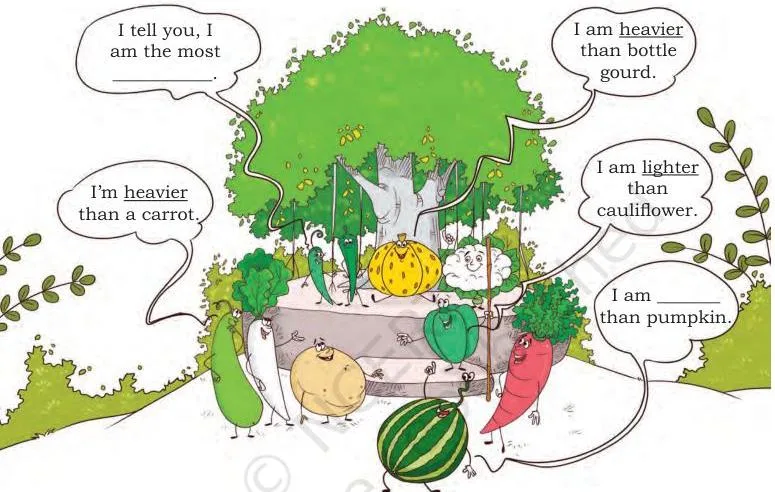
| ‘Pumpkin’s Chaupal’ and ‘Fruits in the Park’ | Compare vegetables and see-saw fruits to decide which is heavier or lighter | Weight: comparing things and putting them in order |
| ‘Let us make Nimbu Pani’ and the bottle activities | Count glasses of water and make a drink for three people | Capacity: how much a container holds |
A pattern runs through all of it: the blanks in the block-tower, chaupal and see-saw activities are answered by counting and looking at the pictures in the book. In this chapter the artwork is not decoration — it is where the answers live.
The three ideas behind every activity: length, weight and capacity
Every activity in the chapter is one of three ideas, so these three cover the whole chapter. Here they are in Class 2 language, each tied to the activity that teaches it.
| Idea | What it means | The activity that teaches it |
|---|---|---|
| Length | How long, short or tall something is; compare and then measure with one fixed unit — blocks, hand-lines, thread or the textbook itself | Measuring the desk, blackboard and window; the hand tracing; the block towers |
| Weight | How heavy something is; heavier, lighter, heaviest and lightest are settled by holding or by a balance, not by size | Pumpkin’s Chaupal; the cup-and-hanger balance; the sand and dry-leaves bags |
| Capacity | How much a container holds, counted in glasses | Making nimbu pani; Raghu’s bottle, which holds four glasses |
Length is how long, short or tall something is. The first activity gives the idea its shape: estimate the length of the desk, the blackboard and the window, then measure the actual length with the child’s own textbook as the measuring tool.
The same idea returns in the hand tracing — trace your hand and count the lines — and in the path activities where children compare longer and shorter routes and check them with a thread.
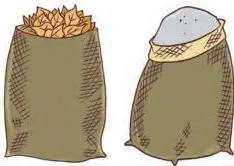
Weight is how heavy something is. The chapter is careful about one point: size and weight are different. Two paper bags of the same size feel different when one is filled with sand and the other with dry leaves.
A homemade balance — a paper cup, a piece of thread and a hanger — shows that heavy and light are decided by weight and not by size.
Capacity is how much a container holds, counted in glasses. Raghu’s bottle holds four glasses of water, so children fill their own bottle and a friend’s bottle and compare whether it holds equal, less or more water. Making nimbu pani for three glasses is the same idea with a recipe.
There are no formulas to memorise in this chapter — the learning lives in the doing, not in written sums.
Reading the pictures in this chapter
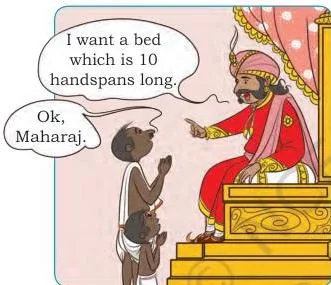
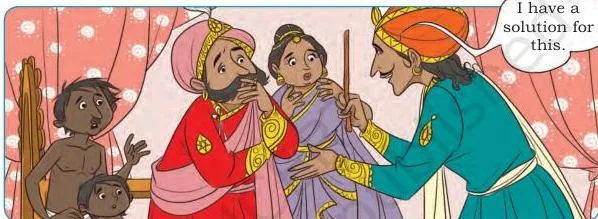
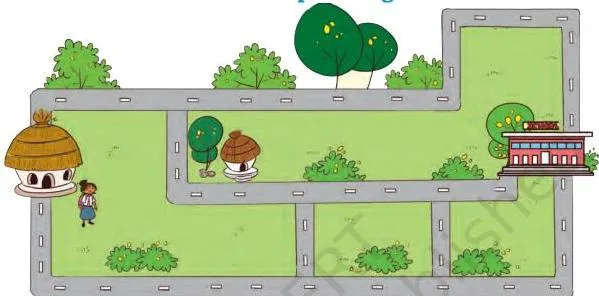


The pictures stay in the book — none are reproduced on this page — so here is what each scene shows and what to do with it.
- The Raja’s carved bed: a confused court around it; discuss the Mantri’s solution to the confusion.
- Kavita going to school: two paths to school in the picture; mark the one she should take to reach school fast.
- Paths from A to B: choose the longest path and make the shortest path between A and B; verify the choice with a thread.
- Block towers of the giraffe, monkey and elephant: the answers come from counting blocks in the pictures — one blank already gives the number 7 and asks which toy is that tall.
- Hand outline on a line grid: trace your hand and count the number of lines.
- Pumpkin’s Chaupal: vegetables to compare as heavier or lighter, then the pumpkin-versus-watermelon discussion.
- The balance: a paper cup, thread and hanger, with objects such as an eraser, ball, bead, pencil and crayon to compare.
- Two paper bags of the same size: one filled with sand, one with dry leaves — which is heavier?
- Fruits in the Park see-saw: mangoes balance the watermelon — the count comes from counting mangoes in the picture, and the chapter states that one coconut is equal to two mangoes.
- Jal tarang: glasses or bowls with different water levels, tapped with a spoon to hear different sounds.
Measurement words this chapter builds
Knowing these words is the real test of this chapter, because each one names a skill: guess, compare, order, measure.
| Word | What it means | Where it appears in this chapter |
|---|---|---|
| Estimate | A sensible guess you make before measuring | The first measuring table, in the ‘Estimated length’ column |
| Actual length | The real measurement you get when you measure | The same table, in the ‘Actual length’ column |
| Longer / shorter | Comparing two paths or objects by length | The paths from A to B; Kavita’s route to school |
| Taller | Higher when compared with something else | The block towers |
| Heavier / lighter | Weighs more / weighs less than another thing | Pumpkin’s Chaupal; the balance activity |
| Heaviest / lightest | Weighs more / weighs less than all the others | The ‘Fill in the blanks’ and circle activities |
| Balance | A tool that shows which side is heavier | The paper cup, thread and hanger activity |
| Capacity | How much a container holds | Nimbu pani; Raghu’s bottle holds four glasses |
Where children slip in this chapter
These are the predictable places where a child goes wrong — and the fix is built into the chapter’s own design.
| Mistake | Correct rule | How to check your answer |
|---|---|---|
| Treating the estimate as the answer and leaving the measurement undone | Both columns matter: estimate first, then measure the actual length | Every row of the desk, blackboard and window table has both columns filled |
| Mixing different measuring tools in one comparison | Use one fixed unit for one comparison | Count the block towers of the giraffe, monkey and elephant in the same unit — blocks |
| Picking the longest path between A and B by eye | Check the path with a thread rather than judging by sight | Lay the thread along each path on the picture and compare |
| Judging heavy by size | Weight is decided with a balance or by holding, not by size | Compare the two same-size bags — sand against dry leaves |
| Doubling the nimbu pani recipe when 3 glasses are asked | Multiply every ingredient by three | Water 3 glasses, sugar 3 spoons, lemon juice 6 spoons, salt 3 pinches |
How this chapter fits the school year
Class 2 has no board examination, and the value of ‘Let us Read’ is not a mark — it is the measurement vocabulary and the hands-on skills: estimate, compare, order, measure with a unit.
The chapter belongs to the play-based Joyful Mathematics series, so the project works — measuring a wall, bed or door at home, comparing family members’ weights, making a jal tarang — are the real lessons, not extras.
One honest caution: textbook contents and the examinable syllabus are not always identical, so check the current official CBSE syllabus before planning around this chapter.
Five things to remember from this chapter
This is our own recap of how the chapter flows — the book itself has no printed summary block, so nothing here is quoted from it.
- Measure with one fixed unit: blocks, hand-lines, thread or the textbook itself.
- Estimate first, then measure for real — the two columns in the first activity are deliberate.
- Heavier and lighter are settled by a balance, not by size — the same-size sand and leaf bags make the point.
- Capacity means how many glasses fit — Raghu’s bottle holds four.
- When a quantity grows, multiply every ingredient by the same number — one glass of nimbu pani becomes three.
Related resources
This listing is maintained for the 2026-27 academic session using the NCERT textbook information available to us. NCERT remains the authority for confirming the latest edition.
Move on to the notes pages for the same book and class:
- Class 2 Mathematics notes — the whole book, chapter by chapter.
- Class 2 hub — every Class 2 subject in one place.
- CBSE notes home — notes for every class.
- Decoration for Festival — Class 2 Mathematics chapter notes.
- Grouping and Sharing — Class 2 Mathematics chapter notes.
For the whole book itself, the official NCERT e-textbook portal is the authoritative source for every Class 2 Mathematics chapter.
Sources and data verification
- This page describes the NCERT Joyful Mathematics textbook for Class 2, Chapter 7 ‘Let us Read’, as published on ncert.nic.in. It covers this one chapter only, activity by activity, and does not reproduce the textbook.
- The page is maintained for the current academic session using the NCERT information available to us.
- NCERT settles textbooks, editions and PDFs; CBSE settles curriculum, syllabus and examinations.
- Textbook contents and the examinable syllabus are not always identical — check the current official syllabus.
Frequently asked questions
What does the NCERT Class 2 chapter ‘Let us Read’ teach?
It teaches the three measurement ideas — length, weight and capacity — through picture-based activities rather than written sums. Children estimate and measure lengths, compare vegetables and fruits by weight, build a balance, count capacity in glasses and scale up a nimbu pani recipe.
How much nimbu pani is needed for 3 glasses?
For one glass the recipe is 1 glass of water, 1 spoon of sugar, 2 spoons of lemon juice and a pinch of salt. For three glasses, multiply every ingredient by three: water 3 glasses, sugar 3 spoons, lemon juice 6 spoons, salt 3 pinches.
How do we make the balance shown in the chapter at home?
Use a paper cup, thread and a hanger as the picture in the book shows. Then compare any two objects — an eraser, ball, bead, pencil or crayon — and see which side goes down; that side holds the heavier object.
Why does the chapter ask children to guess the length before measuring?
The guess builds a sense of how big things are, and the real measurement checks it. That is why the first activity prints two columns — Estimated length and Actual length — and why both matter.
What is jal tarang and what does it have to do with maths?
Jal tarang is a musical instrument made from 5 to 7 similar glasses or bowls filled with varying levels of water; tapping each one gives a different sound. The maths idea is capacity — changing the quantity of water changes the result, the same ‘how much’ idea as the bottle and nimbu pani activities.
The chapter also uses it to discuss the uses of water and the need not to waste it.
Reference: NCERT Class 2 Mathematics textbook, chapter 7, official edition on ncert.nic.in.
Explore Class 2 Mathematics Books
Related chapters: