
This page offers the official NCERT PDF of Look at the Ginladi. Class 2 Joyful Mathematics Chapter 3 — the chapter that teaches counting to 100 through beads, jumps, charts and patterns. The chapter runs 9 printed pages, and the download below is the genuine NCERT file for the current academic session.
Look at the Ginladi. Class 2: Chapter at a Glance
The table below lists what the chapter holds — its parts, activities, pictures and questions — and how much of each there is.
| What the chapter holds | Count | Where it is used |
|---|---|---|
| Printed pages | 9 | |
| Figures with NCERT captions | 4 | |
| Tables | 3 | |
| Activities | 3 | |
| Official NCERT PDF | Download the chapter PDF | the chapter exactly as NCERT publishes it |
What This Chapter Covers
This chapter teaches numbers to 100 by playing — beads, jump games, guessing and charts — not by memorising rules. The table below maps each part of the chapter to the skill it practises, so you can find any activity in the book quickly.
| Part of the chapter | What it teaches |
|---|---|
| Look at the Ginladi. | Count the beads on the rods, write the numbers on blank cards, and make number cards for 38, 44, 58, 65 and 98. |
| Look at the number strip | Move forward along a strip of numbers to the pink, red and yellow flowers, and follow the squirrel’s and frog’s forward-and-backward jumps. |
| Guess my Number | One child thinks of a number; the others guess it with up to 10 yes/no questions such as “Is it more than 50?” |
| Guess my Place | Read the number line where three ants sit, mark 65 and 79, and complete jump patterns like 1, 4, 7, … |
| Let us Do (number chart) | Skip count in twos and fives on the 1–100 chart, and find numbers common to two or three skips. |
| Jump and find the answers | Decide Yes or No: will counting in tens from 10 ever land on 100? Will counting in twos from 4 land on 17? |
| Let us jump backward | Count backward and finish patterns such as 40, 37, 34, … and 100, 80, …; change numbers that do not form a pattern. |
| Let us Talk | Reason aloud: will 19 be said when counting from 20 onwards? How many steps back to 0, in ones and in twos? |
| Patterns in Number Chart | Say what comes just before 10, 20, 30 and 40, follow the green numbers 1, 12, 23, …, and use Lakshanya’s number window on 28. |
| Exploring Patterns | Extend growing block shapes, then play Bingo with two dice and the sums 2 to 12 on a 3 by 4 grid. |
Key Concepts: Beads, Jumps, Charts and Patterns
Six ideas hold the chapter together. Each one below is explained in plain words, with a fresh example to try after the book’s own.
The ginladi is a tens-and-ones counter
A ginladi is a frame of rods with beads. A full rod of 10 beads stands for one ten; loose beads stand for ones. So 38 means 3 full rods and 8 loose beads — in tens and ones, \( 38 = 30 + 8 \). Saying “3 tens and 8 ones” aloud each time is the whole lesson.
Jumps on a number strip
A number strip is a row of numbers in order. Forward means toward bigger numbers; backward means toward smaller ones. A jump that turns around is just the steps done one after another, in order.
Try this walk: a bunny at 2 takes 3 jumps forward, 2 jumps backward and 1 jump forward. \( 2 + 3 – 2 + 1 = 4 \), so the bunny lands on 4.
Skip counting and common numbers
Skip counting means counting in equal steps — twos, threes, fives, sevens or tens — instead of one by one. Numbers that appear in two different skips are called the common numbers of those skips.
| Skip counting | Common numbers (up to 100) |
|---|---|
| In twos and in fives | 10, 20, 30, 40, 50, 60, 70, 80, 90, 100 |
| In twos, threes and fives | 30, 60, 90 |
| In fives and sevens | 35, 70 |
The number chart and Lakshanya’s number window
A number chart is the 1–100 grid in rows of ten. A number window is a cut-out that shows the four neighbours of the number it sits on. Above the centre is 10 less, below is 10 more, on the left is 1 less and on the right is 1 more.
Try a fresh centre: put the window on 45. Above is 35, below is 55, on the left is 44 and on the right is 46.
If the printed chart is not at hand, a wall calendar works for home practice — point to any number and ask what comes just before it, or what is 1 more and 1 less. The chart is the tool; the skill is knowing each number’s neighbours.
Patterns that go backward
A backward pattern subtracts the same step every time. The book’s 100, 90, 80, 70, 60 steps by tens, so it continues 50, 40, 30; 100, 80 steps by twenties, so it continues 60, 40, 20, 0.
A set of numbers is a pattern only when the step is the same between every pair. 100, 90, 80, 75, 60 is not a pattern, because the step changes at 75 — change 75 to 70 and the pattern works again.
The Pictures in This Chapter and How to Read Them


Most of this chapter is pictures — a frame of beads, a number strip, ants on a number line, frogs, charts and blocks. In this book the pictures are working tools, not decoration: the child answers using them.
- The ginladi — count every full rod as 10, then read the loose beads as ones. That is how the blank cards get their numbers.
- The number strip with the butterfly, honey bee, squirrel and frog — the strip labels positions in words (pink flower, red flower, yellow flower), and the child tracks each animal’s jumps on the strip. A multi-step jump such as the squirrel’s 2 back, 5 forward, 3 back is easiest to follow with a finger on the strip.
- The number line with the three ants — the black, red and brown ant sit at printed numbers; the child writes each number, then draws an ant at 65 and a sugar cube at 79.
- Jumpy the frog — the frog’s hops grow in a pattern (1, 4, 7, …), and the child continues it. The book also suggests making a real number line on the ground and jumping on it.
- The 1–100 number charts — the same chart is used twice: once for skip counting with dots and triangles to find common numbers, and once for “comes just before 10, 20, 30, 40” and Lakshanya’s number window.
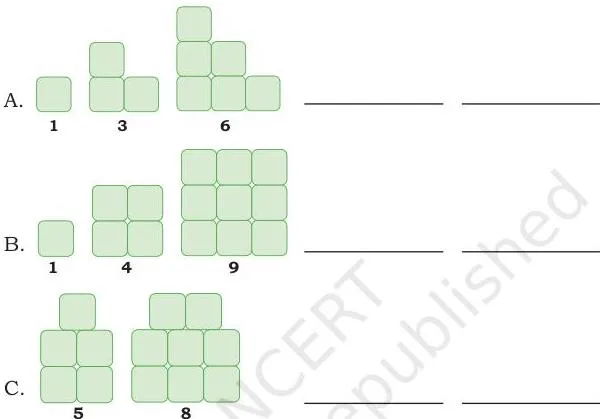
- The block shapes — blocks grow by a regular number from one shape to the next; the child counts the blocks and extends the pattern.
Words and Ideas the Chapter Uses
None of these words need to be memorised — the child learns them by doing. Here they are in plain words.
| Word | What it means |
|---|---|
| Ginladi | A frame of rods with beads used to count and show numbers; each full rod of ten beads stands for one ten. |
| Number strip | A row of numbers in order, to jump along. |
| Number line | Numbers drawn in a line, used to see which number comes further along. |
| Number chart | The 1–100 grid in rows of ten, used for skip counting and number-window work. |
| Number window | A cut-out placed over a centre number that shows 1 less, 1 more, 10 less and 10 more around it. |
| Skip counting | Counting in equal steps — twos, threes, fives, tens — instead of one by one. |
| Counting backward | Moving to smaller numbers, such as 10, 9, 8. |
Common Mistakes to Avoid
Children usually go wrong on direction and on the first number — the counting itself is almost always right. The table below names each mistake and the check that fixes it.
| Mistake | Correct rule | How to check your answer |
|---|---|---|
| Mixing up direction in a multi-step jump (squirrel: 2 back, 5 forward, 3 back; frog: 2 forward, 7 back, 3 back) | Do the steps in order — forward means bigger, backward means smaller. | Act the jump out: stand, take the steps, then read the strip again. |
| Counting the starting number as a jump when counting backward | From 20 to 0 in ones takes 20 jumps; in twos it takes 10 jumps. The start is not a jump. | Count the landings, not the spoken numbers — Viraaj lands on 18, 16, …, 0 — that is 10 jumps in twos, not 11. |
| Thinking 43 can appear when counting in twos from 10 | Counting in twos from 10 lands only on even numbers, so 43 never comes. | Chavi will say 42 and 44 but never 43 — odd numbers are skipped. |
| Missing numbers common to two skips | The common numbers of twos and fives are the multiples of ten: 10, 20, 30, … 100. | Mark each skip on the chart in a different colour; the common numbers carry both marks. |
| Reversing the number-window rule | Above the centre is 10 less, below is 10 more, left is 1 less, right is 1 more. | Test one neighbour each way on any centre: 28 gives 18 above, 38 below, 27 left, 29 right. |
What Children Should Be Able to Do After This Chapter
A good check is not a mark but whether the child can do these things aloud. Each one comes from an activity in this chapter.
- Read and write numbers up to 98 — the card-making activity uses 38, 44, 58, 65 and 98.
- Say which number comes just before another, such as just before 10, 20, 30 and 40.
- Count forward and backward to 100 in ones, twos, fives and tens.
- Say whether a jump will land on a number — counting in tens from 10 reaches 100 (yes); counting in twos from 4 never reaches 17 (no).
- Continue a pattern and say its rule — add 3, subtract 5, subtract 10, and so on.
- Use the chart or the number window to say 1 more, 1 less, 10 more and 10 less for any number.
This chapter is activity-based, and for Class 2 assessment is set by the school. Textbook contents and a school’s own test plan are not always identical, so check the school’s plan for the term.
Quick Revision Pointers
These are the six things the chapter keeps practising.
- A full rod of 10 beads is one ten; 38 is 3 tens and 8 ones.
- Forward jumps grow the number; backward jumps shrink it.
- Counting in equal steps lands on the same pattern every time — the multiples.
- Numbers that appear in both the 2s and 5s skips end in 0.
- In the chart, a number’s neighbours tell 1 less, 1 more, 10 less and 10 more.
- A pattern keeps the same step; if the numbers do not, change them until they do.
Related Resources
This listing is maintained for the 2026-27 academic session using the NCERT textbook information available to us. NCERT remains the authority for confirming the latest edition.
The official Chapter 3 PDF lives on the NCERT textbook portal, where the Joyful Mathematics Class 2 listing hosts every chapter of the book.
Use the Class 2 Joyful Mathematics book page to open other chapters, or start from the Class 2 hub for the whole class.
In this book, Look at the Ginladi comes after Chapter 2, Shapes Around Us, and before Chapter 4, Shadow Story (Togalu). The CBSE notes directory covers higher classes too.
Sources and Data Verification
The activities, charts, patterns and pictures described on this page come from the NCERT Joyful Mathematics textbook for Class 2, Chapter 3, “Look at the Ginladi.” (English medium, current edition on ncert.nic.in). This page is maintained for the current academic session using NCERT’s published information.
- This page covers Class 2 Mathematics (English medium) only — not other Class 2 subjects.
- NCERT settles textbook content, editions and PDFs; CBSE settles curriculum, syllabus and examinations.
- Textbook contents and the examinable syllabus are not always identical — check the current official syllabus.
Frequently Asked Questions
What is a ginladi in this chapter?
A ginladi is a counting frame of rods with beads. Each full rod has 10 beads, so one rod stands for one ten and loose beads stand for ones. The child counts beads to write numbers on blank cards and to make cards for numbers such as 38, 44, 58, 65 and 98.
Which numbers come in both the twos and fives skip counting?
The numbers in both skips are the multiples of ten: 10, 20, 30, 40, 50, 60, 70, 80, 90 and 100. Any number that is a multiple of 2 and a multiple of 5 must end in 0.
How does the number window show what is above, below, left and right?
The window sits over a centre number. Above is 10 less, below is 10 more, left is 1 less and right is 1 more. On centre 28 that gives 18 above, 38 below, 27 left and 29 right.
From 20, how many backward steps does it take to reach 0?
In ones it takes 20 steps; in twos it takes 10 steps. The start at 20 is not counted as a step — the first one-step jump lands on 19, and the twentieth lands on 0.
Why does the Bingo grid use numbers from 2 to 12 only?
Because the players roll two dice. The smallest sum is \( 1+1=2 \) and the largest is \( 6+6=12 \), so no other sum can appear. The eleven sums from 2 to 12 fit easily in the 12 boxes of a 3 by 4 grid, and numbers may be repeated.
Reference: NCERT Class 2 Joyful Mathematics textbook, chapter 3, official edition on ncert.nic.in.
Explore Class 2 Mathematics Books
Related chapters: