
How Much Rupal Spent? Class 2 is Chapter 10 of the NCERT Joyful Mathematics textbook for Class 2. It is a 10-page money chapter: Rupal goes to the fair with the ₹50 her mother gave her, and the whole lesson follows what she spends.
The official chapter PDF from NCERT is right here, and below it a plain-language walkthrough of every part of the chapter.
Chapter 10 at a Glance: Sections and Activities Inside the PDF
Chapter 10 is built around one scene: Rupal goes to the fair with the ₹50 her mother gave her, and every activity follows her money around the fair. The table below shows what the chapter file contains.
| What the chapter holds | Count | Where it is used |
|---|---|---|
| Printed pages | 10 | |
| Figures with NCERT captions | 9 | |
| Tables | 3 | |
| Activities | 3 | |
| Official NCERT PDF | Download the chapter PDF | the chapter exactly as NCERT publishes it |
The named parts of the chapter — the fair story, the spent-money example, the ticket table, notes and coins, Pop the Balloon, the Let us Do activities, Let us Buy, and Project Work — are each explained in the walkthrough below.
What ‘How Much Rupal Spent?’ Covers, Part by Part
Working through the PDF in order, each part has one clear job. The table below names the part, what it asks the child to do, and the skill it builds — you can follow the book page by page.
| Part of the chapter | What it asks the child to do | The skill it builds |
|---|---|---|
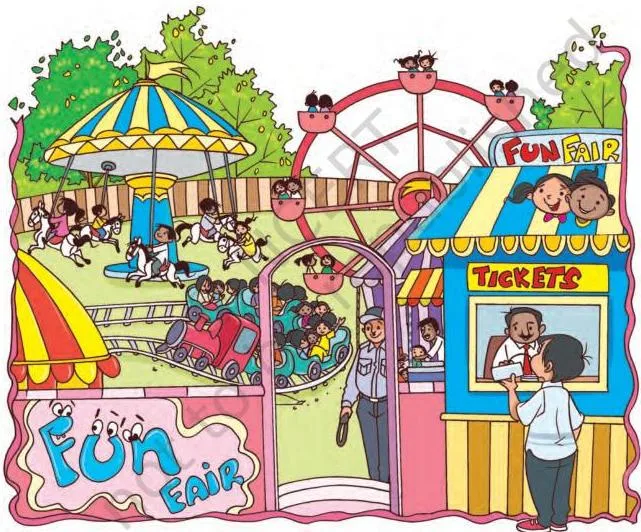
| The fair story (opening page) | Rupal’s mother gives her ₹50 and she spends most of it on rides; children talk about fairs they have visited | Money as something real that gets spent |
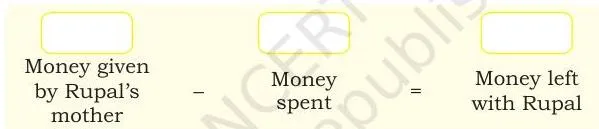
| How Much Rupal Spent? | A friend has ₹8 left from ₹50 and finds what she spent by adding ₹20 + ₹20 + ₹2 to the ₹8 | Money spent = money had − money left, with a built-in check |
| The ride ticket table | Fill the missing numbers: 2 tickets at ₹20, the ₹10 tickets that cost ₹30, 2 tickets at ₹15 | Repeated addition as early multiplication |
| Notes and coins | Count the words and numbers on a ₹500 note, name its monument, look at other commonly used Indian notes, and recognise the old 25, 50, 10 and 20 paise coins | Careful observation, and the rupee–paise relationship |
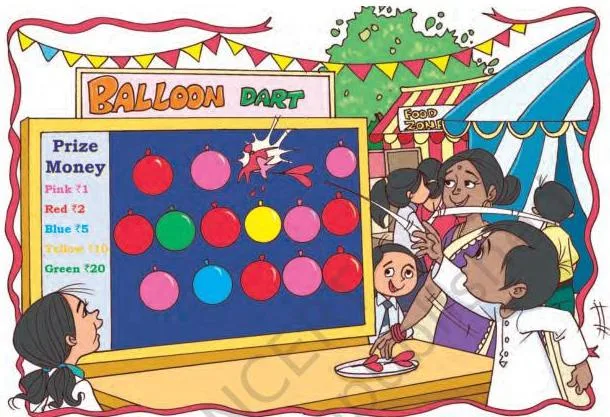
| Pop the Balloon | Three chances for ₹10: find totals, pop balloons to make ₹17, ₹22 and ₹31, and aim for the highest total | Making a target amount and comparing totals |
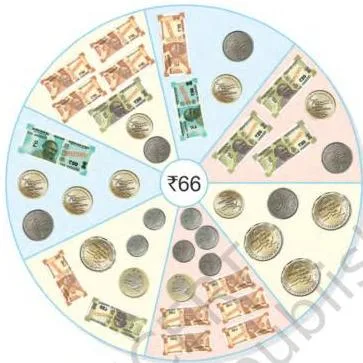
| Let us Do (combinations) | See ₹66 paid several ways, complete the ready-made row for ₹54, make combinations for ₹85 | One amount can be made from many combinations |
| Let us Buy | Write the money needed for items, the money you have, and the money left or more money needed | Comparing and subtracting to decide if money is enough |
| Let us Do (closing page) | Add ₹18 + ₹32 and three more column sums; solve four word problems; notice that we sometimes pay using mobile phones | Column addition of rupees and reading money questions |
| Project Work | Make a list of real purchases made with parents, and discuss the value of saving money | Connecting money sums to real life |
The Core Math Ideas: Paise, Rupees and Money Spent
The chapter is not really about money — it is about what money does. Any amount can be made in many ways, and spending can be found by adding purchases or by taking the leftover away from the starting amount. These five ideas are the whole chapter.
1. 100 Paise = 1 Rupee
This one fact is the foundation, so the book spells it out with coins: 100 paise is exactly 1 rupee. The grandmother’s coins make it visible with two 50-paise coins, and the quick derivations follow from there.
- Two 50-paise coins: \(50 + 50 = 100\) paise, which is ₹1.
- Four 25-paise coins: \(25 \times 4 = 100\), so \(100 \div 25 = 4\) coins make ₹1.
- Five 20-paise coins: \(20 \times 5 = 100\), so \(100 \div 20 = 5\) coins make ₹1.
Paise is the smaller unit, so it always takes more coins to reach a rupee — the smaller the coin, the more of them you need.
2. Finding Money Spent From the Money Left
Questions that say “spent” make children reach for subtraction, and the tricky part is knowing what to subtract from what. Rupal’s friend had ₹50 and had ₹8 left, so the money spent is the part that is missing: \(50 – 8 = 42\), which is ₹42.
The chapter shows the friend’s own way of checking by adding forward: ₹8 + ₹20 (rides) = ₹28, + ₹20 (snacks) = ₹48, + ₹2 (candies) = ₹50. The chain reaches the starting ₹50, so every added purchase is part of what was spent. Either way, the answer is ₹42, and the built-in check is that money left + money spent = money you started with — here \(8 + 42 = 50\).
3. One Amount, Many Ways
A price does not come with only one set of notes. The combinations table shows ₹66 paid several ways and gives one ready-made row for ₹54: \(2 \times ₹2 + 3 \times ₹10 + 1 \times ₹20 = ₹54\).
Using only the denominations printed in the table (₹1, ₹2, ₹5, ₹10, ₹20, ₹50):
- ₹66 as \(₹50 + ₹10 + ₹2 + ₹2 + ₹2\) — one 50, one 10, three twos.
- ₹66 as \(₹20 + ₹20 + ₹20 + ₹2 + ₹2 + ₹2\) — three twenties, three twos.
- ₹85 as \(₹50 + ₹20 + ₹10 + ₹5\) — one of each.
The idea to teach: the amount stays the same, only the notes and coins change.
4. Repeated Addition for Tickets
Before multiplication is formal, the ticket table asks for the same price added again and again.
- 2 tickets at ₹20: \(20 + 20 = 40\), so ₹40.
- ₹30 worth of ₹10 tickets: \(10 + 10 + 10 = 30\), so 3 tickets.
- 2 tickets at ₹15: \(15 + 15 = 30\), so ₹30.
Repeated addition is the multiplication a Class 2 child can already do — seeing \(2 \times 20\) and \(20 + 20\) side by side is the point.
5. Column Addition of Rupees
The rupee sign does not change the arithmetic: rupees add exactly like two-digit numbers, as long as the columns line up. For ₹18 + ₹32, the ones are \(8 + 2 = 10\), so write 0 and carry 1; the tens are \(1 + 3 + 1 = 5\), giving ₹50.
The closing page gives three more: ₹15 + ₹27 = ₹42, ₹47 + ₹50 = ₹97, and ₹22 + ₹35 = ₹57.
Worked example with fresh numbers. A child takes ₹60 to the fair and comes home with ₹17. She spent ₹25 on rides and ₹18 on food. Both numbers are in rupees, so they can be added directly. How much did she spend in all?
Method 1 — add each purchase: \(25 + 18 = 43\), so she spent ₹43.
Method 2 — subtract what is left: \(60 – 17 = 43\), so she spent ₹43.
Both methods give the same answer. The check: ₹43 spent + ₹17 left = ₹60, the amount she started with.
The Chapter’s Pictures: Notes, Coins and the Balloon Booth




The illustrations in the PDF do real teaching work, and each one has a job. Here is what each picture is for, so you can point at it while your child works — the images themselves are in the download above.
- The opening fair scene: Rupal with her friends, holding the ₹50 from her mother. It sets the story that every money sum in the chapter hangs from.
- The ₹500 note: children count how many times “Five hundred rupees” is written in words and how many times 500 appears in numbers, and name the monument printed on it. The counting trains careful observation. The teacher note in the chapter asks adults to discuss the note’s specifications — such as the lines on the border and their number on each note — which help specially abled people identify notes by touch.
- The old coins: 25, 50, 10 and 20 paise. They train recognition of paise coins and show how many of each make ₹1.
- The balloon booth: prices written on balloons. It turns addition into a game — reach a target like ₹17, ₹22 or ₹31, or beat the total.
For the balloon game, a useful strategy: to reach a target, try a combination and compare; to make the highest total, start with the largest balloon values and see which three (or four, if four chances are allowed) add to the most.
Money Words a Class 2 Child Needs
A quick reference for the money vocabulary the chapter uses, in words a seven-year-old and a parent can both read.
| Word | What it means | Where it appears in the chapter |
|---|---|---|
| Rupee | The main unit of money, written as ₹ | The ₹50 Rupal’s mother gave her |
| Paise | The smaller unit; 100 paise make 1 rupee | The old coins: 25, 50, 10, 20 paise |
| Coin | A metal piece of money | The grandmother’s 50-paise coins |
| Note | Paper money | The ₹500 note activity |
| Total | Everything added together | Jayant’s question: how much he spent in total |
| Money spent | What was paid out | How Much Rupal Spent? |
| Money left | What remains after spending | The ₹8 left out of ₹50 |
| Money needed | The price of what you want to buy | The ticket table: how much money will be needed |
| More money needed | The shortfall when your money is less than the price | The Let us Buy table |
Where Children Slip Up With Money Sums
These four mistakes are the ones this chapter’s activities provoke most often. Naming them before the child makes them saves a lot of erasing.
| Mistake | Why it happens | Correction | How to check |
|---|---|---|---|
| Reading 100 paise as ₹10 | “100” sounds bigger than “1” | 100 paise is exactly 1 rupee, and two 50-paise coins make ₹1 | Say it aloud: paise coins always come in many more to reach a rupee |
| Mixing up money spent with money left | The word “spent” makes the child subtract the leftover and stop | Money spent = money had − money left | Add the leftover back: left + spent must return to the starting money |
| Adding for “more money needed” | The child adds whenever money appears | First compare; more money needed = money needed − money you have | Check that money you have + more needed = money needed |
| Misaligned column sums | Ones and tens not lined up | Put ones under ones and tens under tens before adding | Estimate first: ₹18 + ₹32 must be about ₹50 |
The chapter itself models the safest habit: the friend with ₹8 left adds every purchase back up until the total reaches ₹50, so the answer is checked before it is written.
How to Tell If the Chapter Has Been Understood
What mastery looks like — a five-minute check, not an exam prediction. If the child can do these, the chapter has worked.
- Make ₹1 from 25-paise coins (four of them) and from 20-paise coins (five of them).
- Find money spent when only the leftover is known: had ₹50, left ₹8, spent ₹42.
- Pay ₹66 in two different ways from the notes available.
- Finish the four closing word problems: Jayant’s total of ₹25 + ₹40 = ₹65, Meera’s ₹43 + ₹14 = ₹57, Vivek’s ₹30 + ₹60 = ₹90, and Ajay’s ₹58 − ₹48 = ₹10.
- Keep column sums tidy, like ₹18 + ₹32 = ₹50.
The quick check rule: after any “money spent” answer, add the leftover back and see that it returns to the starting amount.
A home shopping conversation works on the same idea as the Let us Buy table: pick two real items, ask the child to write the money needed, the money you have, and then work out either the money left or the more money needed. Deciding in advance whether the money is enough is the skill the table builds.
One honest limit: textbook contents and the examinable syllabus are not always identical. Check the current official syllabus for what is examinable this session.
One-Minute Revision Summary of the Chapter
- Rupal goes to the fair with ₹50 from her mother and spends most of it on rides.
- Money spent can be found by adding every purchase, or by subtracting what is left from what you had.
- The built-in check: money left + money spent = the money you started with (₹8 + ₹42 = ₹50).
- 100 paise = 1 rupee: two 50-paise coins, four 25-paise coins, five 20-paise coins.
- One amount can be paid many ways — ₹66, ₹54 and ₹85 each have more than one combination.
- In shop sums, compare money needed with money you have: the answer is money left or more money needed.
- Rupees add in columns like two-digit numbers: ones under ones, tens under tens.
- The project habit: list real purchases and talk about saving money.
Related NCERT Resources for Class 2 Mathematics
This listing is maintained for the 2026-27 academic session using the NCERT textbook information available to us. NCERT remains the authority for confirming the latest edition.
Chapter 10 sits in the middle of the Joyful Mathematics book, between the seasons chapter and data handling. For the rest of the Class 2 maths work, start at the Class 2 hub, then the Class 2 Mathematics notes. The chapter before this one is Which Season is it?, and the chapter after it is Data Handling. The CBSE notes index covers every class.
The full Joyful Mathematics book and its chapter PDFs are published on the official NCERT e-textbook portal.
Sources and Data Verification
The figures on this page describe the NCERT Class 2 Joyful Mathematics textbook — the current English edition — Chapter 10, How Much Rupal Spent? This page covers that single chapter only; it does not cover other chapters of the book or other Class 2 subjects. It is maintained for the current academic session using the NCERT information available to us.
NCERT settles textbook content, editions and official PDFs; CBSE settles the curriculum, syllabus and examinations.
Common Questions About ‘How Much Rupal Spent?’
How much money did Rupal’s friend spend when ₹8 was left from ₹50?
She spent ₹42. Her way of checking was to add the ₹8 back on: ₹8 + ₹20 (rides) + ₹20 (snacks) + ₹2 (candies) = ₹50. So the spending is \(50 – 8 = 42\), and the check is \(42 + 8 = 50\).
If ₹3 is left from ₹40, how many rupees did the child spend at the fair?
The child spent ₹37. Take the money left away from what was given: \(40 – 3 = 37\).
How many 25 paise coins make ₹1, and how many 20 paise coins make ₹1?
Four 25-paise coins and five 20-paise coins make ₹1. The working: \(100 \div 25 = 4\) and \(100 \div 20 = 5\).
Why does the chapter ask children to count how many times 500 is written on a ₹500 note?
To train careful observation of real currency. Reading a note closely — its words, numbers and monument — is the first step to handling money sensibly. The chapter’s teacher note also points to the specifications on notes, such as the lines on the border and their number, which help specially abled people identify notes by touch.
What does the Let us Buy activity in Class 2 Chapter 10 ask a child to work out?
For each set of items, the child writes the money needed to buy them and the money they have, then works out the third column: money left if they have enough, or more money needed if they fall short. The skill is comparing before subtracting.
Reference: NCERT Class 2 Mathematics textbook, chapter 10, official edition on ncert.nic.in.
Explore Class 2 Mathematics Books
Related chapters: