
This is the Shapes Around Us Class 2 chapter — Chapter 2 of NCERT Joyful Mathematics, the activity-based maths book for young learners. It is a short, picture-led chapter with no exercise numbers, built entirely around play. The official PDF is right here, and the sections below explain what the chapter asks a six-year-old to do.
The Shapes Around Us Class 2 chapter PDF (NCERT Joyful Mathematics) is published on ncert.nic.in, the official source of every NCERT textbook, and can be downloaded from there directly.
Chapter 2 at a glance: what the PDF contains
Before you open the file, the table below counts what the chapter holds — its sections, activities, pictures and questions — so you know exactly what is inside.
| What the chapter holds | Count | Where it is used |
|---|---|---|
| Printed pages | 7 | |
| Figures with NCERT captions | 2 | |
| Tables | 2 | |
| Activities | 4 | |
| Official NCERT PDF | Download the chapter PDF | the chapter exactly as NCERT publishes it |
What this chapter asks a Class 2 child to do
The chapter builds five solid names — cube, cuboid, cone, cylinder, sphere — and the words faces, edges and corners through play, not through exercises. No instructions to read, no sums to write: each activity teaches one small idea about the shape of everyday things.
- The instruments page (Let us Do). Children look at pictures of a drum, a matka, a shehnai and a harmonium. They circle the instruments shaped like a drum, tick the ones shaped like a matka, pick the shape that matches a shehnai, and say how a harmonium’s shape differs from a drum’s. Then they cross out the odd one out. The sorting rule is the object’s outline — its shape — not the sound it makes. A closing line asks children to match instruments and objects to their solid shapes, with one match done for them.
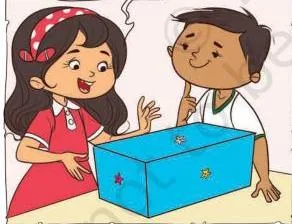
- The gift-box story (Heena and Atif). Two children decorate a box for a friend’s birthday. They place one star on each face — “It has 6 faces so we need 6 stars” — and put ribbons on its sides: 12 ribbons, one for each edge, some short and some long.
- The decoration table (Let us Do). The same pattern continues: children say how many stars, ribbon stripes and pompom balls each new object needs, one row per shape.
- The five-solids table (Let us Think). Children look at objects, match each to its solid name, and fill columns for faces, edges and corners.
- The blindfold game (Touch and Tell. Who am I?). One child is blindfolded and must pick, for example, an object with one corner. The class sorts its objects into the columns No Corners, One Corner, Three Corners and ______ Corners.
- The cardboard project (Project Work). From a cardboard sheet, children try to make an object with four faces, then an object with one face. The book also suggests clay or dough.
To see where this chapter sits in the year’s work, open the Class 2 Mathematics notes hub.
Key ideas: faces, edges and corners on a gift box
One idea runs through the whole chapter: every solid object can be read as flat surfaces, meeting lines and meeting points. In the Heena and Atif story, decoration is what makes each one countable — faces get stars, edges get ribbons, corners get pompom balls.
Counting faces, edges and corners on the gift box with stars, ribbons and pompom balls is the chapter’s one real task.
This chapter has no formulas. The mathematics is counting surfaces, edges and points, and the book leaves the numbers for the child to discover.
A teacher’s note in the book names three objects for this: a chalk box, a duster and a piece of chalk. The counts below are practice values for this page, since the book deliberately leaves such numbers blank:
| Object | Solid shape | Faces | Edges | Corners |
|---|---|---|---|---|
| Chalk box | Cuboid | 6 | 12 | 8 |
| Duster | Cuboid | 6 | 12 | 8 |
| New piece of chalk | Cylinder | 2 flat faces | — | 0 |
The point of the trio: two cuboids with identical counts, and one cylinder that rolls with no corners to count.
Reading the pictures: what the illustrations teach
The chapter’s lessons sit in its pictures, not in its sentences. Here are the three pictures a child has open, and one question to ask while they point.
- The instruments page. Children compare the drum, matka, shehnai and harmonium pictures and group them by outline — the matka’s pot-like body, the shehnai’s long tube, the drum’s wide short cylinder. Ask: “Which two look the same from the side?”
- The Heena and Atif sequence. The pictures move from an undecorated box to a decorated one. The discussion point is the hidden bottom face: you see three faces at a time, yet the box has six. The hidden bottom face still counts towards the six faces of a box. Ask: “Which face would the star go on here?” and turn the box over to find the face you cannot see.
- The Let us Think pictures. Five solid drawings — cube, cuboid, cone, cylinder, sphere — sit beside real objects, and the child matches each object to its drawing before filling the table.
Words a child learns in this chapter: five solids, three parts
These are the words the “Let us Think” table and the “Touch and Tell” game are testing. A child who can say them can do the whole chapter.
| Word | What it means in a six-year-old’s words |
|---|---|
| Cube | A box whose six faces are all equal squares. |
| Cuboid | A box with rectangular faces — a duster or a chalk box. |
| Cone | A pointed top over a flat circular base, like an ice-cream cone. |
| Cylinder | Like a tin or a new piece of chalk — two flat round faces, and it rolls. |
| Sphere | An exact ball — no flat face at all. |
Then the three parts every solid is made of:
- Face — a flat surface you can touch; the star sits on it.
- Edge — where two faces meet; the ribbon runs along it.
- Corner — where edges meet; the pompom ball marks it.
Where children slip up: counting faces, edges and corners
Children make the same counting mistakes in this chapter, and they all come from one habit: counting only what they can see.
| Mistake | Correct rule | How to check your answer |
|---|---|---|
| Counting 5 faces on the gift box, forgetting the bottom | The hidden bottom face still counts — the box has 6 faces, so 6 stars | Turn the box over and feel for the face underneath |
| Saying a cone has no corner because it is round | A cone has one corner, and it is its pointed top | Touch the tip of a pencil or an ice-cream cone |
| Calling the ball’s drawn outline an edge | A sphere has no edges and no corners — a drawn outline is not an edge | Run a finger around a real ball; there is no ridge to feel |
| Mixing up cube and cuboid | Both have 6 faces, 12 edges and 8 corners; they differ in the shapes of their faces — all equal squares for a cube, rectangles for a cuboid | Ask: does every face look the same? If yes, cube; if some are rectangles, cuboid |
How this chapter is assessed at school
Class 2 has no board examination, and this chapter uses activities and a cardboard project instead of numbered exercise questions. A school check is usually oral and hands-on.
A teacher is likely to ask a child to point to a face, an edge and a corner on a real object, and to name the five solids when shown everyday things. The checkable tasks printed in the book are the “Let us Think” table, the corner-column blanks, and the Project Work.
One caution: textbook contents and the examinable syllabus are not always identical — confirm against the current official CBSE syllabus for the session.
How to revise this chapter in ten minutes
Ten minutes is plenty, because the chapter’s own activities are the revision — this chapter has no printed summary, so the activities are the summary. Run them in reverse: name the solid first, then count its parts.
- Play the blindfold game with five household objects and name each solid as it is pulled out.
- Retell the Heena and Atif story and say what sits where: stars on faces, ribbons on edges, pompom balls on corners.
- Run the “Let us Think” pattern on one object of each solid — say the name, then count faces, edges and corners aloud.
- Say which corner column each solid belongs to: sphere — no corners; cone — one corner; cube and cuboid — eight corners, the ______ Corners blank.
- State what the project asks: an object with four faces and an object with one face. Children usually arrive at a pyramid-like solid with a pointed top for four faces, and a ball for one face.
Carrying the activities home: games with objects you already have
Every activity in this chapter is designed for objects already in the house. A parent needs nothing extra except a cloth for the blindfold.
- The instruments talk. From the first “Let us Do” page, ask what the child has seen or played and how it is played — beaten, strummed or blown. The way it sounds does not matter for sorting; the outline does.
- Touch and Tell at home. Pick objects with no small parts, blindfold the child, and ask for “an object with one corner” — then work through no corners, one corner and eight corners, keeping the five solids as the answer set.
- Project Work with clay or dough. Instead of cardboard, roll a ball for one face and pinch a cone for one corner — the book itself suggests clay or dough.
Related resources: the Class 2 book and its chapters
For the rest of the year’s work, start at the Class 2 Mathematics notes hub, or open the Class 2 hub for every subject. Nearby Class 2 mathematics topic pages include the Let Us Do page and the Look at the Ginladi page, and the full CBSE notes library holds every class and subject.
The official Joyful Mathematics Class 2 textbook page on ncert.nic.in is the source of every chapter PDF.
Reference: NCERT Class 2 Mathematics (Joyful Mathematics) textbook, chapter 2, official edition on ncert.nic.in.
Sources and data verification
This page’s facts come from the NCERT Joyful Mathematics Class 2 textbook (rationalised edition), Chapter 2, as published on ncert.nic.in. The activity list, the object names and the faces-edges-corners framing all come from that chapter.
This page covers that one chapter. Other Class 2 subjects are listed on the Class 2 hub.
This listing is maintained for the 2026-27 academic session.
NCERT settles textbook titles, editions and PDFs; CBSE settles the curriculum, syllabus and examinations.
Shapes Around Us Class 2: common questions
Which NCERT book contains the Shapes Around Us Class 2 chapter?
NCERT Joyful Mathematics for Class 2, Chapter 2. The official PDF is on ncert.nic.in — the Joyful Mathematics textbook page.
What does a Class 2 child have to do in the Shapes Around Us chapter?
Sort the instruments by shape, count faces, edges and corners on the gift box, fill the five-solid table, and play the blindfold game.
How do I explain faces, edges and corners to a six-year-old?
Use the star, ribbon and pompom rule from the gift box: faces get stars, edges get ribbons, corners get pompom balls.
Does the Shapes Around Us chapter have solved exercises?
No — there are no numbered questions. The chapter runs on activities, the “Let us Think” table and a cardboard project instead.
Is Shapes Around Us still part of the current Class 2 NCERT syllabus?
It is in the current NCERT book. For the examinable syllabus in your session, confirm against the official CBSE syllabus.
Explore Class 2 Mathematics Books
Related chapters: