
Looking for the official Seasons Class 2 chapter PDF? This page offers NCERT Class 2 Joyful Mathematics Chapter 9 Seasons — the complete 15-page chapter on the five seasons, the 2023 calendar, O’clock times on the clock and the four directions. The official chapter file from ncert.nic.in is right below, and this page is maintained for the current academic session.
Download the official Seasons chapter PDF
The chapter file above is the official NCERT edition, published on NCERT Class 2 Joyful Mathematics Chapter 9 Seasons PDF at ncert.nic.in — the same file schools follow, including the 2023 calendar pages inside it.
Chapter at a glance: what is inside the Seasons PDF
| What the chapter holds | Count | Where it is used |
|---|---|---|
| Printed pages | 15 | |
| Figures with NCERT captions | 18 | |
| Tables | 14 | |
| Activities | 2 | |
| Official NCERT PDF | Download the chapter PDF | the chapter exactly as NCERT publishes it |
The chapter moves from the world outside — seasons and festivals — to the tools that organise it: the calendar, the clock and the compass.
It opens with a poem that names the five seasons, then sorts festivals into summer, winter and monsoon. The middle of the chapter is the 2023 calendar: twelve monthly grids, day counts and Sunday counting.
A matching game links activities to how long they take, a picture story follows a family’s train trip to Vijayawada, and the chapter closes with reading a clock at O’clock times and finding direction with the sun.
The headings the book uses — Let us Discuss, Let us Talk, Let us Do and Project Work — show the pattern: every idea is met by talking and doing, not by copying.
What the Seasons Class 2 chapter teaches
The chapter wraps four big ideas into poems, puzzles, a matching game and a picture story, so a child meets every idea more than once.
- Seasons and their festivals: the opening poem names the five seasons, and the festival lists give each season something to notice.
- The calendar: all twelve months of 2023 are printed as grids, and children count the days in each month.
- Time: first as duration (how long does something take?), then as reading the clock at O’clock times.
- Direction: position words grow into the four compass directions — East, West, North and South.
Each strand feeds an everyday skill: ordering the year, planning events, running a daily routine and saying where things are.
The calendar inside the chapter is based on 2023, and the festival lists are discussion starters — the book asks children to talk about local seasons, food and clothes rather than memorise a list.
Key ideas in Seasons: seasons, calendar, clock and direction
These are the ideas a child needs before opening the activities, each explained in the order the chapter teaches it.
The five seasons and the festivals that fall in them
Seasons divide the year by its weather, and festivals give a child a reason to notice which season has arrived.
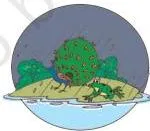
The opening poem names five seasons: spring with flowers and birdsong, summer with the shining sun and long days, the rainy season with water drops, the dancing peacock and the hopping frog, autumn with falling leaves and pleasant winds, and winter with snow.
| Season | Festivals the chapter lists |
|---|---|
| Summer | Guru Purnima, Buddha Purnima, Ram Navami, Mahavir Jayanti |
| Winter | Lohri, Christmas, Republic Day, Guru Nanak Jayanti, Bihu |
| Monsoon | Janmashtami, Raksha Bandhan, Independence Day |
The discussion that follows matters as much as the sorting. The book suggests talking about season names in Hindi, such as Vasant and Shishir, and in other regional languages, and it notes that festivals like Eid are not tied to a season.
The Let us Discuss questions ask which season a child’s birthday and vacation fall in, and the teacher note points to local clothes such as the pheran in Kashmir.
Reading the 2023 calendar: months and day counts
A calendar is a map of the year, and the counting skill here is matching a date to its weekday.
The calendar page prints all twelve months of 2023, each as a grid that starts with Sunday. Children fill a table that groups the months by their day count:
| Group of months | Months | Days |
|---|---|---|
| 31-day months | January, March, May, July, August, October, December | 31 |
| 30-day months | April, June, September, November | 30 |
| February | February | 28 |
The next questions push the same skill further: a week has 7 days, April 2023 has five Sundays (2, 9, 16, 23 and 30), and April plus March comes to \( 30 + 31 = 61 \) days.
Worked example — Fridays in May 2023. Use the same grid in four steps:
- Find the first Friday in the May grid — it is 5 May.
- Add 7 days to reach the next Friday: \( 5 + 7 = 12 \).
- Keep adding 7: \( 12 + 7 = 19 \), then \( 19 + 7 = 26 \).
- The next step, \( 26 + 7 = 33 \), is past May’s 31 days, so the count stops.
May 2023 has four Fridays: 5, 12, 19 and 26.
The Project Work on page 5 asks the child to make their own birthday month calendar and mark the birthday — the same counting skill built in reverse.
How long does it take? Matching activities to durations
Before a child can read a clock, they need a feel for how long things take — the difference between a minute and a year.
The matching activity on page 6 lines up everyday activities with the duration each one needs: cooking, summer vacation, filling a water tank, knitting a sweater, playing, a seed growing into a plant, the change of season and yoga.
The point of the task is to feel the range, from a few minutes to a whole year. The discussion prompt then asks children to think of other things that take different durations — which is exactly what the Vijayawada story turns into hours and days.
The trip to Vijayawada: hours and days inside a story
This picture story turns duration into something a child can follow day by day: leaving, arriving, sightseeing, returning.
| Date | Time shown in the story | What happens |
|---|---|---|
| 24 November | 8:25 in the morning | The train is about to leave Visakhapatnam |
| 24 November | 1:15 in the afternoon | Dada Ji says there is one more hour, so the family reaches Vijayawada at about 2:15 |
| 25 November | 10:00 at night | Mama Ji’s wedding celebration |
| 26 November | 11:00 in the morning to 5:00 in the evening | Sightseeing at Manglagiri hills — six hours |
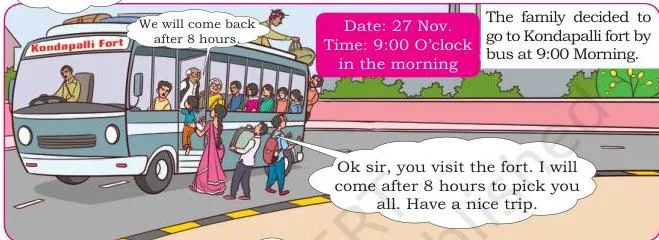
| 27 November | 9:00 in the morning | Kondapalli fort by bus; the driver returns after 8 hours |
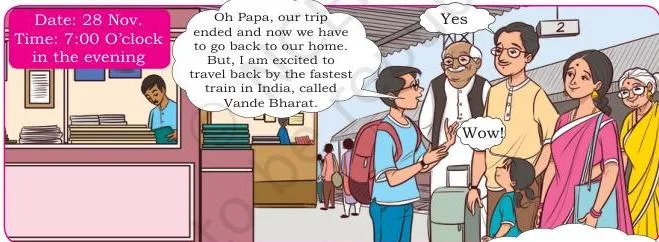
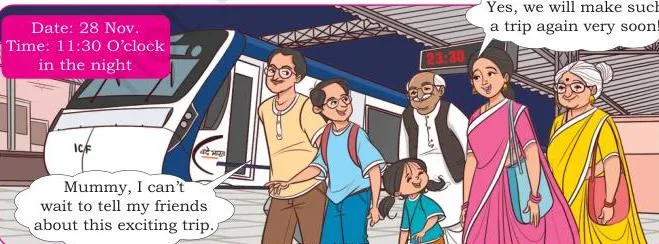
| 28 November | 7:00 in the evening | The trip ends; the family travels back by Vande Bharat |
Worked example — length of the trip. The journey starts on 24 November and ends on 28 November. Counting both end days — 24, 25, 26, 27 and 28 — the trip lasts five days.
One phrase needs care: on 26 November the family says their train is day after tomorrow. That day is 28 November, not 27 November — the same counting skill, one step further.
The story ends with a fact many children enjoy: Vande Bharat is the fastest train in India, designed in India, and the first Indian train with an integrated engine rather than a separate engine coach. The book leaves the return train’s times open, so the Let us Talk questions ask children to discuss both journeys themselves.
Gargi’s day and the O’clock clock
At an O’clock time the rule is simple: the minute hand points straight at 12, and the hour hand points at the hour number.
Gargi’s day shows a picture for each part of her routine, with a clock to fill in. Two anchor times are fixed — she wakes up at 6 O’clock and draws water at 7 O’clock — and the child writes the times for going to school, playing, coming home, lunch, studying and going to sleep.
The note beside the pictures names the two hands: the short hand is the hour hand and the long hand is the minute hand.
The next page asks children to read times on clocks and then draw both hands for 3, 11, 4, 9, 12 and 6 O’clock, and the page after asks them to mark their own study, play and lunch times on blank clocks. Moving from reading a clock to drawing one is where the skill settles.
East, West, North and South: finding direction
Direction words let us say where things are, and the rising sun gives a fixed starting point.
The chapter builds this in three steps. First, the blindfold game on page 13 uses only three words — right, left and straight — with a safe word like danger agreed before starting, and it runs for 5 to 7 rounds. This is the warm-up: it builds position words on the child’s own body before the compass words arrive.
Second, Sarah’s way to school draws a route — the green line is Sarah’s path, and children draw different coloured paths for Aastha and Nia.
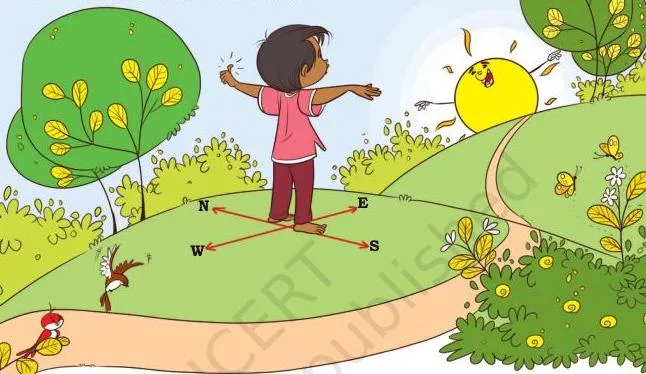
Finally the poem fixes the four directions. Face the rising sun: that is East. West is behind you, your left thumb points North, and your right side is South.
The closing classroom map uses a compass to answer questions — where Haneet’s desk sits relative to Sarah’s, where the almirah sits relative to Ali’s desk, and which turns lead to the blackboard and to the birds on the window. The Do you know? line names the tool: a compass is a tool for finding direction.
Picture walkthrough: the illustrated activities in the chapter

The chapter is picture-led, and its pictures carry no printed captions — the words beside each scene tell the child what to do. The descriptions below stay close to those printed words.
- Opening poem scene (page 1): the five-season poem with the year’s weather around it — spring bloom and birdsong, summer sun, rain with the dancing peacock, falling leaves and snow. It sets the vocabulary the whole chapter uses.
- Twelve monthly calendar grids (page 4): one grid for each month of 2023, each starting with Sunday, with the day-count table to fill below. This practises matching dates to weekdays.
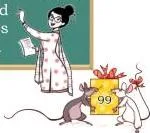
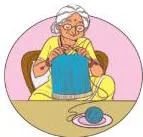
- Duration matching pictures (page 6): cooking, summer vacation, filling a water tank, knitting a sweater, playing, a seed growing, the change of season and yoga, each matched with how long it takes. This practises ordering time from short to long.
- Vijayawada story pictures (pages 7 to 8): every scene carries a speech bubble with its date and clock time — 8:25 in the morning on 24 November, 1:15 in the afternoon the same day, 10:00 at night on 25 November, and so on. This practises reading hours and days inside a story.
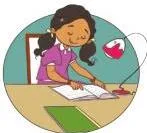
- Gargi’s day pictures (page 10): a separate scene for each part of her routine, each with a clock to complete. This practises matching an activity to an O’clock time.
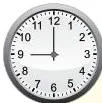
- Blank clocks (page 11): first clocks to read, then blank faces where the child draws both hands for 3, 11, 4, 9, 12 and 6 O’clock. This practises drawing what reading taught.
- Sarah’s way to school (page 13): a map with Sarah’s route drawn in green, and room for children to draw coloured routes for Aastha and Nia. This practises following paths with position words.
- Classroom map with compass (page 15): a plan of the classroom with the compass marked, followed by North, South, East and West questions about desks and paths. This practises using direction words on a map.
Words the chapter builds: season, calendar, O’clock and compass
These are the words the chapter uses again and again, defined the way a seven-year-old meets them. Parents can read this table aloud before starting the PDF.
| Term | Plain meaning | Chapter page |
|---|---|---|
| Season | One of the parts of the year marked by its weather — spring, summer, rainy season, autumn or winter. | 1 |
| Festival | A special day that people celebrate. | 3 |
| Calendar | A chart that shows the days, weeks and months of a year. | 4 and 5 |
| Month | One of the twelve parts of a year, such as January or May. | 4 |
| Week | A group of 7 days. | 5 |
| Duration | How long something takes to finish. | 6 |
| O’clock | A time when the minute hand points at 12 and the hour hand points at an hour number. | 11 |
| Hour hand | The short hand on a clock; it shows the hour. | 10 |
| Minute hand | The long hand on a clock; it shows the minutes. | 10 |
| Direction | The way something lies or the way to go — East, West, North or South. | 14 |
| Compass | A tool for finding direction. | 15 |
Common mistakes in the Seasons chapter and how to fix them
These errors show up when children do the Let us Talk and Let us Do tasks. Naming them before they happen saves a child the confusion.
| Mistake | Correct rule | How to check your answer |
|---|---|---|
| Reading the minute hand as the hour hand | The minute hand is the long hand; at every O’clock time it points straight at 12. The hour hand is the short hand and points at the hour number. | At 6 O’clock the long hand points at 12, not at 6. |
| Assuming February always has 28 days | February has 28 days in 2023, but a leap year gives it 29 days. | One year’s calendar is not exactly the same as the next year’s; check the year before you count. |
| Mixing up the 30-day and 31-day months | January, March, May, July, August, October and December have 31 days; April, June, September and November have 30. | Use the chapter’s grouping table on the calendar page. |
| Miscounting Sundays in a month | A month has 4 or 5 Sundays, depending on the weekday it starts with. | April 2023 starts on a Saturday, so its Sundays fall on 2, 9, 16, 23 and 30 — five Sundays. |
| Confusing left and right with compass directions | Face the rising sun: East is in front, West behind, your left thumb is North, your right side is South. | Fix North first with the poem, then name the other three. |
| Reading “day after tomorrow” as the very next day | From 26 November, day after tomorrow is 28 November, not 27 November. | Count two mornings ahead, not one. |
How the Seasons chapter is used in class
Class 2 has no board exam, so this chapter is learned and checked through discussion, the Let us Do tasks and the Project Work — not through a formal test.
What teachers check: the calendar day counts, the number of Sundays in April, reading and drawing O’clock times, and the compass questions on the classroom map.
How a parent can practise at home:
- Build the Project Work birthday month calendar from page 5 and mark the child’s birthday in it, then count the days together.
- Read the clock at meal times — ask “which O’clock is it?” — and let the child draw the hands.
- Find East from the rising sun and repeat the East, West, North or South poem from page 14 while facing it.
One note on planning: textbook contents and the examinable syllabus are not always identical, so check the current official CBSE syllabus before deciding what to cover.
Quick recap of the Seasons chapter
After this chapter, a child can do all of this:
- Name the five seasons: spring, summer, rainy season, autumn and winter.
- Group festivals by season — the chapter sorts them into summer, winter and monsoon.
- Say that a week has 7 days.
- State the month day counts: 31 days, 30 days, and 28 for February — with 29 in a leap year.
- Compare durations from a few minutes to a whole year.
- Read an O’clock time: minute hand at 12, hour hand at the hour number.
- Find the four directions — East, West, North and South — from the rising sun.
Related chapters and resources
This listing is maintained for the 2026-27 academic session using the NCERT textbook information available to us. NCERT remains the authority for confirming the latest edition.
Seasons sits inside the NCERT Class 2 Joyful Mathematics book. The chapter before it is Grouping and Sharing, and the chapter that follows is How Much Rupal Spent.
For the full picture, open the Class 2 Joyful Mathematics book page to see every chapter of the book, or start from the Class 2 hub and browse other subjects. All CBSE notes on this site are organised by class and subject.
Reference: NCERT Class 2 Mathematics textbook, chapter 9, official edition on ncert.nic.in.
Sources and data verification
Everything described on this page follows the NCERT Class 2 Joyful Mathematics textbook, Chapter 9 Seasons, in its current edition. The calendar printed inside the chapter is based on 2023.
This page covers the NCERT textbook chapters on this page; it does not describe the whole CBSE scheme of studies, which includes optional and skill subjects this page does not cover.
NCERT settles textbooks, editions and PDFs; CBSE settles the curriculum, syllabus and examinations. This page is maintained using the NCERT information available to us, and no separate review by subject experts is claimed.
Frequently asked questions about Seasons Class 2
Short answers to the questions children and parents most often ask about this chapter.
How many seasons are there in the Class 2 Seasons chapter?
The opening poem names five seasons: spring, summer, the rainy season, autumn and winter. The festival activity then groups festivals into three of them — summer, winter and monsoon.
Why does February have 28 days in the 2023 calendar and 29 days in a leap year?
The 2023 calendar in the chapter shows February with 28 days. In a leap year February gets 29 days, and that is exactly why one year’s calendar cannot be reused unchanged on the next. The Let us Talk question asks children to discuss whether February always has the same number of days.
Which hand on a clock shows the hour and which hand shows the minutes?
The short hand is the hour hand and the long hand is the minute hand. At an O’clock time the minute hand points straight at 12, so at 6 O’clock the long hand points at 12 and the short hand points at 6.
How do you find East, West, North and South using the sun?
Face the rising sun — that is East. West is behind you, your left thumb points North, and your right side is South. The chapter teaches this as a poem with actions.
What does the trip to Vijayawada story teach in this chapter?
The story turns duration into days and hours: the family leaves on 24 November, spends six hours at Manglagiri hills on 26 November, visits Kondapalli fort on 27 November and ends the trip on 28 November. It also practises the phrase “day after tomorrow”, which from 26 November means 28 November.
Where can I download the official NCERT Class 2 Joyful Mathematics Seasons chapter PDF?
From the official NCERT portal. Use the download box at the top of this page, or open NCERT Class 2 Joyful Mathematics Chapter 9 Seasons PDF directly from ncert.nic.in.
Explore Class 2 Mathematics Books
Related chapters: