
This page is about the official NCERT Class 2 Joyful Mathematics Chapter 1, titled Let us Do. It is a 15-page activity chapter that teaches children to count in groups, build numbers from tens and ones, and compare numbers up to 100.
The official Let Us Do Class 2 Chapter 1 PDF from ncert.nic.in is right here, and below it you will find what every activity inside the chapter teaches.
Download the Official Let Us Do Class 2 Chapter 1 PDF
NCERT publishes this chapter as its own 15-page PDF, file bejm101.pdf, and this is the official edition the chapter is taught from. The download is free and hosted on the NCERT website — no login, no payment.
Let Us Do Class 2 Chapter 1 PDF — the official NCERT Class 2 Joyful Mathematics Chapter 1 Let us Do file, straight from ncert.nic.in.
Let Us Do Class 2: Chapter at a Glance
This chapter has one purpose: to make counting faster and numbers meaningful. Every picture activity in the chapter builds a small number skill, and the table below maps each one to the page where it lives. The content box underneath shows what the chapter holds — its sections, pictures and activities.
| What the chapter holds | Count | Where it is used |
|---|---|---|
| Printed pages | 15 | |
| Figures with NCERT captions | 14 | |
| Tables | 10 | |
| Activities | 2 | |
| Official NCERT PDF | Download the chapter PDF | the chapter exactly as NCERT publishes it |
Each row below pairs an activity with the skill it builds, from the opening seashore count to the August calendar.
| Activity | What it asks | Skill it builds | NCERT page |
|---|---|---|---|
| Opening seashore picture | Count coconuts, boats, children and oranges, then discuss one-by-one vs group counting | Counting in groups | p. 1 |
| Shops and Surbhi’s seashells | Count necklaces of 10 shells, groups of balloons, banana bunches and Surbhi’s shell groups | Reading groups of ten in pictures | p. 2 |
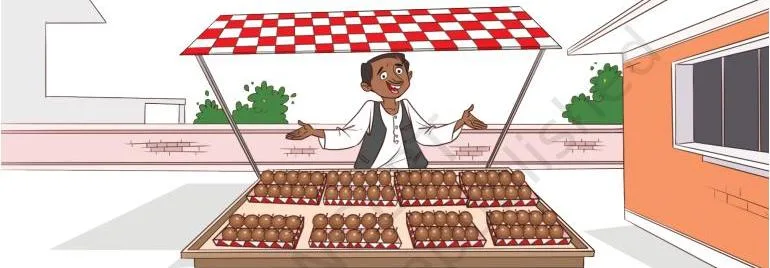
| Packs of ten and Tasty Chikoos | List things sold in packs of ten; pack 25, 43, 35 and 58 chikoos into trays of ten | Trading loose items for tens | p. 3 |
| Matching chikoos | Match 80, 72, 56 and 28 chikoos to the right trays | Reading a two-digit number as tens plus ones | p. 4 |
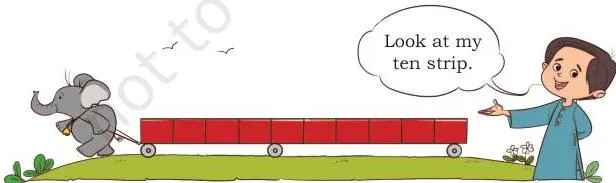
| Fun with Blocks and Strips | Find how many blocks make a block stick and how many units make a ten strip | Recognising 10 as one group | p. 4 |
| Complete the table | Fill in ten strips and units for totals such as 24 and 36 | Splitting numbers into tens and ones | p. 5 |
| Let us Make 100 grid | Join yellow and red ten strips so every combination totals 100 | Making 100 from tens | p. 6 |
| Banker game and counting cards | Roll two dice, take units, and exchange ten units for one ten strip | The exchange rule: ten ones equal one ten | p. 7 |
| Tens and ones with T/O | Read ▲ and ● card pictures and T/O tables such as 3 tens + 1 one = 31 | Writing numbers as tens and ones | p. 8 |
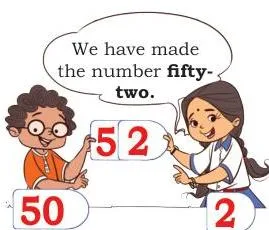
| Make Numbers and Trays of Oranges | Join cards 50 and 2 to make 52; regroup 73 as 70 + 3 | Composing and regrouping two-digit numbers | p. 9 |
| More or Less | Fill in “more than” and “less than” blanks such as 67 chikoos are ____ than 76 | Comparing quantities | p. 11 |
| Flash Card Game | Use digit cards 0-9 to build numbers greater than 50, less than 30 and between 47 and 59 | Place value and ordering | p. 12 |
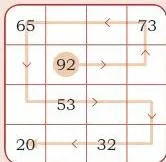
| Number Path | Move from the largest number to the smallest, passing every number once | Ordering numbers in decreasing order | p. 13 |
| Who am I? | Solve six riddles about two-digit numbers | Reasoning about place value | p. 13 |
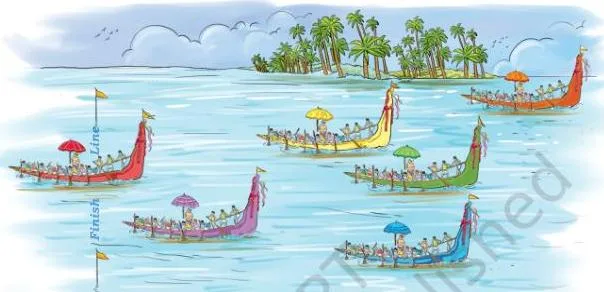
| Vallam kali boat race | Name the first and third boats and the position of each colour | Using first, second and third | p. 14 |
| August calendar | Find Onam, Independence Day and Raksha Bandhan; mark birthdays | Reading a calendar | pp. 14-15 |
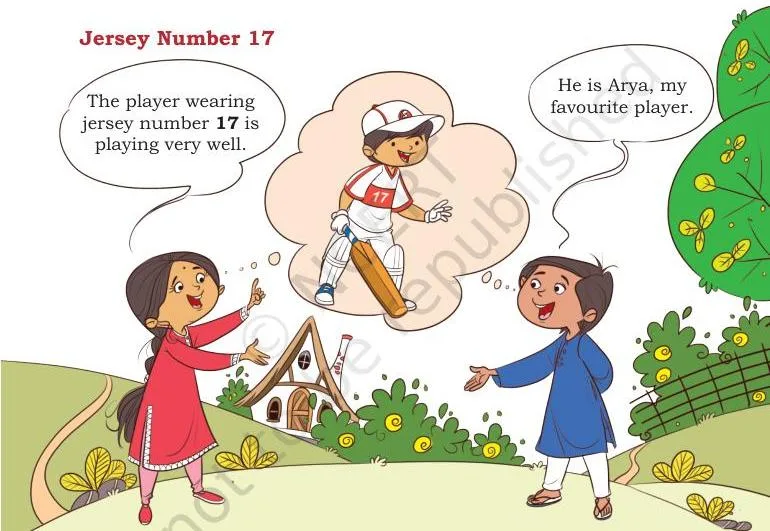
| Jersey Number 17 | Spot jersey number 17 and other numbers used as labels | Numbers as names and labels | p. 15 |
What Let Us Do for Class 2 Actually Teaches
The chapter opens with a seashore picture and one question that sets up everything after it: “Did you count them one by one or in bunches or groups?” (NCERT, p. 1). Children count coconuts, boats, children and oranges, and the discussion that follows is the whole point of the chapter — counting in groups is faster than counting one by one.
From there the chapter builds a single path.
Groups of ten appear in the shop pictures and in trays of chikoos; ten strips and units give those groups a written form; the banker game teaches the exchange rule; the T/O table turns tens and ones into written numbers; and more or less, ordering, positions and a calendar give the numbers meaning in real life.
Notice that this chapter has no traditional exercises with question numbers. Its practice is the activities themselves — picture reading, fill-in-the-blanks, games and puzzles — and each activity is the practice.
Textbook contents and the examinable syllabus are not always identical, so check the current official syllabus if you need exam guidance. At Class 2, though, the value of this chapter is number sense built in class and at home.
Counting in Tens and Ones: Key Ideas
This chapter is about grouping objects so counting is faster and numbers have meaning. The two tools it uses are the ten strip and the single unit: one block stick equals ten blocks, and one ten strip equals ten units (NCERT, p. 4).
Put the two together and you can build any two-digit number. Four ten strips and seven units make 47, written as \(40 + 7 = 47\). The ten strip does the heavy lifting; the units are only the leftovers.
The chapter writes this in a T/O table — T for tens, O for ones — using a ▲ card for a group of ten and a ● card for one shell (NCERT, p. 8). Three tens and one one read as \(30 + 1 = 31\).
The exchange rule keeps counting honest: whenever loose units reach ten or more, trade them for one ten strip (NCERT, p. 7). This is why ten ones behave exactly like one ten, and why ten ten-strips together make a 100-unit grid.
Comparing comes last, and the rule is to look at the tens digit first. So 84 is more than 48, because 8 tens outrank 4 tens (NCERT, p. 11). Only when the tens are equal do you compare the ones.
Games Inside the Chapter: Let us Make 100, Flash Cards and More
Most of this chapter’s practice is tucked inside its games. Here is how the main ones work, so you can run them at home without the book.
Let us Make 100 (the banker game). A group of 5 or 6 children plays with one banker. Each player rolls two dice together and takes that many units from the bank — the chapter suggests rajma, pebbles or chana as units. Whenever a player holds ten or more units, they exchange ten units for one ten strip from the banker (NCERT, p. 7).
The goal is to collect ten ten-strips and lay them together as a 100-unit grid.
Counting through cards. Instead of counting shells one by one, a child places a ▲ card for every group of ten shells and a ● card for every loose shell (NCERT, p. 7). The cards are the bridge between real objects and written numbers.
Make numbers. The teacher calls out a number such as 52; children holding the cards 50 and 2 come together to form it (NCERT, p. 9). The same game repeats for 27 and other numbers.
Flash card game. With digit cards 0 to 9, children build numbers greater than 50, less than 30, and between 47 and 59, then answer the two bonus questions — the smallest and largest two-digit numbers they can make, and why (NCERT, p. 12).
Number path. Children mark a path from the largest number to the smallest, passing through every number at least once (NCERT, p. 13). That is ordering practice wearing a game’s clothes.
A home version of the exchange rule. Take a pile of 23 pebbles or matchsticks. Ask your child to bundle ten pebbles or matchsticks into one bundle every time ten loose ones collect. Two bundles and three loose sticks make 23.
Repeat with a fresh pile each day — this one habit teaches the same exchange rule as the banker game, using nothing but things from the kitchen.
The Picture Scenes in the Chapter, Walked Through



Children work from pictures in this chapter more than from text, so knowing what each scene shows helps you talk it through. The chapter’s main scenes are:
- Seashore (p. 1): coconuts, boats, children and oranges. Count each set, then ask how the counting was done — one by one, or in bunches. The teacher note also asks whether children have visited a seashore or riverside and which animals and plants are seen there.
- The shops (p. 2): shell necklaces with 10 shells in each necklace, groups of balloons with some loose balloons, and bunches of bananas with loose bananas. Surbhi’s collected seashells are grouped for bracelets and necklaces. The page ends with a tongue twister: “She sells seashells at the seashore.”
- Block sticks and ten strips (p. 4): a block stick stands for ten blocks and a ten strip stands for ten units; children then count totals such as 3 block sticks and 4 blocks.
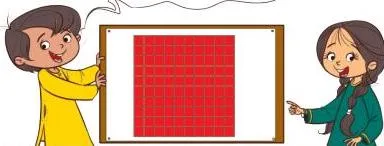
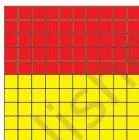
- The 100-unit grid (p. 6): 70 yellow units and 30 red units — that is, 7 yellow ten strips and 3 red ten strips — together make 100 units or 10 ten strips. Children try other yellow-and-red combinations that also total 100.
- Vallam kali boat race (p. 14): a Kerala snake-boat race near the finish line, where children name which colour boat came first, which is likely to come third, and the positions of the blue, green, pink and orange boats.
- August calendar (pp. 14-15): a calendar of August — the book prints one based on 2023 — marked with Independence Day on 15 August, Onam on 29 August and Raksha Bandhan on 30 August. Children answer calendar questions and mark friends’ birthdays in the month.
Words Used in Let Us Do, Explained
A short glossary for reading over your child’s shoulder. Each term is explained the way the chapter uses it.
| Term | What it means | Where it appears |
|---|---|---|
| Ten strip | One strip made of ten units joined together — the picture of one group of ten. | p. 4 |
| Unit | One single object or block, counted on its own. | p. 4 |
| Tens place | The digit that tells how many groups of ten. In 64, the 6 is in the tens place. | p. 8 |
| Ones place | The digit that tells how many single units are left over. In 64, the 4 is in the ones place. | p. 8 |
| Two-digit number | A number with one digit for tens and one for ones, from 10 to 99. | p. 8 |
| More than | The bigger of two quantities — 76 is more than 67, because 7 tens outrank 6 tens. | p. 11 |
| Less than | The smaller of two quantities — 35 is less than 53, because 3 tens are fewer than 5 tens. | p. 11 |
| First, second, third | Positions in a race or a line — the order in which boats finish in the vallam kali race. | p. 14 |
| Calendar | A chart showing every day and date of a month; the chapter uses August to practise reading dates. | pp. 14-15 |
Read numbers aloud as a habit after this chapter: 64 is 6 tens and 4 ones, never “six four”.
Common Mistakes in Let Us Do and How to Fix Them
The chapter is built to catch four routine slips. Name them before your child makes them.
| Mistake | Correct rule | How to check your answer |
|---|---|---|
| Counting every object one by one, even in a picture full of coconuts | Count in groups first — point to groups of ten, then count the tens and the leftovers | After counting, ask “how many tens?” If you cannot say, you have not grouped (NCERT, p. 1) |
| Refusing to exchange ten loose units for a ten strip | Whenever units reach ten or more, trade them for one ten strip from the banker | Never end a turn holding ten or more loose units (NCERT, p. 7) |
| Reading 72 as “seven two” and writing it wrongly | Read the tens digit first: 72 is 7 tens and 2 ones — seventy-two | Write the number in a T/O table; the T column holds 7 and the O column holds 2 (NCERT, p. 8) |
| Comparing by the first digit you see, so 48 looks bigger than 84 | Compare the tens digits first; compare ones only when tens are equal | For 84 vs 48: 8 tens outrank 4 tens, so 84 is more than 48 — the tens digit is compared first (NCERT, p. 11) |
The Who am I? riddles (NCERT, p. 13) catch the same slips in puzzle form. The classic trap is riddle B: children answer 99 because it is the largest two-digit number they know, but 99 repeats the digit 9. So the largest two-digit number with no repeated digit is 98, not 99. All six riddles, worked out:
| Riddle | Answer | Why |
|---|---|---|
| A. Largest two-digit number | 99 | 9 is the largest digit, used in both places. |
| B. Largest two-digit number with no digit repeated | 98 | 99 would repeat 9, so take 9 in the tens place and the next largest digit, 8, in the ones. |
| C. Smallest two-digit number | 10 | The tens digit must be at least 1 and the ones digit at least 0. |
| D. Smallest two-digit number with digits repeated | 11 | The smallest repeated pair is 1 and 1. |
| E. Smallest two-digit number with 3 at the tens place | 30 | Tens is fixed as 3; put the smallest ones digit, 0, to keep the number small. |
| F. Largest two-digit number with 2 at the ones place | 92 | Ones is fixed as 2; put the largest digit, 9, in the tens place. |
What a Teacher Checks After This Chapter
Class 2 mathematics is not board-examined. The value of this chapter is number sense built in class and at home, and a teacher or parent checks it by watching a child do these six things:
- Count in groups — a handful of objects counted in tens, not one by one.
- Say how many tens and ones are in a two-digit number — for example, splitting 64 into 6 tens and 4 ones.
- Build and read numbers to 100 — with ten strips and units, and on a T/O table.
- Compare with more and less — using the tens digit first.
- Order numbers — travelling the number path from largest to smallest.
- Use positions and a calendar — first, second and third in the boat race, and dates in the August calendar.
If a child can do all six, the chapter has done its job. Textbook contents and the examinable syllabus are not always identical, so check the current official syllabus for anything exam-related. For extra practice ideas, the Class 2 mathematics notes hub and the Class 2 notes hub across all subjects collect resources by topic.
Let Us Do Class 2: Quick Recap
The chapter ends without a printed summary — these six points are the takeaways a child should leave with.
- Count in groups of ten — counting is faster when objects are packed in tens.
- Ten strips and units build numbers — 4 ten strips and 7 units make 47.
- Ten ten-strips make 100 — the 100-unit grid is just 10 strips joined.
- Write numbers as tens and ones — the T/O table shows both places at once.
- Compare using the tens first — 84 beats 48 because 8 tens beat 4 tens.
- Put numbers in order and use positions — first, second and third, and the August calendar.
Related NCERT Class 2 Resources
This listing is maintained for the 2026-27 academic session using the NCERT textbook information available to us. NCERT remains the authority for confirming the latest edition.
- NCERT Class 2 books hub — all Class 2 textbook pages together.
- Joyful Mathematics book page — the full book this chapter belongs to, with every chapter listed.
- Shapes Around Us — the next chapter in Joyful Mathematics, covered as Class 2 notes.
- All subject notes on this site — for exploring beyond Class 2.
The official source for every book and edition above is NCERT’s own website, ncert.nic.in, where all official PDFs are published.
Sources and Data Verification
- The activity and scene descriptions on this page come from the NCERT Joyful Mathematics textbook for Class 2, Chapter 1 (Let us Do), in the official NCERT PDF bejm101.pdf.
- This page covers that one chapter only — not the whole Joyful Mathematics book and not other Class 2 subjects.
- This listing is maintained for the current academic session using the NCERT textbook information available to us. A chapter in the textbook and the examinable syllabus are not always identical.
- NCERT settles textbook editions and official PDFs; CBSE settles curriculum, syllabus and examinations. The official NCERT portal is ncert.nic.in.
Let Us Do Class 2: Common Questions
What does Chapter 1 Let us Do teach in Class 2 Joyful Mathematics?
It teaches counting in groups, tens and ones, building numbers to 100, comparing with more than and less than, ordering numbers, and using positions and a calendar — all through activities and games. The opening seashore picture asks children whether they counted one by one or in bunches or groups, and that question is the whole chapter in one line (NCERT, p. 1).
How does the Let us Make 100 game work?
Children play in groups of 5 or 6 with one banker. Each player rolls two dice together and takes that many units from the bank — rajma, pebbles or chana work well as units. Whenever a player has ten or more units, they exchange ten units for one ten strip.
The aim is to collect ten ten-strips and lay them together as a 100-unit grid (NCERT, pp. 6-7).
Where can I download the official Let Us Do Class 2 PDF?
NCERT hosts the official file at Let Us Do Class 2 Chapter 1 PDF on ncert.nic.in. It is the official edition of the chapter, and you can also open it from the download box at the top of this page.
How can I help my child practise tens and ones at home?
Give your child a pile of pebbles or matchsticks and let them bundle ten pebbles or matchsticks into one bundle whenever ten collect. Two bundles and three loose sticks make 23. Then call out numbers such as 52 and 37 and let your child build them with bundles and loose sticks — the same exchange rule the banker game teaches.
Why is 98 the largest two-digit number with no repeated digit in the Who am I? activity?
Because 99, the largest two-digit number overall, uses the digit 9 twice. The largest number with no repeated digit therefore puts 9 in the tens place and 8 in the ones place: 98.
How is the August calendar used in Let us Do?
Children read the month of August — the book prints a calendar based on 2023 — to find that Onam falls on 29 August, Independence Day on 15 August, and Raksha Bandhan on Wednesday 30 August. They then mark any friends’ birthdays in the month (NCERT, pp. 14-15).
Reference: NCERT Class 2 Joyful Mathematics textbook, chapter 1, official edition on ncert.nic.in.
Explore Class 2 Mathematics Books
Related chapters: