
This page offers the official Decoration for Festival Class 2 chapter PDF from NCERT’s Joyful Mathematics book — chapter 6, a 21-page chapter in which children add and subtract two-digit numbers using garlands of flowers, rows of diyas, blocks and a ginladi (counting string).
The download sits right below. After it, this page explains what the chapter teaches, activity by activity, so you know what is inside before you open the file.
Chapter 6 at a glance
The table below is read from the NCERT chapter itself and shows what the chapter holds — its sections, figures, activities and practice sets — so you can see its size at a glance.
| What the chapter holds | Count | Where it is used |
|---|---|---|
| Printed pages | 21 | |
| Figures with NCERT captions | 18 | |
| Tables | 10 | |
| Activities | 4 | |
| Official NCERT PDF | Download the chapter PDF | the chapter exactly as NCERT publishes it |
What this chapter covers: garlands, diyas and two-digit sums
The chapter is one long festival story. Children string flower garlands, count diyas, pile blocks, skip rope and buy a gift wrapper — and every picture is doing real arithmetic. In order, the activities are:
- Decoration for Celebration! — the opening table. Each child has 10 flowers, so Rohan’s \(10 + 2 = 12\) and Suwali’s \(50 + 3 = 53\) are read as tens and ones.
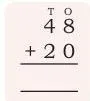
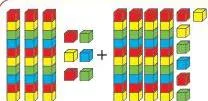
- How many flowers? — picture questions add pairs in the Tens (T) and Ones (O) columns: \(12 + 53 = 65\) and \(20 + 43 = 63\), with more pairs left for the child to finish.
- Let us do it on Ginladi — counting on: \(25 + 12\) by moving 12 beads ahead, then splitting 34 into \(30 + 4\) so \(57 + 34 = 87 + 4 = 91\).
- Add these Numbers — column sums such as \(44 + 23\), \(56 + 23\), \(60 + 25\) and \(52 + 30\), done without pictures.
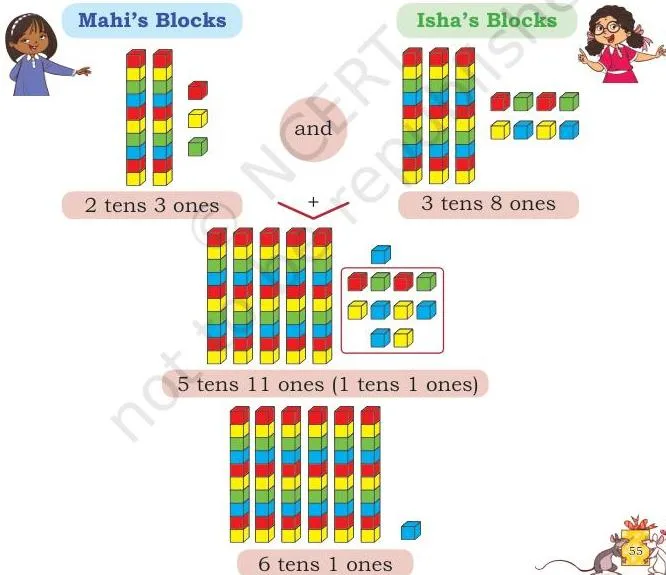
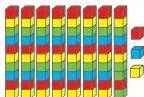
- Playing with Blocks — Mahi’s 3 tens 6 ones plus Isha’s 4 tens 7 ones make 7 tens 13 ones, exchanged to 8 tens 3 ones = 83.
- Let us Count Diyas — 75 diyas made and 35 sold: counting back 35 steps on the ginladi lands on 40, so \(75 – 35 = 40\).
- Let us do some practice on number line — \(26 – ?\), \(39 – 28\), \(38 – 11\), \(22 – 22\), \(14 – 0\) and \(35 – 12\), read from jumps on the number line.
- Playing with Blocks (taking away) — 45 blocks with 12 given away leaves 33: \(45 – 12 = 33\), written in the T and O columns.
- Decorating with Garlands — borrowing: 46 flowers sit as 4 garlands and 6 flowers; opening one garland gives 3 tens 16 ones, so \(46 – 18 = 28\).
- Skip the Rope — missing addends: \(20 – 14 = 6\) and \(14 + 6 = 20\) are the same fact written two ways.
- Addition and Subtraction Facts — fact families for 20, 30, 50 and for 10, 20, 30.
- Hania and Mansi’s Gift — a two-step money story: ₹24 and ₹37 spent from a ₹78 purse.
- Project Work — Daljeet’s solved answers, which the child must verify and correct.
Key concepts: tens and ones, adding and taking away
One idea runs through the whole chapter: ten loose things make one bundle. A garland of ten flowers is one ten, a pile of ten blocks is one ten, and ten beads on the ginladi are one ten. The bundle is what makes the tens digit.
Tens and ones: a bundle of ten flowers
A two-digit number is a count of bundles plus a count of leftovers: 12 is 1 ten and 2 ones, 53 is 5 tens and 3 ones.
In Decoration for Celebration!, each child’s flowers are drawn as complete garlands plus loose flowers. Rohan’s picture reads \(10 + 2 = 12\); Suwali’s reads \(50 + 3 = 53\).
The Tens (T) and Ones (O) columns in the next activity are bookkeeping for the same idea: the tens digit goes under T, the ones digit under O.
Why bundle at all? Because counting 53 loose flowers one at a time is slow and easy to lose track of. Bundles of ten let a child see the size of a number at a glance.
Adding in the tens and ones columns
When the ones add up to 10 or more, the ones column cannot hold a two-digit number. Ten of the ones are exchanged for one ten, and that extra ten is carried into the tens column.
Worked example with fresh numbers, \(38 + 47\):
Step 1 — add the ones: \(8 + 7 = 15\). Write 5 in the ones column and carry the 1 ten over to the tens column.
Step 2 — add the tens: \(3 + 4 + 1 = 8\) — the carried ten must be added too. Write 8 in the tens column.
\[ \begin{array}{r} 38 \\ +\ 47 \\ \hline 85 \end{array} \]
Answer: 85.
The chapter’s block picture in Playing with Blocks shows the same exchange: 3 tens 6 ones plus 4 tens 7 ones make 7 tens 13 ones, and 10 of the 13 ones are bundled into a new ten, leaving 8 tens 3 ones = 83. That bundling is exactly the carry.
Subtraction as taking away and counting back
In this chapter, subtraction always means something real: diyas are sold, flowers are given away, money is spent. Two ways lead to the answer — take the objects away, or count back on the ginladi or number line.
In Let us Count Diyas, a child makes 75 diyas and sells 35. Start at 75 on the ginladi and go 35 steps backward: the last bead is 40, so \(75 – 35 = 40\). The same activity does \(32 – 12 = 20\).
Two special cases get their own teacher note: \(22 – 22 = 0\) — taking a number away from itself leaves nothing, like spending all your money. And \(14 – 0 = 14\) — subtracting zero changes nothing, like spending no money at all.
Borrowing: opening one garland of ten
Borrowing looks mysterious on paper, but the garland picture makes it physical: to borrow, you open one bundle of ten into ten loose ones.
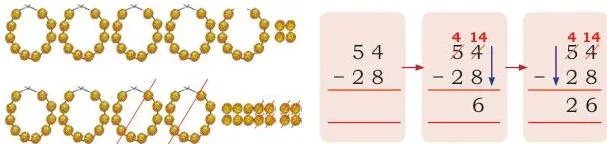
In Decorating with Garlands, 46 flowers are 4 garlands and 6 flowers. Six loose flowers are not enough to give away 18, so one garland is opened: now there are 3 garlands and 16 flowers. Then \(16 – 8 = 8\) and \(3 – 1 = 2\), leaving 28 flowers.
Worked example with fresh numbers, \(52 – 17\):
Step 1 — open one ten: 52 is 5 tens 2 ones. The ones \(2 – 7\) are not enough, so open one ten: 4 tens 12 ones.
Step 2 — subtract the ones: \(12 – 7 = 5\).
Step 3 — subtract the tens: \(4 – 1 = 3\).
\[ \begin{array}{r} 52 \\ -\ 17 \\ \hline 35 \end{array} \]
Answer: 35. The same opening-a-ten idea is applied later in the chapter to \(73 – 47\) and \(54 – 28\).
The fact family: addition and subtraction are opposite
One set of three numbers can be written as four true sentences. This is a fact family, and it shows children that subtraction undoes addition.
For the numbers 20, 30 and 50, the four sentences are:
\[ 20 + 30 = 50, \quad 30 + 20 = 50, \quad 50 – 30 = 20, \quad 50 – 20 = 30 \]
The Skip the Rope game uses the same idea with a blank: Aman needs \(20 – 14 = 6\) more skips, and \(14 + 6 = 20\) says the same thing forwards.
Why four sentences? Because addition and subtraction are opposites — every addition fact can be turned into two subtraction facts, and vice versa.
Picture-based activities: what the flowers, diyas and blocks teach





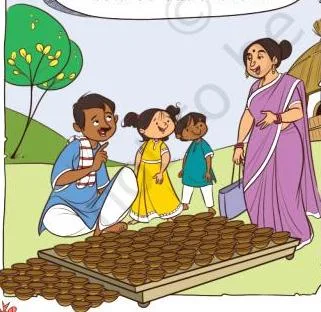



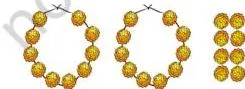
This chapter carries its mathematics in pictures drawn inside the story more than in labelled diagrams. Four pictures do the main teaching:
- The flower garlands of the opening table. Each child’s ten flowers are drawn as complete garlands plus loose flowers. One garland and two loose flowers is the number 12; five garlands and three loose flowers is 53. The garlands are the tens, the loose flowers are the ones.
- Mahi and Isha’s block piles. Two piles — 3 tens 6 ones and 4 tens 7 ones — are pushed together into 7 tens 13 ones, and the picture shows 10 of the 13 ones being bundled into a new ten to give 8 tens 3 ones = 83. This picture stands for addition with carrying.
- The row of 75 diyas. The picture shows 35 diyas being taken away from a row of 75, leaving 40. It stands for subtraction as taking away; the same story is then done on the ginladi by jumping back 35 steps.
- The garlands-and-flowers picture of 46. Four garlands and six flowers, with one garland shown opened into ten loose flowers: 3 tens and 16 ones. It stands for borrowing — one ten becomes ten ones so that subtraction can happen.
Child-friendly definitions for the words in this chapter
These words appear in the chapter and are easy to explain when a child gets stuck. Each definition ends with where the word appears.
- Two-digit number — a number with a tens digit and a ones digit, like 37: 3 tens and 7 ones.
- Tens — complete bundles of ten, the way a full garland is ten flowers.
- Ones — the loose things left over, fewer than ten; the ones column holds the leftovers.
- Addition — putting groups together to find the total, as in “How many flowers are used by Rohan and Suwali together?”
- Subtraction — taking a group away to find what is left, as when 35 diyas are sold out of 75.
- Carrying — exchanging 10 ones for 1 ten in addition, and moving that ten into the tens column.
- Borrowing — opening 1 ten into 10 ones in subtraction, so the ones column has enough to subtract from.
- Number line — a line of counting numbers; jump forward to add and jump backward to subtract.
- Ginladi — the bead counting string; move 12 beads ahead of 25 to add, or 35 beads back from 75 to subtract.
- Fact family — four true sentences built from the same three numbers, two additions and two subtractions.
- Missing addend — the blank in a sentence like \(14 + \_ = 20\); it asks how many more are needed to reach the total.
Mistakes children make with tens and ones (and how to fix them)
Every mistake below comes from one part of the chapter’s pictures being missed. Name the mistake before the child makes it, then show the right thinking.
- The carried ten gets forgotten. For \(36 + 47\), the ones \(6 + 7 = 13\) produce one extra ten. The tens column must be \(3 + 4 + 1 = 8\), giving 83 — not \(3 + 4 = 7\), which would give 73 and lose the extra ten.
- 13 ones written as “713”. A ones column can hold only one digit. 7 tens 13 ones is exchanged to 8 tens 3 ones = 83, never “713”.
- Subtracting the smaller digit from the larger in every column. For \(73 – 47\), taking 3 from 7 and 4 from 7 gives 34 — wrong. Borrow first: \(13 – 7 = 6\) and \(6 – 4 = 2\), so the answer is 26.
- The tens digit not reduced after borrowing. For \(46 – 18\), opening one ten changes 4 tens 6 ones into 3 tens 16 ones — not 4 tens 16 ones. So \(16 – 8 = 8\) and \(3 – 1 = 2\), giving 28, not 38.
- Counting the starting number as a step. For \(25 + 12\), the first jump from 25 lands on 26. Twelve jumps land on 37. Counting 25 as “step 1” lands one too far — on 38.
- The special cases. \(22 – 22 = 0\) (a number minus itself) and \(14 – 0 = 14\) (subtracting zero changes nothing) still surprise children who have only practised “big minus small” sums.
| Mistake | Correct rule | How to check your answer |
|---|---|---|
| Carried ten forgotten: \(3 + 4 = 7\), answer 73 | Add the carried ten last: \(3 + 4 + 1 = 8\), answer 83 | Check with subtraction: \(83 – 47 = 36\) |
| 13 ones written as “713” | Exchange 10 ones for 1 ten; write 8 tens 3 ones | Read the number aloud: 83, not 713 |
| Smaller digit subtracted from larger: \(73 – 47\) gives 34 | Borrow one ten first: \(13 – 7 = 6\), \(6 – 4 = 2\) | Check with addition: \(26 + 47 = 73\) |
| Tens digit kept at 4 after borrowing in \(46 – 18\) | Opening one ten makes it 3 tens 16 ones | Ask: did the tens digit come down by one? Answer must be 28 |
| Starting number counted as step 1 in \(25 + 12\) | Start at 25; each jump adds exactly one | Check backward: \(37 – 12 = 25\) |
Practice after the chapter: the Let us Do sets and the syllabus note
The chapter’s “Let us Do” sets are its own checkpoints — a child who can finish these has covered everything in the chapter.
- Addition word problems — Rahim’s \(43 + 58\) runs; Simarpreet’s \(12 + 36\) colour pencils; Heena’s \(34 + 57\) marbles; Sarika and Manish’s fair money; 36 men and 47 women on the bus.
- Money subtractions — Shikha’s ₹82 minus ₹22 after buying pencils; Ruby’s ₹60 minus ₹20 after buying a notebook.
- Six take-away word problems — Anushka’s \(63 – 26\) shells; \(54 – 16\) bus passengers; \(40 – 13\) balloons; Kanika’s \(72 – 36\) bangles; \(87 – 56\) birds that came later; Arman’s \(35 – 18\) dribbles.
- Fact family fill-ins — complete the four sentences for 20, 30, 50 and for 10, 20, 30.
- The two-step gift problem — Hania and Mansi spend ₹24 and ₹37; the total is ₹61, and ₹78 minus ₹61 leaves ₹17.
- Project Work — verify Daljeet’s answers and correct the wrong ones; this builds checking habits.
For parents: before paper sums, use real objects — flowers, beads, blocks — exactly as the chapter does. A child who has physically bundled ten flowers into one garland understands why the tens digit exists.
A syllabus note: textbook contents and the examinable syllabus are not always identical — check the current official CBSE syllabus at cbse.gov.in before deciding what to revise. The chapter file itself is NCERT’s, hosted on the official e-textbook portal at ncert.nic.in.
Quick recap: the chapter in eight points
The chapter has no summary box of its own; these eight points condense it for a quick read-aloud.
- A bundle of ten flowers, beads or blocks makes one ten.
- Read every two-digit number as tens and ones: 53 is 5 tens and 3 ones.
- To add, add the ones first; when they make 10 or more, carry the extra ten into the tens column.
- Subtraction means taking away (diyas sold) or counting back on the ginladi and number line.
- To borrow, open one ten into ten ones — the tens digit comes down by one.
- A number minus itself is 0 (\(22 – 22\)), and a number minus zero is unchanged (\(14 – 0\)).
- Three numbers make a fact family of four sentences: two additions and two subtractions.
- Story sums put the same operations into words — runs, marbles, diyas, rupees.
Related resources: Class 2 maths book and nearby chapters
This listing is maintained for the 2026-27 academic session using the NCERT textbook information available to us. NCERT remains the authority for confirming the latest edition.
Move around the book from here: the Class 2 Joyful Mathematics book page holds every chapter of the book, and the Class 2 hub covers all subjects. Chapter 6 sits between Chapter 5 Playing with Lines and the next chapter, Let Us Read. Notes for other classes start at the CBSE Notes home page.
Reference: NCERT Class 2 Mathematics (Joyful Mathematics) textbook, chapter 6, official edition on ncert.nic.in.
Sources and data verification
- This page describes NCERT’s Joyful Mathematics textbook for Class 2, chapter 6, Decoration for Festival, in its official English edition.
- The listings on this page are maintained for the current academic session using the NCERT information available to us.
- NCERT settles textbook editions and official PDFs; CBSE settles the curriculum, syllabus and examinations.
- The counts on this page come from the textbook entries this directory holds, not from the whole CBSE scheme.
Questions students ask about this chapter
What does chapter 6 Decoration for Festival teach in Class 2 Joyful Mathematics?
It teaches adding and subtracting two-digit numbers. Children read numbers as tens and ones, carry when the ones add past 9, borrow by opening a ten, count on and back with the ginladi and number line, and finish with fact families and money story sums. Every idea begins with a festival picture — garlands, diyas, blocks or a skipping rope.
How do you add two numbers when the ones add up to more than 10?
Exchange the 10 ones for 1 ten and carry it to the tens column. For \(38 + 47\): the ones give \(8 + 7 = 15\), so write 5 and carry 1; the tens become \(3 + 4 + 1 = 8\); the answer is 85. The chapter’s block picture shows the same exchange as 7 tens 13 ones becoming 8 tens and 3 ones.
How much money did Hania and Mansi spend, and how much was left from ₹78?
The gift wrapper costs ₹24 and the ribbons cost ₹37, so the total spent is ₹61. From the ₹78 purse, ₹78 minus ₹61 leaves ₹17.
What is a fact family in addition and subtraction?
Three numbers written as four true sentences. For 20, 30 and 50, the family is \(20 + 30 = 50\), \(30 + 20 = 50\), \(50 – 30 = 20\) and \(50 – 20 = 30\). Addition and subtraction are opposite operations, and the family shows it.
Why does the chapter borrow a ten from the tens column in subtraction?
Because sometimes the ones column does not have enough ones to subtract from. In \(52 – 17\), the ones are \(2 – 7\), which cannot be done, so one ten is opened: 52 becomes 4 tens 12 ones, then \(12 – 7 = 5\) and \(4 – 1 = 3\). The picture of opening a garland exists to make this visible.
Where can I download the official Class 2 Joyful Mathematics chapter 6 PDF?
Use the download block at the top of this page — it links to the official NCERT file. The chapter PDF is also hosted on the official NCERT e-textbook portal at ncert.nic.in/textbook.php, where all Class 2 books appear in the same place.
Explore Class 2 Mathematics Books
Related chapters: