
This is the 4 Shadow Story (Togalu) Class 2 chapter — NCERT Joyful Mathematics, Chapter 4, a short, picture-led chapter of about 12 pages that introduces shapes through shadow play at a village fair. The official PDF is here, along with a walk-through of every activity and a plain account of the shape ideas hiding inside them, for parents and teachers helping a 7-year-old.
Download 4 Shadow Story (Togalu) Class 2 PDF
This is the official NCERT chapter PDF for 4 Shadow Story (Togalu) Class 2.
NCERT Class 2 Joyful Mathematics Chapter 4 Shadow Story (Togalu) PDF can be read on any device and printed for the child to trace and colour.
Chapter at a glance: what is inside
The table below lists how much the downloaded file holds — its sections, picture pages, activities and questions — so you can judge the chapter before opening it.
| What the chapter holds | Count | Where it is used |
|---|---|---|
| Printed pages | 12 | |
| Figures with NCERT captions | 10 | |
| Activities | 3 | |
| Official NCERT PDF | Download the chapter PDF | the chapter exactly as NCERT publishes it |
The chapter is a play-based introduction to shapes through shadows. It is built from conversation prompts and hands-on activities — acting, tracing, hiding, colouring, folding and printing — rather than numbered exercises or formal definitions.
How the chapter flows: from shadow play to shape patterns
The chapter moves from watching shadows at the fair to making and tracing them, then to naming shapes, corners and patterns. Each activity below does one job.
| Activity | What it builds |
|---|---|
| Togalu Gombeyaata opening | Curiosity about shadows — a shadow puppet show at the village fair |
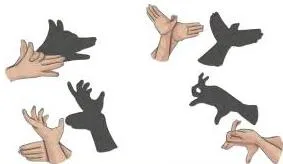
| Let us Do | Animal shadows made with fingers, with sounds |
| Let us Talk | When shadows appear, and when they vanish |
| Fun with Shadows | Does moving the torch change a shadow’s size? Longest and shortest shadows |
| Let us Trace | Tracing an eraser, leaf, matchbox, sharpener or pencil colour to get outlines |
| Let us Think | What else traces like a bottle cap or an eraser |
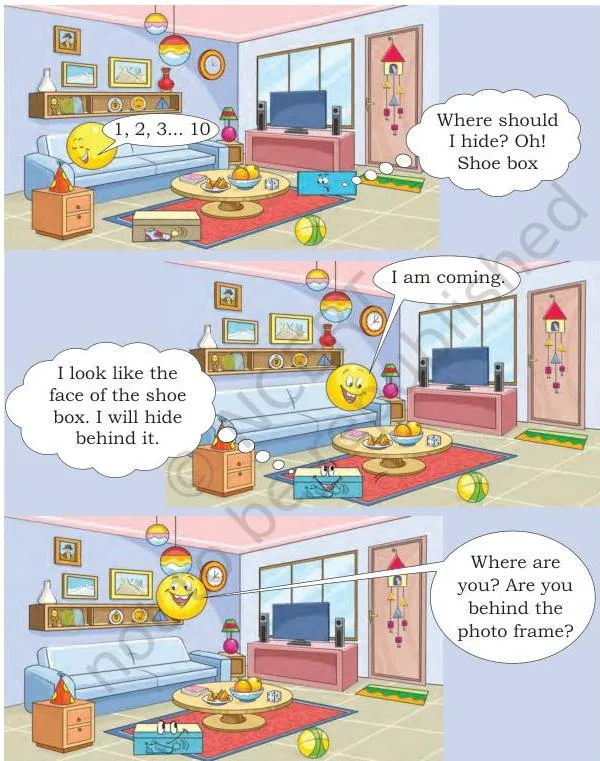
| Hide and Seek | Rectangle hides behind the TV, then behind the shoe box |
| They all are playing together now | Where circles, rectangles, triangles and squares hide in the room |
| Colour the Carpet | Sorting by name — red triangles, green circles, yellow rectangles, blue squares |
| Catch the Corner! | Corners, straight edges and curved edges, learned through a running game |
| Let us Think | Corners on curved shapes; objects with straight and curved edges |
| Origami Fun! | Folding a square into a triangle, then into a paper dog |
| Patterns | Stamping and mehandi patterns from bottle caps, coins and hands |
| Let us Do | Leaf printing — a pattern made from nature |
| Project Work | A wall hanging made from shape cutouts |
| Extend the following patterns | Arrow patterns, cross-and-box groups, AB BC CD letter pairs, and number patterns that add 3, 5, 5, 7 and 6 |
The maths hiding in the activities
The chapter never names its ideas as topics. It hides them inside play, so this section pulls them out one at a time and tells you which activity shows each one.
Shadows: light blocked by an object
A shadow appears when an object blocks the light, and vanishes when the object or the light moves. Let us Talk asks exactly that — when do we see a shadow, and when does it vanish? Fun with Shadows then asks whether moving the torch changes a shadow’s size, and when the day’s shadow is longest and shortest.
The low sun of early morning and late afternoon makes long shadows; the overhead sun at midday makes the shortest.
Tracing: the outline of an object’s face
A trace is the outline you draw around an object’s flat face. Let us Trace has children trace an eraser, leaf, matchbox, sharpener and pencil colour; Let us Think then asks which objects give the same trace — a bottle cap gives a circle, and an eraser gives a rectangle.
Shapes hiding in everyday objects
In Hide and Seek, Rectangle hides behind the TV and then behind the shoe box until the doorbell rings and Triangle and Square join. The book then asks where each shape could hide, and the child learns to see a shape’s outline inside real objects.
| Shape | Edges | Corners | Hides in |
|---|---|---|---|
| Circle | 1 curved edge | 0 | clock, ball |
| Triangle | 3 straight edges | 3 | the child suggests places |
| Square | 4 straight edges, all four equal | 4 | the child suggests places |
| Rectangle | 4 straight edges, opposite sides equal | 4 | shoe box, photo frame |
Edges and corners
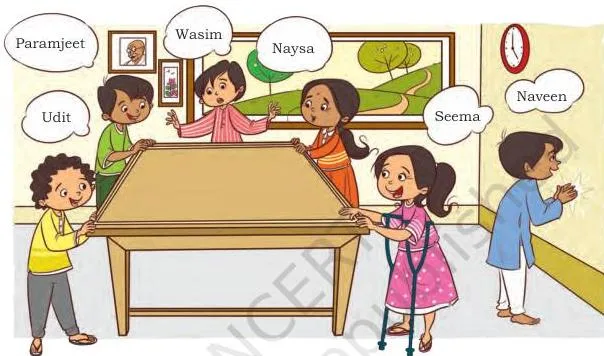
Catch the Corner! is a running game: the child who stops without standing at a table corner is out. Playing it teaches that a corner is where straight edges meet, and that an object with only curved edges has no corners at all — which is why the game cannot be played around a round table.
The Let us Think answer for corners on curved shapes is therefore zero.
Patterns that repeat and grow
A pattern is a unit that repeats — stamped bottle caps, mehandi on a hand, leaves printed on paper. Extend the following patterns moves the same idea to numbers: each pattern grows by a fixed step. The chapter’s patterns add 3, 5, 5, 7 and 6. Try the same method with fresh numbers: \(2, 5, 8, 11, 14\) adds 3 each step, and \(3, 8, 13, 18\) adds 5 each step.
Folding changes corners and edges
Origami Fun! lets a child watch the shape change: a square folded in half, joining two corners, becomes a triangle. The child counts corners and edges before and after the fold.
| Fold | Shape in hand | Corners and edges |
|---|---|---|
| Paper folded into a square to start | Square | 4 corners, 4 edges |
| Fold in half, joining two corners | Triangle | 3 corners, 3 edges |
| Two triangles from two corners, then fold the third corner up | Paper dog with ears, nose and eyes | The child counts again |
The activity closes by asking whether the same square can be folded into a shape with 4 sides — and how many corners that one has.
Reading the picture pages with your child

The pictures carry half the teaching, so here is what each scene shows and one question to ask while the child looks at it.
- The fair’s shadow play — Nakul and his friends watch Togalu Gombeyaata and are fascinated by its shadows, then make animal shadows on the wall with their fingers. Ask: “What animal shadow can you make with your hands?”
- Hide and Seek — Circle looks for Rectangle, who hides behind the TV and then behind the shoe box; the doorbell rings and Triangle and Square join. Ask: “Where could a triangle hide in this room?”
- Colour the Carpet — the carpet is full of shapes to colour: triangles red, circles green, rectangles yellow, squares blue. Ask while colouring: “Why is this one a square, not a rectangle?”
- Catch the Corner! — Naveen claps facing the wall while his friends run around the table; whoever stops away from a corner is out. The questions also ask which children stand near the corners, where Wasim is standing, and what objects around the house have straight or curved edges. Ask: “Why can’t we play this around a round table?”
- Origami fold pictures — the steps turn a square sheet into a paper dog. Ask at the first fold: “What shape is the paper now?”
Shape words made simple
The book uses these words throughout but never stops to define them — so here they are in words a 7-year-old follows. The chapter itself prints no formal definitions.
| Word | Plain meaning | Where it appears |
|---|---|---|
| Shadow | The dark shape made when an object blocks light | Let us Talk, Fun with Shadows |
| Trace | The outline you draw around an object’s flat face | Let us Trace, Let us Think |
| Straight edge | A side that does not bend, like the side of a book | Catch the Corner! |
| Curved edge | A side that bends, like the rim of a coin | Catch the Corner!, Let us Think |
| Corner | Where two straight edges meet | Catch the Corner!, Let us Think |
| Circle | A round shape with one curved edge and no corners | Hide and Seek, Colour the Carpet |
| Triangle | Three straight edges and three corners | They all are playing together now |
| Square | Four straight edges, all four sides equal, four corners | They all are playing together now |
| Rectangle | Four straight edges, opposite sides equal, four corners | Hide and Seek, Colour the Carpet |
| Pattern | Something that repeats again and again | Patterns, Extend the following patterns |
Where children get stuck in this chapter
Each mistake below comes out of the chapter’s own questions. Name it before the child makes it.
| Mistake | Why it happens | How to check |
|---|---|---|
| “My shadow is longest at noon because the sun is strongest.” | The child judges by how bright the day feels. | The low sun of early morning and late afternoon makes the longest shadows; the noon sun overhead makes the shortest. Compare outdoors at three times of day. |
| Naming the object, not the traced shape — “bottle cap” instead of “circle”. | Let us Think asks for the shape of the trace, but the child names what they hold. | Ask “What shape is the outline?” The outline is the answer. |
| Trying to count corners on a curved shape. | Every shape met so far had corners, so the child hunts for them on circles too. | Shapes with only curved edges have zero corners — the reason the corner game fails around a round table. Run a finger along the rim to show none. |
| Colouring squares as rectangles in Colour the Carpet. | A square looks like a rectangle and both have four sides. | A square’s four sides are all equal; a rectangle’s opposite sides are equal. Test with a paper strip. |
| Guessing the next number without finding the step. | Extend the patterns looks like a guessing game. | Subtract two neighbours first. The chapter’s patterns add 3, 5, 5, 7 and 6; once the step is fixed, the next term is fixed too. |
How to check what your child has learned
After the chapter, a child should be able to answer these aloud, with no paper or pencil.
- When does a shadow appear, and when does it vanish? (Let us Talk)
- Does moving the torch change a shadow’s size? When is your shadow longest, and shortest? (Fun with Shadows)
- Which objects trace a circle, and which trace a rectangle? (Let us Think)
- Where could a triangle and a square hide in this room? (They all are playing together now)
- Why can the corner game not be played around a round table? (Catch the Corner!)
- How many corners does a curved-edge object have? (Let us Think)
- How would you continue a shape pattern and a number pattern? (Extend the following patterns)
The chapter in five minutes
Six lines to read aloud with the book closed, following the chapter’s own arc.
- A shadow appears when something blocks the light, and vanishes when the light or the thing moves.
- Trace around an object’s flat face — that outline is its shape.
- Outlines give us circles, triangles, squares and rectangles.
- Edges are straight or curved; corners appear only where straight edges meet.
- Fold a square in half and it becomes a triangle — 3 corners and 3 edges where the square had 4.
- Patterns repeat, and number patterns grow by a fixed step.
Other Class 2 Joyful Mathematics chapters
Find the whole book from the Class 2 Joyful Mathematics book page or the Class 2 hub. For study support, the Class 2 Joyful Mathematics notes, the Class 2 notes hub and the main CBSE notes index cover the same book. You can also move chapter by chapter — back to Chapter 3 or forward to Chapter 5.
Sources and data verification
This listing is maintained for the 2026-27 academic session using the NCERT textbook information available to us. NCERT remains the authority for confirming the latest edition.
- The contents described here come from the NCERT Joyful Mathematics textbook for Class 2, Chapter 4, Shadow Story (Togalu), official edition on ncert.nic.in.
- This page covers that one chapter and its activities, not the full CBSE Class 2 scheme.
- The listing is maintained for the current session using the NCERT information available to us.
- NCERT settles textbooks, editions and PDFs; CBSE settles the curriculum, syllabus and examinations.
- Textbook contents and the examinable syllabus are not always identical — check the current official syllabus.
Reference: NCERT Class 2 Joyful Mathematics textbook, chapter 4, official edition on ncert.nic.in.
Questions parents ask about Shadow Story (Togalu)
What is Togalu Gombeyaata in Class 2 Chapter 4?
Togalu Gombeyaata is a shadow puppet art form from Karnataka. In the chapter, Nakul and his friends watch such a show at a village fair, are fascinated by its shadows, and then try making animal shadows themselves with their fingers.
The puppets are used to depict scenes from Indian epics, and the chapter invites children to share their own puppet-show experiences.
When is a shadow longest and when is it shortest?
A shadow is longest in the early morning and late afternoon, and shortest at midday. When the sun sits low, its light comes at an angle and the shadow stretches; when the sun is overhead at midday, the shadow shrinks. Fun with Shadows asks both questions.
How many corners does a circle have in this chapter?
Zero. A circle has one curved edge, and corners appear only where straight edges meet, so an object with only curved edges has no corners. That is also why the corner game cannot be played around a round table.
Which objects have the same trace as a bottle cap or an eraser?
Any object whose flat face has the same outline. A bottle cap traces a circle, so a coin or a lid gives the same trace; an eraser traces a rectangle, so a book or a matchbox face does. Let us Think asks the child to find such objects at home.
What number patterns are in the Extend the patterns activity?
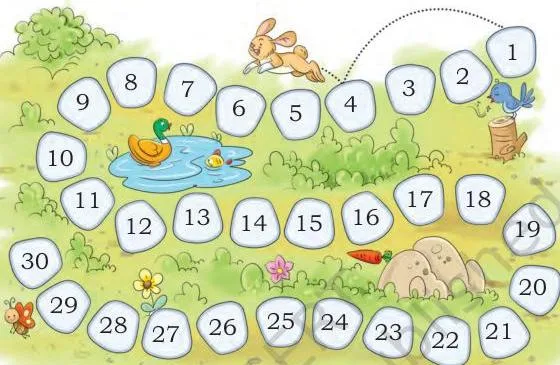
Five number patterns, each growing by a fixed step: \(1, 4, \dots\) adds 3; \(1, 6, 11, \dots\) adds 5; \(5, 10, 15\) adds 5; \(7, 14, 21\) adds 7; and \(1, 7, 13\) adds 6. Kikku the rabbit jumps on the 4th tile and his mother on the 6th, so the first two patterns are shown as jumps on tiles.
Why does the chapter teach shapes through origami?
Because folding makes a shape change in the child’s own hands. A square folded in half, joining two corners, becomes a triangle — 4 corners and 4 edges become 3 and 3 — and every further fold changes the count again. The activity ends with a paper dog the child folded alone, and a question about folding the square into a shape with 4 sides.
Explore Class 2 Mathematics Books
Related chapters: