
This page is about Chapter 8, Working with Fractions, of the NCERT Class 7 Mathematics book Ganita Prakash. The chapter opens on textbook page 172, runs about 39 printed pages, and is the book’s fraction-arithmetic lesson: how to multiply and divide fractions, how to apply both to word problems, and how to judge whether an answer is sensible.
This page follows the current NCERT edition, and the official Working with Fractions Class 7 Chapter 8 PDF is right below.
Download the official Working with Fractions Class 7 Chapter 8 PDF from the NCERT textbook page for Ganita Prakash so you can read the chapter, its figures and its exercises on any device.
Chapter at a glance
The chapter table on this page counts what the PDF holds — sections, figures, worked examples and exercise questions — so you know the file’s size before you open it. Here is the shape of what is inside.
- Section 8.1 Multiplication of Fractions — pages 173–186.
- Section 8.2 Division of Fractions — pages 186–189.
- Section 8.3 Some Problems Involving Fractions — pages 190–198.
- The printable PDF spans about 39 pages, from page 172 to page 199.
- The chapter closes with SUMMARY (page 198) and an “It’s Puzzle Time!” chess activity — placing eight non-attacking queens on an 8 × 8 board (page 199).
The book assumes you arrive already knowing what a fraction is and how to add and subtract fractions — page 189 calls those rules “you learnt earlier”. What is new in this chapter is the two operations on fractions, each built from pictures first and formulas second.
What Working with Fractions Class 7 covers — and how it is organised
Knowing the order of the chapter tells you what to practise first: multiplication is taught completely before division begins, because division is built on multiplication.
- 8.1 builds multiplication in three stages. First a whole number times a fraction (Aaron walking, then his tortoise), then a fraction times a fraction using the unit-square method, then the general formula \( \frac{a}{b} \times \frac{c}{d} = \frac{a \times c}{b \times d} \) and the trick of cancelling common factors before multiplying (pages 173–186).
- 8.2 builds division by rewriting it. Every division is turned into a multiplication problem with a missing number — \( \frac{2}{3} \times ? = 3 \) — and the missing number turns out to be the reciprocal of the divisor (pages 186–189).
- 8.3 applies both operations to word problems, including historical ones from the Śhulbasūtras and from Bhāskara II’s Līlāvatī (pages 190–198).
Two “A Pinch of History” boxes sit in the chapter as context, not as arithmetic to memorise: one explains apavartana, the old Indian name for reducing a fraction to lowest terms (page 183); the other traces fraction arithmetic from the ancient Śhulbasūtras (c. 800 BCE) to Brahmagupta’s general rules of 628 CE and Bhāskara II’s clarification in the Līlāvatī of 1150 CE (pages 194–195).
The formulas those boxes quote are the lesson; the dates are reading.
Key concepts: multiplication of fractions
Multiplication of fractions is the chapter’s first big idea: what it means to take a fraction of a quantity, and how to compute it. The book builds it in stages so the rule never feels like magic.
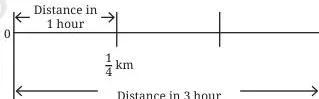
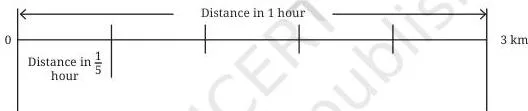
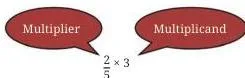
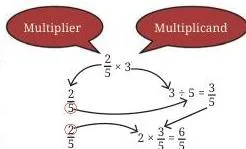
Stage 1 — a whole number times a fraction. Aaron’s tortoise walks \( \frac{1}{4} \) km in an hour (NCERT, p. 173). In 3 hours it covers \( 3 \times \frac{1}{4} = \frac{3}{4} \) km — three quarters of a kilometre (NCERT, p. 174). The rule that comes out of this: to multiply a fraction by a whole number, divide the whole number by the denominator, then multiply by the numerator.
For \( \frac{2}{5} \times 3 \): \( 3 \div 5 = \frac{3}{5} \), then \( \frac{3}{5} \times 2 = \frac{6}{5} \) (NCERT, p. 175).
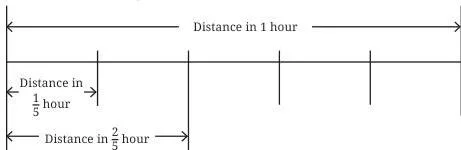
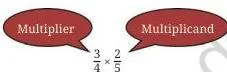
Stage 2 — a fraction times a fraction. The tortoise now walks \( \frac{2}{5} \) km in an hour; how far in \( \frac{3}{4} \) of an hour? The product \( \frac{3}{4} \times \frac{2}{5} = \frac{3}{10} \) is found by counting shaded cells in a grid — the unit-square figures in the walkthrough below show the same idea (NCERT, pp. 177–178).
Stage 3 — the general formula. Once several products are on the board, the chapter states the rule in symbols (NCERT, p. 182):
\[ \frac{a}{b} \times \frac{c}{d} = \frac{a \times c}{b \times d} \]
Here \( a \) and \( c \) are the numerators (top numbers) and \( b \) and \( d \) are the denominators (bottom numbers): multiply the tops, multiply the bottoms. The book records that this general form was first written by Brahmagupta in the Brāhmasphuṭasiddhānta in 628 CE (NCERT, p. 182).
The same formula appears in the chapter’s SUMMARY, so it is part of what the book expects you to carry.
Three shortcuts complete the multiplication toolkit:
- Write whole numbers as fractions with denominator 1: \( 3 \times \frac{3}{4} = \frac{3}{1} \times \frac{3}{4} = \frac{9}{4} \) (NCERT, p. 182).
- Cancel common factors before multiplying: \( \frac{12}{7} \times \frac{5}{24} = \frac{1 \times 5}{7 \times 2} = \frac{5}{14} \) (NCERT, pp. 182–183). Dividing a numerator and a denominator by a common factor leaves the fraction unchanged, so you may simplify at the end instead — cancelling first just keeps the numbers small.
- The order does not matter: \( \frac{a}{b} \times \frac{c}{d} = \frac{c}{d} \times \frac{a}{b} \) (NCERT, p. 186). For unit fractions the product is even simpler: \( \frac{1}{b} \times \frac{1}{d} = \frac{1}{b \times d} \) (NCERT, p. 181).
Is the product always bigger? No. The chapter asks this directly on page 184: \( 3 \times 5 = 15 \) is bigger than both factors, but \( \frac{1}{4} \times 8 = 2 \) sits between its factors, and \( \frac{3}{4} \times \frac{2}{5} = \frac{3}{10} \) is smaller than both.
The rule, printed in the book’s own SUMMARY: if one factor is between 0 and 1, the product is less than the other number; if one factor is greater than 1, the product is greater than the other number. The full comparison table is in the common-mistakes section below.
Key concepts: division of fractions
Division of fractions is the rule students forget most, because it is multiplication in disguise. The chapter never hands you the reciprocal rule cold — it shows why the rule is forced by the meaning of division.
The core trick: every division can be rewritten as a multiplication with a missing number. \( 3 \div \frac{2}{3} \) means “what must \( \frac{2}{3} \) be multiplied by to give 3?” Write it as \( \frac{2}{3} \times ? = 3 \) (NCERT, p. 187).
To get 1 from \( \frac{2}{3} \), multiply by \( \frac{3}{2} \) — the fraction with numerator and denominator swapped. Then multiply that by 3 to reach 3:
\[ 3 \div \frac{2}{3} = \frac{3}{2} \times 3 = \frac{9}{2} \]
That swapped fraction has a name: the reciprocal. The reciprocal of \( \frac{3}{5} \) is \( \frac{5}{3} \), and any fraction times its reciprocal is 1: \( \frac{3}{5} \times \frac{5}{3} = 1 \) (NCERT, p. 188).
The general rule follows (NCERT, p. 189):
\[ \frac{a}{b} \div \frac{c}{d} = \frac{a}{b} \times \frac{d}{c} = \frac{a \times d}{b \times c} \]
In words: keep the dividend, flip the divisor, multiply. In \( \frac{2}{3} \div \frac{3}{5} \), the dividend is \( \frac{2}{3} \), the divisor is \( \frac{3}{5} \), and the quotient is \( \frac{10}{9} \) (NCERT, p. 188):
\[ \frac{2}{3} \div \frac{3}{5} = \frac{2}{3} \times \frac{5}{3} = \frac{10}{9} \]
Does division always give a smaller answer? Again, no — the chapter makes the point with \( 6 \div \frac{1}{4} = 24 \) (NCERT, p. 189). Dividing by a number between 0 and 1 makes the quotient greater than the dividend, because you are asking “how many quarters fit in 6?”. Dividing by a number greater than 1 makes the quotient smaller, as in \( 6 \div 3 = 2 \).
Because both the multiplication and division formulas are named for Brahmagupta and both are recorded in SUMMARY (NCERT, p. 198), these are the two results the book itself treats as the chapter’s core.
Word problems that mix the operations
The final section shows where the two operations actually appear: sharing, measuring, filling, and comparing. The skill being tested is recognising which operation a question needs — do not start computing until you have decided that.
| Pattern in the question | Operation | Chapter example |
|---|---|---|
| Sharing a total equally | Division | 5 litres of oil shared by 3 families: \( 5 \div 3 = \frac{5}{3} \) litres each (NCERT, p. 176) |
| A fraction of a quantity | Multiplication | Tap filling \( \frac{7}{10} \) of a tank per hour, open for \( \frac{3}{4} \) hour: \( \frac{7}{10} \times \frac{3}{4} = \frac{21}{40} \) of the tank (NCERT, p. 183) |
| Which fraction of two weights is heavier | Compute both, then compare | \( \frac{12}{15} \times 500 \) g = 400 g vs \( \frac{3}{20} \times 4000 \) g = 600 g (NCERT, p. 184) |
The chapter’s flagship division problem is Example 5, the cistern (NCERT, p. 191). Four fountains can fill a cistern in \( 1 \), \( \frac{1}{2} \), \( \frac{1}{4} \) and \( \frac{1}{5} \) of a day. Each “times per day” is a division: \( 1 \div 1 = 1 \), \( 1 \div \frac{1}{2} = 2 \), \( 1 \div \frac{1}{4} = 4 \), \( 1 \div \frac{1}{5} = 5 \). Working together they fill it \( 1 + 2 + 4 + 5 = 12 \) times in a day, so one fill takes \( \frac{1}{12} \) of a day.
Notice how every sub-answer is a quotient, and the divisor being less than 1 is why each quotient is bigger than 1.
The most playful problem is Bhāskara II’s “Dramma-tic Donation” from the Līlāvatī (NCERT, pp. 193–194): six fractions of a dramma multiplied together — \( \frac{1}{2} \times \frac{2}{3} \times \frac{3}{4} \times \frac{1}{5} \times \frac{1}{16} \times \frac{1}{4} = \frac{6}{7680} = \frac{1}{1280} \). Since a dramma was worth 1280 cowrie shells, the miser gave exactly one cowrie.
It is a pure fraction-of-a-fraction multiplication and a fine cancellation drill: consecutive numerators and denominators keep cancelling.
Figure walkthrough: what the unit-square pictures are doing
The unit square is the chapter’s core picture: a \( 1 \times 1 \) square stands for the whole, and any fraction is a piece of that square. A fraction product is then a rectangle or a grid of shaded cells inside it — this is how the book shows you why the formula works before stating it.

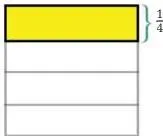
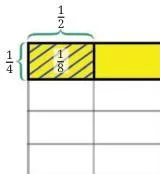
This is the starting diagram for fraction times fraction (NCERT, p. 177). The whole square is 1; the shaded strip is \( \frac{1}{4} \) of it. To find \( \frac{1}{2} \times \frac{1}{4} \), the book halves that strip — dividing the \( \frac{1}{4} \) into 2 equal parts. The square now has 8 equal parts and one is shaded, so \( \frac{1}{2} \times \frac{1}{4} = \frac{1}{8} \).
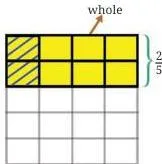
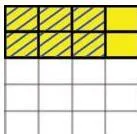
Fig. 8.1 shows the middle step of \( \frac{3}{4} \times \frac{2}{5} \) (NCERT, p. 178). The whole is divided into 5 rows and 4 columns — \( 5 \times 4 = 20 \) equal parts — and 2 cells are shaded, so one quarter of \( \frac{2}{5} \) is \( \frac{2}{20} \). Multiplying by 3 gives \( \frac{6}{20} = \frac{3}{10} \). Count shaded cells over total cells and you have the product.
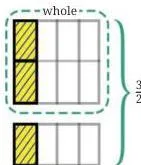
Fig. 8.2 handles \( \frac{5}{4} \times \frac{3}{2} \) (NCERT, p. 179). Because \( \frac{3}{2} \) is more than one, the picture needs more than one whole square. The grid shown has 2 rows and 4 columns — 8 equal parts — of which 3 are yellow: that is \( \frac{3}{8} \), one quarter of \( \frac{3}{2} \). Multiplying by 5 gives \( \frac{15}{8} \), a product bigger than 1.
This is the figure to remember when a product comes out larger than both factors.
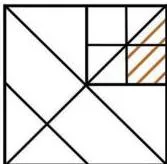
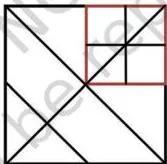
Fig. 8.4 is a fraction of a fraction (NCERT, p. 192). The top-right smaller square is \( \frac{1}{4} \) of the whole; the yellow triangle inside it is half of that, so \( \frac{1}{2} \times \frac{1}{4} = \frac{1}{8} \); and the shaded region is \( \frac{3}{4} \) of the triangle, so \( \frac{3}{4} \times \frac{1}{8} = \frac{3}{32} \).
Read it top-down: square → triangle → shaded corner, multiplying by \( \frac{1}{4} \), \( \frac{1}{2} \), then \( \frac{3}{4} \) at each step.
Definitions: the terms the chapter expects you to know
This glossary is for the night before: scan it once, and every worked example in the chapter becomes readable.
| Term | Meaning in plain words | Where it appears |
|---|---|---|
| Unit square | A \( 1 \times 1 \) square that stands for the “whole” in fraction pictures | page 177 |
| Numerator / denominator | Top and bottom of a fraction: in \( \frac{a}{b} \), \( a \) is the numerator and \( b \) the denominator | pages 177–182 |
| Reciprocal | The fraction you get by swapping numerator and denominator: \( \frac{3}{5} \) becomes \( \frac{5}{3} \) | page 188 |
| Dividend, divisor, quotient | In \( \frac{2}{3} \div \frac{3}{5} \): dividend \( \frac{2}{3} \), divisor \( \frac{3}{5} \), quotient \( \frac{10}{9} \) | pages 188–189 |
| Mixed fraction | A whole number plus a proper fraction, e.g. \( 1\frac{1}{4} \); convert to \( \frac{5}{4} \) before multiplying | page 176 |
| Apavartana | The old Indian name for reducing a fraction to its lowest terms | page 183 |
Worked examples with fresh numbers
The three examples below use numbers that are not in the textbook. Cover the solution, attempt each one, then compare your steps.
Example 1: area of a rectangle with mixed-number sides
Step 1: Convert the mixed numbers.
\( 3\frac{3}{4} = \frac{15}{4} \) and \( 2\frac{2}{3} = \frac{8}{3} \).
Step 2: Write the area as a product.
Area = length × breadth = \( \frac{15}{4} \times \frac{8}{3} \).
Step 3: Cancel common factors before multiplying.
15 and 3 share a factor of 3; 4 and 8 share a factor of 4:
\[ \frac{15}{4} \times \frac{8}{3} = \frac{5}{1} \times \frac{2}{1} = 10 \]
Final answer: the rectangle has area \( 10 \) square feet.
Example 2: distance a car covers on a fractional tank
Step 1: Convert the mixed number.
\( 2\frac{1}{2} = \frac{5}{2} \) litres.
Step 2: Multiply distance per litre by the number of litres.
Distance = \( \frac{5}{2} \times 14 \) km.
Step 3: Divide 14 by the denominator 2, then multiply by 5.
\[ \frac{5}{2} \times 14 = 5 \times 7 = 35 \]
Final answer: the car covers \( 35 \) km on \( 2\frac{1}{2} \) litres.
Example 3: division using the reciprocal rule
Step 1: Find the reciprocal of the divisor.
The divisor is \( \frac{5}{4} \), so its reciprocal is \( \frac{4}{5} \).
Step 2: Multiply the dividend by that reciprocal.
\( \frac{5}{2} \div \frac{5}{4} = \frac{5}{2} \times \frac{4}{5} \).
Step 3: Cancel common factors.
The 5s cancel, and \( 4 \div 2 = 2 \):
\[ \frac{5}{2} \times \frac{4}{5} = \frac{1 \times 4}{2 \times 1} = 2 \]
Final answer: \( \frac{5}{2} \div \frac{5}{4} = 2 \). Read as a word problem: a \( 2\frac{1}{2} \)-litre jug is filled by exactly 2 bottles of \( 1\frac{1}{4} \) litres each.
Common mistakes — and the fix from the chapter’s own rules
These five errors are the chapter’s characteristic ones, named before you make them. Each correction comes from the rule the book itself states.
| The mistake | Correct rule | How to check your answer | NCERT page |
|---|---|---|---|
| Flipping the wrong fraction in division — inverting the dividend instead of the divisor | Invert only the divisor: \( \frac{a}{b} \div \frac{c}{d} = \frac{a}{b} \times \frac{d}{c} \) | Multiply your answer by the divisor — you must get back the dividend | 189 |
| Believing multiplication always makes things bigger | A factor between 0 and 1 shrinks the product: \( \frac{3}{4} \times \frac{2}{5} = \frac{3}{10} \), and \( \frac{3}{10} \lt \frac{3}{4} \) | Ask: is any factor between 0 and 1? If yes, expect a smaller product | 184 |
| Multiplying a mixed number without converting it | Convert first: \( 1\frac{1}{4} = \frac{5}{4} \), then multiply | Check the conversion: whole part × denominator + numerator, over the denominator | 176 |
| Skipping cancellation and getting a huge fraction to simplify | Cancel common factors before multiplying: \( \frac{12}{7} \times \frac{5}{24} \) — 12 and 24 both divide by 12 | Before multiplying, scan each numerator against each denominator for a common factor | 182 |
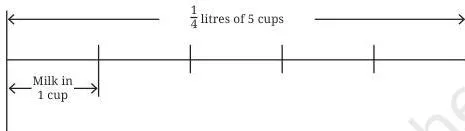
| Misreading the divisor in word problems | \( \frac{1}{4} \) kg makes 12 rotis, so 6 rotis take half the flour: \( \frac{1}{4} \times \frac{1}{2} = \frac{1}{8} \) kg | Ask: is the new quantity bigger or smaller than the original? Halve, do not multiply by 12 | 197 |
One reference table for both operations. The comparison rules mirror each other, so learn them together:
| Number you use | In multiplication, the product is… | In division, the quotient is… |
|---|---|---|
| Between 0 and 1 | less than the other number | greater than the dividend |
| Greater than 1 | greater than the other number | less than the dividend |
| Exactly 1 | equal to the other number | equal to the dividend |
Exam notes for this chapter
This is a skills chapter: what the book records in SUMMARY (page 198) is the list it expects you to carry — the two Brahmagupta formulas and the two comparison rules. Those are the chapter’s examinable core.
- Memorise both formulas in symbols and in words. Multiplication: multiply numerators and denominators. Division: multiply the dividend by the reciprocal of the divisor.
- Use the “Figure it Out” blocks as your practice set. They appear after the area-connection section (page 180), after simplifying (page 183), and as the chapter’s final block (pages 196–198). Working through them by section is the fastest complete revision.
- Practise the number-sense question type. The final block asks, without full computation, whether \( \frac{565}{465} \times \frac{707}{676} \) is greater or less than each factor (page 197). Both factors exceed 1, so the product is greater than both and greater than 1 — options (a), (c) and (e).
- The “A Pinch of History” boxes are reading, not exam data. Read them once for context; the formulas they quote are what matter.
- Textbook contents and the examinable syllabus are not always identical — check the current official CBSE syllabus.
- The closing chess puzzle (page 199) is enrichment, not a question source.
Revision summary — the chapter’s SUMMARY in our words
NCERT closes Chapter 8 with a SUMMARY (page 198). Here is every point it makes, restated so you can revise in five minutes:
- Multiplication formula: \( \frac{a}{b} \times \frac{c}{d} = \frac{a \times c}{b \times d} \).
- Cancel first: if numerators and denominators share common factors, cancel them before multiplying.
- Product rule: one factor between 0 and 1 makes the product less than the other number; one factor greater than 1 makes the product greater.
- Reciprocal: the reciprocal of \( \frac{a}{b} \) is \( \frac{b}{a} \), and \( \frac{a}{b} \times \frac{b}{a} = 1 \).
- Division formula: \( \frac{a}{b} \div \frac{c}{d} = \frac{a}{b} \times \frac{d}{c} = \frac{a \times d}{b \times c} \).
- Quotient rule: divisor between 0 and 1 makes the quotient greater than the dividend; divisor greater than 1 makes the quotient less.
- Two power facts the exercises lean on: unit fractions multiply as \( \frac{1}{b} \times \frac{1}{d} = \frac{1}{b \times d} \), and the telescoping product \( (1 – \frac{1}{2})(1 – \frac{1}{3}) \dots (1 – \frac{1}{n}) = \frac{1}{n} \).
Related resources
This listing is maintained for the 2026-27 academic session using the NCERT textbook information available to us. NCERT remains the authority for confirming the latest edition.
Chapter 8 sits inside the larger Ganita Prakash Class 7 Mathematics book — the full set of chapters is listed on our Class 7 Mathematics notes page. For all subjects of the class, start from the Class 7 hub, and for related Class 7 mathematics material, including Finding the Unknown Class 7 notes, the mathematics page is the index.
The official NCERT Class 7 Mathematics textbook page on ncert.nic.in hosts the chapter PDFs for the whole book.
Sources and data verification
- Page numbers and content describe the NCERT Class 7 Mathematics textbook Ganita Prakash, official edition, Chapter 8 “Working with Fractions”, which begins on page 172.
- This page covers only that NCERT textbook chapter — it does not cover CBSE syllabus documents or other publishers’ books.
- The listing is maintained for the current academic session using the NCERT edition available to us. Textbook contents and the examinable syllabus are not always identical — check the current official CBSE syllabus.
- NCERT settles textbooks, editions and PDFs; CBSE settles curriculum and examinations.
| What the chapter holds | Count | Where it is used |
|---|---|---|
| Printed pages | 39 | |
| Sections in the chapter | 3 | |
| Figures with NCERT captions | 23 | |
| Tables | 4 | |
| In-text questions | 46 | |
| Official NCERT PDF | Download the chapter PDF | the chapter exactly as NCERT publishes it |
Frequently asked questions
How do you multiply a whole number by a fraction?
Divide the whole number by the denominator, then multiply by the numerator. For \( \frac{2}{5} \times 3 \): \( 3 \div 5 = \frac{3}{5} \), then \( \frac{3}{5} \times 2 = \frac{6}{5} \) (NCERT, p. 175). Equivalently, \( n \times \frac{a}{b} = \frac{n \times a}{b} \).
Why does 1/2 × 1/4 equal 1/8 — what is the unit square doing?
The unit square is the whole. Shade \( \frac{1}{4} \) of it, then cut that quarter into 2 equal parts. The square now has 8 equal parts and 1 is shaded, so \( \frac{1}{2} \times \frac{1}{4} = \frac{1}{8} \) (NCERT, p. 177). The product is always the shaded fraction of the whole square.
What is the reciprocal of a fraction, and why does it matter for division?
The reciprocal swaps numerator and denominator: \( \frac{3}{5} \) becomes \( \frac{5}{3} \). A fraction times its reciprocal is 1: \( \frac{3}{5} \times \frac{5}{3} = 1 \) (NCERT, p. 188). Division uses it directly — you multiply the dividend by the reciprocal of the divisor.
Does multiplying fractions always give a smaller answer than the numbers you started with?
No. If a factor is between 0 and 1, the product is less than the other number; if a factor is greater than 1, the product is greater. \( \frac{3}{4} \times \frac{2}{5} = \frac{3}{10} \) is smaller than both factors, while \( \frac{5}{4} \times \frac{3}{2} = \frac{15}{8} \) is greater than both (NCERT, pp. 184–185).
How do you divide one fraction by another fraction?
Multiply the dividend by the reciprocal of the divisor: \( \frac{a}{b} \div \frac{c}{d} = \frac{a}{b} \times \frac{d}{c} \). Example: \( \frac{2}{3} \div \frac{3}{5} = \frac{2}{3} \times \frac{5}{3} = \frac{10}{9} \) (NCERT, p. 189).
How do you multiply or divide a mixed fraction like 2 3/4?
Convert it to an improper fraction first: \( 2\frac{3}{4} = \frac{2 \times 4 + 3}{4} = \frac{11}{4} \). Then multiply or divide normally. The chapter does exactly this in Example 2, converting \( 1\frac{1}{4} \) to \( \frac{5}{4} \) (NCERT, p. 176).
Reference: NCERT Class 7 Mathematics textbook, chapter 8, official edition on ncert.nic.in.
Explore Class 7 Mathematics Books
Related chapters: