
The official NCERT Class 7 Maths Chapter 1 — Geometric Twins opens the Ganita Prakash, Grade 7, Part-II textbook. The chapter runs 23 printed pages, and you can download the official PDF below.
The rest of this page walks through the chapter section by section: what congruence means, the five conditions that prove triangles congruent (SSS, SAS, ASA, AAS, RHS), the two conditions that fail, the key figures, and the mistakes students make.
Download the Official NCERT Chapter 1 PDF
The official chapter is published by NCERT inside the Ganita Prakash Grade 7 Part-II textbook and is hosted free on the NCERT textbook portal. Download the NCERT Class 7 Maths Chapter 1 Geometric Twins PDF to read or print the chapter exactly as it appears in the printed book.
Geometric Twins at a Glance: What the Chapter Holds
This chapter teaches congruence by discovery: every section starts with a practical problem and builds one result from it. The counts table on this page lists how much the chapter holds — sections, figures, questions and pages. This list shows where each idea lives:
- 1.1 Geometric Twins (p. 1) — the signboard symbol: what measurements recreate a figure exactly?
- Figure it Out (p. 3) — spotting congruent figures, circles and rectangles.
- 1.2 Congruence of Triangles (p. 4) — the search for conditions that force one unique triangle.
- Figure it Out (p. 8) — congruence notation and deciding from figures.
- Figure it Out (p. 13) — midpoints, parallel lines and equal parts.
- 1.3 Angles of Isosceles and Equilateral Triangles (p. 17) — congruence used to prove angle properties.
- Figure it Out (p. 20) — the chapter’s main question set.
- SUMMARY (p. 22) and the closing puzzle ‘Expression Engineer!’ (p. 23).
What This Chapter Covers: From a Signboard to Five Rules
The chapter opens with a problem: recreate the symbol on a signboard without tracing it (NCERT, p. 1). Tracing paper works for small figures, so the real question is which measurements fix a figure exactly.
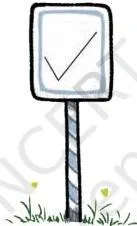
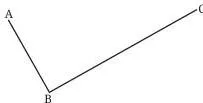
Two arm lengths alone are not enough (NCERT, p. 2). The same lengths AB = 4 cm and BC = 8 cm fit many symbols; the angle \( \angle ABC \) between them is what pins the shape.
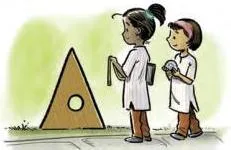
That same question is then asked of triangles. Meera and Rabia must copy a triangular frame too large to trace (NCERT, p. 4). Their experiments answer which triples of measurements leave no choice in the shape.
By the end, the chapter has found five conditions that guarantee congruence — SSS, SAS, ASA, AAS and RHS (NCERT, p. 17) — and two impostors given in the story: all three angles, and two sides with a non-included angle (NCERT, pp. 9–11). It then uses congruence itself to prove the isosceles base-angle property and the 60° angles of an equilateral triangle (NCERT, pp. 17–18).
The chapter’s own SUMMARY on page 22 collects every result the book wants you to keep.
Key Concepts: Congruence and Its Conditions, Explained
Congruence is the one big idea of the chapter: two figures are congruent when one can be placed exactly on top of the other. The chapter’s trick is to find small sets of measurements that guarantee this without ever tracing or cutting out figures.
What congruence means: exact copies that may be flipped or rotated
Two figures are congruent when they have the same shape and size and can be superimposed exactly, one over the other (NCERT, pp. 1–2). Superimposing means laying one figure on the other so they coincide fully.
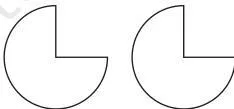
Students miss two things about this definition. First, rotation and flipping are allowed while checking congruence — a mirrored figure is still congruent (NCERT, p. 2). Second, measurements fix a figure only when they leave no choice, which the signboard example shows:
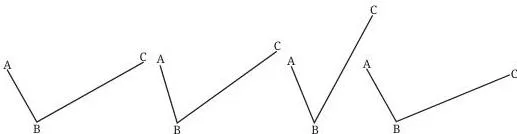
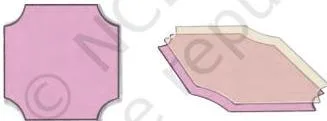
The arm lengths AB = 4 cm and BC = 8 cm leave the angle free, so many non-congruent symbols share them (NCERT, p. 2). Add the measure of \( \angle ABC \) and the shape is forced — that is why the two arms plus the angle recreate the symbol exactly.
SSS: three matching side lengths fix the triangle
Meera measures only the three sides of the triangular frame — 40 cm, 60 cm and 80 cm — and claims the angles are not needed (NCERT, p. 5). Rabia’s construction shows why. Draw one side, say 6 cm, then draw circles of radii 4 cm and 8 cm from its two ends. The circles meet in two points, giving two triangles \( \triangle ABE \) and \( \triangle ABF \).
Are these two triangles congruent? Yes: the base AB acts as a line of symmetry, so the two triangles are mirror images with the same size and shape (NCERT, p. 5). From this general construction: if two triangles have the same sidelengths, then they are congruent — the SSS (Side Side Side) condition.
Writing congruence: why the order of vertices matters
The statement \( \triangle ABC \cong \triangle XYZ \) is a claim about correspondence, not just about sameness (NCERT, p. 6). By convention, first vertex matches first, second matches second, third matches third: A↔X, B↔Y, C↔Z.
The order exists so that equal sides overlap when the triangles are placed on each other, and it immediately gives the equal angles: \( \angle A = \angle X \), \( \angle B = \angle Y \), \( \angle C = \angle Z \).
So for these triangles, writing \( \triangle ACB \cong \triangle XYZ \) is incorrect, while \( \triangle ACB \cong \triangle XZY \) is correct (NCERT, p. 7). In the rectangle example (Fig. 1.1, p. 7), the triangles ΔABD and ΔCDB share side BD, with AB = CD and AD = CB.
The tempting guess A↔C, B↔B, D↔D fails because it lays AB over CB; the correct match is A↔C, B↔D, D↔B, giving \( \triangle ABD \cong \triangle CDB \).
SAS: two sides and the angle between them
The first side-angle test uses the included angle — the angle sitting between the two measured sides. The book’s case is AB = XY = 6 cm, AC = XZ = 5 cm and \( \angle A = \angle X = 30^\circ \) (NCERT, p. 10). Every construction comes out as the same triangle, so this is a valid condition: SAS (Side Angle Side).
The word “included” is the whole section — it is what separates SAS from the failed condition next.
SSA: the condition that looks right and fails
Now move the angle out of the middle: AB = XY = 6 cm, AC = XZ = 4 cm and \( \angle B = \angle Y = 30^\circ \) (NCERT, p. 10). The given angle is at B, so it is not between the two measured sides. This is the SSA (Side Side Angle) set-up — and it does not guarantee congruence.
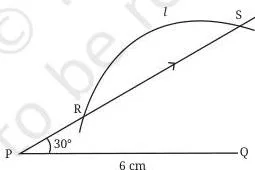
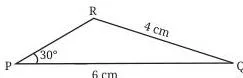
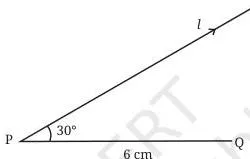
The construction explains why (NCERT, pp. 10–11). Draw PQ = 6 cm. From P, draw a ray making 30° with PQ. Now from Q, draw an arc of radius 4 cm: it cuts the ray at two points, R and S. Both \( \triangle PQR \) and \( \triangle PQS \) match the given measurements, yet they are different triangles. Same data, two shapes — so SSA is not enough.
ASA, and the angle-sum trick that turns AAS into ASA
Angles can also pin a triangle. When two angles and the side between them are equal — the book uses BC = YZ = 5 cm, \( \angle B = \angle Y = 50^\circ \), \( \angle C = \angle Z = 30^\circ \) (NCERT, p. 12) — the two rays from the ends of the side meet at exactly one point, so the triangle is forced. That is ASA (Angle Side Angle).
What if the matching side is not between the two given angles? The book’s case: \( \angle A = \angle X = 35^\circ \), \( \angle C = \angle Z = 75^\circ \), BC = YZ = 4 cm (NCERT, p. 14). The trick is to find the missing angle first using the angle-sum rule: \( \angle B = 180^\circ – 35^\circ – 75^\circ = 70^\circ \), and the same gives \( \angle Y = 70^\circ \).
The triangles now satisfy the ASA template with \( \angle B = \angle Y \), BC = YZ and \( \angle C = \angle Z \) (NCERT, p. 15). This is the AAS (Angle Angle Side) condition. It works because the third angle is forced — AAS quietly becomes ASA.
RHS: the right triangle special case
A right triangle has one special side: the hypotenuse, the side opposite the right angle (NCERT, p. 16). The book’s case: BC = YZ = 4 cm, right angle at B and Y, and hypotenuse AC = XZ = 5 cm.
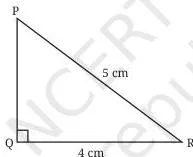
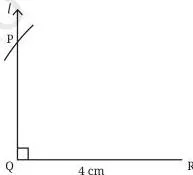
The construction shows why this holds (NCERT, p. 16). Draw the leg QR = 4 cm, erect a perpendicular at Q, then cut an arc of radius 5 cm from R. The arc meets the perpendicular in exactly one point above the base, and the matching triangle below the base is its mirror image, so it is congruent.
The right angle is a known fixed angle, which is why this special SSA-type case works. This is RHS (Right angle, Hypotenuse, Side).
The chapter returns to RHS later to prove the isosceles property (NCERT, p. 18). The figure walkthrough below reads that proof step by step.
The five conditions that guarantee congruence
NCERT collects the results on page 17: five conditions are sufficient, and each needs exactly three matched parts. The two impostors are all three angles (AAA, NCERT, p. 9) and two sides with a non-included angle (SSA, NCERT, pp. 10–11).
| Condition | Three matched parts it needs | Guarantees congruence? |
|---|---|---|
| SSS | All three side lengths | Yes |
| SAS | Two sides and the included angle | Yes |
| ASA | Two angles and the included side | Yes |
| AAS | Two angles and a non-included side — compute the third angle, then apply ASA | Yes |
| RHS | Right angle, hypotenuse and one more side (right triangles only) | Yes |
Memory hooks: “SAS cannot be SSA — the angle must sit between the sides”, and “AAS becomes ASA once you find the third angle.” For AAA, remember that shape is not size: two triangles can share all three angles yet differ in size as much as a stamp and a poster.
Worked Examples: Choosing the Right Condition
Every problem in this chapter reduces to one first question: is the matching angle (or side) included between the two matched parts? Answer that before naming any condition.
Example 1: SAS works when the angle is included
Given: \( \triangle ABC \) and \( \triangle DEF \) with AB = DE = 7 cm, BC = EF = 6 cm and \( \angle B = \angle E = 45^\circ \).
Step 1 — check inclusion: \( \angle B \) lies between AB and BC, and \( \angle E \) lies between DE and EF.
The equal angle is included between the two equal sides.
Step 2 — name the condition: SAS applies.
\[ \triangle ABC \cong \triangle DEF \quad (\text{SAS}) \]
Final answer: \( \triangle ABC \cong \triangle DEF \) by SAS, with A↔D, B↔E, C↔F.
Example 2: the same sides fail when the angle is not included
Given: AB = DE = 7 cm, BC = EF = 6 cm, but now \( \angle A = \angle D = 45^\circ \) instead.
Step 1 — check inclusion: \( \angle A \) is the angle between AB and AC — not between AB and BC, the two sides in the data.
The angle is non-included.
Step 2 — name the set-up: this is SSA, two sides and a non-included angle.
Step 3 — decide: the construction on NCERT page 11 can produce two different triangles from this data, so congruence cannot be concluded.
Final answer: Not enough information — SSA does not guarantee congruence.
Example 3: AAS becomes ASA through the angle sum
Given: \( \angle A = \angle D = 40^\circ \), \( \angle C = \angle F = 60^\circ \), and BC = EF = 5 cm.
The given side is opposite \( \angle A \), not between the two given angles.
Step 1 — find the third angle: the angles of a triangle add to 180°, so \( \angle B = 180^\circ – 40^\circ – 60^\circ = 80^\circ \).
The same sum gives \( \angle E = 80^\circ \).
Step 2 — re-read the data as ASA: now \( \angle B = \angle E = 80^\circ \), BC = EF = 5 cm and \( \angle C = \angle F = 60^\circ \) — two angles with the side BC/EF included between them.
\[ \triangle ABC \cong \triangle DEF \quad (\text{ASA after the angle-sum trick}) \]
Final answer: \( \triangle ABC \cong \triangle DEF \), with A↔D, B↔E, C↔F.
NCERT’s own Question 2 on page 20 tests exactly this skill in five sub-cases, (a)–(e); the questions section below maps each one to its condition.
Reading the Figures in the Chapter, Step by Step
The chapter’s diagrams are the argument, not decoration. This tour goes through them in the order they appear and says what to look for in each. The construction figures shown in the key concepts sections above are read again here, line by line.
- The signboard symbol (p. 1). Shown above in “What This Chapter Covers”. Notice the symbol has two straight arms meeting at a corner — arm lengths alone leave the angle free, which is exactly the problem section 1.1 sets up.
- AB = 4 cm, BC = 8 cm (p. 2). Shown in the congruence section. The point is that the same two lengths appear in several different symbols; the angle is the missing measurement.
- The three-measurement figure (p. 2). AB, BC and \( \angle ABC \) together fix the symbol — the first hint that three measurements can force one unique figure.
- Two congruent figures (p. 2). Trace one and lay it on the other: they coincide exactly. The figure invites you to test the superimposition idea, with rotation and flipping allowed.
- Meera and Rabia with the triangular frame (p. 4). The frame is too large to trace — the practical reason the chapter needs measurement-based conditions.
- SSA construction, step 3 (p. 11). The most important picture in the chapter, shown in the SSA section above. Read it slowly: the ray from P makes the given 30°, and the arc from Q has the given radius 4 cm. The arc crosses the ray twice, at R and S. Two different triangles satisfy the same data — that is the whole proof that SSA fails.
- RHS rough diagram (p. 16). Shown in the RHS section above. Note the perpendicular from Q is drawn first, and the hypotenuse arc (radius 5 cm) comes from R. The arc has only one meeting point above the base, and the mirror image below is congruent — so RHS holds.
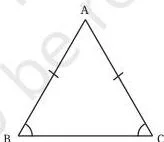
- AD, the common side (p. 18). Here is the isosceles proof in four lines. In \( \triangle ABC \), AB = AC and AD is the altitude to BC:
- AB = AC (given)
- \( \angle ADB = \angle ADC = 90^\circ \) (construction)
- AD is common to \( \triangle ADB \) and \( \triangle ADC \)
- RHS gives \( \triangle ADB \cong \triangle ADC \), so \( \angle B = \angle C \) as corresponding parts.
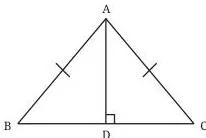
That proves the property: angles opposite to equal sides are equal (NCERT, pp. 17–18).
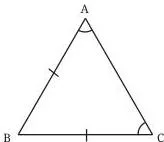
- AB = AC (p. 18). For an equilateral triangle, repeat the argument: AB = AC gives \( \angle B = \angle C \), and AB = BC gives \( \angle A = \angle C \). All three angles are equal, and since they sum to 180°, each is \( 60^\circ \) (NCERT, p. 18). This figure shows the starting condition for that argument.
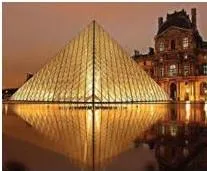
- Congruent triangles in real life (p. 19). The collage shows the Louvre pyramid, the Pyramid of Giza, a dome, a rangoli and the Howrah Bridge — structures built from repeating congruent triangular panels. It is the chapter’s closing motivation for why congruence matters outside the classroom.
Definitions: The Terms You Must Know
Every term this chapter introduces, with the NCERT page where it is defined — written for a fast lookup while solving questions.
| Term | Meaning | NCERT page |
|---|---|---|
| Congruent figures | Figures with the same shape and size that can be superimposed exactly | p. 1–2 |
| Superimposition | Placing one figure exactly over another so they coincide | p. 2 |
| SSS condition | Two triangles with all three side lengths equal are congruent | p. 5 |
| Corresponding vertices, sides, angles | The parts of two congruent triangles that fit exactly over each other | p. 6 |
| Congruence statement | Writing \( \triangle ABC \cong \triangle XYZ \) so first, second and third vertices correspond in order | p. 6–7 |
| SAS condition | Two sides and the included angle equal ⇒ congruent | p. 10 |
| SSA condition | Two sides and a non-included angle equal; does not guarantee congruence | p. 10–11 |
| ASA condition | Two angles and the included side equal ⇒ congruent | p. 12 |
| AAS condition | Two angles and a non-included side equal ⇒ congruent, after finding the third angle | p. 14–15 |
| Hypotenuse | The side opposite the right angle in a right triangle | p. 16 |
| RHS condition | Right angle, hypotenuse and one more side equal ⇒ congruent | p. 16 |
| Isosceles triangle | A triangle with two equal sides | p. 17 |
| Equilateral triangle | A triangle with all three sides equal | p. 18 |
| Angles opposite equal sides | In a triangle, the angles facing two equal sides are themselves equal | p. 17–18 |
Common Mistakes in Geometric Twins and How to Avoid Them
The errors below are the ones this chapter’s own examples are designed to catch — read them before you attempt the Figure it Out sets.
| Mistake | Correct rule | How to check your answer |
|---|---|---|
| Using SSA as if it were SAS | The equal angle must be included between the equal sides (NCERT, pp. 10–11) | Re-check which angle the data names; mark it on a rough figure before deciding |
| Believing three equal angles prove congruence | AAA gives the same shape but any size — not congruent (NCERT, p. 9) | Ask: could two triangles of different sizes share these angles? If yes, congruence fails |
| Writing congruence in the wrong vertex order | The order names the correspondence — \( \triangle ACB \cong \triangle XYZ \) is wrong for the book’s pair (NCERT, p. 7) | List the vertex pairs (A↔X, B↔Y, C↔Z) before you write the statement |
| Calling a flipped or rotated figure non-congruent | Rotation and flipping are allowed before superimposing (NCERT, p. 2) | Try tracing the figure and turning it over before deciding |
| Confusing the hypotenuse | The hypotenuse is opposite the right angle; RHS applies only to right triangles (NCERT, p. 16) | Mark the right angle first — the hypotenuse faces it |
| Picking the wrong equal angles in an isosceles triangle | With AB = AC, the equal angles are \( \angle B \) and \( \angle C \), opposite the equal sides (NCERT, pp. 17–18) | The unequal angle is the one where the equal sides meet |
What the Chapter’s Questions Train You To Do
These are the question patterns inside the chapter itself — a map of the skills the Figure it Out sets build, not an exam forecast.
- Spotting congruence by eye and choosing measurements (p. 3, Questions 1–4). The first questions ask what to measure. The answers this chapter builds towards: for a circle, its radius; for a rectangle, its length and breadth. Question 4 introduces the pair-checking figure below.
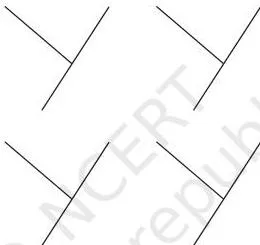
Read Question 4’s figure as a practice board: each row holds a pair of shapes, and the task is to decide congruence by checking whether one can be superimposed on the other, rotating or flipping if needed.
- Congruence notation (p. 8, Question 1). If \( \triangle HEN \cong \triangle BIG \), the pairing is H↔B, E↔I, N↔G, and there are six correct ways to write it: \( \triangle HEN \cong \triangle BIG \), \( \triangle HNE \cong \triangle BGI \), \( \triangle EHN \cong \triangle IBG \), \( \triangle ENH \cong \triangle IGB \), \( \triangle NEH \cong \triangle GBI \) and \( \triangle NHE \cong \triangle GIB \).
- Deciding congruence from figures and giving the reason (p. 8, Questions 2–4; p. 13, Questions 1–2; p. 20, Question 2). The p. 13 pair uses parallel lines: when AB and CD are parallel, alternate angles are equal, which supplies the missing angle pair. Question 2’s five sub-cases are a condition-identification drill:
| Case | Matched parts | Condition to use | Congruent? |
|---|---|---|---|
| (a) | \( AB = DE \), \( BC = EF \), \( CA = DF \) | SSS | Yes |
| (b) | \( AB = EF \), \( \angle A = \angle E \), \( AC = ED \) | SAS (angle included between the two sides) | Yes |
| (c) | \( AB = DF \), \( \angle B = \angle D = 90^\circ \), \( AC = FE \) | RHS (hypotenuse AC = FE, leg AB = DF) | Yes |
| (d) | \( \angle A = \angle D \), \( \angle B = \angle E \), \( AC = DF \) | AAS (side AC is not between the two given angles) | Yes |
| (e) | \( AB = DF \), \( \angle B = \angle F \), \( AC = DE \) | SSA — non-included angle | Not guaranteed |
- Using congruence to prove statements (p. 13, Questions 3–4; p. 20, Questions 3–4). Question 3 on p. 20 uses midpoints: OB = OC and OA = OD, with \( \angle AOB = \angle DOC \) as vertically opposite angles, gives \( \triangle AOB \cong \triangle DOC \) by SAS. Then \( \angle OAB = \angle ODC \) are equal alternate angles with AD as transversal, so AB is parallel to CD. The square question asks you to show \( \triangle ABC \cong \triangle ADC \), then to find pairs that can be matched in two — or even six — different ways.
- Isosceles and equilateral angle properties (p. 21, Questions 5–6). These use the tick convention: sides marked with one ‘|’ are equal, sides marked with ‘||’ are equal to each other, and so on. Read the ticks first — they tell you which angles are equal before you compute.
Note: textbook contents and the examinable syllabus are not always identical — check the current official syllabus for what is examinable this session.
One-Page Revision Summary of Geometric Twins
NCERT closes the chapter with its SUMMARY (p. 22). Here is every result in plain words:
- Congruent figures have the same shape and size; one superimposes on the other, with rotation or flipping allowed.
- SSS: three equal side lengths ⇒ congruent.
- SAS: two equal sides with the included angle equal ⇒ congruent.
- ASA: two equal angles with the included side equal ⇒ congruent.
- AAS: two equal angles with a non-included side equal ⇒ congruent — compute the third angle, then use ASA.
- Hypotenuse: the side opposite the right angle.
- RHS: a side and the hypotenuse equal in two right triangles ⇒ congruent.
- SSA: two sides and a non-included angle equal does not guarantee congruence.
- Angles opposite equal sides are equal.
- Equilateral triangle: all three angles are \( 60^\circ \).
Test yourself with the closing puzzle, ‘Expression Engineer!’ (p. 23): draw lines to split the region of white squares into 6 smaller congruent regions. If you can visualise six identical pieces filling the region, the congruence eye this chapter builds is working.
Related Resources for Class 7 Maths
This listing is maintained for the 2026-27 academic session using the NCERT textbook information available to us. NCERT remains the authority for confirming the latest edition.
This page covers only Chapter 1 of Ganita Prakash, Part-II. For the rest of the book and the earlier part:
- NCERT Class 7 Maths book — Ganita Prakash Part-I and Part-II
- NCERT Class 7 Maths Chapter 2 — Arithmetic Expressions
- All NCERT Class 7 books by subject
- CBSE notes for every class
Sources and Data Verification
- The chapter details, section structure, page references and figure captions on this page describe the NCERT Ganita Prakash, Grade 7, Part-II (Mathematics) textbook, Chapter 1 ‘Geometric Twins’, official edition on ncert.nic.in.
- This page covers Chapter 1 only; the rest of Part-II and all of Part-I live on their own pages.
- This listing is maintained for the current academic session using the NCERT information available to us.
- NCERT settles textbooks, editions and PDFs; CBSE settles the curriculum and examinations. Textbook contents and the examinable syllabus are not always identical, so the current official syllabus is the final check.
| What the chapter holds | Count | Where it is used |
|---|---|---|
| Printed pages | 23 | |
| Sections in the chapter | 3 | |
| Figures with NCERT captions | 18 | |
| In-text questions | 18 | |
| Official NCERT PDF | Download the chapter PDF | the chapter exactly as NCERT publishes it |
Reference: NCERT Class 7 Mathematics textbook (Ganita Prakash Part-II), Chapter 1, official edition on ncert.nic.in.
Frequently Asked Questions
Why is SSA not a valid congruence condition even though it looks like SAS?
Because the angle is not in the same position. In SAS the equal angle sits between the two equal sides, so the third side is forced.
In SSA the equal angle is outside the pair of sides, and the given side can reach the opposite ray in two places — the construction on NCERT page 11 produces two different triangles, \( \triangle PQR \) and \( \triangle PQS \), from identical data. Same two sides and the same angle, two shapes: that is why SSA cannot be used.
Why do three equal angles not make two triangles congruent?
Three equal angles fix the shape but not the size. The chapter draws many 30°–70°–80° triangles of different sizes (NCERT, p. 9); they have the same shape but are not congruent. Congruence requires equal size too, which is why at least one side must also match.
What is the difference between ASA and AAS?
ASA is two angles with the side between them; AAS is two angles with a side that is not between them. In AAS, first find the third angle using the 180° angle-sum rule — then the data becomes ASA, exactly as the book does on pages 14–15. Both conditions guarantee congruence.
How do I write a congruence statement in the correct order?
Write the vertices so the order names the correspondence: the first vertex of the first triangle pairs with the first vertex of the second, and so on. If \( \triangle ABC \cong \triangle XYZ \), then A↔X, B↔Y, C↔Z.
NCERT’s check on page 7: \( \triangle ACB \cong \triangle XYZ \) is wrong for these triangles, but \( \triangle ACB \cong \triangle XZY \) is correct.
Are two triangles congruent if one is flipped or rotated?
Yes. Congruence is checked after rotating or flipping a figure — the chapter says so explicitly on page 2. A mirror image and a rotated copy still have the same shape and size, so they superimpose exactly once you move them.
What measurements do I need to check whether two circles or two rectangles are congruent?
For a circle, its radius; for a rectangle, its length and breadth (from the Figure it Out set on NCERT page 3). With those fixed, the figure is forced — the same thinking that drives all the triangle conditions in the chapter.
Reference: NCERT Class 7 Mathematics textbook (Ganita Prakash Part-II), Chapter 1, official edition on ncert.nic.in.
Explore Class 7 Mathematics Books
- Previous: Working with Fractions
- Next: Operations with Integers
Related chapters: