
This is the NCERT 2 Arithmetic Expressions Class 7 chapter — Chapter 2 of Ganita Prakash, the Class 7 Mathematics textbook, running about 20 printed pages from simple expressions like \(13 + 2\) to the distributive property. The official NCERT PDF is right below, and under it this page explains every idea in the chapter in plain language, so you can read the chapter once and understand it.
Keep the file open as you scroll: each section below matches a part of the book.
Download the 2 Arithmetic Expressions Class 7 NCERT PDF
Get the chapter file before anything else — the explanation below is meant to be read with the PDF open. NCERT publishes the whole Ganita Prakash book on its official portal, and Chapter 2 is inside that book.
Open the official NCERT textbook portal to download the NCERT Class 7 Maths Chapter 2 Arithmetic Expressions PDF (official) — the same free file your school follows, published by NCERT itself.
Chapter 2 at a Glance
The table below lists how much the chapter holds — its sections, figures, worked examples and question sets — so you can see the whole file at a glance before reading on.
What This Chapter Covers: From Simple Expressions to the Distributive Property
This is a reading map. It tells you where each idea appears and why the chapter moves from one idea to the next, so you are never lost in the order of the book.
- Section 2.1 (Simple Expressions): revises what an arithmetic expression is, what its value is, and how to compare two expressions by reasoning instead of calculating.
- Section 2.2 (Reading and Evaluating Complex Expressions): introduces brackets and terms, then builds through swapping and grouping, real-life expressions, removing brackets (two parts), Tinker the Terms (two parts), and the distributive property.
- Closing pages: a SUMMARY of the whole chapter followed by four number puzzles.
Why this order: a simple expression like \(13 + 2\) is unambiguous. Once expressions mix operations — as in \(30 + 5 \times 4\) — a second reader can get a different answer. Brackets and terms are the tools that remove that ambiguity, and the commutative, associative and distributive properties then let you rearrange expressions for speed. Each section exists to fix the confusion left by the previous one.
What Is an Arithmetic Expression and What Is Its Value?
This is the chapter’s starting definition. Everything later — terms, brackets, properties — is really about reading expressions like these correctly.
An arithmetic expression is a mathematical phrase made of numbers and operations: \(13 + 2\), \(20 – 4\), \(12 \times 5\) and \(18 \div 3\) are all expressions. Its value is the single number it evaluates to. The equals sign is the link between the two:
\[13 + 2 = 15\]
This says the expression \(13 + 2\) has the value 15. The chapter notes you can read it either as “13 plus 2” or as “the sum of 13 and 2” — both readings describe the same phrase.
Two different-looking expressions can share one value. The chapter shows \(10 + 2\), \(15 – 3\), \(3 \times 4\) and \(24 \div 2\) all equal 12 (NCERT, Section 2.1). Its first worked example makes the point with money: Mallika spends ₹25 a day on lunch for five school days, written as \(5 \times 25\) — choosing the right expression matters as much as computing it.
Comparing Expressions by Reasoning Instead of Calculating
Section 2.1’s real skill is comparison: deciding which expression is bigger without evaluating both. The trick is to compare the starting amounts and the changes separately.
The chapter does this with two friends, Raja and Joy. For \(1023 + 125\) versus \(1022 + 128\): Raja starts with 1 more marble, but Joy gains 3 more, so Joy ends 2 ahead, and \(1023 + 125 \lt 1022 + 128\). For \(113 – 25\) versus \(112 – 24\): Raja starts 1 ahead but also loses 1 more, so the extra loss cancels the head start — \(113 – 25 = 112 – 24\). Neither comparison needs the four actual sums.
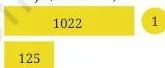
Read the first picture as Raja’s situation: his starting marbles plus the new gain. The picture makes the two parts of the comparison visible — what he began with and what happened today.
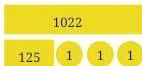
Set the two pictures side by side and the reasoning appears: the starting amounts differ by 1 and the gains differ by 3, so the second child nets 2 more. That is the shortcut — picture the situation, compare the parts, skip the full arithmetic.
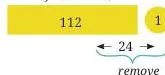
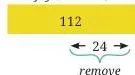
These two pictures tell the subtraction story: Raja’s head start of 1 is exactly eaten up by losing 1 more marble, so both children end equal. Drawing the situation rather than diving into arithmetic is the habit these pictures train.
Here is the same method on new numbers:
Step 1: Compare the starting amounts.
\(236 + 18\) starts from 236; \(235 + 20\) starts from 235.
The first starts 1 ahead.
Step 2: Compare the gains.
The first gains 18; the second gains 20.
The first gains 2 less.
Step 3: Combine the two differences.
Ahead by 1 but short by 2 on the gain means the first ends 1 behind.
\[236 + 18 = 254 \quad \text{and} \quad 235 + 20 = 255\]
Conclusion: \(236 + 18 \lt 235 + 20\), found by comparing amounts and gains, not by full addition.
Why 30 + 5 × 4 Needs Brackets
This section introduces the chapter’s central problem: some expressions can be read in two ways, and brackets are the punctuation that fixes the reading.
Language comes first. Without a comma, “Shalini sat next to a friend with toys” can mean the friend has the toys; with a comma — “Shalini sat next to a friend, with toys” — Shalini has them. A comma changes who owns the toys. Brackets do the same job for expressions.

The picture shows the two readings of the same sentence. The expression \(30 + 5 \times 4\) has the same problem: two readers get two values. Purna, adding 30 and 5 first, gets 140; Mallesh, multiplying first, gets 50. The situation — 30 marbles plus 5 bags of 4 marbles — says Mallesh’s 50 is right, but the bare expression does not say so.
Writing \(30 + (5 \times 4)\) makes the intended order visible: evaluate \(5 \times 4\) first, then add.
The shopkeeper example shows the same trouble in money. Irfan buys a ₹15 biscuit packet and a ₹56 packet of toor dal, and gives ₹100. Writing the change as \(100 – 15 + 56\) produces 141 — more than he handed over, which is absurd. The correct expression is \(100 – (15 + 56) = 100 – 71 = 29\), the real change. Brackets fix meaning exactly as a comma fixes a sentence.
Terms: Reading Every Expression as a Sum
Brackets are one tool; terms are the other. This section gives you a habit that makes every later expression easy: read every expression as a sum of terms.
A term is a part of an expression separated by a ‘+’ sign. In \(12 + 7\), the terms are 12 and 7. The chapter’s method for finding terms:
- Rewrite every subtraction as adding the inverse. The inverse of a number has the opposite sign: the inverse of 14 is \(-14\), and the inverse of \(-14\) is 14.
- Mark each chunk separated by a ‘+’ sign. Those chunks are the terms.
- Evaluate each term first, then add the term values.
Marked examples from the chapter:
\[83 – 14 = \boxed{83} + \boxed{-14}, \qquad -18 – 3 = \boxed{-18} + \boxed{-3}\]
\[6 \times 5 + 3 = \boxed{6 \times 5} + \boxed{3}, \qquad 2 – 10 + 4 \times 6 = \boxed{2} + \boxed{-10} + \boxed{4 \times 6}\]
A product like \(6 \times 5\) has no ‘+’ sign inside it, so it stays one term. Once every expression is a sum of terms, evaluation becomes mechanical: find each term’s value, then add. This is why the chapter keeps returning to “write it as a sum of terms” — it is the safety check that stops wrong orders.
Swapping and Grouping Terms: Commutative and Associative Properties
Once an expression is a sum of terms, the next question is whether the order of adding matters. This section shows it does not — and then shows when order does matter in real life.
The drone example: Madhu’s drone goes 6 m up and then 4 m down. As a sum of terms, \(6 + (-4) = 2\). Swap the terms: \((-4) + 6 = 2\). Same value. With three terms, \((-7) + 10 + (-11)\) gives \(-8\) whether you add the first two terms first or the last two first.
These two observations get names:
- Commutative property of addition: swapping terms does not change the sum — \(\text{Term 1} + \text{Term 2} = \text{Term 2} + \text{Term 1}\).
- Associative property of addition: grouping terms differently does not change the sum.
The Manasa question is the payoff. She added a long list and got 11749, then realised she had skipped the number 9055. Because grouping does not change a sum, she does not restart — she simply adds 9055 to her total.

The hat-and-shoes picture marks the boundary. Hat and shoes: either order, Manasa looks the same — like swapping addends. Socks and shoes: order matters, because wearing shoes over socks is the only comfortable way. So the commutative property is true for addition, but it is not a universal rule of life, and the chapter is careful to separate the two.
The chapter also invites you to explain all of this with the Class 6 Token Model of integers — the same model that explains why subtracting is the same as adding the inverse.
More Real-Life Expressions and Their Terms
With the tools in place, the chapter turns to situations. The skill here is not computing — it is choosing the expression that matches the story.
- Dosa bill: four dosas at ₹23 each plus a ₹5 tip is \(4 \times 23 + 5 = 92 + 5 = 97\), with terms \(4 \times 23\) and 5.
- Fire in the mountain: the teacher calls 5; 33 children settle into 6 full groups of 5 with 3 left over. Ruby writes \(6 \times 5 + 3\) — three more than \(6 \times 5\).
- Rice packets: 100 kg packed into 2 kg packets is \(100 \div 2\) new packets; adding the four he already had gives \(4 + \frac{100}{2}\), with terms 4 and \(\frac{100}{2}\).
- ₹432 in notes and coins: the same amount can be built many ways, such as \(4 \times 100 + 1 \times 20 + 1 \times 10 + 2 \times 1\) or \(8 \times 50 + 1 \times 10 + 4 \times 5 + 2 \times 1\). Each way is a sum of terms, one per note or coin type.
- Dot arrangements: \(5 \times 2 + 3\) means “3 more than \(5 \times 2\)” and matches one picture; \(2 \times (5 + 3)\) matches the other. The same numbers, different brackets, different pictures.
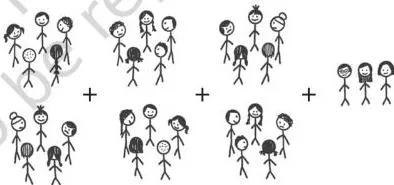
This picture is the fire-game moment: each group has 5 children, there are 6 full groups, and 3 children are outside any group. The expression \(6 \times 5 + 3\) counts exactly what the picture shows. The punchline of the section is that \(5 \times 2 + 3\) and \(2 \times (5 + 3)\) describe different pictures — writing the expression that matches the situation is the actual skill being practised.
Removing Brackets: When Signs Flip
The two “Removing Brackets” sections give one rule plus the reasoning behind it, so you can re-derive the rule any time you forget it.
Bracket after a minus sign: every sign inside flips.
\[200 – (40 + 3) = 200 – 40 – 3 = 157\]
Why: subtracting the whole of \(40 + 3\) is the same as subtracting 40 and then subtracting 3. The harder case:
\[500 – (250 – 100) = 500 – 250 + 100 = 350\]
Why: if you subtract 250, you have subtracted 100 more than the bracket asked for, so you add the 100 back. The chapter is explicit that \(500 – (250 – 100)\) is not \(500 – 250 – 100\).
Bracket not preceded by a minus: signs stay.
\[28 + (35 – 10) = 28 + 35 – 10 = 53\]
Hira’s coins — 28 in one bag, 35 in another, then gifting 10 — is the story behind this one. Since the bracket here is reached by adding, the terms inside keep their signs. The chapter’s own advice: figure it out by thinking about the meaning of the expression, rather than memorising a rule.
Same rule on fresh numbers:
Step 1: You have ₹150 and buy two things costing ₹45 and ₹35.
The change is \(150 – (45 + 35)\).
Step 2: Remove the bracket after the minus: \(150 – 45 – 35\).
\[150 – 45 = 105, \qquad 105 – 35 = 70\]
Step 3: Check against the bracket-first route: \(150 – (45 + 35) = 150 – 80 = 70\).
Both roads give the same change.
Final answer: \(150 – (45 + 35) = 150 – 45 – 35 = 70\).
The Distributive Property: Multiplying a Sum or Difference
This is the chapter’s last big structure. It says the multiple of a sum equals the sum of the multiples — and the same for a difference. The chapter teaches it by counting the same thing two ways.
Hotel bill first. Lhamo and Norbu each order a vegetable cutlet (₹43) and a rasgulla (₹24). Doubling one person’s share, \(2 \times (43 + 24)\), is the same as paying for two cutlets and two rasgullas separately: \(2 \times 43 + 2 \times 24\). Both routes give 134. Note the chapter’s warning: \(2 \times 43 + 24\) would mean “24 more than twice 43” — the bracket is essential for the double.
Parade next. Scouts march in 4 rows of 5 and guides in 3 rows of 5. Count the children as \(4 \times 5 + 3 \times 5 = 35\), or count the rows first: \((4 + 3) \times 5 = 35\). Same total, two expressions.

The diagram above is the general picture: 10 times 98 and 3 times 98 is simply 13 times 98, so \(10 \times 98 + 3 \times 98 = (10 + 3) \times 98\).

The second diagram shows the same idea for a difference: 14 times 10 minus 6 times 10 is 8 times 10, so \(14 \times 10 – 6 \times 10 = (14 – 6) \times 10\). The chapter’s summary line: the multiple of a sum (difference) is the same as the sum (difference) of the multiples.
That property is a mental-math engine. Worked example with original numbers:
Step 1: \(48 \times 7\) is 7 copies of 48.
Write 48 as \(50 – 2\).
\[48 \times 7 = (50 – 2) \times 7\]
Step 2: Distribute the 7 across the difference: \(50 \times 7 – 2 \times 7 = 350 – 14\).
\[350 – 14 = 336\]
Final answer: \(48 \times 7 = 336\).
Entering by 50 and subtracting the two extra copies is usually faster than the standard algorithm. The Tinker the Terms II examples — finding \(63 \times 18\) from \(53 \times 18 = 954\), and evaluating \(97 \times 25\) as \(100 \times 25 – 3 \times 25\) — run on exactly this idea.
Tinkering with Terms: Changing One Number Without Recalculating
The “Tinker the Terms” sections train a quick-check habit: when one term of an expression changes by 1, the value changes by 1 — so you can update an answer without redoing the arithmetic.
Start from the given fact \(53 + (-16) = 37\).
- \(54 + (-16) = 38\) — one more in the first term gives one more in the value.
- \(52 + (-16) = 36\) — one less gives one less.
- \(53 + (-15) = 38\) — \(-15\) is one more than \(-16\), so the value rises by 1.
- \(53 + (-17) = 36\) — \(-17\) is one less than \(-16\), so the value falls by 1.
The only judgement is “is the changed number one more or one less?” On a number line, \(-15\) sits one step to the right of \(-16\). No new computation is needed — which is precisely why this is a checking tool.
Figure Walkthrough: The Pictures That Carry the Meaning
Each picture in the chapter does a job, and it has been shown and explained where it belongs above. This table gathers all of them in one place so you can verify you have understood every one.
| Figure | What it shows | Idea it supports |
|---|---|---|
| Raja (1023 + 125) | Raja’s starting marbles plus his new gain | Compare starting amounts and gains, not full sums |
| Joy (1022 + 128) | Joy’s starting marbles plus her new gain | \(1023 + 125 \lt 1022 + 128\) by reasoning |
| Raja (113 − 25) | Raja’s 113 marbles with 25 lost | Weigh the starting difference against the loss difference |
| Joy (112 − 24) | Joy’s 112 marbles with 24 lost | \(113 – 25 = 112 – 24\) — the differences cancel |
| Shalini and the comma | The same sentence read two ways | Punctuation — like brackets — fixes meaning |
| Manasa’s hat and shoes | Hat and shoes in either order, same look | Swapping can leave a result unchanged: commutativity |
| Teacher calls 5 | Groups of 5 with 3 children over | \(6 \times 5 + 3\) matches the picture |
| 10 × 98 + 3 × 98 | 13 groups of 98 in two parts | Distributive property for a sum |
| 14 × 10 − 6 × 10 | 14 rows of 10 minus 6 rows of 10 | Distributive property for a difference |
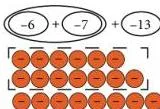
| −6 + (−7) + (−13) | Negative addends grouped two ways | Grouping in any order gives the same sum (−26) |
The last row is the token-model diagram for negative addends, shown here:
Read the circled numbers as tokens. Group the first two first: \((-6) + (-7) = -13\), then \(-13 + (-13) = -26\). Group the last two first: \((-7) + (-13) = -20\), then \((-6) + (-20) = -26\). Same result either way — the associative property holds even when every term is negative, and the picture shows why.
Formulas and Properties in One Place
This is a quick lookup table for the property statements the chapter names. Each example uses fresh numbers, not the book’s.
| Property | What it means | Example |
|---|---|---|
| Commutative property of addition | Swapping terms does not change the sum | \(9 + (-4) = (-4) + 9 = 5\) |
| Associative property of addition | Grouping terms differently does not change the sum | \((12 + 5) + (-3) = 12 + (5 + (-3)) = 14\) |
| Removing brackets after a minus | Every sign inside the bracket flips | \(150 – (45 + 35) = 150 – 45 – 35 = 70\) |
| Distributive property (sum) | The multiple of a sum equals the sum of the multiples | \(6 \times (20 + 3) = 6 \times 20 + 6 \times 3 = 138\) |
| Distributive property (difference) | The multiple of a difference equals the difference of the multiples | \(7 \times (50 – 2) = 7 \times 50 – 7 \times 2 = 336\) |
Definitions: The Terms You Need to Remember
Every key word of the chapter in one glossary, in working language you can actually use:
- Arithmetic expression: a mathematical phrase made of numbers joined by operations such as \(+\), \(-\), \(\times\) and \(\div\) — for example, \(13 + 2\).
- Value of an expression: the number the expression evaluates to; the value of \(13 + 2\) is 15.
- Term: a part of an expression separated by a ‘+’ sign, once every subtraction is rewritten as adding the inverse. \(6 \times 5 + 3\) has the terms \(6 \times 5\) and 3.
- Inverse of a number: the same number with the opposite sign. The inverse of 14 is \(-14\); the inverse of \(-14\) is 14. Subtracting a number equals adding its inverse.
- Commutative property of addition: swapping terms does not change the sum.
- Associative property of addition: grouping terms differently does not change the sum.
- Distributive property: multiplying a number by a bracket equals multiplying it by each term inside the bracket — \(a \times (b + c) = a \times b + a \times c\).
Common Mistakes Students Make in This Chapter
These are the errors this chapter is designed to catch. Read each one before you make it.
| Mistake | Correct rule | How to check your answer |
|---|---|---|
| Computing \(30 + 5 \times 4\) as \((30 + 5) \times 4 = 140\) | Evaluate each term first: \(30 + (5 \times 4) = 30 + 20 = 50\). | Rewrite as terms — \(30\) and \(5 \times 4\). The product is one term; evaluate it before adding. |
| Writing \(100 – 15 + 56\) for the shopkeeper’s change | The whole spend goes inside the bracket: \(100 – (15 + 56) = 29\). | Change can never exceed the money you paid. 141 is absurd; 29 is sane. |
| Removing a bracket after a minus without flipping: \(500 – (250 – 100) = 500 – 250 – 100\) | Every sign inside flips: \(500 – (250 – 100) = 500 – 250 + 100 = 350\). | Evaluate the bracket first: \(250 – 100 = 150\), then \(500 – 150 = 350\). |
| Reading \(2 \times 43 + 24\) as the double of \(43 + 24\) | The double needs a bracket: \(2 \times (43 + 24)\). \(2 \times 43 + 24\) means 24 more than twice 43. | Rewrite as terms — \(2 \times 43 + 24\) has terms \(2 \times 43\) and 24, so the 24 is an add-on, not part of the doubling. |
| Regrouping subtraction freely: \(16 – (8 – 3) = (16 – 8) – 3\) | Subtraction does not regroup like addition: \(16 – (8 – 3) = 16 – 5 = 11\), but \((16 – 8) – 3 = 5\). | Always evaluate the bracket first, then compare the two values. |
How the Figure it Out Sets Practice the Ideas
Each Figure it Out set in the chapter targets one skill. Use this map to know what a set is for before you start it.
| Figure it Out set | Where it sits | Skill it trains |
|---|---|---|
| Set 1 | End of Section 2.1 | Filling blanks to make two expressions equal; arranging expressions in ascending order of value without full computation. |
| Set 2 | After “More Expressions and Their Terms” | Finding values by writing terms; writing a story for a given expression; converting situations and pictures into expressions. |
| Set 3 | After “Removing Brackets—I” and Tinker the Terms I | Removing brackets; placing brackets to force a target value; identifying equal expressions using terms; reasoning how a one-term change moves the value. |
| Set 4 | Just before the SUMMARY | Building expressions from real situations; choosing the model expression for a story; comparing by reasoning; recognising equal expressions without computing; creating many expressions for one value. |
The chapter’s answer pages carry worked answers for these sets — attempt each set first, then check.
Number Puzzles at the End of the Chapter
These puzzles sit after the SUMMARY and are easy to skip. They are worth doing: they force you to use brackets, terms and the order rules quickly.
- Using three 3s with the four operations and brackets — for example, \((3 + 3) \div 3 = 2\), \(3 + 3 – 3 = 3\), \(3 \times 3 + 3 = 12\) — create as many different values as you can.
- Using four 4s, create expressions for every value from 1 to 20.
- Using 1, 2, 3, 4 and 5 exactly once each, in any order, get as many values as possible between \(-10\) and \(+10\).
- Using 0 to 9 exactly once, make an expression with value 100.
How to Use This Chapter for Practice and Tests
This is an honest study order — no shortcuts promised, just the sequence that builds each skill on the one before.
- Read Section 2.1 and do Figure it Out Set 1. The point is comparing by reasoning, so say each comparison aloud before writing the sign.
- Practise writing every expression as a sum of terms. This single habit removes most errors in the rest of the chapter.
- Do the bracket-removal questions in Set 3, and for each one re-derive the rule by thinking what the expression means.
- Finish with the distributive property and the number puzzles.
One honest caution: textbook contents and the examinable syllabus are not always identical. This page describes what the NCERT chapter contains; for what is examinable this session, check the current official syllabus.
The Chapter’s Summary in Plain Words
NCERT closes the chapter with a SUMMARY. Here are the same six points in plainer words, for a last look before you study.
- Simple expressions like \(13 + 2\) have values, and the same value can be written in many different ways.
- Many comparisons can be decided by reasoning over starting amounts and changes, without full arithmetic.
- Terms and brackets are the tools that make complex expressions unambiguous.
- Because addition is commutative and associative, the order and grouping of terms never changes a sum.
- Removing a bracket preceded by a minus sign flips every sign inside it.
- The distributive property: the multiple of a sum or difference equals the sum or difference of the multiples.
Related NCERT Resources
This listing is maintained for the 2026-27 academic session using the NCERT textbook information available to us. NCERT remains the authority for confirming the latest edition.
Carry on with the rest of the book from here. The Class 7 Mathematics notes cover the whole Ganita Prakash book chapter by chapter, and the Class 7 study hub lists every subject for the class. The chapters around this one — Geometric Twins and A Peek Beyond the Point — build directly on the expression habits this chapter teaches.
For older material, the CBSE notes index is the starting point.
For the file itself, the official NCERT textbook portal at ncert.nic.in/textbook.php publishes the complete Ganita Prakash book; the chapter PDF linked at the top of this page comes from that portal.
Sources and Data Verification
- This page describes NCERT Class 7 Mathematics (Ganita Prakash), Chapter 2, Arithmetic Expressions, from the NCERT edition.
- It covers this single chapter only — not other chapters of the book, and not other classes.
- It is maintained for the current session using the NCERT information available to us; when a new edition or a syllabus change appears, the details here may change.
- NCERT settles textbook editions and official PDFs; CBSE settles the curriculum, syllabus and examinations for the session.
| What the chapter holds | Count | Where it is used |
|---|---|---|
| Printed pages | 40 | |
| Sections in the chapter | 2 | |
| Figures with NCERT captions | 10 | |
| Tables | 1 | |
| In-text questions | 27 | |
| Official NCERT PDF | Download the chapter PDF | the chapter exactly as NCERT publishes it |
Reference: NCERT Class 7 Mathematics (Ganita Prakash) textbook, chapter 2, official edition on ncert.nic.in.
Frequently Asked Questions
What is an arithmetic expression in Class 7?
An arithmetic expression is a mathematical phrase made of numbers and operations such as \(+\) and \(\times\), like \(13 + 2\). Its value is the number it evaluates to — \(13 + 2 = 15\) — and the equals sign connects the expression to its value (NCERT, Section 2.1).
Why do we need brackets in 30 + 5 × 4?
Without a bracket, the expression can be read two ways: add first and get \((30 + 5) \times 4 = 140\), or multiply first and get \(30 + (5 \times 4) = 50\). The context — 30 marbles plus 5 bags of 4 marbles — makes 50 correct, and the bracket makes that the only possible reading.
When we remove brackets after a minus sign, do the signs always change?
Yes. When a bracket is preceded by a minus, every sign inside flips: \(500 – (250 – 100) = 500 – 250 + 100\), and \(200 – (40 + 3) = 200 – 40 – 3\). When the bracket is not preceded by a minus, the signs stay as they are: \(28 + (35 – 10) = 28 + 35 – 10\).
What are terms in an arithmetic expression?
Terms are the parts of an expression separated by a ‘+’ sign, after you rewrite every subtraction as adding the inverse. In \(2 – 10 + 4 \times 6\), the terms are \(2\), \(-10\) and \(4 \times 6\). Evaluate each term first, then add the term values.
What is the distributive property in this chapter?
It says the multiple of a sum (or difference) equals the sum (or difference) of the multiples: \(2 \times (43 + 24) = 2 \times 43 + 2 \times 24\). In practice it turns mental products like \(48 \times 7\) into \(50 \times 7 – 2 \times 7 = 336\).
Where can I get the official NCERT Class 7 Maths Chapter 2 Arithmetic Expressions PDF?
From the official NCERT textbook portal — the download link at the top of this page opens ncert.nic.in/textbook.php, where the complete Ganita Prakash book, Chapter 2 included, is published free.
Explore Class 7 Mathematics Books
Related chapters: