
This is the NCERT Class 7 Maths Chapter 4, Expressions Using Letter-Numbers, from the official Ganita Prakash textbook — the book’s first algebra chapter. It turns everyday situations (ages, matchsticks, bills) into short expressions in which letters stand for numbers. The official expressions using letter-numbers class 7 PDF is right below, followed by a guide to every part of the chapter.
Download the Official NCERT Chapter 4 PDF
The official file is NCERT Class 7 Maths Chapter 4 Expressions Using Letter-Numbers PDF — the current Ganita Prakash edition of the chapter, including every Figure it Out question and the worked answer key printed at the end of the chapter. Open it in the browser or save it for offline study; every section reference on this page points into this same file.
Chapter at a Glance
The table below gives the chapter’s size in one view — how many sections, figures and questions the chapter holds — so you can gauge the workload before starting. What follows is what is actually inside the file:
- sections 4.1 to 4.5, from “The Notion of Letter-Numbers” to “Pick Patterns and Reveal Relationships”;
- two “Mind the Mistake, Mend the Mistake” blocks that print wrong simplifications for you to correct;
- three “Figure it Out” practice sets placed through the chapter;
- the SUMMARY at the end, and a worked answer key covering every printed page of the chapter (from Page No. 83 to Page No. 105).
What Chapter 4 Covers, Section by Section
The chapter moves in a straight line: real situations first, then letters standing for numbers, then simplification, then using expressions to prove patterns. Here is the tour.
4.1 The Notion of Letter-Numbers
Section 4.1 answers one question: how do you write a relationship in shorthand? Shabnam is 3 years older than Aftab, so instead of writing “Aftab’s age” every time, the book uses the letter \(a\) and writes Shabnam’s age as \(s = a + 3\).
The same move repeats for matchsticks, laddus and perimeters: \(n\) Ls take \(2 \times n\) sticks, \(c\) coconuts and \(j\) kg of jaggery cost \(c \times 35 + j \times 60\), and a square of side \(q\) has perimeter \(4 \times q\). The section closes with the first Figure it Out set, which turns perimeters, pipes, banknotes and a flour mill into expressions.
4.2 Revisiting Arithmetic Expressions
Before letters, the book revises the number rules that expressions rely on: swapping (adding in any order), grouping, brackets, and the distributive property. It evaluates examples like \(23 – 10 \times 2 = 3\) and shows \(68 – (18 + 13)\) solved two ways — bracket first, or opening the bracket and changing the signs inside. The point is that the same rules will later be applied to expressions that contain letters.
4.3 Omission of the Multiplication Symbol
The star of this section is one small convention: \(4 \times n\) is shortened to \(4n\), with the number written first. The sequence 4, 8, 12, 16, … is the multiplication table of 4, so its \(n\)th term is \(4n\). Evaluating works by replacing the letter: \(5m + 3\) at \(m = 2\) is \(5 \times 2 + 3 = 13\). The first “Mind the Mistake, Mend the Mistake” block checks whether pupils replace letters correctly.
4.4 Simplification of Algebraic Expressions
The longest section teaches how to make expressions shorter but equal. A rectangle’s perimeter \(l + b + l + b\) becomes \(2l + 2b\), and a shop’s pencil-and-eraser sales over three days combine into \(18c + 11d\) — which cannot be simplified further because \(c\) and \(d\) are different letter-numbers.
The section then works through brackets: \((40x + 75y) – (6x + 10y)\) opens to \(34x + 65y\), quiz scores build to \(21p – 9q\), and \(4(x + y) – y\) simplifies to \(4x + 3y\). A long comparison of \(5u\) with \(5 + u\), and \(10y – 3\) with \(10(y – 3)\), shows why the hidden multiplication matters. A grid-sum example reaches \(2r + 2s + 24\) three different ways.
4.5 Pick Patterns and Reveal Relationships
The final section uses expressions to explain patterns. The Formula Detective number machines hide operations you must deduce; the saree-border designs sit at positions \(3n\), \(3n – 1\) and \(3n – 2\), so dividing a position by 3 tells you the design — remainder 0 means Design C, remainder 1 Design A, remainder 2 Design B.
Calendar patterns show that every \(2 \times 2\) square has equal diagonal sums because both diagonals equal \(2a + 8\), and matchstick triangles build to \(3 + 2(y – 1) = 2y + 1\). The closing Figure it Out includes the rope, the traffic signal, matchstick squares and the endless 4-column grid, whose number in row \(r\), column \(c\) is \(4(r – 1) + c\).
The chapter closes with a SUMMARY of three big ideas, and a worked answer key that solves every Figure it Out question, organised by the printed page numbers of the chapter.
The Core Ideas: Letter-Numbers, Expressions and Simplification
These are the five ideas every exercise in this chapter draws on. When a question feels hard, identify which of these it is asking you to use — that is usually half the solution.
1. Letter-Numbers: a letter is a placeholder for any number
Section 4.1 introduces the term letter-number: a letter such as \(a\), \(n\) or \(q\) used to represent a number. Because the letter stands for any number, one expression such as \(s = a + 3\) answers the age question for every possible age of Aftab. An expression built with letter-numbers is an algebraic expression; a concise mathematical relation written this way is a formula.
2. The Hidden Multiplication
Section 4.3 fixes the convention that \(2n\) means \(2 \times n\): the number is written first, the letter after it, and the multiplication sign is left out. So \(4n\) is four times n, \(7k\) at \(k = 4\) is 28, and \(5m + 3\) at \(m = 2\) is 13. Mistaking this convention is the cause of most errors in this chapter.
3. Terms, Like Terms and Unlike Terms
Section 4.4 defines the parts of an expression: each part added to the others is a term. Terms that carry the same letter-number — \(5c\), \(3c\), \(10c\) — are like terms and can be merged into one term by combining their coefficients. This works because of the distributive property: \(5c + 3c + 10c\) is simply \(c\) counted \((5 + 3 + 10)\) times, which is \(18c\).
Terms with different letter-numbers, such as \(18c\) and \(11d\), are unlike terms and cannot be combined.
4. Simplification: Brackets First, Then Grouping
A simplified form is a shorter expression equal to the original for every value of the letter-numbers. The standard moves are: open brackets — changing signs when a minus sits outside, because \((40x + 75y) – (6x + 10y)\) means \((40x + 75y) + (-6x – 10y)\) — then swap and group like terms:
\[ (40x + 75y) – (6x + 10y) = 40x + 75y – 6x – 10y = (40 – 6)x + (75 – 10)y = 34x + 65y \]
5. Evaluating by Substitution
The chapter evaluates expressions by replacing each letter with a number, then applying the arithmetic rules of Section 4.2. Section 4.1 does this for ages, and Section 4.3 for \(5m + 3\). The worked examples below use new numbers, not the book’s own, so you can practise the method without remembering answers.
Worked Example 1: Two days’ sales in one expression
Ravi sells notebooks at ₹p each and pens at ₹q each. Day one: 6 notebooks and 4 pens. Day two: 9 notebooks and 2 pens. Build one expression for the two days, simplify it, then evaluate it for p = 25, q = 10.
Step 1 — write each day: Day 1 gives \(6p + 4q\); Day 2 gives \(9p + 2q\).
Step 2 — combine the days: total for the two days is \(6p + 4q + 9p + 2q\).
Step 3 — swap and group like terms: collect the \(p\)-terms and the \(q\)-terms.
\[ 6p + 4q + 9p + 2q = (6 + 9)p + (4 + 2)q = 15p + 6q \]
Step 4 — substitute p = 25, q = 10: replace each letter by its number.
\[ 15 \times 25 + 6 \times 10 = 375 + 60 = 435 \]
Final answer: the joint bill is \(15p + 6q\) rupees, which is ₹435 for these prices.
Worked Example 2: Evaluating by substitution
Find the value of \(9n – 4\) when \(n = 6\).
Step 1 — substitute: \(9n\) means \(9 \times n\), so put 6 in place of n.
\[ 9n – 4 = 9 \times 6 – 4 \]
Step 2 — multiply before subtracting:
\[ 54 – 4 = 50 \]
Final answer: the expression takes the value 50 when \(n = 6\).
Figure Walkthrough: Reading NCERT’s Diagrams
Every diagram in this chapter answers one question: how do we turn a picture into an expression? Each figure below is the one printed in your book, and each teaches a single move — from picture to formula, or from a long expression to a short one.
Pictures That Become Formulas
Figure 4.2 shows Parthiv’s matchstick Ls. Each L is built from 2 matchsticks, so the count of sticks is always 2 times the count of Ls. If \(n\) stands for the number of Ls, the formula is \(2 \times n\), shortened later to \(2n\).

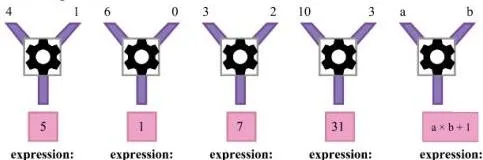
The Formula Detective number machines work the other way round: you see inputs and outputs and must deduce the hidden operation. The figure below shows one machine from the answer key — inputs \(a\) and \(b\) produce \(a \times b + 1\), shortened to \(ab + 1\). For inputs 10 and 3, that gives \(10 \times 3 + 1 = 31\), and the 5th expression is \(a \times b + 1\).
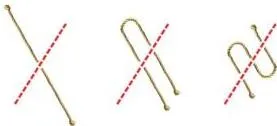
The rope puzzle in the final Figure it Out shows a physical pattern becoming a rule. Cut once gives 2 pieces; fold once and cut gives 3 pieces. The pattern continues: folding \(r\) times and cutting gives \(r + 2\) pieces, so 10 folds give \(10 + 2 = 12\) pieces.
Geometry Pictures That Become Simplified Expressions
The rectangle figure shows the first simplification in Section 4.4. Walking around the rectangle adds length, breadth, length, breadth: \(p = l + b + l + b\). By swapping and grouping, \(l + l = 2l\) and \(b + b = 2b\), so the simplified form is \(p = 2l + 2b\).
The figure’s point is that both expressions give the same number for the same rectangle — with \(l = 3\), \(b = 4\), both give 14.
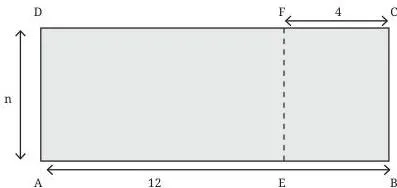
The split-rectangle figure shows subtraction of expressions. Rectangle ABCD is length 12 and breadth n; rectangle EBCF is length 4 and breadth n. The area of AEFD is found directly as \(n \times (12 – 4) = 8n\), or by subtracting areas: \(12n – 4n\). Because both methods describe the same rectangle, \(12n – 4n = 8n\).
Why Two Expressions Can Look Different but Be Equal
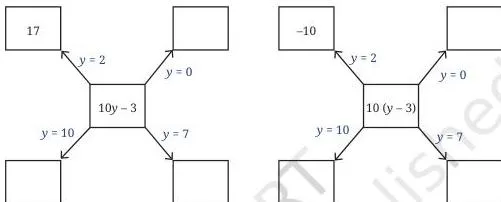
The value-comparison figure tests whether \(10y – 3\) and \(10(y – 3)\) are the same. Read them in words first: \(10y – 3\) means “3 less than 10 times y”, while \(10(y – 3)\) means “10 times (3 less than y)”. Filling the diagram for different values of y shows they differ — these two expressions are not equal.
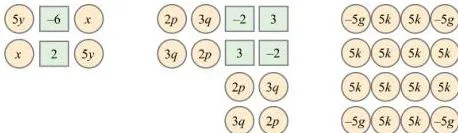
The “add the numbers” pictures show that the order of adding does not change the total. One grid holds terms such as \(5y\), \(x\), \(-6\) and 2. Adding like terms first gives \((5y + 5y) + (x + x) + (-6 + 2) = 10y + 2x – 4\); adding row by row gives exactly the same answer. Example 11 makes the same point — the grid sum reaches \(2r + 2s + 24\) three different ways.
Growing Patterns: From a Picture to a Rule
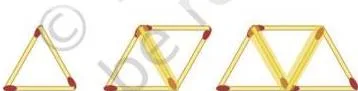
The matchstick-triangle pattern starts at 3 sticks and adds 2 sticks at every step: 3, 5, 7, 9, … At step y, the count is \(3 + 2 \times (y – 1)\) — a 3, then \(y – 1\) twos — which simplifies to \(2y + 1\).

The same triangles counted a different way: horizontal sticks run 1, 2, 3, 4, … (so \(y\) at step y), and diagonal sticks run 2, 3, 4, 5, … (so \(y + 1\) at step y). The two orientations add to \(y + (y + 1) = 2y + 1\), the same rule as before — two expressions, equal.
The traffic-signal figure is a repeating pattern of 4. The answer key gives the expressions: red lights sit at positions \(4n – 3\), green at \(4n – 1\), and yellow at \(2n\). Check: 90 and 190 are both yellow, since \(90 = 2 \times 45\) and \(190 = 2 \times 95\); \(343 = 4 \times 86 – 1\), so it is green. Alternatively, find the remainder on division by 4 to locate the colour in the cycle.
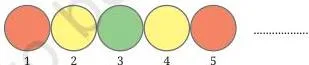
The same signal sequence is printed again where the answer key solves it, so you can see the order of colours in the sequence.
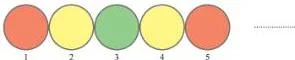
Figure-to-Expression Quick Map
| Figure | What it shows | Expression it produces |
|---|---|---|
| Matchstick Ls (Fig. 4.2) | Each L needs 2 sticks | \(2n\) sticks for n Ls |
| Number machine | Hidden operations on two inputs | e.g. \(ab + 1\) |
| Rope cut | Each fold adds one piece | \(r + 2\) pieces for r folds |
| Rectangle sides | Perimeter adds each side | \(l + b + l + b = 2l + 2b\) |
| Split rectangle AEFD | Area by subtraction | \(12n – 4n = 8n\) |
| Matchstick triangles | 3 sticks, then 2 more each step | \(3 + 2(y – 1) = 2y + 1\) |
| Traffic signal | Colours repeat every 4 positions | red \(4n – 3\), green \(4n – 1\), yellow \(2n\) |
Key Terms and Definitions
These are the words the chapter defines, in the order it meets them. Each meaning below is in plain words; the third column tells you where to find it in the book.
| Term | Meaning in plain words | Where it appears |
|---|---|---|
| Letter-number | A letter (like \(a\), \(n\), \(q\)) used to represent a number — any number. | Section 4.1 |
| Algebraic expression | A mathematical expression that contains letter-numbers, such as \(a + 3\). | Section 4.1 |
| Formula | A mathematical relation expressed concisely, e.g. perimeter \(4q\). | Section 4.1 |
| Term | One part of an expression that is added to the others. | Section 4.2 |
| Simplified form | A shorter expression equal to the original for every value of the letters. | Section 4.4 |
| Like terms | Terms with the same letter-numbers, e.g. \(5c\), \(3c\), \(10c\). | Section 4.4 |
| Unlike terms | Terms with different letter-numbers, e.g. \(18c\) and \(11d\). | Section 4.4 |
| Distributive property | A multiple of a sum equals the sum of the multiples: \(6(p + 2) = 6p + 12\). | Sections 4.2 and 4.4 |
Common Mistakes and How to Fix Them
The book itself prints wrong simplifications in its two “Mind the Mistake, Mend the Mistake” blocks and asks you to find the error. These are exactly the errors teachers expect you to recognise, so it is worth reading the table below line by line.
The 11 Mind-the-Mistake Simplifications, Corrected
| Expression | Wrong “simplest form” printed | What went wrong | Correct simplest form |
|---|---|---|---|
| \(3a + 2b\) | 5 | Like terms were added across different letter-numbers — \(a\)-terms and \(b\)-terms cannot be combined. | \(3a + 2b\) |
| \(3b – 2b – b\) | 0 | No mistake here: \(3b – 2b = b\), then \(b – b = 0\). | 0 |
| \(6(p + 2)\) | \(6p + 8\) | The 2 inside the bracket was not multiplied by 6. | \(6p + 12\) |
| \((4x + 3y) – (3x + 4y)\) | \(x + y\) | The minus outside the second bracket was not applied to both terms. | \(x – y\) |
| \(5 – (2 – 6z)\) | \(3 – 6z\) | Both signs inside change when the bracket opens: \(-6z\) becomes \(+6z\). | \(3 + 6z\) |
| \(2 + (x + 3)\) | \(2x – 6\) | The plus sign was treated as multiplication and signs were flipped. | \(x + 5\) |
| \(2y + (3y – 6)\) | \(-y + 6\) | Signs were flipped; the job here is just adding the \(y\)-terms. | \(5y – 6\) |
| \(7p – p + 5q – 2q\) | \(7p + 3q\) | \(7p – p = 6p\), not \(7p\). | \(6p + 3q\) |
| \(5(2w + 3x + 4w)\) | \(10w + 15x + 20w\) | Stopped before combining the like terms \(10w\) and \(20w\). | \(30w + 15x\) |
| \(3j + 6k + 9h + 12\) | \(3(j + 2k + 3h + 4)\) | Equal in value, but it still has a bracket, so it is not in simplest form. | \(3j + 6k + 9h + 12\) |
| \(4(2r + 3s + 5)\) | \(-20 – 8r – 12s\) | Signs were flipped as if a minus sat outside the bracket. | \(8r + 12s + 20\) |
Expression Traps: Two Pairs That Look Alike
Section 4.4 spends two full comparisons on look-alike expressions. The rule to remember: the multiplication sign is hidden in \(5u\), but the plus sign in \(5 + u\) is doing a different job.
| Mistake | Correct rule | How to check your answer |
|---|---|---|
| Reading \(5u\) as “5 plus u” | \(5u\) means \(5 \times u\); \(5 + u\) means 5 more than u. | Substitute \(u = 2\): \(5u = 10\), but \(5 + u = 7\) — not equal. |
| Treating \(10y – 3\) as \(10(y – 3)\) | \(10y – 3\) means \((10 \times y) – 3\); \(10(y – 3)\) means \(10 \times (y – 3)\). | Substitute \(y = 5\): \(10 \times 5 – 3 = 47\), but \(10(5 – 3) = 20\) — not equal. |
Two more cautions from the chapter. The snail question shows the edge case of climbing: after 10 days and nights the snail is \(10(u – d)\) cm from the start, and if \(d \gt u\) it slips down more than it climbs each night, so it will never reach the top.
And after correcting all 11 simplifications, the book asks you to notice that the number of terms in a simplified form need not match the number of different letters: \(6(p + 2)\) simplifies to \(6p + 12\) — two terms, one letter.
How to Practise Chapter 4 for Tests
A fair warning first: textbook contents and the examinable syllabus are not always identical — check the current official CBSE syllabus for what is examinable this session. No one can promise which questions will appear; the practice order below simply follows the skills the chapter builds.
- Translate words into expressions. Work through the first Figure it Out (questions 1–6): perimeters, the joined pipe, the note-count table, the flour-mill choice, “5 more than a number”, and describing situations for an expression.
- Evaluate by substitution. Take each expression you write and replace the letters with numbers — this is where the hidden multiplication (\(2n = 2 \times n\)) matters most.
- Simplify by removing brackets and combining like terms. Use the Figure it Out inside Section 4.4 and questions 7–9 of the final set: add them, subtract them, always checking that the final form is the shortest equal one.
- Pattern questions last. Matchsticks, the rope, the traffic signal, squares and the 4-column grid all follow one method — count a few steps, find the rule, then write the expression, e.g. \(4(r – 1) + c\) for the grid.
Keep the chapter’s method in order with the mnemonic “Some Words Let Every Sum Verify” — Situation, Words, Letters, Expression, Simplify, Verify. State the situation, describe it in words, choose a letter, write the expression, simplify it, then verify by substituting a number.
The chapter’s own questions come in three shapes: choose-the-expression (like the jowar roti, flowers and flour-mill questions), simplify-the-expression drills, and “describe a situation for this expression” — the reverse translation. The night before a test, revise in this order: definitions, then simplification rules, then one worked pattern question.
The Chapter’s Summary in Plain Words
NCERT closes the chapter with a SUMMARY of three points; here they are in plainer words, with the book’s three ideas kept intact:
- Algebraic expressions sit inside formulas to model patterns and relationships between quantities, and to make predictions — one expression replaces a whole table of cases.
- Algebraic expressions behave exactly like arithmetic expressions, because letter-numbers obey the same rules as numbers. Those rules — swapping, grouping, brackets, the distributive property — reduce expressions to their simplest form.
- An expression can be described in ordinary language, and ordinary language can be translated into an expression. Algebra wins whenever the pattern would be long and complicated to say in words.
The chapter ends with a worked answer key organised under the book’s printed page numbers, from Page No. 83 through Page No. 105, so every Figure it Out question can be checked step by step.
Related NCERT Resources
This listing is maintained for the 2026-27 academic session using the NCERT textbook information available to us. NCERT remains the authority for confirming the latest edition.
Algebra returns through the rest of the book, and the skills of this chapter — translating, simplifying, evaluating — are the foundation for all of it. Use these to move around:
- The Class 7 Mathematics notes cover the whole book, chapter by chapter.
- The Class 7 hub holds every Class 7 subject.
- The previous chapter, Finding Common Ground, comes just before this one in the book.
- The next chapter, Parallel and Intersecting Lines, follows Chapter 4 in the book.
For the official source, browse the NCERT textbook portal, where the current Class 7 Ganita Prakash editions are published. The direct chapter file is the NCERT Class 7 Maths Chapter 4 Expressions Using Letter-Numbers PDF from that portal.
| What the chapter holds | Count | Where it is used |
|---|---|---|
| Printed pages | 41 | |
| Sections in the chapter | 5 | |
| Figures with NCERT captions | 11 | |
| Tables | 26 | |
| In-text questions | 24 | |
| Official NCERT PDF | Download the chapter PDF | the chapter exactly as NCERT publishes it |
Reference: NCERT Class 7 Mathematics textbook, chapter 4, official edition on ncert.nic.in.
Sources and Data Verification
- The content and figures on this page describe the NCERT Class 7 Mathematics textbook Ganita Prakash, official NCERT edition.
- This page covers that book’s Chapter 4 only — it does not cover other Class 7 subjects or other chapters of the book.
- The listing is maintained for the current academic session, using the NCERT information available to us.
- NCERT settles textbooks, editions and PDFs; CBSE settles the curriculum, syllabus and examinations.
Frequently Asked Questions
What exactly is a letter-number in Class 7 Maths Chapter 4?
A letter-number is a letter used to represent a number — any number. In Section 4.1 the book uses \(a\) for Aftab’s age and writes Shabnam’s age as \(s = a + 3\); changing \(a\) changes \(s\), but one expression works for every age. Expressions containing letter-numbers are called algebraic expressions.
Why is 5u not the same as 5 + u?
Because the operations are different. \(5u\) is shorthand for \(5 \times u\), while \(5 + u\) means “5 more than u”. Substitute \(u = 2\) to see it: \(5u = 10\), but \(5 + u = 7\). Section 4.4 makes the same comparison for \(10y – 3\) and \(10(y – 3)\).
Can 18c + 11d be simplified further?
No. The terms \(18c\) and \(11d\) carry different letter-numbers, so they are unlike terms and cannot be combined into one term. The expression is already in its simplest form (Section 4.4).
How do I find which design appears at position 122 in the saree pattern?
Divide the position by 3 and look at the remainder. Remainder 0 means Design C (multiples of 3), remainder 1 means Design A, and remainder 2 means Design B. Since \(122 = 3 \times 40 + 2\), Position 122 has Design B. The answer key confirms: Design C at 99, Design B at 122, Design A at 148.
Why do the diagonal sums of every 2 by 2 calendar square match?
Let \(a\) be the top-left number of any 2 by 2 square. The square is \(a\), \(a + 1\), \(a + 7\), \(a + 8\), and both diagonals simplify to \(2a + 8\): \(a + (a + 8) = 2a + 8\) and \((a + 1) + (a + 7) = 2a + 8\). Since the result does not depend on the particular \(a\), the sums match for every square (Section 4.5).
Which NCERT book is Class 7 Maths Chapter 4 from?
It is from Ganita Prakash, the NCERT Class 7 Mathematics textbook. Chapter 4, “Expressions Using Letter-Numbers”, is the book’s first algebra chapter, and the official PDF at the top of this page is the NCERT file for it.
Explore Class 7 Mathematics Books
Related chapters: