
The Parallel and Intersecting Lines Class 7 chapter — Chapter 5 of NCERT’s Ganita Prakash, the current Class 7 Mathematics textbook — covers the angle rules that tell you when lines are parallel, and the official NCERT download link sits right below.
The chapter opens with paper folding: you crease a square sheet, draw along the creases, and suddenly you are looking at pairs of lines that meet, cross, or never meet. This page walks you through every section of the chapter, reads its figures, and explains the rules in plain words.
Download the Parallel and Intersecting Lines Class 7 PDF
NCERT hosts every chapter of Ganita Prakash on its official textbook pages, so the file you get is the government edition, not a scan from a third-party site. Open the book’s page and choose Chapter 5: NCERT Class 7 Mathematics Chapter 5 Parallel and Intersecting Lines PDF download.
Chapter 5 at a glance
A table on this page lists how much the chapter holds — sections, figures, activities and questions — so you can see the shape of the file before you open it.
The chapter’s numbered sections run in this order, with the printed page where each begins:
- 5.1 Across the Line — p. 107: intersecting lines, linear pairs and vertically opposite angles.
- 5.2 Perpendicular Lines — p. 108: the case where all four angles are equal.
- 5.3 Between Lines — p. 109: what parallel means, and the same-plane condition.
- 5.5 Transversals — p. 115: one line crossing two others.
- 5.6 Corresponding Angles — p. 115: the test for parallelism.
- 5.7 Drawing Parallel Lines — p. 118: construction with a set square and with paper folding.
- 5.8 Alternate Angles — p. 120: the second angle family and interior angles.
- 5.9 Parallel Illusions — p. 125: the closing visual puzzle.
The book jumps from 5.3 to 5.5 — there is no numbered section 5.4. The two pieces in between, Activity 2 (paper folding, p. 111) and Notations (arrow marks and the right-angle square, p. 112), sit between sections 5.3 and 5.5. The chapter’s SUMMARY is on p. 126.
What the chapter covers: from folded paper to parallel lines
The whole chapter runs on one idea: two lines meeting forces something about their angles; add a third line that cuts both, and the angles it creates become a test for whether the two lines are parallel. The sections below follow the book’s order, so you can keep a finger on the page.
5.1 Across the Line — folding paper and intersecting lines
The section starts with paper: fold a square sheet a few times, draw along the creases, and pairs of lines appear. The table top, your paper, the blackboard — these are plane surfaces. Some line pairs meet on the paper; others do not — but would they meet if extended?
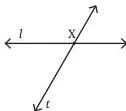
When two lines meet at a point on a plane surface, they are intersecting lines, and four angles appear at that point.
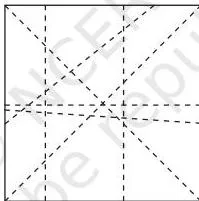
Activity 1 has you draw four intersecting pairs and measure all four angles each time. The pattern is always the same: opposite pairs are equal, and adjacent pairs add to \(180^\circ\).
The book then repeats the argument with symbols instead of measurements — that general reasoning is the chapter’s first proof, and it names the two pieces of vocabulary you will use all chapter: linear pair (adjacent angles adding to \(180^\circ\)) and vertically opposite angles (opposite angles, always equal).
5.2 Perpendicular Lines — four equal angles
If all four angles at an intersection are equal, each must be \(90^\circ\), because four equal angles share a full turn of \(360^\circ\). Such lines get a name: perpendicular lines, lines that intersect at right angles (p. 108). Perpendicular is one special case of intersecting; parallel, coming next, is the other.
5.3 Between Lines — what parallel means
Here the book moves from segments that meet to segments that would never meet. Fig 5.5 shows pairs in different situations — two meeting at an endpoint, two crossing, two that would meet only if extended — and asks you to describe each with precise words and measured angles.
The conclusion is the definition of parallel lines: a pair of lines that lie on the same plane and never meet, however far both ends are extended (pp. 109–110).
A note to the teacher on p. 110 pins down the phrase “same plane”: a line drawn on a table and a line drawn on a blackboard may never meet, yet they are not parallel. Both must live on one flat surface.
Activity 2 and Notations — folding parallel lines, arrow marks
Activity 2 folds a square sheet again and again. One horizontal fold gives three parallel lines; a second gives five; a third gives nine. The pattern is \(2^n + 1\) parallel lines after \(n\) horizontal folds (p. 111). Each fold line stays perpendicular to the vertical sides, and a vertical fold is perpendicular to all the horizontal ones.
Notations (p. 112) then give you the drawing language of the chapter: one arrow mark (>) on a set of lines shows they are parallel, and a second set of parallel lines gets two arrow marks. A small square between two lines marks a right angle.
5.5 Transversals — one line crossing two lines
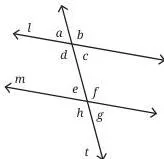
The hinge of the chapter: one line \(t\) crossing two other lines \(l\) and \(m\) is a transversal, and it produces eight angles (p. 115). Four of those pairs are vertically opposite and equal, so the eight angles can never all be different — at most four distinct measures.
5.6 Corresponding Angles — the test for parallelism
Angles in the same relative position on the two lines — 1 and 5, 2 and 6, 3 and 7, 4 and 8 in Fig 5.14 — are corresponding angles.
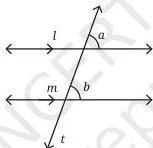
The section’s three activities build the rule in both directions. Activity 3 draws a second line through the transversal at the same angle and the two lines come out parallel. Activity 4 checks that parallel lines always give equal corresponding angles. Activity 5 shows that on lines that are not parallel, equal corresponding angles are impossible.
So the rule is two-way: equal corresponding angles prove the lines are parallel, and parallel lines guarantee equal corresponding angles. The note to the teacher on p. 118 calls this necessary and sufficient — the rule detects parallelism and is guaranteed by it.
5.7 Drawing Parallel Lines — set square and paper folding
Two constructions. First, the geometry box: slide a set square along a fixed ruler, and a line drawn along the set square’s edge is parallel to the first line (Fig 5.21). The second line makes the same angle with the original line — with a set square, \(90^\circ\) — and equal corresponding angles guarantee parallelism (Fig 5.22).
Second, paper folding: fold a perpendicular to \(l\) through point A, then fold a perpendicular to that perpendicular through A; the new crease is parallel to \(l\) (Fig 5.24, p. 120).
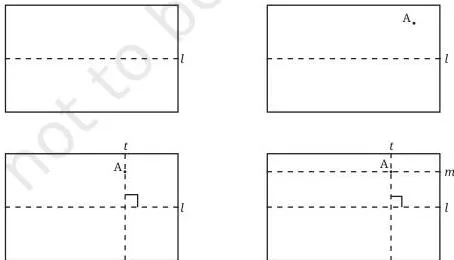
5.8 Alternate Angles and interior angles
A second family. \(\angle d\) is the alternate angle of \(\angle f\) in Fig 5.25: find the corresponding angle of \(\angle f\), then its vertically opposite angle, and you land on \(d\). Alternate angles formed by a transversal on parallel lines are equal (p. 120).
Activity 6 reasons this without measuring: \(\angle f = \angle b\) (corresponding) and \(\angle b = \angle d\) (vertically opposite), so \(\angle f = \angle d\).
The section closes with interior angles: angles inside the two lines, on the same side of the transversal, add up to \(180^\circ\) when the lines are parallel (Example 3, pp. 121–122). Examples 1–4 are the chapter’s worked angle-chases, worth doing once with the rules beside you.
5.9 Parallel Illusions — the chapter’s closing trick
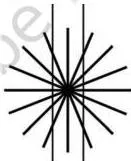
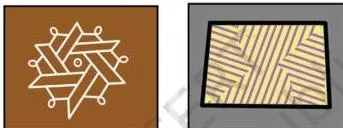
The book ends with a picture in which, apparently, no parallel lines appear. The point is that the eye can be fooled — which is exactly why the transversal angle rules exist: they give you a check that does not depend on how things look (p. 125).
Key concepts: the angle rules of Chapter 5
Everything in this chapter is one chain: two lines meet, four angles appear; special pairs get names; one case is singled out as perpendicular; the never-meeting case is parallel; and then a third line, the transversal, lets you test which case you are looking at. Here is each concept in order, with its printed page.
- Intersecting lines and linear pairs (p. 107): two lines meeting at a point make four angles; each adjacent pair adds to \(180^\circ\).
- Vertically opposite angles (pp. 107–108): the pair across from each other at the intersection; always equal, proved once and for all.
- Perpendicular lines (p. 108): intersecting lines whose four angles are all equal — so all \(90^\circ\).
- Parallel lines (pp. 109–110): lines on the same plane that never meet, however far extended.
- Transversal (p. 115): a line that intersects two other lines, making eight angles.
- Corresponding angles (pp. 115–118): the four pairs in matching positions — equality works both ways with parallelism.
- Alternate angles (p. 120): found through the corresponding angle, then the vertically opposite one; equal on parallel lines.
- Interior same-side angles (pp. 121–122): inside the two lines, on one side of the transversal; sum to \(180^\circ\) on parallel lines.
Fig 5.14 carries most of the chapter’s vocabulary, so read it slowly. The transversal \(t\) crosses \(l\) and \(m\), and around the two intersections sit eight angles in two sets of four: \(\angle 1\) to \(\angle 4\) on \(l\), \(\angle 5\) to \(\angle 8\) on \(m\).
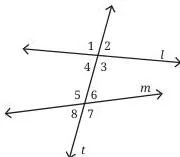
The matching positions — 1 with 5, 2 with 6, 3 with 7, 4 with 8 — are the corresponding pairs. The vertically opposite pairs (1 and 3, 2 and 4, 5 and 7, 6 and 8) are why the eight angles cannot all be different.
The five angle relationships of the chapter, and which of them depend on parallelism:
| Angle pair | Where the angles sit | What is true of them | Needs parallel lines? |
|---|---|---|---|
| Linear pair | Adjacent, side by side at one intersection | Sum to \(180^\circ\) | No — true for any intersecting lines |
| Vertically opposite | Across from each other at one intersection | Equal | No — true for any intersecting lines |
| Corresponding | Same position on the two lines, same side of the transversal | Equal | Yes — equal only when lines are parallel; equality itself proves parallelism |
| Alternate | Opposite sides of the transversal | Equal | Yes — equal when the lines are parallel |
| Interior, same side | Inside the two lines, on one side of the transversal | Sum to \(180^\circ\) | Yes — the sum holds when the lines are parallel |
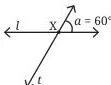
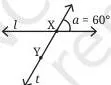
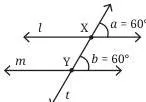
The same two-way logic powers the constructions of section 5.7. Slide a set square and you draw a second line making the same angle with the original as the first line does — equal corresponding angles, so the lines must be parallel.
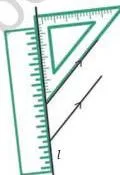
The reason is visible in the figure: because a set square was used, both angles with line \(l\) measure \(90^\circ\), and those equal corresponding angles are the certificate that the two new lines are parallel (pp. 118–119). The paper-folding version replaces the set square with a double perpendicular — fold through A perpendicular to \(l\), then through A perpendicular to that fold.
Two lines perpendicular to the same line are parallel to each other (pp. 119–120).
Reading the figures: what each diagram shows
Geometry in this chapter is learned by seeing, not only by reading, and the figures are where the definitions actually live. Here is what to look at in each of the chapter’s key diagrams.
Fig 5.5 builds the vocabulary of meeting. One pair of segments meets at an endpoint (FG and FH meet at F at \(115.3^\circ\)); another pair crosses; two more would meet only if extended. Reading it aloud with the words — endpoint, midpoint, meet, intersect — is the warm-up for the whole chapter (p. 109).
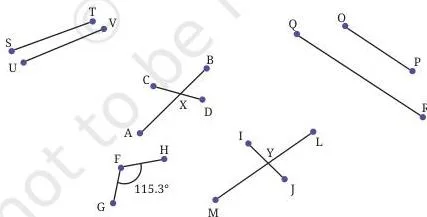
Fig 5.9 is the chapter’s notation key. The arrow marks (>) on a set of lines say “these are parallel”; a second set gets two arrow marks so you can tell the sets apart. Where two lines are perpendicular, a small square sits between them instead of a measured angle (p. 112).
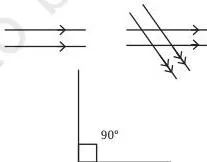
Fig 5.14, already read in the key concepts section, is the one figure to memorise: eight angles, four corresponding pairs, four vertically opposite pairs. Once you can point to \(\angle 1\) and \(\angle 5\), every later rule is just naming different pairs of this same picture.
Fig 5.25 shows how alternate angles are located. Start at \(\angle f\), take its corresponding angle \(\angle b\), then take the vertically opposite angle of \(\angle b\) — that is \(\angle d\), the alternate angle of \(\angle f\). The route matters because it is the proof: each step is a rule you already know (p. 120).
The chapter’s closing figure carries its own caption as its question: “There do not seem to be any parallel lines here. Or, are there?” Whatever your eye reports, the transversal rules settle it — that is the whole point of section 5.9.
Example 2’s figure (Fig 5.27) is the chapter’s built-in trap, and it is read in the common mistakes section below.
Chapter 5 glossary: terms for lines and angles
A quick lookup table for the chapter’s terms, with the printed page where the book introduces each one. The definitions here are in plain words, not the book’s phrasing.
| Term | Plain meaning |
|---|---|
| Intersecting lines (p. 107) | Two lines that meet at one point on the plane. |
| Linear pair (p. 107) | The two adjacent angles at an intersection; together they form a straight angle of \(180^\circ\). |
| Vertically opposite angles (p. 108) | The pair of angles across from each other at an intersection; always equal. |
| Perpendicular lines (p. 108) | Intersecting lines whose four angles are all right angles (\(90^\circ\)). |
| Parallel lines (pp. 109–110) | Lines on the same plane that never meet, however far they are extended in both directions. |
| Transversal (p. 115) | A line that intersects two other lines, forming eight angles. |
| Corresponding angles (p. 115) | Angles in matching positions at the two intersections of a transversal. |
| Alternate angles (p. 120) | The angle on the opposite side of the transversal, located through the corresponding angle and then the vertically opposite one. |
| Interior angles (pp. 121–122) | Angles lying between the two lines cut by a transversal; the same-side pair sums to \(180^\circ\) on parallel lines. |
Common mistakes in parallel and intersecting lines
This chapter has a small set of characteristic errors, and the book quietly warns about all of them. The worst one — applying the parallel-line rules to lines that are not actually parallel — is Example 2’s job, so read that figure first.
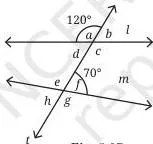
Example 2 (Fig 5.27) asks a simple-sounding question: lines \(l\) and \(m\) are cut by a transversal, \(\angle a = 120^\circ\) and \(\angle f = 70^\circ\) — are the lines parallel? Work it out: \(\angle b = 60^\circ\) because it forms a linear pair with \(\angle a\). But \(\angle b\) is the corresponding partner of \(\angle f\), and \(60^\circ \neq 70^\circ\).
The corresponding angles are not equal, so the lines are not parallel — even though the figure looks as though they should be (p. 121). The book’s “Measurements and Geometry” box (p. 108) explains why measured angles can also mislead: drawn lines have thickness, and protractors are read imperfectly.
An ideal line has no thickness, so the geometry is exact even when your measurement lands a degree off.
| Mistake | Correct rule | How to check your answer |
|---|---|---|
| Applying corresponding or alternate angle rules to lines that are not parallel | Corresponding, alternate and interior-same-side results hold only when the lines are parallel — but equal corresponding angles themselves prove parallelism | Compute the corresponding pair first. In Example 2 they come out \(60^\circ\) and \(70^\circ\) — unequal, so stop: the lines are not parallel |
| Trusting measured angles over reasoning | Ideal geometry is exact: a linear pair is exactly \(180^\circ\), vertically opposite angles exactly equal | If your protractor says \(179^\circ\), re-check the measurement — the geometry did not fail, the reading did |
| Forgetting the same-plane condition | Parallel lines must lie on the same plane | Ask: could both lines be drawn on one flat surface? A line on the table and a line on the blackboard never meet but are not parallel (p. 110) |
| Grabbing the wrong pair when angle-chasing | Interior same-side angles lie inside the two lines and on the same side of the transversal | Name the two lines, then the transversal; only then decide which angles are inside the strip |
| Misreading the folding pattern | After \(n\) horizontal folds the sheet shows \(2^n + 1\) parallel lines (p. 111) | Count: 1 fold → 3 lines; 2 folds → 5; 3 folds → 9. The sequence 3, 5, 9 fits \(2^n + 1\), not \(n + 1\) or \(2n\) |
How the chapter’s questions work, with a worked example
The chapter tests two skills: judging parallel and perpendicular by eye on dot paper, and computing angles from the rules. Its “Figure it Out” blocks mix both, and the figures they name are the ones you need.
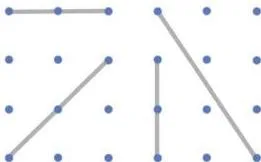
The dot-paper blocks (pp. 113–114) train visual judgement. Question 1 uses Fig 5.10: draw perpendiculars to the given lines on the dot grid — vertical, horizontal and \(45^\circ\) lines are easiest. A full answer here is a drawing plus the notation: arrow marks for parallel sets, a square for each right angle.
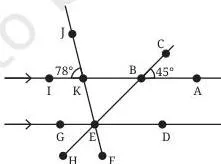
The angle-finding blocks (pp. 123–125) test the transversal rules, and the figures named in the questions matter. Question 4 (Fig 5.33) gives \(\angle ABC = 45^\circ\) and \(\angle IKJ = 78^\circ\) and asks for three angles around the figure. A full-marks answer names the rule at each step — corresponding, alternate, linear pair, vertically opposite — and states where parallelism was assumed.
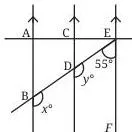
Question 5 (Fig 5.34) is the chain problem: \(AB \parallel CD\) and \(CD \parallel EF\), with \(EA\) perpendicular to \(AB\). The chain means an angle found on one pair of parallels transfers to the next pair; the book’s answer is \(\angle x = \angle y = 125^\circ\), by corresponding angles.
Question 6 carries the technique worth learning as a general strategy. To find \(\angle NOP\) in its figure, the book’s hint says: draw lines parallel to LM and PQ through points N and O. Auxiliary parallel lines like these split a blocked angle into two parts, each of which the transversal rules can name.
The answer the book settles on is \(108^\circ\).
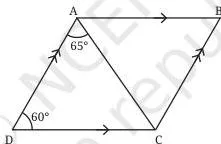
Fig 5.29, from Example 4, shows the same strategy in a different shape: two pairs of parallel segments (\(AB \parallel CD\) and \(AD \parallel BC\)). Here \(AD\) acts as the transversal for the first pair, and the interior same-side rule feeds one angle into the next until all four are found.
One honest caution for exam season: textbook contents and the examinable syllabus are not always identical — check the current official syllabus.
Worked example: one angle of 110 degrees, find all eight angles
Here is an original angle-chase with fresh numbers, so you can practise the rules without redoing the book’s examples. The arrangement is Fig 5.28’s: parallel lines \(l\) and \(m\), transversal \(t\), angles numbered 1 to 8 the same way. You are given \(\angle 6 = 110^\circ\).
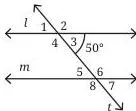
Step 1 — corresponding angles: \(\angle 6\) sits on \(m\); its matching position on \(l\) is \(\angle 2\).
On parallel lines, corresponding angles are equal:
\[ \angle 2 = \angle 6 = 110^\circ \]
Step 2 — vertically opposite angles: pairs across each intersection are equal:
\[ \angle 8 = \angle 6 = 110^\circ, \quad \angle 4 = \angle 2 = 110^\circ \]
Step 3 — linear pair: \(\angle 5\) is adjacent to \(\angle 6\), so together they form \(180^\circ\):
\[ \angle 5 = 180^\circ – 110^\circ = 70^\circ \]
Step 4 — the rest: \(\angle 7 = 70^\circ\) (vertically opposite to \(\angle 5\)); \(\angle 1 = 70^\circ\) (linear pair with \(\angle 2\), or corresponding to \(\angle 5\)); \(\angle 3 = 70^\circ\) (linear pair with \(\angle 4\), or corresponding to \(\angle 7\)).
Check with the other rules: \(\angle 4\) is the alternate angle of \(\angle 6\), so \(\angle 4 = 110^\circ\) ✓.
The interior same-side pair gives \(\angle 3 + \angle 6 = 70^\circ + 110^\circ = 180^\circ\) ✓.
Final answer: \(\angle 2 = \angle 4 = \angle 6 = \angle 8 = 110^\circ\) and \(\angle 1 = \angle 3 = \angle 5 = \angle 7 = 70^\circ\).
| Angle | Value | Rule used |
|---|---|---|
| \(\angle 2\), \(\angle 4\), \(\angle 6\), \(\angle 8\) | \(110^\circ\) | Corresponding (2 = 6), vertically opposite (4 = 2, 8 = 6) |
| \(\angle 1\), \(\angle 3\), \(\angle 5\), \(\angle 7\) | \(70^\circ\) | Linear pair (5 with 6), vertically opposite (7 = 5), corresponding (1 with 5, 3 with 7) |
Closing rules of Chapter 5: what to remember
These are the chapter’s SUMMARY results (p. 126), rebuilt in plainer words — the seven things to hold the night before.
- Two intersecting lines make four angles: vertically opposite angles are equal, and each linear pair adds to \(180^\circ\).
- If all four angles are equal, each is \(90^\circ\) and the lines are perpendicular.
- Lines on the same plane that never meet are parallel.
- A transversal cutting a pair of lines makes two sets of four angles; each angle in the first set has a corresponding angle in the second.
- Corresponding angles are equal precisely when the lines are parallel — each direction implies the other.
- Alternate angles are equal when the lines are parallel.
- Interior angles on the same side of the transversal add to \(180^\circ\) when the lines are parallel.
Related Class 7 Maths resources
This listing is maintained for the 2026-27 academic session using the NCERT textbook information available to us. NCERT remains the authority for confirming the latest edition.
If this chapter made sense, the rest of the Class 7 Mathematics book follows the same pattern of small experiments leading to a rule. Useful next pages:
- Class 7 Mathematics (Ganita Prakash) book page — all chapters of this textbook.
- Chapter 4 of Ganita Prakash and Chapter 6 — the chapters before and after this one.
- Class 7 Mathematics revision notes for chapter-by-chapter notes.
- Number Play notes and the Another Peek pages for related number work.
- Class 7 study hub, the main notes index, and the Class 7 hub for every Class 7 NCERT book.
| What the chapter holds | Count | Where it is used |
|---|---|---|
| Printed pages | 34 | |
| Sections in the chapter | 8 | |
| Figures with NCERT captions | 23 | |
| Tables | 3 | |
| In-text questions | 17 | |
| Activities | 6 | |
| Official NCERT PDF | Download the chapter PDF | the chapter exactly as NCERT publishes it |
Reference: NCERT Class 7 Mathematics textbook (Ganita Prakash), Chapter 5, official edition on ncert.nic.in.
Sources and data verification
Where the details on this page come from, stated plainly:
- The section-by-section tour, figure descriptions and question mapping above come from the NCERT Class 7 Mathematics textbook, Ganita Prakash, Chapter 5, printed pages 107–126.
- This page covers Chapter 5 only, not the whole book. The other chapters have their own pages in the Class 7 Mathematics section.
- The page is maintained for the current session using the NCERT information available to us. NCERT settles the textbook, its edition and the official PDFs at ncert.nic.in.
- CBSE settles the curriculum and examinations. Textbook contents and the examinable syllabus can differ, so confirm the examinable topics against the current official CBSE syllabus.
Frequently asked questions on parallel and intersecting lines
The questions students search for on this chapter, answered from the book.
Are corresponding angles always equal, or only when the lines are parallel?
Only when the lines are parallel. If the lines are parallel, corresponding angles are guaranteed equal; if the corresponding angles are equal, the lines are proved parallel. The book shows both directions in Activities 3–5 (p. 117), and Example 2 (p. 121) is the trap: the lines look parallel, but the corresponding pair measures \(70^\circ\) against \(60^\circ\), so they are not.
Can two straight lines intersect at more than one point?
No. When a pair of lines meets on a plane, they meet at exactly one point — that is what “intersect” means (p. 107). The chapter asks this exact question on p. 107. Two distinct straight lines cannot share two points; if they did, they would be the same line.
Why do my measured angles not add up to exactly 180 degrees?
Because drawn lines have thickness and protractors are read imperfectly. The book’s “Measurements and Geometry” box (p. 108) says an ideal line has no thickness, but every pencil line does; that alone can shift a reading by a degree or two. The geometry itself is exact — the rule that a linear pair sums to \(180^\circ\) comes from reasoning, not measurement.
What is the difference between alternate angles and corresponding angles?
Position. Corresponding angles sit in the same relative spot on the two lines — both top-right, for instance — on the same side of the transversal (p. 115). Alternate angles sit on opposite sides of the transversal: take a given angle’s corresponding partner, then that partner’s vertically opposite angle, and you reach the alternate angle (Fig 5.25, p. 120).
On parallel lines, both pairs are equal.
How do you draw a line parallel to a given line through a point using a geometry box?
Use a ruler and set square. Place one side of the set square along line \(l\), hold the ruler firmly against the other side, slide the set square along the ruler until its side reaches point A, and draw the line through A (pp. 118–119).
The paper-folding version: fold a perpendicular to \(l\) through A, then a perpendicular to that fold through A — the new crease is parallel to \(l\) (pp. 119–120).
Why is a line on the table not parallel to a line on the blackboard even if they never meet?
Because parallel lines must lie on the same plane. The tabletop and the blackboard are different planes, so the two lines never meet but are not parallel. The book’s note to the teacher on p. 110 makes exactly this point: never meeting alone is not enough.
Explore Class 7 Mathematics Books
Related chapters: