
Our Environment Class 10 is Chapter 13 of the NCERT Science textbook, running from page 207 to page 217 of the current NCERT edition. It explains what an ecosystem is, how energy moves through food chains, and how human activities damage the environment through ozone depletion and waste. The official chapter PDF is linked right below.
If you want the exact chapter as printed in the official textbook, the NCERT Class 10 Science Chapter 13 Our Environment PDF is the current NCERT edition hosted on ncert.nic.in — the same source the school textbook is printed from — so you can open it and follow every page reference on this page as you read.
Our Environment Chapter 13 at a Glance
This table shows what is inside the official chapter file, so you know what you are opening before you download it:
| What the chapter contains | Count |
|---|---|
| Main sections (13.1 and 13.2, with their subsections) | 5 |
| Diagrams | 4 |
| Activities | 9 |
| Exercise questions at the end of the chapter | 9 |
| In-text questions inside the sections | 7 |
Chapter 13 splits into two halves: Section 13.1 builds the ecosystem idea — components, food chains, trophic levels and energy flow — and Section 13.2 looks at how human activities damage the environment through ozone depletion and waste.
What This Chapter Covers, Section by Section
The chapter opens with how often the word ‘environment’ appears on television, in newspapers and in everyday conversation (NCERT, p. 207). The promise it makes is simple: study how the components of the environment interact, and study how we impact it.
Section 13.1 defines an ecosystem as interacting organisms plus non-living surroundings, splits it into biotic and abiotic components, and sorts organisms into producers, consumers and decomposers (NCERT, p. 208). Section 13.1.1 then builds food chains, trophic levels, food webs and energy flow (NCERT, pp. 210-211), and ends with biological magnification (NCERT, pp. 211-212).
Section 13.2 studies two environmental problems in detail: depletion of the ozone layer by CFCs (NCERT, pp. 212-213) and managing the biodegradable and non-biodegradable waste we generate (NCERT, pp. 213-215).
Key Concepts in This Chapter
These seven ideas carry the whole chapter: what an ecosystem is, how energy moves through it, and how our activities damage it. Each one is explained below in the order the chapter presents it.
Ecosystem: Biotic and Abiotic Components
An ecosystem is every living thing in an area plus its non-living surroundings, all interacting with each other (NCERT, p. 208). This is the chapter’s founding definition — every later idea, from food chains to waste, happens inside an ecosystem.
An ecosystem has two parts. Biotic components are the living organisms. Abiotic components are physical factors like temperature, rainfall, wind, soil and minerals.
A garden is an ecosystem: grasses, trees, flowering plants, frogs, insects and birds interact with each other, and their growth is affected by the abiotic components. Forests, ponds and lakes are natural ecosystems; gardens and crop-fields are human-made (artificial) ecosystems.
Producers, Consumers and Decomposers
From earlier classes you already know these three groups; this chapter uses them to explain how an ecosystem runs. The sorting is by how an organism gets its food.
Producers are green plants and certain bacteria that make organic food like sugar and starch from inorganic substances, using the radiant energy of the Sun with the help of chlorophyll (NCERT, p. 208). Consumers depend on producers either directly or indirectly — herbivores, carnivores, omnivores and parasites.
Decomposers are bacteria and fungi that break down dead remains and waste into simple inorganic substances that return to the soil and are used again by plants.
The aquarium activity makes the point concrete: add aquatic plants and animals and the aquarium becomes a self-sustaining ecosystem — yet it still has to be cleaned once in a while (NCERT, p. 208).
The book then asks the question that leads into decomposers: what would happen to garbage and dead plants and animals if decomposers were absent?
Food Chains, Food Webs and Trophic Levels
A food chain is a series of organisms feeding on one another, and each step of that series is a trophic level (NCERT, p. 210). The levels are always named the same way, so learn the names once.
- First trophic level: autotrophs or producers.
- Second: herbivores or primary consumers.
- Third: small carnivores or secondary consumers.
- Fourth: larger carnivores or tertiary consumers.
Real ecosystems rarely stay in a straight line. Because each organism is generally eaten by two or more other kinds of organisms, feeding relations branch into a food web (NCERT, p. 211).
Exercise question 2 tests the definition: grass, goat and human form a chain, but grass, wheat and mango do not — they are all producers, so no feeding series exists among them (NCERT, p. 216).
Energy Flow and the 10% Rule
Energy is what moves along a food chain, and it shrinks at every step. This is the most-tested idea in the chapter, and it explains why food chains are short.
Two averages from the book (NCERT, p. 210): green plants in a terrestrial ecosystem capture about 1% of the sunlight that falls on their leaves, and of the food a consumer eats, an average of 10% becomes its own body mass, available to the next level.
The 1% figure is about sunlight; the 10% figure is about food eaten. The 10% value can be taken as the average amount of organic matter that reaches the next level of consumers.
Worked example with original numbers. Suppose a wheat field fixes \( 20{,}000\ \text{J} \) of energy:
| Trophic level | Organism | Energy available |
|---|---|---|
| Producers | Wheat | \( 20{,}000\ \text{J} \) |
| Primary consumer | Grasshopper | \( 2{,}000\ \text{J} \) |
| Secondary consumer | Frog | \( 200\ \text{J} \) |
| Tertiary consumer | Snake | \( 20\ \text{J} \) |
Each transfer loses energy as heat, in digestion and in doing work (NCERT, p. 210). After three steps, only \( 20\ \text{J} \) of the original \( 20{,}000\ \text{J} \) is left for the tertiary consumer — so little remains that food chains generally have only three or four steps.
The energy flow diagram (Fig. 13.4) makes two further points (NCERT, p. 211): the flow is unidirectional — energy captured by autotrophs never returns to the solar input, and energy passed to herbivores never comes back to autotrophs — and the energy available at each level diminishes progressively. Energy does not cycle the way matter does.
Biological Magnification
Pesticides travel along the same food chains that carry energy, but unlike energy they are not used up or lost. Instead they build up.
Pesticides and other crop-protection chemicals wash into the soil or into water bodies. From the soil, plants absorb them along with water and minerals; from the water, aquatic plants and animals take them up. That is how they enter the food chain (NCERT, p. 211).
Because these chemicals are not degradable, they accumulate progressively at each trophic level. Humans occupy the top level in any food chain, so the maximum concentration builds up in our bodies. This is biological magnification (NCERT, pp. 211-212).
The mechanism: each level eats many organisms from the level below, so a small concentration in producers becomes a large one in tertiary consumers. That is why food grains like wheat and rice, vegetables, fruits and even meat carry pesticide residues that cannot always be removed by washing (NCERT, p. 212).
The Ozone Layer: Formation and CFC Depletion
Ozone is one gas with two reputations. Keep the two locations — ground and upper atmosphere — separate, and this topic becomes easy.
Ozone (\( O_3 \)) is a molecule of three oxygen atoms (NCERT, p. 212). Near the ground it is a deadly poison. High in the atmosphere it performs an essential job: it shields the Earth’s surface from ultraviolet (UV) radiation from the Sun, which is known to cause skin cancer.
Ozone forms when UV radiation acts on oxygen (NCERT, p. 213): high-energy UV splits molecular oxygen (\( O_2 \)) into free oxygen atoms, and those atoms combine with \( O_2 \) to form ozone:
\[ \begin{aligned} \text{O}_2 &\xrightarrow{\text{UV}} \text{O} + \text{O}\\ \text{O} + \text{O}_2 &\rightarrow \text{O}_3 \quad \text{(ozone)} \end{aligned} \]
The amount of ozone began to drop sharply in the 1980s. The decrease was linked to synthetic chemicals called chlorofluorocarbons (CFCs), used as refrigerants and in fire extinguishers (NCERT, pp. 212-213).
In 1987, the United Nations Environment Programme (UNEP) forged an agreement to freeze CFC production at 1986 levels, and it is now mandatory for manufacturing companies worldwide to make CFC-free refrigerators (NCERT, p. 213).
Biodegradable and Non-Biodegradable Waste
The chapter sorts the garbage we generate into two classes using a single question: can biological processes break it down? The answer decides whether a material disappears or persists.
Substances that are broken down by biological processes are biodegradable. Substances that are not broken down this way are non-biodegradable — they may persist inertly in the environment for a long time, or they may harm the members of the ecosystem (NCERT, pp. 213-214).
Why do plastics persist while food waste rots? Enzymes are specific in their action: a particular enzyme breaks down a particular substance. Because of this, bacteria and other saprophytes do not break down human-made materials like plastics under the normal conditions found in our environment (NCERT, p. 214) — the chapter links this to what you learnt in Life Processes.
The real-world case in the book is the tea cup (NCERT, p. 215). Disposable plastic cups create huge amounts of non-biodegradable waste. Clay kulhads were suggested instead, but mass-producing them would cost the fertile top-soil. Disposable paper cups are the current compromise. Every choice trades one environmental problem for another.
Figure Walkthrough: Reading the Four NCERT Diagrams
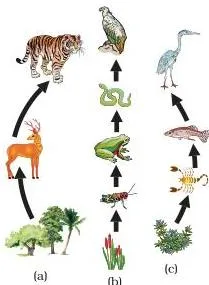
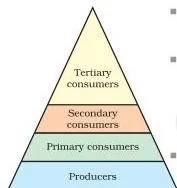
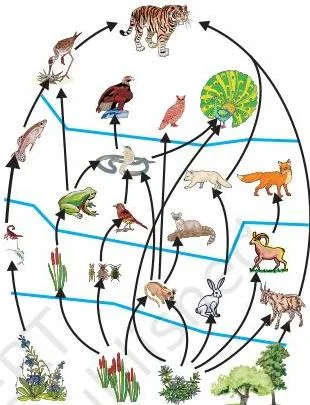
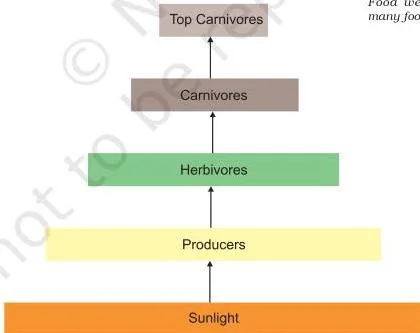
These four diagrams carry most of the chapter’s meaning in picture form. Each one below has its NCERT caption and an explanation of what to look at.
Fig 13.1 — Food Chain in Nature
All three panels show the same idea from the chapter text: a series of organisms feeding on one another, starting from producers (NCERT, p. 210). The book places this figure right after the aquarium food-chain activity, so you can compare the chains you made in the aquarium with the ones operating in a forest, a grassland and a pond.
Fig 13.2 — Trophic Levels
The diagram stacks a food chain into four steps (NCERT, p. 210). Read it from the bottom: first trophic level = autotrophs or producers; second = herbivores or primary consumers; third = small carnivores or secondary consumers; fourth = larger carnivores or tertiary consumers. Every question that asks about trophic levels is testing whether you can name these four.
Fig 13.3 — Food Web
This diagram shows why ‘food chain’ is a simplification (NCERT, p. 211). Because each organism is generally eaten by two or more other kinds of organisms, the straight feeding line of a single chain becomes a web of branching lines.
Exercise questions 4 and 5 lean on this picture: remove one species and the lines around it break, but the web structure means the damage spreads through several routes.
Fig 13.4 — Flow of Energy in an Ecosystem
The chapter says this one diagram makes two things clear (NCERT, p. 211). First, energy flow is unidirectional: the energy captured by autotrophs does not return to the solar input, and energy passed to herbivores does not come back to autotrophs. Second, available energy diminishes at every trophic level.
Watch the arrows — they all point one way, from the sun onward, and each step carries less.
Definitions: The Terms to Know
Definitions in this chapter are straightforward, and this table collects the chapter’s main terms for a fast revision pass. Meanings below are in plain words; the NCERT page is where the book defines each term.
| Term | Plain meaning | NCERT page |
|---|---|---|
| Ecosystem | All the interacting organisms in an area together with the non-living constituents of the environment. | p. 208 |
| Biotic components | The living organisms in an ecosystem. | p. 208 |
| Abiotic components | Physical factors such as temperature, rainfall, wind, soil and minerals. | p. 208 |
| Producers | Green plants and certain bacteria that make organic food from inorganic substances using sunlight and chlorophyll. | p. 208 |
| Consumers | Organisms that feed on producers directly or on other consumers indirectly. | p. 208 |
| Decomposers | Bacteria and fungi that break down dead remains and waste into simple inorganic substances. | p. 208 |
| Trophic level | Each step or level of a food chain. | p. 210 |
| Food chain | A series of organisms feeding on one another. | p. 210 |
| Food web | The branching network of many food chains in an ecosystem. | p. 211 |
| Biological magnification | Progressive accumulation of non-degradable chemicals at each trophic level. | pp. 211-212 |
| Ozone | A molecule of three oxygen atoms. | p. 212 |
| Biodegradable | Substances broken down by biological processes. | pp. 213-214 |
| Non-biodegradable | Substances not broken down by biological processes. | pp. 213-214 |
What the Nine Activities Demonstrate
Each activity in the chapter demonstrates one idea the book wants you to carry away. One line each below — the point is the demonstration, not the procedure.
- Activity 13.1 (p. 208): builds a self-sustaining aquarium ecosystem.
- Activity 13.2 (p. 209): forms a food chain of at least three steps from the aquarium organisms.
- Activity 13.3 (p. 212): debates pesticide bans and where pesticides in food come from.
- Activity 13.4 (p. 213): researches the chemicals responsible for ozone depletion and whether regulations have shrunk the ozone hole.
- Activity 13.5 (pp. 213-214): buries household waste and observes which materials remain unchanged.
- Activity 13.6 (p. 214): finds how long non-biodegradable substances last and whether new ‘biodegradable’ plastics harm the environment.
- Activity 13.7 (p. 215): audits waste generated at home and in the classroom, and suggests ways of dealing with it.
- Activity 13.8 (p. 215): investigates how local sewage and industrial waste are treated.
- Activity 13.9 (p. 216): investigates hazardous materials in e-waste and how plastic recycling affects the environment.
Common Mistakes Students Make in This Chapter
This chapter looks easy, and that is exactly why these five errors are common. Each row names the mistake, the correct rule from the chapter, and a quick way to check yourself.
| Mistake | Correct rule | How to check your answer |
|---|---|---|
| “The 10% rule means 10% of the organisms survive.” | It means the average amount of organic matter that reaches the next level of consumers — about 10% of the food eaten becomes the consumer’s body mass (NCERT, p. 210). | Read your own sentence back: if it says “10% of the organisms”, it is wrong — the 10% is about food energy and body mass. |
| “Food chains can go on for many steps.” | Energy loss at each step is so great that food chains generally have only three or four steps (NCERT, p. 210). | Count the levels in any chain you write; if you pass four, explain where the energy for the next level would come from. |
| “Ozone is good for us, so more ozone anywhere is better.” | At ground level ozone is a deadly poison; only high in the atmosphere does it shield the Earth from UV radiation (NCERT, pp. 212-213). | State where the ozone sits — ground or upper atmosphere — before you call it good or bad. |
| “Biodegradable means it rots quickly.” | Biodegradable means broken down by biological processes; non-biodegradable materials are simply not attacked by bacteria and saprophytes under normal conditions (NCERT, pp. 213-214). | Ask what process breaks the material down. If no biological process attacks it, it is non-biodegradable. |
| “Energy cycles through an ecosystem like matter does.” | Energy flow is unidirectional — it never returns to the sun and never passes back to the previous level (NCERT, p. 211). | Trace the arrows on Fig. 13.4: if any arrow points backwards, the flow is not unidirectional. |
Exam Notes: How the Questions Test These Ideas
The exercise questions at the end of the chapter test the same concepts in order, so mapping them saves revision time. The pattern is stable.
- Q1 — biodegradable classification from a list of items (p. 216).
- Q2 — which items actually form a food chain: grass, goat and human do; grass, wheat and mango do not (p. 216).
- Q3 — environment-friendly practices (p. 216).
- Q4 and Q5 — what happens if all organisms in one trophic level are removed, and whether any level can be removed without damage (pp. 216-217).
- Q6 — biological magnification and whether its concentration differs at different levels of the ecosystem (p. 217).
- Q7 — problems caused by non-biodegradable waste (p. 217).
- Q8 — whether even all-biodegradable waste has no impact; the chapter’s direction is that lifestyle changes have increased the amount of waste generated and disposal is a serious problem (pp. 215-216).
- Q9 — why ozone damage is a concern and what steps limit it; a full answer names the 1987 UNEP agreement and the worldwide rule that refrigerators be CFC-free (pp. 212-213, 217).
The in-text questions follow the same pattern: two after Section 13.1 ask about trophic levels and the role of decomposers (NCERT, p. 212); three after the waste section ask why some substances are biodegradable and how each waste type affects the environment (NCERT, p. 214); and the closing pair ask about ozone and how you can help reduce waste disposal (NCERT, p. 216).
Textbook contents and the examinable syllabus are not always identical — check the current official CBSE syllabus for what is examinable this session.
Revision Summary: The Chapter’s Takeaways
NCERT closes the chapter with ‘What you have learnt’ — seven points that form the fastest honest revision of the whole chapter (NCERT, p. 216). In plain words:
- Every component of an ecosystem depends on the others.
- Producers make the energy from sunlight available to the rest of the ecosystem.
- Energy is lost at each trophic level, and that loss limits the number of trophic levels in a food chain.
- Human activities have an impact on the environment.
- Chemicals like CFCs have endangered the ozone layer; since the ozone layer blocks ultraviolet radiation from the Sun, this could damage the environment.
- The waste we generate may be biodegradable or non-biodegradable.
- The disposal of the waste we generate is causing serious environmental problems.
Related Chapters and Resources
This listing is maintained for the 2026-27 academic session using the NCERT textbook information available to us. NCERT remains the authority for confirming the latest edition.
Chapter 13 sits at the end of the Class 10 Science book, after Chapter 12, Magnetic Effects of Electric Current. For the full book, use the Class 10 Science notes index and the Class 10 hub; the main CBSE notes hub organises revision pages by class and subject.
Two earlier ideas are worth revisiting if you feel shaky: enzyme specificity from Life Processes, which the chapter uses to explain why plastics persist (NCERT, p. 214), and the idea that whenever energy changes form, some is lost to the environment, which the chapter recalls on NCERT p. 210.
Sources and Data Verification
This page describes the NCERT Class 10 Science textbook, Chapter 13, ‘Our Environment’, pages 207-217 of the current NCERT edition. It covers this chapter only — it is not the CBSE curriculum or a syllabus document.
It is maintained for the current academic session using the NCERT information available; check the NCERT textbook portal for the latest edition. NCERT settles textbook editions and PDFs; CBSE settles the curriculum, syllabus and examinations.
| What the chapter holds | Count | Where it is used |
|---|---|---|
| Printed pages | 10 | |
| Sections in the chapter | 5 | |
| Figures with NCERT captions | 4 | |
| Exercise questions | 9 | answered in our NCERT Solutions |
| In-text questions | 7 | |
| Activities | 9 | |
| Official NCERT PDF | Download the chapter PDF | the chapter exactly as NCERT publishes it |
Reference: NCERT Class 10 Science textbook, chapter 13, official edition on ncert.nic.in.
Frequently Asked Questions
What is the difference between a food chain and a food web?
A food chain is a single series of organisms feeding on one another, while a food web is the branching network formed because each organism is generally eaten by two or more other kinds of organisms (NCERT, pp. 210-211). A food web is the realistic picture of an ecosystem; a food chain is one straight line through it.
Why does only 10 percent of energy reach the next trophic level?
When a primary consumer eats plants, a great deal of the energy is lost as heat to the environment, some goes into digestion and doing work, and only the rest goes towards growth and reproduction. On average, 10% of the food eaten becomes the consumer’s own body mass, which is what is available to the next level (NCERT, p. 210).
What is biological magnification and why do humans get the highest concentration of pesticides?
Pesticides washed into soil and water are absorbed by plants and enter the food chain. Because they are not degradable, they accumulate progressively at each trophic level. Humans occupy the top level in any food chain, so the maximum concentration accumulates in our bodies — this is biological magnification (NCERT, pp. 211-212).
Why do bacteria break down food waste but not plastics?
Enzymes are specific in their action: particular enzymes are needed to break down a particular substance (NCERT, p. 214). Bacteria and other saprophytes can break down natural waste using their enzymes, but under normal environmental conditions they do not attack human-made materials like plastics, so plastics persist.
Why is ozone harmful near the ground but essential in the upper atmosphere?
Ozone (\( O_3 \)) is a deadly poison when breathed near the ground, but at higher levels of the atmosphere it shields the Earth’s surface from ultraviolet (UV) radiation from the Sun — radiation that is known to cause skin cancer (NCERT, pp. 212-213). The same gas protects us high up and harms us down low.
What happens to an ecosystem if all organisms at one trophic level are removed?
Organisms of one trophic level are food for the level above and feeders on the level below, so removing an entire level breaks both links (NCERT, pp. 216-217, exercises 4-5).
The level above loses its food source, the level below loses a consumer, and because feeding relations branch into a web, the damage spreads along several routes — every level depends on the others, so no level can be removed without damaging the ecosystem.
Explore Class 10 Science Books
Related chapters:
- Chemical Reactions and Equations
- Acids, Bases and Salts
- Metals and Non-metals