
This is Chemical Reactions and Equations, Chapter 1 of the NCERT Class 10 Science textbook, running from page 1 to page 16. The official NCERT chapter PDF is offered right below, and the rest of this page works through what that file contains — every reaction type, each activity and diagram, and the balancing steps that usually cost marks.
It is written for a student who has the chapter open and wants it to make sense quickly.
Download the Official NCERT Chapter PDF
NCERT publishes the whole Class 10 Science book free on its own website, and this chapter is included in full. You can download the Chemical Reactions and Equations Class 10 Chapter 1 PDF directly from the official NCERT file on ncert.nic.in — it is the same chapter that appears in the printed textbook, with the activities, figures and exercises intact.
If you would rather browse the whole book, the Class 10 Science textbook page on ncert.nic.in lists every chapter in one place, so you can open Chapter 1 there too and keep the rest of the book at hand.
Chapter 1 at a Glance
The table on this page shows the size of the chapter at a glance — its sections, figures, activities and questions. Beyond the numbers, the chapter teaches one continuous story in four blocks.
It opens with daily-life changes such as milk turning sour and iron rusting, and uses Activities 1.1–1.3 to fix the four observable signs of a reaction (NCERT, p. 1). It then builds a symbolic language for chemistry, from word equations to skeletal and balanced equations with state symbols (NCERT, p. 2).
The middle of the chapter sorts reactions into combination, decomposition, displacement, double displacement and oxidation–reduction families (NCERT, p. 6), and it closes with corrosion and rancidity, the two faces of oxidation in daily life (NCERT, p. 13), followed by the closing summary and exercises (NCERT, p. 14).
What This Chapter Covers
Use this as a map. Open the book at any page below and you will know which section you are in and what it is doing.
| Part of the chapter | NCERT page | What happens there |
|---|---|---|
| Opening situations; Activities 1.1–1.3 | p. 1–2 | Daily-life changes; the four signs of a chemical reaction |
| 1.1 Chemical Equations | p. 2 | Word equations; reactants and products |
| 1.1.1 Writing a Chemical Equation | p. 3 | Chemical formulae replace words; the skeletal equation |
| 1.1.2 Balanced Chemical Equations | p. 3–5 | Law of conservation of mass; hit-and-trial balancing; state symbols and reaction conditions |
| 1.2 Types of Chemical Reactions | p. 6 | Why reactions are grouped into families |
| 1.2.1 Combination Reaction | p. 6–7 | A single product from two or more reactants; exothermic reactions |
| 1.2.2 Decomposition Reaction | p. 8–10 | One reactant breaking down; thermal, electrolytic and photolytic decomposition; endothermic reactions |
| 1.2.3 Displacement Reaction | p. 10–11 | More reactive element displaces a less reactive one; double displacement and precipitation |
| 1.2.5 Oxidation and Reduction | p. 12–13 | Gain and loss of oxygen; redox reactions |
| 1.3.1 Corrosion; 1.3.2 Rancidity | p. 13 | Oxidation in daily life and how it is slowed down |
| What you have learnt; Exercises | p. 14–16 | Closing summary points and the exercise set |
Key Ideas: Balanced Equations and Reaction Types
This is the teaching core of the chapter. Each idea follows the order the book uses, with the NCERT page number beside it so you can check the printed text as you read.
How to Tell a Chemical Reaction Has Happened
Chemistry is invisible, so the chapter opens by asking how you would know a reaction occurred at all. The answer is four observable signs, each drawn from an activity (NCERT, p. 2).
- Change in state — a solid, liquid or gas appears where it was not before.
- Change in colour — the mixture takes on a new colour.
- Evolution of a gas — bubbles form and escape.
- Change in temperature — the vessel becomes warmer or colder.
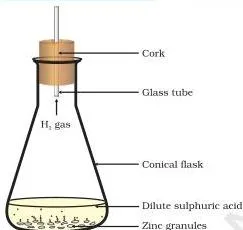
Remember the four as “Smart Chemists Get Tense”: State, Colour, Gas, Temperature. One reaction can show several signs at once — in Activity 1.3, zinc granules with dilute acid give gas bubbles and the flask warms, so both “gas” and “temperature” appear together (NCERT, p. 2).
In Activity 1.1, the burning ribbon shows a colour change and a change in state at the same time (NCERT, p. 1). Activity 1.2 (lead nitrate solution plus potassium iodide solution) leaves the observation to you — keep the question in mind, because the recall questions on page 11 expect a yellow precipitate of lead iodide, which makes the reaction a double displacement one.
From Word Equations to Balanced Equations
Word equations describe a reaction in names; chemical equations describe it in formulae; balanced equations make sure the formulae obey the law of conservation of mass. This is the chapter’s toolkit, and everything later depends on it.
Reactants are the substances that undergo change, written on the left; products are the new substances formed, on the right (NCERT, p. 2). The arrow points from reactants to products. Magnesium + Oxygen → Magnesium oxide is the chapter’s first word equation (NCERT, p. 2).
Replacing names with formulae gives a chemical equation like \( \text{Mg} + \text{O}_2 \rightarrow \text{MgO} \). Count the atoms: one oxygen on the right, but two on the left. Because the numbers of atoms are unequal across the arrow, this form is a skeletal chemical equation (NCERT, p. 3).
Balancing exists because of the law of conservation of mass you learnt in Class IX — mass cannot be created or destroyed, so the number of atoms of each element must be the same on both sides (NCERT, p. 3). The book’s hit-and-trial example is the reaction of iron with steam.
The skeleton is \( \text{Fe} + \text{H}_2\text{O} \rightarrow \text{Fe}_3\text{O}_4 + \text{H}_2 \). The method runs in five moves (NCERT, pp. 3–5):
- Box every formula — then change nothing inside a box. Only coefficients, the numbers in front, may change.
- Count atoms on each side: Fe 1 vs 3, H 2 vs 2, O 1 vs 4. Oxygen is the element most out of balance.
- Balance the most crowded compound first — \( \text{Fe}_3\text{O}_4 \) has the most atoms, so start there. Four water molecules give four oxygen atoms: \( 4\text{H}_2\text{O} \).
- Balance hydrogen next — \( 4\text{H}_2\text{O} \) holds 8 hydrogen atoms, so the right side needs \( 4\text{H}_2 \).
- Balance iron last — three Fe atoms on the left. Verify: \( 3\text{Fe} + 4\text{H}_2\text{O} \rightarrow \text{Fe}_3\text{O}_4 + 4\text{H}_2 \).
The one rule you may never break: you may change a coefficient, never a subscript. \( 4\text{H}_2\text{O} \) means four water molecules; \( \text{H}_2\text{O}_4 \) would be a different substance that does not exist (NCERT, p. 4).
Then add the state symbols (NCERT, p. 5): (s) for solid, (l) for liquid, (g) for gas, and (aq) for a substance dissolved in water. In the iron–steam reaction, water is steam, so it is written \( \text{H}_2\text{O(g)} \).
Conditions such as pressure, temperature or sunlight go above or below the arrow — photosynthesis uses “Sunlight” over “Chlorophyll” (NCERT, p. 5).
Worked example — balancing the burning of propane, a reaction the chapter does not use, so try it on your own first. Propane burns in oxygen to give carbon dioxide and water.
Step 1 — write the skeleton: \( \text{C}_3\text{H}_8 + \text{O}_2 \rightarrow \text{CO}_2 + \text{H}_2\text{O} \) Step 2 — balance carbon first: 3 carbon atoms on the left need 3 on the right: \( \text{C}_3\text{H}_8 + \text{O}_2 \rightarrow 3\text{CO}_2 + \text{H}_2\text{O} \) Step 3 — balance hydrogen: 8 hydrogen atoms on the left need 4 water molecules: \( \text{C}_3\text{H}_8 + \text{O}_2 \rightarrow 3\text{CO}_2 + 4\text{H}_2\text{O} \) Step 4 — balance oxygen: the right side now holds \( 3 \times 2 + 4 \times 1 = 10 \) oxygen atoms, so the left needs \( 5\text{O}_2 \).
\[ \text{C}_3\text{H}_8 + 5\text{O}_2 \rightarrow 3\text{CO}_2 + 4\text{H}_2\text{O} \]
Step 5 — verify: carbon 3 = 3, hydrogen 8 = 8, oxygen 10 = 10.
Every element balances.
Final balanced equation with states: \( \text{C}_3\text{H}_8\text{(g)} + 5\text{O}_2\text{(g)} \rightarrow 3\text{CO}_2\text{(g)} + 4\text{H}_2\text{O(g)} \)
Combination and Exothermic Reactions
The first reaction family is the simplest idea in the chapter: several substances join to make one. When that joining also releases heat, the reaction carries a second label as well.
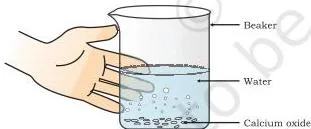
A combination reaction forms a single product from two or more reactants (NCERT, p. 6). In Activity 1.4, calcium oxide (quick lime) reacts vigorously with water:
\[ \text{CaO(s)} + \text{H}_2\text{O(l)} \rightarrow \text{Ca(OH)}_2\text{(aq)} + \text{Heat} \]
The beaker becomes warm because heat is given out with the product — that makes it exothermic (NCERT, p. 7). Other combination reactions: \( \text{C} + \text{O}_2 \rightarrow \text{CO}_2 \) (burning coal) and \( 2\text{H}_2 + \text{O}_2 \rightarrow 2\text{H}_2\text{O} \) (formation of water) (NCERT, p. 7).
The whitewashing link is worth carding (NCERT, p. 7): a solution of slaked lime, \( \text{Ca(OH)}_2 \), is used for whitewashing. It reacts slowly with carbon dioxide in the air to form a thin layer of calcium carbonate, \( \text{CaCO}_3 \), which gives walls their shiny finish. Marble is also \( \text{CaCO}_3 \).
Other exothermic reactions named in the chapter: burning of natural gas \( \text{CH}_4 + 2\text{O}_2 \rightarrow \text{CO}_2 + 2\text{H}_2\text{O} \); respiration, in which glucose combines with oxygen in your cells to release energy; and the decomposition of vegetable matter into compost (NCERT, p. 7).
The chapter then asks a summing-up question: Activity 1.1 — magnesium burning — is combination and exothermic, because it forms a single product and gives out heat (NCERT, p. 7).
Decomposition and Endothermic Reactions
Decomposition is the reverse habit of combination: one substance breaks into simpler ones. The chapter sorts decomposition reactions by the energy source that drives them (NCERT, p. 8).
A decomposition reaction is one in which a single reactant breaks down to give two or more simpler products (NCERT, p. 8). Three energy sources appear in the chapter:
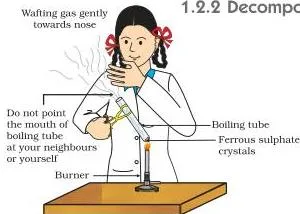
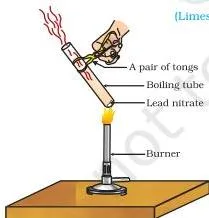
- Thermal decomposition (heat): green ferrous sulphate crystals change colour and give the smell of burning sulphur — \( 2\text{FeSO}_4 \xrightarrow{\text{Heat}} \text{Fe}_2\text{O}_3 + \text{SO}_2 + \text{SO}_3 \) (NCERT, p. 8). Limestone gives quick lime for cement — \( \text{CaCO}_3 \xrightarrow{\text{Heat}} \text{CaO} + \text{CO}_2 \) (NCERT, p. 8). Lead nitrate gives brown fumes of nitrogen dioxide — \( 2\text{Pb(NO}_3\text{)}_2 \xrightarrow{\text{Heat}} 2\text{PbO} + 4\text{NO}_2 + \text{O}_2 \) (NCERT, p. 9).
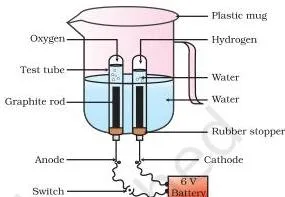
- Electrolytic decomposition (electricity): water, with a few drops of dilute acid, splits into hydrogen and oxygen in a 2:1 volume ratio (NCERT, p. 9).
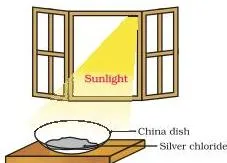
- Photolytic decomposition (light): white silver chloride turns grey in sunlight — \( 2\text{AgCl} \xrightarrow{\text{Sunlight}} 2\text{Ag} + \text{Cl}_2 \) — and silver bromide behaves the same way; these reactions are the basis of black-and-white photography (NCERT, pp. 9–10).
Because these reactions take in energy — heat, light or electricity — they are endothermic reactions (NCERT, p. 10). The chapter’s touch-test activity makes the point without a name: mix barium hydroxide with ammonium chloride and the test tube turns cold against your palm. A drop in temperature shows energy is being absorbed, so the reaction is endothermic (NCERT, p. 10).
Displacement and Double Displacement Reactions
The two families that share the word “displacement” work differently: one moves an element, the other swaps ions. The pattern table below tells them apart at a glance.
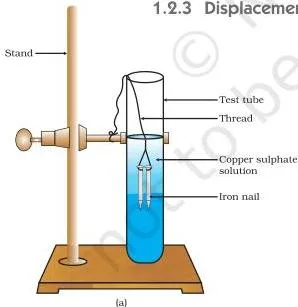
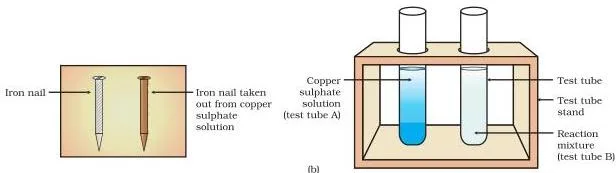
In a displacement reaction, a more reactive element removes a less reactive one from its compound (NCERT, pp. 10–11). In Activity 1.9, iron nails in copper sulphate solution show two changes: the blue colour fades and the nails pick up a brownish deposit of copper.
\[ \text{Fe(s)} + \text{CuSO}_4\text{(aq)} \rightarrow \text{FeSO}_4\text{(aq)} + \text{Cu(s)} \]
Zinc and lead behave the same way because they are more reactive than copper: \( \text{Zn} + \text{CuSO}_4 \rightarrow \text{ZnSO}_4 + \text{Cu} \) and \( \text{Pb} + \text{CuCl}_2 \rightarrow \text{PbCl}_2 + \text{Cu} \) (NCERT, p. 11).
In a double displacement reaction, two compounds exchange ions (NCERT, p. 11). In Activity 1.10, sodium sulphate and barium chloride give a white substance that does not dissolve in water — the precipitate, barium sulphate:
\[ \text{Na}_2\text{SO}_4\text{(aq)} + \text{BaCl}_2\text{(aq)} \rightarrow \text{BaSO}_4\text{(s)} + 2\text{NaCl(aq)} \]
Any reaction that produces an insoluble solid is called a precipitation reaction (NCERT, p. 11). The recall questions on page 11 connect Activity 1.2 to this family: lead nitrate plus potassium iodide gives a yellow precipitate of lead iodide, and the reaction is a double displacement one.
Pattern table — identify any reaction type from the shape of the equation. One line for each family:
| Shape of the equation | Reaction type | Quick test |
|---|---|---|
| \( A + B \rightarrow AB \) — two or more reactants, one product | Combination | Count the products: exactly one? |
| \( AB \rightarrow A + B \) — one reactant, two or more products | Decomposition | Count the reactants: exactly one? |
| \( A + BC \rightarrow AC + B \) — a free element plus a compound | Displacement | An element swaps places with one inside a compound? |
| \( AB + CD \rightarrow AD + CB \) — two compounds exchange partners | Double displacement | Two compounds swapped ions, often forming a precipitate? |
Oxidation, Reduction and Redox Reactions
The last family is named after what oxygen does to a substance. One partner gains oxygen, the other loses it, and both changes happen in the same reaction (NCERT, p. 12).
In Activity 1.11, copper powder is heated in air. The surface turns black because the copper gains oxygen:
\[ 2\text{Cu} + \text{O}_2 \xrightarrow{\text{Heat}} 2\text{CuO} \]
Passing hydrogen over the hot black coating turns it brown again:
\[ \text{CuO} + \text{H}_2 \xrightarrow{\text{Heat}} \text{Cu} + \text{H}_2\text{O} \]
Now the book names the change (NCERT, p. 13): a substance is oxidised when it gains oxygen or loses hydrogen, and reduced when it loses oxygen or gains hydrogen. In the second equation, copper(II) oxide loses oxygen (reduced), while hydrogen gains oxygen (oxidised).
Because one reactant is oxidised and the other reduced in the same reaction, it is called a redox reaction (NCERT, p. 12). The book’s other examples: \( \text{ZnO} + \text{C} \rightarrow \text{Zn} + \text{CO} \) (carbon oxidised, ZnO reduced) and \( \text{MnO}_2 + 4\text{HCl} \rightarrow \text{MnCl}_2 + 2\text{H}_2\text{O} + \text{Cl}_2 \) (NCERT, p. 12).
Mnemonic: gaining Oxygen means Oxidised — both begin with O. Its partner loses oxygen and is reduced. And remember the hydrogen half of the definition: oxidation can also be a loss of hydrogen, reduction a gain of hydrogen (NCERT, p. 13).
Worked example — a redox reaction the chapter does not use. In the reaction \( \text{Fe}_2\text{O}_3 + 3\text{CO} \rightarrow 2\text{Fe} + 3\text{CO}_2 \), follow the oxygen:
Step 1 — count oxygen on each side: \( \text{Fe}_2\text{O}_3 \) carries three oxygen atoms; \( 3\text{CO} \) carries three more.
The oxygen ends up entirely in \( 3\text{CO}_2 \).
Step 2 — decide each partner: \( \text{Fe}_2\text{O}_3 \) loses oxygen, so it is reduced.
\( \text{CO} \) gains oxygen, so it is oxidised.
Step 3 — verify the atom count: Fe 2 = 2, C 3 = 3, O 6 = 6.
Balanced.
Final answer: iron(III) oxide is reduced and carbon monoxide is oxidised; the reaction is a redox reaction.
The chapter closes the section by turning its own opening activity back on you: in Activity 1.1, magnesium gains oxygen, so magnesium is being oxidised (NCERT, p. 13).
Corrosion and Rancidity: Oxidation in Daily Life
The chapter’s last pair of ideas shows oxidation leaving the lab and appearing on kitchen shelves and metal gates. Both are everyday versions of the gain-of-oxygen idea, and both have practical fixes (NCERT, p. 13).
Corrosion is what happens when a metal is attacked by the substances around it — air, moisture, acids. Iron gets a reddish-brown coat of rust, silver a black coating, copper a green coating; the damage shows on car bodies, bridges, iron railings and ships (NCERT, p. 13).
Rancidity is what happens when fats and oils in food are oxidised: the smell and taste change, and the food is said to be rancid. Slowing it down is why antioxidants are added to such foods, why storage in airtight containers helps, and why chips packets are flushed with nitrogen (NCERT, p. 13).
Side by side, the two are easy to keep apart:
| Corrosion | Rancidity | |
|---|---|---|
| What gets oxidised | A metal — for example iron | Fats and oils in food |
| What you observe | Reddish-brown rust on iron, black coating on silver, green coating on copper | Change in the smell and taste of food |
| How it is prevented | Painting keeps air and moisture away from the metal surface (the point of Exercise 18) | Antioxidants, airtight containers, flushing with nitrogen (NCERT, p. 13) |
Reading the Figures in Chapter 1
The chapter teaches through experiments, and each figure captures the one observation you must be able to reproduce in an answer. Read each figure with its explanation; the observation paired with the equation is what activity questions test.
Figure 1.2: Hydrogen Gas From Zinc and Dilute Acid
This is the set-up for Activity 1.3: zinc granules drop into dilute acid, and bubbles rise through the liquid (NCERT, p. 2). The bubbles are the “evolution of a gas” sign, and the warming tube is the “change in temperature” sign — two signs in one activity.
The reaction is later written as \( \text{Zn} + \text{H}_2\text{SO}_4 \rightarrow \text{ZnSO}_4 + \text{H}_2 \) (NCERT, p. 3), so the bubbles are hydrogen gas.
Figure 1.3: Quick Lime and Water Make Slaked Lime
The hand in Fig. 1.3 is doing the observation for Activity 1.4: touching the beaker to feel the heat. Quick lime and water combine to form slaked lime and release heat:
\[ \text{CaO(s)} + \text{H}_2\text{O(l)} \rightarrow \text{Ca(OH)}_2\text{(aq)} + \text{Heat} \]
This one reaction carries two labels — combination (single product) and exothermic (heat given out) — and it is the source of the whitewashing reaction on page 7 (NCERT, p. 6).
Figures 1.4 and 1.5: Heating Ferrous Sulphate and Lead Nitrate
Both figures show thermal decomposition in a boiling tube, and each gives you an observation to memorise. Fig. 1.4 shows the correct way to heat the crystals and how to smell the odour safely (NCERT, p. 8). The green ferrous sulphate crystals change colour and give the smell of burning sulphur:
\[ 2\text{FeSO}_4 \xrightarrow{\text{Heat}} \text{Fe}_2\text{O}_3 + \text{SO}_2 + \text{SO}_3 \]
Fig. 1.5 shows lead nitrate being heated while brown fumes of nitrogen dioxide rise (NCERT, p. 9):
\[ 2\text{Pb(NO}_3\text{)}_2 \xrightarrow{\text{Heat}} 2\text{PbO} + 4\text{NO}_2 + \text{O}_2 \]
The colour change and the brown fumes are the identifying observations for these two decomposition reactions.
Figure 1.6: Electrolysis of Water — Why One Gas Is Double the Other
Fig. 1.6 is the electrolysis set-up for Activity 1.7: carbon electrodes in water, with a few drops of dilute acid, and inverted test tubes collecting the gases (NCERT, p. 9). Bubbles form at both electrodes and displace the water.
Because water is \( \text{H}_2\text{O} \), hydrogen forms in twice the volume of oxygen, so the tube with the double volume holds hydrogen. This figure is the answer to the in-text question on page 10 — the activity’s own question. Decomposition driven by electricity is electrolytic decomposition.
Figure 1.7: Silver Chloride Turns Grey in Sunlight
In Fig. 1.7, silver chloride is left in sunlight and turns grey — the change that Activity 1.8 asks you to observe (NCERT, p. 9). The light decomposes the white salt:
\[ 2\text{AgCl} \xrightarrow{\text{Sunlight}} 2\text{Ag} + \text{Cl}_2 \]
Silver bromide does the same (NCERT, p. 10):
\[ 2\text{AgBr} \xrightarrow{\text{Sunlight}} 2\text{Ag} + \text{Br}_2 \]
The book notes these light-driven decompositions are the basis of black-and-white photography (NCERT, pp. 9–10). Light is the energy source, so this is photolytic decomposition.
Figure 1.8: Iron Nails in Copper Sulphate Solution
Fig. 1.8(a) shows iron nails tied with thread and dipped into blue copper sulphate solution; Fig. 1.8(b) lets you compare before and after (NCERT, pp. 10–11). After about twenty minutes the blue has faded and the nails carry a brownish deposit of copper metal.
Iron is more reactive than copper, so it displaces copper from the solution:
\[ \text{Fe(s)} + \text{CuSO}_4\text{(aq)} \rightarrow \text{FeSO}_4\text{(aq)} + \text{Cu(s)} \]
This is the chapter’s displacement reaction, and the same observation answers the in-text question on page 13 about why the colour changes.
Figure 1.9: A White Precipitate of Barium Sulphate
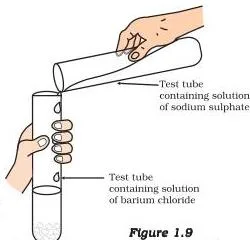
Fig. 1.9 shows Activity 1.10: sodium sulphate and barium chloride solutions are mixed, and a white solid appears that will not dissolve in water (NCERT, p. 11). That solid is the precipitate, barium sulphate:
\[ \text{Na}_2\text{SO}_4\text{(aq)} + \text{BaCl}_2\text{(aq)} \rightarrow \text{BaSO}_4\text{(s)} + 2\text{NaCl(aq)} \]
The reaction is a precipitation reaction and also a double displacement reaction, because the ions have exchanged partners.
Figure 1.10: Oxidation of Copper to Copper Oxide
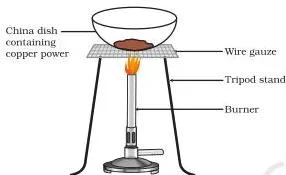
Fig. 1.10 shows copper powder being heated in a china dish, the surface turning black (NCERT, p. 12). The black coat is copper(II) oxide, formed as the copper gains oxygen:
\[ 2\text{Cu} + \text{O}_2 \xrightarrow{\text{Heat}} 2\text{CuO} \]
This is the chapter’s doorway into redox. When hydrogen passes over the hot black solid, the coating turns brown again as CuO loses oxygen (reduced) and hydrogen gains oxygen (oxidised) (NCERT, p. 12).
Key Terms and Their Definitions
Use this table as the chapter’s dictionary. Each definition is in plain words, and the page number sends you to the book’s own explanation.
| Term | What it means | NCERT page |
|---|---|---|
| Chemical reaction | A process in which substances change into new substances with different identities | p. 1 |
| Reactants | The starting substances, written on the left of the arrow, that undergo change | p. 2 |
| Products | The new substances formed, written on the right of the arrow | p. 2 |
| Word equation | A reaction written in names: reactants on the left, arrow, products on the right | p. 2 |
| Skeletal chemical equation | A formula equation that is not yet balanced | p. 3 |
| Balanced chemical equation | An equation with equal numbers of atoms of each element on both sides | p. 5 |
| Combination reaction | Two or more substances combine to form a single product | p. 6 |
| Exothermic reaction | A reaction that releases heat along with the products | p. 7 |
| Decomposition reaction | A single substance breaks into two or more simpler substances | p. 8 |
| Thermal decomposition | Decomposition carried out by heating | p. 8 |
| Electrolytic decomposition | Decomposition driven by electricity | p. 9 |
| Photolytic decomposition | Decomposition driven by light | p. 9 |
| Endothermic reaction | A reaction that absorbs energy | p. 10 |
| Displacement reaction | A more reactive element removes a less reactive one from its compound | p. 11 |
| Double displacement reaction | A reaction in which two compounds exchange ions | p. 11 |
| Precipitation reaction | A reaction that produces an insoluble solid | p. 11 |
| Precipitate | The insoluble solid formed in a reaction | p. 11 |
| Oxidation | Gain of oxygen or loss of hydrogen | p. 13 |
| Reduction | Loss of oxygen or gain of hydrogen | p. 13 |
| Redox reaction | A reaction in which one substance is oxidised and another is reduced | p. 12 |
| Corrosion | The attack on a metal by moisture, acids and similar surroundings | p. 13 |
| Rancidity | The change in smell and taste of fats and oils when they are oxidised | p. 13 |
| Antioxidant | A substance added to food to prevent oxidation | p. 13 |
What Each Activity Demonstrates
The fastest way to revise activity-based questions is to remember what you do, what you see, and which idea each activity proves. Name the activities as the book does — 1.1 through 1.11.
| Activity | What you observe | Reaction or idea it demonstrates |
|---|---|---|
| 1.1 Magnesium burnt in air | Dazzling white flame; white powder of magnesium oxide forms | Combination + exothermic: single product with heat (NCERT, p. 1) |
| 1.2 Lead nitrate + potassium iodide | Observation left for you — the recall question on page 11 expects a yellow precipitate of lead iodide | Double displacement / precipitation (NCERT, pp. 2, 11) |
| 1.3 Zinc + dilute acid | Bubbles of gas around the granules; the tube warms | Signs: gas + temperature; \( \text{Zn} + \text{H}_2\text{SO}_4 \rightarrow \text{ZnSO}_4 + \text{H}_2 \) (NCERT, pp. 2–3) |
| 1.4 Quick lime + water | Beaker becomes warm to the touch | Combination + exothermic: \( \text{CaO} + \text{H}_2\text{O} \rightarrow \text{Ca(OH)}_2 + \text{Heat} \) (NCERT, p. 6) |
| 1.5 Heating ferrous sulphate | Green crystals change colour; smell of burning sulphur | Thermal decomposition: \( 2\text{FeSO}_4 \rightarrow \text{Fe}_2\text{O}_3 + \text{SO}_2 + \text{SO}_3 \) (NCERT, p. 8) |
| 1.6 Heating lead nitrate | Brown fumes of nitrogen dioxide | Thermal decomposition: \( 2\text{Pb(NO}_3\text{)}_2 \rightarrow 2\text{PbO} + 4\text{NO}_2 + \text{O}_2 \) (NCERT, pp. 8–9) |
| 1.7 Electrolysis of water | Bubbles at both electrodes; gases collected in a 2:1 ratio | Electrolytic decomposition; hydrogen is the double-volume gas (NCERT, p. 9) |
| 1.8 Silver chloride in sunlight | White silver chloride turns grey | Photolytic decomposition: \( 2\text{AgCl} \rightarrow 2\text{Ag} + \text{Cl}_2 \); basis of black-and-white photography (NCERT, pp. 9–10) |
| 1.9 Iron nail in copper sulphate | Blue colour fades; nail gets a brownish deposit | Displacement: \( \text{Fe} + \text{CuSO}_4 \rightarrow \text{FeSO}_4 + \text{Cu} \) (NCERT, pp. 10–11) |
| 1.10 Sodium sulphate + barium chloride | A white substance insoluble in water forms | Precipitation / double displacement: \( \text{Na}_2\text{SO}_4 + \text{BaCl}_2 \rightarrow \text{BaSO}_4 + 2\text{NaCl} \) (NCERT, p. 11) |
| 1.11 Heating copper powder | Surface turns black; hydrogen restores the brown colour | Oxidation and redox: \( 2\text{Cu} + \text{O}_2 \rightarrow 2\text{CuO} \); \( \text{CuO} + \text{H}_2 \rightarrow \text{Cu} + \text{H}_2\text{O} \) (NCERT, p. 12) |
Common Mistakes and How to Avoid Them
Most marks in this chapter are lost on small habits, not on the chemistry. Watch for these eight.
| Mistake | Correct rule | How to check your answer |
|---|---|---|
| Changing a subscript to force a balance — writing \( \text{H}_2\text{O}_4 \) or \( (\text{H}_2\text{O})_4 \) | Coefficients change, subscripts never do: \( 4\text{H}_2\text{O} \) is four water molecules (NCERT, p. 4) | Every formula in the final equation must be identical to the original skeleton |
| Leaving out state symbols when the question asks for them | Add (s), (l), (g), (aq) after each formula (NCERT, p. 5) | Re-read the question: “with state symbols” means all four must appear |
| Writing \( \text{H}_2\text{O(l)} \) where steam is meant | In the iron–steam reaction water is steam, so it is \( \text{H}_2\text{O(g)} \) (NCERT, p. 5) | Ask: does the reaction need liquid water or hot steam? |
| Calling every two-reactant reaction a combination | Combination must give exactly ONE product (NCERT, p. 6) | Count the products; two or more means it is not combination |
| Calling a single-reactant break-up a combination | One reactant splitting into several products is decomposition (NCERT, p. 8) | Count the reactants; exactly one means decomposition |
| Mixing up displacement and double displacement | Displacement: one element displaces another. Double displacement: two compounds exchange ions (NCERT, p. 11) | Is a free element among the reactants? If yes, displacement |
| Forgetting oxidation can be loss of hydrogen | Oxidation = gain of oxygen OR loss of hydrogen; reduction = the reverse (NCERT, p. 13) | Check oxygen and hydrogen separately, not oxygen alone |
| Naming quick lime for whitewashing | Whitewashing uses slaked lime, \( \text{Ca(OH)}_2 \), formed from quick lime + water (NCERT, pp. 6–7) | Write the reaction: \( \text{CaO} + \text{H}_2\text{O} \rightarrow \text{Ca(OH)}_2 \) |
| Muddling corrosion with rancidity | Corrosion attacks metals; rancidity attacks fats and oils (NCERT, p. 13) | Ask what is being oxidised — a metal or a food fat? |
What the NCERT Questions Test
The questions in the book come in a few repeating shapes. Practise each shape once and you have covered the whole set; the question numbers below tell you where each shape lives.
- Balancing and writing equations with state symbols — the first question set on page 6 (hydrogen + chlorine, barium chloride + aluminium sulphate, sodium + water) and Exercises 5, 6 and 7. A full-marks answer shows the balanced equation, state symbols where the question asks for them, and a final check that each element balances.
- Identifying the reaction type from an equation — Exercise 1 (statements about \( 2\text{PbO} + \text{C} \)), Exercise 2 (\( \text{Fe}_2\text{O}_3 + 2\text{Al} \)), and Exercise 8 (write and identify four reactions). In-text question 3 on page 13 asks the same skill from the oxygen side: which substance is oxidised and which is reduced in \( 4\text{Na} + \text{O}_2 \rightarrow 2\text{Na}_2\text{O} \) and \( \text{CuO} + \text{H}_2 \rightarrow \text{Cu} + \text{H}_2\text{O} \).
- Definitions in the student’s own words — “What is a balanced chemical equation?” (Exercise 4), exothermic and endothermic with examples (Exercise 9), displacement vs double displacement (Exercise 13), precipitation (Exercise 15), oxidation and reduction with two examples each (Exercise 16), corrosion and rancidity (Exercise 20).
- Activity observations — why a magnesium ribbon is cleaned before burning (p. 6), why one gas is double the other in electrolysis (p. 10), why the copper sulphate colour fades (p. 13), the substance X for whitewashing (p. 10), and the shiny brown element that turns black on heating (Exercise 17 — copper, oxidising to copper oxide).
- Daily-life application — paint on iron articles (Exercise 18), nitrogen in food packets (Exercise 19), and why respiration is exothermic (Exercise 10).
- The silver-refining displacement question — Exercise 14: \( \text{Cu} + 2\text{AgNO}_3 \rightarrow \text{Cu(NO}_3\text{)}_2 + 2\text{Ag} \). Copper displaces silver from silver nitrate solution.
One honest note: textbook contents and the examinable syllabus are not always identical — check the current official CBSE syllabus before deciding how deeply to revise each part.
What You Have Learnt, in Short
The book’s closing “What you have learnt” list (NCERT, p. 14) is the fastest revision guide there is. In tighter words:
- A complete chemical equation shows the reactants, products and physical states symbolically.
- Every equation must be balanced so the numbers of atoms of each element are the same on both sides — the law of conservation of mass in equation form.
- Combination — two or more substances combine to form one new substance.
- Decomposition — one substance breaks into two or more; the opposite of combination.
- Exothermic — heat given out with the products; endothermic — energy absorbed.
- Displacement — an element displaces another element from its compound.
- Double displacement — two atoms or groups of atoms (ions) are exchanged.
- Precipitation reactions — reactions that produce insoluble salts.
- Oxidation — gain of oxygen or loss of hydrogen; reduction — loss of oxygen or gain of hydrogen.
Related NCERT Resources
This listing is maintained for the 2026-27 academic session using the NCERT textbook information available to us. NCERT remains the authority for confirming the latest edition.
If this chapter made sense, the natural next step is the next chapter, Acids, Bases and Salts, which uses the same equation language on a new set of reactions. For the rest of the book, the Class 10 Science notes go chapter by chapter, and the Class 10 hub collects every subject. New to the site?
The NCERT notes index is where all of it begins.
| What the chapter holds | Count | Where it is used |
|---|---|---|
| Printed pages | 16 | |
| Sections in the chapter | 12 | |
| Figures with NCERT captions | 10 | |
| Tables | 5 | |
| Exercise questions | 20 | answered in our NCERT Solutions |
| In-text questions | 8 | |
| Activities | 11 | |
| Official NCERT PDF | Download the chapter PDF | the chapter exactly as NCERT publishes it |
Reference: NCERT Class 10 Science textbook, chapter 1, official edition on ncert.nic.in.
Sources and Data Verification
This page describes the NCERT Class 10 Science textbook (Science), Chapter 1, Chemical Reactions and Equations, pages 1–16, in the official edition published on ncert.nic.in. It covers only this chapter of this book — not other chapters, other Class 10 subjects, or other editions.
This listing is maintained for the current academic session on the basis of the NCERT information available to us. NCERT settles textbook contents, editions and official PDFs; CBSE settles the curriculum, syllabus and examinations, so the exact examinable scope of this chapter is confirmed by the current official CBSE syllabus, not by the textbook alone.
Frequently Asked Questions
Why should a magnesium ribbon be cleaned before burning in air?
The ribbon carries a dull coating formed by its slow reaction with air. Rubbing it with sandpaper removes the coating and exposes fresh magnesium, so the metal burns readily with the dazzling white flame the activity expects (NCERT, pp. 1, 6).
Why is the gas collected in one test tube double the amount in the other during electrolysis of water?
Water is \( \text{H}_2\text{O} \): two hydrogen atoms for every oxygen atom, so electrolysis produces hydrogen and oxygen in a 2:1 volume ratio. The tube collecting the double volume holds hydrogen; the other holds oxygen (NCERT, p. 9).
Why does the blue colour of copper sulphate solution fade when an iron nail is dipped in it?
Iron is more reactive than copper, so it displaces copper from copper sulphate. Blue \( \text{CuSO}_4 \) becomes pale \( \text{FeSO}_4 \), while brownish copper metal deposits on the nail: \( \text{Fe(s)} + \text{CuSO}_4\text{(aq)} \rightarrow \text{FeSO}_4\text{(aq)} + \text{Cu(s)} \) (NCERT, p. 11). This is a displacement reaction.
Why are decomposition reactions called the opposite of combination reactions?
Combination joins two or more substances into a single product; decomposition starts with a single substance and breaks it into two or more simpler ones. Each reverses the other, which is why the book pairs them (NCERT, pp. 8, 14).
Why is respiration considered an exothermic reaction?
During respiration, glucose combines with oxygen in the cells and releases energy: \( \text{C}_6\text{H}_{12}\text{O}_6 + 6\text{O}_2 \rightarrow 6\text{CO}_2 + 6\text{H}_2\text{O} + \text{energy} \). Because heat and usable energy come out with the products, respiration is classed as exothermic (NCERT, p. 7).
Why are oil and fat containing food items flushed with nitrogen gas?
Fats and oils turn rancid when oxygen oxidises them, changing their smell and taste. Nitrogen is an unreactive gas, so filling the packet with it pushes out the oxygen and slows that oxidation down (NCERT, p. 13). The same idea explains why antioxidants are added to such foods.
Explore Class 10 Science Books
Related chapters:
- Metals and Non-metals
- Carbon and its Compounds
- Life Processes