
This page is for Chapter 7, “How do Organisms Reproduce?”, from the NCERT Science textbook for Class 10 — the chapter that traces reproduction from a single DNA copy to a nine-month pregnancy and the birth of a new individual.
The chapter runs over about 15 printed pages, starting at page 112 of the current NCERT edition, and this page is maintained for the current academic session. The official NCERT PDF is right below; underneath it, every idea in the chapter is explained in order.
Download the Official NCERT Chapter PDF
Here is the chapter exactly as NCERT printed it, straight from the official source, so you can read it in its original layout with every figure, activity and question intact. Download the How do organisms reproduce? Class 10 NCERT Science Chapter 7 PDF to read the full chapter exactly as NCERT printed it, from page 112 onward (file jesc107.pdf).
You can also verify the current list of NCERT textbooks on the official NCERT textbook page.
Chapter at a Glance
The table below gives the chapter’s size in one scan — what it holds in sections, figures, activities and questions — so you know the shape of the file before you open it. Use the table to plan your reading, then work through the explanations that follow.
What This Chapter Covers: From DNA Copies to Contraception
The book builds one continuous argument, and this roadmap shows where each idea sits so you always know where the chapter is heading. Follow the stops in order, with your own book open beside you.
- Why reproduce at all? (p. 112) — Reproduction is not needed to keep an individual alive, yet every species does it. The chapter opens with this puzzle before explaining the mechanisms.
- DNA copying and variation (pp. 112–114) — Reproduction begins with copying the DNA blueprint. Because copying is imperfect, offspring are similar but not identical; that variation is what lets a species survive a changed environment.
- Asexual reproduction (pp. 115–118) — Fission in Amoeba, Leishmania and Plasmodium; regeneration and budding in Hydra and Planaria; vegetative propagation and tissue culture in plants; spore formation in Rhizopus.
- Sexual reproduction and meiosis (p. 119) — Why combining DNA from two parents creates more variation, and how meiosis stops the chromosome number from doubling every generation.
- Flowering plants (pp. 120–121) — From flower structure and pollination to fertilisation, seed and fruit.
- Human reproduction (pp. 121–123) — Puberty, the male and female reproductive systems, and the placenta.
- Reproductive health (pp. 124–125) — Menstruation, contraception and sexually transmitted infections.
Key Concepts Explained: The Ideas Behind Reproduction
This section works through the chapter’s ideas in the order the book presents them, with the NCERT page beside each one so you can keep a finger on your own copy. Each topic opens with the single idea you need before the details.
DNA Copying and Variation: Why Offspring Are Similar but Not Identical
Reproduction begins with copying the blueprint of the body, the DNA — and because the copying is never perfectly reliable, offspring end up similar to, but not identical with, their parents.
DNA is the information source. The DNA in the cell nucleus carries the information for making proteins. If the information changes, different proteins are made, and different proteins eventually mean altered body designs. That is why the basic event in reproduction is creating a DNA copy (NCERT, p. 113).
Making the copy is only half the job. A cell uses chemical reactions to build the second DNA copy, but that copy also needs organised cellular structure to stay alive.
So DNA copying is accompanied by the creation of additional cellular apparatus — the cell builds everything a second working cell needs — and then the two copies separate, each with its own apparatus. In effect, one cell divides to give two cells (NCERT, p. 113).
Copying errors are the source of variation. No biochemical reaction is absolutely reliable, so every copying round adds some variation. A newborn cell survives only if its DNA copy can work with the cellular apparatus it inherits; drastic variations are lethal, while mild ones persist. The surviving cells are therefore similar to, but subtly different from, one another.
Why the species needs variation. Populations fill niches — definite places in the ecosystem. If a niche changes beyond the organisms’ control, a population with no variation can be wiped out. The book’s example is bacteria in temperate waters: when the water warms, most die, but the few heat-resistant variants survive and grow (NCERT, p. 114).
An example with rabbits instead of bacteria. The same logic works for a rabbit population in a region where winters are turning colder. Most rabbits die in the first harsh winter, but any that happened to be born with thicker fur survive, breed and pass the trait on. The individual variants are not protected — the species is.
The book calls this inbuilt tendency to vary during reproduction the basis for evolution, and says it will take the idea up in the next chapter (NCERT, p. 113). It then asks two questions on page 114: what makes DNA copying important in reproduction, and why variation helps the species rather than the individual.
Fission: How Unicellular Organisms Multiply
In unicellular organisms, a single cell division can deliver a whole new individual — reproduction and cell division become the same event.
- Binary fission — many bacteria and protozoa split into two equal halves. Amoeba can divide in any plane, while Leishmania, which has a whip-like flagellum at one end, divides in a definite orientation relative to that structure (NCERT, p. 115).
- Multiple fission — the malarial parasite Plasmodium divides into many daughter cells at the same time (NCERT, p. 116).
- Yeast — instead of splitting, it puts out small buds that separate and grow further, which Activity 7.1 shows under a microscope (NCERT, p. 115).
- Spirogyra and the limits of simple division — this pond alga simply breaks into fragments that grow into new individuals. Complex multicellular organisms cannot divide cell by cell, because their specialised cells are organised into tissues, and tissues into organs fixed at definite positions (NCERT, p. 116).
The figures for the fission patterns — Fig 7.1(a), 7.1(b) and 7.2 — are read in the walkthrough below.
Regeneration and Budding: New Individuals from Body Parts
Some organisms can grow back a whole body from a piece of themselves — but the chapter is careful to say that this ability is not the same as reproduction.
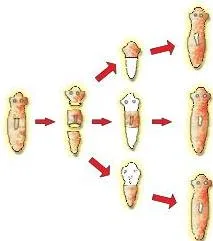
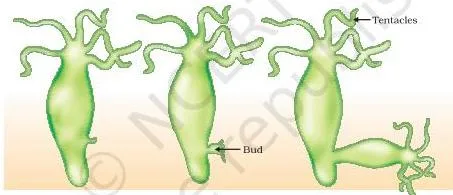
- Regeneration — Hydra and Planaria can be cut into any number of pieces and each piece grows into a complete organism. The work is done by specialised cells that first proliferate, then change into different cell types in an organised sequence called development (NCERT, p. 116).
- The book’s warning — regeneration is not reproduction, because most organisms do not normally depend on being cut up in order to reproduce (NCERT, p. 116).
- Budding — Hydra uses the same regenerative cells for reproduction. A bud develops as an outgrowth from repeated cell division at one spot, then separates (NCERT, p. 117). Yeast buds the same way, as Activity 7.1 showed.
Fig 7.3 and 7.4, read in the walkthrough below, make the stages of both processes visible.
Vegetative Propagation and Spore Formation: Reproduction Without Seeds
Plants can grow new individuals from ordinary body parts — a root, a stem or a leaf — which is why a potato piece with a notch sprouts shoots.
- Vegetative propagation — roots, stems and leaves develop into new plants under appropriate conditions. It is used commercially through layering and grafting for plants such as sugarcane, roses and grapes (NCERT, p. 117).
- Its advantages — plants bear flowers and fruits earlier; it makes propagation possible for banana, orange, rose and jasmine, which have lost the capacity to produce seeds; and every offspring is genetically similar enough to the parent to share all its characteristics (NCERT, p. 117).
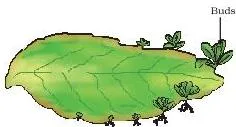
- Bryophyllum — buds form in the notches along the leaf margin, fall on the soil and develop into new plants (NCERT, p. 118; Fig 7.5). Activity 7.5 shows the same principle in potato: only pieces carrying a notch or bud give rise to fresh shoots and roots.
- Tissue culture — cells taken from the growing tip of a plant divide rapidly in an artificial medium to form a callus. The callus is transferred to a medium containing hormones for growth and differentiation, and the plantlets that form are planted in soil. Many plants can be grown from one parent in disease-free conditions — a technique commonly used for ornamental plants (NCERT, p. 118).
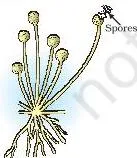
- Spore formation — in the bread mould Rhizopus, the thread-like hyphae are not reproductive parts; the tiny blob-on-a-stick structures, the sporangia, contain spores. The spores have thick walls that protect them until they reach a moist surface and begin to grow (NCERT, p. 118; Fig 7.6). Activity 7.2 first grows these moulds on wet bread.
Asexual Reproduction at a Glance: Modes Compared
When the modes begin to blur together, put them side by side: this table separates each mode by what actually makes the new individual.
| Mode | Example organisms | What produces the new individual | NCERT page |
|---|---|---|---|
| Binary fission | Amoeba, Leishmania | A parent cell splits into two roughly equal halves | 115 |
| Multiple fission | Plasmodium | A parent cell divides into many daughter cells at once | 116 |
| Regeneration | Planaria, Hydra | A piece of the body regrows into a complete organism through specialised cells | 116 |
| Budding | Hydra, yeast | An outgrowth at one spot separates and grows further | 117 |
| Vegetative propagation | Potato, Bryophyllum, sugarcane, roses, grapes | A root, stem or leaf develops into a new plant | 117–118 |
| Spore formation | Rhizopus | Spores inside sporangia grow on a moist surface | 118 |
The Sexual Mode: Why Meiosis Keeps the Chromosome Number Constant
Combine DNA from two individuals and the amount would double every generation — meiosis is the way organisms keep the count constant.
Why combine at all? DNA copying is precise enough that variation accumulates slowly. But every new variation is added to copies that already carry past variations, so two individuals in a population carry different patterns of accumulated variation.
Combining DNA from two individuals creates novel combinations — and since both starting variants come from living individuals, the combinations begin free of lethal defects (NCERT, p. 119).
The doubling problem. If each new generation combined the DNA of two parents, it would end up with twice the DNA of the previous generation, which would disrupt the DNA’s control of the cellular apparatus (NCERT, p. 119).
The meiosis solution. Complex multicellular organisms keep special lineages of cells in specialised organs — germ-cells — made by meiosis. These cells carry only half the number of chromosomes and half the amount of DNA of body cells. When two germ-cells fuse, the full number is re-established in the new generation (NCERT, p. 119).
Worked example with original numbers. Suppose a body cell contains 46 chromosomes in 23 pairs. Meiosis produces germ-cells with 23 single chromosomes each. At fertilisation the two germ-cells fuse: a male germ-cell with 23 chromosomes joins a female germ-cell with 23 chromosomes to give a zygote with 46.
The offspring’s body cells again have 46 chromosomes in 23 pairs — the number has been restored, not doubled, and it stays constant generation after generation.
The two gametes. The germ-cells also specialise. One is large and stores food — the female gamete. The other is smaller and motile — the male gamete. The need to make and deliver these two different gametes shapes the male and female reproductive organs (NCERT, p. 119).
Sexual Reproduction in Flowering Plants: From Pollination to Germination
In flowering plants the flower is the reproductive organ — this section follows one pollen grain from the stamen all the way to a germinating seed.
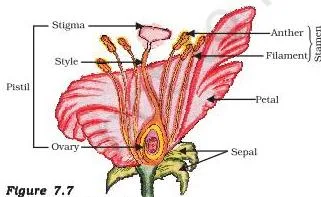
- Flower structure — the stamen is the male part and makes yellowish pollen grains. The pistil, at the centre, has three parts: the stigma (terminal, often sticky), the style (middle, elongated) and the ovary (swollen base). The ovary contains ovules, and each ovule holds an egg cell (NCERT, p. 120).
- Unisexual and bisexual flowers — a flower may carry only stamens or only a pistil (papaya, watermelon) or both (Hibiscus, mustard) (NCERT, p. 120).
- Pollination — the transfer of pollen from the stamen to the stigma. Within the same flower it is self-pollination; from one flower to another it is cross-pollination, brought about by wind, water or animals (NCERT, p. 120).
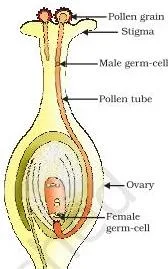
- The pollen tube — after landing on a suitable stigma, a tube grows out of the pollen grain and travels through the style to reach the ovary (NCERT, p. 120).
- Fertilisation — the fusion of the male germ-cell with the egg cell in the ovule, forming the zygote (NCERT, p. 120).
- Seed and fruit — the zygote divides to form an embryo inside the ovule; the ovule develops a tough coat and becomes a seed; the ovary ripens into a fruit; petals, sepals, stamens, style and stigma shrivel; and the seed germinates into a seedling (NCERT, pp. 120–121).
A mnemonic for the pollen tube’s path: think “SSO” — the pollen lands on the Sticky stigma, Slides down the Style, and Stops at the Ovary. That is the same order you label the parts in a flower diagram.
The difference that matters: pollination moves pollen to the stigma — transport only. Fertilisation fuses germ-cells. The book asks you to state this difference directly on page 126.
Reproduction in Human Beings: Puberty, Organs and the Placenta
Humans reproduce sexually, and this section moves from the changes you can see during adolescence to the organs and tissues you cannot see.
Puberty. While the body is growing, its resources go into growth, so reproductive tissue matures late. As the rate of general body growth slows, reproductive tissues begin to mature — this period of adolescence is puberty (NCERT, p. 122). The changes are gradual, and neither the timing nor the speed is the same for any two people (NCERT, p. 121).
- Changes common to boys and girls — thick hair in new places such as the armpits and genital area, thinner hair on legs, arms and face, oily skin with pimples, and new awareness of one’s own body (NCERT, p. 121).
- Changes in girls — breast size increases, the nipples darken, and menstruation begins (NCERT, p. 121).
- Changes in boys — new thick facial hair appears, the voice cracks, and the penis may occasionally become enlarged and erect (NCERT, p. 121).
- Why these signals exist — if mating is to happen, an animal’s state of sexual maturity must be identifiable by other individuals (NCERT, p. 122).
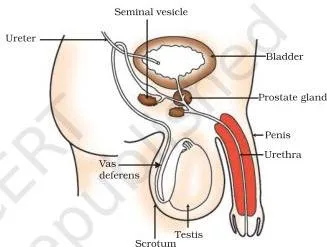
Male reproductive system (NCERT, p. 123). The testes create sperms, and they sit outside the abdominal cavity in the scrotum because sperm formation requires a lower temperature than normal body temperature. A common wrong guess — that the scrotum is there to protect the testes from injury — is not the book’s reason.
Testosterone, discussed in the previous chapter, regulates sperm formation and the appearance changes of puberty. Sperms travel through the vas deferens, which unites with a tube from the urinary bladder, making the urethra a common passage for both sperms and urine. The prostate and seminal vesicles add secretions that ease transport and provide nutrition.
Each sperm is mostly genetic material with a long tail that helps it move towards the female germ-cell.
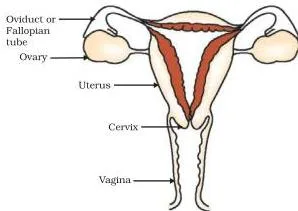
Female reproductive system (NCERT, p. 123). The ovaries make eggs and some hormones. A girl is born with thousands of immature eggs; from puberty, one egg is produced roughly every month. The egg is carried through a thin fallopian tube (oviduct) to the uterus — an elastic, bag-like structure that opens into the vagina through the cervix.
Sperms enter through the vagina and travel up to the oviduct, where fertilisation can occur.
From zygote to birth. The fertilised egg divides to form a ball of cells, the embryo, which implants in the lining of the uterus and develops organs to become the foetus.
The embryo gets nutrition from the mother’s blood through the placenta — a disc embedded in the uterine wall, with villi on the embryo’s side and blood spaces on the mother’s side, giving a large surface area for glucose and oxygen to pass across, and for wastes to pass back.
Development inside the mother takes about nine months, and the child is born through rhythmic contractions of the uterine muscles (NCERT, p. 123).
Reproductive Health: Menstruation, Contraception and STDs
The closing section connects the biology to real decisions — what the body does when there is no pregnancy, and the ways people prevent one.
Menstruation. If the egg is not fertilised, it lives for about one day. The uterus had prepared a thick, spongy lining to receive a fertilised egg; when no embryo arrives, the lining breaks down and comes out through the vagina as blood and mucus, usually for about two to eight days. This roughly monthly cycle is menstruation (NCERT, p. 124).
Readiness is not automatic. Some degree of sexual maturation does not mean the body or mind is ready for sexual activity or for raising children — pregnancy makes major demands on both (NCERT, p. 125).
Sexually transmitted infections. Gonorrhoea and syphilis are bacterial; warts and HIV-AIDS are viral. A condom on the penis during sex reduces the transmission of many of these infections (NCERT, p. 125).
Contraception (NCERT, p. 125) falls into categories:
- Mechanical barriers — condoms on the penis or coverings in the vagina stop sperm from reaching the egg.
- Hormonal pills — they change the hormonal balance so eggs are not released, but they can cause side-effects.
- Intrauterine devices — the loop or copper-T is placed in the uterus to prevent pregnancy; irritation of the uterus can cause side-effects.
- Surgical methods — blocking the vas deferens in the male or the fallopian tubes in the female prevents fertilisation; safe in the long run, though surgery can cause infections if not performed properly.
The book’s warning. Surgery can also be misused, as in illegal sex-selective abortion of female foetuses. Prenatal sex determination is prohibited by law, yet the child sex ratio is declining at an alarming rate in some sections of society (NCERT, p. 125).
Birth and death rates determine a population’s size, and an expanding population makes it harder to improve everyone’s standard of living (NCERT, p. 125).
Figure Walkthrough: Reading the Diagrams This Chapter Asks You to Draw
The diagrams are where the chapter’s distinctions become visible. Each one below carries its NCERT caption and a note on what to actually look at and label — so “look at the figure” becomes “know what it shows”.
Amoeba and the Patterns of Fission
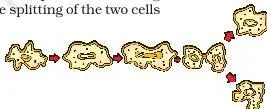
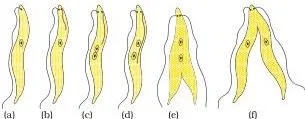
These three drawings make one distinction visible: how many new cells come from one parent cell, and in what direction the division happens. One parent cell, two outcomes — that is the whole point.
The binary fission in Amoeba figure (Fig 7.1(a)) shows a single rounded cell dividing into two roughly equal halves. Amoeba can divide in any plane, so the split in the drawing can run anywhere — there is no fixed top or bottom (NCERT, p. 115).
If you have to draw it, show one parent cell becoming two similar cells, and label both halves.
Fig 7.1(b) shows binary fission in Leishmania, the parasite that causes kala-azar. Because one end of the cell carries a whip-like flagellum, division happens in a definite orientation relative to that structure. Notice how the split line in the drawing sits in a fixed direction — that orientation is the entire point of the figure (NCERT, p. 115).
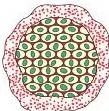
Fig 7.2 shows multiple fission in Plasmodium, the malarial parasite. Instead of two equal halves, the parent cell breaks into many daughter cells at the same time. The contrast with Fig 7.1 is the concept: two cells from one in binary fission, many cells from one in multiple fission (NCERT, p. 116).
Regeneration, Budding and Spore Formation
Three different answers to one question — “how does one individual become many?” — and each figure shows the stages in order.
Fig 7.3 maps regeneration in Planaria across stages: a piece of the worm, a growing mass of cells, and finally a complete organism. What matters for the concept is that the stages are organised — the book calls this sequence development, and it is carried out by specialised cells, not by any cell at all (NCERT, p. 116).
Fig 7.4 shows budding in Hydra as a series: a bud appears as an outgrowth from repeated cell division at one spot, enlarges, and eventually separates as a new individual (NCERT, p. 117). In a drawing, label the bud and the parent body — the bud is drawn smaller and still attached.
Fig 7.6 is the bread mould Rhizopus, first grown in Activity 7.2. The thread-like hyphae are not reproductive. The blob-on-a-stick structures are the sporangia, and inside each lie the spores. The concept to take away: a spore’s thick wall protects it until it reaches a moist surface and begins to grow (NCERT, p. 118).
If asked to draw it, show sporangia at the tips of hyphae and label both — but remember which one is reproductive.
Vegetative Propagation: The Bryophyllum Leaf
A single leaf can carry the next generation — the Bryophyllum diagram proves that a vegetative part, not a flower or seed, can reproduce the plant.
Fig 7.5 shows a leaf of Bryophyllum with buds along the notches of its margin. Those buds fall on the soil and develop into new plants (NCERT, p. 118). It pairs with Activity 7.5: in both, a vegetative part carries pre-formed buds that start a new plant. When you label the figure, mark the buds in the notches along the leaf edge.
The Flower: Unisexual and Bisexual Blooms, and the Pollen Tube
These two figures answer Exercise 7 (draw the flower’s longitudinal section) and the in-text question on pollination versus fertilisation — together they carry half the plant section’s marks.
The page-120 figure is a longitudinal section of a flower, and it carries the chapter’s distinction between unisexual and bisexual flowers. A unisexual flower (papaya, watermelon) carries either stamens or a pistil; a bisexual flower (Hibiscus, mustard) carries both.
When you label the section, name the sepals, petals, stamens, and the pistil’s three parts — stigma, style and ovary — with the ovules inside the ovary (NCERT, p. 120). This is the drawing Exercise 7 asks you to produce.
Fig 7.8, germination of pollen on stigma, shows what pollination sets up: a pollen grain resting on the stigma sends a tube through the style towards the ovule in the ovary. It is the visual bridge between pollination — transport of pollen to the stigma — and fertilisation — fusion of germ-cells inside the ovule (NCERT, p. 121).
Once you can see this route, the “SSO” mnemonic makes sense: Sticky stigma, Slide down the Style, Stop at the Ovary.
The Human Reproductive Systems: Diagrams to Practise Drawing
These two labelled diagrams are the ones students are most often asked to draw. Learn them by tracing a gamete’s path rather than memorising labels from the top down.
Fig 7.10 is the human male reproductive system, with the labels NCERT uses: the testes in the scrotum, the vas deferens, the seminal vesicles, the prostate, the urethra and the penis.
Learn the diagram by tracing the path of a sperm — formed in the testes, carried through the vas deferens, mixed with fluid from the seminal vesicles and prostate, and delivered through the urethra — instead of memorising top to bottom (NCERT, p. 123).
Fig 7.11 is the human female reproductive system. Trace the path of the egg to learn the labels: ovary → fallopian tube → uterus → cervix → vagina. Then trace the sperms’ path in reverse: they enter through the vagina, move up through the uterus and into the fallopian tube, where fertilisation can occur (NCERT, p. 123).
Labels that follow a gamete’s journey are far easier to recall than a random list.
Definitions: The Chapter’s Terms in Plain Words
This table is the chapter’s vocabulary in one place — each term explained the way a teacher would explain it, with the NCERT page where it appears.
| Term | Plain meaning | NCERT page |
|---|---|---|
| DNA | The molecule in the cell nucleus that carries the information for making proteins — the blueprint of body design | 113 |
| Variation | Small differences in DNA copies that arise because copying reactions are not perfectly reliable | 113–114 |
| Fission | Cell division in unicellular organisms that creates new individuals | 115 |
| Binary fission | Splitting of one cell into two roughly equal halves | 115 |
| Multiple fission | Division of one cell into many daughter cells at the same time | 116 |
| Regeneration | Growth of a complete organism from a piece of its body, carried out by specialised cells | 116 |
| Budding | Reproduction in which an outgrowth at one spot separates to form a new individual | 117 |
| Vegetative propagation | New plants developing from roots, stems or leaves of a parent plant | 117 |
| Spore | A thick-walled cell inside a sporangium that can grow into a new organism on a moist surface | 118 |
| Tissue culture | Growing new plants from cells of the growing tip, placed in an artificial medium | 118 |
| Gamete | A germ-cell; male gametes are small and motile, female gametes are large and store food | 119 |
| Meiosis | Cell division that makes germ-cells with half the chromosomes and half the DNA of body cells | 119 |
| Zygote | The cell formed when male and female germ-cells fuse at fertilisation | 120 |
| Pollination | Transfer of pollen from the stamen to the stigma | 120 |
| Self-pollination | Transfer of pollen within the same flower | 120 |
| Cross-pollination | Transfer of pollen from one flower to another, by wind, water or animals | 120 |
| Fertilisation | Fusion of the male germ-cell with the egg cell in the ovule to form a zygote | 120 |
| Embryo | The ball of cells formed when the zygote divides, which implants in the uterine lining | 123 |
| Foetus | The embryo after its organs have developed | 123 |
| Placenta | A disc embedded in the uterine wall through which the embryo gets nutrition and removes wastes | 123 |
| Puberty | The period of adolescence when reproductive tissues begin to mature as general body growth slows | 122 |
| Menstruation | The monthly shedding of the uterine lining as blood and mucus when the egg is not fertilised | 124 |
| Contraception | Any method used to avoid pregnancy | 125 |
Common Mistakes in This Chapter and How to Avoid Them
These are the confusions the chapter itself sets you up to notice. Each is corrected with the page where the book makes the distinction, and a way to check your own answer.
| Mistake | Correct rule | How to check your answer | NCERT page |
|---|---|---|---|
| Treating binary and multiple fission as the same | Binary fission makes two equal halves; multiple fission makes many daughter cells at once | Count the daughter cells in the drawing: two = binary, many = multiple | 115–116 |
| Confusing pollination with fertilisation | Pollination only transfers pollen to the stigma; fertilisation fuses germ-cells in the ovule | Ask whether any cells have fused — if not, it is pollination | 120–121 |
| Treating regeneration as the same as reproduction | Regeneration regrows a body from a piece; most organisms do not reproduce by being cut up | Check whether the process is the organism’s normal way of making offspring | 116 |
| Saying the male urethra carries only urine | The urethra is a common passage for both sperms and urine | Recall that the vas deferens joins a tube from the urinary bladder before the urethra | 123 |
| Describing the placenta as a simple cord | The placenta is a disc embedded in the uterine wall, with villi on the embryo side and blood spaces on the mother’s side | Ask whether your answer describes a large surface area for exchange | 123 |
| Expecting copper-T to protect against STDs | Copper-T is placed in the uterus to prevent pregnancy; condoms reduce disease transmission | Ask what the device stops: a pregnancy, or a germ | 124–125 |
| Saying variation protects the individual | Variation gives the species a chance when its niche changes; an individual that does not match the new niche dies | Test the heat-resistant bacteria example — which ones survive? | 113–114 |
| Saying the testes are outside the body for protection | Sperm formation needs a temperature lower than normal body temperature | Give the book’s stated reason — temperature, not protection | 123 |
Exam Notes: What the Chapter’s Own Questions Ask For
The book’s own questions are the most honest list of what it thinks matters. This section maps the in-text questions and the final exercises to the parts of the chapter that answer them.
Where the in-text questions sit
- Page 114 — the importance of DNA copying in reproduction; why variation benefits the species but not necessarily the individual.
- Page 119 — how binary fission differs from multiple fission; how an organism benefits from reproducing through spores; why complex organisms cannot give rise to new individuals through regeneration; why vegetative propagation is practised; why DNA copying is essential.
- Page 126 — how pollination differs from fertilisation; the role of the seminal vesicles and prostate gland; changes seen in girls at puberty; how the embryo gets nourishment; whether copper-T protects against sexually transmitted diseases.
The exercises on page 127 and where each answer lives
| Exercise | What it tests | Where the answer sits |
|---|---|---|
| 1 — budding takes place in | Identifying the budding organism | Budding in Hydra and yeast, p. 117 |
| 2 — not a part of the female system | Parts of the female reproductive system | Female system, p. 123 |
| 3 — the anther contains | Flower structure | Stamen and pollen grains, p. 120 |
| 4 — advantages of sexual reproduction | Why the sexual mode generates more variation | Sexual mode and meiosis, p. 119 |
| 5 — functions of the testis | Male reproductive organs | Male system, p. 123 |
| 6 — why menstruation occurs | The unfertilised egg and the uterine lining | Egg not fertilised, p. 124 |
| 7 — draw the flower’s longitudinal section | The flower diagram | Flower figure, p. 120 |
| 8 — methods of contraception | Contraceptive categories | Reproductive health, p. 125 |
| 9 — unicellular vs multicellular reproduction | Why body design decides the mode | Fission and complex body design, p. 116 |
| 10 — reproduction and population stability | Variation and niches | Importance of variation, pp. 113–114 |
| 11 — reasons for adopting contraceptives | Health and readiness | Reproductive health, pp. 124–125 |
The chapter repeats three question shapes — learn to recognise each one:
- Contrast questions: “how does X differ from Y” — binary versus multiple fission, pollination versus fertilisation.
- Function questions: “what is the role of Z” — testis, seminal vesicles and prostate, anther.
- Reasoning questions: “why does X happen or why is X essential” — menstruation, DNA copying, vegetative propagation, contraceptive adoption.
For worked answers to the chapter’s questions, see the Class 10 Science notes. Textbook contents and the examinable syllabus are not always identical — check the current official CBSE syllabus for what is actually tested, and never assume a specific question will appear in an exam.
The Chapter’s Activities: What Each One Demonstrates
The activities are the chapter’s evidence — each one builds a concept from something you can see at home or under a microscope. Here is the point of each observation.
- Activity 7.1 (p. 115) — yeast granules in sugar water, kept warm and then viewed under a microscope: you see small buds on the yeast cells, which is budding in action.
- Activity 7.2 (p. 115) — a wet bread slice kept cool, moist and dark: thread-like hyphae and tiny blob-on-a-stick sporangia form. The hyphae are not reproductive — the spores are.
- Activity 7.3 (p. 115) — permanent slides of a normal Amoeba and of one in binary fission: you compare a whole cell with a cell splitting into two.
- Activity 7.4 (p. 116) — pond-water filaments show that Spirogyra breaks into pieces that grow: simple multicellular organisms can reproduce by fragmentation.
- Activity 7.5 (p. 118) — potato pieces on moist cotton: only the pieces carrying a notch or bud grow shoots and roots, which is vegetative propagation.
- Activity 7.6 (p. 118) — money-plant cuttings with at least one leaf take root in water; stem pieces without leaves do not grow. Vegetative propagation again.
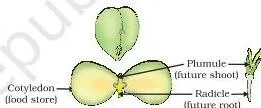
- Activity 7.7 (p. 121) — soaked Bengal gram seeds are cut open so you can see the seed’s parts, then compare them with Fig 7.9 below.
Activity 7.7 asks you to compare your cut-open seed with Fig 7.9 (above). The figure shows germination — the seed’s parts as the new plant begins to grow. Use it to identify the seed coat and the embryo inside your soaked seed (NCERT, p. 121).
Revision Summary: The Chapter in Ten Points
This condenses the book’s closing “What you have learnt” list into points you should be able to say from memory, in your own words.
- Reproduction is not essential to keep an individual alive — but species depend on it.
- Every reproduction involves creating a DNA copy plus additional cellular apparatus for the copy to work.
- The mode of reproduction depends on the organism’s body design.
- Asexual modes — fission, regeneration, budding, vegetative propagation, spore formation — create new generations from a single individual.
- Sexual reproduction involves two individuals and allows greater variation, which helps the species survive.
- Meiosis keeps the chromosome number constant: germ-cells carry half the chromosomes of body cells.
- In flowering plants, pollination is followed by fertilisation, then seed and fruit formation.
- Puberty changes — breast growth in girls, facial hair in boys — are signs of sexual maturation.
- Male system: testes, vas deferens, seminal vesicles, prostate, urethra, penis; female system: ovaries, fallopian tubes, uterus, vagina; fertilisation occurs in the fallopian tube.
- Contraception to avoid pregnancy: condoms, oral pills, copper-T and other methods.
Related Resources: The Rest of Class 10 Science
This listing is maintained for the 2026-27 academic session using the NCERT textbook information available to us. NCERT remains the authority for confirming the latest edition.
Continue studying without hunting around the site. These pages connect this chapter to the rest of the Class 10 Science book.
- Class 10 Science chapters — the full list of chapters in this book.
- Class 10 study resources — everything for the class, across subjects.
- CBSE notes home — jump to any class or subject.
- Chapter 6, Control and Coordination — where testosterone and the other hormones are first introduced.
- Chapter 8, Heredity — the next chapter, which builds on the variation introduced here as the basis for evolution.
Sources and Data Verification
Which book. Every page reference above describes the NCERT Science textbook for Class 10, Chapter 7 “How do Organisms Reproduce?”, file jesc107.pdf, official edition on ncert.nic.in.
What this page covers. This page details that one chapter of that one textbook. It does not describe the book’s other chapters in detail, and it does not cover any other Class 10 Science textbook.
What settles what. NCERT publishes the textbooks and their official PDFs; CBSE settles the curriculum, syllabus and examinations. Textbook contents and the examinable syllabus are not always identical — check the current official CBSE syllabus for what is tested.
| What the chapter holds | Count | Where it is used |
|---|---|---|
| Printed pages | 15 | |
| Sections in the chapter | 17 | |
| Figures with NCERT captions | 12 | |
| Exercise questions | 11 | answered in our NCERT Solutions |
| In-text questions | 12 | |
| Activities | 7 | |
| Official NCERT PDF | Download the chapter PDF | the chapter exactly as NCERT publishes it |
Reference: NCERT Class 10 Science textbook, chapter 7, official edition on ncert.nic.in.
Frequently Asked Questions
Why is DNA copying an essential part of reproduction?
Because DNA is the information source for making proteins, and body design depends on those proteins. Reproduction at its most basic level means creating a DNA copy, plus the cellular apparatus the copy needs to work — without the copy, there is no blueprint to pass on, so offspring could not resemble their parents (NCERT, p. 113).
How is pollination different from fertilisation?
Pollination is the transfer of pollen from the stamen to the stigma — transport only, with no cell fusion. Fertilisation is the fusion of the pollen’s male germ-cell with the egg cell inside the ovule, forming the zygote. Pollination must happen first; fertilisation completes the process (NCERT, pp. 120–121).
Why does menstruation occur?
The uterus thickens and fills with blood each month to receive a fertilised egg. If the egg is not fertilised — it lives for about one day — the lining is not needed, so it breaks down and comes out through the vagina as blood and mucus, usually for about two to eight days. This monthly cycle is menstruation (NCERT, p. 124).
If a woman is using a copper-T, will it protect her from sexually transmitted diseases?
No. The copper-T is placed in the uterus to prevent pregnancy; it does nothing against infections. To reduce the transmission of sexually transmitted diseases, the book points to a condom on the penis, which acts as a barrier (NCERT, pp. 124–125).
Where does fertilisation take place in the human female reproductive system?
In the fallopian tube (oviduct). The egg travels from the ovary through the oviduct towards the uterus, and sperms entering through the vagina move up through the uterus to the oviduct, where they may meet the egg. The chapter’s summary states it directly: fertilisation occurs in the fallopian tube (NCERT, p. 123 and p. 126).
Why is variation beneficial to the species but not necessarily for the individual?
A population fills a niche, and niches can change. If no variation exists and the niche shifts drastically, the whole population can be wiped out. Variation means a few individuals happen to suit the new conditions — they survive and breed.
The individuals that do not match the new niche die either way, so the benefit shows up over time in the species, not in each individual (NCERT, p. 114).
Explore Class 10 Science Books
Related chapters:
- Chemical Reactions and Equations
- Acids, Bases and Salts
- Metals and Non-metals