
NCERT Class 10 Science Chapter 6, Control and Coordination, is about how organisms detect changes in their surroundings and respond with carefully controlled movements. This page offers the official Control and Coordination Class 10 chapter PDF from NCERT, then explains what the chapter contains: the nervous system, plant movements, plant hormones, animal hormones and the endocrine system.
In the printed book the chapter runs from pages 100 to 112 of the current NCERT Science textbook for Class X. The official PDF is right below, and beneath it you will find a clear map of the chapter, a walkthrough of every figure, and the definitions and comparisons you need for the exercises.
Download the Control and Coordination Class 10 NCERT PDF
Open the Control and Coordination Class 10 chapter PDF to read the full lesson in the official NCERT layout, with all figures, activities, tables and exercises exactly as printed. The file is the official NCERT PDF of Chapter 6 in Science for Class X, hosted on ncert.nic.in, and is free to download and read on any device.
Control and Coordination Class 10: Chapter at a Glance
This section tells you what is inside the file before you download it. The chapter moves in three clear blocks:
- The nervous system in animals — receptors, nerve impulses, reflex actions, the brain, and how nervous tissue makes muscles move (NCERT pages 100-105).
- Coordination in plants — movement independent of growth, movement due to growth, tropisms, and the plant hormones that control them (NCERT pages 105-108).
- Hormones in animals — adrenaline, the endocrine glands, the hormones of Table 6.1, and the feedback mechanism that keeps hormone levels precise (NCERT pages 109-111).
The central idea running through all three blocks is a trade-off. Electrical nerve signals are very fast, but they reach only cells that are connected by nervous tissue and they need reset time before the next impulse. Chemical signals are slower, but they spread to every cell that can detect them and they can act steadily.
The chapter table on this page lists the exact totals for sections, figures, activities and questions.
What This Chapter Covers, and Why the Order Makes Sense
Before the details, here is the argument of the chapter in a few lines. Understanding this order makes every later section easier because each idea is introduced to solve the problem left by the previous one.
- Movement in response to the environment needs control and coordination: the right response must follow the right trigger (NCERT, p. 100).
- Animals use nervous and muscular tissue for this, with receptors in sense organs detecting stimuli (NCERT, p. 101).
- Reflex actions are handled by the spinal cord because thinking through every danger would be too slow (NCERT, pp. 102-103).
- The brain adds thinking, voluntary control and the involuntary control of vital actions (NCERT, pp. 103-105).
- But electrical impulses reach only connected cells and need time to reset, so a second, slower, wider-reaching system is needed: chemical coordination (NCERT, pp. 107-108).
- Plants have no nervous tissue, so they coordinate through growth movements and plant hormones (NCERT, pp. 105-108).
- Animals too use hormones from endocrine glands, regulated by feedback mechanisms (NCERT, pp. 109-111).
Key Concepts: Neurons, Reflexes and the Brain
These are the working ideas of the animal nervous system: how a signal travels, what a reflex arc is, and what each brain part does.
Receptors and the path of a nerve impulse
All information from the environment is detected by the specialised tips of nerve cells called receptors. They are usually located in sense organs: gustatory receptors detect taste, olfactory receptors detect smell (NCERT, p. 101).
A stimulus sets off a chemical reaction at the dendritic tip of a neuron, which creates an electrical impulse. The impulse travels from the dendrite to the cell body, then along the axon to its end.
At the end of the axon, the impulse triggers the release of chemicals that cross the gap, or synapse, and start a fresh impulse in the next neuron. A similar synapse finally carries the message to a muscle cell or gland (NCERT, p. 101).
Reflex action and the reflex arc
A reflex is a sudden response to a stimulus done without thinking about it. The textbook’s example is touching a flame: by the time the brain finished thinking about the pain and the danger, the hand could already be burnt.
So the body solves the problem with a shorter path called a reflex arc, formed in the spinal cord where input and output nerves first meet. The information also goes on to the brain, but the brain is not needed for the immediate pull-away (NCERT, pp. 102-103).
Trace this sequence for stepping on a sharp object:
- Receptors in the skin of the foot detect the sharp touch.
- A sensory neuron carries the impulse to the spinal cord.
- Inside the spinal cord, the impulse passes to a motor neuron through the reflex arc.
- The motor neuron carries the impulse to the leg muscles.
- The leg muscles pull the foot up.
- Meanwhile, information about the event also travels up to the brain, so you feel and understand it a moment later.
A similar trace applies to bright light focused on the eyes: the receptors are in the eyes, the reflex arc reduces the pupil or makes you blink, and the brain is informed afterwards.
The human brain
The brain and spinal cord together form the central nervous system, which receives information from all parts of the body and integrates it. Cranial and spinal nerves make up the peripheral nervous system, carrying messages between the centre and the rest of the body (NCERT, pp. 103-104).
- Fore-brain — the main thinking part. It has sensory areas for hearing, smell, sight and so on, association areas that interpret information, and a hunger centre that tells you when you have eaten enough (NCERT, p. 104).
- Mid-brain and hind-brain — control many involuntary actions like blood pressure, salivation and vomiting through the medulla in the hind-brain (NCERT, p. 104).
- Cerebellum — part of the hind-brain responsible for the precision of voluntary actions and for maintaining posture and balance (NCERT, p. 104).
Protection and muscle action
The brain sits inside a bony box, and inside that box it is contained in a fluid-filled balloon that absorbs shock. The spinal cord is protected by the vertebral column or backbone (NCERT, p. 105).
When a nerve impulse reaches a muscle, the muscle fibres shorten. Muscle cells contain special proteins that change their shape and arrangement in response to nervous electrical impulses, giving the cell a shorter form (NCERT, p. 105). This is how the final movement happens.
Key Concepts: How Plants Coordinate Without a Nervous System
Plants have neither nervous tissue nor muscles, yet they respond to stimuli. This section explains the two kinds of plant movement and the hormones behind them.
Two kinds of movement: with and without growth
When you touch the leaves of the chhui-mui (sensitive or touch-me-not plant), they fold up and droop. No growth is involved: plant cells change shape by changing their water content, swelling or shrinking, and that changes the shape of the leaves (NCERT, p. 106).
In contrast, a germinating seed pushes soil aside and its seedling moves because it is growing. If growth stops, that movement stops. So plants show growth-dependent movement and growth-independent movement (NCERT, pp. 105-106).
Tropic movements: growth in a particular direction
Tendrils of a pea plant are sensitive to touch. When a tendril meets a support, the side in contact grows less rapidly than the side away from it, so the tendril circles around the support and clings to it (NCERT, p. 106).
Light and gravity change the direction in which plant parts grow. These directional growth movements are called tropic movements:
- Phototropism — shoots bend towards light, roots bend away from it (NCERT, p. 107).
- Geotropism — roots grow downwards and shoots grow upwards in response to gravity (NCERT, p. 107).
- Hydrotropism — growth towards water, as the name suggests.
- Chemotropism — growth towards chemicals; the textbook’s example is the growth of pollen tubes towards ovules (NCERT, p. 107).
Activity 6.2 shows the key point about tropic movement: when a flask of germinating seeds is turned, the old parts of the shoot and root do not change direction. Only the new growth bends towards or away from light. So tropism is a property of growing regions, not of mature tissue (NCERT, p. 107).
Why electrical signals are not enough — the need for hormones
Fast responses need quick information transfer, and electrical impulses are excellent for that. But they have two limits: they reach only cells connected by nervous tissue, and a cell needs time to reset before it can transmit a new impulse.
Chemicals, on the other hand, diffuse around the cell that releases them, can be detected by any cell with the right surface molecules, reach all parts of the body, and act steadily. This is why multicellular organisms also use chemical communication (NCERT, pp. 107-108).
Plant hormones
Plant hormones are synthesised at one place and diffuse to the area where they act (NCERT, p. 108).
- Auxin — synthesised at the shoot tip; it helps cells grow longer. When light comes from one side, auxin diffuses towards the shady side, cells there grow longer, and the shoot bends towards light (NCERT, p. 108).
- Gibberellins — help in the growth of the stem (NCERT, p. 108).
- Cytokinins — promote cell division; found in greater concentration in fruits and seeds (NCERT, p. 108).
- Abscisic acid — inhibits growth; its effects include wilting of leaves (NCERT, p. 108).
Designing the hydrotropism experiment
The in-text questions ask you to design an experiment to demonstrate hydrotropism. Here is one complete design:
- Take a pot and sow a few germinating seeds in the middle of the soil.
- Place a moist cotton wad on one side of the pot, close to the inner wall, and keep the soil on the other side dry.
- Leave the pot undisturbed for a few days.
- Observe the direction in which the roots grow: they should bend towards the moist cotton wad.
- Keep a second control pot with the same setup but with soil kept uniformly moist all around.
- In the control pot, roots should grow straight down because there is no moisture gradient.
Key Concepts: Animal Hormones and the Endocrine System
Animal bodies also need chemical signals. This section explains why a hormone like adrenaline is necessary, what the endocrine glands do, and how feedback keeps hormone levels steady.
Adrenaline: preparing the body to fight or run
In a scary situation, the body must prepare for either fighting or running away. These activities use many tissue types together. If the body relied only on electrical impulses, only the cells connected by nerves would be prepared. A chemical signal, however, reaches all cells and produces the wide-ranging changes needed.
The hormone adrenaline, secreted by the adrenal glands directly into the blood, does this job (NCERT, p. 109).
Under adrenaline, the heart beats faster and supplies more oxygen to the muscles; blood to the digestive system and skin is reduced and diverted to skeletal muscles; and breathing rate increases. Together, these responses make the body ready to deal with the situation (NCERT, p. 109).
The endocrine glands and Table 6.1
Endocrine glands are part of the endocrine system, the body’s second way of control and coordination. Learning Table 6.1 is easier if you pair each hormone with its gland and its main function:
| Hormone | Endocrine gland | Main function |
|---|---|---|
| Growth hormone | Pituitary gland | Stimulates growth in all organs; deficiency in childhood causes dwarfism |
| Thyroxin | Thyroid gland | Regulates carbohydrate, protein and fat metabolism for body growth; needs iodine |
| Insulin | Pancreas | Regulates blood sugar level; deficiency raises blood sugar and causes diabetes |
| Testosterone | Testes | Development of male characteristics at puberty |
| Oestrogen | Ovaries | Development of female sex organs, regulates menstrual cycle |
| Adrenaline | Adrenal glands | Prepares the body for fight or flight |
| Releasing hormones | Hypothalamus | Stimulate the pituitary gland to release hormones |
A mnemonic for the gland order in Table 6.1: Pink Tigers Play Tunes, Old Aunt Howls — Pituitary, Thyroid, Pancreas, Testes, Ovaries, Adrenal, Hypothalamus. For the hormones in the same order: Great Tigers Inhale The Odour And Run — Growth hormone, Thyroxin, Insulin, Testosterone, Oestrogen, Adrenaline, Releasing hormones. Match the first with the first, second with second, and so on.
The Do You Know box adds one extra point: when the level of growth hormone is low, the hypothalamus releases growth hormone releasing factor, which stimulates the pituitary to release growth hormone (NCERT, p. 110).
The feedback mechanism
Hormones must be secreted in precise amounts. The timing and amount released are regulated by feedback mechanisms. For example, when blood sugar rises, cells of the pancreas detect it and produce more insulin; as the blood sugar level falls, insulin secretion is reduced (NCERT, p. 110).
Walkthrough of the Chapter’s Figures
Every NCERT figure in this chapter is a labelled diagram you can be asked to identify or reproduce. Here is what each one shows and what to notice about it.
Figure 6.1: Structure of a neuron and neuromuscular junction
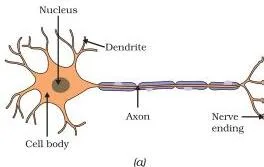
Information is acquired at the dendritic tip of the neuron. The electrical impulse travels through the cell body and along the axon. At the axon’s end, the impulse becomes a chemical signal that crosses the synapse and starts a new impulse in the next neuron (NCERT, p. 101).
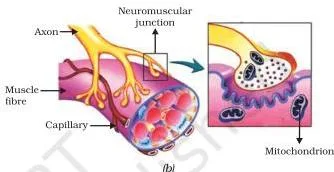
The second part of the figure shows the same chemical transfer happening where a neuron meets a muscle cell. This is how the nervous system finally causes movement.
Figure 6.2: Reflex arc
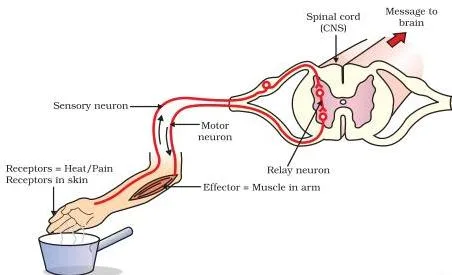
Follow the arrows: receptor to sensory neuron to spinal cord to motor neuron to muscle. The reflex arc is formed in the spinal cord because the input and output nerves meet there, which allows the fastest possible response. The information also travels onwards to the brain (NCERT, p. 103).
Figure 6.3: Human brain
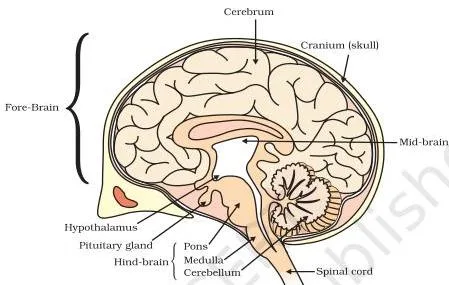
The figure shows the three major regions: fore-brain (thinking and sensory processing), mid-brain, and hind-brain (involuntary actions, with the medulla and cerebellum). The cerebellum, at the back of the hind-brain, maintains posture and balance (NCERT, p. 104).
Figure 6.4: The sensitive plant
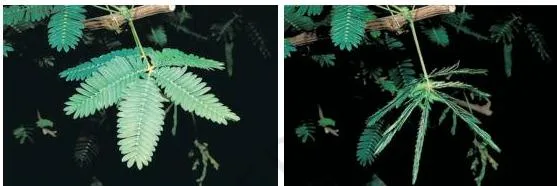
When touched, the leaves fold at a point different from where the touch happened, so information must be passed from cell to cell by electrical-chemical means. Movement happens because plant cells change their shape by changing their water content (NCERT, p. 106).
Figure: Growth is controlled in animals too
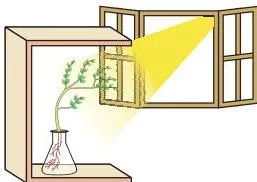
This figure makes the point that growth, and not only movement, is coordinated. Our arms and fingers grow in particular directions, not haphazardly. So controlled responses can be slow growth or fast movement, whichever the situation needs (NCERT, p. 107).
Figure 6.6: Plant showing geotropism
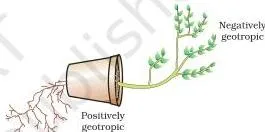
Roots grow downwards and shoots grow upwards in response to the pull of gravity. Contrast this with phototropism, where shoots bend towards light and roots away from it (NCERT, p. 107). Both are directional growth movements.
Figure 6.7: Endocrine glands in human beings
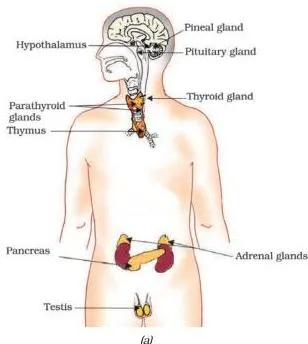
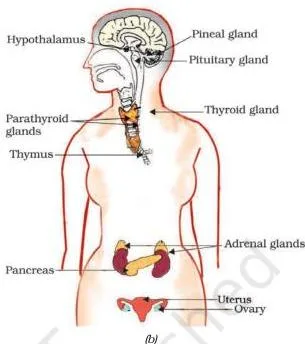
Locate the thyroid gland in the neck: this is why iodine deficiency produces goitre with a swollen neck. The adrenal glands sit above the kidneys and secrete adrenaline. The pancreas makes insulin, the pituitary controls growth, and the testes or ovaries produce the sex hormones (NCERT, pp. 109-110).
What the Chapter’s Activities 6.1 to 6.4 Teach
Activities are often skipped, but each one demonstrates an idea that can appear as a question. All four are quick to try at home.
- Activity 6.1 (page 101): Block your nose and eat sugar. The taste changes because smell receptors contribute to how we perceive taste — this is why food seems dull when you have a cold.
- Activity 6.2 (page 107): The conical flask with a wire mesh and germinating bean seeds shows shoots bending towards light and roots away from it. Turning the flask shows that old parts do not change direction — only new growth does. This is tropism in action.
- Activity 6.3 (page 109): Study Figure 6.7 and identify the endocrine glands. The activity asks you to consult books and teachers to find out about glands beyond those listed in Table 6.1.
- Activity 6.4 (page 111): Complete Table 6.1 from the hormone, gland and function columns. This is a direct test of whether you have memorised the hormone table.
Definitions: Key Words of Control and Coordination
Scan this list the night before. Each definition is in plain words with the NCERT page that supports it.
| Term | Meaning | NCERT page |
|---|---|---|
| Receptor | Specialised tip of a nerve cell that detects information from the environment | p. 101 |
| Impulse | Electrical signal that travels from the dendrite along the axon | p. 101 |
| Synapse | The gap between two neurons, crossed by chemicals that start a new impulse | p. 101 |
| Reflex action | Sudden response to a stimulus done without thinking about it | pp. 102-103 |
| Reflex arc | The connection between input and output nerves, formed in the spinal cord | p. 103 |
| Voluntary action | Action based on deciding what to do next, like moving a chair | p. 103 |
| Involuntary action | Action over which we have no thinking control, like heartbeat and salivation | p. 104 |
| Central nervous system | The brain and spinal cord together | p. 103 |
| Peripheral nervous system | Cranial nerves from the brain and spinal nerves from the spinal cord | p. 104 |
| Fore-brain | The main thinking part of the brain, with sensory and association areas | p. 104 |
| Medulla | Part of the hind-brain controlling blood pressure, salivation and vomiting | p. 104 |
| Cerebellum | Hind-brain part responsible for posture, balance and precision of voluntary actions | p. 104 |
| Tropism | Directional growth movement of a plant towards or away from a stimulus | p. 107 |
| Phototropism | Growth response towards or away from light | p. 107 |
| Geotropism | Growth response to gravity: roots down, shoots up | p. 107 |
| Hydrotropism | Growth response towards water | p. 107 |
| Chemotropism | Growth response towards chemicals, such as pollen tubes growing towards ovules | p. 107 |
| Hormone | Chemical compound released by cells that diffuses to act on other cells | p. 108 |
| Auxin | Plant hormone from the shoot tip that makes cells grow longer | p. 108 |
| Gibberellins | Plant hormones that help stem growth | p. 108 |
| Cytokinins | Plant hormones that promote cell division | p. 108 |
| Abscisic acid | Plant hormone that inhibits growth and causes wilting | p. 108 |
| Endocrine gland | A gland that secretes hormones directly into the blood | p. 109 |
| Feedback mechanism | System that regulates the timing and amount of hormone released | p. 110 |
Common Mistakes Students Make in This Chapter
Each mistake below is one students actually make, with the correction and the page that proves it. Check your own understanding against this list.
| Mistake | Correct rule | How to check your answer |
|---|---|---|
| Auxin collects on the lit side of the shoot | Auxin diffuses towards the shady side, making cells there grow longer, so the shoot bends towards light (NCERT, p. 108) | Ask: which side grows more? The shady side. |
| The brain runs every reflex | The reflex arc completes in the spinal cord; the brain is informed but is not needed for the immediate response (NCERT, pp. 102-103) | Ask: could the hand pull away before you feel pain? Yes. |
| The synapse is a wire connecting neurons | The synapse is a gap crossed by chemicals that start a new impulse in the next neuron (NCERT, p. 101) | Ask: what crosses the gap? Chemicals, not electricity. |
| All plant movement is growth | The sensitive plant folds by changing water content and cell shape, with no growth involved (NCERT, p. 106) | Ask: does folding stop if growth stops? No, growth is not needed. |
| Involuntary and reflex actions are the same | Involuntary actions like heartbeat and salivation are controlled by the medulla; reflexes are sudden responses through a reflex arc (NCERT, pp. 103-104) | Ask: is a heartbeat a response to a sudden stimulus? No. |
| Insulin raises blood sugar | Insulin lowers blood sugar; if it is not secreted properly, blood sugar rises and causes diabetes (NCERT, p. 110) | Ask: what does an insulin injection do for a diabetic? It lowers blood sugar. |
| Goitre is caused by thyroxin shortage alone | Goitre is caused by iodine deficiency, because iodine is needed to make thyroxin (NCERT, pp. 109-110) | Ask: why do salt packets say iodised? To supply iodine for thyroxin. |
Exam Notes: Turning the Chapter Into Answers
Textbook contents and the examinable syllabus are not always identical — check the current official CBSE syllabus before deciding what to study. Nothing here promises any specific question or marks; this is simply a map of what the chapter’s exercises test.
The 12 exercise questions on page 112 test the chapter in this order:
| Exercise question | What it tests | Where the idea is explained |
|---|---|---|
| Q1 | Identifying a plant hormone | Plant hormones, Section 6.2.2 |
| Q2 | The gap between two neurons | Synapse, Section 6.1 |
| Q3 | Functions of the brain as a whole | Human brain, Section 6.1.2 |
| Q4 | Function of receptors and failure of receptors | Receptors, Section 6.1 |
| Q5 | Drawing a neuron and explaining its function | Figure 6.1 and Section 6.1 |
| Q6 | How phototropism occurs | Auxin and Section 6.2.2 |
| Q7 | Signals disrupted in spinal cord injury | Reflex arc, Section 6.1.1 |
| Q8 | Chemical coordination in plants | Plant hormones, Section 6.2.2 |
| Q9 | Why control and coordination are needed | Chapter introduction, pages 100-101 |
| Q10 | Involuntary versus reflex actions | Human brain, Section 6.1.2 |
| Q11 | Comparing nervous and hormonal mechanisms | Sections 6.1 and 6.3 |
| Q12 | Sensitive plant movement versus leg movement | Sections 6.2.1 and 6.1.4 |
The in-text questions scattered through the chapter are the book’s own checkpoints: five after the nervous system section, five after the plants section, and four after the hormones section. Revise them aloud. A useful drill is to cover Figure 6.3 (human brain) and Table 6.1 (hormones) and try to reproduce the labels and rows from memory.
One-Page Revision Summary of Control and Coordination
This recap is built from the chapter’s own ‘What you have learnt’ points, rewritten in plainer words (NCERT, p. 111).
- Control and coordination are the functions of the nervous system and hormones in our bodies.
- The responses of the nervous system are of three kinds: reflex action, voluntary action and involuntary action.
- The nervous system transmits messages as electrical impulses along neurons.
- Information comes in through the sense organs, and actions are carried out through muscles.
- Chemical coordination is seen in both plants and animals.
- Hormones are produced in one part of the organism and travel to another part to achieve their effect.
- A feedback mechanism regulates the amount of hormone released.
This chapter sets up the next one: hormonal coordination of growth and reproduction continues in Chapter 7, How do Organisms Reproduce?
Related Chapters and Resources
This listing is maintained for the 2026-27 academic session using the NCERT textbook information available to us. NCERT remains the authority for confirming the latest edition.
Chapter 5, Life Processes Class 10 notes, explains how organisms maintain themselves, which is the background this chapter builds on. The next chapter, How do Organisms Reproduce? Class 10 notes, picks up hormones again in growth and reproduction.
For the whole book, see the Class 10 Science notes and resources hub and the Class 10 study hub. To check the edition and browse other chapters, visit the official NCERT Class 10 Science textbook page on ncert.nic.in.
Sources and Data Verification
This page describes the NCERT Class 10 Science textbook, Chapter 6 Control and Coordination (Science for Class X, NCERT, chapter PDF jesc106), official edition on ncert.nic.in. The printed page numbers used here come from that edition, and the page is maintained for the current session using the NCERT information available to us.
NCERT settles textbooks, editions and PDFs. CBSE settles curriculum, syllabus and examinations. Textbook contents and the examinable syllabus are not always identical — check the current official CBSE syllabus before the exam.
| What the chapter holds | Count | Where it is used |
|---|---|---|
| Printed pages | 13 | |
| Sections in the chapter | 9 | |
| Figures with NCERT captions | 9 | |
| Tables | 1 | |
| Exercise questions | 12 | answered in our NCERT Solutions |
| In-text questions | 14 | |
| Activities | 4 | |
| Official NCERT PDF | Download the chapter PDF | the chapter exactly as NCERT publishes it |
Chapter-wise notes for this subject are not published yet. The unit-wise syllabus on this page is complete and verified against the official CBSE curriculum document.
Reference: NCERT Class 10 Science textbook, chapter 6, official edition on ncert.nic.in.
Frequently Asked Questions About Control and Coordination Class 10
What is the difference between a reflex action and walking?
A reflex action is a sudden, automatic response through a reflex arc in the spinal cord, with no thinking involved — like pulling your hand away from a flame. Walking is a voluntary action: you decide what to do next and the brain plans and controls each step (NCERT, pp. 102-103).
Which part of the brain maintains posture and equilibrium of the body?
The cerebellum, a part of the hind-brain, is responsible for maintaining posture and balance and for the precision of voluntary actions like walking in a straight line or picking up a pencil (NCERT, p. 104).
Why is the use of iodised salt advisable?
Iodine is necessary for the thyroid gland to make thyroxin, which regulates carbohydrate, protein and fat metabolism. If iodine is deficient in the diet, the thyroid cannot make enough thyroxin and a person may suffer from goitre, one symptom of which is a swollen neck (NCERT, pp. 109-110).
How does phototropism occur in plants?
When light comes from one side, auxin synthesised at the shoot tip diffuses towards the shady side of the shoot. This auxin concentration makes the cells on the shady side grow longer, so the shoot bends towards light (NCERT, p. 108).
How are involuntary actions and reflex actions different from each other?
Involuntary actions such as heartbeat, breathing and salivation happen without our thinking control and are regulated by the medulla in the hind-brain. Reflex actions are sudden responses to a specific stimulus that travel through a reflex arc in the spinal cord (NCERT, pp. 103-104).
Which signals get disrupted in case of a spinal cord injury?
Sensory signals travelling up from the body to the brain and motor signals travelling down from the brain to muscles both pass through the spinal cord, so both are disrupted. Reflex arcs formed inside the spinal cord itself can continue to work because they do not need to reach the brain (NCERT, p. 103).
Explore Class 10 Science Books
Related chapters:
- Chemical Reactions and Equations
- Acids, Bases and Salts
- Metals and Non-metals