
This is the NCERT Class 10 Science Chapter 2 Acids, Bases and Salts — the chapter as printed in the NCERT Science textbook, 20 pages from textbook page 17 to page 36.
The official PDF is right below, and underneath it you will find each section explained: the reactions, the ions, the pH scale and the salts, so you can follow along in your own book or revise without it.
Download the official NCERT PDF
The NCERT Class 10 Science Chapter 2 Acids, Bases and Salts PDF is the official chapter file published by NCERT (file jesc102.pdf) — open it to read the complete chapter text, every activity, the tables and figures and the exercise set at the end.
At a glance: what is inside this chapter
The table below shows how much the chapter holds in numbers; the list underneath names the blocks it is built from.
| Contents of the chapter | Count |
|---|---|
| Numbered sections | 4 |
| Activities | 15 |
| Figures | 12 |
| Tables | 4 |
| Chemical equations | 24 |
| Exercise questions | 15 |
| In-text questions | 18 |
- Chemical properties of acids and bases — how acids and bases react with metals, carbonates, hydrogencarbonates, oxides and each other (textbook pages 18 to 22).
- What all acids and all bases have in common — the ions they produce in water, and what happens during dilution (pages 22 to 24).
- How strong are acid or base solutions? — the pH scale, the universal indicator, and pH in daily life and nature (pages 25 to 28).
- More about salts — families of salts, chemicals made from common salt, water of crystallisation and Plaster of Paris (pages 28 to 33).
- Recap, exercises and activities — the closing summary, the exercise set, and two home activities: preparing your own indicator and a soda-acid fire extinguisher (pages 33 to 36).
What this chapter covers, section by section
Use this map to follow along in your book — each numbered section, the pages it spans, and the core idea in one or two lines.
2.1 Chemical properties of acids and bases (pages 18 to 22)
This section sets up the tools: indicators that tell an acid from a base by colour, and olfactory indicators (onion, vanilla, clove) whose smell changes in acid or base. It then runs through the reaction patterns — acids with metals, with metal carbonates and hydrogencarbonates, neutralisation, and the behaviour of metallic and non-metallic oxides.
2.2 What do all acids and all bases have in common? (pages 22 to 24)
The question here is why every acid behaves like an acid. The answer: acids produce \( \text{H}^+(aq) \) ions — written as the hydronium ion \( \text{H}_3\text{O}^+ \) — and bases produce \( \text{OH}^-(aq) \) ions in water. The section also shows that acid and base solutions conduct electricity, and why dilution must be done carefully.
2.3 How strong are acid or base solutions? (pages 25 to 28)
This is the pH section. A universal indicator and the pH scale from 0 to 14 put a number on how acidic or basic a solution is. The section then applies pH to real life: the narrow range our bodies need, acid rain, soil treatment, digestion, tooth decay and stings.
2.4 More about salts (pages 28 to 33)
Salts are the products of neutralisation. Here the chapter groups them into families, explains why some salts are acidic and others basic, and follows common salt through the chlor-alkali process to sodium hydroxide, bleaching powder, baking soda and washing soda. It ends with water of crystallisation, gypsum and Plaster of Paris.
The chapter then closes with its own recap, the exercise set and two take-home activities — making an indicator from beetroot, and building a soda-acid fire extinguisher from sodium hydrogencarbonate and dilute sulphuric acid (pages 33 to 36).
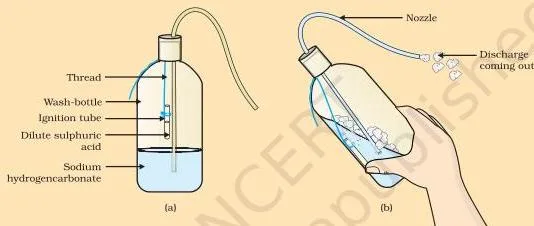
The extinguisher (Fig. 2.10, p. 36) uses the same carbonate–acid reaction: the acid meets the hydrogencarbonate, carbon dioxide is produced, and the gas drives the discharge out of the nozzle onto the fire.
Key concepts: reactions, ions, pH and salts
This is the teaching core of the chapter, in six blocks. Each one opens in plain language, then gives the terms, reactions and page numbers you need.
Indicators: telling acids from bases safely
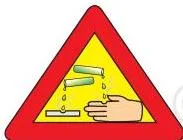
Indicators exist so you can identify an acid or a base without tasting or touching it — many bases are corrosive and must never be tasted or handled directly (NCERT, p. 24).
- Litmus is a natural indicator — a purple dye from lichen, a plant of the division Thallophyta. Acids turn blue litmus red; bases turn red litmus blue (p. 17).
- Turmeric turns reddish-brown in a base, like soap. That is why a curry stain on white cloth reddens when soap is rubbed on it and turns yellow again when washed with plenty of water (p. 17).
- Methyl orange and phenolphthalein are synthetic indicators; phenolphthalein is pink in base and colourless in acid (Activity 2.1, p. 18).
- Olfactory indicators change smell, not colour, in acidic or basic media — onion, vanilla essence and clove oil all work this way (Activity 2.2, p. 18).
- Other natural materials that work as indicators are red cabbage leaves and the coloured petals of flowers such as Hydrangea, Petunia and Geranium (p. 17).
The five reactions of acids and bases
Almost every question from Section 2.1 is one of these patterns. Recognise the pattern and you already know the products; the table gives one worked example of each.
| Reaction pattern | Example | Page |
|---|---|---|
| Acid + Metal → Salt + Hydrogen gas | \( \text{Zn}(s) + \text{H}_2\text{SO}_4(aq) \rightarrow \text{ZnSO}_4(aq) + \text{H}_2(g) \) | p. 20 |
| Base + Metal → Salt + Hydrogen gas | \( 2\text{NaOH}(aq) + \text{Zn}(s) \rightarrow \text{Na}_2\text{ZnO}_2(s) + \text{H}_2(g) \) (sodium zincate) | p. 20 |
| Carbonate or hydrogencarbonate + Acid → Salt + CO₂ + Water | \( \text{Na}_2\text{CO}_3(s) + 2\text{HCl}(aq) \rightarrow 2\text{NaCl}(aq) + \text{H}_2\text{O}(l) + \text{CO}_2(g) \) and \( \text{NaHCO}_3(s) + \text{HCl}(aq) \rightarrow \text{NaCl}(aq) + \text{H}_2\text{O}(l) + \text{CO}_2(g) \) | p. 20 |
| Acid + Base → Salt + Water (neutralisation) | \( \text{NaOH}(aq) + \text{HCl}(aq) \rightarrow \text{NaCl}(aq) + \text{H}_2\text{O}(l) \) | p. 21 |
| Metal oxide + Acid → Salt + Water | \( \text{CuO}(s) + 2\text{HCl}(aq) \rightarrow \text{CuCl}_2(aq) + \text{H}_2\text{O}(l) \) — the solution turns blue-green | p. 21 |
| Non-metal oxide + Base → Salt + Water | \( \text{Ca(OH)}_2(aq) + \text{CO}_2(g) \rightarrow \text{CaCO}_3(s) + \text{H}_2\text{O}(l) \) | pp. 20–22 |
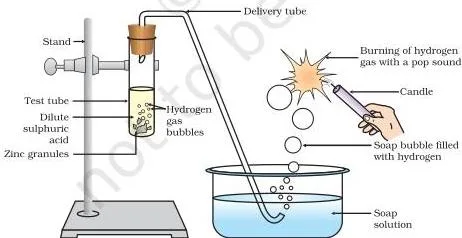
Two gas tests matter. Hydrogen from a metal–acid reaction makes a burning candle pop when it reaches a gas-filled bubble (Activity 2.3, Fig. 2.1).
Carbon dioxide from a carbonate–acid reaction turns lime water milky — the white precipitate is calcium carbonate — and the milkiness disappears if excess CO₂ is passed, because calcium carbonate turns into soluble calcium hydrogencarbonate: \( \text{CaCO}_3(s) + \text{H}_2\text{O}(l) + \text{CO}_2(g) \rightarrow \text{Ca(HCO}_3)_2(aq) \) (p. 20).
Worked example: neutralisation by proportion
20 mL of sodium hydroxide solution is exactly neutralised by 12 mL of hydrochloric acid of a given concentration. What volume of the same acid will neutralise 50 mL of the same base?
Step 1 — read the ratio.
The same two solutions are used throughout, so the volumes stay in the same ratio.
Step 2 — find the acid needed for 1 mL of base.
\[ \frac{12\ \text{mL acid}}{20\ \text{mL base}} = 0.6\ \text{mL of acid per mL of base} \]
Step 3 — scale up to 50 mL of base.
\[ 50 \times 0.6 = 30\ \text{mL of acid solution} \]
Final answer: 30 mL of the same hydrochloric acid neutralises 50 mL of the sodium hydroxide solution.
Ions: what acids and bases share
Acids and bases do what they do because of the ions they release in water. That single idea explains conductivity, the need for water, and why the hydronium ion is written as \( \text{H}_3\text{O}^+ \).
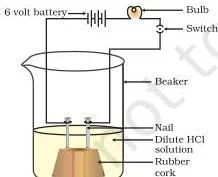
- Conductivity: in Activity 2.8 (p. 22) a bulb glows when the circuit passes through dilute HCl or H₂SO₄ but not through glucose or alcohol solutions. The current is carried by ions — charged particles present in acid solutions but not in glucose or alcohol solutions (Fig. 2.3).
- Acids give \( \text{H}^+(aq) \): acids contain H⁺ as the cation, with anions such as Cl⁻, NO₃⁻, SO₄²⁻ and CH₃COO⁻. In water these form hydronium ions: \( \text{HCl} + \text{H}_2\text{O} \rightarrow \text{H}_3\text{O}^+ + \text{Cl}^- \) (p. 23).
- Hydrogen ions cannot exist alone — they always combine with a water molecule, so they must be shown as \( \text{H}^+(aq) \) or \( \text{H}_3\text{O}^+ \), never as a bare H⁺ (p. 23).
- Dry HCl is not acidic: Activity 2.9 (p. 23) shows that dry HCl gas does not change dry blue litmus, but wet litmus turns red. Water must be present for H⁺ ions to form.
- Bases give \( \text{OH}^-(aq) \): bases such as NaOH, KOH and Mg(OH)₂ dissolve in water to release hydroxide ions: \( \text{NaOH}(s) \xrightarrow{\text{H}_2\text{O}} \text{Na}^+(aq) + \text{OH}^-(aq) \) (p. 23).
- Alkali: a base that dissolves in water is called an alkali. Not every base dissolves, so “base” and “alkali” are not synonyms (p. 24).
- Neutralisation in ions: in solution the net change is just \( \text{H}^+(aq) + \text{OH}^-(aq) \rightarrow \text{H}_2\text{O}(l) \) (p. 24).
Dilution: dissolving an acid or a base in water is a highly exothermic process (Activity 2.10, p. 24). The safe order is always acid into water, slowly, with constant stirring; pouring water into concentrated acid can make the mixture splash out and burn, and local heating can break the glass (Fig. 2.5).
The pH scale
The pH scale turns “how acidic or basic?” into a number from 0 to 14. The p in pH comes from the German word potenz, meaning power — the power of the hydrogen ion concentration (p. 25). That origin is the memory hook: a lower pH number means a higher hydrogen ion concentration.
- The scale runs from 0 (very acidic) to 14 (very alkaline), and the middle value, pH 7, is neutral.
- Values below 7 are acidic; values above 7 are basic. As pH rises from 7 to 14, the OH⁻ ion concentration increases (p. 25).
- The universal indicator is a mixture of several indicators that shows different colours at different hydrogen ion concentrations; paper dipped in it gives an approximate pH reading.
- Strong vs weak acids: take HCl and acetic acid at the same concentration, say one molar — HCl produces more H⁺ ions, so it is the strong acid; acetic acid, producing fewer, is the weak acid (p. 26). The same logic defines strong and weak bases.
Worked example: reading pH values
Sort five solutions with pH values 2, 5, 7, 9 and 13 into strongly acidic, weakly acidic, neutral, weakly basic and strongly basic, and arrange them in increasing order of hydrogen ion concentration.
Step 1 — classify each pH.
The chapter’s own labels (Exercise 9, p. 35) put pH 1 as strongly acidic, 4 as weakly acidic, 7 neutral, 9 weakly alkaline and 11 strongly alkaline.
So:
- pH 2 — strongly acidic
- pH 5 — weakly acidic
- pH 7 — neutral
- pH 9 — weakly basic
- pH 13 — strongly basic
Step 2 — arrange by hydrogen ion concentration.
Lower pH means more \( \text{H}^+(aq) \).
Increasing order of hydrogen ion concentration is therefore the reverse of increasing pH: pH 13, then 9, then 7, then 5, then 2.
Final answer: pH 2 → strongly acidic; pH 5 → weakly acidic; pH 7 → neutral; pH 9 → weakly basic; pH 13 → strongly basic. Increasing hydrogen ion concentration: 13, 9, 7, 5, 2.
pH in daily life and nature
These applications are the chapter’s way of showing that pH is not a lab idea — your body, your teeth, farm soil and rain water all sit on the same 0–14 scale (pp. 26–28).
| Situation | What pH has to do with it | The idea it illustrates |
|---|---|---|
| Your body | works only within the narrow pH range 7.0 to 7.8 | living organisms are pH sensitive (p. 26) |
| Acid rain | rain below pH 5.6 lowers river pH and threatens aquatic life | the pH scale in nature (p. 26) |
| Soil for crops | plants need a specific pH range; a farmer adds quick lime, slaked lime or chalk to correct acidic soil | bases neutralise acids (p. 28) |
| Stomach digestion | the stomach makes HCl; too much causes pain, cured by antacids such as milk of magnesia, Mg(OH)₂ | neutralisation (p. 27) |
| Tooth decay | mouth pH below 5.5 corrodes enamel (calcium hydroxyapatite); basic toothpaste neutralises the acid | pH and neutralisation (p. 27) |
| Bee and nettle stings | both inject methanoic acid; baking soda (a mild base) relieves a bee sting, and a dock plant leaf is the traditional nettle remedy | acid neutralised by a base (pp. 27–28) |
The chapter’s Table 2.3 collects naturally occurring acids: vinegar has acetic acid, orange and lemon have citric acid, tamarind has tartaric acid, tomato has oxalic acid, curd has lactic acid, and ant and nettle stings contain methanoic acid (p. 28).
Salts and chemicals from common salt
Salts are what remains when acids and bases react, and they matter in daily life more than any other product of this chapter. The word “family” is specific here: salts sharing the same positive or negative radical belong to one family — NaCl and Na₂SO₄ are both sodium salts, while NaCl and KCl are both chloride salts (Activity 2.13, p. 28).
- Are salts acidic or basic? A salt of a strong acid and a strong base is neutral (pH 7) — sodium chloride is the example. A salt of a strong acid and a weak base is acidic (below 7), and a salt of a strong base and a weak acid is basic (above 7) (p. 29).
- Common salt is a raw material. Seawater holds many salts; sodium chloride is separated from them. Rock salt, mined like coal, formed when seas of bygone ages dried up (p. 29).
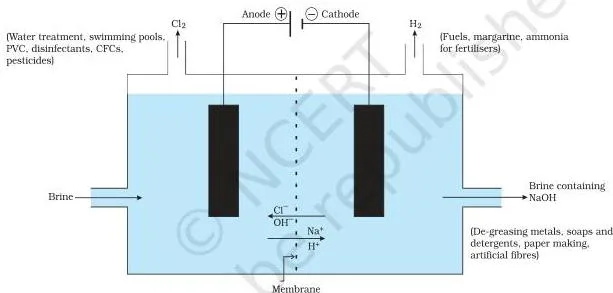
- Chlor-alkali process: electricity passed through brine (aqueous NaCl) decomposes it into sodium hydroxide, chlorine and hydrogen (p. 30):
\[ 2\text{NaCl}(aq) + 2\text{H}_2\text{O}(l) \xrightarrow{\text{electricity}} 2\text{NaOH}(aq) + \text{Cl}_2(g) + \text{H}_2(g) \]
The name itself carries the products — chlor for chlorine, alkali for sodium hydroxide. Chlorine gas comes off at the anode, hydrogen at the cathode, and sodium hydroxide forms near the cathode.
Chemicals made from common salt
| Chemical | Formula | How it is made | Uses |
|---|---|---|---|
| Sodium hydroxide | NaOH | chlor-alkali process: electrolysis of brine | one of three useful products; Fig. 2.8 maps its uses alongside chlorine and hydrogen (p. 30) |
| Bleaching powder | Ca(ClO)₂ (actual composition is complex) | chlorine gas on dry slaked lime: \( 2\text{Ca(OH)}_2 + 2\text{Cl}_2 \rightarrow \text{Ca(ClO)}_2 + \text{CaCl}_2 + 2\text{H}_2\text{O} \) | bleaching cotton, linen, wood pulp and washed clothes; oxidising agent in industry; making drinking water germ-free (p. 30) |
| Baking soda | NaHCO₃ (sodium hydrogencarbonate) | from NaCl, water, CO₂ and ammonia: \( \text{NaCl} + \text{H}_2\text{O} + \text{CO}_2 + \text{NH}_3 \rightarrow \text{NH}_4\text{Cl} + \text{NaHCO}_3 \) | baking powder (with tartaric acid) for soft spongy cakes; antacid; soda-acid fire extinguisher (p. 31) |
| Washing soda | Na₂CO₃·10H₂O | heating baking soda gives Na₂CO₃; recrystallisation with water adds the 10H₂O: \( \text{Na}_2\text{CO}_3 + 10\text{H}_2\text{O} \rightarrow \text{Na}_2\text{CO}_3 \cdot 10\text{H}_2\text{O} \) | glass, soap and paper industries; making borax; domestic cleaning; removing permanent hardness of water (pp. 31–32) |
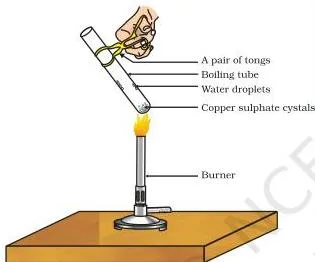
Water of crystallisation is the fixed number of water molecules present in one formula unit of a salt (p. 32). Blue copper sulphate crystals look dry but hold five water molecules per formula unit, CuSO₄·5H₂O. Heated, they lose this water, turn white and leave droplets on the tube; moistened again, the blue colour returns (Activity 2.15, Fig. 2.9).
The 10H₂O in washing soda is the same idea — the crystals are not “wet”.
Gypsum and Plaster of Paris: gypsum is CaSO₄·2H₂O. Heated at 373 K it loses water and becomes calcium sulphate hemihydrate, CaSO₄·½H₂O — Plaster of Paris, the white powder doctors use to support fractured bones (p. 32). On mixing with water it sets back to gypsum as a hard solid (p. 33):
\[ \text{CaSO}_4 \cdot \frac{1}{2}\text{H}_2\text{O} + 1\frac{1}{2}\text{H}_2\text{O} \rightarrow \text{CaSO}_4 \cdot 2\text{H}_2\text{O} \]
The “half” water molecule means two formula units of CaSO₄ share one water molecule.
Reading the chapter’s figures

These are the diagrams in your book. Each figure below is followed by the two or three points you should read from it.
Figure 2.1 draws the whole test for hydrogen. The test tube holds zinc granules in dilute sulphuric acid; bubbles rise from the zinc surface as hydrogen forms, and the delivery tube carries the gas into soap solution. A burning candle brought near a gas-filled bubble makes it burn with a pop — the pop identifies hydrogen.
The same set-up works with HCl, HNO₃ and acetic acid, so all these acids give hydrogen with a metal (p. 19).
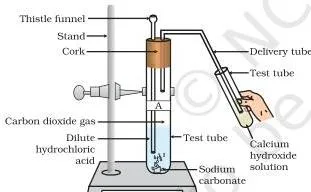
Figure 2.2 shows carbon dioxide from the carbonate–acid reaction bubbling into lime water, which is a calcium hydroxide solution. The lime water turns milky because insoluble calcium carbonate forms. Remember the book’s follow-up: pass excess CO₂ and the milkiness disappears, because CaCO₃ turns into soluble calcium hydrogencarbonate — “milky, then clear” is still carbon dioxide (p. 20).
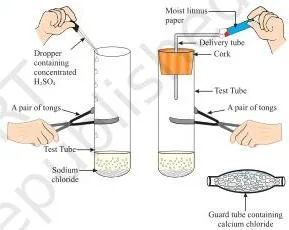
Figure 2.4 is the apparatus for Activity 2.9: sodium chloride and concentrated sulphuric acid react to give hydrogen chloride gas, which is tested on dry and then wet blue litmus. Only the wet paper changes colour. The whole lesson is that water is required for acidity — dry HCl gas is not acidic because H⁺ ions form only in water (p. 23).
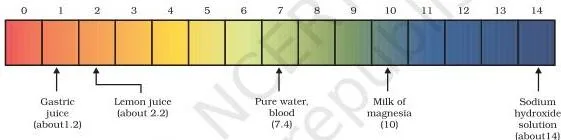
Figure 2.6 is the pH scale itself, running from 0 to 14 with pH 7 neutral in the middle. Read the two arrows together: as pH increases, \( \text{H}^+(aq) \) concentration falls and \( \text{OH}^-(aq) \) concentration rises. That is why “lower pH” and “more hydrogen ions” always go together (p. 25).
Figure 2.7 places everyday substances on the pH scale: lemon juice, aerated drinks, tomato juice and coffee on the acidic side, and the basic substances on the alkaline side, with tap water near neutral. The book prints its own warning — the colours are only a rough guide.
Use the chart to classify household substances, then confirm with the table in Activity 2.11 (p. 26).
Figure 2.8 shows that the chlor-alkali process gives three useful products at once — sodium hydroxide, chlorine and hydrogen — and maps each to its uses. Chlorine, for instance, goes on to make bleaching powder. One raw material, common salt, feeds a whole family of daily-use chemicals, which is why the chapter calls it a raw material for chemicals (p. 30).
Figure 2.9 is the evidence for water of crystallisation. Blue copper sulphate crystals are heated in a dry boiling tube: the solid turns white while water droplets condense near the mouth of the tube. Those droplets are the water locked inside each formula unit — CuSO₄·5H₂O — driven out as steam.
Add a few drops of water to the white solid and the blue returns, proving the water was held inside the crystal, not on its surface (p. 32).
Definitions you need for this chapter
A quick glossary, one line per term. The page references let you find the full explanation in the book.
| Term | Definition in plain words | Page |
|---|---|---|
| Indicator | A dye or mixture of dyes that shows, by a colour change, whether a solution is acidic or basic | p. 17 |
| Olfactory indicator | A substance whose smell changes in acidic or basic media — onion, vanilla, clove | p. 18 |
| Acid | A substance that produces \( \text{H}^+(aq) \) ions (hydronium ions) in water | pp. 22–23 |
| Base | A substance that produces \( \text{OH}^-(aq) \) ions in water | pp. 23–24 |
| Alkali | A base that dissolves in water | p. 24 |
| Neutralisation | The reaction of an acid with a base to give a salt and water | p. 21 |
| Hydronium ion | \( \text{H}_3\text{O}^+ \) — an H⁺ ion combined with a water molecule; the form in which H⁺ exists in water | p. 23 |
| pH and universal indicator | pH is a number from 0 to 14 measuring hydrogen ion concentration; a universal indicator is a mixture of indicators showing different colours at different pH | p. 25 |
| Strong acid / weak acid | At the same concentration, an acid producing more H⁺ ions is strong; one producing fewer is weak | p. 26 |
| Acid rain | Rain water with pH below 5.6 | p. 26 |
| Family of salts | Salts sharing the same positive or negative radical, e.g. sodium salts or chloride salts | pp. 28–29 |
| Chlor-alkali process | Electrolysis of brine to give sodium hydroxide, chlorine and hydrogen | p. 30 |
| Bleaching powder | Ca(ClO)₂, made from chlorine and dry slaked lime | p. 30 |
| Baking soda | Sodium hydrogencarbonate, NaHCO₃ — a mild, non-corrosive basic salt | p. 31 |
| Washing soda | Sodium carbonate decahydrate, Na₂CO₃·10H₂O | pp. 31–32 |
| Water of crystallisation | The fixed number of water molecules present in one formula unit of a salt | p. 32 |
| Gypsum | CaSO₄·2H₂O — calcium sulphate with two water molecules of crystallisation | p. 32 |
| Plaster of Paris | Calcium sulphate hemihydrate, CaSO₄·½H₂O — gypsum heated at 373 K | pp. 32–33 |
Mistakes students make in this chapter
Each of these errors appears, directly or indirectly, in the chapter’s own activities and questions. Reading them now costs less than losing marks on them later.
| Mistake | Correct rule | How to check your answer |
|---|---|---|
| Writing H⁺ instead of \( \text{H}^+(aq) \) or \( \text{H}_3\text{O}^+ \) | Hydrogen ions cannot exist alone in water; they combine with water molecules | Any equation showing isolated H⁺ in water should show \( \text{H}^+(aq) \) or \( \text{H}_3\text{O}^+ \) instead (p. 23) |
| Saying dry HCl gas is acidic | Dry HCl shows no acidic behaviour; water must be present for H⁺ ions to form | Wet litmus changes colour, dry litmus does not (p. 23; Exercise 8, p. 35) |
| Adding water to a concentrated acid | Add the acid slowly to water with constant stirring; the mixing is exothermic | The container stays intact and the mixture does not spit or splash (p. 24) |
| Reading pH backwards | Higher pH means fewer \( \text{H}^+(aq) \) ions, not more | A solution of pH 2 is more acidic than one of pH 6 (pp. 25–26) |
| Calling every base an alkali | An alkali is a base that dissolves in water; not all bases dissolve | NaOH is an alkali; a base that does not dissolve in water is not an alkali (p. 24) |
| Confusing baking soda with washing soda | Baking soda is NaHCO₃; washing soda is Na₂CO₃·10H₂O — different formulas, different uses | Write the formula before naming the use (pp. 31–32) |
| Saying hydrated copper sulphate is wet | The blue colour comes from water of crystallisation locked inside each formula unit | Heat the crystals: they turn white and water droplets appear (p. 32) |
| Swapping gypsum and Plaster of Paris | Gypsum is CaSO₄·2H₂O; Plaster of Paris is CaSO₄·½H₂O; heating gypsum at 373 K makes Plaster of Paris | Count the water molecules: 2H₂O versus ½H₂O (pp. 32–33) |
| Thinking basic solutions contain no H⁺ ions | Basic solutions do contain \( \text{H}^+(aq) \) ions — they are basic because OH⁻ is in excess | A pH above 7 means OH⁻ outnumbers H⁺, not that H⁺ is absent (p. 28, question 3) |
Exam notes: what the chapter’s own questions test
No one can promise which questions will appear in an exam, but the chapter’s own questions show where its difficulty concentrates. Textbook contents and the examinable syllabus are not always identical, so check the current official syllabus as well.
- Reactions with metals and the gas tests — the in-text questions on p. 18 (Q2, Q3) and Exercises 2 and 5 (pp. 34–35). Exercise 5 asks for four balanced equations, one each for zinc, magnesium, aluminium and iron.
- Why water is needed for acidity — the in-text questions on p. 25 (Q1, Q3, Q4) and Exercises 6, 7 and 8 (p. 35). Question 6 and question 8 both check this same idea: Q6 asks you to design the activity proving glucose and alcohol are not acids, and Q8 asks why dry HCl gas shows no acidic behaviour without water.
- Reading the pH scale — Exercises 1, 9 and 10, plus the pH question block on p. 28 (Q1–Q3). Exercise 10 compares fizzing in HCl versus acetic acid of the same concentration — the fizzing is more vigorous in HCl because it is the stronger acid and produces more H⁺ ions (p. 26).
- Neutralisation in daily life — Exercise 4 (antacid), 11 (milk turning to curd), 12 (the milkman and baking soda) and 14 (defining neutralisation with two examples).
- Salts and water of crystallisation — the in-text question block on p. 33 (Q1–Q5) and Exercises 13 and 15.
How to practise: write the four balanced equations in Exercise 5, starting from word equations; learn the two gas tests — the hydrogen pop and carbon dioxide turning lime water milky; and use the pH vocabulary (strongly acidic, weakly acidic, neutral, weakly basic, strongly basic) exactly as Exercise 9 does.
A full-marks answer for the gas-test questions must name the gas, give the test, and state the observation.
Quick recap of the chapter
This is the chapter’s own closing summary, “What you have learnt” (NCERT, pp. 33–34), reworded for a fast revision pass:
- Acid-base indicators are dyes or mixtures of dyes that reveal acids and bases by a colour change.
- Acidic nature comes from \( \text{H}^+(aq) \) ions in solution; basic nature from \( \text{OH}^-(aq) \) ions.
- Acid + metal → salt + hydrogen gas.
- A base can also react with a metal to give hydrogen, forming a salt whose negative ion contains the metal and oxygen — zinc with sodium hydroxide gives sodium zincate.
- Acid + metal carbonate or hydrogencarbonate → salt + carbon dioxide + water.
- Acidic and basic solutions conduct electricity because of the H⁺ and OH⁻ ions they produce.
- The pH scale runs from 0 to 14; 7 is neutral, below 7 acidic, above 7 basic.
- Living beings carry out their metabolic activities within an optimal pH range.
- Mixing concentrated acids or bases with water is highly exothermic — always add acid to water.
- Acids and bases neutralise each other to give corresponding salts and water.
- Water of crystallisation is the fixed number of water molecules in one formula unit of a salt.
- Salts have many uses in everyday life and in industries.
Related resources
This listing is maintained for the 2026-27 academic session using the NCERT textbook information available to us. NCERT remains the authority for confirming the latest edition.
Continue with the rest of the book, or move to revision notes for this chapter:
- Class 10 Science book — every chapter of the NCERT Class 10 Science textbook.
- Chapter 1: Chemical Reactions and Equations — the previous chapter, which sets up the equations used here.
- Chapter 3: Metals and Non-metals — the next chapter, where the metal reactions return.
- Class 10 Science revision notes — quick revision material, including Chemical Reactions and Equations notes and Metals and Non-metals notes.
- Class 10 notes hub — revision material for all subjects.
| What the chapter holds | Count | Where it is used |
|---|---|---|
| Printed pages | 20 | |
| Sections in the chapter | 16 | |
| Figures with NCERT captions | 12 | |
| Tables | 4 | |
| Exercise questions | 15 | answered in our NCERT Solutions |
| In-text questions | 18 | |
| Activities | 15 | |
| Official NCERT PDF | Download the chapter PDF | the chapter exactly as NCERT publishes it |
Reference: NCERT Class 10 Science textbook, chapter 2, official edition on ncert.nic.in.
Sources and data verification
- This page describes the NCERT Class 10 Science textbook (English medium), Chapter 2, “Acids, Bases and Salts”, as published by NCERT. The official editions are published at ncert.nic.in.
- It covers this one chapter of this one book — not other subjects, other media or other editions.
- The page is maintained for the current academic session against the NCERT editions currently published on ncert.nic.in.
- NCERT settles textbooks, editions and PDFs; CBSE settles curriculum, syllabus and examinations. Textbook contents and the examinable syllabus are not always identical, so check the current official syllabus.
Frequently asked questions
Why do acid solutions conduct electricity but glucose and alcohol solutions do not?
Acids produce \( \text{H}^+(aq) \) ions in water, and these charged ions carry the electric current through the solution. Glucose and alcohol dissolve in water without forming ions, so no current flows and the bulb in Activity 2.8 stays off (p. 22).
Why does dry HCl gas not change the colour of dry litmus paper?
The H⁺ ions that give HCl its acidic character form only when HCl meets water: \( \text{HCl} + \text{H}_2\text{O} \rightarrow \text{H}_3\text{O}^+ + \text{Cl}^- \). Dry HCl gas has no water to react with, so dry litmus stays unchanged, while wet litmus turns red (Activity 2.9, p. 23).
While diluting an acid, why must the acid be added to water and not water to the acid?
Dissolving an acid in water is highly exothermic. Adding water to the acid heats the small amount of acid violently and locally; the mixture can splash out and cause burns, and the glass container may break. Adding the acid slowly to water, with constant stirring, spreads the heat safely (p. 24).
Why is baking soda used in antacids and in baking powder?
Baking soda is sodium hydrogencarbonate, NaHCO₃, a mild, non-corrosive basic salt. In an antacid it neutralises excess acid in the stomach and gives relief. In baking powder it sits with tartaric acid; on heating or wetting, it releases carbon dioxide gas, which makes cakes and bread soft and spongy (p. 31).
Why must Plaster of Paris be stored in a moisture-proof container?
Plaster of Paris (CaSO₄·½H₂O) reacts with water and resets to gypsum, CaSO₄·2H₂O, as a hard solid. Moisture in the air would start this setting reaction inside the container and spoil the powder before use (pp. 32–33).
What is the difference between baking soda and washing soda?
Different chemicals with different jobs. Baking soda is sodium hydrogencarbonate (NaHCO₃), used in baking powder, antacids and soda-acid fire extinguishers. Washing soda is sodium carbonate decahydrate (Na₂CO₃·10H₂O), used in the glass, soap and paper industries, as a domestic cleaning agent and for removing permanent hardness of water (pp. 31–32).
Explore Class 10 Science Books
- Previous: Chemical Reactions and Equations
- Next: Metals and Non-metals
Related chapters: