
This page is for the official NCERT Class 8 Mathematics textbook, Chapter 3, Understanding Quadrilaterals — a 16-page chapter in the published PDF.
The understanding quadrilaterals class 8 NCERT chapter PDF is available right here from ncert.nic.in, so what you study matches your school copy. Below the download you get the chapter mapped section by section, every property it proves, the figures explained, and worked examples.
Download the Understanding Quadrilaterals Class 8 PDF
Download the Understanding Quadrilaterals Class 8 NCERT chapter PDF — this is the official NCERT file hosted at ncert.nic.in, so it matches the chapter your school prescribes. No third-party mirror is offered; the official PDF is the only version on this page.
Chapter at a glance: sections, figures and exercises
Before you start, see how much of the chapter you are dealing with. The table below lists what this chapter holds — its sections, figures, worked examples and exercise questions.
What this chapter covers: from polygons to the quadrilateral family
This chapter builds one idea on another: first what a polygon is, then one rule about all polygons, then the quadrilateral family from trapezium up to square. Read it in this order and each section supplies what the next one needs.
- 3.1 Introduction — plane curves and polygons. A plane curve is drawn by joining points without lifting the pencil. A polygon is a simple closed curve made only of line segments. The chapter then splits polygons into convex (every diagonal lies inside) and concave (some diagonal lies outside), and states that this class will deal with convex polygons only. It closes with regular versus irregular polygons: regular means both equiangular and equilateral.
- 3.2 Sum of the measures of the exterior angles of a polygon. A chalk walk around a pentagon shows each turn at a vertex is an exterior angle, and one complete round is a full rotation of \( 360^\circ \). So the exterior angles of any polygon add to \( 360^\circ \). Worked Examples 1 and 2 apply the rule to a missing angle and to counting the sides of a regular polygon.
- 3.3 Kinds of quadrilaterals. Quadrilaterals get special names from their sides and angles: trapezium, kite, parallelogram. The parallelogram then gets three focused sections of its own — elements (opposite and adjacent sides and angles), angles, and diagonals.
- 3.4 Rhombus, rectangle and square. Each special parallelogram is built from the previous one: a rhombus is a special kite (and therefore a parallelogram), a rectangle is a parallelogram with every angle a right angle, and a square is a rectangle with equal sides.
Notice the book’s method. Every property is first discovered by a hands-on activity — paper folding, a chalk walk, set-squares — and then justified by triangle congruence (ASA, SSS, SAS). The activity shows the fact; the congruence proof shows why it must be true.
Exercise placement matters. Exercise 3.1 closes the polygon work, Exercise 3.2 follows the exterior-angle rule, Exercise 3.3 comes after the parallelogram properties, and Exercise 3.4 rounds off the chapter — its true/false list is the chapter’s own self-check.
Key concepts: the exterior angle rule and parallelogram properties
These rules are the chapter’s whole toolkit. Nearly every exercise asks for one missing value — a side, an angle or a half-diagonal — and you find it with one of these rules. Learn them in the order the book proves them.
| Rule | Statement | Where the book establishes it |
|---|---|---|
| Exterior angle sum | The sum of the measures of the exterior angles of any polygon is \( 360^\circ \). | DO THIS walking activity, printed p. 24 |
| Regular polygon angles | Each exterior angle \( = 360^\circ \div n \), where \( n \) is the number of sides; each interior angle \( = 180^\circ – \) the exterior angle. | Try These, printed p. 24; Exercise 3.2, printed p. 25 |
| Opposite sides | The opposite sides of a parallelogram are of equal length. | Printed p. 28 |
| Opposite angles | The opposite angles of a parallelogram are of equal measure. | Printed p. 29 |
| Adjacent angles | The adjacent angles in a parallelogram are supplementary. | Printed p. 30 |
| Diagonals bisect | The diagonals of a parallelogram bisect each other at their point of intersection. | Printed p. 31 |
| Rhombus diagonals | The diagonals of a rhombus are perpendicular bisectors of one another. | Printed p. 33 |
| Rectangle diagonals | The diagonals of a rectangle are of equal length. | Printed p. 34 |
| Square diagonals | The diagonals of a square are perpendicular bisectors of each other. | Printed p. 35 |
A mnemonic that works: “opposites match, neighbours add”. In a parallelogram, opposite sides are equal and opposite angles are equal, while adjacent angles add up to \( 180^\circ \). If one angle is \( 63^\circ \), the angle across from it is \( 63^\circ \) and each angle next to it is \( 117^\circ \).
Reading the figures: what each diagram teaches
Each diagram below is one you are looking at in your own book. Read it alongside the activity text; the captions name the figure and the idea it demonstrates.
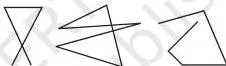
The book’s first sorting diagram separates simple closed curves made only of line segments from curves that miss the definition. The polygon set is entirely straight-sided and closed; the other set contains open curves and curves with bends or gaps. This is the exact definition of a polygon that the chapter uses everywhere after.
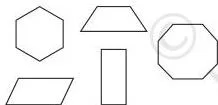
Can you see how the two rows differ? In every convex polygon, no portion of any diagonal lies in the exterior, and any segment joining two interior points stays wholly inside. In a concave polygon at least one diagonal runs partly outside the shape.
The book announces that from here on it deals with convex polygons only — that choice is what keeps the later parallelogram proofs clean.
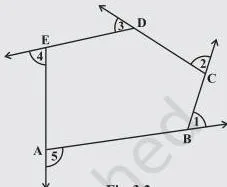
This figure is the proof of the exterior-angle rule, done with your feet. Start at A and walk along AB; at B you turn through \( m\angle 1 \) to face BC, then \( m\angle 2 \) at C, and so on.
By the time you return to side AB you have made one complete turn — a full rotation of \( 360^\circ \). The same argument works for any polygon, so the sum of the measures of the exterior angles of any polygon is \( 360^\circ \).
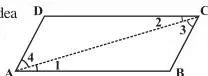
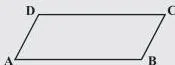
This figure converts “opposite sides are equal” from a measured guess into a proof. Because AB is parallel to DC and AD is parallel to BC, alternate angles give \( \angle 1 = \angle 2 \) and \( \angle 3 = \angle 4 \).
With AC common, triangles ABC and CDA are congruent by ASA. So \( AB = DC \) and \( BC = AD \) — the opposite sides of a parallelogram are equal (printed p. 28).
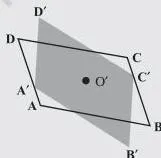
Copy the parallelogram on a tracing sheet, pin both at the point where the diagonals meet, and rotate the copy by \( 180^\circ \). The copy still coincides with the original, but A’ now lies on C and B’ on D.
That perfect fit tells you opposite angles are equal: \( \angle A \) matches \( \angle C \) and \( \angle B \) matches \( \angle D \) (printed p. 29).
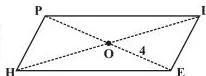
This is the working diagram of Example 6, and it shows why “diagonals bisect each other” is useful. O is the midpoint of both diagonals, so OE = OP = 4 means PE = 8. Since HL is 5 more than PE, HL = 13, and OH — half of HL — is \( 6.5 \) cm. One half-diagonal gives you the other half for free (printed p. 31).

Because a rhombus is also a parallelogram, its diagonals bisect each other, so OA = OC and OB = OD. Add AD = CD (all sides of a rhombus are equal) and OD common, and triangles AOD and COD are congruent by SSS.
Their corresponding angles \( \angle AOD \) and \( \angle COD \) are equal, and being a linear pair each is \( 90^\circ \) — the diagonals of a rhombus are perpendicular bisectors (printed p. 33).
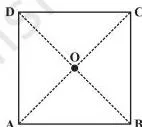
The square repeats the rhombus argument. OA = OC because a square is a parallelogram, all sides are equal, and OD is common, so triangles AOD and COD are congruent by SSS.
The equal angles \( \angle AOD \) and \( \angle COD \) form a linear pair, hence each is a right angle — the diagonals of a square are perpendicular bisectors of each other (printed p. 35).
Quadrilateral definitions: six named shapes in one family
Definitions are the chapter’s vocabulary — every property later hangs off one of them, so this is the section to learn first. The two figures below show the two names that depend on side markings.
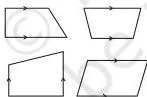
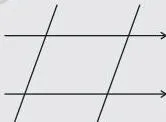
The arrow marks are the reading key: they show which sides are parallel. The upper set are trapeziums because each has one pair of parallel sides — only one pair is required. The lower set are not trapeziums because no sides are parallel. If the non-parallel sides are equal, the book calls it an isosceles trapezium (printed p. 25).
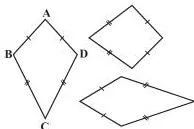
The tick marks are the reading key: sides with the same marking are equal. For a kite, AB = AD and BC = CD, giving exactly two distinct consecutive pairs of equal sides. The word “distinct” rules out equal pairs that are the same pair; “consecutive” rules out pairs that do not share a vertex.
A square counts as a kite, because four equal sides still give two distinct consecutive pairs (printed p. 26).
| Term | Definition in the book | What it adds |
|---|---|---|
| Polygon | A simple closed curve made up only of line segments | Separates straight-sided closed shapes from all other curves (Section 3.1) |
| Convex polygon | A polygon with no portion of its diagonals in the exterior; any segment joining two interior points lies wholly inside | Every diagonal stays inside the shape (Section 3.1) |
| Concave polygon | A polygon that is not convex — at least one diagonal lies partly outside | Has an indentation; the chapter studies convex polygons only |
| Regular polygon | A polygon that is both equiangular and equilateral | All angles equal and all sides equal; a rectangle is not regular (printed p. 22) |
| Trapezium | A quadrilateral with a pair of parallel sides | Needs only one pair of parallel sides (printed p. 25) |
| Isosceles trapezium | A trapezium with non-parallel sides of equal length | Special trapezium, reached in the set-square activity (printed p. 25) |
| Kite | A quadrilateral with exactly two distinct consecutive pairs of equal sides | AB = AD and BC = CD; a square is also a kite (printed p. 26) |
| Parallelogram | A quadrilateral whose opposite sides are parallel | Both pairs of opposite sides parallel (printed p. 27) |
| Rhombus | A quadrilateral with sides of equal length | Also a parallelogram and a special kite (printed p. 33) |
| Rectangle | A parallelogram in which every angle is a right angle | Equal angles force each angle to \( 90^\circ \) (printed p. 34) |
| Square | A rectangle with equal sides | Has all properties of parallelogram, rhombus and rectangle (printed p. 35) |
Common mistakes in quadrilaterals — and the corrections
The true/false list in Exercise 3.4 is the book’s own trap-finder, and the THINK, DISCUSS AND WRITE prompts extend it. The table below names the traps and the correction for each.
| Mistake | Correct rule | Where the book flags it |
|---|---|---|
| “All kites are rhombuses” | False. A rhombus needs all four sides equal; a kite needs only two distinct consecutive pairs. The rhombus is a special kite, not every kite is a rhombus. | Exercise 3.4 Q1(e) |
| “All rectangles are squares” | False. A square is a rectangle with equal sides; a rectangle’s sides need not be equal. | Exercise 3.4 Q1(a) |
| “Diagonals of a parallelogram are equal” | False in general. Diagonals of a parallelogram can be of different lengths; only rectangles and squares have equal diagonals. | Printed pp. 31 and 34 |
| “A rectangle is a regular polygon” | False. Regular means equiangular and equilateral; a rectangle is equiangular but not equilateral. | Printed p. 22 |
| “All parallelograms are trapeziums” | True. The book’s trapezium needs only a pair of parallel sides, and a parallelogram has two pairs. For the same reason all squares are trapeziums (Q1(h)). | Exercise 3.4 Q1(g), Q1(h) |
| Confusing opposite with adjacent angles | Opposite angles of a parallelogram are equal; adjacent angles are supplementary, adding to \( 180^\circ \). | Printed p. 30 |
Using these properties in exercises: worked examples
The exercises mostly ask for one missing value — an angle, a side or a half-diagonal — and a complete answer names the property it uses at each step. Exercise 3.3 Q7 asks for exactly that: “State the properties you use.” The three examples below cover the chapter’s three rule types with numbers the textbook does not use.
Worked example: sides from an interior angle
Problem: A regular polygon has each interior angle \( 144^\circ \).
How many sides does it have?
Step 1: Interior and exterior angles at a vertex form a linear pair, so each exterior angle is \( 180^\circ – 144^\circ \).
\[ \text{exterior angle} = 180^\circ – 144^\circ = 36^\circ \]
Step 2: The exterior angles of every polygon add to \( 360^\circ \).
For a regular polygon all exterior angles are equal, so the number of sides is \( 360^\circ \div 36^\circ \).
\[ \text{number of sides} = \frac{360^\circ}{36^\circ} = 10 \]
Final answer: The polygon has 10 sides.
Worked example: angles of a parallelogram
Problem: In parallelogram ABCD, \( m\angle A = 63^\circ \).
Find the other three angles.
- Step 1: Opposite angles are equal, so \( m\angle C = m\angle A = 63^\circ \).
- Step 2: Adjacent angles are supplementary, so \( m\angle B = 180^\circ – 63^\circ = 117^\circ \).
\[ m\angle B = 180^\circ – 63^\circ = 117^\circ \]
Step 3: \( \angle D \) is opposite \( \angle B \), so \( m\angle D = m\angle B = 117^\circ \).
Final answer: \( m\angle C = 63^\circ \), \( m\angle B = m\angle D = 117^\circ \).
Worked example: halves of diagonals
Problem: The diagonals of parallelogram ABCD meet at O.
If AC = 18 cm and BD = 12 cm, find OA and OD.
- Step 1: The diagonals of a parallelogram bisect each other, so O is the midpoint of both AC and BD.
- Step 2: O is the midpoint of AC, so OA is half of AC.
\[ OA = \frac{18}{2} = 9\ \text{cm} \]
Step 3: O is the midpoint of BD, so OD is half of BD.
\[ OD = \frac{12}{2} = 6\ \text{cm} \]
Final answer: \( OA = 9\ \text{cm} \) and \( OD = 6\ \text{cm} \).
Two honest notes before you go further. Textbook contents and the examinable syllabus are not always identical — check the current official syllabus for what is testable. And no page can promise specific board questions or marks; what this chapter demands is that you can state each property and name it when you use it.
Chapter recap: the quadrilateral family tree
The chapter closes with its own one-page table, “What have we discussed?”. Restated as a family tree:
- Every square is a rectangle, a rhombus and a parallelogram — it inherits all three sets of properties.
- Every rectangle and every rhombus is a parallelogram.
- Every parallelogram is a trapezium under the book’s definition, because a trapezium needs only one pair of parallel sides.
- A kite stands apart: exactly two distinct consecutive pairs of equal sides, perpendicular diagonals, one diagonal bisecting the other, and one pair of opposite angles equal.
The table below shows at a glance how sides, angles and diagonals differ across the five named quadrilaterals.
| Quadrilateral | Sides | Angles | Diagonals |
|---|---|---|---|
| Parallelogram | Opposite sides equal | Opposite angles equal; adjacent angles supplementary | Bisect each other; not equal in general |
| Rhombus | All sides equal | Same as parallelogram | Perpendicular bisectors of each other |
| Rectangle | Opposite sides equal | Every angle a right angle | Equal; bisect each other |
| Square | All sides equal | Every angle a right angle | Equal, perpendicular bisectors of each other |
| Kite | Exactly two distinct consecutive pairs of equal sides | One pair of opposite angles equal | Perpendicular; one bisects the other |
Related resources: the Class 8 Mathematics book and neighbouring chapters
This listing is maintained for the 2026-27 academic session using the NCERT textbook information available to us. NCERT remains the authority for confirming the latest edition.
This chapter sits between two others in the same book. Work through Linear Equations in One Variable before it and Data Handling after it.
For the whole book, use the Class 8 Mathematics book page to jump to any chapter, or start from the Class 8 hub for every subject. The chapter text itself is in the official NCERT Class 8 Mathematics chapter 3 PDF at ncert.nic.in.
Sources and data verification
- The contents, properties and figures on this page describe the NCERT Class 8 Mathematics textbook, Chapter 3, “Understanding Quadrilaterals”, official edition at ncert.nic.in (chapter PDF hemh103.pdf).
- This page covers the NCERT textbook chapter, not the CBSE syllabus. Textbook contents and the examinable syllabus are not always identical, so check the current official syllabus.
- This listing is maintained for the current academic session using the NCERT information available to us.
- NCERT settles textbooks, editions and PDFs; CBSE settles curriculum, syllabus and examinations.
| What the chapter holds | Count | Where it is used |
|---|---|---|
| Printed pages | 16 | |
| Sections in the chapter | 15 | |
| Figures with NCERT captions | 24 | |
| Tables | 1 | |
| Worked examples | 1 | solved step by step in our NCERT Solutions |
| Exercise questions | 25 | answered in our NCERT Solutions |
| In-text questions | 4 | |
| Official NCERT PDF | Download the chapter PDF | the chapter exactly as NCERT publishes it |

Reference: NCERT Class 8 Mathematics textbook, chapter 3, official edition on ncert.nic.in.
Common questions about quadrilaterals
Is a square a rhombus?
Yes. Exercise 3.4 Q1(c) says all squares are rhombuses and also rectangles. A square has all four sides equal, which is the rhombus condition, and all angles \( 90^\circ \), the rectangle condition.
Are the diagonals of a parallelogram equal?
Not in general. The book states that the diagonals of a parallelogram can be of different lengths (printed p. 31); the rectangle is the special case whose diagonals are equal (printed p. 34).
Is every parallelogram a trapezium?
Yes, under the book’s definition. A trapezium is a quadrilateral with a pair of parallel sides (printed p. 25), and a parallelogram has two pairs — so it certainly has one.
Why do the exterior angles of any polygon add up to 360 degrees?
A complete turn is \( 360^\circ \). Walking around the polygon, the angle you turn at each vertex is an exterior angle, and finishing the round means you have rotated through a full circle (printed p. 24).
Is a rectangle a regular polygon?
No. Regular means both equiangular and equilateral, and a rectangle is equiangular but not equilateral (printed p. 22).
What is the minimum interior angle possible for a regular polygon?
\( 60^\circ \), the interior angle of an equilateral triangle (Exercise 3.2 Q6). As the number of sides increases, the interior angle of a regular polygon increases.
Explore Class 8 Mathematics Books
- Previous: Linear Equations in One Variable
- Next: Quadrilaterals
Related chapters:
- A Square and a Cube
- Rational Numbers
- Power Play