
Mensuration Class 8 — NCERT Mathematics, Chapter 9 — moves you from flat shapes to real ones. It first finds the areas of polygons such as trapeziums and rhombuses, then teaches the surface area and volume of the cube, cuboid and cylinder. The chapter runs 18 pages in the NCERT Class 8 Mathematics book, and the official PDF is right below.
Under the download you get a section-by-section map of the chapter, every formula with its symbols explained, and the book’s own figures read for you.
Open the official NCERT Class 8 Maths Mensuration Chapter 9 PDF from ncert.nic.in to read or download the chapter exactly as published, the same pages your teacher and your textbook follow.
| What the chapter holds | Count | Where it is used |
|---|---|---|
| Printed pages | 18 | |
| Sections in the chapter | 12 | |
| Figures with NCERT captions | 19 | |
| Tables | 2 | |
| Exercise questions | 29 | answered in our NCERT Solutions |
| Official NCERT PDF | Download the chapter PDF | the chapter exactly as NCERT publishes it |



Reference: NCERT Class 8 Mathematics textbook, chapter 9, official edition on ncert.nic.in.
Mensuration Class 8: What’s Inside Chapter 9
The chapter builds in six steps: 9.1 Introduction (what you already know about perimeter and area), 9.2 Area of a Polygon (trapezium, rhombus, splitting polygons), 9.3 Solid Shapes (faces of solids, right circular cylinder), 9.4 Surface Area of Cube, Cuboid and Cylinder, 9.5 Volume of Cube, Cuboid and Cylinder, and 9.6 Volume and Capacity (litres).
Practice comes in three exercises: Exercise 9.1 (polygon and quadrilateral areas), Exercise 9.2 (surface area) and Exercise 9.3 (volume and capacity). Small THINK, DISCUSS AND WRITE boxes run through the chapter — they are the book asking you to find the error before it finds you.
The table below lists the chapter’s contents — sections, figures, worked examples and exercise questions — so you can see at a glance how much ground Chapter 9 covers.
Two Halves of One Idea: Plane Areas, Then Solids
This chapter is not a list of disconnected formulas. It is one habit applied twice: cut the unfamiliar shape into shapes you already know.
In the plane half, a polygon is split into triangles and trapeziums (Section 9.2). In the solid half, the surface area of a solid is the sum of the areas of its faces (Section 9.4), and its volume is base area × height (Section 9.5).
Section 9.1 assumes you know the perimeter and area of triangles, rectangles and circles, and the area of pathways or borders in rectangular shapes. You will use all of it here.
Why does “base area × height” work for both a cuboid and a cylinder? Because both have a top and a base that are congruent and parallel, and sides that stand perpendicular to the base.
The book makes this exact argument in Section 9.5.3 — if the top matches the base and the sides are upright, then stacking base after base until you reach the height fills the whole solid.
Area of a Polygon: Cut It Into Shapes You Know
A polygon is any closed shape made of straight sides. You already have formulas for triangles and trapeziums, so the chapter cuts polygons into those.
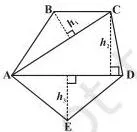
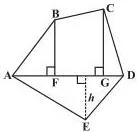
Observe the two splitting strategies for the same pentagon below. In Figure 9.1, two diagonals from one vertex divide it into three triangles; in Figure 9.2, one diagonal plus two perpendiculars divide it into right triangles and a trapezium. Both strategies give the same total area.
Trapezium: average the parallel sides, then multiply by height
A trapezium is a quadrilateral with one pair of parallel sides. Its area formula (Section 9.2) is \[ \text{Area of a trapezium} = \frac{1}{2} h(a + b) \]
where \( a \) and \( b \) are the two parallel sides and \( h \) is the perpendicular distance between them. The \( \frac{1}{2} \) is not a decoration: two copies of the same trapezium fit together into a parallelogram of base \( (a + b) \) and height \( h \), so one trapezium is half of that.
Worked example: parallel sides 12 cm and 8 cm, height 5 cm.
\[ \frac{1}{2} \times 5 \times (12 + 8) = \frac{1}{2} \times 5 \times 20 = 50\ \text{cm}^2 \]
Final answer: the area is \( 50\ \text{cm}^2 \).
Rhombus: half the product of the diagonals
A rhombus is a quadrilateral with all four sides equal. Its area formula is \[ \text{Area of a rhombus} = \frac{1}{2} d_1 d_2 \]
where \( d_1 \) and \( d_2 \) are the two diagonals. The reason: a diagonal splits the rhombus into two congruent triangles, each with one diagonal as base and half the other diagonal as height.
Worked example: diagonals 9 cm and 12 cm.
\[ \frac{1}{2} \times 9 \times 12 = 54\ \text{cm}^2 \]
Final answer: the area is \( 54\ \text{cm}^2 \). Since a rhombus is also a parallelogram, its area can equally be found as base × altitude — Exercise 9.1 Q6 uses that version.
Splitting any polygon: one diagonal, several perpendiculars
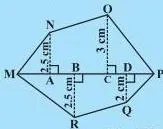
When diagonals alone do not give clean shapes, the book’s second trick is: draw one diagonal, drop perpendiculars on it from the remaining vertices, and the polygon becomes triangles plus trapeziums.
Read the figure this way: MP is the base line, and each perpendicular from a vertex to MP is the height of its region. The Try These in the book gives the segment lengths along the diagonal — MA = 2 cm, MB = 4 cm, MC = 6 cm, MD = 7 cm, MP = 9 cm — and each region’s area uses one perpendicular as its height.
The end triangles use \( \frac{1}{2} \times \) segment \( \times \) perpendicular; the middle regions are trapeziums whose parallel sides are two consecutive perpendiculars.
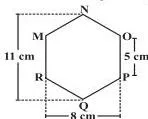
The chapter’s worked examples set the pattern: a trapezium field whose area and height are known, with one parallel side missing (Example 1); a rhombus with area \( 240\ \text{cm}^2 \) and one diagonal 16 cm, asking for the other diagonal (Example 2); and a hexagon split two different ways (Example 3).
Expect to rearrange the formula — working backwards from area to a missing length appears in Exercise 9.1 Q2 and Q8.
Solid Shapes: Faces and Right Circular Cylinders
A solid is built from faces, and the 2D figures you know appear as those faces (Section 9.3). Take any cuboidal, cubical or cylindrical box and cut it open: the faces are the flat shapes that cover it.
The book’s DO THIS asks you to collect such boxes, cut out every face, and compare: the cuboid has three pairs of identical faces, the cube has all six faces congruent, and the cylinder has two congruent circular faces that are parallel to each other.
That last property defines a right circular cylinder: the line joining the centres of the two circular faces is perpendicular to the base. The book’s THINK, DISCUSS AND WRITE then shows a tilted solid and asks why it is incorrect to call it a cylinder — because its centre line is not perpendicular to the base.
The chapter studies only right circular cylinders, so every cylinder formula assumes this shape.
Surface Area of Cuboid, Cube and Cylinder
Paint a box and the paint covers its faces. That is the whole idea: the surface area of a solid is the sum of the areas of its faces (Section 9.4).
The chapter opens with Imran, Monica and Jaspal painting a cuboid, a cube and a cylinder of the same height — each needs a different formula, which is why three formulas follow.
Cuboid: six faces, three identical pairs
A cuboid of length \( l \), breadth \( b \) and height \( h \) has six faces in three identical pairs: two \( l \times b \), two \( b \times h \), two \( h \times l \). Adding them (Section 9.4.1):
\[ \text{Total surface area} = 2(lb + bh + hl) \]
The lateral surface area — the four walls, excluding top and bottom — is \[ \text{Lateral surface area} = 2h(l + b) \]
A useful check the book asks you to think about: total = lateral + 2 × base area. Since the base is \( l \times b \), we get \( 2h(l + b) + 2lb = 2(lb + bh + hl) \).
Worked example: a cuboid measuring \( 10\ \text{cm} \times 6\ \text{cm} \times 4\ \text{cm} \).
\[ \text{TSA} = 2(10 \times 6 + 6 \times 4 + 4 \times 10) = 2(60 + 24 + 40) = 248\ \text{cm}^2 \]
\[ \text{LSA} = 2 \times 4 \times (10 + 6) = 128\ \text{cm}^2 \]
Check: \( 128 + 2 \times 60 = 248 \).
Cube: all six faces equal
The cube is the special case of the cuboid with \( l = b = h \). If the side is \( l \):
\[ \text{Total surface area} = 6l^2, \qquad \text{Lateral surface area} = 4l^2 \]
The lateral formula follows from the cuboid formula with all sides equal: \( 2h(l + b) = 2l(l + l) = 4l^2 \).
This Try These figure is a trap to name: it asks for total surface area of cube A but lateral surface area of cube B. Read which area the question wants before substituting. Worked example: side 7 cm → total \( 6 \times 49 = 294\ \text{cm}^2 \), lateral \( 4 \times 49 = 196\ \text{cm}^2 \).
Cylinder: the curved part is a rectangle in disguise
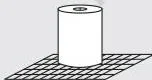
The cylinder’s curved surface is the classic trick of the chapter: cut it open and you get a rectangle. In the figure below, a paper strip just fits around the can — its length equals the circumference of the base \( 2\pi r \), and its width equals the height \( h \).
So the curved surface area is \( 2\pi r h \), and the total adds two circles (Section 9.4.3):
\[ \text{Curved surface area} = 2\pi r h \]
\[ \text{Total surface area} = 2\pi r^2 + 2\pi r h = 2\pi r(r + h) \]
Why two \( r \)s at the end? The bracket \( (h + r) \) is the curved rectangle plus one circle on top and one on the bottom. The book takes \( \pi = \frac{22}{7} \) unless a question says otherwise.
Worked example: cylinder, radius 14 cm, height 10 cm.
\[ \text{CSA} = 2 \times \frac{22}{7} \times 14 \times 10 = 88 \times 10 = 880\ \text{cm}^2 \]
\[ \text{TSA} = 2 \times \frac{22}{7} \times 14 \times (14 + 10) = 88 \times 24 = 2112\ \text{cm}^2 \]
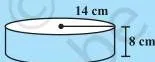
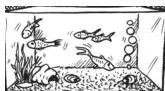
In Figure 9.27, read the radius and height straight off each diagram, then substitute into \( 2\pi r(r + h) \). The real-life problems in Examples 4–7 are all about which faces count: an aquarium needs only base + back + two side faces; whitewashing a room starts with the four walls, then walls + ceiling is added; cylindrical pillars are painted on the curved surface only.
Volume of Cube, Cuboid and Cylinder: Counting Unit Cubes
Area is counted in square units; volume is counted in cubic units. The space a solid occupies is its volume (Section 9.5), measured by counting how many unit cubes fit inside. The book shows two differently shaped solids that each hold exactly 8 unit cubes — same volume, different shape.
The activity with 36 cubes makes the formula. Arrange 36 unit cubes as a cuboid and you always get \( l \times b \times h = 36 \), in any arrangement. So for a cuboid:
\[ \text{Volume} = l \times b \times h = \text{base area} \times \text{height} \]
A cube is the special case \( l = b = h \): volume \( = l^3 \).
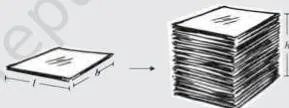
The paper pile makes the formula physical: the area of one sheet is the base area, the height of the pile is \( h \), and their product is the volume.
The method works for any solid whose top and base are congruent and parallel and whose edges are perpendicular to the base — which is exactly why it works for a cylinder (Section 9.5.3):
\[ \text{Volume of a cylinder} = \pi r^2 h \]
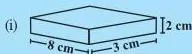
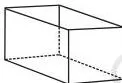
Figure 9.30 shows cuboids for you to find the volume of — copy the three dimensions from the figure and multiply. The rolling-paper figure shows the reverse skill: a rectangle rolled into a cylinder.
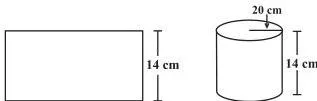
When a rectangle is rolled into a cylinder, one dimension becomes the height and the other becomes the circumference. Worked example (original numbers): paper \( 22\ \text{cm} \times 7\ \text{cm} \) rolled along its width.
\[ 2\pi r = 22 \quad \Rightarrow \quad r = \frac{22}{2 \times \frac{22}{7}} = 3.5\ \text{cm}, \quad h = 7\ \text{cm} \]
\[ V = \pi r^2 h = \frac{22}{7} \times 3.5 \times 3.5 \times 7 = 269.5\ \text{cm}^3 \]
Quick checks to run on your own: cuboid \( 8 \times 5 \times 3 \) cm gives \( 120\ \text{cm}^3 \); cube of side 6 cm gives \( 216\ \text{cm}^3 \); cylinder radius 5 cm, height 14 cm gives \( 1100\ \text{cm}^3 \).
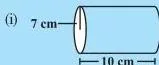
The book ends this section with a business question: two cuboidal boxes can hold the same volume yet need different amounts of packing material. The economical box is the one with the smaller surface area for that volume — comparing boxes A and B is exactly this trade-off.
Volume vs Capacity: Litres, Millilitres and Cubic Units
Volume is the space an object occupies; capacity is the quantity a container holds (Section 9.6). The container’s volume and its capacity are usually the same number — the words differ because one describes the object and the other what it can hold.
The three conversions you need:
- \( 1\ \text{cm}^3 = 1\ \text{mL} \)
- \( 1\ \text{L} = 1000\ \text{cm}^3 \)
- \( 1\ \text{m}^3 = 1000000\ \text{cm}^3 = 1000\ \text{L} \)
Worked example (original numbers): a cuboidal tank measuring \( 50\ \text{cm} \times 30\ \text{cm} \times 20\ \text{cm} \).
\[ V = 50 \times 30 \times 20 = 30000\ \text{cm}^3 = 30000\ \text{mL} = 30\ \text{L} \]
A second tank, \( 2\ \text{m} \times 1\ \text{m} \times 0.5\ \text{m} \), has volume \( 1\ \text{m}^3 \), so it holds exactly \( 1000\ \text{L} \).
Two rearrangements from the Examples finish the section: height of a cuboid = volume ÷ base area, and the number of boxes that fit = godown volume ÷ one box volume. They are the skills Exercise 9.3 Q3–Q5 need.
Figure Walkthrough: Reading NCERT’s Mensuration Diagrams
In this chapter the diagram IS the question: the lengths you need are printed on the figure, and the cut lines show which shapes to make. Two figures repay careful reading.
Hexagon MNOPQR, two ways (Example 3)
Aman cuts the hexagon with one diagonal, giving two congruent trapeziums. Ridhima cuts it into a rectangle plus two congruent triangles. Different cuts, same area — the book’s point is that any correct split works.
Compare the totals: Aman’s two trapeziums give \( 2 \times 32 = 64\ \text{cm}^2 \); Ridhima’s rectangle plus triangles give \( 40 + 12 + 12 = 64\ \text{cm}^2 \). Two methods, one answer — a built-in check.
The pentagonal park, two cuts (Exercise 9.1, Q10)
Jyoti and Kavita each split the pentagon differently, and the figure marks both plans. Work out the area once per plan — because both cover the same park, the two totals must be equal. The question’s challenge, “can you suggest some other way?”, is answered by any correct alternate split, such as drawing diagonals from one vertex to form three triangles.
Quick map: which figure lives where
A fast navigation aid for the chapter’s key diagrams.
| Figure | What it shows | Where it is used |
|---|---|---|
| Pentagon splits (Fig 9.1, 9.2) | A polygon cut into triangles and trapeziums | Section 9.2 |
| Fig 9.5 | Perpendiculars dropped on a diagonal | Section 9.2, Try These |
| Hexagon with two cuts | Two splitting methods, one total area | Example 3 |
| Pentagonal park | Two different cuts of the same park | Exercise 9.1, Q10 |
| Painted boxes | Cuboid, cube, cylinder of equal height | Section 9.4 |
| Cubes A and B (Fig 9.22) | Total vs lateral surface area | Section 9.4.1, Try These |
| Paper-strip cylinder (Fig 9.25) and cut-open cylinder | Curved surface as a rectangle | Section 9.4.3, DO THIS |
| Fig 9.27 | Cylinders with radius and height marked | Section 9.4.3, Try These |
| Paper pile (Fig 9.29) | Base area × height as volume | Section 9.5.1, DO THIS |
| Fig 9.30, Fig 9.31 | Cuboid volumes; rectangle rolled into a cylinder | Section 9.5, Try These and Example 10 |
All Mensuration Formulas in One Table (with Key Terms Defined)
This is the whole chapter compressed for revision. Five terms first, then one table with every formula and what each symbol means.
- Surface area — the sum of the areas of a solid’s faces.
- Lateral surface area — the faces excluding the top and bottom (the four walls).
- Volume — the space a solid occupies.
- Capacity — the quantity a container holds.
- Right circular cylinder — a cylinder whose circular faces are parallel and whose centre line is perpendicular to the base.
Note: \( \pi \) is taken as \( \frac{22}{7} \) unless a question states otherwise.
| Quantity | Formula | What the symbols mean | Typical units |
|---|---|---|---|
| Area of a trapezium | \( \frac{1}{2} h(a + b) \) | \( a, b \) = parallel sides; \( h \) = perpendicular distance between them | \( \text{cm}^2, \text{m}^2 \) |
| Area of a rhombus | \( \frac{1}{2} d_1 d_2 \) | \( d_1, d_2 \) = diagonals | \( \text{cm}^2, \text{m}^2 \) |
| Area of a quadrilateral (via a diagonal) | \( \frac{1}{2} d(h_1 + h_2) \) | \( d \) = diagonal; \( h_1, h_2 \) = perpendiculars from the other two vertices | \( \text{m}^2 \) |
| Total surface area of a cuboid | \( 2(lb + bh + hl) \) | \( l \) = length, \( b \) = breadth, \( h \) = height | \( \text{cm}^2, \text{m}^2 \) |
| Lateral surface area of a cuboid | \( 2h(l + b) \) | same symbols; four walls only | \( \text{cm}^2, \text{m}^2 \) |
| Total surface area of a cube | \( 6l^2 \) | \( l \) = side of the cube | \( \text{cm}^2, \text{m}^2 \) |
| Lateral surface area of a cube | \( 4l^2 \) | \( l \) = side; follows from the cuboid formula with \( l = b = h \) | \( \text{cm}^2, \text{m}^2 \) |
| Curved surface area of a cylinder | \( 2\pi r h \) | \( r \) = radius, \( h \) = height; \( \pi = \frac{22}{7} \) unless stated | \( \text{cm}^2, \text{m}^2 \) |
| Total surface area of a cylinder | \( 2\pi r(r + h) \) | same symbols; two circles + curved surface | \( \text{cm}^2, \text{m}^2 \) |
| Volume of a cuboid | \( l \times b \times h \) | also base area × height | \( \text{cm}^3, \text{m}^3 \) |
| Volume of a cube | \( l^3 \) | \( l \) = side | \( \text{cm}^3, \text{m}^3 \) |
| Volume of a cylinder | \( \pi r^2 h \) | \( r \) = radius, \( h \) = height | \( \text{cm}^3, \text{m}^3 \) |
| Capacity conversions | \( 1\ \text{cm}^3 = 1\ \text{mL} \); \( 1\ \text{L} = 1000\ \text{cm}^3 \); \( 1\ \text{m}^3 = 1000000\ \text{cm}^3 = 1000\ \text{L} \) | litres, millilitres, cubic units | \( \text{L}, \text{mL}, \text{cm}^3, \text{m}^3 \) |
Common Mistakes in Mensuration and How to Fix Them
Most marks in this chapter are lost to six repeatable slips, not to hard geometry. NCERT plants two of them in its own THINK, DISCUSS AND WRITE boxes — so the book expects you to step on them.
| Mistake | Correct rule | How to check your answer |
|---|---|---|
| Two cubes (side \( b \)) joined: surface area \( 12b^2 \) | The joined face is hidden on both cubes: \( 6b^2 + 6b^2 – 2b^2 = 10b^2 \) | Count visible faces: 6 + 6 − 2 = 10 square faces |
| Using the diameter in place of the radius in \( 2\pi r \) formulas | Halve the diameter first: \( r = \frac{d}{2} \). Road roller 84 cm → \( r = 42\ \text{cm} \) (Exercise 9.2 Q9–Q10, Exercise 9.3 Q5) | If your curved-area answer is double the sensible size, you used the full diameter |
| Mixing centimetres and metres in one multiplication | Convert everything to one unit first. Example 6 changes 28 cm to 0.28 m before multiplying | Check every length in the calculation has the same unit symbol |
| Counting the wrong faces in paint, plaster and paper problems | List the faces the wording includes before using a formula. Aquarium: base + back + two sides; whitewashing: four walls; cabinet painted except bottom: five faces | Draw the object and shade every face the question mentions |
| Dropping the \( \frac{1}{2} \) in trapezium or rhombus area | Two same trapeziums make a parallelogram of base \( (a + b) \), so one is half; a rhombus’s diagonal split gives two triangles, each \( \frac{1}{2} \) | Name the shapes your cut creates — a triangle’s area always carries \( \frac{1}{2} \) |
| Choosing surface area when the question means volume | “How much it can hold” → volume; “cement bags to plaster” → surface area; “number of smaller tanks that can be filled” → volume (Exercise 9.3 Q1) | Ask: is this about covering the outside or filling the inside? |
Corrected pillar calculation (original numbers): a pillar has radius 35 cm and height 5 m. Before multiplying, convert the radius: \( 35\ \text{cm} = 0.35\ \text{m} \).
\[ \text{Curved surface area} = 2 \times \frac{22}{7} \times 0.35 \times 5 = 11\ \text{m}^2 \]
Had you kept 35 cm and height 5 m together, the product would be nonsense — a clear sign the units must match first.
Exam Notes: What to Practise in Mensuration Class 8
This is a study order, not a prediction — no question is guaranteed, and textbook contents and the examinable syllabus are not always identical, so check the current official CBSE syllabus. Practise in this order:
- Polygon splitting — trapezium and rhombus formulas, Section 9.2, Exercise 9.1.
- Cuboid LSA vs TSA word problems — walls, ceiling, cabinet, suitcase, Section 9.4.1, Exercise 9.2 Q1–Q6.
- Cylinder CSA and TSA with \( \pi = \frac{22}{7} \) — Section 9.4.3, Exercise 9.2 Q7–Q10.
- Volume and capacity conversions to litres — Sections 9.5–9.6, Exercise 9.3.
- Reverse problems — height from volume or surface area (Examples 7–9; Exercise 9.3 Q3 and Q5): practise rearranging the formula, not just substituting.
The one nugget worth memorising is the scaling rule from Exercise 9.3 Q7: doubling a cube’s edge multiplies its surface area by 4 and its volume by 8, because \( l^2 \) becomes \( (2l)^2 = 4l^2 \) and \( l^3 \) becomes \( (2l)^3 = 8l^3 \).
Before starting any question, run the read-the-question check: does it ask what something holds (volume), what covers it (surface area), or how much material makes it (surface area)?
Chapter 9 Summary: What Have We Discussed
This is the chapter’s own closing summary, restated for a two-minute read before the exam.
- Surface area of a solid is the sum of the areas of its faces: cuboid \( 2(lb + bh + hl) \), cube \( 6l^2 \), cylinder \( 2\pi r(r + h) \).
- Volume is the space a solid occupies: cuboid \( l \times b \times h \), cube \( l^3 \), cylinder \( \pi r^2 h \).
- Capacity is what a container holds: \( 1\ \text{cm}^3 = 1\ \text{mL} \), \( 1\ \text{L} = 1000\ \text{cm}^3 \), \( 1\ \text{m}^3 = 1000000\ \text{cm}^3 = 1000\ \text{L} \).
Remember only three things: cut polygons into shapes you know; surface area is faces; volume is base area × height for the cuboid, cube and cylinder. The full formula table above carries every symbol.
Related Resources and Sources
This listing is maintained for the 2026-27 academic session using the NCERT textbook information available to us. NCERT remains the authority for confirming the latest edition.
Want the whole book? Open the NCERT Class 8 Mathematics book page to browse every chapter, and use the Class 8 Mathematics notes for chapter-by-chapter revision. The previous chapter and the next chapter sit either side of Mensuration in the book. For revision companions on related skills, see the Algebraic Expressions and Identities notes and the Exponents and Powers notes.
The Class 8 notes hub links everything together, and CBSE notes covers the other classes.
Verify the current edition of the book on the official NCERT Class 8 Mathematics textbook gateway.
Sources and data verification
The formulas, figures, sections and exercise numbers on this page come from the NCERT Class 8 Mathematics textbook, Chapter 9 (Mensuration), official edition published on ncert.nic.in. The page covers this one chapter of the current NCERT book; it does not describe the whole CBSE curriculum. It is maintained for the current academic session using the NCERT materials.
NCERT publishes the textbooks and their official PDFs; CBSE sets the examinable syllabus.
Frequently Asked Questions
What is the formula for the area of a trapezium in Class 8 Mensuration?
\( \frac{1}{2} h (a + b) \), where \( a \) and \( b \) are the parallel sides and \( h \) is the perpendicular distance between them (Section 9.2). Example: parallel sides 12 cm and 8 cm, height 5 cm → \( \frac{1}{2} \times 5 \times 20 = 50\ \text{cm}^2 \).
What is the difference between total surface area and lateral surface area of a cuboid?
Total surface area covers all six faces: \( 2(lb + bh + hl) \). Lateral surface area covers only the four walls, leaving out the top and bottom: \( 2h(l + b) \) (Section 9.4.1). The link between them: total = lateral + 2 × base area.
Why is the surface area of two cubes joined as a cuboid not 12b²?
Because the face where the cubes meet is hidden inside — it is not part of the outer surface. Each cube alone has \( 6b^2 \), so the joined cuboid has \( 6b^2 + 6b^2 – 2b^2 = 10b^2 \). NCERT’s THINK, DISCUSS AND WRITE in Section 9.4 asks exactly this question.
How do you convert cubic metres and cubic centimetres into litres for capacity questions?
Use \( 1\ \text{cm}^3 = 1\ \text{mL} \), \( 1\ \text{L} = 1000\ \text{cm}^3 \) and \( 1\ \text{m}^3 = 1000000\ \text{cm}^3 = 1000\ \text{L} \) (Section 9.6). A tank \( 50\ \text{cm} \times 30\ \text{cm} \times 20\ \text{cm} \) holds \( 30000\ \text{cm}^3 = 30\ \text{L} \).
If a cube’s edge is doubled, what happens to its surface area and volume?
Surface area becomes 4 times and volume becomes 8 times (Exercise 9.3 Q7). Surface area uses \( l^2 \), so \( (2l)^2 = 4l^2 \); volume uses \( l^3 \), so \( (2l)^3 = 8l^3 \).
Reference: NCERT Class 8 Mathematics textbook, chapter 9, official edition on ncert.nic.in.
Explore Class 8 Mathematics Books
- Previous: Algebraic Expressions and Identities
- Next: Proportional Reasoning-2
Related chapters:
- A Square and a Cube
- Rational Numbers
- Power Play