
This page is about squares and square roots class 8 — the chapter NCERT publishes as Chapter 5 of its Class 8 Mathematics book. The chapter runs 20 printed pages, and the official PDF is right here. Keep reading for what the chapter teaches, section by section, in plain words.
Everything a student needs for this chapter sits in one official file: NCERT Class 8 Maths Chapter 5 Squares and Square Roots PDF, published by NCERT on ncert.nic.in and containing all six numbered sections, the four exercises, the in-text prompts and the closing summary exactly as printed in the current rationalised edition.
Chapter 5 at a glance: what the PDF contains
One glance at this table tells you the size of the chapter — what NCERT packs into its 20 printed pages.
| What the chapter holds | Count |
|---|---|
| Printed pages | 20 |
| Numbered sections | 5.1 Introduction to 5.6 Square Roots of Decimals (six sections) |
| Exercises | 5.1, 5.2, 5.3, 5.4 (four exercises) |
| Exercise questions | 30 |
| In-text questions (TRY THESE prompts) | 9 |
| Figures | 7 |
What this chapter teaches, section by section
The chapter is ordered so each section builds the next tool: recognise square numbers first, then collect squaring shortcuts, then learn what a square root is and the ways to find one, then extend the best method to decimals.
Section 5.1, Introduction. Opens with what you already know — the area of a square is \( \text{side} \times \text{side} \) — and defines a square number as a natural number of the form \(n^2\). Its test case: 32 is not a square, because it falls between \(5^2 = 25\) and \(6^2 = 36\), and no natural number lies between 5 and 6.
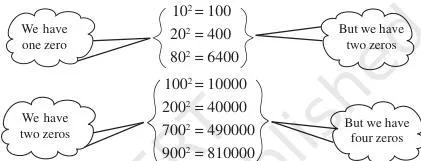
Section 5.2, Properties of Square Numbers. Collects the quick rejection tests: a square never ends in 2, 3, 7 or 8; an even number squares to an even number and an odd number to an odd number; and a square can carry only an even number of trailing zeros.
Section 5.3, Some More Interesting Patterns. The pattern section: consecutive triangular numbers combine into squares, \(2n\) numbers lie between \(n^2\) and \((n+1)^2\), and the sum of the first \(n\) odd numbers is \(n^2\). It also gives the product identity \((a+1)(a-1) = a^2 – 1\) and the symmetric squares of numbers like 111 and 667.
Section 5.4, Finding the Square of a Number. Squaring without long multiplication: expanding \((a+b)^2\), the a5 shortcut \((a5)^2 = a(a+1)\) hundred + 25, and Pythagorean triplets built from \(2m,\ m^2 – 1,\ m^2 + 1\).
Section 5.5, Square Roots. The chapter’s main skill: square root as the inverse operation of squaring, the convention that \( \sqrt{} \) means the positive root only, and three methods — repeated subtraction, prime factorisation by pairing, and the division method for large numbers.
Section 5.6, Square Roots of Decimals. Extends the division method to decimals with a new barring rule, then applies it to real situations: a square plot of area \(2304\ \text{m}^2\) has side 48 m, and 2401 students standing in equal rows and columns form 49 rows.
WHAT HAVE WE DISCUSSED. The closing summary restates the chapter’s results — the square-number definition, the units-digit rule, the even-zeros rule and the positive-root convention. The revision table at the end of this page is built from it, reworded.
Squares and Square Roots Class 8: the key concepts
The quick tools come first, the heavy machinery second: reject a non-square in one glance, then square fast, then extract roots. The two places students usually get stuck — the \( \sqrt{} \) sign convention and the division method — get extra space below.
What makes a number a square number
Everything in the chapter rests on one definition, so get it exact before anything else.
The area of a square is \( \text{side} \times \text{side} \), and numbers such as 4, 9 and 25 are square numbers because they equal \(n^2\) for a whole number: \(4 = 2^2\), \(9 = 3^2\), \(25 = 5^2\).
The formal definition (NCERT, section 5.1): a natural number \(m\) is a square number — also called a perfect square — when \(m = n^2\) for some natural number \(n\).
To test a candidate, squeeze it between two consecutive squares. The book’s own case is 32: since \(5^2 = 25 \lt 32 \lt 6^2 = 36\), the square of 32 would need a natural number between 5 and 6, and there is none. So 32 is not a square number.
The units-digit rules — and their limits
This is the fastest filter in the chapter: one look at the last digit rejects most non-squares. The rule only rejects, never confirms — and forgetting that is the chapter’s most common error.
- A square ends only in 0, 1, 4, 5, 6 or 9 — never 2, 3, 7 or 8.
- If a square ends in 1, its root ends in 1 or 9 (\(121 = 11^2\), \(361 = 19^2\)).
- If a square ends in 6, its root ends in 4 or 6 (\(16 = 4^2\), \(256 = 16^2\)).
- The square of an even number is even; the square of an odd number is odd.
- A square can end with only an even number of zeros.
Each rule works one way only (NCERT, section 5.2): 21 ends in 1 but is not a square, 14 ends in 4 but is not a square, and 64000 ends in 0 but carries three zeros, so it fails too. Use these rules to reject, never to confirm.
The gap between consecutive squares
A counting pattern with a classic trap: how many whole numbers sit between two neighbouring squares, with the endpoints excluded.
The difference between consecutive squares is \((n+1)^2 – n^2 = 2n + 1\). Since both endpoints are themselves squares, the non-square numbers strictly between them are \(2n\) (NCERT, section 5.3.2).
Worked check: between \(10^2 = 100\) and \(11^2 = 121\) the numbers run 101 to 120 — twenty of them, exactly \(2 \times 10\). Never count the endpoints.
Odd-number sums and repeated subtraction
Adding odd numbers in order builds squares from nothing, and subtracting them in order reverses the process — which gives the chapter its first square-root method.
The result (NCERT, section 5.3.3): the sum of the first \(n\) odd natural numbers is \(n^2\), so \(1 + 3 + 5 + 7 = 16 = 4^2\). Worked check: \(1 + 3 + 5 + 7 + 9 + 11 + 13 = 49 = 7^2\), seven terms.
So a number is a perfect square exactly when it can be written as successive odd numbers starting from 1: 25 works as \(1 + 3 + 5 + 7 + 9\); 38 runs to a negative result and is not a square.
Repeated subtraction runs the same idea backwards: subtract 1, 3, 5, … until you reach 0, and the number of subtractions is the root. For 81 it takes nine subtractions, so \( \sqrt{81} = 9\) (NCERT, section 5.5.2).
Shortcuts: the a5 trick, consecutive products, symmetric patterns
Three time-savers for squaring, each a pattern you verify once and then trust. Exercise 5.1 uses the symmetric patterns directly.
- The a5 trick (NCERT, section 5.4.1): \((a5)^2 = a(a+1)\) hundred + 25. Worked: \(85^2 = 8 \times 9\) hundreds + 25 = 7225.
- Consecutive products (NCERT, section 5.3.5): \((a+1)(a-1) = a^2 – 1\). Worked: \(17 \times 19 = 18^2 – 1 = 323\).
- Symmetric patterns (NCERT, section 5.3.6): \(11^2 = 121\), \(111^2 = 12321\), \(1111^2 = 1234321\); also \(67^2 = 4489\), \(667^2 = 444889\). Exercise 5.1 Q4 and Q5 ask you to extend them.
Pythagorean triplets
Three natural numbers fit \(a^2 + b^2 = c^2\), and the chapter gives one formula that manufactures them — plus a warning about which member you were handed.
The definition (NCERT, section 5.4.2): a Pythagorean triplet is three natural numbers \(a, b, c\) with \(a^2 + b^2 = c^2\); the first example is 3, 4, 5. For any natural number \(m \gt 1\), \((2m)^2 + (m^2 – 1)^2 = (m^2 + 1)^2\), so \(2m,\ m^2 – 1,\ m^2 + 1\) always forms a triplet.
The book’s Example 2 shows the trap: to get a triplet whose smallest member is 8, trying \(m^2 – 1 = 8\) gives \(m = 3\) and the triplet 6, 8, 10 — but there 8 is the largest member, not the smallest. So try \(2m = 8\): \(m = 4\), giving 8, 15, 17, which is correct because \(8^2 + 15^2 = 17^2\).
Fresh check with 10 as the member: \(m^2 – 1 = 10\) gives no integer \(m\), and \(m^2 + 1 = 10\) gives \(m = 3\), but the triplet 6, 8, 10 does not have 10 as its smallest member.
So take \(2m = 10\), giving \(m = 5\) and the triplet 10, 24, 26 — verify with \(100 + 576 = 676 = 26^2\). The book also notes that not every triplet comes from this formula; 5, 12, 13 is one that does not.
Three methods for finding square roots
Square root is the inverse operation of squaring: you know the square, and you want the number that produced it (NCERT, section 5.5.1).
Convention first. Both \(9^2\) and \((-9)^2\) equal 81, so 81 has two integral square roots. But this chapter takes only the positive root, and the symbol \( \sqrt{} \) always means that positive root: \( \sqrt{81} = 9\), not \(-9\).
Method 1 — repeated subtraction (section 5.5.2). Subtract 1, 3, 5, … in order and count steps until you reach 0. It works, but only for small squares.
Method 2 — prime factorisation (section 5.5.3), worked with an original number: find \( \sqrt{3025}\).
- Step 1: factorise: \(3025 = 5 \times 5 \times 11 \times 11\).
- Step 2: pair identical factors and take one from each pair: \(3025 = (5 \times 11)^2\).
\[ \sqrt{3025} = 5 \times 11 = 55 \]
Final answer: \( \sqrt{3025} = 55\).
The pairing test also identifies non-squares: 48 factors as \(2^4 \times 3\), and the 3 has no pair, so 48 is not a perfect square. Multiplying by the unpaired factor repairs it: \(48 \times 3 = 144\), and \( \sqrt{144} = 12\) (NCERT, section 5.5.3).
Method 3 — division method (section 5.5.4), worked with an original number: find \( \sqrt{6084}\).
Step 1: bar the digits in pairs from the right: \( \overline{60}\,\overline{84}\).
Two bars mean a two-digit root.
- Step 1: the largest square below 60 is \(7^2 = 49\), so the first digit is 7; divisor 7, remainder \(60 – 49 = 11\).
- Step 2: bring down the next pair, 84, making the new dividend 1184.
- Step 3: double the quotient to get \(14\_\), and find the digit \(d\) with \(14d \times d \leq 1184\).
\[ 148 \times 8 = 1184 \text{ exactly, so the next digit is } 8. \]
Final answer: \( \sqrt{6084} = 78\). Check: \(78^2 = 6084\).
The digit-count rule (section 5.5.4): an \(n\)-digit perfect square has a root of \( \frac{n}{2}\) digits when \(n\) is even, and \( \frac{n+1}{2}\) when \(n\) is odd. So \( \sqrt{6084}\) (four digits) has a two-digit root, exactly as the bars showed.
Square roots of decimals
Decimals use the same division method, with two extra rules: where the bars go, and when the decimal point enters the quotient (NCERT, section 5.6).
- Integral part: bars run left from the units digit, exactly as before.
- Decimal part: bars run right from the decimal point in pairs, starting at the first decimal place. A single leftover digit gets a 0 inserted before it — 176.341 bars as \( \overline{1}\,\overline{76}.\overline{34}\,\overline{10}\).
- The decimal point appears in the quotient the moment you begin using the decimal-part bars.
Worked with an original number: find \( \sqrt{29.16}\).
- Step 1: bars: \( \overline{29}.\overline{16}\).
- Step 2: the largest square below 29 is \(5^2 = 25\), so the first digit is 5; remainder 4.
- Step 3: bring down 16 to make 416, and put the decimal point in the quotient.
- Step 4: double 5 to get \(10\_\), and \(104 \times 4 = 416\) exactly, so the next digit is 4.
Final answer: \( \sqrt{29.16} = 5.4\). Check: \(5.4^2 = 29.16\).
The chapter’s figures, explained
The diagrams in this chapter are not decoration — each one teaches a pattern the section wants you to see. Read the caption, then the explanation below it.

The opening figure draws 1, 4, 9 and 16 as dots arranged in square grids. Each is a full square of side 1, 2, 3 or 4 — which is exactly why they are called square numbers. A square whose side is \(n\) holds \(n^2\) unit squares (NCERT, section 5.1).
This is the number–square table that section 5.2 asks you to study. Read down the units column of the squares and only 0, 1, 4, 5, 6, 9 appear — never 2, 3, 7 or 8. The same table supplies the sub-rules: a square ending in 1 comes from a root ending in 1 or 9, and a square ending in 6 from a root ending in 4 or 6.
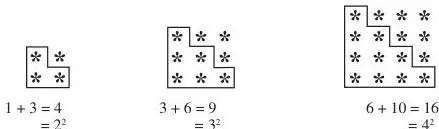
The triangular numbers are the dot patterns that form triangles — 1, 3, 6, 10, … . The figure pairs consecutive ones, and the two triangles lock together into a square: 1 + 3 = 4, 3 + 6 = 9, 6 + 10 = 16 (NCERT, section 5.3.1). It is the chapter’s first hint that squares hide inside other patterned sequences.
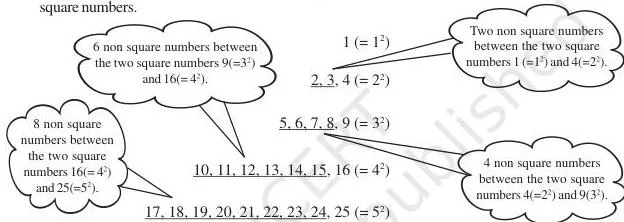
This diagram carries the earliest gaps: between \(1^2\) and \(2^2\) lie 2 and 3; between \(2^2\) and \(3^2\) lie 5, 6, 7, 8. Count them and the rule appears — between \(n^2\) and \((n+1)^2\) there are \(2n\) numbers (NCERT, section 5.3.2). The key is that both square endpoints are excluded from the count.
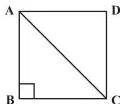
This figure sits at the start of section 5.5.1: a square of area 9 drawn as 3 by 3 unit squares. The side of the square is the number whose square equals the area, and that is the definition of a square root. Finding the side of a square from its area is the motivating problem for the whole section.

The chapter acknowledges that \((-2)^2 = 4\) and \((-9)^2 = 81\), so a perfect square has two integral square roots. But the symbol \( \sqrt{} \) is reserved for the positive one only (NCERT, section 5.5.1). This convention stops a \( \pm \) confusion from running through every later calculation.

This is the first calculation in the long division method (section 5.5.4), applied to \( \sqrt{529}\). Bars split 529 into the single left digit 5 and the pair 29; since \(2^2 \lt 5 \lt 3^2\), the first quotient digit is 2. The following steps double that quotient, guess the next digit 3, and finish at \( \sqrt{529} = 23\).
Definitions to write down
These are the chapter’s defined terms. Every method later in the chapter leans on one of them, so keep the section number attached when you revise.
| Term | Plain definition | Section |
|---|---|---|
| Square number (perfect square) | A natural number \(m\) that can be written as \(n^2\) for some natural number \(n\) — e.g. 1, 4, 9, 16. | 5.1 |
| Non-square number | A natural number that cannot be written as \(n^2\), such as 2, 3, 5 or 32. | 5.1, 5.3 |
| Triangular number | A number whose dots can be arranged as a triangle, such as 1, 3, 6, 10. | 5.3.1 |
| Pythagorean triplet | Three natural numbers \(a, b, c\) satisfying \(a^2 + b^2 = c^2\), e.g. 3, 4, 5. | 5.4.2 |
| Square root | The number which, when squared, gives the given number — the inverse operation of squaring. | 5.5.1 |
| Radical sign \( \sqrt{} \) | The symbol used for the positive square root only: \( \sqrt{4} = 2\), not \(-2\). | 5.5.1 |
Mistakes students make in this chapter
Every error below is one the chapter itself warns about — the units-digit, zero and \( \pm \) rules appear in its THINK, DISCUSS AND WRITE prompts. Read them once now, and again before the exam.
| Mistake | Correct rule | How to check your answer |
|---|---|---|
| Treating the units-digit rule as a two-way test: “21 ends in 1, so it must be a square.” | The ending rule only rejects. A square must end in 0, 1, 4, 5, 6 or 9, but a number with such an ending may still fail — 21 and 14 both fail. | Squeeze the number between consecutive squares: 21 sits between \(4^2\) and \(5^2\), so it is not a square. |
| Writing \( \sqrt{81} = \pm 9\). | 81 has two integral square roots, 9 and −9, but the radical sign \( \sqrt{} \) means the positive one only. | In this chapter every answer with a \( \sqrt{} \) is a single non-negative number. |
| Ignoring the trailing-zero rule: “222000 ends in 0, so it may be a square.” | A square has an even number of trailing zeros. 222000 has three (odd), so it cannot be a square — same for 64000. | Count the zeros at the end of the number. Odd count → reject immediately. |
| Miscounting the gap as \(2n + 1\) numbers. | \(2n + 1\) is the difference \((n+1)^2 – n^2\); the numbers strictly between the two squares are \(2n\). | List them between \(2^2\) and \(3^2\): 5, 6, 7, 8 — four numbers, and \(2 \times 2 = 4\). |
| Prime factorisation without pairing: every factor counts once. | A perfect square has every prime factor in pairs. \(48 = 2^4 \times 3\) has one unpaired 3, so it is not a square. | Pair identical factors. One factor left over → not a square; multiply by that factor to repair (48 × 3 = 144). |
| Barring the decimal part from the wrong end. | Integral part: bars run left from the units digit. Decimal part: bars run right from the decimal point in pairs, inserting 0 for a leftover digit — 176.341 bars as \( \overline{1}\,\overline{76}.\overline{34}\,\overline{10}\). | Every bar on the decimal part carries exactly two digits; a single leftover digit gets a 0 before it. |
| Taking the first triplet that appears when a member is given. | Try all three expressions \(2m\), \(m^2 – 1\), \(m^2 + 1\). For member 8, \(m^2 – 1 = 8\) gives 6, 8, 10, but 8 is the largest there, so it is wrong for “smallest member 8”. | Use \(2m = 8\) → \(m = 4\) → 8, 15, 17; verify with \(8^2 + 15^2 = 17^2\). |
How to use this chapter when studying
The chapter’s examinable skills are quick rejection tests, three root-finding methods, and word problems that reduce to a square root. The table maps each skill to where the book teaches and practises it.
| Skill | Taught in | Practice |
|---|---|---|
| Rejecting non-squares by units digit, even/odd, trailing zeros | Section 5.2 | Exercise 5.1 Q1–Q3 |
| Counting numbers between consecutive squares | Section 5.3.2 | Exercise 5.1 Q9 |
| Squaring without multiplying; the a5 trick; product pattern | Sections 5.4, 5.4.1, 5.3.5 | Exercise 5.2 Q1 |
| Pythagorean triplets from the formula, including the three-attempt trap | Section 5.4.2, Examples 2–3 | Exercise 5.2 Q2 |
| Repeated subtraction (small numbers only) | Section 5.5.2 | Exercise 5.3 Q3 |
| Prime factorisation and multiply/divide-to-repair questions | Section 5.5.3, Examples 4–8 | Exercise 5.3 Q4–Q6, Q9–Q10 |
| Division method for large numbers and decimals | Sections 5.5.4, 5.6, Examples 9–13 | Exercise 5.4 Q1, Q3 |
| Digit-count rule (no calculation) | Section 5.5.4 | Exercise 5.4 Q2 |
| Reach-next-square: add/subtract questions | Examples 10–12 | Exercise 5.4 Q4–Q5 |
| Word problems: rows = columns, square plots, donations | Examples 14–15 | Exercise 5.3 Q7–Q8; Exercise 5.4 Q6–Q9 |
Which method for which number? The chapter’s own progression is the guide: repeated subtraction only for small squares (Exercise 5.3 Q3 finds \( \sqrt{100}\) and \( \sqrt{169}\) this way); prime factorisation for medium numbers and for the multiply/divide-to-repair type; division method when the number is large or a decimal (Exercise 5.4 Q1, Q3). The digit-count rule answers Exercise 5.4 Q2 without any calculation.
Word problems all reduce to the same sentence: which number squared gives the total? The donation problem (Exercise 5.3 Q7) asks for the number whose square is 2401 — the answer is 49. The square-plot problem (Example 14) asks for the side whose square is 2304 — the answer is 48. Write the sentence \(x^2 = \text{total}\), then apply the division method.
Textbook contents and the examinable syllabus are not always identical — check the current official syllabus for what is examinable this year.
Last-minute revision: the chapter in one table
This is the chapter’s closing summary, reworded, plus the formulas worth keeping. Every row below is a result the chapter itself states.
| Idea | What it says |
|---|---|
| Square number | A natural number \(m\) is a square number when \(m = n^2\) for a natural number \(n\). |
| Units digit of a square | Always 0, 1, 4, 5, 6 or 9 — never 2, 3, 7 or 8. |
| Trailing zeros of a square | Only an even number of zeros can end a square number. |
| Square root | The inverse operation of squaring: finding the number whose square is known. |
| The radical sign | \( \sqrt{} \) means the positive root only, so \( \sqrt{9} = 3\). |
| Gap between consecutive squares | \((n+1)^2 – n^2 = 2n + 1\), so \(2n\) numbers lie strictly between \(n^2\) and \((n+1)^2\). |
| Sum of odd numbers | \(1 + 3 + 5 + \dots + (2n – 1) = n^2\). |
| Consecutive product | \((a + 1)(a – 1) = a^2 – 1\). |
| Squaring numbers ending in 5 | \((a5)^2 = a(a+1)\) hundred + 25, e.g. \(85^2 = 7225\). |
| Pythagorean triplet | For any natural \(m \gt 1\): \(2m,\ m^2 – 1,\ m^2 + 1\). |
| Digits in a square root | An \(n\)-digit perfect square has a root of \( \frac{n}{2}\) digits when \(n\) is even, and \( \frac{n+1}{2}\) when \(n\) is odd. |
Related NCERT Class 8 Maths chapters
The pages below sit next to this chapter in the Class 8 Mathematics book, or one level up in the notes library.
- NCERT Class 8 Mathematics notes — the book page where every chapter of this subject lives.
- Data Handling (Chapter 4) — the chapter before squares, straight from the same book.
- Cubes and Cube Roots (Chapter 6) — the next chapter; it reuses the prime-factorisation pairing skill, so it follows naturally.
- Class 8 hub — notes for every Class 8 subject on this site.
- CBSE notes index — the full notes library across classes.
Sources and data verification
This listing is maintained for the 2026-27 academic session using the NCERT textbook information available to us. NCERT remains the authority for confirming the latest edition.
This page describes the NCERT Class 8 Mathematics textbook, Chapter 5 (Squares and Square Roots), in its current rationalised edition; the chapter’s official PDF is hosted on ncert.nic.in. You can confirm the current book’s full chapter list on the official NCERT textbook portal.
This page covers this one chapter and the NCERT book that contains it — not the full CBSE syllabus. Textbook contents and the examinable syllabus are not always identical.
This page is maintained for the current academic session using the NCERT information available to us. NCERT settles textbooks, editions and PDFs; CBSE settles curriculum, syllabus and examinations.
| What the chapter holds | Count | Where it is used |
|---|---|---|
| Printed pages | 20 | |
| Sections in the chapter | 11 | |
| Figures with NCERT captions | 7 | |
| Tables | 18 | |
| Worked examples | 2 | solved step by step in our NCERT Solutions |
| Exercise questions | 30 | answered in our NCERT Solutions |
| In-text questions | 9 | |
| Official NCERT PDF | Download the chapter PDF | the chapter exactly as NCERT publishes it |
Reference: NCERT Class 8 Mathematics textbook, chapter 5, official edition on ncert.nic.in.
Frequently asked questions about squares and square roots
Short answers to the questions students search most often about this chapter, all grounded in the book’s sections.
Why is 64000 not a perfect square even though it ends in 0?
Because of the trailing-zero rule. A square number can carry only an even number of zeros at its end — 100 and 400 are fine, but 64000 ends in three zeros. Three is odd, so 64000 is rejected immediately (NCERT, section 5.2). Exercise 5.1 Q2 lists 64000 among numbers that are “obviously not perfect squares”.
Is the square root of 81 equal to 9 or -9?
In this chapter, 9. Both \(9^2\) and \((-9)^2\) equal 81, so the number 81 has two integral square roots, 9 and -9. But the radical sign \( \sqrt{} \) is defined as the positive root only: \( \sqrt{81} = 9\), not \(-9\) (NCERT, section 5.5.1).
How many non-square numbers lie between the squares of 90 and 91?
180. The rule from section 5.3.2: \((n+1)^2 – n^2 = 2n + 1\), so exactly \(2n\) numbers lie strictly between the two squares. Put \(n = 90\): \(2 \times 90 = 180\). The endpoints \(90^2\) and \(91^2\) are themselves squares, so they are not counted.
How do I find a Pythagorean triplet when one member is given, for example 8?
Try each of the three expressions \(2m\), \(m^2 – 1\), \(m^2 + 1\) and keep the triplet that uses your member in the right position.
For 8: \(m^2 – 1 = 8\) gives \(m = 3\) and the triplet 6, 8, 10 — but there 8 is the largest member, not the smallest. So take \(2m = 8\), giving \(m = 4\), \(m^2 – 1 = 15\), \(m^2 + 1 = 17\), and the triplet 8, 15, 17. Check: \(8^2 + 15^2 = 17^2\). Not every triplet comes from this formula — 5, 12, 13 is an example the book itself notes.
Which square-root method should I use — repeated subtraction, prime factorisation or division?
Match the method to the number. Repeated subtraction is for small squares only (Exercise 5.3 Q3 uses it for 100 and 169). Prime factorisation suits medium numbers and the multiply- or divide-to-repair questions (Exercise 5.3 Q4–Q6). The division method handles large numbers and decimals (Exercise 5.4 Q1, Q3). Before starting, the digit-count rule of section 5.5.4 tells you how many digits the root will have.
How do I find the smallest square number divisible by 4, 9 and 10?
The answer is 900. First take the LCM of 4, 9 and 10: \(180 = 2^2 \times 3^2 \times 5\). The factor 5 has no pair, so multiply by 5 to pair it: \(180 \times 5 = 900\), and \( \sqrt{900} = 30\). Because every prime factor is now paired, 900 is the smallest such square (NCERT, section 5.5.3 — the method is Example 8, and the question is Exercise 5.3 Q9).
Explore Class 8 Mathematics Books
- Previous: Data Handling
- Next: We Distribute, Yet Things Multiply
Related chapters:
- A Square and a Cube
- Rational Numbers
- Power Play