
The Algebraic Expressions and Identities Class 8 chapter — NCERT Class 8 Mathematics, Chapter 8 — runs about ten printed pages and covers the addition, subtraction and multiplication of algebraic expressions. The official chapter PDF is right below; the rest of this page walks through each section, figure and exercise so you can follow along with the book open.
This page describes the official NCERT edition of the chapter as published on ncert.nic.in.
Download the Algebraic Expressions and Identities Class 8 chapter PDF
The official Algebraic Expressions and Identities Class 8 PDF (official NCERT chapter) is published on the NCERT Class 8 Mathematics textbook page at ncert.nic.in. Open that page and choose Chapter 8 to view or download the file.
| What the chapter holds | Count | Where it is used |
|---|---|---|
| Printed pages | 10 | |
| Sections in the chapter | 10 | |
| Figures with NCERT captions | 4 | |
| Tables | 5 | |
| Worked examples | 6 | solved step by step in our NCERT Solutions |
| Exercise questions | 15 | answered in our NCERT Solutions |
| Official NCERT PDF | Download the chapter PDF | the chapter exactly as NCERT publishes it |

Reference: NCERT Class 8 Mathematics textbook, chapter 8, official edition on ncert.nic.in.
Chapter 8 at a glance: sections, figures and exercises
The table below shows how much the chapter holds; the list underneath names its parts in order.
| What the chapter holds | Count |
|---|---|
| Numbered sections (8.1 through 8.5.2) | 10 |
| Figures | 4 |
| Worked examples | 6 |
| Exercise questions (Exercises 8.1 to 8.4) | 15 |
- 8.1 Addition and Subtraction of Algebraic Expressions
- 8.2 Multiplication of Algebraic Expressions: Introduction
- 8.3 Multiplying a Monomial by a Monomial
- 8.4 Multiplying a Monomial by a Polynomial
- 8.5.1 Multiplying a Binomial by a Binomial
- 8.5.2 Multiplying a Binomial by a Trinomial
- Exercises 8.1 to 8.4
- Closing section: “What Have We Discussed?”
What this chapter covers, section by section
The chapter moves in one direction: it first combines expressions by adding and subtracting, then it multiplies them. Each multiplication rule builds on the one before it, starting with a single term and finishing with two full expressions.
- 8.1 Addition and Subtraction of Algebraic Expressions: arrange the expressions in rows so that like terms sit one below the other, then combine those terms. Unlike terms have no partner to combine with, so they are carried over unchanged — Example 1 carries over \(-4y\) and \(5x\) exactly as they are.
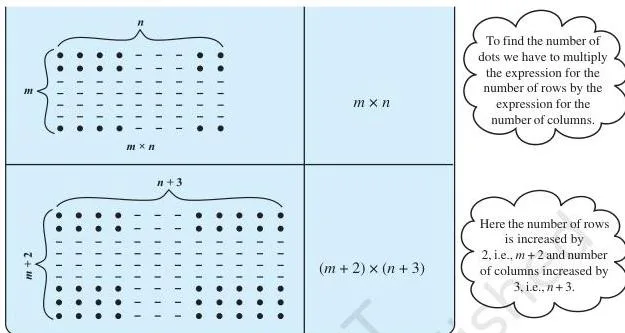
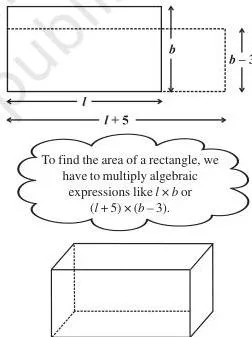
- 8.2 Multiplication of Algebraic Expressions: Introduction: multiplication is needed in real situations, and the chapter opens with four of them — patterns of dots, rectangle area, the volume of a box, and the price of bananas. Two of these appear as figures below.
- 8.3 Multiplying a Monomial by a Monomial: multiply the coefficients, then multiply the variable parts. Example: \(5x \times 4x^2 = 20x^3\). The product of monomials is always a monomial.
- 8.4 Multiplying a Monomial by a Polynomial: the distributive law spreads the monomial across every term of the polynomial. Example: \(3p \times (4p^2 + 5p + 7) = 12p^3 + 15p^2 + 21p\).
- 8.5 Multiplying a Polynomial by a Polynomial: every term of the first expression multiplies every term of the second. A binomial multiplied by a binomial gives four products; a binomial multiplied by a trinomial gives six; the like terms in the product are then combined.
Edition note: the chapter title carries the word “Identities”, but in this edition the numbered sections run to 8.5.2 and the chapter ends with Exercise 8.4 — the standard identity formulas are not printed in these pages. Textbook contents and the examinable syllabus are not always identical, so check the current official syllabus.
Key concepts that run through the chapter
The whole chapter rests on a small set of ideas. Learn these first, and every operation in the exercises becomes predictable.
The table below lists the seven ideas the book keeps returning to.
| Concept | What it means in this chapter |
|---|---|
| Variables and constants | Expressions are formed from variables and constants; for instance, \(x + 3\) joins the variable \(x\) with the constant 3. |
| Terms and factors | Terms are added to form expressions, and each term is itself a product of factors. |
| Like terms | Terms made from the same variables with the same powers; their coefficients need not match. |
| Monomial, binomial, trinomial, polynomial | Exactly one term, exactly two terms, exactly three terms; any one-or-more-term expression with non-zero coefficients and variables having non-negative integer exponents is a polynomial. |
| Distributive law | The rule that spreads multiplication across a sum: \(3x \times (5y + 2) = 15xy + 6x\) (section 8.4.1). It drives every multiplication rule from section 8.4 onward. |
| Exponent rule | \(x \times x^2 = x^3\): coefficients multiply, and powers of the same variable add (section 8.3.1). |
| Grouping three or more monomials | The order of multiplication does not matter: collect the coefficients first, then the variable powers. Example: \(2x \times 5y \times 7z = 70xyz\) (section 8.3.2). |
Worked example: binomial multiplied by binomial
Step 1: Write the product as a binomial multiplied by a binomial.
Every term of the first multiplies every term of the second.
\[ (3x + 2)(2x – 5) = 3x(2x – 5) + 2(2x – 5) \]
Step 2: Multiply term by term.
Watch the sign of \(2 \times (-5)\).
\[ = (3x \times 2x) + (3x \times (-5)) + (2 \times 2x) + (2 \times (-5)) \]
\[ = 6x^2 – 15x + 4x – 10 \]
Step 3: Combine the like terms \(-15x\) and \(4x\).
\[ = 6x^2 – 11x – 10 \]
Final answer: \((3x + 2)(2x – 5) = 6x^2 – 11x – 10\).
Worked example: binomial multiplied by trinomial
Step 1: This product will give 2 times 3 = 6 terms before combining.
\[ (a + 3)(a^2 – a + 2) = a(a^2 – a + 2) + 3(a^2 – a + 2) \]
Step 2: Multiply each term of the trinomial by each term of the binomial.
\[ = a^3 – a^2 + 2a + 3a^2 – 3a + 6 \]
Step 3: Combine like terms: \(-a^2 + 3a^2 = 2a^2\) and \(2a – 3a = -a\).
\[ = a^3 + 2a^2 – a + 6 \]
Final answer: \((a + 3)(a^2 – a + 2) = a^3 + 2a^2 – a + 6\).
The four figures in this chapter, explained
These are the four diagrams the chapter actually uses, and each one carries part of the argument. The first is the subtraction layout from section 8.1, Example 2.
The layout shows the expression being subtracted in the second row, with a marker row of \((-)(+)(-)(+)\) beneath it. Each marker tells you which operation to perform on that term: subtracting \(6y\) is the same as adding \(-6y\), and subtracting \(-3\) is the same as adding \(+3\). Copy this habit and subtraction stops costing sign errors.
The dot-pattern table opens section 8.2: one arrangement totals \(4 \times 9\) dots and another \(5 \times 7\). Counting the dots is multiplication in disguise, and the same structure — two quantities combined into one total — appears in every product rule that follows.
The banana-price example puts two changes into words: the price per dozen falls from ₹ \(p\) to ₹ \((p – 2)\), and the dozens needed fall from \(z\) to \((z – 4)\). The amount payable is the product of the two new quantities, \((p – 2)(z – 4)\) — two binomials, which is exactly the kind of product section 8.5 teaches you to expand.
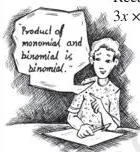
This figure carries the justification for the distributive law in section 8.4.1. Because expressions stand for numbers, \(3x\) can multiply \((5y + 2)\) the same way 7 multiplies 106 in the book’s mental-maths example: term by term, giving \((3x \times 5y) + (3x \times 2) = 15xy + 6x\).
Definitions you need for this chapter
The exercises depend on six terms used precisely, and a loose definition produces wrong answers. The table gives each term, a plain definition, and the section where the book first uses it.
| Term | Plain definition | Where it first appears |
|---|---|---|
| Monomial | An expression containing exactly one term, such as \(3x^2\). | Section 8.3 |
| Binomial | An expression containing exactly two terms. | Section 8.4 |
| Trinomial | An expression containing exactly three terms. | Section 8.4 |
| Polynomial | An expression containing one or more terms with non-zero coefficients and variables having non-negative integer exponents. | Section 8.4 |
| Like terms | Terms formed from the same variables with the same powers; their coefficients need not match. | Sections 8.1 and the closing section |
| Additive inverse | The opposite of a term: subtracting a term is the same as adding its additive inverse. Subtracting \(-3\) means adding \(+3\). | Section 8.1, Example 2 |
Common mistakes in this chapter
These are the mistakes the textbook itself pauses to warn about — the sign flips in subtraction, the exponent that stops growing, and the products that go missing. Each row names the error, the correct rule, and a way to check your own work.
| Mistake | Correct rule | How to check your answer |
|---|---|---|
| Treating unlike terms as addable, for example combining \(2x\) and \(3y\) | Unlike terms never combine; they are carried over unchanged in addition and subtraction. | Look at each term’s variable part. If the variables or their powers differ, the terms stay separate. |
| Dropping the sign change when subtracting | Subtraction is adding the additive inverse: subtracting \(6y\) is adding \(-6y\), and subtracting \(-3\) is adding \(+3\). | Write the \((-)(+)(-)(+)\) marker row under the subtracted expression, as in section 8.1 Example 2. |
| Multiplying coefficients but forgetting exponents | Powers of the same variable add: \(x \times x^2 = x^3\). | Rewrite the variable product as \(x^{1+2}\) and confirm the exponent grew. |
| Losing the sign of a negative product | One negative factor makes the product negative: \(5x \times (-3y) = -15xy\). | Count the minus signs in each multiplication before writing the answer. |
| Writing fewer than four products in a binomial times a binomial | Every term of one binomial multiplies every term of the other: \(2 \times 2 = 4\) products. | List the four products explicitly; two of them are usually like terms that combine. |
| Leaving like terms uncombined in a binomial times a trinomial | \(2 \times 3 = 6\) products appear first and collapse to five or fewer after combining. | After expanding, underline every pair of like terms and add them before writing the final answer. |
Worked example: simplify, then evaluate
Step 1: Expand both parts separately.
\[ 2y(3y – 4) = 6y^2 – 8y \]
\[ (y – 2)(2y + 1) = y(2y + 1) – 2(2y + 1) = 2y^2 + y – 4y – 2 = 2y^2 – 3y – 2 \]
Step 2: Subtract the second expansion from the first.
Flipping every sign of \(2y^2 – 3y – 2\) is the key move.
\[ 6y^2 – 8y – (2y^2 – 3y – 2) = 6y^2 – 8y – 2y^2 + 3y + 2 = 4y^2 – 5y + 2 \]
Step 3: Evaluate at \(y = -1\).
\[ 4(-1)^2 – 5(-1) + 2 = 4 + 5 + 2 = 11 \]
Final answer: the simplified expression is \(4y^2 – 5y + 2\), and its value at \(y = -1\) is 11.
Exam notes: how Exercises 8.1 to 8.4 test these skills
The four exercises are not random: each one tests a single operation, and the same applications keep returning. The table maps each exercise to the skill it practises.
| Exercise | Skill tested | Question shapes |
|---|---|---|
| 8.1 | Adding and subtracting whole expressions | Q1 adds four groups of expressions; Q2 subtracts three pairs, including expressions in three variables. |
| 8.2 | Monomial multiplied by monomial | Q1 pairs of monomials; Q2 rectangle areas from length and breadth; Q3 the product table; Q4 rectangular box volumes; Q5 products of three or more monomials. |
| 8.3 | Monomial multiplied by polynomial | Q1 multiplies expression pairs; Q2 completes a product table; Q3 products with fractional coefficients; Q4 simplifies then evaluates; Q5 adds, subtracts and combines expanded forms. |
| 8.4 | Polynomial multiplied by polynomial | Q1 multiplies binomials; Q2 finds products; Q3 simplifies eight longer expressions that mix the earlier skills. |
Two question patterns deserve attention before you practise.
- Geometry applications: area equals length times breadth, and volume equals length times breadth times height, with the sides given as expressions. Examples 3 and 4 work these out, and the pattern returns in Exercise 8.2 Q2 and Q4 and Exercise 8.3 Q2.
- Expand, then substitute: the pattern of Example 5 — expand fully, combine like terms, and only then substitute the given value. It appears again in Exercise 8.3 Q4 and in several parts of Exercise 8.4 Q3.
No weightage is stated in this chapter, and no one can promise which questions will appear. Textbook contents and the examinable syllabus are not always identical — check the current official CBSE syllabus before deciding what to revise.
What the chapter’s closing section tells you
NCERT closes the chapter with a nine-point recap called “What Have We Discussed?”. These are the same points in plainer words, so a night-before revision takes two minutes.
- Expressions are built from variables and constants.
- Terms joined by plus or minus form expressions, and each term is a product of factors.
- One-term, two-term and three-term expressions are monomials, binomials and trinomials; any such expression with non-zero coefficients and variables having non-negative integer exponents is a polynomial.
- Like terms share the same variables with the same powers; coefficients need not match.
- To add or subtract, combine like terms first; unlike terms carry over unchanged.
- Real situations such as rectangle area, with sides given as expressions, need multiplication of expressions.
- A monomial multiplied by a monomial always gives a monomial.
- Multiplying a polynomial by a monomial multiplies every term of the polynomial.
- Multiplying a polynomial by a binomial or trinomial multiplies term by term, and like terms in the product are combined.
Related resources
This listing is maintained for the 2026-27 academic session using the NCERT textbook information available to us. NCERT remains the authority for confirming the latest edition.
Once this chapter is done, the rest of Class 8 Mathematics uses the same language of expressions. The chapter before this one is Comparing Quantities (Chapter 7), and the chapter after it is Mensuration (Chapter 9), which applies the same multiplication skills to areas and volumes.
- Class 8 Mathematics: chapters and notes
- Class 8 study hub
- Chapter 7 Comparing Quantities
- Chapter 9 Mensuration
- CBSE notes index
Sources and data verification
- The section names, figures and exercise details on this page describe the NCERT Class 8 Mathematics textbook, Chapter 8, “Algebraic Expressions and Identities”, official edition published on ncert.nic.in.
- This page covers that one chapter. It does not describe the full CBSE curriculum.
- The listing is maintained for the current academic session.
- NCERT settles textbook editions and PDFs; CBSE settles the curriculum, syllabus and examinations.
Reference: NCERT Class 8 Mathematics textbook, chapter 8, official edition on ncert.nic.in.
FAQs
The chapter is called Algebraic Expressions and Identities: where are the standard identities in it?
In this edition they are not printed in the chapter. The title carries the word “Identities”, but the numbered sections run from 8.1 to 8.5.2 and the chapter ends with Exercise 8.4; the printed content covers adding, subtracting and multiplying expressions.
Textbook contents and the examinable syllabus are not always identical, so check the current official syllabus to see what this year’s course asks for.
How do I subtract one algebraic expression from another without sign errors?
Flip every sign of the expression being subtracted, then add. Subtracting a term is the same as adding its additive inverse, so subtracting \(-3\) means adding \(+3\), and subtracting \(6y\) means adding \(-6y\).
Section 8.1, Example 2 writes a marker row of \((-)(+)(-)(+)\) under the subtracted expression to track the flips. Copying that layout removes most sign errors.
Why can’t I add 2x and 3y together?
Because \(2x\) and \(3y\) are unlike terms — they involve different variables, raised to the same power but with nothing in common to factor out. Like terms combine only when they share the same variables with the same powers.
So \(2x + 3y\) stays as \(2x + 3y\). In the same way, the book carries \(-4y\) and \(5x\) over unchanged when they have no like terms to combine with.
How do I multiply three monomials like 2x, 5y and 7z?
Multiply the coefficients first: \(2 \times 5 \times 7 = 70\). Then multiply the variable parts: \(x \times y \times z = xyz\). The product is \(70xyz\).
Section 8.3.2 shows that the order does not matter — \((2x \times 5y) \times 7z\) gives the same answer as any other grouping.
Why does (a + 7)(a^2 + 3a + 5) give only four terms when six multiplications happen?
Because the six products are written first, and then like terms are combined. Expanding gives \(a^3 + 3a^2 + 5a + 7a^2 + 21a + 35\).
The pairs \(3a^2 + 7a^2 = 10a^2\) and \(5a + 21a = 26a\) reduce six terms to four: \(a^3 + 10a^2 + 26a + 35\). The book stops in section 8.5.2 to ask exactly this question.
Where do rectangles and boxes appear in the algebraic expressions chapter?
The rectangle-area pattern appears in section 8.2, where the length and breadth are given as expressions, and then in Examples 3 and 4, Exercise 8.2 Q2 (areas) and Q4 (volumes), and Exercise 8.3 Q2.
The formulas used are area equals length times breadth, and volume equals length times breadth times height, with the sides given as monomials or larger expressions.
Explore Class 8 Mathematics Books
- Previous: Comparing Quantities
- Next: The Baudhāyana-Pythagoras Theorem
Related chapters:
- A Square and a Cube
- Rational Numbers
- Power Play