
This is the official NCERT Class 7 Mathematics (Ganita Prakash) chapter 7 — A Tale of Three Intersecting Lines Class 7, running 34 printed pages from page 145 of the book. The original chapter PDF is right here, with the constructions, figures and question sets in NCERT’s own layout. Below the download: a section-by-section map, the key ideas with page references, and the mistakes to avoid.
Open the NCERT Class 7 Maths Chapter 7 A Tale of Three Intersecting Lines PDF from the official NCERT textbook portal — that is the same file teachers use, with every diagram, worked construction and Figure it Out question set in place.
Chapter at a glance: what is inside
The chapter is organised into five numbered sections — 7.1 Equilateral Triangles, 7.2 Constructing a Triangle When its Sides are Given, 7.3 Construction of Triangles When Some Sides and Angles are Given, 7.4 Constructions Related to Altitudes of Triangles and 7.5 Types of Triangles.
Each section works through Figure it Out question sets, and the chapter ends with a SUMMARY and the puzzle Shortest Path in a Box! The table below shows what the chapter holds in total.
What this chapter covers, section by section
Use this as a reading map — each part of the chapter, with the printed pages it occupies, so you can jump straight to what you need.
- Chapter opening (p 145-146): a triangle as the most basic closed shape — three vertices, three sides, three angles — how to name a triangle, and the opening question about what happens when the three vertices lie on a straight line.
- 7.1 Equilateral Triangles (p 146-148): the most symmetric triangle and the two-arc compass method that builds it without trial and error.
- 7.2 Constructing a Triangle When its Sides are Given (p 148-159): the general three-side construction, the triangle inequality, the three circle cases, and the conclusion that decides existence.
- 7.3 Construction of Triangles When Some Sides and Angles are Given (p 160-166): two sides with the included angle, two angles with the included side, when no triangle exists, the angle sum property and exterior angles.
- 7.4 Constructions Related to Altitudes of Triangles (p 167-169): altitudes by paper folding and by set square.
- 7.5 Types of Triangles (p 169-171): sorting by sides and by angles, ending with the chapter SUMMARY.
- Closing (p 171-172): the shortest-path-in-a-box puzzle.
The chapter’s answers to the Figure it Out questions are printed at the end of the chapter in the book, so you can check each set as you finish it.
Key concepts in A Tale of Three Intersecting Lines Class 7
Everything in this chapter hangs on one question: given a few measurements of a triangle, can you draw it — and does it actually exist?
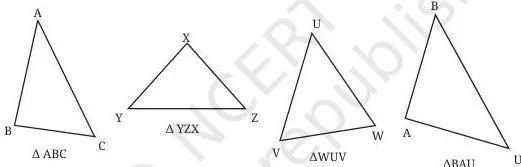
The opening gallery shows the parts of a triangle: three vertices (corner points), three sides (the line segments joining them) and three angles where the sides meet (p 145-146). A triangle is named by its vertices — for example \( \triangle ABC \) has angles \( \angle A \), \( \angle B \) and \( \angle C \).
The chapter also begins with a question you can answer only later: what happens when the three vertices lie on a straight line?
Two arcs meet: constructing a triangle from three side lengths
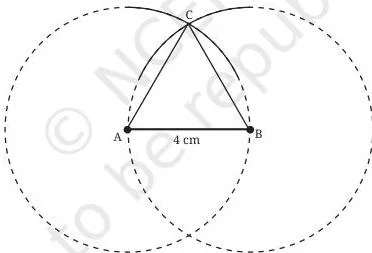
This is the simplest construction in the chapter: a triangle whose sides are all equal. The compass does the work — the point where two arcs cross is exactly the third vertex, with no guessing.
Why not use a marked ruler alone? The chapter tries it first (p 147): draw base AB = 4 cm, then place point C so that AC = 4 cm — but nothing forces BC to be 4 cm too, so you adjust and re-adjust. A compass removes the guessing.
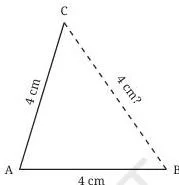
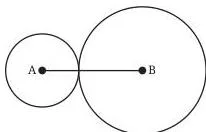
The figure above shows the problem: point C can sit anywhere on a circle around A, but keeping it exactly 4 cm from A does not keep it 4 cm from B. The two-arc method fixes both distances at once.
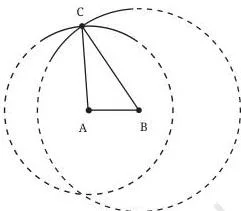
Step 1: draw AB = 4 cm. From A, draw a long arc of radius 4 cm. Every point on that arc is 4 cm from A, so C must lie somewhere on it.
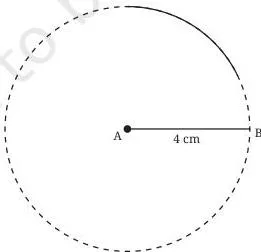
Step 2: from B, draw another arc of radius 4 cm. The crossing point C lies on both arcs, so it is 4 cm from A and 4 cm from B.
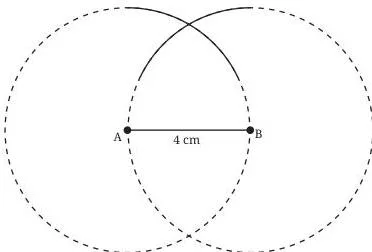
Step 3: join AC and BC. All three sides are 4 cm, so the triangle is equilateral (p 148).
The same idea builds any triangle from its three side lengths. For sides 4 cm, 5 cm and 6 cm, take AB = 4 cm as the base, draw an arc of radius 5 cm from A and an arc of radius 6 cm from B (p 149).
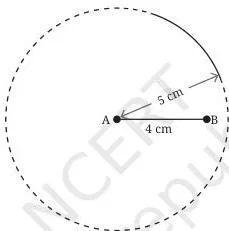
Fig 7.2 is the first arc drawn as a full circle: the third vertex must lie somewhere on the circle of radius 5 cm around A — that is exactly what “AC = 5 cm” means.
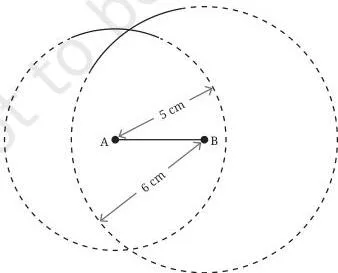
Fig 7.3 adds the second arc from B. The crossing point is on both circles, so its distance from A is 5 cm and its distance from B is 6 cm. That is why the crossing point is the third vertex — and the book notes that full circles are unnecessary, since arcs that cross are enough (p 150).
For practice with fresh numbers, build a triangle with sides 5 cm, 6 cm and 7 cm: base AB = 5 cm, then an arc of radius 6 cm from A and an arc of radius 7 cm from B. The crossing point gives the third vertex. The word isosceles — two equal sides — is also first met in this section (p 150).
The triangle inequality: which lengths actually form a triangle
Not every set of three lengths builds a triangle. This section gives you the rule that settles the question before you touch a compass, and the circle picture that explains why the rule works.
The chapter starts with a plot of land holding a tent, a tree and a pole (p 151-152). The direct path from the tent to the tree is always shorter than the path that goes through the pole.
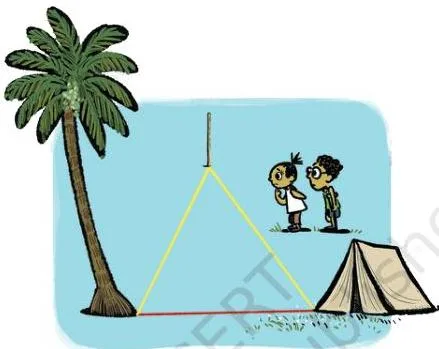
Read the tent figure as a triangle: tent, tree and pole are its three vertices. The red direct path is one side; the yellow path is the sum of the other two sides. Because a direct path is always the shortest, every side of a triangle must be smaller than the sum of the other two sides.
That requirement is the triangle inequality: a set of lengths satisfies it when each length is smaller than the sum of the other two (p 154).
Here is the chapter’s test case — lengths 10 cm, 15 cm and 30 cm. Suppose a triangle with these sides existed. Then the direct path CA of 30 cm would have to be shorter than the roundabout route \( CB + BA = 10 + 15 = 25 \) cm — but 30 is not shorter than 25, which is absurd. So no such triangle exists (p 152-153).
One-comparison shortcut. You do not need three checks. Put the lengths in order and compare only the largest with the sum of the other two: if the largest is smaller, the other two comparisons follow automatically, and if the largest is not smaller, no triangle exists (p 154-155).
Check 6, 9, 14: \( 14 \lt 6 + 9 = 15 \) — the largest is smaller, so a triangle exists.
Check 2, 5, 8: \( 8 \gt 2 + 5 = 7 \) — the largest is bigger, so no triangle exists.
The range of the third side. If two sides are 6 cm and 10 cm, the third side \( x \) must satisfy \( 6 + x \gt 10 \), so \( x \gt 4 \), and \( 6 + 10 \gt x \), so \( x \lt 16 \). Any length strictly between 4 cm and 16 cm works. The book’s own example: with sides 1 and 100, all numbers strictly between 99 and 101 are possible (p 159).
Why does the rule match the construction? Imagine the longest side, 8 cm, as the base, with circles of radius 4 cm and 5 cm drawn around its two ends (p 155).
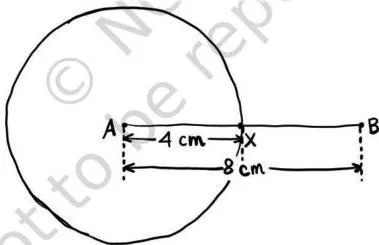
In the figure, AX = 4 cm and AB = 8 cm, so BX = 4 cm. The circle centred at B has radius 5 cm — larger than the gap of 4 cm — so it must cross the circle centred at A.
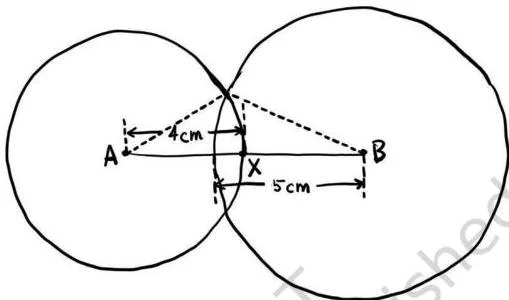
Fig 7.5 shows the result: the circles intersect at two points, and either crossing point, joined to A and B, gives a triangle with sides 4 cm, 5 cm and 8 cm (p 156).
Now read the three circle cases, taken with the longest side as the base and the two smaller lengths as the radii (p 157-158):
| Case | Relation between radii and base | What the circles do | Triangle? |
|---|---|---|---|
| Case 1 | \( \text{sum of radii} = AB \) | touch at one point | no |
| Case 2 | \( \text{sum of radii} \lt AB \) | stay apart | no |
| Case 3 | \( \text{sum of radii} \gt AB \) | cross at two points | yes |
Case 1 is the trap. Lengths 3, 6, 9 have \( 3 + 6 = 9 \) exactly — equality, not “less than”.
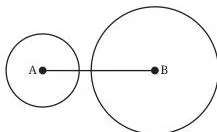
As the figure shows, the circles only touch at one point. Touching gives one shared point, but a triangle needs three distinct vertices, so no triangle exists (p 157; the book confirms 3, 6, 9 cannot be side lengths on p 159).
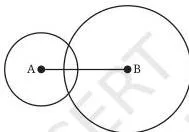
Case 2 shows the circles failing to reach each other — the sum of the two smaller lengths is less than the longest, so no triangle. Only Case 3, where the sum is greater, produces the two crossing points a triangle needs.
The conclusion (p 159): if a set of lengths satisfies the triangle inequality, a triangle with those side lengths exists; if it does not, no triangle exists.
Constructing with sides and angles, and when a triangle fails
Sometimes the given information mixes sides and angles. The chapter gives one construction recipe for each combination, plus a rule that tells you when the recipe cannot work.
Two sides and the included angle (p 160). The included angle is the angle between the two given sides. Example: AB = 5 cm, AC = 4 cm, \( \angle A = 45^\circ \).
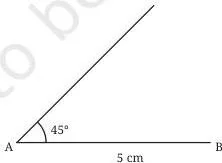
Read the figure as the recipe: draw the base AB; draw the given angle at A, which fixes the direction of the second side; mark the second given length AC on that new arm; join B to C. Placing the angle at the shared end of the two sides is what “included” means.
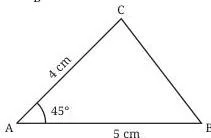
The completed triangle shows the result. One existence rule for this recipe: the included angle must be smaller than \( 180^\circ \) — at \( 180^\circ \) the two sides form a straight line and cannot close a triangle (p 161).
Two angles and the included side (p 161). Here the side is the one both angles touch. Example: AB = 5 cm, \( \angle A = 45^\circ \), \( \angle B = 80^\circ \). Draw the base, draw both angles at their ends, and the two new arms meet at the third vertex C.
When does the second recipe fail? The two given angles must sum to less than \( 180^\circ \) (p 163). The 40° figure shows why.
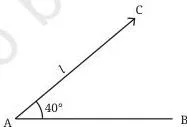
With one base angle fixed at 40°, the other arm must be steep enough to meet the first. The steepest line that just fails to meet is the parallel line m. When the two lines are parallel, the internal angles on the same side of the transversal sum to \( 180^\circ \), so the boundary is \( \angle B = 140^\circ \).
Any \( \angle B \) of \( 140^\circ \) or more and the arms never meet; below \( 140^\circ \) they do. The length of the base plays no part in this decision (p 163).
Worked checks with fresh numbers. \( 40^\circ + 130^\circ = 170^\circ \lt 180^\circ \), so 40° and 130° can be two angles of a triangle. \( 60^\circ + 120^\circ = 180^\circ \), so 60° and 120° cannot — their arms run parallel.
The angle sum property and exterior angles
The most important result in the chapter: the three angles of any triangle add to the same number, no matter the shape. One extra line makes the proof visible.
Draw a line through the top vertex, parallel to the base — a trick the book traces to Euclid’s Elements (p 166).
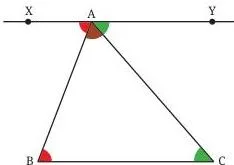
In Fig 7.7, line XY is drawn through A parallel to BC. Since AB is a transversal of the parallel lines, \( \angle XAB = \angle B \) (alternate angles); likewise \( \angle YAC = \angle C \). On the line XY, the three angles \( \angle XAB \), \( \angle BAC \) and \( \angle YAC \) together form a straight angle:
\[ \angle XAB + \angle BAC + \angle YAC = 180^\circ \]
Substituting the equal angles gives \( \angle A + \angle B + \angle C = 180^\circ \) — the angle sum property of triangles (p 166).
Worked example (original numbers). Two angles of a triangle are 48° and 72°. The third is \[ \angle C = 180^\circ – 48^\circ – 72^\circ = 180^\circ – 120^\circ = 60^\circ \]
The book also verifies the property by folding a paper triangle (p 166) — that figure is read in the diagram walkthrough below.
Exterior angles. Extend side BC past C to D. The angle \( \angle ACD \), formed between the extension and the other side CA, is an exterior angle of the triangle (p 167).
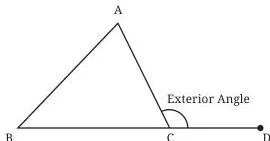
The figure shows \( \angle ACD \) sitting outside the triangle. Two straight-angle facts give the relation: \( \angle ACD + \angle ACB = 180^\circ \) (straight angle on line BD) and \( \angle A + \angle B + \angle ACB = 180^\circ \) (angle sum property). Subtract the common \( \angle ACB \): the exterior angle equals the sum of the two opposite interior angles — \( \angle ACD = \angle A + \angle B \).
Worked example (original numbers). If \( \angle A = 40^\circ \) and \( \angle B = 75^\circ \), the exterior angle at C is \( \angle ACD = 40^\circ + 75^\circ = 115^\circ \).
Altitudes: measuring the height of a triangle
The height of a triangle is not one of its sides. This section defines height precisely and shows two ways to draw it accurately.
An altitude is the perpendicular line segment from a vertex to the opposite side (p 167). Every triangle has three altitudes, one from each vertex.
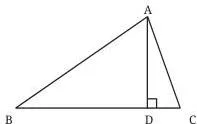
Fig 7.8 shows all three: AD from A to BC, BE from B to AC, and CF from C to AB. When the book says “height of the triangle”, it usually means the altitude to whatever side is taken as the base — AD in this figure (p 167).
The obtuse case. The perpendicular may land on the extension of the base rather than on the side itself: you extend BC and drop the perpendicular from A onto the extension (p 168).
Paper folding (p 168). Cut out a paper triangle, fix one side as the base, and fold so the top vertex lands on the base. The crease meets the base at a right angle, so the crease is an altitude. Unfold and draw along the crease.
Set square construction (p 169). A freehand ruler cannot guarantee a right angle, so the book uses a set square with a ruler:
- Align the ruler with the base, and place the set square on the ruler with one edge of its right angle touching it.
- Slide the set square along the ruler until its vertical edge passes through the vertex.
- Draw the altitude along that vertical edge.
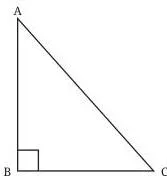
Special case. In a right-angled triangle, a side is itself an altitude: the two sides meeting at the right angle are perpendicular to each other, so each is the altitude to the other (p 169).
Two ways to sort triangles
With construction finished, the chapter sorts the triangles it has been building into families — two independent ways of classifying the same shapes.
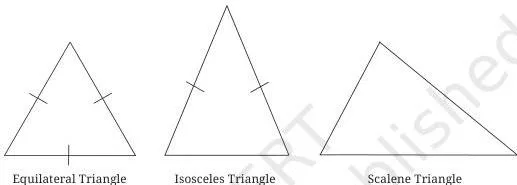
The figure collects the kinds of triangles met so far: equilateral, isosceles, scalene and right-angled. The table below is the classification of section 7.5 (p 170).
| By side lengths | Rule | By angle measures | Rule |
|---|---|---|---|
| Equilateral | all three sides equal | Acute-angled | all three angles acute |
| Isosceles | two sides equal | Right-angled | one right angle |
| Scalene | three different side lengths | Obtuse-angled | one obtuse angle |
The side-based names come from the construction sections: equilateral (all sides equal), isosceles (two sides equal) and scalene (three different sides) — p 150 and p 170. The angle-based names are acute-angled, right-angled and obtuse-angled (p 170).
The trap in “acute-angled”. It cannot mean “has one acute angle”, because every triangle has at least two acute angles (p 170). Since the angles sum to \( 180^\circ \), at most one angle can be \( 90^\circ \) or more — so a triangle with only one acute angle does not exist. Acute-angled therefore means all three angles are acute.
The book notes that the relation between the side-based and angle-based classifications is taken up in a later chapter, so do not try to force one naming scheme onto the other here (p 170).
Reading the diagrams in this chapter
These NCERT figures carry the chapter’s hardest ideas in picture form. Once you can read their language, the constructions stop being a sequence of steps and become something you can predict.
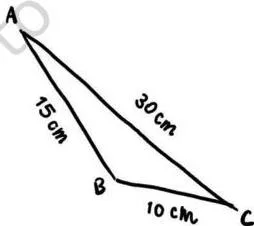
A rough diagram can lie (p 152). Fig 7.4 is a rough sketch of a triangle with sides 10 cm, 15 cm and 30 cm, and it looks perfectly normal. The absurdity is not in the drawing but in the arithmetic: the direct side CA is 30 cm, while the roundabout route via B is only 25 cm.
When a length check fails, the sketch will not show it — the calculation is the only trustworthy judge.
The three circle cases (p 157). This figure lines up the only three possibilities for two circles built on one base. Read it as three relations between the sum of the two radii and the base length: equal — touch at one point, no triangle; less — stay apart, no triangle; greater — cross at two points, triangle.
Only the third relation leaves room for a third vertex.
Which line does the drawing? (p 169). In the set-square construction, the vertical edge of the set square draws the perpendicular. The ruler underneath does no drawing of its own — it only keeps the set square sliding parallel to the base so the vertical edge stays perpendicular to it.
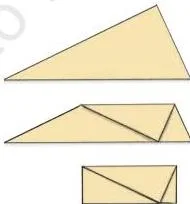
The angle sum made physical (p 166). In the paper fold, the three corners of the cut-out meet at one point, stacking the triangle’s three angles side by side along a straight line. A straight line is \( 180^\circ \), so the folded paper is the angle sum property you can see and touch.
Key terms defined in this chapter
Use this glossary when a term in the chapter stops making sense. Each definition is the chapter’s meaning in plainer words, with the page where the term is used.
| Term | What it means | NCERT page |
|---|---|---|
| Vertex | a corner point of a triangle; each triangle has three | p 146 |
| Side | a line segment joining two vertices | p 146 |
| Equilateral triangle | a triangle with all three sides equal | p 150 |
| Isosceles triangle | a triangle with two sides equal | p 150 |
| Scalene triangle | a triangle with three different side lengths | p 170 |
| Triangle inequality | the condition that each length is smaller than the sum of the other two | p 154 |
| Included angle | the angle that lies between two given sides | p 160 |
| Included side | the side that both given angles touch | p 161 |
| Angle sum property | the three angles of any triangle add to 180° | p 166 |
| Exterior angle | the angle between an extended side and the other side of the triangle | p 167 |
| Altitude | the perpendicular from a vertex to the opposite side | p 167 |
| Acute- / right- / obtuse-angled triangle | all three angles acute; one right angle; one obtuse angle | p 170 |
Mistakes students make with triangles
These are the places in this chapter where wrong answers usually begin. Each has a one-line correction, and the page that settles it.
| Mistake | Correct rule | How to check your answer |
|---|---|---|
| Checking only one comparison of side lengths | Every length must be smaller than the sum of the other two — 10, 15, 30 fails on \( 30 \gt 10 + 15 \) even though the other two checks pass (p 154) | Order the lengths and compare only the largest with the sum of the other two |
| Treating equality as acceptable (3, 6, 9) | The inequality is strict — \( 3 + 6 = 9 \) makes the circles only touch, so no triangle (p 157; question on p 159) | If the largest length equals the sum of the other two, that is the touch case — no triangle |
| Letting two given angles sum to 180° or more | Two angles can be angles of a triangle only when their sum is less than 180° (p 163) | Add the two angles; if the sum is 180° or more, the triangle does not exist |
| Confusing included angle with included side | Included angle: the angle between the two given sides (p 160). Included side: the side both given angles share (p 161) | In the first recipe, draw the angle at the shared end of the two sides; in the second, draw both angles at the two ends of the one side |
| Defining acute-angled as “has one acute angle” | Acute-angled means all three angles are acute; every triangle already has at least two acute angles (p 170) | If one angle is 90° or more, the other two are forced to be acute — so “one acute angle” would describe every triangle |
| Assuming the altitude always lies inside | In an obtuse triangle, extend the base and drop the perpendicular onto the extension (p 168) | Sketch the triangle first — if the base has an obtuse angle at its end, the altitude from the opposite vertex lands outside |
Using this chapter for exam practice
Textbook contents and the examinable syllabus are not always identical — check the current official syllabus before planning what to revise.
Practise the four constructions with real instruments. Construction questions test the accuracy of drawn steps, so rehearse each sequence until it is automatic: a triangle from three sides (p 148-150), two sides and the included angle (p 160), two angles and the included side (p 161), and an altitude with a set square (p 169).
For timed inequality checks use the one-comparison shortcut — largest length against the sum of the other two (p 154) — after confirming the three lengths share the same unit of measure, as the book does in its own question sets (p 156).
Treat the Figure it Out sets as your practice bank. The answers are printed at the end of the chapter in the book, so you can mark your own work. If the decimal third-side values (p 159) slow you down, the working with fractions notes for Class 7 cover the operations behind them.
Optional challenge: the closing puzzle, Shortest Path in a Box! (p 171-172), asks for the shortest route a spider can walk along the surfaces of a box from one corner to the opposite corner.
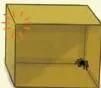
The box figure is the puzzle’s starting position — the spider cannot fly, so every candidate route is a chain of straight segments across the faces. It is the tent figure’s direct-path question in three dimensions, and a good test of whether the shortest-path intuition from the triangle inequality has settled in.
For a faster second pass over the constructions in this chapter, see our constructions and tilings notes for Class 7 and the Class 7 mathematics notes hub.
What to remember from this chapter
These are the chapter’s SUMMARY points (p 171) in plainer words, with the two existence rules the chapter proves along the way.
- A compass removes the guesswork from triangle construction when the side lengths are given (p 147-150).
- Triangle inequality: when each length is smaller than the sum of the other two, a triangle with those side lengths exists; and a triangle’s sides always satisfy it (p 154, p 159).
- Triangles can be constructed from two sides and the included angle, and from two angles and the included side (p 160-161).
- The three angles of any triangle add to 180° — the angle sum property (p 166).
- An altitude is the perpendicular from a vertex to its opposite side (p 167).
- By sides: equilateral (all equal), isosceles (two equal), scalene (three different). By angles: acute-angled, right-angled, obtuse-angled (p 170).
- Existence check for sides: the largest length must be smaller than the sum of the other two (p 154).
- Existence check for angles: two given angles must sum to less than 180° (p 163).
- The chapter closes with the shortest-path-in-a-box puzzle, which re-uses the direct-path idea from the tent figure (p 171-172).
Related chapters and official sources
This listing is maintained for the 2026-27 academic session using the NCERT textbook information available to us. NCERT remains the authority for confirming the latest edition.
Where to go next in the same book, and where the official file comes from.
The same book continues with two neighbouring chapters. The previous chapter (Chapter 6 of Class 7 Mathematics) comes immediately before this one, and the next chapter (Chapter 8 of Class 7 Mathematics) follows it. The Class 7 Mathematics book page lists every chapter of Ganita Prakash, and the Class 7 hub leads to the other subjects of the class.
For study material in note form, start at the Class 7 notes collection or go straight to the full CBSE notes library.
The authoritative source for this chapter is NCERT itself: the official NCERT textbook portal at ncert.nic.in hosts the complete Ganita Prakash Class 7 book, and it is the same portal that serves the chapter PDF linked at the top of this page.
| What the chapter holds | Count | Where it is used |
|---|---|---|
| Printed pages | 34 | |
| Sections in the chapter | 5 | |
| Figures with NCERT captions | 32 | |
| Tables | 1 | |
| In-text questions | 19 | |
| Official NCERT PDF | Download the chapter PDF | the chapter exactly as NCERT publishes it |

Reference: NCERT Class 7 Mathematics (Ganita Prakash) textbook, chapter 7, official edition on ncert.nic.in.
Sources and data verification
The page numbers, section names and figure contents above describe the NCERT Class 7 Mathematics textbook Ganita Prakash, Chapter 7, as published by NCERT. This page covers that single chapter; it does not cover other Class 7 subjects or other mathematics textbooks.
This listing is maintained for the current academic session using the NCERT information available to us. NCERT settles textbook editions and the official PDFs; CBSE settles the curriculum, syllabus and examinations. Where the textbook and the examinable syllabus differ, the official CBSE syllabus is the authority to check.
Frequently asked questions
Short, direct answers to the questions students search when this chapter does not make sense.
How do I check quickly whether three lengths can form a triangle?
Compare only the largest length with the sum of the other two (NCERT, p 154). If the largest is smaller than that sum, a triangle exists; if it is equal or larger, no triangle exists. For 6, 9 and 14: \( 14 \lt 6 + 9 = 15 \), so a triangle exists. For 2, 5 and 8: \( 8 \gt 2 + 5 = 7 \), so none does.
One comparison is enough because the smaller lengths are each automatically less than the largest plus the other small length.
Why do 3, 6 and 9 not form a triangle even though the numbers look close?
Because the triangle inequality must be strict: \( 3 + 6 = 9 \) is equality, not “less than”. With the longest length 9 as the base and circles of radius 3 and 6, the circles touch at exactly one point (Case 1, p 157) — touching leaves no room for a third vertex, so no triangle. The book’s question set confirms that 3, 6, 9 cannot be side lengths (p 159).
What is the difference between an included angle and an included side?
An included angle is the angle between the two given sides, used in the two-sides-and-one-angle construction (p 160). An included side is the side that both given angles touch, used in the two-angles-and-one-side construction (p 161).
In the first, draw the angle at the shared end of the two sides; in the second, draw the two angles at the two ends of the one side.
How do I find the third angle when two angles of a triangle are given?
Subtract their sum from \( 180^\circ \) — that is the angle sum property (p 166). If two angles are \( 48^\circ \) and \( 72^\circ \), the third is \( 180^\circ – 48^\circ – 72^\circ = 60^\circ \). If the given pair sums to \( 180^\circ \) or more, no triangle exists with those two angles (p 163).
When is a side of a triangle also its own altitude?
In a right-angled triangle (p 169). The two sides that meet at the right angle are perpendicular to each other, so each side is the altitude to the other. For example, in a triangle with \( \angle B = 90^\circ \), side AB is an altitude to BC, and side BC is an altitude to AB.
Does the length of the included side change the size of the third angle?
No — the book’s own experiment shows that once two angles are fixed, changing the included side from 5 cm to 7 cm leaves the third angle the same, or only very slightly different (p 164). With two angles of \( 60^\circ \) and \( 70^\circ \), the third is always \( 50^\circ \), whatever the side between them.
The side decides how big the triangle is, not the shape of its angles.
Explore Class 7 Mathematics Books
Related chapters: