
Number Play Class 7 is Chapter 6 of the NCERT Class 7 Mathematics textbook Ganita Prakash, the current NCERT series for Class 7. The chapter holds five short explorations: a height line-up that hides actual heights, even and odd numbers seen as pairs, row and column sums that grow into magic squares, the Virahāṅka–Fibonacci sequence, and digits disguised as letters.
The official chapter PDF is available immediately below.
Download the Number Play Class 7 chapter PDF
The official Number Play Class 7 NCERT Mathematics chapter PDF is published by NCERT on its textbook portal — the same file schools and teachers use. On the portal, choose Class 7, then Mathematics, to reach the Ganita Prakash chapter file.
The chapter sits in Ganita Prakash: NCERT Class 7 Mathematics, Chapter 6, Number Play. Use the section below to see what the file contains before you open it.
Chapter 6 at a glance
The chapter table below lists what the file holds — sections, figures and question prompts — exactly as the textbook’s own structure organises them.
One structural fact helps before you start: everything in this chapter is practice. The questions appear as “Figure it Out” prompts inside each of the five sections, and the closing pages of the chapter work through them. There is no separate exercise block at the end to find.
What this chapter covers
This chapter is five short explorations, each built around one question. Knowing what each section is trying to do makes the order of the chapter obvious.
6.1 Numbers Tell Us Things: what a line-up can say
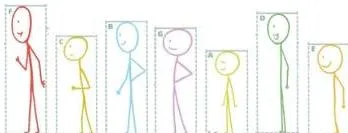
The opening activity asks what numbers can record about a group without giving the heights themselves. The rule: each child calls out how many children in front of them are taller.
- The first child in line always says 0.
- The tallest child always says 0 too, because nobody in front of them is taller.
- Saying 0 does not mean you are tallest — anyone with no taller child in front says 0.
- In a group of 8, the largest number possible is 7.
- The Figure it Out prompts ask you to sort statements as always, sometimes or never true, and to arrange stick-figure cutouts from the back of the book to match given sequences.
The numbers, in other words, code the order of heights, not the heights themselves.
6.2 Picking Parity: even and odd as pairs
The section opens with Kishor’s puzzle: five boxes, each holding one odd number card, must add to 30. The pairing picture answers it without guessing.
- Even means the number can be arranged in pairs with nothing left over; odd means one more than a pair (equivalently, one less than a pair).
- This even–odd property is called parity.
- Five odd numbers always add to an odd number, so Kishor’s boxes can never reach 30.
- Consecutive numbers are one even and one odd, so their sum is odd — two siblings born a year apart cannot have ages summing to 112.
- The same idea extends to grids: a \(3 \times 3\) grid has 9 small squares (odd), a \(3 \times 4\) grid has 12 (even).
- Later the section applies parity to algebraic expressions like \(3n + 4\).
6.3 Some Explorations in Grids: row sums and magic squares
Circled numbers outside a grid are the sums of the rows and columns they face. The section shows how much those sums force the grid’s contents.
- A circled sum in a 1 – 9 grid must lie between 6 \((1+2+3)\) and 24 \((9+8+7)\); a grid demanding 5 or 26 is impossible before you start.
- The three row sums always total 45, and so do the three column sums, because both count the numbers 1 through 9.
- Equal row, column and diagonal sums define a magic square; that common total is the magic sum.
- There are 3,62,880 ways to fill a \(3 \times 3\) grid with 1 – 9 without repetition — the book’s reason for working systematically.
- The section ends with history: the Khajuraho Chautīsā Yantra, the Chinese Lo Shu square, and Indian temple and household yantras.
6.4 Nature’s Favourite Sequence: the Virahāṅka–Fibonacci numbers
Most people meet the sequence 1, 2, 3, 5, 8, 13, 21, 34, 55, … in science. The book’s surprise: it was first discovered in poetry.
- A short syllable takes 1 beat and a long syllable takes 2 beats, so “how many 8-beat rhythms exist” becomes “how many ways can 8 be written as a sum of 1s and 2s”.
- The answer is 34 — the 8th term of the sequence.
- Each new term is the sum of the two before it: \(8 + 13 = 21\), \(13 + 21 = 34\), and so on.
- The chapter names the discoverers in order: Piṅgala (c. 300 BCE), Virahāṅka (c. 700 CE), Gopala (c. 1135 CE), Hemachandra (c. 1150 CE), Fibonacci (1202 CE).
6.5 Digits in Disguise: cryptarithms
Here arithmetic itself becomes the puzzle. Digits are replaced by letters, and each letter stands for exactly one digit (0 – 9).
- The opening example \(T + T + T = UT\) forces \(T = 5\) and \(U = 1\), because three 5s make 15.
- The closing example \(UT + TA = TAT\) works out to \(U = 9\), \(T = 1\), \(A = 0\).
- More puzzles follow: \(YY + Z = ZOO\), \(B5 + 3D = ED5\), \(KP + KP = PRR\), \(C1 + C = 1FF\).
- The reliable method: start at the units column, track carries, and remember a leading letter can never stand for 0.
Key concepts in Number Play Class 7, explained
These are the ideas the chapter keeps returning to. Each is stated in plain words with the reasoning behind it, so you can apply it to a fresh question instead of recalling an answer.
The taller-than rule and what it proves
The rule is deliberately local: each child looks only at the children in front of them, counts how many are taller, and says that number. It never refers to anyone behind, and it never names an actual height.
That local view is why the 6.1 Figure it Out classification comes out as it does:
- Always true: the tallest child says 0, and the first child in line says 0.
- Only sometimes true: “saying 0 means you are tallest”; “a middle child cannot say 0” (a middle child often can); “the child with the largest number is the shortest”.
- The largest number possible in a group of 8 people is 7 — a child can count at most the 7 people ahead of them.
Question 2 of the 6.1 Figure it Out is the whole lesson in one prompt: test each statement against a small layout and you see what the rule does and does not record.
Parity: the pairing definition and the sums that follow
Parity is the chapter’s name for the even–odd property. The pairing picture below is the definition, and every rule in the table follows from it.
| Sum or difference | Parity of the result | Reason, from the pairing picture |
|---|---|---|
| even + even | even | Two complete collections of pairs join to make only pairs. |
| odd + odd | even | The two single leftover dots pair up with each other. |
| even + odd | odd | All pairs except one: the odd addend leaves one dot unpaired. |
| even − even | even | Removing pairs from pairs leaves pairs. |
| odd − odd | even | Each odd has a leftover dot; the two dots cancel, leaving pairs. |
| even − odd | odd | Taking a pair-plus-one from a pair leaves one dot alone. |
| odd − even | odd | Removing pairs from a pair-plus-one leaves the single dot. |
| any number of evens | even | Every addend is made of pairs, so the total is made of pairs. |
| an even count of odds | even | The leftover dots pair up two at a time. |
| an odd count of odds | odd | One leftover dot is left unpaired at the end. |
| grid product \(m \times n\) | odd only when both \(m\) and \(n\) are odd | If either dimension has a pair in it, the squares can be grouped in pairs. |
These rules let the chapter judge sums without adding:
- Kishor’s five odd cards cannot sum to 30 — an odd count of odds is odd, and 30 is even.
- Consecutive ages are one even and one odd, so their sum is odd; 112 is even, so Martin and Maria cannot be one year apart with that total.
- Lakpa’s coins add as odd + odd + even = even, so ₹205 (odd) is impossible — he made a mistake.
- 50 loose sheets carry 50 even and 50 odd page numbers; both groups sum to even, so 6000 is possible.
- The sum of numbers from 1 to 100 contains 50 odd numbers — an even count of odds — so it is even.
Expressions that force parity: 2n and 2n − 1
Positions in the even and odd lists can be written as expressions. The pairing picture tells you which expressions always come out even, which always odd, and which depend on the input.
- The nth even number is \(2n\), because \(2n = 2 \times n\) is always a pair. So the 100th even number is \(2 \times 100 = 200\).
- The nth odd number is \(2n – 1\) — one less than a pair. The 100th odd number is \(200 – 1 = 199\).
- Always even: \(100p\), \(48w – 2\). Always odd: \(2m + 1\), \(8a + 3\).
- Variable: \(3n + 4\) is 13 (odd) for \(n = 3\) and 28 (even) for \(n = 8\).
- To list all odd numbers, the chapter settles on \(2n – 1\): run \(n = 1, 2, 3, …\) and no odd number is skipped.
Magic squares: the three observations and the generalised form
With the numbers 1 – 9, a magic square is not found by guessing. Three observations force it, and each has a reason.
- Magic sum must be 15 (Observation 1). The three rows use every number 1 – 9 once, and \(1 + 2 + \dots + 9 = 45\). Three equal rows share 45, so each row is \(45 \div 3 = 15\).
- Centre must be 5 (Observation 2). The centre belongs to four lines: a row, a column and two diagonals. Each must total 15, so the centre needs four different partner pairs from 1 – 9. Only 5 has four: \(1+9\), \(2+8\), \(3+7\), \(4+6\).
- 1 and 9 cannot sit in corners (Observation 3). A corner lies on three lines, so 1 would need three partner pairs summing to \(15 – 1 = 14\). Only \(5 + 9\) and \(6 + 8\) exist, so 1 must go in an edge-middle position — and so must 9.
Once these are fixed, the whole square can be written in a generalised form. With the centre labelled \(m\), the chapter’s generalised square is:
| Generalised \(3 \times 3\) magic square (centre \(m\)) | ||
|---|---|---|
| \(m + 3\) | \(m – 4\) | \(m + 1\) |
| \(m – 2\) | \(m\) | \(m + 2\) |
| \(m – 1\) | \(m + 4\) | \(m – 3\) |
Every row, column and diagonal sums to \(3m\), so the magic sum is three times the centre. That is why adding 1 to every cell raises the magic sum by 3, and doubling every cell doubles the magic sum.
Worked example — build a magic square with 21 at the centre.
Put \(m = 21\) into the generalised form:
\[ \begin{array}{ccc} 24 & 17 & 22 \\ 19 & 21 & 23 \\ 20 & 25 & 18 \end{array} \]
Step 2: The magic sum is \(3m = 3 \times 21 = 63\).
\[ 24+17+22 = 63,\qquad 19+21+23 = 63,\qquad 20+25+18 = 63 \]
Step 3: Columns and diagonals: \(24+19+20 = 63\), \(17+21+25 = 63\), \(22+23+18 = 63\), \(24+21+18 = 63\), \(22+21+20 = 63\).
Final answer: all eight lines sum to 63, so the completed square is magic.
The two famous squares in the history section obey the same arithmetic. The Lo Shu square is \(3 \times 3\) using 1 – 9, total 45, so each row must be \(45 \div 3 = 15\). The Chautīsā Yantra is \(4 \times 4\) using 1 – 16, total 136, so each row must be \(136 \div 4 = 34\) — and “chautīs” means 34. Both magic sums are the total of the numbers divided by the number of rows.
You can also work the other way: the chapter builds a square with magic sum 60 from the generalised form, and a later prompt asks for magic sum 0 using negative numbers.
The Virahāṅka–Fibonacci sequence: one rule, many stories
One rule builds the whole sequence: each term is the sum of the two before it. The poetry, the daisies and the parity pattern all follow from that rule.
Worked example — 144 and 233 are consecutive Virahāṅka numbers.
Find the two terms after and the two terms before them.
Step 1 (forward, by addition): the next term is \(144 + 233 = 377\), and the one after that is \(233 + 377 = 610\).
Step 2 (backward, by subtraction): a term is the sum of the two before it, so the term before 233 is \(233 – 144 = 89\), and the term before 144 is \(144 – 89 = 55\).
Final answer: the six consecutive terms run 55, 89, 144, 233, 377, 610.
The same subtraction trick handles the chapter’s question with 987 and 1597: the next two terms are 2584 and 4181, the previous two are 610 and 377.
The rhythm counting behind it all: every 5-beat rhythm starts with a 1-beat syllable in front of a 4-beat rhythm, or a 2-beat syllable in front of a 3-beat rhythm. So the count for 5 equals the count for 4 plus the count for 3 — which is the sequence rule restated.
Parities, position by position: write O for odd and E for even. The first six terms give O, E, O, O, E, O.
Because each term is the sum of the previous two, the block (O, E, O) repeats forever: O + E = O, E + O = O, and O + O = E. For the 20th term, \(20 = 6 \times 3 + 2\) — it sits in the second slot of the next block, which is even. You never need to write out twenty terms.
Cryptarithms: reading hidden arithmetic
A cryptarithm (the chapter also calls these alphametics) is a calculation where each letter replaces one digit. The method is the same every time:
- Start at the units column, and write each column’s sum including its carry.
- Track the carries column by column; a carry out of the top column becomes a new leading digit.
- Remember a leading letter can never be 0.
- Use the shape of the sum — how many digits it has — to force digits before guessing.
Worked example — solve \(AB + BA = CBC\).
Step 1: the sum has three digits, so the tens column must carry; the carry lands in the hundreds place, which makes \(C = 1\).
Step 2 (units column): \(B + A\) writes the digit \(C = 1\).
Since \(A\) and \(B\) are both leading digits, neither is 0, so \(A + B = 11\) — write 1, carry 1.
Step 3 (tens column): \(A + B + 1 = 11 + 1 = 12\).
Write 2, carry 1.
The written digit is \(B\), so \(B = 2\).
Step 4: \(A + B = 11\) with \(B = 2\) gives \(A = 9\).
Final answer: \(A = 9\), \(B = 2\), \(C = 1\), and \(92 + 29 = 121\) — the check confirms it.
The chapter’s own examples run the same way: \(T + T + T = UT\) gives \(T = 5\), \(U = 1\); \(UT + TA = TAT\) gives \(U = 9\), \(T = 1\), \(A = 0\) because \(91 + 10 = 101\). The four practice cryptarithms are yours to solve with the same four steps.
The figures in this chapter, explained
Most of the visuals in this chapter are working pictures — each one carries part of an argument, from the pairing definition of even to the placement of 5 in a magic square. Here is what to look at in each group.
The pairing pictures that prove the parity rules

The first picture shows even numbers as complete rows of pairs. That is the chapter’s definition of even, and it is why even + even = even needs no calculation: joining two sets of pairs never creates a leftover.

An odd number is drawn as pairs plus one leftover dot. The book also asks whether an odd number can be read as one less than a pair — and it can, which is exactly the picture behind \(2n – 1\): one less than the even number \(2n\).
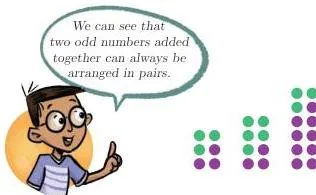
This figure is a proof. Put two odd collections together and their two leftover dots become a pair, so the whole sum is pairs. The book names it a proof because the picture settles the rule for every odd number at once, not just for the two shown.
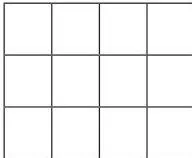
The grid picture seeds the grid-parity rule: 9 small squares is odd, 12 is even. Since the square count is the product of the dimensions, a product is odd only when both dimensions are odd — why \(27 \times 13\) is odd but \(42 \times 78\) and \(135 \times 654\) are even.
The reasoning pictures behind the 3 × 3 magic square
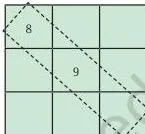
The chapter builds the magic square by elimination, and this picture shows one dead end. If 1 sat in the centre, a 2 placed in the same line would need a third number \(15 – 2 – 1 = 12\), which is not available in 1 – 9.
The mirror argument kills 9 at the centre, and the same style of check removes every other candidate until only 5 survives.
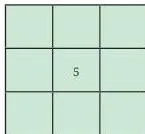
A corner belongs to three lines — row, column and diagonal — so 1 in a corner would need three partner pairs summing to \(15 – 1 = 14\). Only \(5 + 9\) and \(6 + 8\) exist, so two partners are missing; 1 cannot be a corner. The same argument puts 9 in an edge middle, and the figure splits the boundary into corners and edge middles so you can see both positions.
Magic squares in history and culture
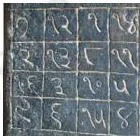
The Chautīsā Yantra uses the numbers 1 – 16, which total 136, and its four rows share that total equally: \(136 \div 4 = 34\). The name itself says it — chautīs means 34 — and the book invites you to look for other four-number groups that also sum to 34.
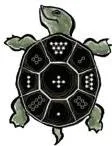
The Lo Shu is the 3 by 3 square of legend: a turtle carried it out of the flood of the Lo River, with 1 – 9 arranged in a magical pattern. It obeys this chapter’s rules — 45 shared among three rows gives the magic sum 15, and 5 sits in the centre.
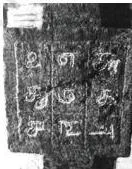
The Navagraha Yantra gives each graha its own magic square, and a different magic sum belongs to each. It makes the point that magic squares are not museum pieces: the book shows them on temple pillars, in homes and in shops.
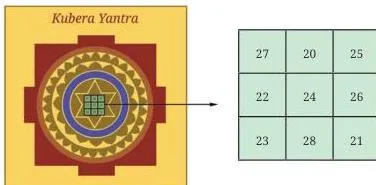
The Kubera Yantra is the chapter’s household example — a working magic square people actually use. Together with the Lo Shu and the Chautīsā, it shows the same row–column–diagonal balance appearing in ancient China, Khajuraho, and Indian homes; the book adds that magic squares were studied in India, Japan, Central Asia and Europe.
The heights activity and the number line-up
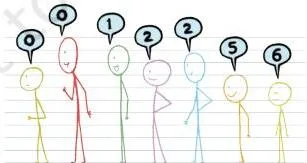
Re-read the rule at the picture: each child says how many children in front of them are taller. The numbers change when the arrangement changes, because the rule always talks about the current line. The first child has nobody in front, so that position always produces 0.
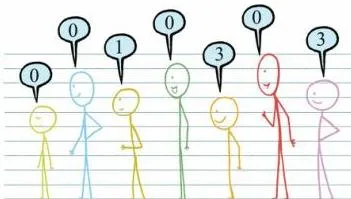
The solved line-up in the closing pages reads 0, 0, 1, 0, 3, 0, 3 from left to right. Check any entry by scanning the children ahead of that child and counting the taller ones — the child saying 3, for instance, has three taller children in front. This is the same verification the 6.1 Figure it Out asks for.
The Virahāṅka numbers in flowers
The three daisies carry 13, 21 and 34 petals — three consecutive Virahāṅka numbers. The sequence that poets counted in rhythm turns up again as a plain count of petals, which is why the chapter calls these numbers nature’s favourite sequence.
Grid and cryptarithm puzzles at the end of the chapter
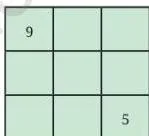
Here the circled numbers are targets: each row and column must add to the circle it faces, using 1 – 9 without repetition. Before filling anything, check the band — any circled sum below 6 or above 24 marks a grid that is impossible, like the one with 5 and 26 the chapter deliberately gives you.
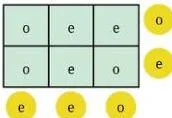
This is one working answer to the \(2 \times 3\) parity-grid puzzle: fill six boxes with three odd and three even numbers so that every circled letter — e for even, o for odd — matches the parity of that row or column sum. “One of the ways” means the parities are fixed but the actual numbers can vary; the book invites more combinations.
This closing illustration is the chapter’s summary of 6.5: arithmetic rewritten as a detective puzzle. Each letter hides one digit, the leading letter is never 0, and the units column is where every solution starts.
Key terms in this chapter, defined
A quick-reference list of the chapter’s vocabulary in plain words.
| Term | Plain definition | Where it matters |
|---|---|---|
| Parity | Whether a number is even or odd | 6.2 — deciding sums and products without calculating them |
| Even number | A number that can be arranged in pairs with nothing left over | The pairing picture behind even + even = even |
| Odd number | A number that is one more than a pair (equivalently, one less than a pair) | Why odd + odd = even, and why \(2n – 1\) lists the odds |
| Magic square | A square grid where every row, every column and both diagonals add to the same total | 6.3 — Observations 1–3 and the generalised form |
| Magic sum | That common row/column/diagonal total | 15 for a 1 – 9 square; \(3m\) in general; 34 for the Chautīsā Yantra |
| Virahāṅka–Fibonacci numbers | The sequence 1, 2, 3, 5, 8, 13, 21, 34, 55, … where each term is the sum of the two before it | 6.4 — rhythm counting, daisy petals, parity pattern |
| Cryptarithm (alphametic) | A calculation where each letter stands for one digit | 6.5 — solved from the units column with carries |
Common mistakes in Number Play Class 7, and the corrections
Seven mistakes appear again and again when students work through this chapter. Each row names the error, explains why it is wrong, and points to the question that exposes it.
| Mistake | Why it is wrong | The correction |
|---|---|---|
| “Saying 0 means I am the tallest.” | The rule counts only the taller children in front. A middle child can say 0 while tall children stand behind. | The tallest child always says 0, and so does the first child; 0 alone proves neither. (6.1 Figure it Out Q2) |
| “odd − odd = odd.” | Each odd has one leftover dot; subtracting them leaves the two dots paired. | odd − odd = even. Test it: 7 − 3 = 4. (6.2 Figure it Out Q3) |
| “A big grid product must be even.” | A product is even if either factor is even — bigness has nothing to do with it. | Check both dimensions: \(27 \times 13\) is odd; \(42 \times 78\) and \(135 \times 654\) are even. (Small Squares in Grids) |
| “The magic centre can be just any number.” | With 1 – 9 the magic sum is forced to 15, and only 5 can pair four ways to reach it — with 1 + 9, 2 + 8, 3 + 7 and 4 + 6. | Centre = 5 and magic sum = 15 for a 1 – 9 square; circled grid sums below 6 or above 24 make a grid impossible. (6.3 Observations 1–3) |
| “Virahāṅka parities alternate odd, even, odd, even…” | Pairing parities cycles differently: O + E = O, E + O = O, O + O = E. | The block odd, even, odd repeats, so the 20th term is even. (6.4 parity questions) |
| “77 toggles is a lot, so the bulb must be ON.” | Each toggle flips the state; only every second toggle restores it. | An odd number of flips changes ON to OFF. (6.5 Figure it Out Q1) |
| “Guess cryptarithm digits one letter at a time.” | Guessing ignores the carries that tie the columns together. | Start at the units column, write the carry, and never let a leading letter be 0. (6.5 cryptarithms) |
Exam notes: how to use this chapter
No page on this site can promise which questions will appear, and this one does not. Textbook contents and the examinable syllabus are not always identical — check the current official syllabus, published at cbse.gov.in, before deciding what to revise.
What the chapter genuinely gives you is a set of transferable reasoning skills:
- Parity arguments — deciding whether a sum, difference or product is even or odd without computing it.
- Systematic construction — building a magic square from observations instead of guessing.
- Working from a rule — extending the Virahāṅka sequence forward by addition and backward by subtraction.
- Place-value logic — solving cryptarithms from the units column, which is column addition and carries used as a puzzle.
The book itself points forward: counting the 3,62,880 grid fills is a later-grade problem, and the generalised \(m\)-form of the magic square is an early meeting with algebra. Every “Figure it Out” prompt in the chapter tests one of these skills — a student who can do them all has done the chapter.
One practical note: this is the NCERT Ganita Prakash series. Students using an older NCERT Class 7 edition will find a differently numbered chapter set — check the chapter list before assuming Chapter 6 is Number Play there.
Number Play Class 7: what to remember
The chapter’s own summary, in shorter words:
- The opening activity codes a height order without heights: each child counts the taller children in front, and the first child always says 0.
- Parity is pairing — even numbers pair completely, odd numbers leave one leftover (and are one less than the next pair).
- The parity of a sum or difference follows from the leftovers: two odds become even, one odd stays odd, an odd count of odds is odd.
- In a 1 – 9 grid, a circled sum below 6 or above 24 makes the grid impossible, and the row sums always total 45.
- A magic square needs equal row, column and diagonal sums; with 1 – 9 that forces magic sum 15, centre 5, and 1 and 9 out of the corners.
- The Virahāṅka–Fibonacci sequence 1, 2, 3, 5, 8, 13, 21, 34, 55, … was first discovered counting poetry rhythms; each term is the sum of the two before it.
- Cryptarithms hide digits behind letters; start at the units column, track carries, and a leading letter is never 0.
Related chapters and resources
This listing is maintained for the 2026-27 academic session using the NCERT textbook information available to us. NCERT remains the authority for confirming the latest edition.
From here you can move around the Class 7 mathematics section of this site.
- The Class 7 hub lists every NCERT book for the class.
- The Ganita Prakash Class 7 book page holds the full set of chapters in this textbook.
- The previous chapter and the next chapter continue the book in order.
- For revision, the Class 7 mathematics notes and the CBSE notes hub for Class 7 gather the same ideas in note form, including pages like Connecting the Dots and A Tale of Three Intersecting Lines.
Sources and data verification
- The figures and facts on this page describe the NCERT Class 7 Mathematics textbook Ganita Prakash, Chapter 6 Number Play, in the edition NCERT currently publishes.
- This page covers that one chapter only — not other Class 7 books, and not older NCERT editions with a differently numbered chapter set.
- The page is maintained against the current NCERT edition listed on ncert.nic.in.
- NCERT settles textbooks, editions and PDFs; CBSE settles the curriculum, syllabus and examinations.
| What the chapter holds | Count | Where it is used |
|---|---|---|
| Printed pages | 32 | |
| Sections in the chapter | 5 | |
| Figures with NCERT captions | 17 | |
| Tables | 26 | |
| In-text questions | 13 | |
| Official NCERT PDF | Download the chapter PDF | the chapter exactly as NCERT publishes it |
Reference: NCERT Class 7 Mathematics textbook (Ganita Prakash), chapter 6, official edition on ncert.nic.in.
Frequently asked questions about Number Play Class 7
Where can I download the official Number Play Class 7 chapter PDF?
The official PDF is Chapter 6 of Ganita Prakash, published by NCERT on its textbook portal — the download link at the top of this page points to ncert.nic.in/textbook.php. On the portal, choose Class 7, then Mathematics, and open the Ganita Prakash book; the chapter file is Number Play.
What is parity in this chapter?
Parity is the property of being even or odd. The chapter defines it through pairing: an even number can be arranged in pairs with nothing left over, and an odd number always leaves one dot unpaired. From that picture come the rules — odd + odd = even, even + odd = odd, an odd count of odds is odd, and so on.
Why must 5 be at the centre of a 3 by 3 magic square made from 1 to 9?
Because every line through the centre must add to the magic sum 15, and 5 is the only number from 1 – 9 that can pair four different ways to reach 15 — with 1 + 9, 2 + 8, 3 + 7 and 4 + 6. Any other centre runs out of partner pairs: 1, for instance, needs pairs summing to 14 and only two exist.
How do I find the terms before a given pair in the Virahāṅka sequence?
Subtract the smaller term from the larger one. Since each term is the sum of the two before it, 233 − 144 = 89 recovers the term before 233, and 144 − 89 = 55 recovers the term before 144. Addition moves forward, subtraction moves backward.
Is the 20th term of the Virahāṅka sequence even or odd, and how do I know without writing all twenty?
It is even. Write the parities as blocks of three: odd, even, odd, odd, even, odd, odd, even, … The block (odd, even, odd) repeats forever because each term is the sum of the previous two. Since 20 = 6 × 3 + 2, the 20th term sits in the second position of a block — the even slot.
What is a cryptarithm and how do I solve one?
A cryptarithm (also called an alphametic) is a calculation where every letter hides one digit. Solve it from the units column upward: write each column’s sum, carry what needs carrying, and never let a leading letter be 0. The chapter’s \(UT + TA = TAT\) falls out as \(U = 9\), \(T = 1\), \(A = 0\), because \(91 + 10 = 101\).
Explore Class 7 Mathematics Books
Related chapters: