
This page covers large numbers class 7 — the complete first chapter of the NCERT Mathematics textbook Ganita Prakash, spanning 38 printed pages of reading, writing, comparing and estimating numbers up to arab, crore, million and billion. The official NCERT PDF is free on the government portal, and the link is right below.
Download the NCERT Class 7 Mathematics Chapter 1 Large Numbers PDF
NCERT publishes every textbook on its official portal, so this chapter does not sit on any third-party site. The file below is the complete Chapter 1 of Ganita Prakash, including every ‘Figure it Out’ exercise and the toothpick-digits activity at the end.
Open the NCERT Class 7 Mathematics Chapter 1 Large Numbers PDF — this is the full official chapter as printed in the current edition, and you can read it online or save it for offline revision. If the book is already open beside you, the sections below are the faster route for revision.
Chapter 1 at a glance: what the large numbers PDF contains
Before you start reading, here is the size and shape of the chapter so you know what to expect.
| What is inside the chapter | Count |
|---|---|
| Printed pages | 38 |
| Named sections | 6 |
| ‘Figure it Out’ in-text questions | 12 (25 parts) |
| Number tables | 14 |
| Equations and expressions in the chapter | 57 |
| Figures explained on this page | 7 |
One structural quirk matters: the practice in this chapter is woven into the sections as ‘Figure it Out’ blocks rather than collected into one final exercise list. The questions therefore sit right after the idea they practise.
What the chapter covers: from rice fields to crores
Read this once to see where the chapter is going; every idea below has its own fuller section further down.
- One lakh, made visible (NCERT, p. 1–4). The chapter opens with Eshwarappa the farmer and the one lakh rice varieties India once had. By comparing a lakh with days in a lifetime and people in a line, you get a real feel for its size.
- The Land of Tens (NCERT, p. 5–7). Special calculators with only +10, +100 and +1000 buttons show how numbers are built from place values, and why the standard form uses the fewest presses.
- Indian and American naming (NCERT, p. 8). The same number takes different commas and different names — lakh and crore on the Indian side, million and billion on the American side.
- Exact vs approximate (NCERT, p. 9–12). Headlines rarely need exact numbers; the section teaches when to round up, when to round down, and how to find nearest neighbours. A table of 20 Indian cities gives estimation practice.
- Patterns in products (NCERT, p. 13–16). Shortcuts for multiplying by 5, 25 and 125, plus a rule that predicts how many digits a product will have before you compute it.
- Did You Ever Wonder…? (NCERT, p. 18–21). Thought experiments turn large numbers into questions you can answer. The chapter closes with the toothpick-digits place-value puzzle (p. 23).
A worked thought experiment (NCERT, p. 18): can the entire population of Mumbai fit into one lakh buses? Assume a bus holds 50 people, and multiply.
\[ 1,00,000 \times 50 = 50,00,000 \]
50 lakh is far below Mumbai’s population of 1,24,42,373 — more than a crore — so the answer is no. Change the assumption: a bus carrying 200 people flips the result.
\[ 1,00,000 \times 200 = 2,00,00,000 \]
Two crore seats now comfortably exceed the city population. The method stays the same every time — capacity per bus, times the number of buses, compared with the population.
Key ideas in this chapter
This chapter has one job: make big numbers easy to read, write, compare and estimate. The four skills below are the ones every exercise in the chapter uses.
Indian and American systems: where the commas go
Commas exist to make reading easier — a long string of digits with no separators is hard to parse (NCERT, p. 4). The two systems simply choose different grouping patterns. Indian commas group from the right as 3-2-2-2 (thousands, lakhs, crores); American commas group uniformly as 3-3-3-3 (thousands, millions, billions).
| Unit | Zeroes | Indian numerals | American numerals |
|---|---|---|---|
| Lakh | 5 | 1,00,000 | 100,000 |
| Million | 6 | 10,00,000 (ten lakhs) | 1,000,000 |
| Crore | 7 | 1,00,00,000 | 10,000,000 (ten million) |
| Arab / Billion | 9 | 1,00,00,00,000 (one hundred crore) | 1,000,000,000 |
The staircase rule (NCERT, p. 8): 100 thousands make a lakh, 100 lakhs make a crore, and 100 crores make an arab. The book also fixes the zero counts in its summary: a lakh has 5 zeroes, a crore 7, a million 6, and a billion — like an arab — 9 (NCERT, p. 22).
Here is the switch in action with an original number. Write 4,72,89,513 in Indian notation: four crore seventy-two lakh eighty-nine thousand five hundred thirteen. The same digits in American notation are 472,895,113: four hundred seventy-two million eight hundred ninety-five thousand one hundred thirteen. Only the commas and the names change; the digit order never does.
Creative calculators: building numbers with button clicks
The Land of Tens calculators (NCERT, p. 5) prove that one number can be built many ways. Creative Chitti presses whatever combination it likes; Systematic Sippy wants the fewest possible presses — and that fewest number turns out to be the sum of the digits.
Worked example: build 8,364 with the smallest number of clicks by using each digit at its own place.
\[ 8,364 = (8 \times 1000) + (3 \times 100) + (6 \times 10) + (4 \times 1) \]
Fewest clicks: \(8 + 3 + 6 + 4 = 21\), which is exactly the digit sum.
Why does the match hold? In the Indian place-value form, each non-zero digit is pressed that many times on its own button — 8 presses on +1000, 3 on +100, and so on. Zeroes need no presses, so they add nothing to the total.
The book makes the same point with 5072, which has two different click recipes on page 6 and a least-click recipe of \((5 \times 1000) + (7 \times 10) + (2 \times 1)\), needing 14 clicks — the digit sum 5 + 0 + 7 + 2.
Rounding, exact values and nearest neighbours
Rounding is a choice, not a fixed rule — the direction depends on the situation (NCERT, p. 9). Two everyday cases from the chapter show why.
- Round up when going short is the problem. A school has 732 people; the principal orders 750 sweets rather than 700 so that nobody is left out. The rounded number is more than the actual count.
- Round down when a lower figure suits. An item costs ₹470; the shopkeeper says “around ₹450” rather than ₹500. The rounded number is less than the actual price.
Nearest neighbours are the round values a number sits between: nearest thousand, ten thousand, lakh, ten lakh and crore. Work them out for 4,72,89,513, a nine-digit number, by checking the deciding digits.
| Nearest | Deciding digits | Result |
|---|---|---|
| thousand | last 3 digits 513, more than half of 1000 | 4,72,90,000 |
| ten thousand | last 4 digits 9,513, more than half of 10,000 | 4,72,90,000 |
| lakh | last 5 digits 89,513, more than half of 1,00,000 | 4,73,00,000 |
| ten lakh | last 6 digits 2,89,513, less than half of 10,00,000 | 4,70,00,000 |
| crore | last 7 digits 72,89,513, more than half of 1,00,00,000 | 5,00,00,000 |
For large additions, estimate first and add exactly afterwards. On page 11, Roxie and Estu both bound \(4,63,128 + 4,19,682\) between eight and nine lakh before anyone computes it — the estimate tells you what answer to expect.
Multiplication shortcuts and digit-count patterns
Shortcuts work by rewriting the multiplier. Because \(5 = 10 \div 2\), multiplying by 5 means dividing by 2 then multiplying by 10; likewise \(25 = 100 \div 4\) and \(125 = 1000 \div 8\) (NCERT, p. 13–14).
\[ 96 \times 125 = (96 \div 8) \times 1000 = 12 \times 1000 = 12,000 \]
\[ 84 \times 25 = (84 \div 4) \times 100 = 21 \times 100 = 2,100 \]
The digit-count rule (NCERT, p. 15) predicts the answer before multiplying: a product has at most as many digits as the two factors combined, and at least one fewer. So a five-digit number times a five-digit number gives a 9- or 10-digit product, and a 12-digit number times a 13-digit number gives a 24- or 25-digit product (NCERT, p. 16).
Why those bounds? The smallest five-digit product is \(10{,}000 \times 10{,}000 = 10{,}00{,}00{,}000\) (9 digits). The largest possible pair, \(99{,}999 \times 99{,}999\), stays below \(1{,}00{,}000 \times 1{,}00{,}000 = 10{,}00{,}00{,}00{,}000\), an 11-digit number — so no five-digit product can reach 11 digits.
Figure walkthrough: what the pictures in the chapter show
The diagrams in this chapter are teaching tools, not decoration. Each one below carries a single idea, with the caption and a line of explanation.
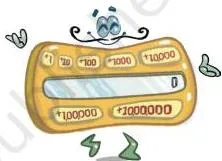
What it shows. Creative Chitti (p. 6) has every +1, +10, +100 button up to +10,00,000 and always has multiple ways to build a number. The two rows on the board are \((50 \times 100) + (7 \times 10) + (2 \times 1)\) and \((3 \times 1000) + (20 \times 100) + (72 \times 1)\), both equal to 5072. The point: place value is flexible.
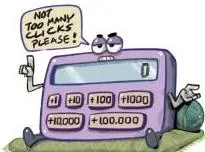
What it shows. Systematic Sippy (p. 7) wants to be used minimally. The fewest-click way to reach a number is the Indian place-value form, which is why the fewest clicks equal the sum of the digits.
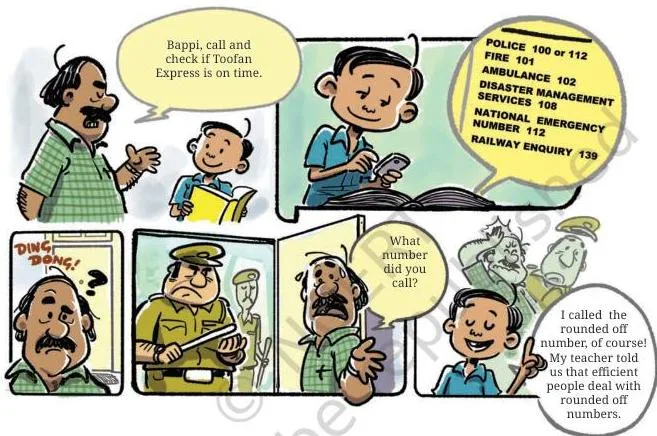
What it shows. This picture (p. 10) sets up the rounding section with a headline-style situation. The 2011 census counted 76,068 people in Chintamani, but saying “about 75,000” gives all the sense anyone needs.

What it shows. The portrait (p. 16) sits beside \(1250 \times 380\), the legendary count of kīrtanas he composed — the product is 4,75,000. A real historical fact becomes a multiplication to solve.

What it shows. The Earth–Sun diagram (p. 16) accompanies \(2100 \times 70,000 = 14,70,00,000\), the approximate distance in kilometres. The caption warns that the distance changes through the year; the farthest is about 152 million kilometres.
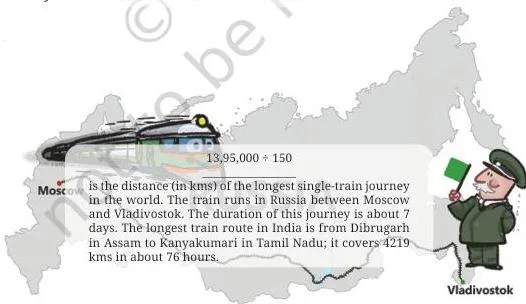
What it shows. This picture (p. 17) turns division into a fact-finder: \(10,50,00,000 \div 700 = 1,50,000\), the kilograms an adult blue whale can weigh more than.

What it shows. The toothpick-digits activity (p. 23) writes digits with sticks — the digit 7 needs three sticks, and 42,019 needs exactly 23. It is a place-value puzzle: add two sticks and make a bigger number, or rearrange four sticks and watch the value jump.
Definitions: the words large numbers class 7 uses
These are the terms every exercise in the chapter uses. The zero counts follow the Indian–American table on NCERT page 8 and the chapter summary on page 22.
| Term | Meaning | Example |
|---|---|---|
| Lakh | 1 followed by 5 zeroes | 1,00,000 |
| Crore | 1 followed by 7 zeroes; a hundred lakhs | 1,00,00,000 |
| Arab | 1 followed by 9 zeroes; a hundred crores | 1,00,00,00,000 |
| Million | 1 followed by 6 zeroes; ten lakhs in Indian terms | 1,000,000 |
| Billion | 1 followed by 9 zeroes; one arab or a hundred crores | 1,000,000,000 |
| Indian system | Digits grouped 3-2-2-2 from the right: thousands, lakhs, crores | 4,72,89,513 |
| American system | Digits grouped 3-3-3-3 from the right: thousands, millions, billions | 472,895,113 |
| Place value notation | A number written as the sum of each digit times its place value | \(8,364 = (8 \times 1000) + (3 \times 100) + (6 \times 10) + (4 \times 1)\) |
| Rounding up | An approximation more than the actual number | 732 people → 750 sweets |
| Rounding down | An approximation less than the actual number | ₹470 → “around ₹450” |
| Nearest neighbour | The nearest thousand, ten thousand, lakh, ten lakh or crore | Nearest lakh of 4,72,89,513 is 4,73,00,000 |
Common mistakes students make in large numbers
Each error below is one the chapter’s exercises are designed to catch. Read the correction before solving, and use the last column to check your next attempt.
| Mistake | Correct rule | How to check your answer |
|---|---|---|
| Putting American 3-3-3 commas when Indian notation is asked | Indian notation groups digits 3-2-2-2 from the right | Count groups from the right: 4,72,89,513 is Indian; 472,895,113 is American |
| Mixing up zero counts | Lakh has 5 zeroes, crore has 7, million has 6, billion and arab have 9 | Write 1 followed by the zeroes: 1,00,000 has five |
| Always rounding to the nearest value | Round up when going short is a problem, round down when a lower figure is better | Ask what the situation needs: school sweets (round up) or a shop price (round down) |
| Thinking a 3-digit × 3-digit product can be 4-digit | Product digit count is at most the sum of the factors’ digit counts, at least one less | Smallest case: \(100 \times 100 = 10,000\) — already 5 digits, so 4 is impossible |
| Using more button clicks than needed | The fewest clicks come from the Indian place-value form and equal the digit sum | Expand the number and add the digits: \(8 + 3 + 6 + 4 = 21\) clicks for 8,364 |
Using this chapter for exam preparation
The chapter builds four reusable skills rather than one formula list. Practise these and the exercises sort themselves out.
- Reading and writing large numbers in both systems — the exercise block on NCERT p. 8 asks for number names in Indian and American notation, and for writing numbers from words, such as ten crore twenty lakh thirty thousand forty.
- Comparing large numbers with \( \lt ,\ \gt ,\ = \) — the same block pits 30 thousand against 3 lakhs and 640 crore against 60 billion.
- Rounding and estimating — nearest neighbours for a given number, and approximation questions drawn from the Indian cities table on p. 12–13.
- Quick multiplication — the products on p. 14 fall to the 25 and 125 shortcuts.
The question types vary: direct-concept questions (write a number in words), comparison questions (fill in the correct symbol), numerical questions (products and quotients), and reasoning puzzles — the digit puzzles on p. 19–21 ask things like “what would the 1000th digit be?”.
A full-marks answer names the number system it is using, places the commas correctly, and shows the working for every estimate. One honest note: textbook contents and the examinable syllabus are not always identical, so check the current official CBSE syllabus before the exam.
Chapter 1 takeaways: what to remember
These points restate the chapter’s own summary (NCERT, p. 22) in shorter form.
- Zero counts: lakh 5, crore 7, million 6, arab 9, billion 9.
- Two comma patterns: Indian 3-2-2-2 (thousands, lakhs, crores); American 3-3-3-3 (thousands, millions, billions).
- Rounding is situational: sometimes up (school sweets), sometimes down (a shopkeeper’s price).
- Get a sense of size by comparison: match an unfamiliar quantity with a familiar one, such as one lakh people in a 38 km line.
- Regrouping simplifies multiplication: \(5 = 10 \div 2\), \(25 = 100 \div 4\), \(125 = 1000 \div 8\).
- Estimate in stages: break a large question into steps — capacity of one bus, then one lakh buses, then compare with the population.
Related resources for Class 7 Maths
This listing is maintained for the 2026-27 academic session using the NCERT textbook information available to us. NCERT remains the authority for confirming the latest edition.
Pair this chapter page with the rest of the Class 7 Mathematics silo. The Class 7 Mathematics book page lists every chapter of Ganita Prakash, and the Class 7 Mathematics notes gather this chapter with the rest of the book’s ideas.
When the chapter makes sense, the next chapter, Arithmetic Expressions, has its own notes page. The Class 7 study hub is the entry point for the grade’s other subjects, and the CBSE notes index is the quickest route to any class.
Sources and data verification
This page describes the NCERT Class 7 Mathematics textbook Ganita Prakash, Chapter 1 (Large Numbers), in its official NCERT edition, published on ncert.nic.in. It is maintained for the current academic session.
NCERT settles textbook editions, chapters and PDFs; CBSE settles the curriculum, syllabus and examinations. All figure images on this page are NCERT’s own diagrams from the same edition.
| What the chapter holds | Count | Where it is used |
|---|---|---|
| Printed pages | 38 | |
| Sections in the chapter | 6 | |
| Figures with NCERT captions | 6 | |
| Tables | 14 | |
| In-text questions | 12 | |
| Official NCERT PDF | Download the chapter PDF | the chapter exactly as NCERT publishes it |
Frequently asked questions about large numbers class 7
How many zeros are in a lakh, crore, million and billion?
1 lakh has 5 zeroes (1,00,000), 1 crore has 7 (1,00,00,000), 1 million has 6 (1,000,000) and 1 billion has 9 (1,000,000,000). An arab also has 9 zeroes, since 1 arab = 100 crores = 1 billion.
What is the difference between the Indian and International number systems?
The Indian system groups digits in a 3-2-2-2 pattern (thousands, lakhs, crores) and uses names like lakh and crore; the International (American) system groups digits in a 3-3-3-3 pattern (thousands, millions, billions). The digits themselves do not change — only the commas and the names do.
How many lakhs make a billion?
10,000 lakhs make one billion (NCERT, p. 20). Since 1 billion = 100 crores and 1 crore = 100 lakhs, \(100 \times 100 = 10,000\) lakhs.
What does nearest lakh mean and how do I round to it?
The nearest lakh is the multiple of 1,00,000 closest to the number. Look at the last five digits: if they are 50,000 or more, round up; otherwise round down. For 4,72,89,513 the last five digits are 89,513, so the nearest lakh is 4,73,00,000.
Why is the fewest number of button clicks equal to the sum of the digits?
Because the cheapest recipe uses each non-zero digit once, at its own place — 8,364 becomes \((8 \times 1000) + (3 \times 100) + (6 \times 10) + (4 \times 1)\), which needs \(8 + 3 + 6 + 4 = 21\) presses. Zeroes add nothing, so the total is exactly the digit sum.
Is Chapter 1 Large Numbers part of the CBSE Class 7 syllabus?
Large Numbers is the opening chapter of the NCERT Class 7 textbook Ganita Prakash. Whether any part of it is examinable depends on the current official CBSE syllabus, so check that document rather than assuming — textbook contents and the examinable syllabus are not always identical.
Reference: NCERT Class 7 Mathematics (Ganita Prakash) textbook, chapter 1, official edition on ncert.nic.in.
Explore Class 7 Mathematics Books
Related chapters: