
A Peek Beyond the Point Class 7 is Chapter 3 of the NCERT Class 7 Mathematics textbook, Ganita Prakash. It extends the place value system you know for whole numbers to quantities below one: tenths, hundredths, place value, conversions and decimal arithmetic.
The official chapter PDF is directly below, and under it sits a section-by-section walkthrough with NCERT page numbers, so you can follow along in your own copy of the book.
Download the chapter PDF
Get the NCERT Class 7 Maths Chapter 3 A Peek Beyond the Point PDF straight from the official NCERT textbook portal — the same edition teachers and examiners work from, so what you revise here is exactly the text the book prints. Reference: NCERT Class 7 Mathematics textbook, chapter 3, official edition on ncert.nic.in.
Chapter 3 at a glance: A Peek Beyond the Point
The table on this page counts what the chapter holds — sections, figures and questions — straight from the book.
The chapter itself opens with Sonu watching his mother fix a toy with a screw that is not quite the right size (NCERT, p. 46), and nearly every idea after that arrives through a measurement story: a pencil, a sheet of paper, a wire, heaps of rice, tiny fish.
It closes with a SUMMARY on page 80, and the answers to its in-text questions are printed in a later section of the book (p. 81) so you can check yourself without a teacher.
What this chapter covers: a map of its sections
This map shows where each idea lives, so you can jump straight to the part you need. Section names are exactly as printed in the book, with the NCERT pages where each one runs.
| Section (as printed) | NCERT pages | What it teaches |
|---|---|---|
| 3.1 The Need for Smaller Units | 46–47 | Why a unit is split into smaller parts for exact measures — screws, pens, sharpeners |
| 3.2 A Tenth Part | 48–51 | Tenths, the 10 one-tenths = 1 unit rule, and adding and subtracting tenths |
| 3.3 A Hundredth Part | 52–57 | Hundredths, the folded paper, and sums with tenths and hundredths |
| 3.4 Decimal Place Value | 58–60 | Why 10 is special — extending the Indian place value system below one |
| How Big? | 60–61 | Thousandths, and questions such as “how many thousandths make one unit?” |
| Notation, Writing and Reading of Numbers | 61–64 | The decimal point, writing and reading decimals, place value tables |
| Length Conversion | 64–66 | mm–cm–m conversions and real small objects measured in millimetres |
| Weight Conversion | 67–68 | g–kg and mg conversions, ending with the rice heaps |
| Rupee–Paise conversion | 68–69 | 100 paise = ₹1, and 1970s prices worth asking adults about |
| 3.6 Locating and Comparing Decimals | 69–73 | Decimals on the number line, the zero dilemma, closest decimals |
| 3.7 Addition and Subtraction of Decimals | 74–76 | Column addition and subtraction, decimal sequences, estimating sums |
| Decimal and Measurement Disasters | 76–77 | Real incidents caused by decimal and unit errors |
| Deceptive Decimal Notation | 77 | 4.5 hours, 5.5 overs, 2.5 ft — decimals that are not decimals |
| A Pinch of History | 78 | How decimal notation developed over time |
| SUMMARY | 80 | The chapter’s own recap |
Key concepts: tenths, hundredths and place value
Decimals are what you get when you keep splitting a unit into 10 equal parts. This chapter runs on four equivalences, so fix these first.
- 10 one-tenths = 1 unit (NCERT, p. 48)
- 10 one-hundredths = 1 tenth (NCERT, p. 53)
- 100 one-hundredths = 1 unit (NCERT, p. 53)
- 10 one-thousandths = 1 hundredth (NCERT, p. 60)
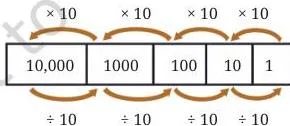
Why always 10? Because 10 is the backbone of the Indian place value system: in 281, the 2 means hundreds, the 8 tens and the 1 ones, and each place is 10 times the one on its right (NCERT, p. 59).
Extending the same rule below one gives tenths, then hundredths, then thousandths. So one tenth is greater than one hundredth, which is greater than one thousandth — in exactly the way a ten is greater than a one.
Why hundredths? The folded-paper problem below is the reason (NCERT, p. 52).
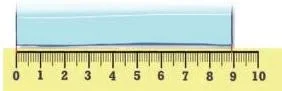
A sheet \(8\frac{9}{10}\) units long, folded in half, ends between \(4\frac{4}{10}\) and \(4\frac{5}{10}\) units — the ruler has no mark between those tenths. The exact length turns out to be 4 units, 4 tenths and 5 hundredths, or \(4.45\), and that name only exists once hundredths are invented.
The figure below shows that split drawn out.
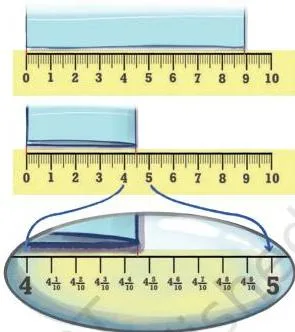
Each one-tenth holds 10 smaller parts, a unit holds 10 one-tenths, so a unit holds \(10 \times 10 = 100\) hundredths (NCERT, p. 53).
Worked example, new numbers: write 318 hundredths as a decimal.
- Step 1: Break 318 hundredths into 300 + 10 + 8 hundredths.
- Step 2: 300 hundredths = 3 units; 10 hundredths = 1 tenth; 8 hundredths stay as they are.
\[ 318\text{ hundredths} = \frac{300}{100} + \frac{10}{100} + \frac{8}{100} = 3 + 0.1 + 0.08 = 3.18 \]
Final answer: \(318\) hundredths \(= 3.18\).
Reading and writing decimals: the decimal point’s job
The decimal point exists because 42 could mean four tens and two ones — or four ones and two tenths. The point separates the whole part from the fractional part, so the same digits can carry different meanings (NCERT, p. 62).
Watch what the point does to one triplet of digits (NCERT, p. 62):
| Written as | Meaning | Whole part | Fractional part |
|---|---|---|---|
| 705 | 7 hundreds, 0 tens, 5 ones | 705 | — |
| 70.5 | 7 tens, 0 ones, 5 tenths | 70 | 5 tenths |
| 7.05 | 7 ones, 0 tenths, 5 hundredths | 7 | 5 hundredths |
Reading rule: say the whole part, then read the fractional part digit by digit. So 0.274 is “zero point two seven four” — never “zero point two hundred seventy-four”, because it is 2 tenths, 7 hundredths and 4 thousandths (NCERT, p. 63).
The wire figure below shows one length wearing three equivalent forms (NCERT, p. 54).

The three forms are \(1 + \frac{1}{10} + \frac{4}{100}\), \(1 + \frac{14}{100}\) and \(\frac{114}{100}\). They are the same length because 14 hundredths is exactly 1 tenth and 4 hundredths, and 1 unit is 100 hundredths.
Worked example, new numbers: write 2 tens, 3 ones, 4 tenths and 9 hundredths as a decimal.
- Step 1: Whole part: \(2\) tens \(+ 3\) ones \(= 23\).
- Step 2: Fractional part: \(4\) tenths \(+ 9\) hundredths \(= 0.49\).
\[ 20 + 3 + \frac{4}{10} + \frac{9}{100} = 23.49 \]
Final answer: \(23.49\).
The reverse direction works too: 156 tenths compact to 15 whole units and 6 tenths.
\[ \frac{156}{10} = \frac{150}{10} + \frac{6}{10} = 15.6 \]
So \(156\) tenths \(= 15.6\).
Converting units: decimals at work on length, weight and money
Conversions are where decimals earn their keep: every step in these three chains is a factor of 10, and the decimal point simply records it (NCERT, pp. 64–68).
| Quantity | Equivalence | Decimal form |
|---|---|---|
| Length | 10 mm = 1 cm | 1 mm = 0.1 cm |
| Length | 100 cm = 1 m | 1 cm = 0.01 m |
| Length | 1000 mm = 1 m | 1 mm = 0.001 m |
| Weight | 1000 g = 1 kg | 1 g = 0.001 kg |
| Weight | 1000 mg = 1 g | 1 mg = 0.001 g |
| Money | 100 paise = 1 rupee | 1 paisa = 0.01 rupee |
Worked example, new numbers: convert 47 mm to cm and then to m.
Step 1: mm → cm: divide by 10, because 10 mm = 1 cm.
\(47 \div 10 = 4.7\).
Step 2: cm → m: divide by 100, because 100 cm = 1 m.
\(4.7 \div 100 = 0.047\).
\[ 47\text{ mm} = \frac{47}{10}\text{ cm} = 4.7\text{ cm} = \frac{4.7}{100}\text{ m} = 0.047\text{ m} \]
Final answer: \(47\text{ mm} = 4.7\text{ cm} = 0.047\text{ m}\).
Two more short ones: \(8\text{ g} = \frac{8}{1000}\text{ kg} = 0.008\text{ kg}\), and \(72\text{ paise} = \frac{72}{100}\text{ rupee} = 0.72\text{ rupee}\).
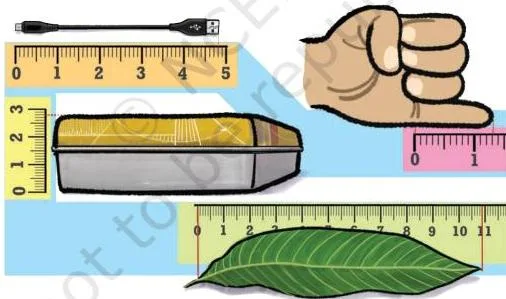
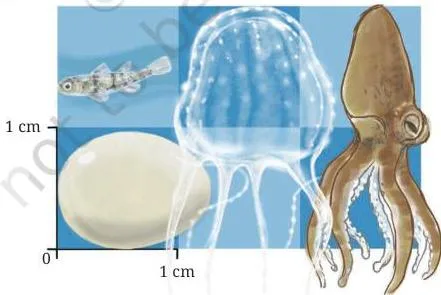
The small-things illustration below shows how real the millimetre scale is.
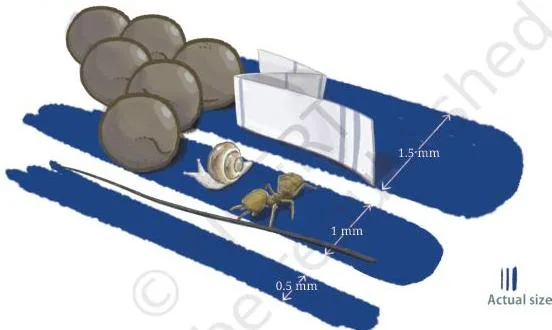
A human hair is about 0.1 mm thick, a newspaper page ranges from 0.05 to 0.08 mm, and the smallest known land snail has a shell 0.7 mm across (NCERT, p. 65). Those sizes only make sense once tenths and hundredths of a millimetre are something you can picture.
The rice picture below is the chapter’s showpiece for place value.
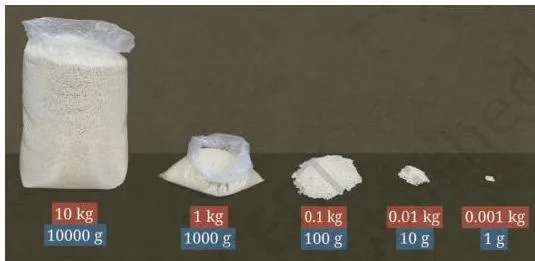
Heaps run from 1 g upward, each ten times heavier than the last, and the combined weight reads 11.111 kg — that is \(10 + 1 + 0.1 + 0.01 + 0.001\) recorded in one number (NCERT, p. 68).
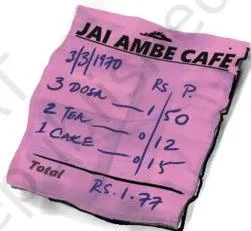
One activity worth trying at home: the book notes that in the 1970s a masala dosa cost 50 paise and a kilogram of rice cost ₹2.45, then suggests asking adults about childhood prices (NCERT, p. 69). That is paise and rupees in real life.
Locating and comparing decimals on the number line
A decimal like 1.4 is a point, not a mystery: it lies between 1 and 2, found by dividing that unit into 10 equal parts and taking 4 of them (NCERT, p. 69).
The zero dilemma. Sonu says 0.2 can be written 0.20 or 0.200; Zara suspects the extra zeros change the value. Place value settles it: 0.2, 0.20 and 0.200 all hold 2 tenths — the trailing zeros merely fill empty hundredths and thousandths places. Only 0.02 is different, because it is 2 hundredths (NCERT, p. 70).
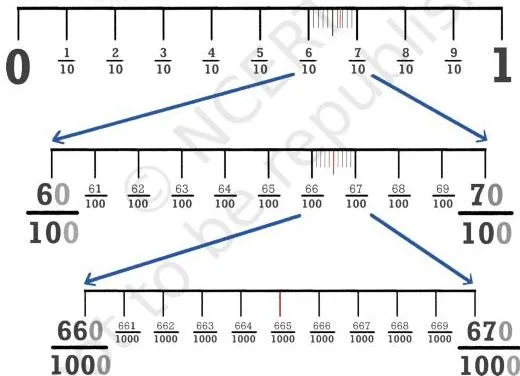
The figure below shows the divisions between 1 and 1.1.

The divisions between 1 and 1.1 are 1.01, 1.02, 1.03 and so on up to 1.09 (NCERT, p. 70). Here the unit has already been split into tenths; this second split goes one place further, into hundredths.
Comparing, digit by digit. The comparison figure below lines up 6.456 and 6.465 place by place.
Both numbers share 6 units and 4 tenths; they part ways at the hundredths — 5 against 6 — so 6.465 is larger (NCERT, p. 72). The rule: start at the left and compare matching places; the first place where the digits differ decides, and everything after it is irrelevant.
Try it: which is larger, 3.07 or 3.7? Compare tenths — 3.7 has 7 tenths, 3.07 has 0 — so 3.7 wins, fewer digits or not. This is the trap the book’s Question 6 names (NCERT, p. 79).
Closest decimals. To find which decimal is closest to a target, measure each candidate’s distance from it. Among 4.9, 5.06 and 5.2, which is closest to 5? In hundredths the distances are 10, 6 and 20 — so 5.06, at 6 hundredths away, wins.
Adding and subtracting decimals: two methods, one rule
The chapter adds decimals by adding like parts — units with units, tenths with tenths — exactly like whole numbers, then compacting any 10 tenths into 1 unit (NCERT, p. 74). The book shows both the fractional form and the column form for Priya’s 2.7 m and Shylaja’s 3.5 m of cloth; both arrive at 6.2 m.
Worked example, new numbers: add \(24.6 + 7.9\).
- Step 1: Add units: \(24 + 7 = 31\).
- Step 2: Add tenths: \(6 + 9 = 15\) tenths, which is 1 unit and 5 tenths.
\[ 24.6 + 7.9 = 31 + \frac{15}{10} = 31 + 1 + \frac{5}{10} = 32.5 \]
Final answer: \(32.5\).
Subtraction adds one move: regrouping. Worked example, new numbers: \(30.2 – 4.35\).
- Step 1: You cannot take 35 hundredths from nothing, so split one unit into 10 tenths: \(30.2 = 29 + \frac{12}{10}\).
- Step 2: Split one of those tenths into 10 hundredths: \(29 + \frac{11}{10} + \frac{10}{100}\).
\[ 30.2 – 4.35 = 29 + \frac{11}{10} + \frac{10}{100} – 4 – \frac{3}{10} – \frac{5}{100} \]
\[ = (29 – 4) + \frac{11 – 3}{10} + \frac{10 – 5}{100} = 25 + \frac{8}{10} + \frac{5}{100} = 25.85 \]
Final answer: \(30.2 – 4.35 = 25.85\).
This is the same split-a-unit step the book uses on page 51 for Shylaja’s finger. Sonu’s estimate (NCERT, p. 76) gives a free check: the sum of two decimals always lies between the sum of their whole parts and that sum plus 2. Test it on \(25.936 + 8.202\): the whole parts sum to 33, and the real sum, 34.138, sits between 33 and 35.
Figures worth looking at twice


Some figures give away their point in one glance; these three do not.
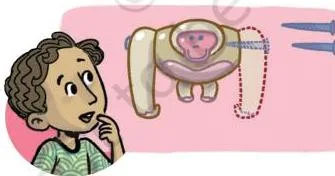
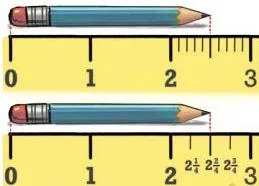
The screws over the scale. The screws-over-the-scale figure below is Sonu’s opening puzzle (NCERT, p. 46).
The scale reads the first screw at \(2\frac{7}{10}\) cm and the second at \(3\frac{2}{10}\) cm — half a centimetre apart, invisible to the eye but decisive for the toy. The chapter’s question — which scale made the difference visible, and why — points to the ruler that divides each centimetre into 10 parts.
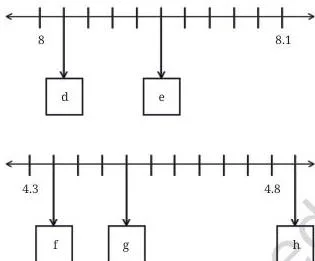
The letters on the number line. The figure below reverses the task: instead of placing a given decimal, you read off the decimals the labels point to (NCERT, p. 70).

The book’s worked hint (NCERT, p. 71): between 5 and 10 there are 5 units divided into 10 equal parts, so every two divisions make one unit and each division is half a unit — that is how b is read as 7.5. Practise this direction; it is “locating decimals” in reverse.
The door mishap. The figure below is a classic unit mix-up (NCERT, p. 77).
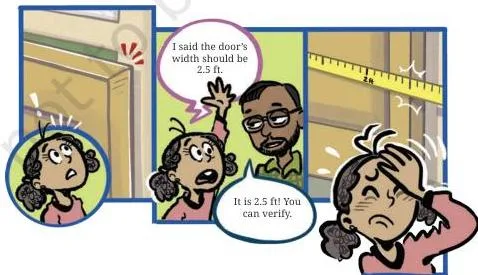
A girl measures an opening as 2 ft 5 inches but asks for a door 2.5 ft wide. The carpenter does the decimal correctly — 0.5 of a 12-inch foot is 6 inches — builds a 2 ft 6 in door, and it is one inch too wide. The fault is mixing feet-and-inches with decimal feet in one number, not the arithmetic.
Key terms: the definitions the chapter relies on
These are the working words of the chapter, defined the way the book uses them.
- Smaller units (NCERT, p. 47) — the equal parts you split a unit of measurement into when exact measures are required.
- One-tenth (NCERT, p. 48) — one of 10 equal parts of a unit; 10 of them make 1 unit.
- One-hundredth (NCERT, p. 53) — one of 100 equal parts of a unit; 100 of them make 1 unit.
- One-thousandth (NCERT, p. 60) — one of 1000 equal parts of a unit; 1000 of them make 1 unit.
- Place value (NCERT, p. 59) — the value a digit gets from its position; each place is 10 times the one on its right.
- Decimal point (NCERT, p. 62) — the separator between the whole part and the fractional part.
- Decimal system and decimal notation (NCERT, pp. 60, 62) — writing numbers by tens (from Latin decem, ten), using the point to show fractional parts.
Common mistakes students make with decimals
The chapter itself flags these traps — two sections are literally named “There is Zero Dilemma!” and “Deceptive Decimal Notation”. Start with three decimal-looking notations that are not true decimals at all (NCERT, p. 77):
- 4.5 hours means 4 hours 30 minutes — 0.5 of an hour is half of 60 minutes.
- 5.5 overs means 5 overs and 5 balls — the digit after the point counts balls, not tenths of an over.
- 2.5 ft means 2 ft 6 in — 0.5 of a 12-inch foot is 6 inches.
The table below pairs the common wrong ideas with corrections and a check for each.
| Mistake | Correct rule | How to check your answer |
|---|---|---|
| Thinking 0.2 and 0.20 are different | They are equal — both are 2 tenths. Only 0.02, which is 2 hundredths, differs (NCERT, p. 70) | Write both in a place value table; identical digits in identical places mean identical values |
| Assuming more digits means a bigger number | Digit count means nothing; compare place by place from the left — 2.5 > 2.05 (NCERT, p. 79) | Line up the decimal points and compare tenths first |
| Reading 0.274 as “two hundred seventy-four” | Read the fractional part digit by digit: zero point two seven four (NCERT, p. 63) | Say each digit’s place: 2 tenths, 7 hundredths, 4 thousandths |
| Taking 4.5 hours as 4:05 or 4:50 | 0.5 hour = half of 60 min = 30 min, so it is 4:30 (NCERT, p. 77) | Convert the fractional part into minutes before reading the clock |
| Reading 5.5 overs as 5 overs and 3 balls | Cricket counts the digit after the point as balls: 5 overs and 5 balls, i.e. \(5\frac{5}{6}\) overs (NCERT, p. 77) | Remember an over has 6 balls, and the notation is not a true decimal |
| Misreading 0.05 mg as 0.5 mg | 0.05 is 5 hundredths; 0.5 is 5 tenths — a ten-times dose error (NCERT, p. 77) | Count the zeros after the point: one zero means tenths, two means hundredths |
| Subtracting without regrouping | You cannot take 7 tenths from 4 tenths; split one unit into 10 tenths first (NCERT, p. 51) | Check that no column difference is negative before writing your answer |
Why this matters. The book’s “Decimal and Measurement Disasters” section reports two real cases (NCERT, p. 76):
- 2013, Amsterdam: the city council’s finance office sent out €188 million in housing benefits instead of €1.8 million because a program paid in euro cents, not euros — a factor of 100.
- 1983, Air Canada: ground staff loaded a Boeing 767 with 22,300 pounds instead of kilograms — about half the fuel needed — and the plane ran out mid-air; the pilots made an emergency landing at an abandoned airfield and everyone survived.
Both lessons are the same: check the unit, because no digit announces a misplaced point.
What the chapter asks you to practise
No surprise question types here. The Figure it Out blocks (NCERT, pp. 57, 75, 78–80) recycle a small set of skills, and each appears more than once.
- Converting fractions to decimals and back
- Writing a quantity as a sum of tenths, hundredths and thousandths
- Ordering a mixed list of decimals, ascending and descending
- Finding the decimal closest to a target number
- Column addition and subtraction of decimals
- Extending decimal sequences mentally (add 0.4, add 0.05, subtract 0.5, and so on)
- Conversion fill-in-the-blanks: mm–cm–m, g–kg, paise–rupee
- Word problems on weights, milk, body measures and railway insurance fees
The final block (pp. 78–79) is a mixed drill: Q1–Q2 are conversion drills; Q3–Q6 are number-line and comparison reasoning; Q7–Q10 and Q12 are word problems and sequence work; Q11 and Q13–Q16 push unit conversion and place value.
For word problems, a complete answer states the unit (kg, L, ₹) and shows the regrouping step explicitly, as the book’s own worked methods do.
Two honest notes. The book advises teachers that estimating before computing helps catch mistakes (NCERT, p. 76), so make the estimate a habit. It also says other ways of writing numbers come in later grades (NCERT, p. 60) — this is the chapter where decimal place value is meant to become solid.
Textbook contents and the examinable syllabus are not always identical, so check the current official syllabus on cbse.gov.in.
Revision summary: the chapter in six points
The book closes with its own SUMMARY (NCERT, p. 80); here is the same content in plainer words.
- To measure more exactly, split a unit into equal parts (NCERT, p. 47).
- The four anchors: 10 one-tenths = 1 unit, 10 one-hundredths = 1 tenth, 100 one-hundredths = 1 unit, 10 one-thousandths = 1 hundredth (NCERT, p. 80).
- The decimal point separates the whole part from the fractional part (NCERT, p. 62).
- Decimals sit on the number line by subdividing units into tenths, hundredths and thousandths (NCERT, p. 69).
- Compare decimals digit by digit from the left (NCERT, p. 72).
- To add and subtract, regroup: 10 tenths become 1 unit, and borrowing means splitting a unit into 10 tenths (NCERT, pp. 74–75).
Related resources
This listing is maintained for the 2026-27 academic session using the NCERT textbook information available to us. NCERT remains the authority for confirming the latest edition.
Go wider with these linked pages. The Class 7 Mathematics revision notes cover the rest of this book chapter by chapter.
- NCERT Class 7 Mathematics book page — every Ganita Prakash chapter in one place
- NCERT Class 7 hub — all Class 7 subjects on this site
- Class 7 notes hub — notes for every Class 7 subject
- CBSE notes home — all classes and subjects
- Operations with integers — Class 7 chapter notes
- Expressions using letter numbers — Class 7 chapter notes
Sources and data verification
This page describes Chapter 3 (A Peek Beyond the Point) of the NCERT Class 7 Mathematics textbook, Ganita Prakash, English edition, as published on ncert.nic.in. It covers only this chapter of this book and is maintained for the current academic session using the NCERT information available to us.
NCERT settles textbook editions, text and PDFs; CBSE settles curriculum, syllabus and examinations.
| What the chapter holds | Count | Where it is used |
|---|---|---|
| Printed pages | 55 | |
| Sections in the chapter | 8 | |
| Figures with NCERT captions | 22 | |
| Tables | 20 | |
| In-text questions | 34 | |
| Official NCERT PDF | Download the chapter PDF | the chapter exactly as NCERT publishes it |
Reference: NCERT Class 7 Mathematics textbook, chapter 3, official edition on ncert.nic.in.
Frequently asked questions
Which chapter is A Peek Beyond the Point in NCERT Class 7 Mathematics?
It is Chapter 3 of Ganita Prakash, the NCERT Class 7 Mathematics textbook. The chapter text opens on page 46 and its SUMMARY closes it on page 80 (NCERT, pp. 46, 80).
Is 0.2 the same as 0.20 and 0.200?
Yes. All three are 2 tenths; the extra zeros only fill empty hundredths and thousandths places (NCERT, p. 70). What changes the value is moving the 2 — 0.02 is 2 hundredths, ten times smaller.
Why does 5.5 overs mean 5 overs and 5 balls, not 5 overs and 3 balls?
Because cricket’s decimal-looking notation is not a real decimal. The digit after the point counts balls, and an over has 6 balls, so 5.5 overs is 5 overs and 5 balls, written \(5\frac{5}{6}\) overs (NCERT, p. 77). A true decimal would give 3 balls — which is exactly why the chapter calls the notation “deceptive”.
How many millimetres are in 1 kilometre?
1,000,000 mm — ten lakh millimetres. The book’s own answer key states it as 1000000 mm (NCERT, p. 79).
Why is 2.5 greater than 2.05 even though 2.05 has more digits?
Because digit count decides nothing; position decides everything. Both numbers have 2 units, then 2.5 has 5 tenths while 2.05 has 0 tenths — so 2.5 is larger (NCERT, p. 79). Compare from the left, place by place.
Where can I download the official Class 7 Ganita Prakash Chapter 3 PDF?
From the official NCERT textbook portal at ncert.nic.in — the NCERT Class 7 Maths Chapter 3 A Peek Beyond the Point PDF link at the top of this page points to it. The chapter runs from page 46 to page 80, with the answer key printed from page 81.
Explore Class 7 Mathematics Books
Related chapters: