
Vitamin-M Class 9 is Chapter 4 of the NCERT English textbook Kaveri. The chapter opens with the comic story “Vitamin-M” by Asha Nehemiah.
The same chapter also carries a linked story, The Lost Child by Mulk Raj Anand, and a poem, I Cannot Remember My Mother by Rabindranath Tagore. The official PDF of the chapter is on this page, with a map of everything the file holds.
Download the Vitamin-M Class 9 Chapter PDF
This is the official NCERT publication: the Class 9 English textbook Kaveri, Chapter 4, published on ncert.nic.in as file iebe104.pdf.
Download the Vitamin-M Class 9 NCERT English Kaveri chapter PDF — the official chapter file, in the book’s own layout with its illustrations, glossary boxes and exercises intact, so the page references on this page match your copy of the book.
For other classes and subjects, browse the catalogue on the official NCERT website.
Vitamin-M Class 9 Chapter at a Glance
The table below lists what this chapter file holds — its sections, figures and exercise questions — so you can see the chapter’s shape before you open it.
What This Chapter Covers: Three Texts on Memory and Childhood
Three readings sit inside Chapter 4, joined by the ideas of memory and childhood: the main story about caring for the elderly, a second story about a child lost at a fair, and a poem about a mother remembered through the senses.
Page numbers below are the printed folios of the Kaveri book, so “p. 105” is the number printed at the foot of that leaf.
| Part of the chapter | Kaveri pages | What it is |
|---|---|---|
| Reflect and Respond | 96-97 | Opening discussion on caring for the elderly, with the starter vocabulary words |
| Vitamin-M, Part I | 98-101 | Ravi’s mother wishes for a memory vitamin; Grandpa resents being treated like a child |
| Check Your Understanding | 102 | Short questions on Part I |
| Vitamin-M, Part II | 102-105 | Ravi trails Grandpa through the park, tea stall and barber shop; the yellow-cap trick |
| Check Your Understanding | 106 | Flow-chart completion of Grandpa’s day, plus questions |
| Vitamin-M, Part III | 107-108 | Ravi’s panic; Grandpa home safe; the gifts and the Vitamin-M joke on his daughter |
| Check Your Understanding | 109 | Reflection questions on Ravi’s feelings and Grandpa’s awareness |
| Critical Reflection | 109-110 | Two extract-based question sets and a block of short-answer questions |
| Vocabulary and Structures in Context | 111-115 | Movement/sound words, synonyms, prepositions, direct and indirect speech |
| Listen and Respond, Speaking, Writing | 116-119 | Listening sentences, intonation, the article “Our Inspiring Elderly” |
| The Lost Child | 119-125 | Linked story by Mulk Raj Anand: a boy lost at a spring fair |
| I Cannot Remember My Mother | 126-135 | Tagore’s poem with stanzas, devices, vocabulary, writing tasks and the shiuli note |
| I Remember, I Remember | 136 | Closing poem by Thomas Hood |
The map shows the chapter’s real shape: the main story runs from p. 98 to p. 108 in three parts, each followed by its own Check Your Understanding questions.
The exercises that follow — vocabulary, structures, speaking, writing — build on the same story before the chapter turns to the linked story (pp. 119-125) and the poem (pp. 126-135).
Key Ideas in the Vitamin-M Story
The story takes a serious worry — an ageing parent’s memory and safety — and plays it as comedy, then reveals that the grandfather was in control all along. The trick is the gap between what Ravi’s mother believes and what the reader slowly discovers.
Plot in Short
- Ravi’s mother wishes someone would invent a memory vitamin — “Vitamin-M” — to improve old people’s memories, and she treats her father like a child who cannot be trusted outdoors (p. 98).
- Grandpa, a retired lawyer of seventy-five, resents the over-loud tone and the “poky little flat” in the crowded city, so the moment Ravi is left in charge he slips out for his Tamil newspaper (p. 99).
- Ravi trails him through a children’s park, a tea stall and a barber shop, hiding behind benches, a banyan tree and even a Ladies’ Hairdressing Salon, feeling more foolish at every stop (pp. 102-104).
- On the bus Ravi corners a stranger wearing Grandpa’s yellow cap — Grandpa had given it away to the man, a gesture typical of his generosity — and Ravi loses him (p. 105).
- Ravi races home in panic and finds Grandpa safe and snoring. Grandpa coolly reports that Ravi “disappeared”, then produces birthday gifts for everyone — including Ravi’s detective-story book, proof that he knew about the chase all along (pp. 107-108).
Characters
- Grandpa — sharp, proud, generous. He can recall whole chess games — Karpov, Bobby Fischer — yet is treated as forgetful (p. 101); he gives away his cap and buys gifts for everyone on his own birthday (pp. 105, 108).
- Ravi — loyal, anxious, resourceful. He promises his mother he will watch Grandpa, then follows him in secret and keeps the day’s mishaps to himself (pp. 100-108).
- Ravi’s mother, Vidya — caring but over-protective. She speaks to her father as though to a child who cannot hear or understand well (p. 100), and it is she who ends up needing Vitamin-M (p. 108).
Themes
- Caring for the elderly with dignity — the chapter opens by asking why we should care for the elderly and what problems they face (pp. 96-97), then shows care hardening into control. The story’s answer is that care must respect the older person’s independence.
- Memory and age — a frail appearance can hide a sharp mind. The chapter’s own question on p. 110 asks you to disprove the “failing memory” portrait; your evidence is the chess recall, the cap trick and the birthday calendar.
- Respect and age bias — the final question on p. 110 asks whether society discards people’s opinions because of age, and invites an example from your own experience.
The Poem I Cannot Remember My Mother: Senses, Refrain and Symbolism
The poem keeps a mother alive not as a picture but as sensations. Each of its three stanzas recalls her through a different sense, and the opening line returns at the start of every stanza like a pulse.
Three Stanzas, Three Senses
- Stanza 1 — hearing (p. 127): in the midst of play, a tune seems to hover over the playthings — the song she used to hum while rocking his cradle.
- Stanza 2 — smell (p. 127): on an early autumn morning, the smell of shiuli flowers and the scent of the temple’s morning service arrive together as the scent of his mother.
- Stanza 3 — sight (p. 129): looking from his bedroom window into the blue of the distant sky, he feels the stillness of his mother’s gaze has spread across that whole sky.
Refrain and Symbolism: the Two Devices NCERT Defines
The poem has no rhyme scheme, and the book asks why it is still enjoyable (p. 128). The answer is the refrain — the repeated line “I cannot remember my mother” — which gives the poem its shape and carries its ache.
- Refrain — a line or group of lines repeated at regular intervals in a poem (p. 128). Here the refrain and the title are the same words.
- Symbolism — using a tangible object, idea or phenomenon to represent something beyond its literal meaning (p. 128). The tune, the shiuli flowers, the temple scent and the sky all symbolise the mother’s continuing presence.
Connected Material Around the Poem
- The vocabulary matching on p. 126 pairs hover, hum, cradle, shiuli, morning service and gaze with meanings; the book glosses shiuli as coral jasmine.
- The sensory-word table on p. 131 sorts words into visual, auditory, olfactory and tactile columns, with glowing, hiss, aroma and sticky as the first entries.
- The shiuli note on p. 135 adds that the flower is also called Parijat, Parijata and Harsingar, blooms at night and carries a sweet fragrance.
- The chapter closes with Thomas Hood’s “I Remember, I Remember” (p. 136), a nostalgic companion poem about the house where the speaker was born.
Figures in the Chapter and What They Show
The illustrations below belong to specific exercises in the chapter. Treat them as part of the task — each one either advances the story or sets up the question beside it.
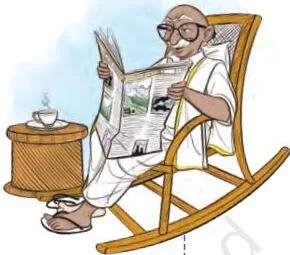
The first illustration (p. 99) sits beside the story’s opening contrast. The picture shows the frail figure in the rocking chair, newspaper held inches from his nose; the words around it show the same man longing for his old house, its mango tree and its dusk silence.
Frailty outside, sharpness inside — hold that contrast and you unlock both the story and the evidence question on p. 110.

Detective Shankar (p. 112) is the character in the vocabulary gap-fill: choose movement words and sound words to complete a paragraph about tracking a suspect. The mirror matters — Shankar trails a suspect exactly as Ravi trailed Grandpa, so words like trailing, creeping and briskly do double duty in the book.


The two Arvind–Priya panels (p. 116) are one exercise shown from both sides: the dialogue in speech bubbles, and the same words as a reported-speech paragraph with blanks. Working through the first exchange shows exactly where if appears.
Direct: Arvind asked Priya, “Do you help in taking care of your grandparents at home?”
Step 1: Turn the question into a statement — “you help in taking care of your grandparents at home”.
Step 2: Yes/No questions take if or whether right after the reporting verb (pp. 114-115).
Step 3: Shift pronouns and tenses: you → she; do help (present) → helped (past).
Reported: Arvind asked Priya if she helped in taking care of her grandparents at home.
Arvind’s later Wh question — “How do you manage your grandparents’ medical needs?” — follows the other rule: keep the same wh-word (how), drop the question order, and the result is “He further enquired how they managed their grandparents’ medical needs”. No if, no whether — that is the fork the chapter’s conversion table draws (pp. 114-115).
Vocabulary from the Chapter: Words in Context
The chapter teaches new words through margin glosses beside the story and through tables you fill in yourself. The same words return in the exercises, so learning them in context pays twice.
The Six Reflect and Respond Words
Before the story begins, the Reflect and Respond activity asks you to sort six words by how familiar they are. Here is what each one means in the story’s context.
| Word | Meaning in the story |
|---|---|
| frail | weak and delicate; used for Grandpa in the rocking chair (p. 98) |
| shuddered | to shake briefly, here from an unpleasant memory (p. 98) |
| poky | small, cramped and uncomfortable; Grandpa’s word for the flat (p. 99) |
| forbid | to order someone not to do something; Grandpa denies anyone the right to forbid him (p. 99) |
| pottering | doing small, unhurried jobs; Grandpa slipped while pottering in the garden (p. 99) |
| winced | to flinch or grimace from embarrassment (p. 100) |
Boxed Words from the Story
- jauntily — happily and confidently (p. 101)
- bustle — busy activity (p. 99)
- crouch — to bend the body low; ducking — moving the head or body down (p. 103)
- a volley of — a lot of (p. 104)
- deterred — prevented from doing something (p. 105)
- confront — to face (p. 105)
- frantic — very frightened (p. 107)
- creases — lines (p. 107)
- darted — looked at somebody quickly (p. 108)
- trailing — following (p. 108)
- solemnly — seriously (p. 108)
Two Classification Games
The story block (p. 111) mixes movement words — pottering, twirling, crouch, crawl, creeping, ducked, zigzagging, briskly, sprinting, jumping, darted, trailing — with sound words such as boomed, thudded, shrieks, whirr, grunted and snoring. The Detective Shankar passage on p. 112 then makes you reuse them.
The poem block (p. 131) sorts sensory words into four columns: visual (glowing), auditory (hiss), olfactory (aroma) and tactile (sticky) are the book’s own first examples. The trap is that scent, aroma and fragrant describe smell, not sight.
Mistakes Students Make in This Chapter
Four errors recur with this chapter — two about the story, two about the grammar and poetry tasks beside it. Naming them in advance is half the battle.
1. Believing Grandpa Is Senile
The surface portrait says “failing memory”, but the chapter’s own question (p. 110, Q1) asks for evidence against that. Collect three incidents.
- the chess recall of Karpov and Bobby Fischer (p. 101);
- the cap Grandpa gives away in the barber shop (p. 105);
- the birthday gifts he remembers to buy for everyone — the calendar his daughter circled in red with “Papa’s birthday” (p. 108).
Grandpa knows Ravi followed him all day; the detective book is his proof.
2. Dropping if or Whether in Reported Speech
Yes/No questions need if or whether immediately after the reporting verb; Wh questions keep their own wh-word. Students either drop the connective or keep the question’s word order. The chapter’s steps-to-remember table (pp. 114-115) gives both rules in one place.
3. Mixing Up Sensory-Word Categories
Scent, aroma and fragrant are olfactory — they describe smell — yet students file them under visual. Ask which sense receives the word: eyes, ears, nose or skin. The p. 131 table gives the four columns and the book’s own first examples.
4. Reading the Refrain as a Rhyme Scheme
The poem has no rhyme scheme, and the book asks why it still works (p. 128). The answer is the refrain: the repeated line “I cannot remember my mother” at the head of every stanza. A refrain is repetition of a line; a rhyme scheme is a pattern of rhyming end-sounds — the two are not interchangeable.
The same four errors, in correction-table form for last-minute revision.
| Mistake | Correct rule | How to check your answer |
|---|---|---|
| Calling Grandpa senile | Evidence contradicts it: chess, cap, gifts (pp. 101, 105, 108) | List three named incidents before answering p. 110 Q1 |
| Dropping if/whether | Yes/No questions take if or whether after the reporting verb (pp. 114-115) | Every Yes/No conversion must contain exactly one connecting word |
| Keeping question word order | Reported clauses are declarative: subject before verb (p. 114) | Read it aloud; if it still sounds like a question, flip it |
| scent/aroma filed as visual | Smell words are olfactory; colour and light words are visual (p. 131) | Ask which sense each word reaches |
| Refrain called a rhyme scheme | Refrain is a repeated line; rhyme scheme is end-rhyme pattern (p. 128) | Quote the repeated line for refrain questions |
How the Exercises Test You
The chapter’s own exercises are the best rehearsal for the extract-based and grammar questions that follow. Each block names the skill it practises, and the list below shows where each skill lives.
In the Story
- Extract-based MCQs on emotion and tone (pp. 109-110): the first extract tests Grandpa’s emotion in his city speech and the meaning of “you can even hear a leaf fall”; the second tests the tone of Grandpa’s reply and why Ravi is confused.
- Character-trait and evidence questions (p. 110): Q1 needs two separate incidents that disprove failing memory; Q2 needs two traits per character, each backed by a moment from the story.
- Flow-chart completion (p. 106): retrace Grandpa’s day in order — park, peanuts, tea stall, barber shop, bus.
- Vocabulary classification and synonym tables (pp. 111-113): movement versus sound words, synonyms for dilemma, parts of speech, and an emotions-matching table (embarrassed, countered, flushed, stricken, gleam).
- Prepositions (p. 113): the story’s own phrases (across, over, under, behind) and a fill-in with a choice of three prepositions each.
- Direct to indirect speech (pp. 114-116): the chapter marks “Shall we play chess?”, “Have you forgotten?” and “Are you playing hide and seek?” as Yes/No type, and “Who are you?” and “What did you both do today?” as Wh type (p. 114); apply the conversion table, then complete the Arvind–Priya paragraph.
- Intonation (p. 117): falling for Wh and How questions, rising for Yes/No, rise-fall for choice questions — then practise with the story’s own questions.
- Article “Our Inspiring Elderly” (pp. 118-119): four paragraphs — introduction, examples, challenges overcome, conclusion — with title, name and grade at the top.
In the Poem
- Stanza and setting blanks (pp. 127-128): what the poet remembers in each stanza and whether the setting is indoor or outdoor.
- Devices (p. 128): alliteration, onomatopoeia, imagery, tone, the title’s impact, the refrain, and symbolism using the book’s own definitions.
- Extract MCQs (pp. 129-130): the hovering tune and the mother’s gaze spread over the sky, with tone and emotion options.
- Sensory-word table (p. 131) and a passage-based fill-in using Sarojini Naidu’s writing about a March morning.
- Listen and Respond (p. 133): match childhood-memory statements to speakers (i)-(iv).
- Diary entry (pp. 134-135): the book prints a contents checklist — day, date, time, first person, sensory details, emotions, significant moments, reflection — and notes how Anne Frank and Zlata Filipovic addressed their diaries.
Textbook contents and the examinable syllabus are not always identical — check the current official syllabus to see which parts of the chapter are examinable in your session.
Vitamin-M in One Page: Quick Recap
The book prints no summary for this chapter, so here is the story in fresh words.
Ravi’s mother believes her father is losing his memory and orders Ravi never to let him go out alone. The moment she leaves, Grandpa — a retired lawyer of seventy-five — slips out for his Tamil newspaper.
Ravi follows him through a park, a tea stall and a barber shop, hiding at every stop, until Grandpa boards a bus and swaps his yellow cap onto a stranger.
Ravi thinks he has lost him for good. But when he reaches home, Grandpa is there, snoring. Grandpa reports that Ravi “disappeared”, buys birthday gifts for the whole family on his own birthday, and hands Ravi The Best Detective Stories — proof he knew about the chase all along.
The closing line, that his daughter is the one who needs Vitamin-M, completes the joke.
The Lost Child (pp. 119-125): a boy at a spring fair loses his parents and refuses every offered comfort — rides, snake music, balloons, flowers, sweets — because only his parents will do.
I Cannot Remember My Mother (pp. 126-135): three sensations — a hummed tune, the smell of shiuli flowers, the stillness of a gaze in the sky — carry the mother’s memory.
I Remember, I Remember (p. 136): Thomas Hood’s nostalgic poem about the house where the speaker was born closes the chapter.
Related NCERT Pages for Class 9 English
Vitamin-M is Chapter 4 of the Kaveri textbook. For revision material across the book, start at the Class 9 English notes hub; for every subject of the year, use the Class 9 hub.
Other Kaveri chapters with their own pages here include Winds of Change and The World of Limitless Possibilities. The main CBSE notes page links every class and subject.
Sources and Data Verification
This listing is maintained for the 2026-27 academic session using the NCERT textbook information available to us. NCERT remains the authority for confirming the latest edition.
Which textbook this page describes: the NCERT Class 9 English textbook Kaveri, Chapter 4 “Vitamin-M”, official edition published on ncert.nic.in, covering printed book pages 96 to 136.
What the data covers: this chapter’s structure as published — the three texts, their exercises, and the figures the book prints. The table on this page describes this NCERT textbook entry, not the full CBSE subject scheme.
Academic session: this page is maintained for the current session using NCERT’s published textbook information.
Which authority settles what: NCERT settles textbooks, editions and PDFs; CBSE settles curriculum, syllabus and examinations.
| What the chapter holds | Count | Where it is used |
|---|---|---|
| Printed pages | 40 | |
| Figures with NCERT captions | 4 | |
| Tables | 15 | |
| In-text questions | 2 | |
| Official NCERT PDF | Download the chapter PDF | the chapter exactly as NCERT publishes it |
Reference: NCERT Class 9 English (Kaveri) textbook, chapter 4, official edition on ncert.nic.in.
FAQs on Vitamin-M Class 9
Who is the author of the story Vitamin-M?
Asha Nehemiah. Her name appears at the end of the story text in the Kaveri textbook (p. 108). The story is Chapter 4 of the NCERT Class 9 English book Kaveri.
Why is the chapter called Vitamin-M?
The name comes from Ravi’s mother’s wish (p. 98): she wants someone to invent a memory vitamin — Vitamin-M — to improve old people’s memories. At the end, Grandpa turns the joke around and says his daughter is the one who needs it (p. 108).
Does Grandpa really have a failing memory?
No — that is the story’s trick. The evidence the chapter itself asks you to gather (p. 110, Q1): his chess recall, the cap he gives away, and the birthday gifts he remembers to buy for everyone (pp. 101, 105, 108).
What is the main theme of the story Vitamin-M?
Caring for the elderly with dignity. The story contrasts over-protection with an older person’s right to independence, and shows how memory and age get misjudged. The chapter opens with a graphic organiser on caring for the elderly (pp. 96-97) and closes with a discussion of age bias (p. 110, Q8).
What is the poem I Cannot Remember My Mother about?
About memory through the senses. The poet cannot picture his mother, but remembers her through a hummed tune (hearing), the smell of shiuli flowers and temple incense (smell), and the stillness of her gaze spread over the sky (sight) (pp. 127-129).
Is The Lost Child part of the same chapter as Vitamin-M?
Yes. It is a linked reading inside Chapter 4 of Kaveri (pp. 119-125), introduced under “Learning Beyond the Text” after the main story and its exercises (p. 119).
Explore Class 9 English Books
- Previous: Winds of Change
- Next: The World of Limitless Possibilities
Related chapters:
- How I Taught My Grandmother to Read
- The Pot Maker
- Twin Melodies