
The World of Limitless Possibilities Class 9 is the chapter this page is about — Chapter 5 of the NCERT English reader Kaveri, running from page 136 to 168 of the book.
The chapter holds two texts: an interview with para-athlete Dr Deepa Malik and the poem Nine Gold Medals, surrounded by comprehension, vocabulary, grammar, listening, speaking and writing tasks. The official NCERT chapter PDF sits right below, and the rest of this page explains what is inside it.
NCERT publishes this chapter as a free PDF, and the whole file — the interview, the poem and every exercise in order — is hosted on the official NCERT textbook portal. Download the World of Limitless Possibilities Class 9 English Kaveri Chapter 5 PDF to read it on screen, print it, or keep it for revision.
Chapter at a Glance: What Is Inside
The table below shows how much this chapter holds — its page span, figures, tables and in-text questions — so you know the size of the file before you open it.
What This Chapter Covers: An Interview and a Poem
This is an activity-rich reading chapter. Two texts sit at its centre — the interview with Dr Deepa Malik and the poem Nine Gold Medals.
Each text is followed by the same cycle of tasks: Reflect and Respond, Check Your Understanding, Critical Reflection, vocabulary and structures, listening, speaking and writing. The table below maps the chapter’s main stops so you can jump straight to the interview, the poem, or the grammar practice you need.
| Book pages | What you will find |
|---|---|
| 136 | Chapter opener — picture of para-archer Sheetal Devi (Arjuna Award, January 2024), a caption task, and a K-W-L chart (What I Know / What I Want to Know) on the Paralympics |
| 137–138 | The chapter’s introduction to the Paralympics and to Dr Deepa Malik, leading into the interview |
| 138–142 | The main text — the interview with Dr Deepa Malik, with margin glosses for difficult words |
| 143 | Fact table on the interview, and practice on fact-opinion and cause-effect pairs |
| 144–146 | Critical Reflection — extract-based questions and long answers on the interview |
| 147–151 | Vocabulary and structures — phrase matching, the word cline, modal auxiliaries, and reported speech |
| 152–153 | Listening task, informal vs formal interview formats, and notice writing |
| 154–155 | Learning Beyond the Text — the Did you know box on the origin of the Paralympics, and a group presentation project |
| 156–161 | The poem Nine Gold Medals, its comprehension questions, stanza gist, and poetic devices |
| 162–166 | Collocations, a second listening task, speaking on the Special Olympics, slogans and a poster |
| 167–168 | Special Olympics 2023 Berlin achievers and an infographic task |
Key Concepts: What the Chapter Actually Teaches
This chapter teaches through its exercises, not just its texts. On the reading side you learn to separate fact from opinion, trace cause and effect, and read a poem for story, devices and tone. On the language side you practise modal auxiliaries, reported speech, the word cline and collocations.
Dr Deepa Malik’s Interview: From Spinal Tumour to Shot-Put Silver
The main text of the chapter is an interview — a question-and-answer conversation that shows how a person rebuilds a life after a severe setback. The facts in it are what the fact table on page 143 tests, and Dr Malik’s ideas are what the long answers on pages 144–146 ask you to discuss.
- The setback: at 29, Dr Malik was diagnosed with a spine tumour; the surgery left her paralysed waist down, and doctors said she would be in a wheelchair for the rest of her life (NCERT, p. 139).
- The choice: she saw two ways forward — waste her life in regret, or transform it into the world of limitless possibilities the chapter takes its title from (NCERT, p. 139).
- The switch: she already loved sports and had been a swimmer, so she moved into para-athletics, and her Paralympics journey began (NCERT, p. 139).
- The breakthrough: at the 2016 Rio Paralympic Games she won the silver medal in shot-put (NCERT, p. 139).
- The firsts: she is the first Indian female Paralympics medallist in any sport, and the first Indian female para-athlete to win an Asian Games medal in athletics (NCERT, p. 140).
- The honours: she holds the Khel Ratna, Arjuna and Padma Shri awards, and her belief is “ability beyond disability” — physical limitations do not define potential (NCERT, pp. 138, 140).
- The advocacy: she works for disability rights and inclusivity, for women’s outdoor sports and adventure, for equipment for para-sportspersons from lower-income backgrounds, and for awareness sessions in schools and colleges (NCERT, p. 141).
- The advice: every setback is an opportunity to prove your strength; build a support system and believe in yourself (NCERT, p. 142).
Hold these points together and you already have the material for most of the extract questions on pages 144–146, including why the title fits Dr Malik.
Fact, Opinion, Cause and Effect: How to Read the Interview
Page 143 uses the interview to teach two reading skills: separating fact from opinion, and linking cause with effect. The exercise on that page asks you to label sentence pairs as one or the other.
- Fact — information that can be proved true, such as a result, a date or a record (NCERT, p. 143).
- Opinion — a speaker’s or writer’s belief or perception, which cannot be verified (NCERT, p. 143).
- Cause — the action or event that makes something happen (NCERT, p. 143).
- Effect — the outcome that follows from the cause (NCERT, p. 143).
The chapter’s own example shows the difference. The statement that the speaker secured the silver medal in shot-put at the 2016 Rio Games is a fact, because the result can be verified.
The statement that she feels it was a moment of personal victory and a step towards changing perceptions is an opinion, because a feeling cannot be checked against evidence (NCERT, p. 143).
In the second pair, the tumour is the cause, and the surgery followed by life in a wheelchair is the effect — the outcome of the diagnosis (NCERT, p. 143). Knowing the difference is exactly what the classification task on page 143 tests.
Modal Auxiliaries: One Verb, Many Functions
The grammar work on pages 148–149 centres on modal auxiliaries — helper verbs that carry meanings such as possibility, ability or obligation. The chapter’s key point is that each modal performs several functions depending on the situation, so you cannot pin a single meaning to a single verb.
| Modal | Function | Fresh example |
|---|---|---|
| could | possibility | The rain could delay the final event. |
| could | unreal ability | She could lift a heavier weight if she trained longer. |
| could | request | Could you share the results with the team? |
| could | suggestion | We could hold the awareness session on Saturday. |
| couldn’t | inability | He couldn’t run because of his injury. |
| couldn’t | impossibility | The damage couldn’t be undone. |
| should | probability | The results should be announced by noon. |
| should | advice | You should warm up before every race. |
| should | obligation | We should keep the field clean for the next event. |
| would | request | Would you mind explaining the rules again? |
| would | past habit | In school, she would swim every morning. |
| would | prediction | If the team trained harder, it would qualify. |
The matching exercise on page 148 adds one more function to each modal — past ability for could, impossibility for couldn’t, obligation for should and prediction for would. Your task is to write a fresh sentence for every function and label it in brackets, exactly as the exercise on page 148 asks.
Reported Speech: The Four Steps and a Worked Conversion
The grammar task on pages 149–151 turns a dialogue into reported speech. Direct speech quotes a speaker’s exact words; reported speech retells the words through a reporting verb.
The steps box on page 150 gives three mechanical rules, and the observation table on page 149 adds the fourth:
- Use a reporting verb: said, told or says (NCERT, p. 150).
- Remove the quotation marks (NCERT, p. 150).
- Add the linking word that after the reporting verb (NCERT, p. 150).
- Shift pronouns and tenses: present becomes past (love → loved), have been becomes had been, will becomes would, and you becomes she (NCERT, p. 149).
Worked example, with original sentences. A coach talks to an athlete before the state finals:
- Coach: “You have trained harder than anyone in this squad.”
- Athlete: “I will give my best performance at the finals.”
- Coach: “I believe you can win a medal.”
Reported version:
- The coach told the athlete that she had trained harder than anyone in that squad.
- The athlete said that she would give her best performance at the finals.
- The coach said that he believed she could win a medal.
Notice the changes line by line. In line 1: told and that added, you → she, have trained → had trained, this → that. In line 2: said and that added, I → she, will → would. In line 3: I → he, can → could.
The two sample sentences on page 149 are in direct speech, and both are declarative sentences — they make statements. Now attempt the boxed Siya–Tarun conversation on page 151 using the same four steps; the dialogue is shown as the first figure below.
Nine Gold Medals: The Story and the Message
The chapter’s second text is the poem Nine Gold Medals by David Roth (NCERT, pp. 156–157). It is a narrative poem — a story in verse — and the story has to be clear before the poetic devices make sense.
- Nine athletes come from across the country to run the hundred-yard dash, after many weeks and months of training; the spectators gather around the old field, excited for the final event (NCERT, p. 156).
- The runners line up on the blocks, poised for the sound of the gun (NCERT, p. 156).
- The pistol fires and everyone charges ahead — but the smallest runner stumbles, staggers and falls on the asphalt (NCERT, p. 157).
- He cries out in frustration and anguish as his effort seems destroyed in the dirt (NCERT, p. 157).
- The eight other runners stop, turn round, go back and help him to his feet (NCERT, p. 157).
- All nine join hands and finish together, the hundred-yard dash reduced to a walk; a banner above them reads Special Olympics (NCERT, p. 157).
- All nine receive gold medals, and the standing ovation and nine beaming faces say more than words could (NCERT, p. 157).
The central message is that collective support matters more than individual victory. The runners changed what the race meant when they chose to finish together. That is why page 161 asks you to explain why all nine were given gold medals: every one of them finished the race, and the shared finish is the true victory.
Imagery, Alliteration, Tone and Mood in the Poem
The appreciation questions on pages 159–160 ask for poetic devices, and students usually mix the terms up. Each one names something different.
- Alliteration — the repetition of initial consonant sounds in nearby words. In the poem, stumbled and staggered repeats the s sound, and dashed in the dirt repeats the d sound (NCERT, p. 157).
- Visual imagery — language that creates pictures in the mind: the spectators around the old field, the runners poised at the line, the boy fallen on the asphalt, nine runners hand in hand at the finish (NCERT, pp. 156–157).
- Auditory imagery — language that recreates sound: the explosion of the starting pistol is the poem’s clearest sound image (NCERT, p. 157).
- Tone — the poet’s attitude towards the subject. Page 159 asks how the tone changes: tense and expectant at the start, painful and sympathetic at the fall, warm and celebratory at the end.
- Mood — the feeling the poem creates in the reader: excitement at the start, empathy at the fall, joy and hope at the finish. The overall mood is uplifting.
Word Cline and Collocations: Building Vocabulary
Two vocabulary skills run through the chapter, and both are worth learning as skills rather than one-time tasks: ordering movement words by pace, and recognising words that habitually pair up.
The word cline task on page 147 gives eleven movement words and asks you to arrange them from slowest to fastest. The book leaves the final order to you, so treat this as a suggested order with reasoning:
creep → crawl → plod → amble → stroll → walk → saunter → jog → run → dart → sprint
- Slow end: creep and crawl are the slowest — movement close to the ground with effort.
- Walking speeds: plod is a heavy, slow walk; amble, stroll, walk and saunter span relaxed to ordinary walking pace.
- Running speeds: jog begins the running speeds, run is faster, dart is a sudden quick movement, and sprint is the fastest of all eleven.
A collocation is a pair or group of words that habitually appear together — the chapter’s example is standing ovation, an adjective-noun pair from the poem (NCERT, p. 162). Two more from the poem are gold medals and beaming faces.
The table on page 162 asks you to complete noun lists for big, heavy, strong, large and great; useful pairs include heavy rain, strong support, large crowd and great responsibility.
The Figures in the Chapter, Explained
The chapter prints several boxes that carry content you will be asked to use — the dialogue for the reported speech task, the history box on the Paralympics, and the banner in the poem. Each one is explained here so no figure sits unexplained.
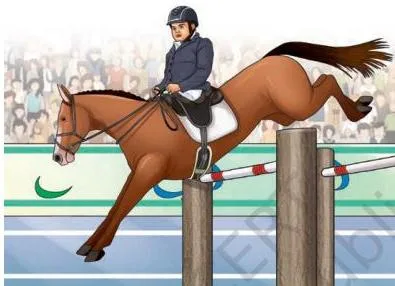
This is the raw material for the reported speech task on page 151. The exercise sets up the first blank for you: Siya’s line, I watched a documentary on the para equestrian event on television last night, converts to she had watched a documentary on the para equestrian event on television the previous night.
Apply the same shifts — tense back one step, pronouns changed, this to that — to the remaining lines and complete the four blanks.
This history box (NCERT, p. 154) carries the background you need for the group presentation on pages 154–155. Read it for the sequence: Stoke Mandeville 1948 → the first Paralympics in Rome in 1960 → Summer and Winter Games alternating every two years → and, since the late twentieth century, the Paralympics held in the same city as the Olympics shortly after the Olympics finish.
The chapter’s introduction adds the Indian dates — Bharat’s Paralympics debut in 1968 and the first medal in swimming in 1972 (NCERT, p. 138) — which also fit the K-W-L chart on page 136.
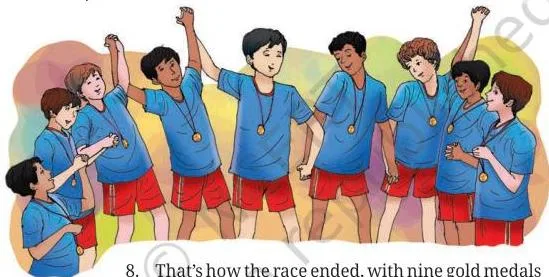
This banner appears in the poem’s seventh stanza: after the nine runners join hands and walk to the finish, a banner above them reads Special Olympics.
The poet’s line that it could not have been more on the mark means the sign fitted the moment exactly — the runners’ gesture of stopping, turning back and finishing together is precisely the Special Olympics ethos. The stanza-gist item on page 159 and the long questions on page 161 build directly on this idea.
Key Words and Their Meanings: Vocabulary from the Chapter
Both texts carry margin glosses, and knowing them before you read saves you from stopping at every line. Table 1 lists the words the interview explains; Tables 2 and 3 cover the poem’s words and the phrases exercise. The book asks students to match these meanings themselves, so treat the tables as a self-check.
| Word | Plain meaning | Page |
|---|---|---|
| resilience | the ability to bounce back quickly from hardship | 138 |
| locomotor | to do with movement — bones, joints or muscles | 138 |
| quell | to control or overcome | 138 |
| indelible | lasting; impossible to wipe away | 139 |
| squander | to waste carelessly | 139 |
| remorse | guilt or regret over what happened | 139 |
| trailblazer | a pioneer who opens the way for others | 140 |
| coveted | desired strongly by many people | 140 |
| accolades | public praise and honours | 140 |
| proponent | someone who argues in support of an idea | 140 |
| fortitude | courage and strength in the face of difficulty | 141 |
| testament | living proof of something | 141 |
| preconceived notions | fixed opinions held before knowing the facts | 141 |
| inclusivity | the practice of including everyone equally | 141 |
| advocating | actively supporting a cause | 141 |
| unleashed | set free, like a force that cannot be held back | 142 |
| Poem word (p. 158) | Plain meaning |
|---|---|
| dashed in the dirt | destroyed; hopes broken in a moment |
| stumbled | stepped awkwardly, lost balance and almost fell |
| staggered | walked or moved with difficulty |
| anguish | extreme pain or suffering |
| asphalt | the hard black material used to make roads |
| Phrase (p. 147) | Plain meaning |
|---|---|
| defy the odds | succeed when most people expect failure |
| a new lease of life | a fresh burst of energy or purpose |
| in hindsight | looking back with clearer understanding |
| breakthrough moment | the point at which something significant changes |
| turn obstacles into stepping stones | use difficulties as a way forward |
Common Mistakes Students Make in This Chapter
This chapter’s exercises train six skills, and each has a trap. Read the table before attempting the tasks, so the mistake is named before you make it.
| Mistake | Correct rule | How to check your answer |
|---|---|---|
| Calling “I feel it was a moment of personal victory” a fact | It is an opinion: a feeling cannot be proved, only the result can be verified (NCERT, p. 143) | Ask “can I prove this with evidence?” A medal result is provable; a feeling is not. |
| Reported speech: keeping quotation marks, dropping the tense shift, or leaving the old pronoun | Remove the quotes, add that, backshift the tense and change the pronoun (NCERT, p. 150) | Report one line, then tick the four steps from page 150 in order. |
| Using could only for past ability and should only for obligation | Each modal has several functions: could also means possibility, request and suggestion; should also means probability and advice (NCERT, pp. 148–149) | Write a fresh sentence for each function and label it, as the task on page 148 asks. |
| Treating sympathy, empathy and compassion as the same thing | Sympathy is feeling sorry for someone; empathy is imagining their feelings; compassion adds the wish to help (NCERT, p. 156) | Match the three sentences on page 156 to the three words before writing your own. |
| Placing jog before walk, or sprint anywhere but the fastest end | Jog is faster than walk; sprint is the fastest of the eleven movement words (NCERT, p. 147) | Fix the extremes first — creep and crawl at the slow end, sprint at the fast end — then order the middle by pace. |
| Confusing tone with mood, or calling any repeated sound alliteration | Alliteration repeats initial consonant sounds; tone is the poet’s attitude; mood is the reader’s feeling (NCERT, pp. 159–161) | Ask “whose attitude?” for tone, “what do I feel?” for mood, and listen for the same starting sound for alliteration. |
How to Revise This Chapter for Tests
Textbook contents and the examinable syllabus are not always identical — check the current official CBSE syllabus for what is examinable this session. Inside the chapter, the skills below are the formats the book itself trains, and they are what you should be able to do.
| Skill | Where in the chapter | What to practise |
|---|---|---|
| Extract-based comprehension | pp. 144–146 (interview); pp. 160–161 (poem) | Read each extract and answer the MCQ and short-answer questions; they test meaning, inference and tone. |
| Fact-opinion and cause-effect | p. 143 | Take any sentence from the interview and say whether it is fact or opinion, cause or effect — with a reason. |
| Reported speech | pp. 149–151 | Convert every line of direct speech; check the reporting verb, the linking word, the pronoun and the tense. |
| Notice writing | p. 153 | Draft a notice within 50 words using the format box: name of organisation, NOTICE, date, heading, details, signature, name and designation. |
| Slogan and poster | pp. 165–166 | Keep the slogan to eight to ten words, make it catchy, and present the poster in a box with the slogan placed among the vital information. |
| Collocations and word cline | pp. 147, 162 | Know a few adjective-noun pairs for big, heavy, strong, large, great, and the order of the eleven movement words by pace. |
Two more details matter. The speaking task contrasts an informal interview with the Sports Captain and a formal interview with the Sports Coach (NCERT, p. 152): the informal one opens with a friendly greeting, the formal one with a polite full-sentence greeting — match your language to your listener.
The listening transcripts sit in the teacher’s section on page 268 (NCERT, pp. 152, 163), so practise by having a partner read the announcement and the radio talk aloud while you fill in the answers.
For a faster last-minute pass, the Class 9 English notes page condenses the prose chapters, with companion notes such as Vitamin M and Twin Melodies; the Class 9 notes hub and the main notes page organise the rest of the subjects.
Quick Recap: The Interview and the Poem in Brief
The chapter closes with tasks rather than a printed summary, so this recap is a plain-language reminder — use it to confirm you have both texts straight before you close the tab.
Interview arc:
- Spine tumour at 29; surgery leaves her paralysed waist down and wheelchair-bound.
- Two choices: waste her life in regret, or transform it.
- Switch to para-athletics — she had been a swimmer and loved sports.
- Rio 2016 shot-put silver is her breakthrough.
- First Indian female Paralympics medallist, with many “firsts” and awards.
- Believes in “ability beyond disability”.
- Advocates inclusivity, women’s outdoor sports, support for lower-income sportspersons and youth awareness sessions.
Poem arc:
- Nine athletes, months of training, the hundred-yard dash.
- The smallest runner stumbles and falls; the other eight turn back to help.
- All nine finish hand in hand; a Special Olympics banner above.
- Nine gold medals and a standing ovation.
The two messages: physical limitations do not define potential, and collective support outweighs individual victory.
Related Resources: The Kaveri Book Page and Class 9 Hub
This listing is maintained for the 2026-27 academic session using the NCERT textbook information available to us. NCERT remains the authority for confirming the latest edition.
To move to other chapters of this book or other Class 9 subjects, use the pages below. The Kaveri book page lists every chapter of this reader, and the Class 9 hub collects the Class 9 book pages on this site.
- NCERT Class 9 English Kaveri book page — every chapter of this reader in order
- Class 9 NCERT books hub — the Class 9 book pages on this site
Sources and Data Verification
- The figures and page references in this article describe the NCERT Class 9 English reader Kaveri, Chapter 5, The World of Limitless Possibilities, pages 136–168 of the official edition.
- This page covers this one chapter only; it does not cover the other Class 9 English textbooks published by NCERT.
- This listing is maintained for the current academic session using the NCERT information available to us.
- NCERT settles textbook editions and official PDFs; CBSE settles the curriculum, syllabus and examinations. For the official chapter file, use ncert.nic.in; for what is examinable this session, check the current CBSE syllabus.
| What the chapter holds | Count | Where it is used |
|---|---|---|
| Printed pages | 32 | |
| Figures with NCERT captions | 3 | |
| Tables | 15 | |
| In-text questions | 17 | |
| Official NCERT PDF | Download the chapter PDF | the chapter exactly as NCERT publishes it |
Frequently Asked Questions About This Chapter
Why is this chapter called The World of Limitless Possibilities?
The title comes from Dr Deepa Malik’s own account of her choice after the surgery: instead of wasting her life in regret, she decided to transform it into a world of limitless possibilities (NCERT, p. 139).
The long-answer task on page 146 asks you to rationalise the title directly — her achievements, her “ability beyond disability” belief and her refusal to accept limits all support it.
Why did all nine runners in the poem get gold medals?
Because all nine of them finished the race. The eight runners stopped, turned round and helped the fallen athlete up, and then all nine crossed the line holding hands, so the race ended with nine gold medals (NCERT, p. 157). The question on page 161 asks you to explain this: the victory belongs to the shared finish, not to individual speed.
How do I convert direct speech into reported speech for this chapter?
Follow the steps on page 150: use a reporting verb (said, told or says), remove the quotation marks, add the linking word that, and then shift pronouns and tenses. For example, “I will give my best performance at the finals” becomes: she said that she would give her best performance at the finals.
What is the difference between a fact and an opinion in this chapter?
A fact is information that can be proved true; an opinion is a belief or perception that cannot be verified (NCERT, p. 143). In the interview, the statement about securing the silver medal in Rio is a fact; the statement that it felt like a moment of personal victory is an opinion — the clue is the phrase “I feel”.
What is the difference between the Olympics, the Paralympics and the Special Olympics?
The book defines the Paralympics as a celebration of the resilience and talent of athletes with locomotor, sensory or intellectual disabilities (NCERT, p. 138) and traces its origin to Sir Ludwig Guttmann’s 1948 competition for war veterans with spinal injuries, with the first Paralympics held in Rome in 1960 (NCERT, p. 154).
For the full three-way comparison, the chapter asks you to work it out in pairs on page 156 — the poem’s banner connects the Special Olympics to the ethos of finishing together rather than finishing first.
Where can I find the transcripts for the listening tasks?
Both listening tasks point you to page 268: the special assembly announcement on page 152 and the radio talk about Patrick Gomes on page 163 each carry the note “(Transcript for teacher on page 268)”. If you are practising alone, have a partner read the transcript aloud while you do the task exactly as you would in class.
Reference: NCERT Class 9 English textbook, chapter 5, official edition on ncert.nic.in.
Explore Class 9 English Books
- Previous: Vitamin-M
- Next: Twin Melodies
Related chapters:
- How I Taught My Grandmother to Read
- The Pot Maker
- Winds of Change