
This is Chapter 7 of the NCERT Class 9 English book Kaveri — Carrier of Words — which opens on printed page 202 and closes with the poem “Weigh Your Words” on page 230.
It follows Khetaram, a Gramin Dak Sewak (rural postman) who delivers mail through the Thar desert, and it carries two poems and the grammar practice that goes with them. The official Carrier of Words Class 9 PDF is right below, followed by a plain-English walkthrough of the story, both poems, the exercises and the figures.
Download the Carrier of Words Class 9 PDF
The chapter PDF is published free on the official NCERT website as part of the current edition of Kaveri. You can open the Carrier of Words Class 9 PDF on ncert.nic.in, where NCERT publishes the current edition of the book for free download.
The rest of this page tells you what the file actually contains, so you know what to study before you open it.
What Is Inside Chapter 7 of Kaveri
Before you start reading, here is the shape of the chapter — where the prose ends, where the poems begin, and what follows each text.
| Part | What it contains | Printed pages |
|---|---|---|
| Opening warm-up | “Reflect and Respond”: pictures of one profession, questions on how words are carried, and a word-fill passage about the desert | 202–203 |
| Prose text | “Carrier of Words” — the story of Khetaram, the Gramin Dak Sewak of the Thar | 204–209 |
| Prose skill blocks | Check Your Understanding (two sets), Critical Reflection, Vocabulary and Structures in Context, Listen and Respond, Speaking Activity, Writing Task, Learning Beyond the Text | 207–219 |
| Poem 1 and its blocks | “Words” by Charles Swain, with the same sequence of skill blocks after it | 220–229 |
| Poem 2 | “Weigh Your Words” by E. F. Hayward, on the final printed page | 230 |
The Story of Khetaram, the Carrier of Words
This is the main prose text of the chapter: a profile of one village postman in the Thar desert. Read it as a portrait of a job that is also a service — and notice the numbers the writer keeps giving, because the exercises test them.
Who Khetaram is and where he works
Khetaram is the sole postman of Somarad Branch Post Office in Rajasthan — sole meaning “only” — about 2.5 km short of the Indo-Pakistan border (NCERT, p. 204). For fifteen years he has been the trusted link between the far-flung hamlets, or dhaanis, of this remote area and their families.
His route matters, because the exercises test it: 120 km beyond the last railhead at Barmer, 50 km beyond the last phone, and 10 km beyond where the Barmer–Chohtan road crumbles into sand.
Mail from Jodhpur, about 330 km away, reaches the border within 24 hours — off the mail train, onto buses, then onto Khetaram’s shoulders (NCERT, p. 204).
What the job costs him
- Regulations stipulate that his mailbag cannot exceed 28 kilos (NCERT, p. 204).
- In summer, one delivery can mean walking 20 km, with the sands sizzling under his mojri (traditional Rajasthani footwear).
- Heat past 50 degrees Celsius is recorded as 49.9 degrees, because 50 degrees would declare a state holiday; on severe days he postpones deliveries till after sundown.
- His khaki turban and uniform are his only protection against scorching winds and sandstorms — he calls himself a walking sandman.
Why India Post created the Gramin Dak Sewak role
Gramin Dak Sewak (GDS) is the official title given in 2001 to India’s three lakh-plus rural delivery agents, earlier called simply “delivery agents” (NCERT, p. 204). They now form more than half of the postal workforce, and their territories include the frozen desert of Ladakh, the isles of Lakshadweep and the riverine communities of the northeast.
The Postmaster-General of Rajasthan Western Region calls the GDS role invaluable, since they deliver in interior areas that are inaccessible by any means besides foot.
The selection rules explain the system: a GDS must have access to another means of livelihood, works only five hours a day, and may serve past 60 up to 65, so the salary becomes an assured income (NCERT, p. 208).
The chapter sets this against two postal systems. The British network existed to relay company dak between administrative centres; after independence, India Post’s mandate was to bring the whole population within the mailing ambit — from about 25,000 post offices in 1947 to more than a lakh and a half today (NCERT, p. 207).
A proposal to scrap the GDS and hand the work to village record keepers (patwaris) was rejected; village elder Budh Singh was sure they could not do the job.
Trust: money orders, BSF lifts and jaggery
Khetaram can dwell on any threshold — reading out letters and drafting replies in his slightly shaky hand — because people trust him with what is most personal (NCERT, p. 208).
In this arid land, a family’s survival is partly dependent on money orders remitted by a relative. Writer Mulk Raj Anand, in his book Story of the Indian Post Office, recorded how dependent people in remote villages are on the post office for sending small sums of money — a sign of the absolute confidence Indians place in it.
The warmth is mutual: the BSF (Border Security Force) gives him a lift and a cup of tea when he distributes their dak, and villagers offer jaggery when he brings news of a birth or a wedding (NCERT, p. 209).

The photograph above belongs to that trust paragraph: it shows what the GDS system makes possible — rural depositors entrusting their monthly savings to the post office in their area.
Every post office holds many operational accounts, and the chapter says those accounts reflect people’s trust in the postal system. When a question asks you to support the statement that people trusted Gramin Dak Sewaks, this image and the money-order paragraph are your two pieces of evidence.
The torn-corner letter
There is one delivery Khetaram dreads: an envelope with the right corner torn off, which signifies that the missive bears news of death (NCERT, p. 209).
His rule is absolute — Ashubh Samachar (bad news) cannot be carried into the house. So he stands outside, reads the letter twice, then tears it to bits. The Critical Reflection extract questions come from this passage, including the true-or-false statement about whether his action differed from his beliefs.
What comes next for Khetaram
Phone lines are now only 50 km away. Khetaram hopes that when they arrive he might become a Gramin Sanchar Sewak, whose duty would entail carrying a cell phone and the post from home to home (NCERT, p. 209).
His answer to the prospect is “Main tayyar hoon” — I’m ready. Then he strides off with his sack to deliver Panna Devi’s dak before sundown. The chapter closes with a salute to people like Khetaram as part and parcel of our social fabric.
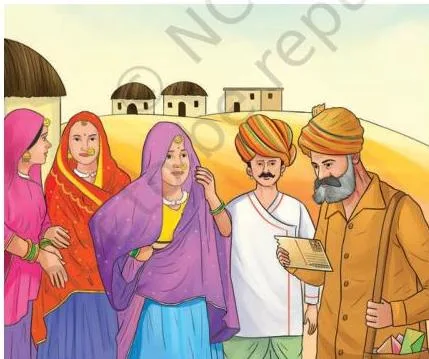
Pair the photograph above with his closing line “Main tayyar hoon”: after fifteen years of bearing words across this desolate geography, his spine is still strong, and he is ready for the next change.
If your teacher sets descriptive writing, this is the image to describe — his posture, his sack and the empty desert around him all say something about the job.
Poem 1: Words by Charles Swain, Few Words That Touch the Heart
The poem “Words” argues one idea in six four-line stanzas: hosts of empty words cannot satisfy the heart, while a little said — and truly said — can. Here is what each stanza says and which devices the exercises name.
| Stanza | What it says | Device the exercises test |
|---|---|---|
| 1 — “If words could satisfy the heart…” | Words seem as though they should satisfy the heart, but they depart like summer birds and leave nothing but empty air. | Simile: “words, like summer birds, depart” (uses “like”). |
| 2 — “The heart, a pilgrim upon earth…” | The heart is a traveller; when it needs words, it finds them as worthless as weeds. | Metaphor: “The heart, a pilgrim” (no “like” or “as”). |
| 3 — “A little said, and truly said…” | A few sincere words give deeper joy than hosts of words that reach the head but never the heart. | The chapter’s central contrast: few sincere vs many empty. |
| 4 — “The voice that wins its sunny way…” | The voice that cheers a lonely home often says the fewest words — “But, oh! those few, how dear!” | The exclamation carries admiration. |
| 5 — “If words could satisfy the chest…” | If words truly satisfied, the world would hold a feast; but when tested, words satisfy the least. | Hyperbole: “The world might hold a feast.” |
| 6 — “Like plants that make a gaudy show…” | Showy words are like plants that blossom but bear no fruit — impressive outside, empty inside. | Simile and the blossom-without-fruit image. |
The devices this poem asks about
- Simile — “words, like summer birds, depart”: compares words to summer birds using “like”. A simile always carries the comparison with “like” or “as”.
- Metaphor — “The heart, a pilgrim upon earth”: the heart is directly equated with a pilgrim, with no “like” or “as”.
- Hyperbole — “The world might hold a feast”: an exaggeration that shows how much words would matter if they could truly satisfy. The exercise gives choices, and the exaggerated option is always the answer: “tonnes of things to do”, “missed the basket by a mile”, “sleep for a decade”, “back in two seconds”.
- Repetition — the word “words” is repeated through the poem to keep the subject in front of the reader and to hammer the point that words keep failing us.
- Rhyme scheme — ABAB throughout. In the opening stanza: heart (A), care (B), depart (A), air (B) — lines 1 and 3 rhyme, lines 2 and 4 rhyme (NCERT, p. 221).
- Metre — the rhythm exercise underlines the stressed syllables in the first four lines (“If WORDS could SA-tis-FY the HEART”); the task is to mark the stressed syllables in the rest of the poem as the teacher reads it aloud.

The illustration above is the poem’s own image for its fourth stanza — those few words, spoken by a voice that cheers a lonely home, are the “dear” ones. When a question asks what the poet values, this line and this image are the answer to hold on to: quality of words beats quantity.
For the emotion question on stanzas 4–6, read the content of each exclamation, not just the mark: stanza 4 ends in admiration (“how dear!”), stanza 5 in frustration (“satisfy the least!”), stanza 6 in disillusionment (“one particle of fruit!”).
Poem 2: Weigh Your Words by E. F. Hayward
The closing poem makes the same theme practical. “Weigh Your Words” (NCERT, p. 230) says: if we weighed every word before speaking and said only what we meant, we would save talk and keep our conscience clean.
- Idle words and careless promises — if trusted by the weak — can cause a heart to ache.
- We never know the pain an idle word may start, and we can never erase a word once written on a heart.
- So it is best to weigh each sentence well: even if we have less to tell, what we say means a whole lot more.
Compare the two poems: both value a few truthful words over many empty ones. But “Words” laments what empty words fail to do — they leave the heart unsatisfied — while “Weigh Your Words” warns of what careless words actually do: they hurt.
Put together, the two give the chapter its message: a carrier of words must choose words carefully, because words carried badly are worse than none at all.
Grammar in This Chapter: Present Perfect Tense and Passive Voice
The chapter’s vocabulary block teaches two structures through exercises. Both are explained here so the exercises stop being guesswork.
Present perfect: has/have + past participle
The present perfect is built as has/have + past participle (the third form of the verb) (NCERT, p. 213). Choose has for a singular subject (he, she, it, Khetaram) and have for plural subjects and for I.
The chapter’s matching exercise lists seven uses of the present perfect. Learn each by its example:
| Use | What it means | Example |
|---|---|---|
| Finished action with present result | The action is over; its result matters now. | Ravi has locked the shop. (It is locked now.) |
| Recently completed action | It finished just now. | I have just posted the letter. |
| Life experience | Something true of your life up to now. | Have you ever climbed a sand dune? |
| Accomplishment | You have achieved something. | She has finished her marathon training. |
| Change over time | Something became different. | The desert has grown greener in five years. |
| Repeated actions at different times | It happened more than once, at different moments. | We have watched this documentary many times. |
| Past action with present impact | The past action still affects the present. | He has lived in Barmer since 2015. (He still does.) |
Worked example. Fill in: “The postman ______ (carry) this route for fifteen years.”
- Find the subject: the postman — singular, so the auxiliary is has.
- Put the verb into its past participle (third) form: carry → carried.
- The time phrase “for fifteen years” reaches into the present, so the present perfect is correct.
Answer: The postman has carried this route for fifteen years.
Passive voice: the subject receives the action
A sentence is in active voice when the subject does the action, and in passive voice when the subject receives it. The chapter’s pair: “GDS delivers the mail at the border” (active) versus “The mail is delivered by the GDS at the border” (passive) (NCERT, p. 214).
The passive is formed as be + past participle, and the agent after “by” can be dropped: “The mail is delivered at the border.”
Worked example. Active: “Khetaram will read out the letter to the family.” Passive: “The letter will be read out to the family by Khetaram.” The tense (will) stays, the main verb becomes a past participle (read), and “by Khetaram” can be removed if the doer is obvious.
The chapter’s transformation exercise turns a list of advice (stamina, reading clearly, writing neatly, full sleeves) into one passive paragraph. The rule for each item is the same: keep the tense, put the main verb into its past participle, and let “by …” carry the doer.
What the Exercise Blocks in This Chapter Ask You to Do
Both the prose and the poem are followed by the same sequence of blocks. Use this map to revise a specific skill — each row names the block, what it asks, and what it trains.
Exercise blocks after the prose text
| Block | What it asks you to do | Skill it tests |
|---|---|---|
| Check Your Understanding I (p. 207) | Fill an identity-card information sheet for Khetaram: position, employer, official address, mode of transport, key responsibilities. | Locating and recording factual details from a text. |
| Check Your Understanding II (p. 210) | Complete a situation–reason table, explain the jaggery offering, and say how phone lines would help Khetaram. | Cause–effect comprehension and inference. |
| Critical Reflection (p. 210) | Extract-based questions on the famine and torn-letter passages: finish reasons, complete an analogy, true or false, justify the GDS role and India Post’s purpose. | Close reading of a passage and building a supported answer. |
| Vocabulary and Structures (p. 212) | Match phrases and words, hunt alliteration and metaphor in the khaki sentence, practise present perfect and passive transformation. | Vocabulary in context and grammar transformation. |
| Listen and Respond (p. 215) | Listen to a girl talk about a letter-writing carnival (teacher transcript on p. 272): fill one blank, choose five options. | Listening for specific information. |
| Speaking Activity (p. 216) | In groups of four, argue which is most important — the postcard, inland letter, envelope or money order form — using given cues. | Speaking with reasons and polite disagreement. |
| Writing Task (p. 217) | Study a model condolence message, then draft one of your own. | Formal written communication with correct format. |
| Learning Beyond the Text (p. 218) | Read about the Daakroom carnival, research stamps for a philately board, examine an old telegram form. | Research, discussion and extended learning. |
Exercise blocks after the poem “Words”
| Block | What it asks you to do | Skill it tests |
|---|---|---|
| Reflect and Respond (p. 220) | Discuss why words matter and whether we can communicate without them; solve a word grid. | Discussion and word-building. |
| Check Your Understanding (p. 222) | Complete one-word blanks, find rhyming words and the rhyme scheme, name poetic devices, explain repetition, choose the emotions in stanzas 4–6, build hyperboles, mark the metre. | Poetry comprehension, literary devices and prosody. |
| Critical Reflection (p. 224) | Extract questions on the “pilgrim” stanza and the “feast” stanza, then five longer questions on words and loneliness. | Interpreting a poem and justifying an opinion. |
| Vocabulary in Context (p. 226) | Match figurative phrases (“satisfy the heart”, “hosts of words”), and build a word map for “cheer”. | Figurative language and dictionary skills. |
| Listen and Respond (p. 227) | Listen to a conversation about a declamation contest (teacher transcript on p. 273); mark the true statements. | Listening and verifying statements. |
| Speaking Activity (p. 227) | Choose a quotation you like, explain it with a personal experience, and write a five-paragraph essay on it. | Speaking with reasons; essay structure (introduction, body, counterargument, conclusion). |
| Learning Beyond the Text (p. 229) | Play the “Non-verbal” game (like Dumb Charades), and read a note on the Father of Sign Language. | Non-verbal communication awareness. |
Reading the Figures in This Chapter
The chapter’s key images carry meaning you can use in answers. Here is what to look for in each.
- Rural depositors (p. 207, shown in the story section above): the image belongs to the paragraph about India Post reaching rural depositors. Read it as visual evidence of the trust theme — people entrust their monthly savings to the post office because they believe the GDS will safeguard them. Use it to support the answer “People trusted Gramin Dak Sewaks.”
- Khetaram striding (p. 209, shown above): the image sits beside his line “Main tayyar hoon”. Notice the sack on his shoulder and the long desert strides — that is a man whose job is physically demanding and who is still ready for more. Use it for descriptive writing about his temperament.
- “But, oh! those few, how dear!” (p. 221, shown above): the poem’s illustration for the fourth stanza. It says visually what the stanza says verbally: the few words that reach a lonely home are the dear ones. Connect it to the argument that quality of words beats quantity.
- Sketch for “cheer” (p. 227, shown below): the word-map example in Vocabulary in Context uses a sketch of sunshine, a sunflower or a smiling face as the symbol for “cheer”. The word-map exercise asks you to do the same for other words — meaning, synonyms, antonyms, a sentence and a quick sketch — and the sketch is the creative part: a symbol that captures the word’s feeling, not a full drawing.

The sketch above is the model for the word-map activity: after you write the meaning, synonym, antonym and a sentence for a word like “depart” or “pilgrim”, you draw a quick symbol that represents it.
The example chose a smiling face for “cheer” because cheer is about brightness and encouragement — your symbol should work the same way: one glance, and the word comes to mind.
Key Words from the Chapter, Explained in Simple English
The story glosses its difficult words in the margin. Here they are in plainer English, with the line from the story that uses each one (NCERT, pp. 204–209).
| Word | Plain meaning | How it is used in the story |
|---|---|---|
| sole | only | Khetaram is the sole postman of Somarad. |
| hamlet | a small settlement | The far-flung hamlets, or dhaanis, of the border area. |
| ply | to move or travel | Sands so soft that even bicycles can’t ply. |
| hefted | lifted | The mail is hefted onto his shoulders. |
| stipulate | to specify by rule | Regulations stipulate that his load cannot exceed 28 kilos. |
| mojri | traditional Rajasthani footwear | His mojri-clad feet on sizzling sand. |
| operating | working | Delivery agents operating in rural areas. |
| riverine | situated on a river bank | The riverine communities of the northeast. |
| inaccessible | unreachable | Areas inaccessible by any means besides foot. |
| ambit | range, scope | Bringing the whole population within the mailing ambit. |
| access | opportunity | The GDS selection criterion is access to another livelihood. |
| remitted | sent (especially money) | Money orders remitted by a relative. |
| scrap | to remove, abolish | A scheme to scrap the GDS was rejected. |
| dwell | to stay on for a while | He can dwell on any threshold. |
| threshold | the entrance to a home | Reading letters at a villager’s threshold. |
| dreads | fears | There is one letter delivery he dreads. |
| missive | a letter | The missive bears news of death. |
| entail | to involve | His duty will entail carrying a cell phone. |
| striding | walking with long steps | Striding off with his sack on his shoulder. |
The vocabulary exercise also asks you to match four figurative phrases. Their meanings:
- crumbles into sand — disappears in the desert: the Barmer–Chohtan road ends in sand so soft even bicycles can’t ply.
- give a new lease of life — a fresh chance to continue living: Khetaram’s appointment gave him a new lease of life in a famine-prone land.
- turn into a trickle before drying out — lessen gradually and then finally stop.
- bearing words across this desolate geography — carrying letters to less populated areas: Khetaram’s own description of his work.
Notice how all four phrases describe the desert and the postman’s relation to it — the chapter keeps returning to the image of words physically carried across difficult land.
Mistakes Students Make in This Chapter
These are the errors that actually cost marks in this chapter’s comprehension, poetry and grammar work. Each row names the mistake, the correct rule, and a quick way to check yourself.
| Mistake | Correct rule | How to check your answer |
|---|---|---|
| Marking “Khetaram’s action of tearing the letter differed from his beliefs” as true. | The statement is false: tearing the letter matches his belief that bad news must not enter the house — “Ashubh Samachar cannot be carried into the house” (NCERT, p. 209). | State the belief, then the action. If they agree, the word “differed” makes the statement false. |
| Completing the analogy “Other families: Money orders :: Khetaram: ____” with “letters”. | The paired idea is Khetaram’s job as a Gramin Dak Sewak: both are means of survival in an arid region — families depend on remitted money orders; Khetaram’s family would starve without his salary. | Ask what the money order does for a family (keeps it alive) and match the thing that does that for Khetaram. |
| Calling “words, like summer birds, depart” a metaphor. | It is a simile — the comparison uses “like” (NCERT, p. 222). | Look for “like” or “as” carrying the comparison; present → simile. |
| Missing that “the heart, a pilgrim” is a metaphor. | It is a metaphor — the heart is directly equated with a pilgrim, with no “like” or “as”. | No “like” or “as”? The direct equation makes it a metaphor. |
| Using the present perfect with finished-time markers. | The present perfect’s seven uses all involve unfinished or indefinite time (NCERT, p. 213). With “yesterday”, “last week” or “in 2010”, use the simple past. | If the time is over, simple past; if the result reaches the present, present perfect. |
| Choosing “has” with a plural subject. | has goes with singular subjects (he, she, it); have with plural subjects and with I/you/we/they. | Match the auxiliary to the subject before you choose the participle. |
| Changing the tense while converting a sentence to passive. | The passive keeps the tense; only the main verb becomes a past participle, and “by …” can be dropped (NCERT, p. 214). | Convert your passive sentence back to active — if the tense differs from the original, fix it. |
How to Prepare for Tests on Carrier of Words
No one can promise which questions will appear, but this chapter’s tests are predictable in format. Practise these.
- Fix the factual skeleton of the prose — places (Somarad, Barmer, Jodhpur, Indo-Pakistan border), distances (2.5 km short of the border, 120 km beyond the last railhead, 50 km beyond the last phone, 330 km from Jodhpur), the 28-kilo limit, the 24-hour delivery, the 49.9 degrees detail, the 2001 GDS recognition, and the post office count (25,000 in 1947 to more than a lakh and a half now).
- Learn the argument of “Words” stanza by stanza, and be ready to name the simile (“like summer birds”), the metaphor (“heart, a pilgrim”), the hyperbole (“the world might hold a feast”) and the ABAB rhyme scheme.
- Link “Weigh Your Words” to the theme — few truthful words beat many empty ones in both poems; “Weigh Your Words” adds the warning that careless words can hurt.
- Practise the book’s own formats: the information sheet, the situation–reason table, extract questions, true or false, analogy completion, phrase matching, present-perfect fill-ins, passive transformation and the condolence message.
Textbook contents and the examinable syllabus are not always identical — check the current official syllabus on cbse.gov.in to confirm what is examinable this session.
The Whole Chapter in Ten Points
Last-minute revision, in the order the chapter builds its ideas.
- Khetaram is the sole postman of Somarad Branch Post Office, near the Indo-Pakistan border (NCERT, p. 204).
- He walks the Thar beyond Barmer — 120 km past the last railhead — and delivers mail from Jodhpur within 24 hours.
- Regulations cap his mailbag at 28 kilograms.
- In summer one delivery can mean 20 km on foot; heat past 50 is recorded as 49.9 degrees because 50 would declare a state holiday.
- In 2001 rural delivery agents were officially accepted as Gramin Dak Sewaks; they now form more than half of the postal workforce.
- Trust runs through the chapter: money orders, the BSF lift, jaggery for good news, and Mulk Raj Anand’s account of rural India’s confidence in the post office.
- A letter with a torn corner means death news; Khetaram reads it outside and tears it up — bad news must not enter the house (NCERT, p. 209).
- Phone lines are 50 km away; when they arrive he hopes to become a Gramin Sanchar Sewak — “Main tayyar hoon”, he is ready.
- The poem “Words” argues that few sincere words touch the heart more than hosts of empty ones.
- The grammar: present perfect (has/have + past participle) and passive voice (be + past participle).
Related Resources for Class 9 English
This listing is maintained for the 2026-27 academic session using the NCERT textbook information available to us. NCERT remains the authority for confirming the latest edition.
If you are working through the whole reader:
- NCERT Class 9 English book page — all chapters of Kaveri in one place.
- Class 9 NCERT books hub — every Class 9 subject, including the other language readers.
- CBSE notes home — Class 9 notes across subjects.
- Other chapters from the same reader with notes on this site: Twin Melodies and Follow.
Sources and Data Verification
This page describes the NCERT Class 9 English Kaveri textbook, Chapter 7 “Carrier of Words”, official NCERT edition — the chapter opens on printed page 202 and closes on page 230.
- The details and figures above describe that single chapter, from its opening warm-up to the closing poem; other chapters of Kaveri and other Class 9 books are covered on their own pages.
- This listing is maintained for the current academic session using the NCERT information available to us.
- NCERT settles textbooks, editions and PDFs; CBSE settles curriculum, syllabus and examinations.
| What the chapter holds | Count | Where it is used |
|---|---|---|
| Printed pages | 28 | |
| Figures with NCERT captions | 4 | |
| Tables | 14 | |
| In-text questions | 11 | |
| Official NCERT PDF | Download the chapter PDF | the chapter exactly as NCERT publishes it |
Frequently Asked Questions
What is a Gramin Dak Sewak?
A Gramin Dak Sewak is a rural postal delivery worker. Until 2001 these workers were called “delivery agents”; that year India’s three lakh-plus delivery agents were officially accepted as Gramin Dak Sewaks (GDS), and they now form more than half of the postal workforce.
They deliver in interior areas — the Thar, Ladakh, Lakshadweep, the northeast — that are inaccessible by any means besides foot (NCERT, p. 204).
Why does Khetaram tear up the letter with a torn corner?
The right corner torn off an envelope signifies that the letter bears news of death. Khetaram believes bad news cannot be carried into the house, so he stands outside, reads the letter twice, and tears it to bits to destroy the bad news (NCERT, p. 209).
What is the rhyme scheme of the poem “Words”?
The rhyme scheme is ABAB throughout. In the opening stanza, lines 1 and 3 rhyme (heart/depart) and lines 2 and 4 rhyme (care/air); every following stanza rhymes its first and third lines, and its second and fourth lines, on the same pattern (NCERT, p. 221).
Which poetic device is used in “words, like summer birds, depart”?
A simile. The line compares words to summer birds using the word “like” — that is what makes it a simile rather than a metaphor (NCERT, p. 222).
How does the chapter explain the present perfect tense?
The chapter defines the present perfect as has/have + past participle (third form of the verb) and lists seven uses through a matching exercise: a finished action with a present result, a recently completed action, a life experience, an accomplishment, a change over time, repeated actions at different times, and a past action whose impact is in the present (NCERT, p. 213).
What does philately mean in this chapter?
Philately is the study of postage stamps and postal history. The chapter notes that you can be a philatelist without owning stamps — the stamps you study may be rare ones found only in museums (NCERT, p. 218).
Reference: NCERT Class 9 English Kaveri textbook, chapter 7, official edition on ncert.nic.in.
Explore Class 9 English Books
- Previous: Twin Melodies
- Next: Follow
Related chapters:
- How I Taught My Grandmother to Read
- The Pot Maker
- Winds of Change