
Twin Melodies Class 9 is Chapter 6 of the NCERT English textbook Kaveri — a 34-page unit (printed pages 168–202) that pairs a three-act play about a young violinist with a poem on music, and closes with a second poem for appreciation. Around both texts the chapter builds vocabulary, grammar, listening, speaking and writing activities. The official PDF is right here on this page.
The file below is the official NCERT edition published on ncert.nic.in, so what you open is exactly the text your school uses, with the full play, poem, exercises and illustrations inside: NCERT Class 9 English Chapter 6 Twin Melodies PDF.
What the Twin Melodies chapter contains
This is the map of the file you just opened. The table below lists the chapter’s sections, figures and questions — read it once to see how much of the unit you have covered, then jump to whichever part you need.
The chapter is two literary units joined by shared skill strands:
- The three-act play Twin Melodies — printed pages 168 to 193.
- The poem unit “A Friend Found in Music” — printed pages 194 to 201.
- A second appreciation poem, “Music” by Walter de la Mare — page 202.
- Running through both units: vocabulary, grammar, listening, speaking and writing activities.
The story of the play, act by act
The whole chapter hangs on this story: a daughter who loves her strict father but wants to play one fusion concert. Read it once here, and every exercise in the chapter will make sense.
The characters (NCERT, p. 170)
Six characters carry the play. The list appears before Act I in the text.
| Character | Who they are |
|---|---|
| Shruti Sharma | A young aspiring violinist, the daughter |
| Guru Nabin Sharma | Shruti’s father, a violinist and the Principal of Sangeetika Music School |
| Leela Devi | Shruti’s mother |
| Avinash | Tabla player of the fusion group |
| Iqbal | Flutist of the fusion group |
| Peter | Keyboard player of the fusion group |
Act I — the secret rehearsals (pp. 170–173)
The play opens on four children finishing an Indo-Western fusion piece in Iqbal’s room — posters of flute players on the wall, instruments being packed up, Shruti looking distressed. A newspaper review in the Parbatpuri Daily Clarion praises her, and Avinash teases her that she is a sensation now.
The boys push her to confess to her father; Shruti explains that Nabin is strict, that he would see fusion as a desecration of the violin, and that she does not want to hurt him. She resolves at the end of Act I to bite the bullet and tell him at dinner (NCERT, p. 173).
Act II — the confession and the refusal (pp. 175–176)
At dinner Shruti stumbles through her confession. Nabin’s reply is “No is the answer”: his rule is one performance every six months because “familiarity breeds contempt”, and he dismisses the fusion concert as noise — a hubbub that will drown her individual style (NCERT, p. 176).
Leela scolds Shruti for keeping the practices a secret, and Shruti promises not to hide things again.
Act III — the rehearsal that changes everything (pp. 178–180)
Shruti plans to practise one last time and then tell her friends she cannot perform. In the middle of the rehearsal her parents walk in. Nabin taps his feet, is visibly moved, and praises Shruti for holding the notes of the raga perfectly (NCERT, p. 179).
Leela then reveals the key back-story: Nabin himself once defied his vocalist family to take up the violin, working painstakingly and working his fingers to the bone to earn his place (NCERT, p. 180).
Nabin admits his fears were baseless — “each bay, its own wind” — and offers the group the music room, promising to root for them at the concert (NCERT, pp. 179–181).
The two musical worlds of the play
Nabin’s opinion is the engine of the plot, and it shifts across the three acts. This table tracks the change.
| Classical Hindustani music | Indo-Western fusion | |
|---|---|---|
| Who stands for it | Nabin — the violin in the classical tradition, “with its ragas and aalaaps” (NCERT, p. 173) | Shruti’s group — violin with flute, tabla and keyboard (NCERT, pp. 170–171) |
| Nabin’s first verdict | The only kind of music “an artist of any worth should play” (NCERT, p. 173) | “A desecration of the violin”; noise — a hubbub that drowns individual style (NCERT, pp. 173, 176) |
| What changes his mind | Watching the rehearsal and hearing Leela’s story of his own youth (NCERT, p. 180) | |
| Nabin’s final verdict | “I underestimated the power of our own music” (NCERT, p. 180) | Praises the group, offers the music room, and will root for them at the concert (NCERT, pp. 179–181) |
The title “Twin Melodies” points at these two musical worlds meeting — and the Critical Reflection at page 183 asks you to justify that title in your own words.
Key ideas the play and poem build on
These are the craft terms and language devices the chapter’s exercises keep returning to. Learn them once here, and the questions on pages 184–198 stop looking unfamiliar.
How a play script is written (NCERT, p. 191)
The script never uses inverted commas around dialogue. After the speaker’s name comes a colon, and the words of the line follow. Brackets carry the delivery direction — “a little loudly”, “calmly but firmly” — doing the job a reporting verb like “he shouted” would do in prose. Words in brackets are never spoken aloud; they tell the actor how to act.
The aside (NCERT, p. 184)
An aside is a theatrical device in which a character directly addresses the audience while the other characters on stage are unaware of the speech.
Shruti uses one at the start of Act III (NCERT, p. 178): she says how much she enjoys the piece and that she plans to tell her friends she cannot join the performance — and nobody on stage hears it.
Non-lexical fillers (NCERT, p. 184)
Sounds like “ahem ahem”, “er”, “uh” and “um” are non-lexical fillers — normal speech sounds that fill pauses while a speaker gathers their thoughts. They are not mistakes; the chapter teaches them as a script device, so you can use them in your own play script.
Music vocabulary (NCERT, p. 185)
The margin notes define notes (a single sound at a certain pitch) and crescendo (a gradual increase in volume). A matching exercise then pairs seven music words with their meanings: rhythm, tempo, bass, baritone, cacophony, pitch and scale.
How “A Friend Found in Music” is built (pp. 194–195)
- Metaphors asked to become similes. The poem calls music the ocean, the rhythm, the therapy and the needed friend. The exercise gives the skeleton “Music is as ___ as ___”: for example, Music is as deep as an ocean and Music is as reliable as a needed friend.
- Rhyme scheme. Each stanza rhymes its second and fourth lines — the pairs are shore/core, blue/through, and there/care. That is the answer to the rhyme-scheme question on page 195.
- Repetition of “music”. The word is repeated deliberately, so the poem keeps pointing back to the single thing the poet is praising.
- Mood. Of the options offered — nostalgic, thoughtful, amused, playful — the mood is thoughtful.
- Message. Music is comfort: the ocean that pulls the poet to the shore, the rhythm that moves her deeply, the therapy when she feels blue, the needed friend when no one seems to care.
Two language points worth knowing early (pp. 197–198)
“Moves me to the core” is not a metaphor in this chapter’s exercise — the point is that move has several meanings (change position, make progress, take action, cause strong feelings), and here it means to affect the emotions strongly (NCERT, p. 197).
The same page introduces phrasal verbs: two-part verbs whose combined meaning is new, like pull through — to succeed in doing something very difficult.
A closer look at the four illustrations
The four pictures in this chapter are not decoration — each one captures a moment the text is built on or an activity it points to.
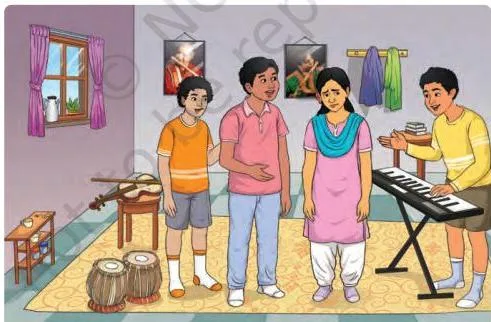
This image belongs to Act I (NCERT, p. 172). It captures the moment the friends realise Shruti’s secret is still hidden — right after Iqbal reads out the newspaper review and the boys crowd around her, trying to distract her from her worry.
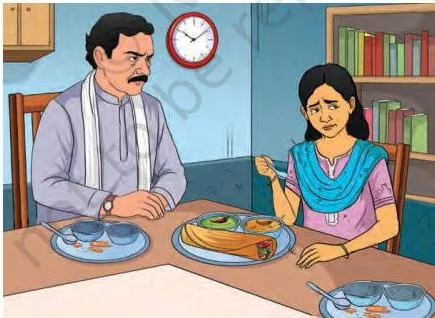
This is the confession scene in visual form (NCERT, p. 175). Notice the ellipses — the dots showing her hesitation. The chapter later teaches the ellipsis as a script device for a dramatic pause (NCERT, p. 190).
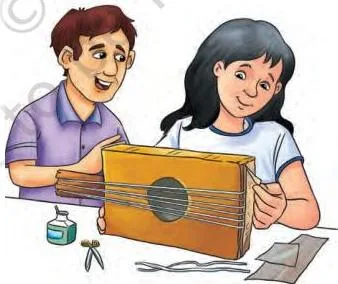
The Recycled Orchestra of Cateura, Paraguay, formed in 2012, plays instruments made from scrap collected from landfills (NCERT, p. 192). It anchors the “Learning Beyond the Text” activity in which students make rhythm from objects around them — junk instruments with a real, working example behind them.
This is the chapter’s recommended reading for humour in plays (NCERT, p. 193). The description accompanying the cover tells you what to expect — a silly King, his Council of nine Ministers and a bed bug — so you know it is comedy before you open it.
Words the chapter teaches, with the moments they appear in
The play explains its difficult words in the margin as they appear. This table collects them for revision, each tied to the line where it occurs.
| Word or phrase | Meaning | Where it appears |
|---|---|---|
| crescendo | A piece of music that gets louder and louder | Act I opens with the fusion piece “in its crescendo” (NCERT, p. 170) |
| desecration | Disrespect towards something sacred | Shruti’s fear about the violin played to Western tunes (NCERT, p. 173) |
| ragas and aalaaps | Elements of Hindustani classical music | Nabin’s belief that only classical music is worthy (NCERT, p. 173) |
| to bite the bullet | To deal with a difficult situation in a courageous, determined way | Shruti’s decision at the end of Act I (NCERT, p. 173) |
| contempt | A strong feeling of dislike and disrespect | “Familiarity breeds contempt” — Nabin’s rule on performances (NCERT, p. 176) |
| hubbub | A loud noise | Nabin’s word for the orchestra (NCERT, p. 176) |
| iterated | Repeated | “My views … have been iterated in this house” (NCERT, p. 176) |
| painstakingly | Done with great care and effort | The family that “painstakingly nurtured the flame of musical heritage” (NCERT, p. 180) |
| worked his fingers to the bone | Worked extremely hard | Leela on how Nabin earned his place (NCERT, p. 181) |
| root | To show support | “I will root for your group at the concert” (NCERT, p. 181) |
| each bay, its own wind | Every path is unique; one rule does not fit everyone | Nabin’s admission at the end of Act III; the speaking table stresses “each” and “own” (NCERT, pp. 180, 189) |
The vocabulary exercise on page 185 asks you to match rhythm, tempo, bass, baritone, cacophony, pitch and scale to their meanings — all words from the play’s music world. The phrase exercise on page 186 works with “drown your individual style”, “sense of musicality” and “go down the drain”; read each phrase inside its full sentence before you write the meaning.
Mistakes students make with this chapter
These five errors are the ones students actually make with this chapter. Naming them now saves the mark later.
| Mistake | Correct rule | How to check your answer |
|---|---|---|
| Treating “ahem ahem” and “er” as errors | They are non-lexical fillers — normal sounds that fill pauses while a speaker gathers thoughts (NCERT, p. 184) | Ask: does the word carry meaning, or is it just holding the speaker’s place while they think? |
| Assuming an aside is heard by everyone on stage | An aside addresses only the audience; the other characters on stage are unaware of it (NCERT, p. 184) | Shruti’s Act III aside works only because nobody on stage hears her plan to leave the group |
| Reading phrasal verbs literally | “Pull through” means to succeed in doing something very difficult — the two words together carry a new meaning (NCERT, p. 197) | Test it in the poem: music makes sure the poet pulls through sad times — physical pulling makes no sense there |
| Keeping the exclamation mark, interjection or quotation marks in reported speech | Use “exclaimed” or “exclaimed with (feeling)” instead of “said”; drop interjections, exclamation marks and quotes (NCERT, p. 186) | “Wow Shruti! You’re a sensation!” becomes “Avinash exclaimed with wonder that Shruti was a great sensation” (NCERT, p. 187) |
| Calling “moves me to the core” a metaphor | “Move” has several meanings — here it means to affect the emotions strongly (NCERT, p. 197) | Try the other meanings — change position, make progress, take action — and only the emotional sense fits |
One misreading is worth correcting too: Shruti is not simply a disobedient daughter. She hides the concert because she does not want to hurt a father whose opinions she genuinely respects — “I don’t want papa to feel that I don’t care about his opinions, because I do” (NCERT, p. 173).
Using this chapter for exam practice
The chapter’s own end-sections model the question shapes worth practising. Here is what each one trains, so revision time goes to the right task.
- Extract-based comprehension — the play’s Critical Reflection (NCERT, pp. 181–183) and the poem’s (NCERT, p. 196). Each begins with MCQs, then short answers. A full-marks answer names the correct option and then supports every short answer with the exact line it comes from.
- Quick plot checks — table completion for Act I (NCERT, p. 174), summary completion for Act II (NCERT, p. 177) and a true/false set for Act III (NCERT, p. 181). These are the fastest way to test whether you actually remember the story’s turn.
- Vocabulary matching — music terms on page 185 and phrase meanings on page 186.
- Grammar conversion — exclamatory to declarative, and direct to reported speech (NCERT, pp. 186–187).
- Two writing tasks — a play script from a given beginning (NCERT, p. 190) and a World Music Day invitation letter (NCERT, p. 200). For the script, the conventions carry the marks: colon after the speaker’s name, brackets for delivery direction, an aside where needed, ellipsis for a pause. For the letter, follow the format and keep the first-person tone warm.
Worked example: an exclamatory sentence in reported speech
This is the conversion pattern the exercises on pages 186–187 train. Use a sentence of your own — here is one not taken from the textbook.
- Name the sentence type. “What a wonderful surprise this is!” said Meera — it starts with “What a” and ends with an exclamation mark, so it is exclamatory.
- Change the reporting verb. Replace “said” with “exclaimed with delight” — the rule gives you “exclaimed” or “exclaimed with (feeling)”.
- Remove the exclamatory markers. Drop the interjection (“What a”), the exclamation mark and the quotation marks.
- Shift the tense. “is” becomes “was”.
Answer: Meera exclaimed with delight that it was a wonderful surprise.
One honest note on listening: the two listening tasks — the yazh description (NCERT, pp. 188–189) and the two-speaker conversation (NCERT, p. 199) — are teacher-led. Their transcripts are printed on page 270 of the book for the teacher, and the audio runs in class.
That makes them speaking practice rather than written-paper material, so spend written revision time on comprehension, vocabulary and the conversions instead. For the revision side of the same chapter, the Class 9 English notes page collects study material for the book, and the CBSE notes index covers every class and subject.
Textbook contents and the examinable syllabus are not always identical — check the current official CBSE syllabus before deciding what to revise.
Quick revision: Twin Melodies Class 9 in ten lines
The chapter has no printed summary, so this is a revision recap in our own words — the whole story in ten lines, then the poem’s message.
- Shruti Sharma rehearses an Indo-Western fusion piece in secret with Iqbal (flute), Avinash (tabla) and Peter (keyboard) (NCERT, p. 170).
- A newspaper review in the Parbatpuri Daily Clarion praises her playing, and her friends call her a sensation (NCERT, p. 171).
- Her friends urge her to confess; she fears her father will see fusion as a desecration of the violin (NCERT, p. 173).
- At dinner she confesses; Nabin’s answer is “No” — one performance every six months (NCERT, p. 176).
- He dismisses the concert as noise that will drown her individual style (NCERT, p. 176).
- Her parents walk in on the final rehearsal; Nabin taps his feet and is won over (NCERT, p. 179).
- Leela reveals that Nabin once defied his vocalist family to take up the violin (NCERT, p. 180).
- Nabin admits his fears were baseless: “each bay, its own wind” (NCERT, p. 180).
- He offers the group the music room and promises to root for them at the concert (NCERT, pp. 179–181).
- The poem “A Friend Found in Music” gives music the same job — ocean, rhythm, therapy and needed friend that lift the poet through sadness (NCERT, pp. 194–195).
The chapter closes with Walter de la Mare’s “Music” (NCERT, p. 202), in which music transforms the world the moment it sounds — flowers, forest trees and water nymphs all changed by it.
The activities inside the chapter, and what each trains
This chapter is built around doing, not just reading. Map the tasks below so none gets skipped.
| Task | Page | What it trains |
|---|---|---|
| Stringed-instrument warm-up and idiom fill-in paragraph | pp. 168–169 | Identifying instruments from first letters; literal vs figurative phrases |
| The yazh listening task | pp. 188–189 | Listening for specific information — the design answers come from the audio, not the print, so do not guess them |
| Stress and intonation practice | p. 189 | Speaking — includes “Each bay, its own wind” with its stress marks explained |
| Play-script writing from a given beginning | p. 190 | Writing — colon, brackets, aside, ellipsis |
| Learning Beyond the Text (play unit) | pp. 191–193 | Extension — Recycled Orchestra of Cateura, indigenous instruments, Rigmarole and Other Plays |
| Music-preferences discussion | p. 194 | Speaking — Reflect and Respond for the poem |
| Two-speaker conversation listening | p. 199 | Listening — guess the six answers first, then check with the audio |
| Role play on taking up music classes | p. 200 | Speaking — student, teacher and parent perspectives |
| World Music Day invitation letter | p. 200 | Writing — letter format and warm first-person tone |
| Learning Beyond the Text (poem unit) | p. 201 | Extension — Raga Chikitsa, Sangita Sudha (17th century), the origin of the seven swaras |
Related resources
This listing is maintained for the 2026-27 academic session using the NCERT textbook information available to us. NCERT remains the authority for confirming the latest edition.
If you are moving to another part of the book — or another chapter — these pages are the fastest way forward.
- Class 9 English book page — open any chapter of Kaveri from here.
- Class 9 hub — every subject’s NCERT textbooks for the year.
- Previous chapter and Chapter 7 — the chapters on either side of this one.
- Notes for the chapters around this one — The World of Limitless Possibilities and Carrier of Words — sit on the Class 9 notes hub.
Sources and data verification
This page describes the NCERT Class 9 English textbook Kaveri, Chapter 6 (Twin Melodies), printed pages 168–202, as published on the official NCERT textbook portal at ncert.nic.in. It covers this chapter’s play, poem and activities only — not other chapters of the book, and not other Class 9 subjects.
It is maintained for the current academic session from the NCERT textbook information available to us. NCERT settles textbook editions, contents and official PDFs; CBSE settles the curriculum, syllabus and examinations — and textbook contents and the examinable syllabus are not always identical, so check the current official CBSE syllabus for what is examinable.
| What the chapter holds | Count | Where it is used |
|---|---|---|
| Printed pages | 34 | |
| Figures with NCERT captions | 4 | |
| Tables | 13 | |
| In-text questions | 7 | |
| Official NCERT PDF | Download the chapter PDF | the chapter exactly as NCERT publishes it |
Frequently asked questions
Who are the characters in the Twin Melodies play?
The play has six characters: Shruti Sharma, a young aspiring violinist; Guru Nabin Sharma, her father, a violinist and the Principal of Sangeetika Music School; Leela Devi, her mother; and Shruti’s three bandmates — Avinash on tabla, Iqbal on flute and Peter on keyboard (NCERT, p. 170).
What is the central theme of the play Twin Melodies?
Tradition versus modernity, and duty towards family versus personal passion. Shruti wants to play Indo-Western fusion, which her father Nabin first sees as a desecration of the classical violin; by the end he realises his fears were baseless (NCERT, p. 180). The Critical Reflection on page 183 asks you to justify the title and analyse this theme yourself.
What does “each bay, its own wind” mean in the play?
It means each person’s path is unique — one rule does not fit everyone. Nabin says it after admitting his fears were baseless, accepting that Shruti’s fusion music is her own bay with its own wind (NCERT, p. 180). The speaking activity on page 189 stresses the words “each” and “own” to highlight exactly this.
What is an aside in a play, and where does Shruti use one?
An aside is a theatrical device in which a character directly addresses the audience while the other characters on stage are unaware of the speech (NCERT, p. 184). Shruti uses one at the start of Act III (NCERT, p. 178): she says she enjoys performing the piece but plans to tell her friends she cannot join the performance.
What does “bite the bullet” mean in the chapter?
To deal with a difficult or unpleasant situation in a courageous, determined way. The margin gloss on page 173 defines it, and Shruti uses it at the end of Act I when she decides to bring up the concert with her father at dinner.
Is the Twin Melodies chapter part of the CBSE Class 9 English syllabus?
It appears in the current NCERT Class 9 English textbook Kaveri as Chapter 6. Textbook contents and the examinable syllabus are not always identical, so check the current official CBSE syllabus for what is examinable this session.
Reference: NCERT Class 9 English (Kaveri) textbook, chapter 6, official edition on ncert.nic.in.
Explore Class 9 English Books
- Previous: The World of Limitless Possibilities
- Next: Carrier of Words
Related chapters:
- How I Taught My Grandmother to Read
- The Pot Maker
- Winds of Change