
Here is the NCERT Class 10 Social Science History Chapter 5 — Print Culture and the Modern World — from the book India and the Contemporary World II. The chapter runs 26 printed pages, from page 102 to page 128, and sits in the book’s closing section, Everyday Life, Culture and Politics.
The official NCERT PDF is right below; after that, the page walks through what the chapter actually contains — its sections, figures, key ideas and exercises — so you know what you are opening.
This is the official file as published on ncert.nic.in, with the same text, figures and page numbers as the printed book — open the NCERT Class 10 Social Science History Chapter 5 Print Culture and the Modern World PDF to read, print or revise the chapter exactly as it appears in the textbook.
What this chapter covers: print in Asia, Europe and India
Print Culture and the Modern World tells one large story: how printed matter began in East Asia, was mechanised in Europe, and changed society in both Europe and colonial India. The chapter opens with the point that print has a history — we live inside a world of books, newspapers and posters, and that world was made, not given.
NCERT’s own framing sets the route: the development of print, from its beginnings in East Asia to its expansion in Europe and in India. Along the way the chapter answers three questions — when did printed literature begin to circulate, how did the spread of technology change social lives and cultures, and how did print help create the modern world?
The narrative arc runs East Asia → Europe → India, and each region adds a layer: the technology of print, the culture of reading, and the politics of controlling what people read. The section map below gives you the chapter’s anatomy at a glance.
Chapter at a glance: nine sections, five activities, one story
The chapter moves in nine numbered sections, from the first woodblocks in China to colonial censorship in India. The table shows each section and the NCERT page it starts on, so you can jump straight to the part you need.
| Section | Title | Starts on NCERT page |
|---|---|---|
| 1 | The First Printed Books | 104 |
| 2 | Print Comes to Europe | 106 |
| 3 | The Print Revolution and Its Impact | 109 |
| 4 | The Reading Mania | 112 |
| 5 | The Nineteenth Century | 115 |
| 6 | India and the World of Print | 117 |
| 7 | Religious Reform and Public Debates | 119 |
| 8 | New Forms of Publication | 121 |
| 9 | Print and Censorship | 125 |
The chapter closes with three exercise blocks — Write in brief, Discuss and a Project — and embeds Activities at pages 108, 111, 116, 118 and 126. The exercises map onto real question patterns, and Section 13 of this page breaks down how to answer each type.
The learning sequence: from hand printing to the press revolution
This part of the page covers the technology half of the chapter — where hand printing began and how Europe turned it into a machine. The social effects later in the chapter only make sense if you can tell a woodblock from a printing press, so that distinction matters.
Hand printing in East Asia
The earliest print technology was hand printing, developed in China, Japan and Korea. From AD 594, books in China were printed by rubbing paper — also invented in China — against the inked surface of woodblocks. Since both sides of the sheet could not be printed, the traditional Chinese ‘accordion book’ was folded and stitched at the side (NCERT, p. 104).
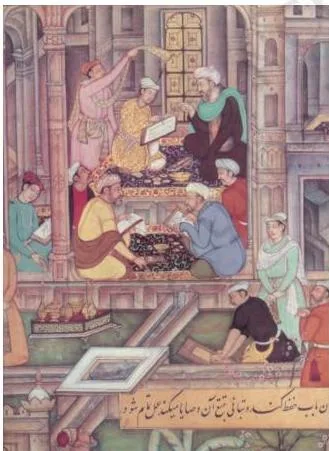
Fig. 1 is the chapter’s opening image — a royal workshop in 1595, much before printing began in India. The text is being dictated, written and illustrated by hand. NCERT’s caption asks you to think about what happened to these hand arts when printing machines arrived; keep that question in mind, because the chapter returns to it in India’s manuscript story.
Print in China was not only for the elite. The imperial state printed textbooks for civil service examinations in vast numbers. By the seventeenth century, as urban culture bloomed, merchants collected trade information in print, leisure reading spread, and women — including wives of scholar-officials and courtesans — began to publish (NCERT, p. 104).
In the late nineteenth century, Shanghai became the hub of a new print culture catering to Western-style schools.
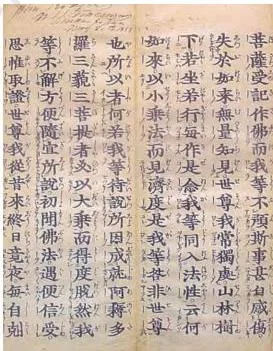
In Japan, Buddhist missionaries introduced hand printing around AD 768–770. The oldest printed Chinese book, the Buddhist Diamond Sutra, dates to AD 868 and contains six sheets of text with woodcut illustrations (NCERT, p. 105). Japan’s cities also produced a rich visual print culture: ukiyo, or ‘pictures of the floating world’.
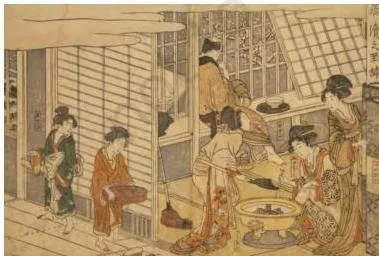
Fig. 3 shows the kind of print produced in late-eighteenth-century Edo (today’s Tokyo). Publishers like Tsutaya Juzaburo chose the subject, artists drew the theme, and a skilled woodblock carver cut the block — destroying the original drawing in the process. These prints travelled to Europe and the US, and influenced artists such as Manet, Monet and Van Gogh (NCERT, p. 107).
Korea contributed two famous objects. The Tripitaka Koreana, a mid-thirteenth-century collection of Buddhist scriptures, was engraved on about 80,000 woodblocks and inscribed on the UNESCO Memory of the World Register in 2007. And the Jikji, printed in the late fourteenth century, is among the world’s oldest existing books printed with movable metal type — inscribed in 2001 (NCERT, p. 108).
Print comes to Europe
Europe received the technology in steps. Paper from China reached Europe in the eleventh century via the silk route. In 1295 the explorer Marco Polo returned to Italy after years in China, bringing back knowledge of woodblock printing — and Italians began producing woodblock books (NCERT, p. 106).
Demand grew faster than hand copying could satisfy. Luxury editions were still handwritten on expensive vellum for aristocratic and monastic libraries, which dismissed printed books as cheap vulgarities. Booksellers employed fifty or more scribes each, yet manuscripts stayed fragile, awkward to handle and limited in circulation.
By the early fifteenth century, woodblocks were widely used to print textiles, playing cards and religious pictures with brief texts — but even that was not quick or cheap enough (NCERT, p. 106).
Gutenberg and the printing press
The breakthrough came at Strasbourg, Germany, where Johann Gutenberg developed the first-known printing press in Europe in the 1430s. He adapted the olive press he had seen on his family’s estate and used moulds to cast metal type for the alphabet; by 1448 he had perfected the system.
His first book was the Bible — about 180 copies, produced in three years, fast by the standards of the time (NCERT, p. 108).
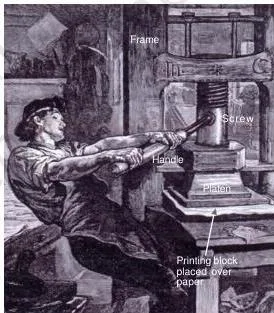
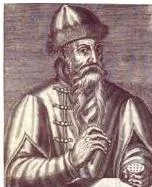
Fig. 5 is Gutenberg’s portrait. What made his system revolutionary was not the machine alone but movable metal type: separate metal letters for each of the 26 characters of the Roman alphabet, arranged and rearranged to compose different words and pages. The Gutenberg press could print about 250 sheets on one side per hour (NCERT, p. 109).
The pages in Fig. 7 are from Gutenberg’s Bible — and they are the classic exam point. The text was printed in black metal type, but the borders were carefully designed, painted and illuminated by hand; colour was added by hand to highlight the holy words.
No two copies were the same, and elites preferred that lack of uniformity because each copy could be claimed as unique (NCERT, p. 110).
The result was a book boom. In the hundred years between 1450 and 1550, presses were set up in most countries of Europe; the second half of the fifteenth century alone saw about 20 million copies flood the markets, and the sixteenth century saw that number rise to roughly 200 million (NCERT, p. 109).
The shift from hand printing to mechanical printing is what NCERT calls the print revolution.
The print revolution: reading public, religious ferment, new fears
This is the conceptual heart of the chapter. The print revolution was not just a new way of producing books; it transformed people’s relationship to information and knowledge, and with institutions and authorities, and opened up new ways of looking at things (NCERT, p. 109).
A new reading public
Printing reduced the cost of books, so many more copies could be produced and sold. Before this, common people lived in a world of oral culture — they heard sacred texts read out, ballads recited and folk tales narrated, and they listened collectively. If there was once a hearing public, now a reading public came into being (NCERT, p. 111).
But literacy was low, so publishers printed profusely illustrated ballads and folk tales that could be sung and recited in villages and taverns even by people who could not read. In this way oral culture entered print, printed material was orally transmitted, and the line between the hearing public and the reading public became blurred (NCERT, p. 111).
Religious debates and the fear of print
Print made it possible for anyone to circulate ideas — including people who disagreed with established authorities — and that power frightened many. The fear was that uncontrolled reading would spread rebellious and irreligious thoughts and destroy the authority of ‘valuable’ literature; religious authorities, monarchs, writers and artists all voiced it (NCERT, p. 112).
The key example is Martin Luther. In 1517 his Ninety Five Theses, posted on a church door in Wittenberg, were reproduced in vast numbers and read widely. The result was the Protestant Reformation — a division within the Church.
Luther’s translation of the New Testament sold 5,000 copies within a few weeks, and he called print ‘the ultimate gift of God and the greatest one’ (NCERT, p. 112).
Established religion answered with control. The Roman Catholic Church began keeping an Index of Prohibited Books from 1558 and used the inquisition to repress heretical ideas. Menocchio, an Italian miller, reinterpreted the Bible for himself, was hauled up twice, and was ultimately executed (NCERT, p. 113).
Even the Catholic reformer Erasmus feared the ‘swarms of new books’, warning in his Adages (1508) that the sheer multitude created a glut — and that even good things suffer from satiety (NCERT, p. 113).
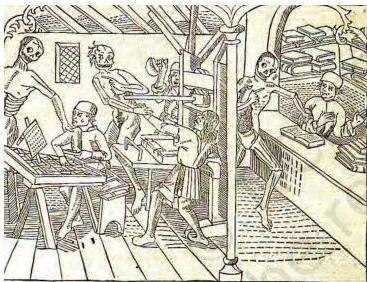
Fig. 10 shows how the fear was dramatised. In this sixteenth-century woodcut, skeletal figures control the printer and his workers, dictating what is to be produced — the coming of print is associated with the end of the world (NCERT, p. 113). The image is not history; it is anxiety made visible.
The chapter’s point on religion and dissent: print and popular religious literature stimulated distinctive individual interpretations of faith even among little-educated working people. That is exactly why authorities feared it (NCERT, p. 113).
Reading mania and the French Revolution debate
This section answers the chapter’s biggest question: did print culture cause the French Revolution? The exam-ready answer is balanced — print created the conditions, but it did not program minds.
The reading mania
Through the seventeenth and eighteenth centuries, literacy rose across Europe as churches of different denominations set up schools in villages. By the end of the eighteenth century, some parts of Europe reached 60 to 80 per cent literacy, producing a virtual reading mania (NCERT, p. 114).
- Almanacs — annual publications carrying astronomical data, the movements of the sun and moon, tides and eclipses.
- Chapbooks — pocket-size books sold for a penny by travelling pedlars (chapmen), so even the poor could buy them in England.
- Bibliotheque Bleue — low-priced small books in France, printed on poor-quality paper and bound in cheap blue covers.
The periodical press developed from the early eighteenth century, mixing current affairs with entertainment, and the ideas of scientists and philosophers reached ordinary readers — Isaac Newton’s published discoveries, and the writings of Thomas Paine, Voltaire and Jean Jacques Rousseau (NCERT, p. 114).
‘Tremble, therefore, tyrants of the world!’
By the mid-eighteenth century many believed books could liberate society from despotism — a system in which absolute power is exercised by an individual, unregulated by legal and constitutional checks. The French novelist Louise-Sebastien Mercier called the printing press the most powerful engine of progress, and declared: ‘Tremble, therefore, tyrants of the world! Tremble before the virtual writer!’ (NCERT, p. 115).
The three arguments linking print to the French Revolution
Historians put forward three arguments, and a full answer should give all three:
- Print popularised the Enlightenment. The writings of thinkers such as Voltaire and Rousseau criticised tradition, superstition and despotism, attacked the sacred authority of the Church and the despotic power of the state, and argued that everything be judged by reason. Readers began to see the world through questioning, critical eyes (NCERT, p. 115).
- Print created a culture of dialogue and debate. All values, norms and institutions were re-evaluated and discussed by a public aware of the power of reason — and within this public culture, new ideas of social revolution came into being (NCERT, p. 115).
- By the 1780s print mocked the monarchy. An outpouring of literature, cartoons and caricatures showed the royalty absorbed in sensual pleasures while common people suffered immense hardships. Circulated underground, this literature built hostile sentiments against the monarchy (NCERT, p. 115).
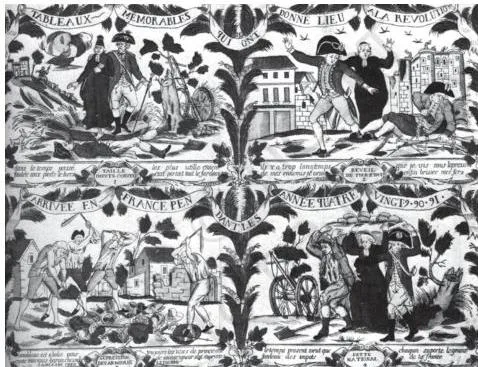
Fig. 11 is the kind of image the third argument describes — a cartoon of the late eighteenth century showing ordinary people, peasants, artisans and workers, having a hard time while the nobility enjoy life and oppress them. NCERT’s caption notes that the circulation of cartoons like this had an impact on people’s thinking before the revolution.
The book’s caution
Then the chapter pulls back. People did not read only one kind of literature — if they read Voltaire and Rousseau, they were also exposed to monarchical and Church propaganda. They accepted some ideas and rejected others, and interpreted things in their own way.
The conclusion worth using in an answer: print did not directly shape minds, but it did open up the possibility of thinking differently (NCERT, p. 115).
The nineteenth century: children, women, workers and new machines
The nineteenth century is the bridge of the chapter: mass literacy made readers of everyone, and faster machines met the demand. It sets up the Indian story that begins at page 117.
Children, women and workers
- Children: from the late nineteenth century, compulsory primary education made children an important category of readers, and school textbooks became critical for publishers. France set up a children’s press in 1857. The Grimm Brothers collected folk tales from peasants and edited them before publication in 1812, cutting anything unsuitable for children. Print recorded old tales — but also changed them (NCERT, p. 117).
- Women: penny magazines and conduct manuals (teaching proper behaviour and housekeeping) were aimed at women. When novels began in the nineteenth century, women were seen as important readers and writers — Jane Austen, the Bronte sisters and George Eliot — whose writing defined a new type of woman with will, strength of personality and the power to think (NCERT, p. 117).
- Workers: lending libraries educated white-collar workers, artisans and the lower middle class, and self-educated workers wrote political tracts and autobiographies. Thomas Wood, a Yorkshire mechanic, rented old newspapers and read them by firelight because he could not afford candles (NCERT, p. 117).
Further innovations
The machines kept improving. Richard M. Hoe’s power-driven cylindrical press (mid-nineteenth century) printed 8,000 sheets per hour — ideal for newspapers. The offset press, developed in the late nineteenth century, could print up to six colours at a time, and turn-of-the-century electrically operated presses accelerated printing further (NCERT, p. 118).
Publishers also invented new ways to sell: serialised novels in periodicals, the cheap Shilling Series of the 1920s, the twentieth-century book jacket, and cheap paperback editions brought out when the Great Depression threatened book sales in the 1930s (NCERT, p. 118).
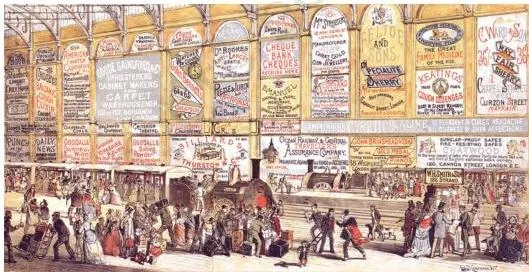
The chapter’s Activity at page 118 uses Fig. 13 — railway-station advertisements from 1874 — and asks what impact such advertisements have on the public mind, and whether everyone reacts to printed material the same way. The discussion point worth keeping: print reached people in public places — street walls, railway platforms, public buildings — and its effect was never uniform.
India and the world of print: manuscripts, missionaries and the first newspapers
The chapter now turns to India — what existed before print, how print actually arrived, and who printed what first. This is the most heavily tested factual content in the chapter, so the dates matter.
Manuscripts before the age of print
India had a rich, old tradition of handwritten manuscripts in Sanskrit, Arabic, Persian and the vernacular languages, copied on palm leaves or handmade paper and often beautifully illustrated. But manuscripts were highly expensive and fragile: they had to be handled carefully, their scripts came in many styles, and they were not widely used in everyday life.
In pre-colonial Bengal, village schools taught students to write by dictation — many became literate without ever actually reading texts (NCERT, p. 119).
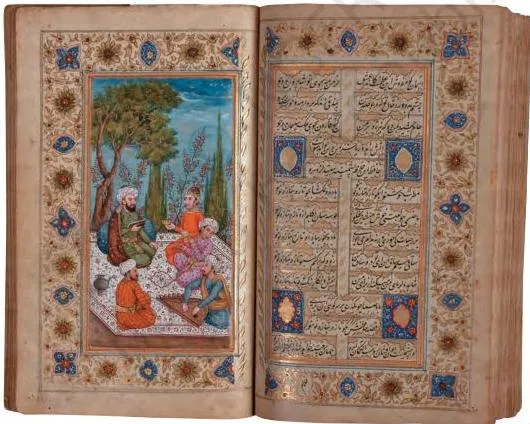
Fig. 14 shows why manuscripts never reached everyday readers: a palm-leaf manuscript of the Gita Govinda in accordion format, from the eighteenth century — beautiful and fragile, the opposite of a cheap, portable printed book. Manuscripts continued to be produced well after print arrived, down to the late nineteenth century, especially for the rich (NCERT, p. 119).
Manuscripts versus print in India
This comparison table is worth reproducing in answers about what changed when print came to India:
| Point of comparison | Manuscripts in India | Printed books |
|---|---|---|
| Cost | Highly expensive | Cheap — lithographic editions, low-priced bazaar books |
| Durability | Fragile, had to be handled carefully | Portable, easily carried and read anywhere |
| Readership | The rich; not widely used in everyday life | A wide circle — even illiterate hearers, through reading aloud |
| Production | Copied by hand on palm leaf or paper | Produced by press in multiple copies |
| After print arrived | Continued till the late nineteenth century | Gradually became the main carrier of texts |
Print comes to India
The press first came to Goa with Portuguese missionaries in the mid-sixteenth century. Jesuit priests learnt Konkani and printed tracts; by 1674 about 50 books had been printed in Konkani and in Kanara. Catholic priests printed the first Tamil book in 1579 at Cochin and the first Malayalam book in 1713; Dutch Protestant missionaries had printed 32 Tamil texts by 1710 (NCERT, p. 120).
The English-language press grew late. From 1780 James Augustus Hickey edited the Bengal Gazette, a weekly that called itself ‘a commercial paper open to all, but influenced by none’. He printed gossip about Company officials, and Governor-General Warren Hastings persecuted him for it.
The first Indian-run newspaper was also called the Bengal Gazette, brought out by Gangadhar Bhattacharya, who was close to Rammohun Roy (NCERT, p. 120).
New forms of publication and a visual culture
Print created an appetite for new kinds of writing — the novel, lyrics, short stories, and essays about social and political matters. By the end of the nineteenth century a new visual culture took shape: presses could reproduce images in multiple copies, and painters like Raja Ravi Varma produced mythological paintings for mass circulation (NCERT, p. 123).
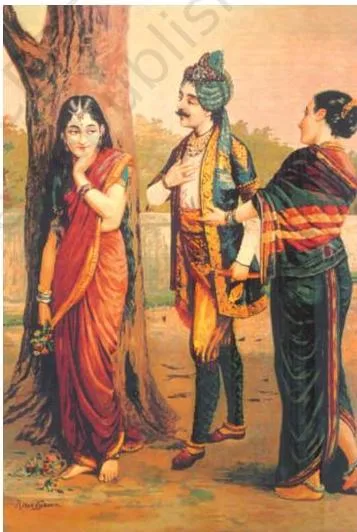
Fig. 17 is a Ravi Varma print — a mythological scene reproduced at the Ravi Varma Press. Cheap prints and calendars like this could be bought even by the poor to decorate their homes, and they began shaping popular ideas about modernity and tradition, religion and politics. Caricatures and cartoons commenting on social and political issues followed from the 1870s (NCERT, p. 123).
Religious reform, new readers, and print for women and the poor
Inside India, print did not just report debates — it shaped them. This section covers religious controversy, women’s reading and writing, and the first printed voices of the poor.
Religious reform and public debates
From the early nineteenth century, intense debates ran between reformers and Hindu orthodoxy over widow immolation, monotheism, Brahmanical priesthood and idolatry. Printed tracts and newspapers spread new ideas and shaped the nature of the debate itself. Rammohun Roy published the Sambad Kaumudi from 1821; the orthodoxy answered with the Samachar Chandrika.
Two Persian newspapers appeared in 1822, joined by the Gujarati Bombay Samachar (NCERT, p. 121).
In north India the ulama — legal scholars of Islam — feared that colonial rulers would encourage conversion and change Muslim personal laws. They used cheap lithographic presses to publish Persian and Urdu translations of holy scriptures and printed religious newspapers and tracts.
The Deoband Seminary, founded in 1867, published thousands of fatwas telling Muslims how to conduct themselves in everyday life (NCERT, p. 121).
Hindu religious texts also entered the market: the first printed Ramcharitmanas of Tulsidas came out from Calcutta in 1810, and from the 1880s the Naval Kishore Press at Lucknow and the Shri Venkateshwar Press in Bombay published numerous religious texts in the vernaculars.
These portable printed books could be read by the faithful anywhere — and read out to large groups of illiterate men and women, connecting communities in different parts of India and creating pan-Indian identities (NCERT, p. 121).
Women and print
Women’s reading increased enormously in middle-class homes. Liberal husbands and fathers educated their womenfolk at home, and journals carried writings by women and explained why women should be educated. But conservative Hindus believed a literate girl would be widowed, and some Muslims feared educated women would be corrupted by Urdu romances; rebel women sometimes defied the bans (NCERT, p. 124).
Rassundari Debi, a young married girl in an orthodox household, learnt to read in the secrecy of her kitchen and wrote Amar Jiban, published in 1876 — the first full-length autobiography in the Bengali language (NCERT, p. 124).
In the 1860s Kailashbashini Debi wrote of women imprisoned at home and forced into hard domestic labour; in the 1880s Tarabai Shinde and Pandita Ramabai wrote with anger about the miserable lives of upper-caste Hindu women, especially widows.
Hindi printing began seriously only from the 1870s, and in Bengal the Battala area of central Calcutta printed cheap editions of religious tracts and of literature considered scandalous, profusely illustrated with woodcuts and coloured lithographs; pedlars took them to homes, letting women read in their leisure time (NCERT, p. 125).
Print and the poor people
Very cheap small books were sold at crossroads in nineteenth-century Madras towns, and public libraries expanded access from the early twentieth century. Issues of caste discrimination entered print from the late nineteenth century: Jyotiba Phule’s Gulangiri (1871), then the writings of B.R. Ambedkar in Maharashtra and E.V.
Ramaswamy Naicker (Periyar) in Madras — read by people all over India (NCERT, p. 126).
Workers wrote too. Kashibaba, a Kanpur millworker, published Chhote Aur Bade Ka Sawal in 1938, showing the links between caste and class exploitation. By the 1930s, Bangalore cotton millworkers set up libraries to educate themselves, following the example of Bombay workers (NCERT, p. 126).
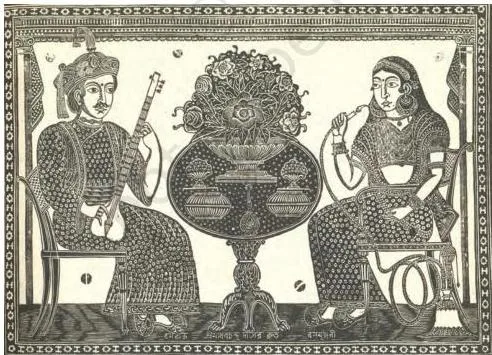
Fig. 19, Ghor Kali (The End of the World), is the artist’s vision of the destruction of proper family relations: a wife sits on her husband’s shoulder, dominating him, while he drags his own mother by a noose.
It is not a documentary photograph of Indian families — it is anxiety about change, provoked by the move towards women’s education in the late nineteenth century. The Activity at page 126 asks whether you agree with the artist’s view; a good answer separates the fear from the reality.
Print and censorship: from the Vernacular Press Act to the Quit India movement
Everywhere governments fear print enough to regulate it, and the chapter ends with the control of print in colonial India. This is the most date-heavy part of the chapter — the timeline table below is the revision tool.
| When | What happened |
|---|---|
| Before 1798 | The East India Company was relaxed about censorship; its early controls were directed against Englishmen in India who criticised Company misrule |
| 1820s | The Calcutta Supreme Court passed regulations to control press freedom; the Company encouraged newspapers that celebrated British rule |
| 1835 | Governor-General Bentinck revised the press laws; Macaulay’s new rules restored the earlier freedoms |
| After 1857 | Enraged Englishmen demanded a clamp down on the ‘native’ press as vernacular papers became assertively nationalist |
| 1878 | Vernacular Press Act, modelled on Irish Press Laws — a warned paper judged seditious could have its press seized and machinery confiscated |
| 1907–08 | Tilak wrote sympathetically in Kesari about deported Punjab revolutionaries; imprisoned in 1908, provoking widespread protests |
| First World War | Defence of India Rules — 22 newspapers were asked to furnish securities; 18 shut down rather than comply |
| 1919 | Rowlatt Sedition Committee Report strengthened controls, leading to penalties on various newspapers |
| Second World War | Defence of India Act allowed censorship of war-related reports; all reports about the Quit India movement came under it, and about 90 newspapers were suppressed in August 1942 |
The 1878 Vernacular Press Act deserves its own sentence: modelled on Irish Press Laws, it gave the government extensive rights to censor reports and editorials in the vernacular press. A newspaper judged seditious was warned first; if the warning was ignored, the press was liable to be seized and the printing machinery confiscated (NCERT, p. 127).
Repression never silenced the nationalist press — it provoked militant protest, producing cycles of persecution and protest. Gandhi’s 1922 statement gives the chapter its final word: the fight for Swaraj was a fight for liberty of speech, liberty of the press and freedom of association (NCERT, p. 127).
Key terms you will be asked to define
The chapter’s New words boxes define the vocabulary you will be asked about in one-mark and short-answer questions. The table gives a one-line meaning you can reproduce, with the NCERT page to check.
| Term | One-line meaning | NCERT page |
|---|---|---|
| Calligraphy | The art of beautiful and stylised writing | 106 |
| Vellum | Parchment made from the skin of animals | 108 |
| Platen | The board pressed onto the back of paper in letterpress printing | 110 |
| Compositor | The person who composes the text for printing | 110 |
| Galley | The metal frame in which types are laid and the text is composed | 110 |
| Ballad | A historical account or folk tale in verse, usually sung or recited | 111 |
| Taverns | Places where people gathered to drink, eat and exchange news | 111 |
| Protestant Reformation | The sixteenth-century movement to reform the Roman Catholic Church, led by Luther | 112 |
| Inquisition | A former Roman Catholic court for identifying and punishing heretics | 113 |
| Heretical | Beliefs that do not follow the accepted teachings of the Church | 113 |
| Satiety | The state of being fulfilled much beyond the point of satisfaction | 113 |
| Seditious | Speech or writing seen as opposing the government | 113 |
| Denomination | A subgroup within a religion | 114 |
| Almanac | An annual publication with astronomical data and everyday information | 114 |
| Chapbook | A pocket-size book sold by travelling pedlars (chapmen) | 114 |
| Despotism | Governance where absolute power is exercised by an individual, unchecked by law | 115 |
| Ulama | Legal scholars of Islam and the sharia (Islamic law) | 121 |
| Fatwa | A legal pronouncement on Islamic law, usually given by a mufti | 121 |
| Vernacular | The everyday spoken language of a region | 119 |
The figures that carry the chapter’s argument
Picture questions give you an NCERT figure and ask what it shows about print’s social impact. The method: read the caption first, then say what the image proves — never just describe it. This table maps the chapter’s key figures.
| Figure | NCERT page | What it shows | The question it answers |
|---|---|---|---|
| Fig. 1 – Book making before the age of print (1595) | 105 | A royal workshop: text dictated, written and illustrated by hand | What was lost or changed when printing machines arrived? |
| Fig. 2a – Diamond Sutra | 106 | The oldest printed Chinese book, AD 868 — six sheets of text with woodcut illustrations | How old is hand printing, and what did early printed books look like? |
| Fig. 3 – Ukiyo print by Utamaro | 107 | Japanese urban print culture — ‘pictures of the floating world’ | How did print reflect urban leisure culture in Edo? |
| Figs. 5–8 – Gutenberg, the press and the Bible | 109–110 | Movable type, 250 sheets per hour, hand-painted Bible borders, a workshop under one roof | What changed in book production, and why did early printed books imitate manuscripts? |
| Fig. 10 – The macabre dance | 113 | Skeletal figures control the printer and his workers | How was the fear of print dramatised visually? |
| Fig. 11 – Nobility and the common people | 116 | Peasants and artisans labour while the nobility enjoy themselves | How did cartoons shape opinion before the French Revolution? |
| Fig. 14 – Gita Govinda manuscript | 119 | A palm-leaf handwritten manuscript in accordion format | Why didn’t manuscripts reach everyday readers in India? |
| Fig. 19 – Ghor Kali (The End of the World) | 125 | A wife dominates her husband; the family ‘turned upside down’ | How did print express anxiety about changing family roles? |
Mistakes that cost marks in this chapter
These confusions are set up by the chapter’s own details — wrong dates, wrong places, and overclaiming what print did. Each row gives the correction and the page that proves it.
| Mistake | Correct rule | How to check your answer |
|---|---|---|
| ‘China and Japan invented printing with movable metal type.’ | China and Japan used woodblock (hand) printing; Korea’s Jikji used movable metal type; Gutenberg’s movable type came later in Europe (pp. 105–108) | Ask: which region, which technology? Match the date to the place before writing |
| ‘Gutenberg invented printing.’ | He developed the first-known printing press in Europe (1430s, Strasbourg), adapting the olive press; printing itself had existed in East Asia for centuries (p. 108) | Rephrase as ‘developed the printing press’, never ‘invented printing’ |
| ‘Printed books instantly replaced manuscripts.’ | Early printed books imitated manuscripts with hand-painted borders; manuscripts continued in India till the late nineteenth century (pp. 109, 119) | Look for the chapter’s stress on continuity — the new technology did not entirely displace the old |
| ‘Print caused the French Revolution.’ | Print popularised Enlightenment ideas and created a culture of debate, but readers accepted some ideas and rejected others; print opened the possibility of thinking differently (p. 115) | Use ‘created conditions for’, never ’caused’ |
| ‘Macaulay’s rules came after the Vernacular Press Act’ or ‘the Defence of India Act belongs to the First World War.’ | Macaulay’s liberalising rules — 1835; Vernacular Press Act — 1878; Defence of India Rules — First World War; Defence of India Act — Second World War (p. 127) | Memorise the set in order: 1835 → 1878 → WWI → 1919 → WWII |
| ‘The first Indian newspaper was Hickey’s Bengal Gazette.’ | Hickey’s Bengal Gazette (1780) was private English enterprise; the first Indian-run newspaper was Gangadhar Bhattacharya’s Bengal Gazette (p. 120) | Ask who ran the paper, not just what it was called |
| Mixing up the dates of Indian firsts | First Tamil book 1579; Bengal Gazette 1780; Sambad Kaumudi 1821; Amar Jiban 1876 | Learn these four as one date set — they are the chapter’s most asked facts |
What to expect in the exam: question patterns from the chapter
The chapter’s own exercises are the best evidence of what is examinable. They fall into four question types, and each type has a structure you can prepare. One honest note first: textbook contents and the examinable syllabus are not always identical — check the current official syllabus before you decide what to revise.
Give reasons for…
Examples include why woodblock print reached Europe only after 1295, why Luther praised print, why the Church’s Index of Prohibited Books began, and why Gandhi linked Swaraj to press freedom. A full answer needs three parts: the cause, the context, the result.
Worked model — why woodblock print reached Europe only after 1295: the cause was Marco Polo, who returned to Italy in 1295 after years of exploration in China and brought the knowledge of woodblock printing back with him. The context: paper had already reached Europe in the eleventh century via the silk route, but the printing technique had not.
The result: Italians began producing books with woodblocks, and the technology soon spread to other parts of Europe (NCERT, p. 106).
Write short notes
Be ready for the Gutenberg Press, Erasmus’s idea of the printed book, and the Vernacular Press Act. A short note needs three sentences: what it was, one key date or detail, and why it matters.
For Erasmus, for instance: his anxiety about the ‘glut’ of new books (1508), his worry that even valuable publications lose value amid the swarms, and what that tells us about the fear of print (NCERT, p. 113).
What did print culture mean to…?
The chapter’s signature three-part question — women, the poor, reformers — and the content for each group is separate:
- Women: penny magazines and conduct manuals; women as novelists; in India, Rassundari Debi’s Amar Jiban (1876), journals on education and widow remarriage, and the Battala books read in leisure time.
- The poor: cheaper books, lending and public libraries; self-educated workers writing; in India, Jyotiba Phule, Kashibaba’s Chhote Aur Bade Ka Sawal (1938) and the Bangalore millworkers’ libraries.
- Reformers: printed tracts and newspapers to spread and answer arguments — the Sambad Kaumudi against the Samachar Chandrika, the ulama’s fatwas, and religious texts read aloud to illiterate audiences.
Discuss…
Four discussion questions close the chapter: print and enlightenment/despotism; the fear of easily available books (give one European example — Erasmus or the macabre dance — and one Indian example — Ghor Kali or the fears about women reading); the effects of print on the poor in nineteenth-century India; and how print assisted the growth of nationalism, where newspapers connecting regions and creating pan-Indian identities is the core point.
The closing Project asks about changes in print technology over the last 100 years — the chapter’s own technological narrative (power-driven press → offset press → electric presses) is your starting point (NCERT, p. 118).
Revision summary: the story in six moves
The whole chapter in six moves. If you can rewrite these from memory, you have the chapter’s spine. Page references are to the NCERT book.
- East Asia invented hand printing. Woodblocks in China from AD 594, the Diamond Sutra (AD 868), Japan’s Buddhist missionaries, Korea’s Tripitaka Koreana and the metal-type Jikji (p. 105).
- Europe mechanised it. Paper via the silk route, Marco Polo (1295), Gutenberg’s press in the 1430s, and the book boom — about 20 million copies in the second half of the fifteenth century, 200 million in the sixteenth (p. 108).
- The print revolution changed culture. A new reading public, religious reform and dissent, then fear — the Index of Prohibited Books and the macabre dance (pp. 110–113).
- The nineteenth century made readers of everyone. Children, women and workers; Hoe’s 8,000-sheet press and the offset press (p. 117).
- India built its own print history. Manuscripts, missionaries at Goa, the Bengal Gazette, religious and caste debates, women and the poor in print (pp. 119–123).
- Colonial censorship. From the Vernacular Press Act (1878) to about 90 newspapers suppressed in August 1942, and Gandhi’s defence of press freedom (p. 127).
Test yourself: close the page and write the six moves from memory, with the key dates attached. If you can, you are ready.
Related Class 10 resources
This listing is maintained for the 2026-27 academic session using the NCERT textbook information available to us. NCERT remains the authority for confirming the latest edition.
This chapter is one part of Class 10 Social Science. For the rest of the subject, start from the Class 10 Social Science notes hub, or go up to the Class 10 hub and the main CBSE notes index.
Chapters that pair naturally with this one include Globalisation and the Indian Economy and Manufacturing Industries — each looks at another side of the modern world this chapter describes.
Sources and data verification
This page describes the NCERT textbook India and the Contemporary World II (Class 10 Social Science — History), Chapter 5, ‘Print Culture and the Modern World’, official edition published at ncert.nic.in.
- Page references (102–128) follow the printed book’s own page numbering.
- The listing is maintained for the current NCERT edition available to us; NCERT settles textbooks, editions and official PDFs.
- CBSE settles the curriculum and syllabus — and textbook contents and the examinable syllabus are not always identical, so check the current official syllabus before planning revision.
| What the chapter holds | Count | Where it is used |
|---|---|---|
| Printed pages | 26 | |
| Sections in the chapter | 13 | |
| Figures with NCERT captions | 19 | |
| Activities | 5 | |
| Official NCERT PDF | Download the chapter PDF | the chapter exactly as NCERT publishes it |
Frequently asked questions
Where can I download the Print Culture and the Modern World Class 10 PDF?
The official file is published by NCERT at ncert.nic.in. The download link at the top of this page goes directly to the textbook page for India and the Contemporary World II, where Chapter 5 is available with the same pagination as the printed book (pages 102–128).
Did print culture cause the French Revolution?
Historians argue it created the conditions, not that it caused the revolution directly. The three arguments are: print popularised Enlightenment thinkers’ critique of tradition and despotism; it created a new culture of dialogue and debate; and by the 1780s an outpouring of mocking literature and caricatures undermined the monarchy.
The book’s own caution is that readers accepted some ideas and rejected others — print opened up the possibility of thinking differently rather than programming minds (NCERT, p. 115).
What are the exercises at the end of this chapter?
Three blocks. ‘Write in brief’ has give-reasons questions (woodblock print after 1295, Luther and print, the Index of Prohibited Books, Gandhi on Swaraj), short notes (Gutenberg Press, Erasmus’s idea of the printed book, the Vernacular Press Act), and a three-part question on what print culture meant to women, the poor and reformers.
‘Discuss’ has four discussion questions on enlightenment and despotism, the fear of the book, the poor, and nationalism. A Project asks about changes in print technology over the last 100 years (NCERT, p. 128).
Is Print Culture and the Modern World History or Geography?
It is History — Chapter 5 of India and the Contemporary World II, the Class 10 Social Science History book, in the section ‘Everyday Life, Culture and Politics’. It runs from page 102 to page 128.
What was the Vernacular Press Act?
A colonial law of 1878, modelled on the Irish Press Laws, that gave the government extensive rights to censor reports and editorials in the vernacular press. A newspaper judged seditious was warned first; if the warning was ignored, the press could be seized and its machinery confiscated (NCERT, p. 127).
Reference: NCERT Class 10 Social Science textbook, chapter 5, official edition on ncert.nic.in.
Explore Class 10 Social Science Books
Related chapters: