
This is Chapter 1 of the NCERT Class 10 Social Science textbook India and the Contemporary World II — The Rise of Nationalism in Europe — which runs 28 printed pages. The official chapter PDF from ncert.nic.in is right below, followed by a guide to what the chapter teaches.
Download the Official NCERT Class 10 Social Science Chapter 1 PDF
Start with the file itself: NCERT Class 10 Social Science Chapter 1 The Rise of Nationalism in Europe PDF opens the exact chapter from the official NCERT site, so you can read it on screen, save it, or print it. Every page reference in the guide below points to this PDF.
The chapter text begins on page 3 of the PDF and runs to page 28, with the exercise pages and project included.
Chapter at a Glance: The Rise of Nationalism in Europe
The chapter is organised into six numbered sections. This table shows each section and the page where it begins.
| Section | NCERT page | What it covers |
|---|---|---|
| 1. The French Revolution and the Idea of the Nation | p.5 | Sovereignty passes from the monarch to the people; tricolour, National Assembly, Napoleonic Code, mixed reaction to French rule. |
| 2. The Making of Nationalism in Europe | p.8 | Aristocracy and new middle class; liberalism, the zollverein, the new conservatism of 1815 and the revolutionaries. |
| 3. The Age of Revolutions: 1830-1848 | p.13 | July Revolution, Greek independence, Romanticism, hunger and popular revolt, the Frankfurt parliament. |
| 4.1-4.3 Germany, Italy and Britain | p.19-21 | Three routes to a nation-state: Prussian wars, Sardinia-Piedmont’s wars, and the long British process. |
| 5. Visualising the Nation | p.23 | Marianne and Germania as allegories; how to read national symbols. |
| 6. Nationalism and Imperialism | p.26 | Nationalism turns aggressive in the Balkans; big-power rivalry leads to the First World War. |
For the exact counts of sections, figures and activities, see the chapter data table on this page.
What This Chapter Covers: From Sorrieu’s Dream to the Balkans
Frédéric Sorrieu, a French artist, made a series of four prints in 1848 to visualise his dream of democratic and social republics. The first print shows the peoples of Europe and America marching past a statue of Liberty, grouped as distinct nations by flags and costume, while broken symbols of absolutist rule lie in the foreground (NCERT, p.3).
Germany appears in the image only through the black, red and gold flag of liberal hopes — at the time, the German nation did not yet exist. That gap between dream and reality is the subject of the whole chapter.
The argument then develops in five moves. The French Revolution created the modern nation by transferring sovereignty from the monarch to the people (p.5). Liberalism and conservatism then fought over what the nation should mean (p.8-10).
Revolutions in 1830 and 1848 spread the idea across Europe, with the Frankfurt parliament as the climax of liberal nationalism (p.13, 17). Germany, Italy and Britain each became nation-states by a different route (p.19-21).
Artists gave these new nations faces — Marianne and Germania (p.23). And in the last section, nationalism turned from a liberal dream into an imperialist creed in the Balkans, leading to the First World War (p.26).
Key Ideas: Nation, Liberalism, Conservatism and Revolution
This section walks through the chapter’s core concepts in the order the book presents them. If you can explain these six ideas in your own words, the chapter’s questions answer themselves.
What Is a Nation? Sorrieu’s Dream and Renan’s Answer
The chapter opens with one problem: what makes a group of people a nation? Two answers frame the book — an artist’s dream and a philosopher’s lecture.
In Sorrieu’s print, Liberty carries the torch of Enlightenment in one hand and the Charter of the Rights of Man in the other. The United States and Switzerland lead the procession because they were already nation-states; Christ, saints and angels gaze down to symbolise fraternity among nations (NCERT, p.3).
Two words in the book’s opening matter. Absolutist means a government with no restraints on its power — centralised, militarised and repressive. Utopian means a vision of society so ideal that it is unlikely to exist (NCERT, p.3).
A nation-state, the chapter explains, is one in which the majority of citizens — not just rulers — share a sense of common identity and a shared history or descent. This commonness did not exist from time immemorial; it was forged through struggles, leaders and the actions of ordinary people (NCERT, p.3).
Ernst Renan, a French philosopher, gave his answer in an 1882 lecture at the Sorbonne. He rejected language, race, religion and territory as the test of a nation. What matters instead is a heroic past and great men — a shared store of memory — and a common will in the present (NCERT, p.4).
Renan called the nation ‘a large-scale solidarity’ whose existence is a daily plebiscite — a direct vote by which the people accept or reject a proposal. So the nation survives only while its citizens keep choosing to belong to it. That is why, in his view, a nation has no real interest in holding a country against its will (NCERT, p.4).
The French Revolution and the Idea of the Nation
The modern nation begins here. When sovereignty moves from a king to the people, subjects become citizens, and the state can call itself a nation. The French Revolution of 1789 was the first clear expression of this idea (NCERT, p.5).
The revolutionaries declared that the people would henceforth constitute the nation and shape its destiny. To make that real, they created a sense of collective identity through concrete measures (NCERT, p.5):
- la patrie (the fatherland) and le citoyen (the citizen) stressed a united community with equal rights under a constitution;
- the tricolour replaced the royal standard;
- the Estates General was renamed the National Assembly;
- new hymns, oaths and martyrs honoured the nation;
- uniform laws, a centralised administration, one system of weights and measures, and the abolition of internal customs duties;
- Parisian French promoted over regional dialects.
France also declared it the nation’s mission to liberate the peoples of Europe from despotism. Jacobin clubs in European cities prepared the way, and French armies marched into Holland, Belgium, Switzerland and much of Italy in the 1790s (NCERT, p.5).
Napoleon exported French reforms to the territories he controlled. The Civil Code of 1804 — the Napoleonic Code — did away with privileges based on birth, established equality before the law and secured the right to property (NCERT, p.6). He simplified administration, abolished the feudal system, freed peasants from serfdom and manorial dues, removed guild restrictions and improved transport.
But reactions to French rule were mixed. In Holland, Switzerland, Brussels, Mainz, Milan and Warsaw the armies were first welcomed as liberators; then hostility grew over increased taxation, censorship and forced conscription into the French armies (NCERT, p.7).
Liberalism, Economic Change and the Zollverein
Liberalism supplied nationalism with its political words — freedom, equality, consent — and economics supplied the practical pressure. The term derives from the Latin root liber, meaning free (NCERT, p.9).
For the new middle classes, liberalism meant freedom for the individual and equality of all before the law. Politically it stood for government by consent, a constitution, representative government, an end to autocracy and clerical privilege, and the inviolability of private property (NCERT, p.9).
But liberalism was not modern democracy. In revolutionary France, only property-owning men had the right to vote; the Napoleonic Code went further and treated women as minors under fathers and husbands. Suffrage — the right to vote — was therefore limited, and women and non-propertied men had to organise opposition movements to demand it (NCERT, p.9).
Economically, liberalism stood for free markets and the free movement of goods and capital. The German-speaking regions showed why this mattered. Napoleon’s measures had left a confederation of 39 states, each with its own currency, weights and measures (NCERT, p.9).
A merchant travelling from Hamburg to Nuremberg in 1833 passed 11 customs barriers and paid about 5 per cent duty at each. A measure of cloth, the elle, meant a different length in every town. Commercial classes therefore demanded a unified economic territory.
In 1834, the zollverein — a customs union formed at the initiative of Prussia — abolished tariff barriers and reduced the number of currencies from over thirty to two (NCERT, p.9). Railways then tied economic interest to national feeling. The economist Friedrich List argued that the zollverein would bind the Germans economically into a nation and awaken national sentiment (NCERT, p.10).
A New Conservatism after 1815
After Napoleon’s defeat, Europe’s rulers tried to undo his changes. This section shows what conservatism wanted to preserve, and how liberals resisted it.
Conservatism stressed tradition, established institutions and customs, and preferred gradual development to quick change. After 1815 it meant preserving the monarchy, the Church, social hierarchies, property and the family (NCERT, p.10).
Most conservatives, however, did not want to return to pre-revolutionary society. They realised that modernisation — a modern army, an efficient bureaucracy, a dynamic economy, the abolition of feudalism and serfdom — could strengthen the monarchy (NCERT, p.10).
In 1815 the powers that defeated Napoleon — Britain, Russia, Prussia and Austria — met at Vienna, hosted by the Austrian Chancellor Duke Metternich. The Treaty of Vienna aimed to undo most of the changes of the Napoleonic wars (NCERT, p.10):
- the Bourbon dynasty was restored in France;
- France lost the territories it had annexed;
- buffer states were set up around France — the Kingdom of the Netherlands (including Belgium) in the north, Genoa added to Piedmont in the south;
- Prussia gained new territory on its western frontiers; Austria took control of northern Italy;
- the German confederation of 39 states was left untouched.
The conservative regimes that followed were autocratic and imposed censorship on newspapers, books, plays and songs. Freedom of the press became one of the major demands of the liberal-nationalists (NCERT, p.11).
Fear of repression drove many liberal-nationalists underground into secret societies. Giuseppe Mazzini, born in Genoa in 1805, joined the Carbonari, was exiled in 1831 for attempting a revolution in Liguria, and founded Young Italy and then Young Europe (NCERT, p.12). He believed God had intended nations as the natural units of mankind.
Metternich called him ‘the most dangerous enemy of our social order’ (NCERT, p.12).
The Age of Revolutions: 1830-1848 and the Frankfurt Parliament
Between 1830 and 1848 Europe saw two different kinds of upheaval: popular revolts by the poor and unemployed, and a revolution of the educated middle classes. The chapter keeps the two separate, and the Frankfurt parliament is the centre of the second.
The first upheaval came in France in July 1830, when liberal revolutionaries overthrew the restored Bourbons and installed a constitutional monarchy under Louis Philippe. ‘When France sneezes,’ said Metternich, ‘the rest of Europe catches cold’ — the revolution spread, and Belgium broke away from the United Kingdom of the Netherlands (NCERT, p.13).
The Greek war of independence, which began in 1821, mobilised nationalist feeling across Europe. Greece had been part of the Ottoman Empire since the fifteenth century. Poets and artists called it the cradle of European civilisation; Lord Byron raised funds and died of fever there in 1824. The Treaty of Constantinople of 1832 recognised Greece as an independent nation (NCERT, p.13).
Romanticism was a cultural movement, not ‘romance’. It criticised the glorification of reason and science and stressed emotion, intuition and a shared collective heritage (NCERT, p.13). The philosopher Herder said true German culture lived among the common people — das volk — in folk songs, poetry and dances that carried the spirit of the nation.
Poland, partitioned by Russia, Prussia and Austria, kept national feeling alive through music and language. Karol Kurpinski turned folk dances like the polonaise and mazurka into nationalist symbols. Polish clergy used their language in church and were jailed or sent to Siberia for refusing to preach in Russian (NCERT, p.14).
The 1830s were years of economic hardship: population grew faster than jobs, people migrated to overcrowded city slums, and small textile producers lost out to cheap English machine-made imports (NCERT, p.15).
In 1848, food shortages and unemployment brought Paris onto the streets. Louis Philippe fled, a Republic was proclaimed with suffrage for all adult males above 21, and the right to work was guaranteed with national workshops (NCERT, p.15).
In 1845, Silesian weavers had already risen against contractors who cut their payments. The army was called in, and eleven weavers were shot (NCERT, p.16).
Parallel to these popular revolts ran the revolution of the liberals. Middle-class professionals, businessmen and prosperous artisans formed political associations, and on 18 May 1848, 831 elected representatives took their seats in the Frankfurt parliament in the Church of St Paul (NCERT, p.17).
The parliament drafted a constitution for a German nation headed by a monarchy subject to parliament. When the crown was offered to Friedrich Wilhelm IV of Prussia on those terms, he refused it. The assembly lost the support of workers and artisans, troops were called in, and it was forced to disband (NCERT, p.17).
Women were the excluded half of this liberal revolution. They had formed their own associations and newspapers but were admitted to the parliament only as observers in the visitors’ gallery. The liberal Carl Welcker argued that men and women were made for different functions; the feminist Louise Otto-Peters answered that ‘Liberty is indivisible!’ (NCERT, p.17).
After 1848 the monarchies began to grant concessions. Serfdom and bonded labour were abolished in the Habsburg dominions and in Russia, and the Habsburgs granted more autonomy to the Hungarians in 1867 (NCERT, p.18).
Germany, Italy and Britain: Three Routes to a Nation-State
The same idea produced different states. This is the chapter’s comparative core: Germany and Italy were unified from above by monarchs and armies, Britain by a long parliamentary process, and France by revolution.
Germany. After 1848, nationalism moved away from its association with democracy and revolution; conservative rulers mobilised it for state power (NCERT, p.19). The liberal initiative of 1848 had been crushed by the monarchy, the military and the Prussian landowners called Junkers.
Prussia then took the lead. Otto von Bismarck, its chief minister, worked through the army and bureaucracy, fought three wars in seven years — against Denmark, Austria and France — and in January 1871 William I was proclaimed German Emperor at Versailles (NCERT, p.19).
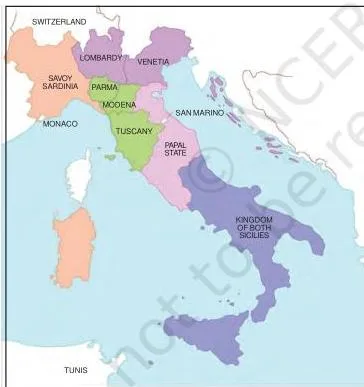
Italy. In the mid-nineteenth century Italy was divided into seven states: the north under Austrian Habsburgs, the centre under the Pope, the south under the Bourbon kings of Spain, and only Sardinia-Piedmont ruled by an Italian princely house (NCERT, p.20). Mazzini’s republican programme of the 1830s failed in 1831 and 1848, so the task fell to Sardinia-Piedmont.
Cavour, the chief minister, was neither a revolutionary nor a democrat. Through a tactful diplomatic alliance with France, Sardinia-Piedmont defeated Austria in 1859. Garibaldi’s volunteers marched into the south and the Kingdom of the Two Sicilies in 1860, and in 1861 Victor Emmanuel II was proclaimed king of united Italy (NCERT, p.20).
Britain. Britain was the strange case — no revolution, no war of unification. A ‘British nation’ did not exist before the eighteenth century; people identified primarily as English, Welsh, Scot or Irish (NCERT, p.21).
The English parliament, which seized power from the monarchy in 1688, forged a nation-state with England at its centre. The Act of Union of 1707 with Scotland created the United Kingdom of Great Britain, and Scotland’s distinctive culture was suppressed — Highlanders were forbidden to speak Gaelic or wear national dress.
After the failed revolt of Wolfe Tone and the United Irishmen in 1798, Ireland was forcibly incorporated into the United Kingdom in 1801 (NCERT, p.21).
| Country | Path to nationhood | Outcome |
|---|---|---|
| France | Revolution (1789) and Napoleon’s reforms | Sovereignty to the people; nationalism exported across Europe |
| Germany | Prussian wars under Bismarck (1866-1871) | German Empire proclaimed at Versailles, January 1871 |
| Italy | Sardinia-Piedmont’s wars, Cavour’s diplomacy, Garibaldi’s volunteers | Unified kingdom under Victor Emmanuel II, 1861 |
| Britain | Long parliamentary process and Acts of Union, no revolution | United Kingdom forged by England’s dominance, 1707-1801 |
Note the pattern: in Germany and Italy, unification came from above, led by monarchs and armies after the liberals of 1848 had failed. Britain achieved the same result through a centuries-long parliamentary process. Only France reached nationhood through revolution.
Visualising the Nation: Marianne, Germania and the Symbol Chart
A nation is an abstraction — you cannot photograph it. Artists solved this by personifying the nation as a woman, and the chapter teaches you to read those images.
An allegory expresses an abstract idea through a person or a thing, carrying two meanings, one literal and one symbolic (NCERT, p.23). French revolutionary artists already did this with Liberty — the red cap or broken chain — and Justice, a blindfolded woman with weighing scales.
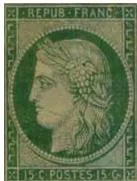
In France, the nation’s allegory was Marianne, a popular Christian name that underlined the idea of a people’s nation. She carried the attributes of Liberty and the Republic — the red cap, the tricolour and the cockade. Her statues stood in public squares, and her image was marked on coins and stamps (NCERT, p.23).
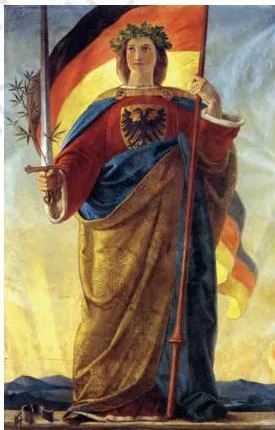
In Germany, the allegory was Germania, who wears a crown of oak leaves because the German oak stands for heroism (NCERT, p.23).
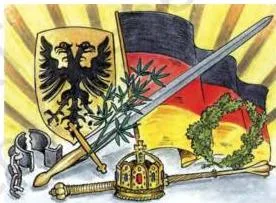
To read images of Germania, use the chapter’s symbol chart in Box 3 (NCERT, p.24). Broken chains mean being freed; the breastplate with the eagle means German imperial strength; the sword means readiness to fight, with the olive branch around it meaning willingness to make peace.
The black, red and gold tricolour was the flag of the liberal-nationalists of 1848, banned by the Dukes of the German states; the rays of the rising sun mean the beginning of a new era (NCERT, p.24).
The figure walkthrough below applies these symbols to Philip Veit’s Germania, painted on a cotton banner for the Frankfurt parliament.
Nationalism and Imperialism: Why the Balkans Exploded
The chapter ends with nationalism changing character — from a liberal dream of liberty into an aggressive creed that helped start the First World War. This is the most frequently tested ‘big picture’ point of the chapter.
After 1871, nationalism no longer kept the idealistic liberal-democratic sentiment of the first half of the century. It became a narrow creed: nationalist groups grew intolerant of each other and ever ready to go to war, while the great powers manipulated nationalist aspirations for their own imperialist aims (NCERT, p.26).
The most serious source of tension was the Balkans — a region of geographical and ethnic variation covering what is today Romania, Bulgaria, Albania, Greece, Macedonia, Croatia, Bosnia-Herzegovina, Slovenia, Serbia and Montenegro, whose inhabitants were broadly known as Slavs (NCERT, p.26). Much of it lay under the weakening Ottoman Empire.
As romantic nationalism spread and the empire disintegrated, subject nationalities broke away one by one, basing their claims on nationality and history. The Balkan states were fiercely jealous of each other, and each of the big powers — Russia, Germany, England and Austro-Hungary — tried to counter the others and extend its own control (NCERT, p.26).
This rivalry led to a series of wars in the region and finally to the First World War. The chapter closes with a wider point: the colonised peoples who opposed imperial domination developed their own varieties of nationalism, even as the idea of organising society as a nation-state came to seem natural and universal (NCERT, p.27).
Figures That Explain the Chapter
Six NCERT figures are most worth learning to read for an exam answer. Each image below is followed by what it shows and how to use it in your own answer.
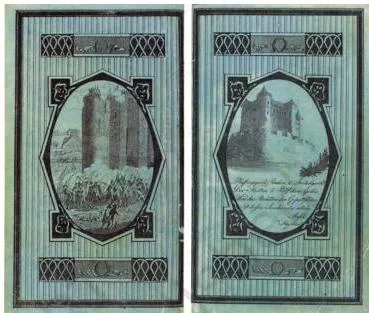
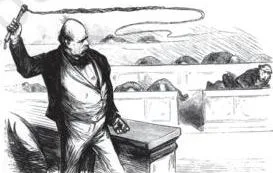
This image belongs to the discussion of Napoleon’s mixed legacy (NCERT, p.7). The French were first received as liberators in places like Holland, Switzerland, Brussels, Mainz, Milan and Warsaw, but taxation, censorship and forced conscription turned enthusiasm into hostility. An exam answer on Napoleon should give both halves of the picture — the reforms and the resentment.
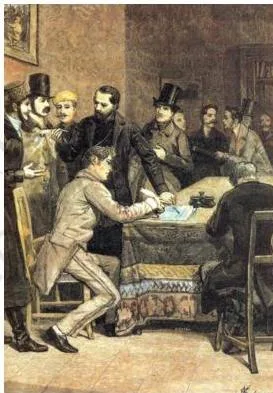
The print shows Mazzini as the archetypal revolutionary of the years after 1815: an exile organising secret societies from abroad. He was 26 when exiled, and founded Young Italy in Marseilles and then Young Europe in Berne for like-minded young men from Poland, France, Italy and the German states (NCERT, p.12).
It captures nationalism at its underground, idealist stage — before monarchs took it over.
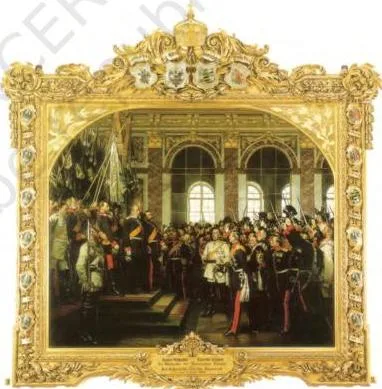
The painting is a statement about who unified Germany. At the centre stand Kaiser William I and the chief commander of the Prussian army, General von Roon, with Bismarck near them (NCERT, p.19). It records a ceremony of princes, the army and ministers — no parliament, no people — held deliberately in France’s Versailles.
That answers the chapter’s own question: the army, not the liberals of 1848, was the architect of the German nation.
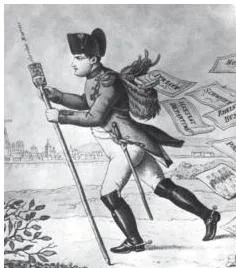
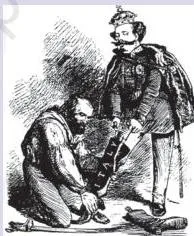
The visual joke carries a serious argument. Garibaldi holds the base of the boot — the south he conquered with his volunteers — so that the king can enter from the top (NCERT, p.22). It tells you that Italy was unified by the monarchy of Sardinia-Piedmont, not by the republicans Mazzini had hoped for.
Marianne’s face on postage stamps shows how an allegory becomes an everyday national symbol. Because the female form did not stand for any real woman, it could give the abstract idea of the nation a concrete form (NCERT, p.23). Coins and stamps made ordinary citizens handle the nation daily — the practical purpose behind the art.
This is the painting the chapter’s Box 3 chart teaches you to decode (NCERT, p.24). The broken chains mean being freed; the breastplate with the eagle means German imperial strength; the sword shows readiness to fight and the olive branch around it willingness to make peace.
The black, red and gold tricolour was the banned flag of the liberal-nationalists of 1848, and the rays of the rising sun mean the beginning of a new era. An image-based answer must name each attribute and its significance — not just describe the woman in the painting.
Definitions from the Chapter’s New Words Boxes
The chapter defines nine key terms in its New words boxes. This table gives each a plain one-line meaning.
| Term | Plain meaning | NCERT page |
|---|---|---|
| Absolutist | A government or system of rule with no restraints on power; in history, a centralised, militarised, repressive monarchy | p.3 |
| Utopian | A vision of a society so ideal that it is unlikely to exist | p.3 |
| Plebiscite | A direct vote in which all the people of a region accept or reject a proposal | p.4 |
| Suffrage | The right to vote | p.9 |
| Conservatism | A political philosophy that values tradition, established institutions and customs, preferring gradual development to quick change | p.10 |
| Feminist | A person aware of women’s rights and interests, based on the belief in social, economic and political equality of the genders | p.17 |
| Ideology | A system of ideas reflecting a particular social and political vision | p.18 |
| Ethnic | Relating to a common racial, tribal or cultural origin or background that a community identifies with or claims | p.22 |
| Allegory | An abstract idea, such as freedom or envy, expressed through a person or a thing; an allegorical story has literal and symbolic meanings | p.23 |
Common Mistakes Students Make in This Chapter
Six errors cost marks in this chapter. The table names each mistake, the correct rule, and one way to check your answer.
| Mistake | Correct rule | How to check your answer |
|---|---|---|
| Treating liberalism as modern democracy | Liberals wanted equality before the law but not universal suffrage — only property-owning men voted in revolutionary France, and the Napoleonic Code treated women as minors (NCERT, p.9) | Ask: did this liberal support women voting? If not, it is liberalism, not democracy. |
| Seeing Napoleon as only a liberator or only an oppressor | He spread equality before the law and abolished serfdom, but also restored monarchy, taxed heavily, censored and conscripted (NCERT, p.7) | Answer with both halves; a one-sided Napoleon answer is incomplete. |
| Confusing Romanticism with romance | Romanticism was a cultural movement stressing emotion, intuition and folk culture — Herder’s das volk — as the basis of national feeling (NCERT, p.13) | If the question mentions Herder, folk songs or language, it means Romanticism the movement. |
| Thinking Germany and Italy were unified democratically | The liberal attempt of 1848 was crushed; unification came through the monarchies and armies of Prussia and Sardinia-Piedmont (NCERT, p.19-20) | Check who led: Bismarck and Cavour, not the Frankfurt parliament. |
| Treating Britain as the typical case | Britain was the strange case — a long parliamentary process with no revolution: Act of Union 1707, suppression of Gaelic, Ireland incorporated in 1801 (NCERT, p.21) | If the question says ‘strange case’, the expected contrast is Britain versus the rest of Europe. |
| Forgetting nationalism changed over the century | After 1871 nationalism became a narrow, intolerant creed ready for war, as in the Balkans (NCERT, p.26) | Compare the liberal hopes of 1848 with the Balkans; the shift itself is the point. |
Using This Chapter for Revision and Exams
The chapter closes on page 28 with three exercise blocks: Write in brief (five short notes), Discuss (five reasoning questions) and a Project. This table maps each question to the section that answers it, so you can revise targetedly.
| Exercise question | What it asks | Where the answer lives |
|---|---|---|
| Write in brief Q1 (a)-(e): Mazzini, Cavour, Greek war of independence, Frankfurt parliament, role of women | Short factual notes on five people and events | Sections 2.4, 4.2, 3, 3.3, 3.3 (NCERT, p.12, 20, 13, 17) |
| Write in brief Q2: steps for a sense of collective identity | The French Revolution’s nation-building measures | The French Revolution section (NCERT, p.5) |
| Write in brief Q3: Who were Marianne and Germania? | Allegories and how they were portrayed | Visualising the Nation (NCERT, p.23) |
| Write in brief Q4: trace German unification | The sequence from 1848 to 1871 | Section 4.1 (NCERT, p.19) |
| Write in brief Q5: Napoleon’s administrative reforms | The Civil Code and related changes | The Napoleon part of the French Revolution section (NCERT, p.6) |
| Discuss Q1: the 1848 revolution of the liberals | What liberals wanted, politically and economically | Sections 3.3 and 2.2 (NCERT, p.17, 9) |
| Discuss Q2: culture and the growth of nationalism | Three examples of culture’s role | Section 3.1, Romanticism (NCERT, p.13-14) |
| Discuss Q3: how nations developed in two countries | Comparison of two paths | Sections 4.1-4.3 (NCERT, p.19-21) |
| Discuss Q4: how Britain was unlike the rest of Europe | The no-revolution route to a nation-state | Section 4.3 (NCERT, p.21) |
| Discuss Q5: why nationalist tensions emerged in the Balkans | Ethnic variation, Ottoman decline, big-power rivalry | Section 6 (NCERT, p.26) |
A full-marks Write-in-brief answer names the person or event, gives its dates, and states its role in the growth of nationalism in one or two sentences. A Discuss answer states a clear position and supports it with at least two examples from the chapter.
The in-chapter Activities on pages 3, 11, 16, 20, 21, 22, 24 and 25 work well as timed self-tests; each asks you to read a source or image and explain it, the same skill image questions demand. For revision across subjects, the Class 10 notes hub collects all topics.
One caution: textbook contents and the examinable syllabus are not always identical. Check the current official syllabus on the CBSE website to confirm what is examinable this session.
The Chapter in One Page: A Quick Recap
The chapter’s own Some important dates box (NCERT, p.8) lists the turning points worth memorising. One line of context beside each date fixes it in memory.
| Year | Event | Why it matters |
|---|---|---|
| 1797 | Napoleon invades Italy; the Napoleonic wars begin | French armies carry the idea of nationalism abroad |
| 1814-1815 | Fall of Napoleon; the Vienna Peace Settlement | Conservatives try to undo the revolutionary changes |
| 1821 | Greek struggle for independence begins | Nationalism mobilises educated Europeans; Greece is independent by 1832 |
| 1848 | Revolutions in Europe | Workers and peasants revolt against hardship; middle classes demand constitutions; subject peoples demand nation-states |
| 1859-1870 | Unification of Italy | Sardinia-Piedmont, Cavour and Garibaldi forge one kingdom |
| 1866-1871 | Unification of Germany | Prussian wars create the German Empire |
| 1905 | Slav nationalism gathers force in the Habsburg and Ottoman Empires | The nationalist tension that leads to the First World War |
Read together, the dates tell one story: nation-states were not born ready-made. They were forged through revolution in France, culture in Poland and Germany, economics in the zollverein, war in Germany and Italy, and finally imperialism in the Balkans — which is why the chapter ends at the threshold of the First World War.
Related NCERT Class 10 Resources
This listing is maintained for the 2026-27 academic session using the NCERT textbook information available to us. NCERT remains the authority for confirming the latest edition.
Continue with the rest of Class 10 Social Science from the Class 10 Social Science book page, which collects chapters and notes for the same book. For a different topic’s study notes, see Forest and Wildlife Resources. The full notes library holds every Class 10 subject.
Sources and Data Verification
- This page describes the NCERT Class 10 Social Science textbook India and the Contemporary World II, Chapter 1, official edition on ncert.nic.in.
- It covers this one chapter, not the full CBSE syllabus for Class 10 Social Science.
- It is maintained for the current academic session using the NCERT information available to us.
- NCERT settles textbooks, editions and PDFs; CBSE settles the curriculum, syllabus and examinations.
| What the chapter holds | Count | Where it is used |
|---|---|---|
| Printed pages | 28 | |
| Sections in the chapter | 10 | |
| Figures with NCERT captions | 10 | |
| Tables | 1 | |
| Activities | 9 | |
| Official NCERT PDF | Download the chapter PDF | the chapter exactly as NCERT publishes it |
Frequently Asked Questions
What does Renan mean when he says a nation is a daily plebiscite?
He means the nation exists by the continuing consent of its people. Just as a plebiscite is a direct vote, the nation is re-chosen by its citizens every day, so it cannot be imposed by force; language, race, religion or territory alone do not make one (NCERT, p.4).
Who were Marianne and Germania in the rise of nationalism in Europe?
They were female allegories of nations — abstract ideas given a face. Marianne stood for France, with the red cap, tricolour and cockade, appearing on coins and stamps; Germania stood for Germany, with a crown of oak leaves, sword, olive branch, broken chains, a breastplate with an eagle and rays of the rising sun (NCERT, p.23-24).
Why is the making of Britain called the strange case?
Because Britain did not become a nation through revolution or a war of unification. It was a long-drawn process: the English parliament forged a nation-state with England at its centre, the Act of Union of 1707 incorporated Scotland, Gaelic was suppressed, and Ireland was incorporated in 1801 (NCERT, p.21).
What was the revolution of the liberals in 1848?
It was the movement of educated middle classes who combined demands for constitutionalism with national unification — a constitution, freedom of the press and association, and a German nation headed by a parliamentary monarchy. Its centre was the Frankfurt parliament, whose crown Friedrich Wilhelm IV refused, and which was eventually disbanded (NCERT, p.17).
Why did nationalist tension emerge in the Balkans?
Because the Balkans was a region of geographical and ethnic variation under a weakening Ottoman Empire, its subject nationalities claimed independence on grounds of nationality and history, and the great powers — Russia, Germany, England and Austro-Hungary — each tried to extend its own control. This rivalry led to a series of wars and finally the First World War (NCERT, p.26).
Where can I download the official Class 10 Social Science Chapter 1 PDF?
Open the NCERT Class 10 Social Science Chapter 1 The Rise of Nationalism in Europe PDF from ncert.nic.in — it is the official file of the full chapter, 28 pages, with the chapter text beginning on page 3.
Reference: NCERT Class 10 Social Science textbook, chapter 1, official edition on ncert.nic.in.
Explore Class 10 Social Science Books
Related chapters:
- Resources and Development
- Power-sharing
- Notes for the Teacher