
The Making of a Global World Class 10 is Chapter 3 of NCERT’s Social Science History book, India and the Contemporary World II. The chapter runs 28 printed pages, from textbook page 50 to page 78, and it argues that the globalised world was made over centuries — long before the term ‘globalisation’ existed.
This page puts the official NCERT chapter PDF first, then a section-by-section guide to what the chapter covers, its key concepts and figures, a definitions list, common mistakes and a revision map of its exercises.
Download the Chapter PDF
The link below is the official NCERT file for this chapter — the same PDF published on ncert.nic.in and used in class. Keep it on your phone or laptop so the chapter text, figures and exercises are always one tap away.
Download the Making of a Global World Class 10 PDF — NCERT Social Science History Chapter 3 to keep the official chapter text, figures and end-of-chapter exercises on your device for offline revision.
If you need the whole book rather than one chapter, the NCERT textbook portal hosts the complete India and the Contemporary World II PDF alongside every other official NCERT textbook.
The Chapter at a Glance
The table below shows what this chapter contains and how it is organised. Read it once before you start so you know how much of the chapter is text, how much is figures, and where the exercises sit.
What This Chapter Covers: From Silk Routes to Globalisation
Before any dates or laws, hold onto the chapter’s single argument: the globalised world was not born in the last fifty years. It was made over centuries by trade, migration, capital and even disease, and the chapter tells that story in four phases.
| Phase | Textbook pages | What the chapter argues |
|---|---|---|
| The Pre-modern World | 53–56 | Silk routes linked Asia with Europe and north Africa; new foods — potato, maize, chilli — travelled from the Americas; silver, smallpox, conquest and trade made the world shrink. |
| The Nineteenth Century (1815–1914) | 57–67 | A world economy took shape around three flows — trade, labour and capital. The Corn Laws, railways and refrigerated ships, colonial conquest, rinderpest, indentured labour and India’s forced role as an exporter of raw materials. |
| The Inter-war Economy | 68–73 | The First World War broke the old economy; mass production and consumption in the US could not prevent the Great Depression, which hit the US, Europe and India differently. |
| Rebuilding a World Economy: The Post-war Era | 74–77 | Bretton Woods built the IMF and the World Bank; decolonisation produced the G-77’s demand for a fairer order; fixed exchange rates ended and globalisation began. |
If you keep these four phases in order, every separate fact in the chapter — a date, a law, a figure — has a place to hang.
Key Concepts: The Ideas That Shape the Chapter
A concept in this chapter is one of the recurring forces the book uses to explain every period — trade, labour, capital, disease, technology and state power. These are the load-bearing ideas that carry the argument, so read them in order.
- The three flows (trade, labour, capital) — p. 57. Economists divide international exchange into three flows: trade in goods such as cloth or wheat, labour as people migrate for work, and capital moving across distances for short- or long-term investment. The chapter insists on looking at all three together because they were closely interwoven. Indian examples run through it: cotton and indigo exports (trade), indentured workers (labour) and the Shikaripuri Shroffs’ cross-border finance (capital).
- The Corn Laws — pp. 57-58. Under pressure from landed groups, Britain’s government restricted the import of corn, which kept food prices high. Industrialists and urban dwellers forced the laws’ abolition; cheap food then flowed in, British agriculture could not compete, land fell out of cultivation and workers migrated to cities or overseas. By 1890 a global agricultural economy had taken shape — between 1820 and 1914 world trade multiplied an estimated 25 to 40 times.
- Technology — railways, steamships, refrigerated ships — pp. 58-60. Technology made the nineteenth-century world, but the chapter’s point is that technology followed economic and political pressures such as colonisation. Refrigerated ships turned meat from a luxury into an ordinary food: animals were now slaughtered at the start point and shipped frozen, cutting costs and giving Europe’s poor a more varied diet.
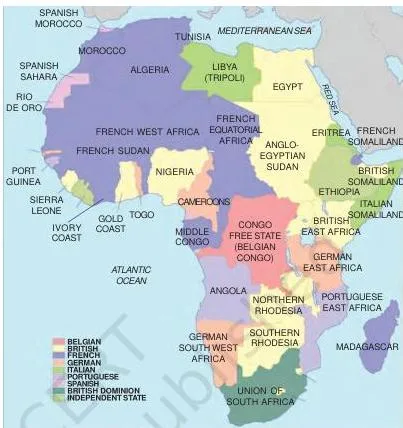
- Late-nineteenth-century colonialism — pp. 60-61. In 1885 the European powers met in Berlin to complete the carving up of Africa; Britain and France made vast territorial additions, while Belgium and Germany became new colonial powers. For colonised people, the expansion of trade meant loss of freedoms and livelihoods.
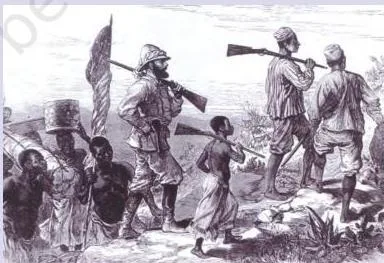
- Rinderpest — p. 62. The cattle plague reached Africa in the late 1880s with infected cattle imported from British Asia, and killed 90 per cent of the herds. The loss of cattle destroyed African livelihoods and let planters, mine owners and colonial governments force Africans into wage labour.
- Indentured labour — pp. 63-64. Indian and Chinese labourers signed contracts to work five years on plantations in return for passage and return travel. Recruitment was often built on false information or force, and the system was called a ‘new system of slavery’; yet workers created new cultures — Hosay in Trinidad, Rastafarianism, chutney music — and the chapter calls that cultural fusion part of the making of the global world.
- Indian entrepreneurs abroad — p. 65. The Shikaripuri Shroffs and Nattukottai Chettiars financed export agriculture in Central and Southeast Asia with a sophisticated system of transferring money across distances, even developing indigenous corporate forms. Hyderabadi Sindhi traders set up emporia in ports worldwide from the 1860s.
- India’s trade surplus and the multilateral system — pp. 65-67. The share of cotton textiles in India’s exports fell from roughly 30 per cent around 1800 to below 3 per cent by the 1870s, while raw materials such as cotton and indigo surged. Because Britain sold more to India than it bought, it ran a trade surplus with India — used to settle its deficits with other countries (the multilateral settlement system) and to pay ‘home charges’ such as pensions of British officials and interest on India’s external debt.
- The First World War — pp. 68-69. The war was the first modern industrial war: 9 million dead and 20 million injured, with industry restructured to produce war goods. Britain financed the war by borrowing from US banks and the US public, which turned the United States from an international debtor into an international creditor.
- Fordism and mass production — pp. 69-70. Henry Ford adapted the slaughterhouse assembly line to car production, so a car came off the line every three minutes. He doubled the daily wage to $5 in January 1914 and banned trade unions; mass production plus hire-purchase credit created the consumer boom of the 1920s.
- What caused the Great Depression — pp. 70-71. The depression came from a combination: agricultural overproduction pushing prices down, panic withdrawal of US loans abroad after 1928, and the US doubling import duties to protect its own economy. Farm produce rotted for lack of buyers.
- India and the Great Depression — pp. 71-72. India’s exports and imports nearly halved between 1928 and 1934, and wheat prices fell by 50 per cent. Bengal jute growers saw raw jute crash by over 60 per cent and fell deeper into debt; peasants sold jewellery and gold, making India an exporter of precious metals. Urban Indians with fixed incomes were better off because everything cost less.
- Bretton Woods — pp. 74-75. In July 1944 the United Nations Monetary and Financial Conference at Bretton Woods set up the IMF to manage member nations’ surpluses and deficits, and the World Bank to finance post-war reconstruction. The system grew out of two inter-war lessons: mass production needs mass consumption with stable incomes and full employment, and markets alone cannot guarantee that — governments must intervene. It ran on fixed exchange rates: national currencies were pegged to the dollar, and the dollar was anchored to gold at $35 per ounce.
- Decolonisation and the G-77 — p. 76. Newly independent Asian and African nations were poor and found the Bretton Woods institutions dominated by the former colonial powers. They organised as the Group of 77 to demand a New International Economic Order: real control over natural resources, more development assistance, fairer prices for raw materials and better market access for their manufactured goods.
- MNCs and the end of Bretton Woods — pp. 76-77. The first multinational corporations appeared in the 1920s, and they spread partly because high import tariffs forced firms to locate production inside many countries at once. From the 1960s the US dollar lost confidence, fixed exchange rates collapsed into floating rates, and from the late 1970s MNCs shifted production to low-wage Asian countries.
The chapter compares how the same crisis landed on different regions. Use this table to keep the three stories straight.
| Region | What the depression did | NCERT page |
|---|---|---|
| United States | Banks slashed lending and called back loans; by 1933 over 4,000 banks had closed and about 110,000 companies collapsed between 1929 and 1932; unemployment soared. | p. 71 |
| Europe | Some major banks failed and currencies such as the British pound collapsed; a wheat glut after eastern European production revived pushed grain prices down. | pp. 70-71 |
| India | Exports and imports nearly halved between 1928 and 1934; wheat prices fell 50 per cent; raw jute crashed over 60 per cent; peasants sank into debt and India exported gold. | pp. 71-72 |
Figure Walkthrough: What the Images Show
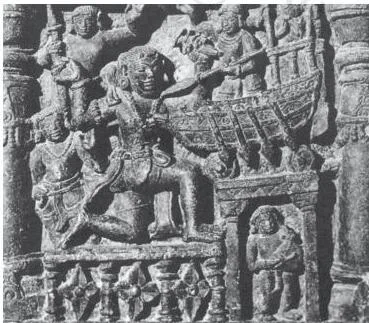
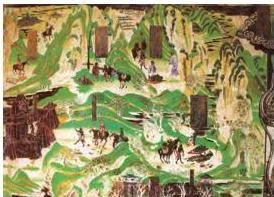
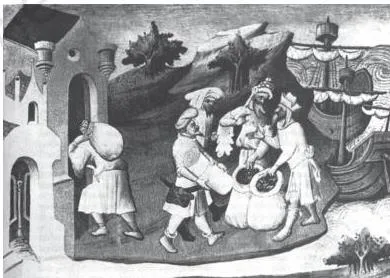
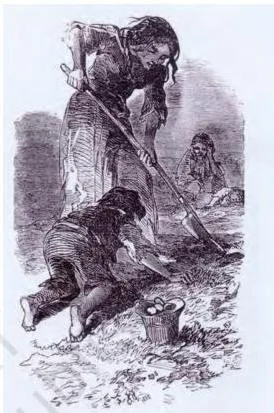
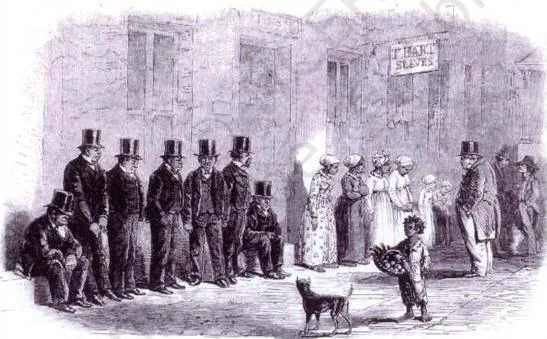
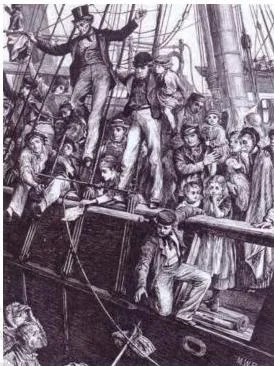
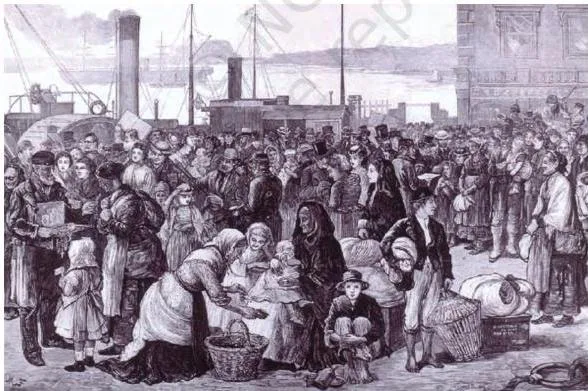
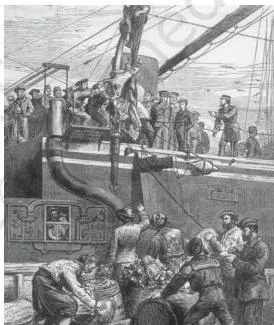
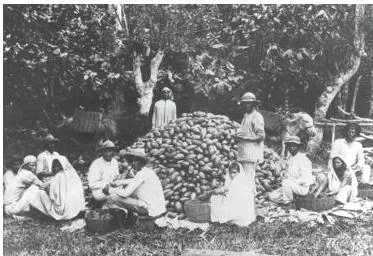
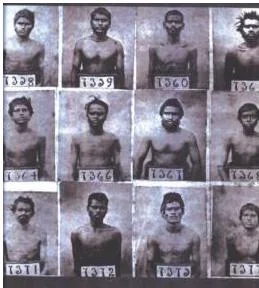
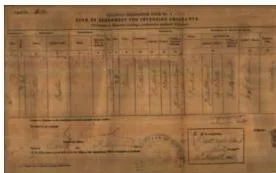
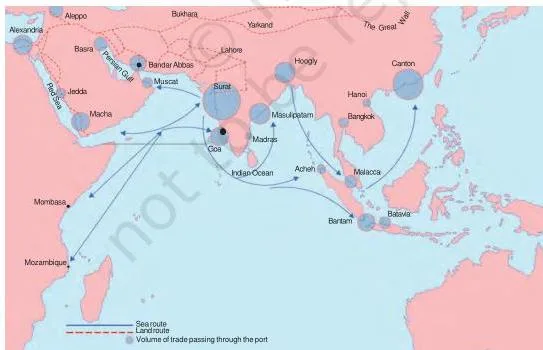
The chapter uses images as historical evidence, not decoration. Each figure below belongs to a different phase of its argument, and reading the caption with the picture is part of what this chapter practises.
The chapter opens with this image to make a quiet point: oceanic trade on India’s western coast mattered centuries before Europeans arrived. Ships appear regularly on memorial stones found on the western coast from the ninth century, which the book reads as a sign of how significant that trade was.
The image puts a face on the chapter’s labour flow. Nearly 50 million people emigrated from Europe to America and Australia in the nineteenth century, and some 150 million are estimated to have left their homes worldwide in search of a better future.
This is the human face of what the chapter calls the ‘new system of slavery’. Conditions on arrival were harsh and legal rights few, yet most workers stayed on after their contracts ended — which is why large communities of Indian descent live in the Caribbean today.
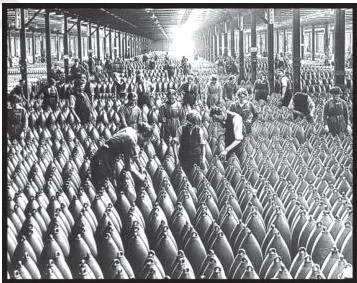
The war pictures in this chapter are evidence, not backdrop. Industries were restructured to produce war-related goods, and as men went to battle, women stepped into jobs that earlier only men were expected to do.
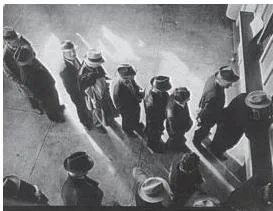
The book pairs the photograph with a hard number: an unemployment census showed 10 million people out of work, and local governments began making small allowances to the unemployed. The long queues came to symbolise the poverty and unemployment of the depression years.
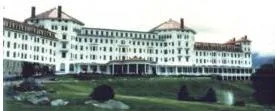
This hotel is where the United Nations Monetary and Financial Conference met in July 1944. The decisions taken here — the IMF, the World Bank and a system of fixed exchange rates — shaped world trade and incomes for the next three decades.
Definitions: The Chapter’s New Words, Explained
This chapter drops several formal economic terms into its narrative, and the book defines most of them in ‘New words’ boxes as they appear. Here they are in plainer words, with the printed page where NCERT defines them.
| Term | What it means | Where NCERT defines it |
|---|---|---|
| Dissenter | Someone who refuses to accept established beliefs and practices. The chapter’s example: religious dissenters persecuted in Europe who fled to America. | p. 56 |
| Indentured labour | A bonded labourer under contract to work for an employer for a specific time, to pay off passage to a new country or home. In this chapter, five years on a plantation with return travel promised. | p. 63 |
| Tariff | A tax imposed on a country’s imports, levied at the point of entry — at the border or the airport. | p. 76 |
| Exchange rates | The rates that link national currencies for international trade. Fixed: governments intervene to prevent movements. Floating or flexible: rates fluctuate with demand and supply of currencies, without government interference. | p. 77 |
| Multilateral settlement system | A system that lets one country’s deficit with a second be settled by its surplus with a third — Britain settled its deficits with other countries using its surplus with India. | pp. 66-67 |
| Home charges | Payments Britain drew from its Indian surplus: private remittances of British officials and traders, interest on India’s external debt, and pensions of British officials in India. | p. 67 |
Common Mistakes Students Make in This Chapter
History chapters usually cost students marks not on facts alone but on misreading the argument. These are the confusions this chapter reliably produces, each with the chapter’s own correction.
| Mistake | Correct rule | How to check your answer |
|---|---|---|
| Reducing the three flows to trade alone | The chapter counts trade, labour and capital as three separate flows (p. 57). | Name all three and give an Indian example of each. |
| Thinking the Corn Laws taxed imports | They restricted the import of corn to protect landed interests; their abolition let cheap food into Britain (pp. 57-58). | Ask who gained from the laws (landed groups) and who gained from repeal (industrialists, urban dwellers). |
| Crediting the conquest of America to guns and firepower | Germs — smallpox above all — were the most powerful weapon, because Americans had no immunity (pp. 55-56). | Include the disease factor whenever you write about the conquest. |
| Treating rinderpest as a purely biological disaster | It killed 90 per cent of cattle, and colonisers used control of the remaining herds to force Africans into wage labour (p. 62). | Connect the disease to its economic and political result, not just its death toll. |
| Calling indentured labour simply slavery | The chapter calls it a ‘new system of slavery’ — a five-year contract with promised return — and stresses the new cultures workers made, such as Hosay and chutney music (pp. 63-64). | Mention both the coercion and the cultural fusion. |
| Blaming the Great Depression on a single event | The chapter lists a combination: agricultural overproduction, withdrawal of US loans and higher US import duties (pp. 70-71). | Your answer should name at least two causes and show how they fed each other. |
| Mixing up fixed and floating exchange rates | Fixed rates peg currencies to the dollar, with the dollar anchored to gold at $35 per ounce; floating rates move with demand and supply (pp. 74, 77). | State who controls the rate: governments (fixed) or markets (floating). |
Exam Notes: Turning the Chapter into Answers
The most honest revision plan for this chapter is to answer the questions NCERT itself set at the end. The book closes with ‘Write in brief’ and ‘Discuss’ sets, and places two Activity tasks inside the chapter.
| End-of-chapter question | What it tests | Where to revise |
|---|---|---|
| Q1 — Two examples of global exchanges before the seventeenth century, one from Asia and one from the Americas | Pre-modern trade and cultural exchange | Section 1, pp. 53-56 |
| Q2 — How the global transfer of disease helped colonise the Americas | Conquest, disease and trade | Section 1.3, pp. 55-56 |
| Q3 a-e — Effects of the Corn Laws, rinderpest, war deaths of working-age men, the Depression on India, and MNC relocation | ‘Effects’ style answers | Sections 2.1, 2.4, 3.1, 3.5, 4.4 (pp. 57-58, 62, 68, 71-72, 77) |
| Q4 — Two historical examples of technology’s impact on food availability | Role of technology | Section 2.2, pp. 58-59 |
| Q5 — Meaning of the Bretton Woods Agreement | Post-war settlement | Section 4.1, p. 74 |
| Q6 — Letter from an indentured labourer in the Caribbean | Indentured labour migration | Section 2.4 and the labourer’s testimony (pp. 63-65) |
| Q7 — The three flows, each with an Indian example | Trade, labour and capital flows | Section 2 plus sections 2.4-2.6 (pp. 57, 63-67) |
| Q8 — Causes of the Great Depression | Depression causes | Section 3.4, pp. 70-71 |
| Q9 — What the G-77 is and how it reacted to the Bretton Woods twins | Decolonisation and the G-77 | Section 4.3, p. 76 |
The two Activity tasks inside the chapter (p. 59) are quick revision tasks in disguise: a flow chart showing how Britain’s decision to import food led to increased migration to America and Australia, and a letter from an Irish agricultural worker in America explaining why he came and how he earns a living.
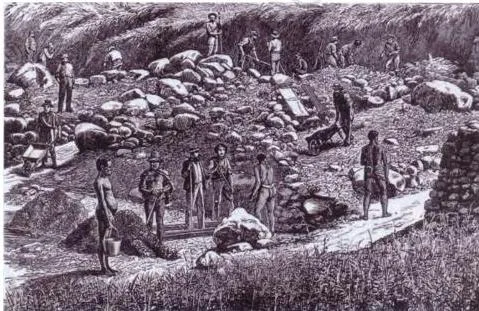
The chapter also ends with a Project on gold and diamond mining in South Africa — a useful research task if your teacher assigns it.
One caution before you treat this as your revision plan: textbook contents and the examinable syllabus are not always identical. Check the current official CBSE syllabus to see exactly what is examinable this session.
Revision Summary: The Chapter in One Read
This chapter does not close with a separate summary box, so the recap below rebuilds its argument from the four phases.
- Pre-modern world (pp. 53-56): silk routes, foods like the potato and spaghetti, silver, and smallpox. The world shrank in the 1500s when sea routes connected Asia, America and Europe.
- Nineteenth century (pp. 57-67): the three flows of trade, labour and capital built a global agricultural economy; the Corn Laws, railways and refrigerated ships; colonial conquest backed by rinderpest; indentured labour; Indian bankers and India’s trade surplus paying for Britain’s deficits.
- Inter-war economy (pp. 68-73): the First World War as industrial war, the US turning creditor, Fordism and mass consumption, then the Great Depression hitting the US, Europe and India in different ways.
- Post-war era (pp. 74-77): Bretton Woods and the IMF and World Bank, decolonisation and the G-77, the collapse of fixed exchange rates, MNCs shifting production to low-wage Asia — globalisation begins.
The chapter’s closing image of this long history is cultural mixing: things from different places get combined, lose their original characteristics and become something entirely new. That, it argues, is the making of the global world.
Related Resources
This listing is maintained for the 2026-27 academic session using the NCERT textbook information available to us. NCERT remains the authority for confirming the latest edition.
- Class 10 Social Science NCERT book page — every NCERT Social Science book for Class 10, listed together.
- Class 10 NCERT books hub — the full Class 10 book set on this site.
- Previous chapter in India and the Contemporary World II — the chapter that comes before this one in the same book.
- Next chapter in India and the Contemporary World II — the chapter that follows this one.
Need revision material instead of the book? The Class 10 Social Science notes hub, the Class 10 notes home and the main notes index collect the study pages for this syllabus. The economics chapters Sectors of the Indian Economy and Agriculture are also covered on this site.
Sources and Data Verification
- The figures on this page describe the NCERT Class 10 Social Science textbook India and the Contemporary World II, Chapter 3 (The Making of a Global World), official edition on ncert.nic.in.
- This page covers that single chapter of that book — not the other Class 10 Social Science books, and not other chapters of this one.
- The listing is maintained for the current academic session using the NCERT information available to us.
- NCERT settles textbooks, editions and PDFs; CBSE settles curriculum, syllabus and examinations.
| What the chapter holds | Count | Where it is used |
|---|---|---|
| Printed pages | 28 | |
| Sections in the chapter | 19 | |
| Figures with NCERT captions | 22 | |
| Activities | 2 | |
| Official NCERT PDF | Download the chapter PDF | the chapter exactly as NCERT publishes it |
Reference: NCERT Class 10 India and the Contemporary World II textbook, chapter 3, official edition on ncert.nic.in.
Frequently Asked Questions
Why does the chapter say the world ‘shrank’ in the 1500s?
Because European sailors opened connections that pulled far-apart regions into a single network. In the sixteenth century they found a sea route to Asia and crossed the western ocean to America; silver from Peru and Mexico financed Europe’s trade with Asia, while smallpox — to which Americans had no immunity — killed whole communities and cleared the way for conquest (NCERT, p. 55).
What were the Corn Laws and why did Britain abolish them?
The Corn Laws were restrictions on the import of corn into Britain, passed under pressure from landed groups who wanted food prices kept high (NCERT, pp. 57-58). Industrialists and urban dwellers forced their abolition; after that, cheap food could be imported, and British agriculture, unable to compete, left land uncultivated and pushed workers to the cities or overseas.
How did rinderpest help the European colonisation of Africa?
Rinderpest killed about 90 per cent of Africa’s cattle in the 1890s, destroying the livelihoods that had kept Africans independent of wage labour (NCERT, p. 62). Planters, mine owners and colonial governments monopolised the few surviving herds and used control over this scarce resource to force Africans into the labour market.
What were the effects of the Great Depression on India?
India’s exports and imports nearly halved between 1928 and 1934, and wheat prices fell by 50 per cent (NCERT, pp. 71-72).
Bengal jute growers saw raw jute crash by over 60 per cent and sank into debt, while peasants sold jewellery and gold and India became an exporter of precious metals. Urban Indians with fixed incomes were actually better off, because everything cost less.
What are the Bretton Woods institutions and what did they do?
The United Nations Monetary and Financial Conference held at Bretton Woods in July 1944 established the International Monetary Fund to deal with member nations’ external surpluses and deficits, and the World Bank to finance post-war reconstruction (NCERT, pp. 74-75). Known together as the Bretton Woods twins, they began operations in 1947 and ran the system of fixed exchange rates anchored on the dollar.
What is the difference between fixed and floating exchange rates?
Fixed exchange rates peg national currencies to the dollar at a fixed value, with the dollar itself anchored to gold at $35 per ounce and governments intervening to prevent movements (NCERT, p. 77). Floating or flexible rates fluctuate according to demand and supply of currencies in foreign exchange markets, in principle without government interference.
Bretton Woods ran on fixed rates until the dollar could no longer hold its value against gold, and floating rates replaced them.
Explore Class 10 Social Science Books
Related chapters: