
This page is the NCERT Class 10 Social Science Chapter 6, Manufacturing Industries, from the Contemporary India II (Geography) textbook — printed pages 57 to 70.
The official chapter PDF from the NCERT portal is linked right below, followed by a plain-language guide to what the chapter teaches: how industries are classified, where India’s major industries are located and why, and how industrial pollution is controlled.
Download the official NCERT PDF
The NCERT Manufacturing Industries Class 10 Chapter 6 PDF is the official chapter file published on the NCERT textbook portal, where the current edition of Contemporary India II is available for free reading and download.
Open it to follow the chapter’s original layout — its distribution maps of the textile and iron and steel industries, the flow charts of aluminium manufacture, the photographs, the activities and the exercises that close the chapter.
Chapter 6 at a glance
The table below lists what this chapter holds — its sections, the figures indexed from it and its exercise questions — so you know the size of the file before opening it.
What this chapter covers
A quick map of the chapter before you start, so the two halves stay separate in your head.
The chapter falls into two clear halves. The first is about India’s manufacturing industries: why they matter, the five criteria by which they are classified, and then the major industries one by one — cotton textiles, jute, sugar, iron and steel, aluminium, chemicals, fertilisers, cement, automobiles and information technology.
The second half turns from production to its side-effects: the four types of industrial pollution, the measures to control environmental degradation, and the NTPC case study that closes the chapter.
In the printed book the chapter runs from page 57 to page 70.
What manufacturing means in this chapter
This is the definition the whole chapter stands on, so fix it first — in plain words rather than the textbook’s sentence order.
Manufacturing is the production of goods in large quantities after processing raw materials into more valuable products (NCERT, p. 57). Paper is manufactured from wood, sugar from sugarcane, iron and steel from iron ore, and aluminium from bauxite — and some types of clothes are manufactured from yarn, which is itself an industrial product.
People employed in secondary activities convert primary materials into finished goods: steel-factory workers, car-plant workers, and people in textile mills, breweries and bakeries. Those who provide services are in tertiary activities. The chapter is concerned only with manufacturing industries, which fall in the secondary sector.
The chapter opens with Harish’s Diwali shopping — shoes, clothes, utensils, sugar, tea and diyas (earthen lamps) — and his father’s explanation that machines in large industries make most of these goods, that some utensils come from small industries, and that diyas are made by individual artisans in household industry.
That one scene sets up the three scales of industry used throughout the book. It closes with the line that a country’s economic strength is measured by the development of its manufacturing industries (NCERT, p. 57).
Why manufacturing is the backbone of development
These reasons are the standard answer to “why is manufacturing important” — each is a one-line point you can reproduce.
Manufacturing is treated as the backbone of development for four reasons given in the book (NCERT, p. 58):
- It modernises agriculture, which forms the backbone of the economy, and reduces people’s heavy dependence on agricultural income by giving them jobs in the secondary and tertiary sectors.
- Industrial development is a precondition for eradicating unemployment and poverty — the main philosophy behind public-sector and joint-sector industries, which were also set up in tribal and backward areas to bring down regional disparity.
- Exports of manufactured goods expand trade and commerce and bring in much-needed foreign exchange.
- Countries that transform raw materials into a wide variety of higher-value finished goods prosper, so India’s prosperity lies in increasing and diversifying its manufacturing industries.
Agriculture and industry move hand in hand: agro-industries depend on agriculture for raw materials and sell farmers irrigation pumps, fertilisers, insecticides, plastic and PVC pipes, and machines and tools, which raises productivity. Under globalisation, the book adds, self-sufficiency alone is not enough — Indian manufactured goods must match international quality so they can compete (NCERT, p. 58).
The five ways industries are classified
This is the most exam-repeated part of the chapter and a classic multiple-choice target — fix the five criteria and the book’s own examples.
| Criterion | Groups | Examples from the book |
|---|---|---|
| Source of raw material | Agro-based / mineral-based | Agro: cotton, woollen, jute, silk textiles, rubber, sugar, tea, coffee, edible oil. Mineral: iron and steel, cement, aluminium, machine tools, petrochemicals. |
| Main role | Basic or key / consumer | Basic: iron and steel, copper smelting, aluminium smelting. Consumer: sugar, toothpaste, paper, sewing machines, fans. |
| Capital investment | Small-scale, defined by maximum investment | At present the maximum investment allowed is one crore rupees; the limit has changed over time. |
| Ownership | Public / private / joint / cooperative | Public: BHEL, SAIL. Private: TISCO, Bajaj Auto, Dabur. Joint: Oil India Ltd. Cooperative: sugar in Maharashtra, coir in Kerala. |
| Bulk and weight of raw material and finished goods | Heavy / light | Heavy: iron and steel. Light: electrical goods. |
The chapter’s activity asks you to sort everyday items — oil, knitting needles, brassware, fuse wires, watches, sewing machines, shipbuilding, electric bulbs, paint brushes, automobiles — into heavy and light groups. That sorting exercise is exactly how the bulk-and-weight criterion is tested (NCERT, p. 59).
Agro-based industries: cotton, jute and sugar
Agro-based industries are the map-work heart of this chapter — fix the dates, the producing belts and the location reasons.
Textiles hold a unique position in the Indian economy because they contribute significantly to industrial production, employment and foreign exchange. The book calls textiles the only industry in the country that is self-reliant and complete in the value chain, from raw material to the highest value-added products.
Cotton textiles: the first successful textile mill was established in Mumbai in 1854 (NCERT, p. 60). In the early years the industry concentrated in the cotton-growing belt of Maharashtra and Gujarat because of the availability of raw cotton, the market, transport with accessible port facilities, labour and a moist climate.
Today, spinning remains centralised in Maharashtra, Gujarat and Tamil Nadu, while weaving is highly decentralised to keep traditional skills and designs alive. India has world-class production in spinning, but weaving supplies low-quality fabric because it cannot use much of the high-quality yarn produced in the country.
The handspun khadi provides large-scale employment to weavers in their homes as a cottage industry.
Jute textiles: India is the largest producer of raw jute and jute goods, and stands second as an exporter after Bangladesh. Most mills lie in West Bengal, mainly along the banks of the Hugli river.
The first jute mill was set up near Kolkata in 1855 at Rishra; after Partition in 1947, the mills stayed in India but three-fourths of the jute-producing area went to Bangladesh (NCERT, p. 60).

The location of jute mills in the Hugli basin is explained by six advantages: proximity to jute-producing areas; inexpensive water transport supported by a good network of railways, roadways and waterways; abundant water for processing raw jute; cheap labour from West Bengal and the adjoining states of Bihar, Odisha and Uttar Pradesh; and Kolkata’s banking, insurance and port facilities for exporting jute goods (NCERT, p. 61).
Sugar: India stands second as a world producer of sugar but first in the production of gur and khandsari. The raw material is bulky, and its sucrose content falls during haulage, so mills sit close to the cane fields. Sixty per cent of the mills are in Uttar Pradesh and Bihar.
The industry is seasonal in nature, which is why it suits the cooperative sector. In recent years mills have tended to shift towards Maharashtra, for three reasons: the cane produced there has a higher sucrose content, the cooler climate ensures a longer crushing season, and the cooperatives are more successful in those states (NCERT, p. 62).
Iron and steel: the basic industry
Steel is the chapter’s most-quoted industry because it is both basic and heavy — two labels that mean different things.
Iron and steel is the basic industry because all other industries — heavy, medium and light — depend on it for their machinery. Steel is needed for engineering goods, construction material, defence, medical, telephonic and scientific equipment, and a variety of consumer goods.
That is why the production and consumption of steel is often regarded as an index of a country’s development (NCERT, p. 62).
It is also a heavy industry: all raw materials as well as finished goods are heavy and bulky, entailing heavy transportation costs. The raw materials are iron ore, coking coal and limestone, required in the approximate ratio \(4:2:1\), with some manganese added to harden the steel.
Read the ratio like this: for roughly every four parts of iron ore by weight, the industry needs two parts of coking coal and one part of limestone.
All three inputs lose weight as they are processed — the metal that finally leaves the plant weighs far less than the minerals that entered it — so steel plants are ideally located near the sources of these minerals, with an efficient transport network to move the finished steel to markets and consumers.
That logic is exactly what gives the Chhotanagpur plateau the maximum concentration of iron and steel industries: low-cost iron ore, high-grade raw materials in proximity, cheap labour, and vast growth potential in the home market (NCERT, p. 63).
Aluminium smelting: from bauxite to metal
Aluminium is a short topic but it carries one memorisable flow chain and two prime location factors.
Aluminium smelting is the second most important metallurgical industry in India. Aluminium is light, resistant to corrosion, a good conductor of heat, malleable, and becomes strong when mixed with other metals; it is used for aircraft, utensils and wires, and has gained popularity as a substitute for steel, copper, zinc and lead in a number of industries (NCERT, p. 64).
Memorise the bauxite-to-aluminium chain in this order:
\[ 4\text{ to }6\ \text{tonnes of bauxite} \rightarrow 2\ \text{tonnes of alumina} \rightarrow 1\ \text{tonne of aluminium} \]
Bauxite, the raw material used in the smelters, is a very bulky, dark reddish rock, so moving it is expensive. That explains the two prime factors for locating the industry: a regular supply of electricity and an assured source of raw material at minimum cost.
Smelting plants are located in Odisha, West Bengal, Kerala, Uttar Pradesh, Chhattisgarh, Maharashtra and Tamil Nadu.
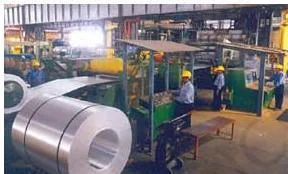
The photograph of the strip mill at the NALCO smelter gives a sense of the scale of a working aluminium plant — NALCO is the public-sector aluminium producer the book names in this section.
Chemical, fertiliser and cement industries
Three mineral-based industries revise quickly as a group — each with one or two facts the book wants you to remember.
Chemicals: India’s chemical industry is fast growing and diversifying, with both large and small units. Inorganic chemicals include sulphuric acid, used to manufacture fertilisers, synthetic fibres, plastics, adhesives, paints and dyestuffs; nitric acid; alkalies; soda ash, used for glass, soaps, detergents and paper; and caustic soda.
Organic chemicals are mainly petrochemicals, used for synthetic fibres, synthetic rubber, plastics, dyestuffs, drugs and pharmaceuticals, and organic plants are located near oil refineries or petrochemical plants. The chemical industry is its own largest consumer (NCERT, p. 64).
Fertilisers: production is centred on nitrogenous fertilisers (mainly urea), phosphatic fertilisers, ammonium phosphate (DAP), and complex fertilisers combining nitrogen, phosphate and potash. The potash component is entirely imported because India has no reserves of commercially usable potash or potassium compounds in any form.
Gujarat, Tamil Nadu, Uttar Pradesh, Punjab and Kerala together contribute half of the country’s fertiliser production (NCERT, p. 65).
Cement: essential for construction activity such as houses, factories, bridges, roads, airports and dams. The industry requires bulky and heavy raw materials — limestone, silica and gypsum — apart from coal, electric power and rail transportation.
The first cement plant was set up in Chennai in 1904, and plants in Gujarat are strategically located for suitable access to the market in the Gulf countries (NCERT, p. 65).
Automobile and information technology industries
These two modern industries grew after liberalisation, and both are tested by their location centres.
Automobiles: trucks, buses, cars, motorcycles, scooters, three-wheelers and multi-utility vehicles are manufactured in India at various centres. After liberalisation, the arrival of new and contemporary models stimulated demand and led to the healthy growth of the industry. It is located around Delhi, Gurugram, Mumbai, Pune, Chennai, Kolkata, Lucknow, Indore, Hyderabad, Jamshedpur and Bengaluru (NCERT, p. 65).
Information technology and electronics: the electronics industry covers a wide range of products, from transistor sets to television, telephones, cellular telecom, telephone exchanges, radars, computers and telecom equipment. Bengaluru has emerged as the electronic capital of India.
Other important centres are Mumbai, Delhi, Hyderabad, Pune, Chennai, Kolkata, Lucknow and Coimbatore, with the major concentration at Bengaluru, Noida, Mumbai, Chennai, Hyderabad and Pune. The industry’s major impact has been employment generation, and continuing growth in hardware and software is the key to its success.
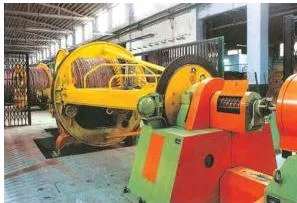
The cable-manufacturing photograph makes the point that the electronics industry is hardware manufacturing as well as software design — cables and telecom equipment are part of what the book counts as the industry’s output.
Industrial pollution: the four types and their causes
This is the long-answer half of the chapter — name the four types clearly, then add the two further kinds of harm the book tucks in.
Industries contribute significantly to India’s economic growth, but the pollution of land, water, air and noise that they cause cannot be overlooked. The book lists four types of pollution: air, water, land and noise, and notes that the polluting industries also include thermal power plants (NCERT, p. 66).
- Air pollution — caused by high proportions of undesirable gases such as sulphur dioxide and carbon monoxide, and by airborne solid and liquid particles like dust, sprays, mist and smoke. Sources are chemical and paper factories, brick kilns, refineries, smelting plants, and the burning of fossil fuels in factories that ignore pollution norms. Toxic gas leaks can be hazardous with long-term effects — the book asks whether you are aware of the Bhopal Gas tragedy.
- Water pollution — caused by organic and inorganic industrial wastes and effluents discharged into rivers. The main culprits are paper, pulp, chemical, textile and dyeing industries, petroleum refineries, tanneries and electroplating industries, which release dyes, detergents, acids, salts and heavy metals like lead and mercury into water bodies. Fly ash, phospho-gypsum and iron and steel slags are the major solid wastes in India.
- Land pollution — dumping of wastes, especially glass, harmful chemicals, industrial effluents, packaging, salts and garbage, renders soil useless; rainwater percolates down carrying the pollutants, and the groundwater also gets contaminated.
- Noise pollution — causes irritation and anger, hearing impairment, increased heart rate and blood pressure. Industrial and construction activities, machinery, factory equipment, generators, saws, and pneumatic and electric drills are the main sources.
The book adds two more kinds of harm: thermal pollution, when hot water from factories and thermal plants is drained into rivers and ponds before cooling, and nuclear wastes from nuclear power plants and weapons-production facilities, which cause cancers, birth defects and miscarriages.

The book places this photograph beside its point that soil and water pollution are closely related — once pollutants reach the soil, percolating rainwater carries them into the groundwater.
How environmental degradation is controlled
This is the other half of the long answer — pair each pollution type with its control measure.
The book opens the section with one striking figure: every litre of waste water discharged by industry pollutes eight times the quantity of fresh water (NCERT, p. 66).
Water use can be cut in three ways: minimise use by reusing and recycling water in two or more successive stages; harvest rainwater to meet water requirements; and treat hot water and effluents before releasing them into rivers and ponds. Treatment of industrial effluents happens in three phases, in this order (NCERT, pp. 66–67):
- Primary treatment — by mechanical means: screening, grinding, flocculation and sedimentation.
- Secondary treatment — by biological process.
- Tertiary treatment — by biological, chemical and physical processes, which involves recycling of waste water.
Overdrawing of groundwater reserves by industry, where there is a threat to the resource, also needs legal regulation. For air, particulate matter can be reduced by fitting smoke stacks with electrostatic precipitators, fabric filters, scrubbers and inertial separators, and smoke can be cut by using oil or gas instead of coal.
For noise, generators should be fitted with silencers, machinery can be redesigned for energy efficiency, noise-absorbing material should be used, and workers can use earplugs and earphones.
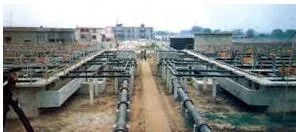
The Faridabad plant shown here is the real-world example of the treatment the book describes — waste water is processed through a treatment plant so that it does not pollute the river it would otherwise reach.
The chapter closes the argument by linking it to sustainable development: the challenge is to integrate economic development with environmental concerns (NCERT, p. 67).
NTPC shows the way
A named case study — the book’s example of an environmentally responsible corporation, worth keeping separate in your notes.
NTPC, a major power-providing corporation, holds ISO certification for EMS (Environment Management System) 14001 and takes a proactive approach to preserving the natural environment and resources like water, oil, gas and fuels in places where it sets up power plants (NCERT, p. 68). Its approach works through five measures:
- optimum utilisation of equipment, adopting the latest techniques and upgrading existing equipment;
- minimising waste generation by maximising ash utilisation;
- providing green belts for nurturing ecological balance, and addressing special-purpose vehicles for afforestation;
- reducing environmental pollution through ash pond management, an ash water recycling system and liquid waste management;
- ecological monitoring, reviews and online database management for all its power stations.
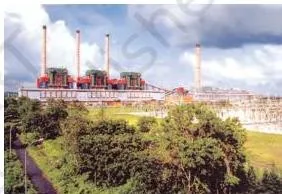
The Ramagundam plant is the photograph the book uses for this section — read it as a working power station operated under the environment management system the case study describes.
Reading the chapter’s key figures

Most figures in this chapter are photographs and distribution maps; one is a concept diagram — the textile value-addition figure — that you should be able to read and explain.
Fig 6.1 shows value addition in the textile industry. Read it as a production chain: the raw material enters at one end, and at each processing stage the product gains value, so by the time it reaches the highest value-added products, the same raw material is worth far more than when it started.
That is the idea behind the book calling textiles the only industry that is self-reliant and complete in the value chain, from raw material to the highest value-added products (NCERT, p. 60).
Two of the chapter’s figures are distribution maps, and these are your map-work component: the map of cotton, woollen and silk industries across India (NCERT, p. 61), and the map of iron and steel plants (NCERT, pp. 62–63). Revise them as belts rather than separate dots.
For location questions, collect the reasons in one place:
| Industry | Main location | Why it is located there |
|---|---|---|
| Cotton textiles | Maharashtra and Gujarat; spinning also in Tamil Nadu | Raw cotton, market, transport and port facilities, labour, moist climate |
| Jute | Hugli basin, West Bengal | Proximity of jute areas, cheap water transport, abundant water, cheap labour, Kolkata’s banking and port facilities |
| Sugar | Uttar Pradesh and Bihar (60% of mills); shifting to Maharashtra | Cane’s sucrose content, length of crushing season, success of cooperatives |
| Iron and steel | Chhotanagpur plateau | Low-cost iron ore, high-grade raw materials in proximity, cheap labour, home-market growth |
| Aluminium | Odisha, West Bengal, Kerala, Uttar Pradesh, Chhattisgarh, Maharashtra, Tamil Nadu | Regular electricity supply and assured raw material at minimum cost |
| Electronics (IT) | Bengaluru and other centres | Bengaluru has emerged as the electronic capital of India |
Common mistakes students make in this chapter
These are the confusions the chapter’s own text guards against — read them before you write, not after.
| Mistake | Correct rule | How to check your answer |
|---|---|---|
| Calling iron and steel “basic” because it is heavy | Basic refers to role — it supplies products as raw materials to other industries. Heavy refers to the bulk and weight of raw materials and finished goods. Iron and steel is both. | Ask whether your sentence is about what the industry does (basic) or how heavy its materials are (heavy). |
| Giving only cooperatives as the reason sugar mills shift to Maharashtra | Three reasons: higher sucrose content in the cane, a longer crushing season from the cooler climate, and more successful cooperatives. | Count three reasons in your location answer — a one-reason answer is incomplete. |
| Treating potash as a fertiliser India produces | India has no reserves of commercially usable potash or potassium compounds in any form, so potash is entirely imported. | Recall N-P-K: India produces nitrogenous and phosphatic fertilisers; the K component is imported. |
| Calling India’s cotton textile industry uniformly world-class | Spinning is world-class, but weaving supplies low-quality fabric because it cannot use much of the high-quality yarn produced. | Separate spinning (centralised, high quality) from weaving (decentralised, lower quality) when you write. |
| Writing the small-scale investment limit as a fixed fact | The limit has changed over time; at present the maximum investment allowed is one crore rupees. | Write “at present” or “currently” together with the figure. |
| Rounding the water-pollution figure | The book says every litre of waste water discharged by industry pollutes eight times the quantity of fresh water. | Memorise the exact “eight times” — it is a precise figure, not an approximation. |
How this chapter is asked in exams
The chapter’s own exercises tell you exactly what the book thinks matters — here is what each one tests and how to structure the answers.
The exercises (NCERT, pp. 68–70) open with two multiple-choice questions: (i) bauxite is the raw material used by aluminium smelting, and (ii) telephones and computers are manufactured by the electronic industry. These test the raw-material-to-industry pairing and the difference between electronics and information technology as industries.
Then come two brief answers, each in not more than 30 words: define manufacturing, and define basic industries with an example.
A full-mark 30-word answer states the definition in one sentence and, for the basic-industry question, names an example such as iron and steel or copper smelting in the next — no extra detail, because the word limit is part of the test.
The long question, in 120 words, asks how industries pollute the environment and what steps minimise environmental degradation. Structure the answer in two halves: the four pollution types with one cause each for the first half, then water reuse and recycling, the three phases of effluent treatment, the air-pollution equipment and the noise measures for the second half.
The chapter’s puzzles fix the terminology: the golden fibre is jute; sugarcane is the basic raw material of the sugar industry; iron ore, coking coal and limestone are the chief raw materials of the iron and steel industry; Bhilai is the public-sector steel plant located in Chhattisgarh; and railway diesel engines are manufactured at Varanasi in Uttar Pradesh (NCERT, pp. 69–70).
For map work, revise the belts named earlier: cotton spinning in Maharashtra, Gujarat and Tamil Nadu; jute along the Hugli; steel on the Chhotanagpur plateau; and Bengaluru as the electronic capital. One honest note: textbook contents and the examinable syllabus are not always identical — check the current official syllabus.
Key terms and definitions from the chapter
A revision-night glossary — each term in words you can reproduce without copying the book.
| Term | Plain meaning |
|---|---|
| Manufacturing | Production of goods in large quantities after processing raw materials into more valuable products (p. 57). |
| Agro-based industry | An industry that uses agricultural raw materials, such as cotton, jute, sugar and edible oil. |
| Mineral-based industry | An industry that uses minerals and metals as raw materials, such as iron and steel, cement and aluminium. |
| Basic or key industry | Supplies its products as raw materials to other industries; examples are iron and steel, copper smelting and aluminium smelting. |
| Consumer industry | Produces goods for direct use by consumers, such as sugar, toothpaste, paper and fans. |
| Small-scale industry | Defined by the maximum investment allowed on the assets of a unit; at present one crore rupees (p. 59). |
| Public sector | Owned and operated by government agencies, such as BHEL and SAIL. |
| Private sector | Owned and operated by individuals or a group of individuals, such as TISCO, Bajaj Auto and Dabur. |
| Joint sector | Run jointly by the state and individuals or a group; example, Oil India Ltd. |
| Cooperative sector | Owned and operated by the producers or suppliers of raw materials, workers, or both, sharing profits and losses proportionately; examples are sugar in Maharashtra and coir in Kerala. |
| Heavy industry | An industry whose raw materials and finished goods are heavy and bulky, such as iron and steel. |
| Light industry | An industry that uses light raw materials and produces light goods, such as electrical goods. |
| Thermal pollution | Pollution of water when hot water from factories and thermal plants is drained into rivers and ponds before cooling (p. 66). |
Revision summary for the night before the exam
The whole chapter as a flow, one line per idea — read this only after you have been through the sections above.
- Definition: production of goods in large quantities after processing raw materials into more valuable products (p. 57).
- Importance: modernises agriculture, creates jobs, brings foreign exchange, and prosperity through value addition (p. 58).
- Classification: five criteria — source of raw material, main role, capital investment, ownership, and bulk and weight (p. 59).
- Cotton: first successful mill in Mumbai in 1854; spinning centralised, weaving decentralised; khadi employs weavers at home (pp. 59–60).
- Jute: first mill at Rishra in 1855; Hugli basin location factors; largest producer, second exporter (pp. 60–61).
- Sugar: 60% of mills in Uttar Pradesh and Bihar; seasonal, suits the cooperative sector; shifting to Maharashtra (p. 62).
- Steel: basic and heavy industry; ratio 4:2:1 with manganese; Chhotanagpur plateau concentration (pp. 62–63).
- Aluminium: 4–6 tonnes bauxite → 2 tonnes alumina → 1 tonne aluminium; needs electricity and raw material at minimum cost (p. 64).
- Chemicals and fertilisers: chemical industry is its own largest consumer; potash is entirely imported; first cement plant in Chennai in 1904 (pp. 64–65).
- Automobiles and IT: grew after liberalisation; Bengaluru is the electronic capital; major centres include Noida, Mumbai, Chennai, Hyderabad and Pune (p. 65).
- Pollution: four types — air, water, land, noise; plus thermal pollution and nuclear wastes (p. 66).
- Control: one litre of waste water pollutes eight times its volume of fresh water; three-phase effluent treatment; air and noise measures (pp. 66–67).
- NTPC: ISO 14001 EMS certification; five-point environmental approach including ash utilisation and green belts (p. 68).
Sources and data verification
This listing is maintained for the 2026-27 academic session using the NCERT textbook information available to us. NCERT remains the authority for confirming the latest edition.
This page describes the NCERT Contemporary India II (Social Science, Class 10) textbook, Chapter 6, Manufacturing Industries, pages 57–70 of the printed book. Page numbers and figure captions follow the current NCERT edition as published on ncert.nic.in.
This page covers this single chapter and its exercises; it does not cover the other chapters of Contemporary India II or other Class 10 subjects. The listing is maintained for the current academic session using NCERT’s published information.
NCERT settles textbooks, editions and PDFs; CBSE settles curriculum, syllabus and examinations. Because textbook contents and the examinable syllabus are not always identical, a chapter appearing in the book does not by itself prove that every part of it is examinable this session — check the current official syllabus.
Related resources
Continue with the rest of the book and the site’s chapter notes:
- Class 10 Social Science notes — chapter summaries across Geography, History, Economics and Political Science
- Lifelines of National Economy — the next chapter of this book, on transport, communication and trade
- Class 10 notes hub — every subject on one page
- CBSE notes home — the full index of note pages
- Consumer Rights notes — the economics chapter that often closes the Class 10 Social Science paper
The previous chapter of this book, Minerals and Energy Resources, feeds directly into Chapter 6: the same minerals studied there — iron ore, bauxite, limestone — become the raw materials of the industries examined here.
| What the chapter holds | Count | Where it is used |
|---|---|---|
| Printed pages | 13 | |
| Figures with NCERT captions | 7 | |
| Tables | 3 | |
| Exercise questions | 3 | answered in our NCERT Solutions |
| Activities | 7 | |
| Official NCERT PDF | Download the chapter PDF | the chapter exactly as NCERT publishes it |
Frequently asked questions
What is manufacturing as defined in Class 10 Contemporary India Chapter 6?
Manufacturing is the production of goods in large quantities after processing raw materials into more valuable products (NCERT, p. 57). The book’s own examples are paper from wood, sugar from sugarcane, iron and steel from iron ore, and aluminium from bauxite.
Why are most jute mills located in the Hugli basin?
Because the basin offers proximity to jute-producing areas, inexpensive water transport supported by railways and roadways, abundant water for processing raw jute, cheap labour from West Bengal and adjoining states, and Kolkata’s banking, insurance and port facilities for export (NCERT, p. 61).
Why is the sugar industry shifting from Uttar Pradesh and Bihar to Maharashtra?
For three reasons: the cane produced in Maharashtra has a higher sucrose content, the cooler climate ensures a longer crushing season, and the cooperatives are more successful there (NCERT, p. 62).
What is the difference between basic industries and heavy industries?
Basic refers to an industry’s role — basic or key industries supply their products as raw materials to other industries, like iron and steel, copper smelting and aluminium smelting. Heavy refers to the bulk and weight of the raw materials and finished goods. Iron and steel is both basic and heavy (NCERT, pp. 59, 62).
What are the four types of industrial pollution listed in this chapter?
Air, water, land and noise pollution. The book adds thermal pollution — hot water drained into rivers before cooling — and nuclear wastes, which cause cancers, birth defects and miscarriages, as two further kinds of harm (NCERT, p. 66).
What is the 4:2:1 ratio in the iron and steel industry?
Iron ore, coking coal and limestone are required in the approximate ratio 4:2:1 — about four parts iron ore to two parts coking coal to one part limestone — with some manganese added to harden the steel (NCERT, p. 62).
Reference: NCERT Class 10 Contemporary India II (Social Science) textbook, Chapter 6, official edition on ncert.nic.in.
Explore Class 10 Social Science Books
Related chapters: