
This page is for Chapter 3, Water Resources, from the NCERT Class 10 Geography textbook Contemporary India II — printed pages 18 to 28. The official chapter PDF is linked right below, and the rest of this page explains what the chapter teaches.
Download the NCERT Class 10 Water Resources chapter PDF — the official chapter as published by NCERT on ncert.nic.in, with every section, figure and exercise exactly as it appears in the printed book. Open it to follow the page references on this page, or save the file for offline revision.
Chapter 3 at a glance: what is inside the PDF
The chapter runs from printed page 18 to page 28 of Contemporary India II. The table below renders the chapter’s contents — sections, figures, activities and exercise questions — directly from the official NCERT PDF, so you can confirm this is the file you want before downloading.
What this chapter covers: from water scarcity to rainwater harvesting
The chapter tells one connected story: water is renewable, yet India faces scarcity; dams became “multi-purpose river projects” and were the first big answer, but carry serious costs; rainwater harvesting — traditional and modern — offers a workable alternative. Its main parts, in printed order:
- Water as a renewable resource, renewed by the hydrological cycle (p. 18)
- Causes of water scarcity and the need for conservation and management (p. 19–20)
- Hydraulic structures in ancient India (p. 21)
- Multi-purpose river projects and integrated water resources management (p. 21–23)
- Traditional rainwater harvesting: guls, tankas, khadins and johads (p. 24–25)
- Rooftop rainwater harvesting and modern adaptations (p. 26–27)
- Bamboo drip irrigation in Meghalaya (p. 28)
The chapter ends with three exercise blocks on pages 28–29 that test all of the above.
Key concepts in Water Resources, explained plainly
This listing is maintained for the 2026-27 academic session using the NCERT textbook information available to us. NCERT remains the authority for confirming the latest edition.
Learn these terms before reading the sections closely. Each one is defined here in plain language, with the page where the chapter introduces it.
- Hydrological cycle (p. 18) — the continuous movement of water between the earth’s surface and the atmosphere: evaporation, condensation, precipitation, runoff and recharge. It continually renews and recharges surface runoff and groundwater, which is why freshwater counts as a renewable resource.
- Water scarcity (p. 19) — a shortage of safe water for people’s needs. The chapter’s central point: scarcity is usually caused not by low rainfall but by over-exploitation, excessive use and unequal access among social groups.
- Dam (p. 22) — a barrier across flowing water that obstructs, directs or retards the flow, often creating a reservoir.
- Multi-purpose river project (p. 21–22) — a dam whose impounded water serves several integrated uses: irrigation, electricity generation, domestic and industrial water supply, flood control, recreation, inland navigation and fish breeding.
- Rooftop rainwater harvesting (p. 25) — collecting rain from a roof through a pipe and storing it in an underground tank, or letting the excess recharge groundwater.
- Tanka (p. 25) — the underground tank used mainly in semi-arid Rajasthan to store rooftop rain as drinking water.
- Bamboo drip irrigation (p. 28) — a gravity-fed system in Meghalaya in which bamboo pipes carry spring water from hilltops and drip it near plant roots.
Keep one question in mind as you read on: if water is renewable, why does scarcity exist? The next section answers it.
Water scarcity: why high rainfall does not end shortage
The chapter opens with a contradiction you must be able to explain: three-fourths of the earth is covered with water, and water is renewed through the hydrological cycle — yet it is predicted that by 2025 nearly two billion people will live in absolute water scarcity (p. 18).
Why? Because scarcity is usually not about rainfall at all. The chapter lists the real causes:
- Over-exploitation and excessive use — irrigated agriculture is the largest consumer of water, and millions of farm wells and tube-wells are lowering groundwater levels.
- Unequal access among different social groups.
- Large and growing population — more people means more domestic water and more food, hence more irrigation.
- Industrialisation and urbanisation — industries are heavy water and power users, and dense cities over-pump groundwater through private borewells and pumping devices.
- Polluted water — water can be abundant but unusable after contamination by domestic and industrial waste, chemicals, pesticides and fertilisers (p. 20).
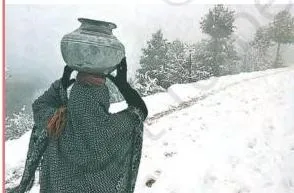
The chapter pairs this list with a striking photograph: after a downpour that recorded 180 mm of rain in Kolkata, a boy still had to collect drinking water from the flooded street (p. 20). Heavy rainfall, yet life was paralysed and drinking water was short — scarcity is a question of management, not just precipitation.
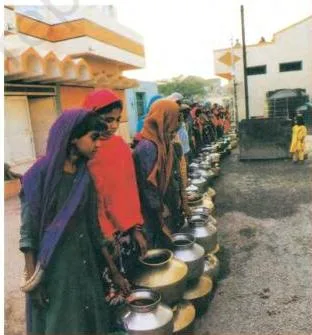
Fig. 3.1 (p. 20) is the picture most readers visualise first — desert regions and women balancing “matkas” (earthen pots) over long distances. The chapter uses this image deliberately: it is only a partial picture, because scarcity hits high-rainfall and low-rainfall regions alike.

Two government schemes close this section. Atal Bhujal Yojana works on groundwater management in more than 8,000 water-stressed gram panchayats across seven states, aiming to shift communities from consumption to conservation. Jal Jeevan Mission aims to give every rural household assured potable piped water at 55 litres per person per day (p. 20).
Multi-purpose river projects: dams, benefits and real costs
A dam is a barrier across flowing water. India has built them for centuries, but modern dams are “multi-purpose”: one reservoir integrates many uses — irrigation, electricity generation, domestic and industrial water supply, flood control, recreation, inland navigation and fish breeding (p. 21–22).
The chapter’s examples: the Bhakra-Nangal project on the Sutluj-Beas basin supplies both hydel power and irrigation, and the Hirakud project on the Mahanadi integrates water conservation with flood control (p. 22).
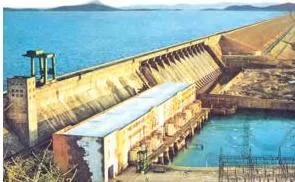
Jawaharlal Nehru called such dams the “temples of modern India” — they were meant to carry agriculture and the village economy into rapid industrialisation (p. 22). But the chapter balances that optimism with a long list of costs. Damming a river:
- changes its natural flow, causing poor sediment flow and sedimentation at the reservoir bottom, rockier stream beds and poorer habitats for aquatic life;
- fragments rivers, making it hard for aquatic fauna to migrate, especially for spawning;
- submerges floodplain vegetation and soil, which then decomposes over time;
- can trigger floods instead of controlling them, because sediment fills the reservoir — big dams have mostly failed to control floods during excessive rainfall;
- has induced earthquakes, water-borne diseases and pests, and pollution from overuse of water;
- shifts cropping to water-intensive commercial crops, causing soil salinisation;
- causes large-scale displacement of people and loss of livelihood.
Two case studies show the human and political side. Sardar Sarovar, built over the Narmada in Gujarat, is one of India’s largest water projects and covers four states — Gujarat, Maharashtra, Madhya Pradesh and Rajasthan (p. 23).
And the Krishna-Godavari dispute began because Karnataka and Andhra Pradesh objected to Maharashtra diverting more water at Koyna, which would reduce downstream flow in their states (p. 23).

The map on printed page 24 lets you locate the projects the chapter names — find Bhakra-Nangal in the Sutluj-Beas basin of the north and Hirakud on the Mahanadi in the east. If you can point to a dam on this map, you have learned its river basin.
Traditional water harvesting: guls, tankas, khadins and johads
Long before the big dams, Indians harvested water in small, local ways matched to the rainfall and soil of each region. The chapter groups these techniques by region (p. 24–25):
| Technique | Region | What it did |
|---|---|---|
| Guls / kuls | Western Himalayas | Diversion channels that carried water from hill streams for agriculture |
| Rooftop rainwater harvesting (tankas) | Rajasthan, especially semi-arid towns | Stored rooftop rain in underground tanks as drinking water |
| Inundation channels | Flood plains of Bengal | Channelled floodwater to irrigate fields |
| Khadins | Jaisalmer | Agricultural fields converted into rain-fed storage that let water stand and moisten the soil |
| Johads | Other parts of Rajasthan | The same rain-fed storage idea as khadins |
The chapter also gives a timeline of ancient hydraulic structures (p. 21):
- 1st century BC: Sringaverapura near Allahabad channelled floodwater of the Ganga.
- Chandragupta Maurya’s time: dams, lakes and irrigation systems were built extensively.
- Evidence of irrigation works at Kalinga (Odisha), Nagarjunakonda (Andhra Pradesh), Bennur (Karnataka) and Kolhapur (Maharashtra).
- 11th century: Bhopal Lake, one of the largest artificial lakes of its time.
- 13th–14th century: the Hauz Khas tank in Delhi, built by Allauddin Khilji to supply the Siri Fort area.
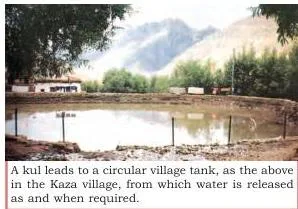
Fig. 3.5 (p. 26) shows one of these systems working today: a kul leads to a circular village tank in Kaza village, and water is released from it as and when required. It is an example of harvesting without a dam — the water is stored at the surface, close to where it is used.
One trend to remember: in western Rajasthan, rooftop rainwater harvesting is now on the decline because the Indira Gandhi Canal supplies plenty of water — though some households keep their tankas because they prefer the taste of rainwater to tap water (p. 26–27).
How rooftop rainwater harvesting works
The chapter explains rooftop harvesting twice: once as the traditional system of Rajasthan, and once as the modern recharge system shown in Fig. 3.3. Master both, because the exercises test exactly this.
The traditional system: tankas in Rajasthan
In Bikaner, Phalodi and Barmer, almost every house had an underground tank called a tanka, built inside the house or courtyard (p. 25). The steps:
- Rain falls on the sloping roof and travels down a pipe into the tanka.
- The first spell of rain is not collected — it cleans the roof and pipes.
- Rain from later showers is stored, and can last till the next rainfall, making it a reliable summer source of drinking water.
- This stored rainwater, called palar pani, is considered the purest form of natural water.
- The underground tank also keeps adjoining rooms cool in summer — one household in Phalodi had a tank 6.1 m deep, 4.27 m long and 2.44 m wide.
Fig. 3.3: the modern recharge system

Trace the figure from top to bottom (p. 26): rooftop rain is collected through a PVC pipe; the water is filtered using sand and bricks; an underground pipe carries it to a sump for immediate use.
Then the excess water from the sump goes to a well, and water from the well recharges the groundwater, to be drawn later. The two inset diagrams show this recharge happening through a hand pump and through an abandoned dugwell.
A worked example: how much water does a roof collect?
Every millimetre of rain on one square metre of roof equals one litre of water: \( 1\ \text{mm} \times 1\ \text{m}^2 = 1\ \text{litre} \). So for a house with a 40 m² roof, in a region receiving 750 mm of rain a year, at 80% collection efficiency:
\[ 40\ \text{m}^2 \times 750\ \text{mm} = 30{,}000\ \text{litres} \]
\[ 30{,}000\ \text{litres} \times 0.80 = 24{,}000\ \text{litres per year} \]
So about 24,000 litres a year — before counting what is lost to the first spell of rain. This is the same arithmetic behind the 50,000-litre figure in Gendathur, discussed next.
Modern adaptations: Gendathur, Shillong and Tamil Nadu
Rooftop harvesting is not just history — it is being revived and updated across India. The chapter gives three examples (p. 26–27).
- Gendathur, Mysuru (Karnataka) — nearly 200 households have installed rooftop harvesting, and the village has earned the rare distinction of being “rich in rainwater”. Gendathur receives 1,000 mm of rain a year; with about 80% collection efficiency and about 10 fillings of the tank, each house can collect about 50,000 litres annually — the same arithmetic as the worked example above.
- Shillong, Meghalaya — the sharpest edge case in the chapter. Cherrapunji and Mawsynram, just 55 km away, receive the highest rainfall in the world, yet Shillong faces an acute water shortage. So rooftop rainwater harvesting is the most common practice in the city: nearly every household has a structure, meeting about 15–25% of its water needs. The lesson: rainfall amount alone does not decide water availability — storage and management do.
- Tamil Nadu — the first state to make rooftop rainwater harvesting structures compulsory for all houses, with legal provisions to punish defaulters.
Bamboo drip irrigation in Meghalaya: a 200-year-old system
The chapter’s final case study uses no pumps, no electricity and no concrete: a 200-year-old Meghalaya system of tapping stream and spring water with bamboo pipes (p. 28). Here is how it works:
- Bamboo pipes divert perennial springs on hilltops down to lower reaches by gravity.
- About 18–20 litres of water enters the pipe system and travels over hundreds of metres.
- The flow reduces to 20–80 drops per minute at the site of the plant.
- Channel sections and diversion units, again made of bamboo, distribute water into branches at the plant site; the flow is controlled by manipulating the pipe positions.
- Where pipes cross a road, they are taken high above the land; the final channel section drops water near the roots of each plant.
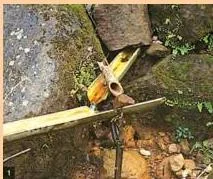

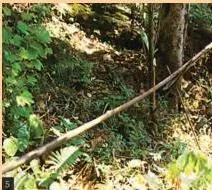
Together the three pictures show the whole journey: the spring tapped on the hilltop, the channels carrying water to the plants, and the pipes lifted clear of a road. It is a reminder that efficient irrigation does not need to be industrial.
Walkthrough of the NCERT figures in this chapter

The chapter uses diagrams to make three ideas visual: scarcity despite rain, the scale of dams, and how harvesting systems move water. Read each figure with the table below, then return to the sections above if a figure is unclear.
| Figure | Page | What it shows and how to read it |
|---|---|---|
| Fig. 3.1: Water Scarcity | 20 | Desert scenes of women carrying water pots — the image people associate with shortage. The chapter’s point: this picture is incomplete, because scarcity also hits high-rainfall cities. |
| Photograph: Kolkata after a downpour | 20 | A boy collects drinking water after 180 mm of rain — proof that rainfall alone does not remove scarcity. |
| Fig. 3.2: Hirakud Dam | 22 | A multi-purpose project on the Mahanadi, integrating conservation of water with flood control. |
| Map: India: Major Rivers and Dams | 24 | Locate Bhakra-Nangal (Sutluj-Beas) and Hirakud (Mahanadi); the map turns project names into places. |
| Fig. 3.3: Rooftop Rainwater Harvesting | 26 | PVC pipe → sand and brick filter → sump → well → groundwater recharge; insets show recharge through a hand pump and an abandoned dugwell. |
| Fig. 3.5: Traditional method of rainwater harvesting | 26 | A kul leading to a circular village tank in Kaza village; water is released as required. |
| Fig. 3.7: Bamboo drip irrigation | 28 | Bamboo pipes diverting perennial springs by gravity; channel sections distributing water at the plant site; pipes taken high above a road. |
Definitions you need for the exam
A quick glossary to scan before answering questions. Every definition is in the chapter’s own terms, shortened for memorising.
| Term | Plain definition | Page |
|---|---|---|
| Hydrological cycle | The continuous movement of water between the earth’s surface and the atmosphere; it renews and recharges freshwater. | 18 |
| Water scarcity | Shortage of safe water caused mainly by over-exploitation, excessive use and unequal access — not only by low rainfall. | 19 |
| Dam | A barrier across flowing water that obstructs, directs or retards the flow, often creating a reservoir. | 22 |
| Multi-purpose river project | A dam whose water is used for irrigation, electricity, water supply, flood control, recreation, navigation and fish breeding. | 22 |
| Tanka | Underground tank in Rajasthan that stores rooftop rainwater for drinking. | 25 |
| Khadin | Rain-fed storage in Jaisalmer made by converting fields so water stands and moistens the soil. | 24 |
| Johad | The same rain-fed storage idea used in other parts of Rajasthan. | 24 |
| Gul / kul | Diversion channel of the Western Himalayas that carried hill water to fields. | 24 |
| Rooftop rainwater harvesting | Collecting roof rain through a pipe for storage in a tank or for groundwater recharge. | 25 |
| Bamboo drip irrigation | Gravity-fed bamboo pipes in Meghalaya that carry spring water and drip it near plant roots. | 28 |
Common mistakes students make in Water Resources
The chapter’s own exercise contains three deliberately false statements. Students who fall for them are usually making the errors below (p. 28–29):
| Mistake | Correct rule | How to check your answer |
|---|---|---|
| High rainfall means no water scarcity. | High rainfall alone does not remove scarcity — a large population or polluted water can cause scarcity despite heavy rain (p. 19–20). | Test the four situations in Exercise 1(i): only the high-rainfall region with no other problem, and the low-rainfall, low-population region, are not classified as suffering. |
| Damming rivers does not affect their natural flow. | Damming changes natural flow: poor sediment flow, sedimentation, rockier stream beds, fragmented habitats, and sometimes floods instead of flood control (p. 22–23). | Before writing “no effect”, list at least three ecological effects from pages 22–23. |
| Rooftop harvesting has gained popularity in Rajasthan because of the Indira Gandhi Canal. | It is the opposite: it is on the decline in western Rajasthan because the canal supplies water; some houses keep tankas only for the taste (p. 26–27). | The chapter’s Exercise 1(iii) marks this statement false — read the canal sentence again before answering. |
| Scarcity is caused only by low rainfall or drought. | In most cases scarcity is caused by over-exploitation, excessive use and unequal access; rainfall variation is only one factor (p. 19). | Use the causes list from page 19 — if your answer names only rainfall, it is incomplete. |
How to use the NCERT exercises to check your understanding
The chapter ends with three exercise blocks on pages 28–29. Use them as a self-test, in this order:
| Exercise block | What it tests | How to approach it |
|---|---|---|
| Block 1: Multiple choice | Classifying situations as water-scarce or not; identifying the argument not in favour of multi-purpose projects; spotting false statements. | For (i), apply the scarcity section: population pressure and pollution create scarcity even with high rainfall. For (ii), recall that displacement and loss of livelihood is a cost, not a benefit. For (iii), the three corrected statements are in the common mistakes table above. |
| Block 2: 30-word answers | Renewable water; the definition and causes of water scarcity; comparison of advantages and disadvantages of multi-purpose projects. | Answer in one sentence of definition or a short list. For the comparison, write one line of advantages and one line of disadvantages. |
| Block 3: 120-word answers | Rooftop rainwater harvesting in semi-arid Rajasthan; modern adaptations of traditional methods. | Structure: 1–2 line opening, 2–3 examples, one-line conclusion. Do not retell the whole chapter. |
A suggested skeleton for the modern-adaptations question (Exercise 3(ii)):
- Opening: modern India is adapting traditional harvesting methods to store and conserve water.
- Gendathur: about 200 households in Mysuru, each collecting about 50,000 litres a year from 1,000 mm of rain at 80% efficiency.
- Shillong: rooftop harvesting is the most common practice even though the world’s wettest places lie 55 km away — rainfall amount alone does not decide water availability.
- Tamil Nadu: the first state to make rooftop rainwater harvesting compulsory for all houses.
- Conclusion: these small, local systems show a viable alternative to large dams.
The chapter’s short activities — writing a water-conservation proposal, listing inter-state water disputes, and similar — also work well as revision prompts. And as a general rule: textbook contents and the examinable syllabus are not always identical — check the current official syllabus to confirm what is examinable this session.
Water Resources in one page: fast recap
This one-page revision summary groups the chapter’s ideas by printed page, so you can revise in the order the book teaches.
- p. 18 — Renewable water. Three-fourths of the earth is water; the hydrological cycle renews and recharges surface runoff and groundwater. Yet nearly two billion people are predicted to live in absolute water scarcity by 2025.
- p. 19–20 — Why scarcity happens. Over-exploitation, excessive use, unequal access, population growth, industry, urbanisation and polluted water. Government responses: Atal Bhujal Yojana (groundwater management) and Jal Jeevan Mission (55 litres of potable piped water per person per day).
- p. 21 — Ancient hydraulic structures. Sringaverapura’s Ganga channels, Mauryan dams and lakes, Kalinga, Nagarjunakonda, Bennur, Kolhapur, Bhopal Lake and Hauz Khas.
- p. 22–23 — Multi-purpose river projects. Benefits: irrigation, electricity, water supply, flood control, recreation, navigation, fish breeding (Bhakra-Nangal, Hirakud). Costs: sedimentation, fragmented habitats, submergence, induced floods, earthquakes, disease, salinisation, displacement; disputes such as Krishna-Godavari.
- p. 24–25 — Traditional harvesting. Guls/kuls (Western Himalayas), tankas (Rajasthan), inundation channels (Bengal), khadins (Jaisalmer) and johads (Rajasthan).
- p. 26–27 — Rooftop harvesting and modern adaptations. PVC pipe → filter → sump → well → recharge; Gendathur (~50,000 litres per house), Shillong (high rainfall, yet harvesting common), Tamil Nadu (compulsory).
- p. 28 — Bamboo drip irrigation. 200-year-old gravity system in Meghalaya; 18–20 litres enters, 20–80 drops per minute reach the plant, no electricity needed.
Related NCERT Class 10 resources
Continue revising with these pages on the same site:
- Class 10 Social Science notes — all the history, geography, political science and economics chapters in one place. The previous chapter of this book, Forest and Wildlife Resources, is part of this set.
- Agriculture (Class 10 Social Science) — the next chapter in Contemporary India II.
- Sectors of the Indian Economy (Class 10) — an economics chapter resource, useful if you are revising that textbook too.
- Class 10 revision hub — notes for every subject at this level.
- All CBSE revision notes — the full notes library, organised by class.
The official chapter file is also published on the NCERT website at ncert.nic.in; the direct chapter PDF is the same link as the download at the top of this page.
Sources and data verification
This page describes Chapter 3 of NCERT Contemporary India II, Class 10 Social Science, printed pages 18 to 28, and is maintained for the current academic session from the official NCERT publication. All section, figure and page references come from that chapter as published on ncert.nic.in.
What this page covers: exactly this chapter — its sections, figures and exercises. What it does not cover: other chapters of the book, and the CBSE curriculum and examination papers beyond this chapter.
Who settles what: NCERT settles the textbook edition and the official chapter PDF; CBSE settles the examinable syllabus. As noted above, textbook contents and the syllabus are not always identical — confirm against the current official CBSE syllabus before deciding what to prioritise.
No external review process is claimed for this page.
| What the chapter holds | Count | Where it is used |
|---|---|---|
| Printed pages | 11 | |
| Figures with NCERT captions | 13 | |
| Exercise questions | 3 | answered in our NCERT Solutions |
| Activities | 6 | |
| Official NCERT PDF | Download the chapter PDF | the chapter exactly as NCERT publishes it |
FAQs: Water Resources questions answered
Why is water a renewable resource if so many places face water scarcity?
Water is renewable because the hydrological cycle continually renews and recharges surface runoff and groundwater (p. 18). Scarcity exists because the problem is not how much water falls but how it is used — over-exploitation, excessive use, unequal access, population pressure and pollution all cause scarcity even where rainfall is high.
What are the main causes of water scarcity in India?
Over-exploitation and excessive use (irrigated agriculture is the largest water consumer), unequal access among social groups, a large and growing population, industrialisation and urbanisation, and polluted water (p. 19–20). Low rainfall is only one factor, and often not the main one.
How is rooftop rainwater harvesting done in Rajasthan?
Rain falling on sloping roofs travels through a pipe into an underground tanka built inside the house or courtyard (p. 25). The first spell of rain is not collected because it cleans the roof and pipes; later rain is stored and can last till the next rainfall. This water, palar pani, is considered the purest natural water.
What are the disadvantages of multi-purpose river projects?
The chapter lists: altered natural flow with poor sediment flow and sedimentation, rockier stream beds, fragmented habitats for aquatic fauna, submergence of vegetation, induced floods, earthquakes, water-borne diseases, soil salinisation, and large-scale displacement and loss of livelihood (p. 22–23).
Where can I download the official NCERT Class 10 Geography Chapter 3 Water Resources PDF?
From the official NCERT website — use the download link at the top of this page, which opens the chapter PDF (file jess103.pdf) hosted on ncert.nic.in. The chapter is printed on pages 18 to 28 of Contemporary India II.
Reference: NCERT Class 10 Social Science Contemporary India-II textbook, chapter 3, official edition on ncert.nic.in.
Explore Class 10 Social Science Books
Related chapters: