
Nationalism in India Class 10 is Chapter 2 of NCERT’s India and the Contemporary World-II, the history book in the Class 10 Social Science set.
The chapter is printed on pages 29 to 50 of the book — 22 pages — and carries the national movement from the Rowlatt satyagraha of 1919 to the Quit India Movement of 1942.
The official NCERT chapter PDF is free, and the download link sits right below. After it comes a section-by-section walkthrough of what the chapter actually contains.
Download the Nationalism in India Class 10 PDF
The Nationalism in India Class 10 PDF (NCERT Chapter 2) is NCERT’s own edition from India and the Contemporary World-II, published free on the official NCERT website so you can read the chapter exactly as printed.
Chapter at a Glance: What Is Inside the PDF
The chapter table above gives you the exact counts — how many sections, figures, activities and exercise blocks the file holds. Here is what that file actually teaches you.
The chapter is organised around four numbered sections:
- Section 1, The First World War, Khilafat and Non-Cooperation (pp. 29-33): satyagraha, the Rowlatt Act, Jallianwalla Bagh and the logic of non-cooperation.
- Section 2, Differing Strands within the Movement (pp. 34-37): the movement in towns, Awadh, the Gudem Hills and the plantations of Assam.
- Section 3, Towards Civil Disobedience (pp. 38-45): the Simon Commission, Purna Swaraj, the Salt March, and who was — and was not — moved by it.
- Section 4, The Sense of Collective Belonging (pp. 46-48): Bharat Mata, folklore, flags and the rewriting of history.
The file also carries several ‘New words’ glossaries (forced recruitment, boycott, picket, begar), source boxes including Gandhi on satyagraha, Nehru on the Rae Bareli firing, the Independence Day Pledge and Iqbal on separate electorates, a ‘Some important dates’ box, in-text Activities, and closing exercise blocks: Write in brief, Discuss and Project.
What This Chapter Covers: 1919 to 1942
The chapter continues where an earlier textbook stopped: the growth of nationalism in India up to the first decade of the twentieth century (p. 29). It then picks up the story from the 1920s and follows one question — how Indians came to see themselves as one nation — through two mass movements and the years between them.
The sweep runs like this:
- Rowlatt satyagraha and the Jallianwalla Bagh massacre (1919)
- the Non-Cooperation-Khilafat Movement (1921-22) and its withdrawal
- the Civil Disobedience Movement (1930-34), with the Salt March at its centre
- what swaraj meant to different social groups
- the cultural processes — Bharat Mata, folklore, flags, history — that built a sense of collective belonging
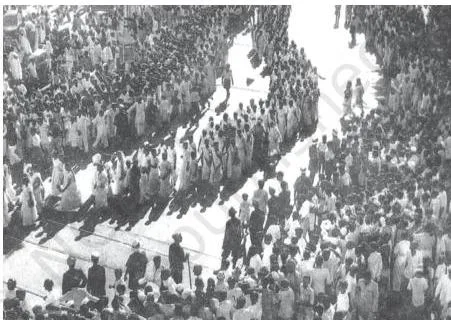
The chapter’s own conclusion: a growing anger against colonial rule brought many groups into a common struggle; the Congress tried to channel and hold them together; unity repeatedly broke down; and what emerged was a nation with many voices wanting freedom (p. 49).
The photograph above closes the book section: women marching in Bombay during the Quit India Movement of 1942. It is visual proof of how far the movement had spread — from the cities’ hartal of 1919 to ordinary people on the streets demanding that the British quit India.
Satyagraha, the Rowlatt Act and the Jallianwalla Bagh Massacre
This section explains the idea on which Gandhi built the whole movement, plus the first nationwide action that tested it — and its most brutal turning point.
Satyagraha means truth-force. If a cause was true, Gandhi argued, the struggle did not need physical force: a satyagrahi wins by appealing to the conscience of the oppressor, persuading people to see the truth instead of forcing it on them through violence (p. 30).
The First World War created the conditions for mass politics. Defence expenditure rose through war loans and new taxes — customs duties were raised, income tax introduced — and prices doubled between 1913 and 1918. Villages were forced to supply soldiers, and forced recruitment caused widespread anger (p. 30).
Then crops failed in 1918-19 and 1920-21, and an influenza epidemic followed. According to the census of 1921, 12 to 13 million people perished from famines and the epidemic (p. 30).
Gandhi returned from South Africa in January 1915 and tested satyagraha locally first: Champaran in 1917 for plantation peasants in Bihar, Ahmedabad in 1918 for cotton mill workers, and Kheda in Gujarat in 1918 for peasants who could not pay revenue after crop failure and plague (p. 30).
In 1919 he launched a nationwide satyagraha against the Rowlatt Act. The Act had been pushed through the Imperial Legislative Council despite the united opposition of its Indian members, and it allowed detention of political prisoners without trial for up to two years (p. 31). The campaign began with a hartal on 6 April 1919.
On 13 April a large crowd gathered in the enclosed ground of Jallianwalla Bagh in Amritsar. Some had come to protest the repressive measures; many others had come for the annual Baisakhi fair and, being from outside the city, did not know that martial law had been imposed (p. 31).
General Dyer blocked the exit points and opened fire, killing hundreds. His declared object, he said later, was ‘to produce a moral effect’ — to create a feeling of terror and awe (p. 31).
Brutal repression followed: satyagrahis were forced to rub their noses on the ground, crawl on the streets and salute officers; people were flogged, and villages were bombed. Seeing violence spread, Gandhi called off the movement (p. 31).
Khilafat, Hind Swaraj and Why Non-Cooperation
This section answers the two connections students find hardest: why an issue from the Ottoman Empire entered the Indian movement, and why non-cooperation was the chosen strategy.
After the Rowlatt satyagraha, Gandhi felt a broader movement was needed, but he was certain it could not be organised without bringing Hindus and Muslims closer together (p. 31).
The Khilafat issue gave him the bridge. The First World War had ended with the defeat of Ottoman Turkey, and the Ottoman emperor — the Khalifa, spiritual head of the Islamic world — faced a harsh peace treaty (p. 31).
A Khilafat Committee was formed in Bombay in March 1919. Muslim leaders Muhammad Ali and Shaukat Ali discussed united mass action with Gandhi, who saw it as an opportunity to bring Muslims under the umbrella of a unified national movement (p. 31).
The strategy came from Hind Swaraj (1909). British rule, Gandhi argued, had been established with Indian cooperation and survived only because of it; if Indians refused to cooperate, British rule would collapse within a year and swaraj would come (p. 32).
He proposed the movement unfold in stages: first, the surrender of government titles and a boycott of civil services, army, police, courts, legislative councils, schools and foreign goods; then, if the government used repression, a full civil disobedience campaign (p. 32).
Many Congress leaders were reluctant — they did not want to boycott the council elections of November 1920 and feared popular violence. An intense internal tussle followed, and a compromise at the Nagpur session in December 1920 adopted the Non-Cooperation programme (p. 33).
Differing Strands: What Swaraj Meant to Different Groups
The chapter’s central point is that one movement carried many meanings. The Non-Cooperation-Khilafat Movement began in January 1921; all groups responded to the call of swaraj, but the term meant different things to different people (p. 34).
Here is what swaraj meant to four groups in the first movement:
- Townspeople. Students left government schools, teachers resigned, lawyers gave up practice. Foreign cloth was boycotted, liquor shops picketed, and foreign cloth burnt in bonfires; imports halved between 1921 and 1922, from Rs 102 crore to Rs 57 crore. The urban movement slowed because khadi cost more than mill cloth and alternative Indian institutions were slow to come up (p. 34).
- Awadh peasants. Led by Baba Ramchandra, they fought talukdars and landlords over exorbitant rents, begar and insecure tenancy, using nai-dhobi bandhs. Jawaharlal Nehru toured the villages from June 1920, and the Oudh Kisan Sabha set up over 300 branches within a month. The Congress grew uncomfortable when peasants attacked talukdars’ houses and took over grain hoards (pp. 34-35).
- Gudem Hills tribals. Forest closures had destroyed their livelihoods — no grazing, no fuelwood, no fruits — and begar was imposed for road building. Alluri Sitaram Raju, who claimed special powers like surviving bullets, invoked Gandhi’s name but believed only force could win. His guerrilla attacks on police stations ended with his capture and execution in 1924; he became a folk hero (pp. 35-36).
- Plantation workers in Assam. Under the Inland Emigration Act of 1859 they could not leave the tea gardens without permission. Thousands walked out anyway, believing Gandhi Raj was coming and land would be given in their villages; a railway and steamer strike stranded them, and they were caught and beaten (p. 36).
The chapter draws the lesson: these visions were not defined by the Congress programme, yet by acting in Gandhi’s name, the tribals and others identified with a movement that went beyond their own locality (p. 37).
The Salt March and the Civil Disobedience Movement
After the withdrawal of the Non-Cooperation Movement in February 1922, eight years passed before the next mass movement. This section explains what changed in between — and what was different the second time.
Inside the Congress, one group wanted council politics: C. R. Das and Motilal Nehru formed the Swaraj Party to contest the provincial councils set up by the Government of India Act of 1919. Younger radicals — Jawaharlal Nehru and Subhas Chandra Bose — pressed for mass agitation and full independence (p. 38).
The world economic depression made the countryside restless: agricultural prices fell from 1926 and collapsed after 1930, so peasants could not sell their harvests or pay revenue (p. 38).
In 1928, the all-British Simon Commission was greeted with ‘Go back Simon’; Lala Lajpat Rai was assaulted by police during a peaceful demonstration and died of his injuries (p. 38). In December 1929 the Lahore Congress, under Nehru’s presidency, demanded Purna Swaraj — full independence — and declared 26 January 1930 Independence Day (p. 38).
Gandhi found in salt a symbol that could unite the nation. On 31 January 1930 he wrote to Viceroy Irwin with eleven demands — some general, some specific to different classes, so that all groups could identify with the campaign (p. 39).
The most stirring demand was the abolition of the salt tax. Salt was consumed by the rich and the poor alike and was among the most essential items of food; the tax and the government monopoly over its production, Gandhi declared, revealed the most oppressive face of British rule (p. 39).
Irwin would not negotiate, so Gandhi marched with 78 trusted volunteers from Sabarmati to Dandi — over 240 miles in 24 days, about 10 miles a day — with thousands joining on the way. On 6 April 1930 he reached Dandi and ceremonially violated the law by manufacturing salt from seawater (p. 39).
This marked the beginning of the Civil Disobedience Movement. The crucial difference from Non-Cooperation is stated plainly in the chapter: in 1921-22 people were asked to refuse cooperation with the British; in 1930 they were asked to break colonial laws (p. 39).
| Aspect | Non-Cooperation Movement (1921-22) | Civil Disobedience Movement (1930-34) |
|---|---|---|
| Aim | Swaraj, in support of Khilafat and self-rule (pp. 31-32) | Purna Swaraj — full independence (p. 39) |
| Method | Refuse cooperation: surrender titles; boycott schools, courts, councils, civil services, army, police, foreign goods (pp. 32-33) | Refuse cooperation and break colonial laws: salt law, forest laws, revenue and chowkidari taxes (p. 39) |
| Key event | Chauri Chaura violence, February 1922 (p. 37) | The Salt March to Dandi, 6 April 1930 (p. 39) |
| Outcome | Withdrawn by Gandhi after the violence (p. 37) | Gandhi-Irwin Pact (5 March 1931); relaunched 1932; lost momentum by 1934 (p. 40) |
The movement spread fast: salt laws broken, foreign cloth boycotted, liquor shops picketed, revenue and chowkidari taxes refused, forest laws violated. About 100,000 people were arrested (p. 40).
The Gandhi-Irwin Pact of 5 March 1931 released political prisoners and sent the Congress to the Round Table Conference. The talks broke down, the movement was relaunched in 1932, and by 1934 it had lost momentum (p. 40).
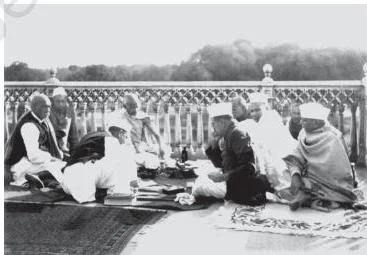
Fig. 6 shows the Congress leadership at Allahabad in 1931 — the leadership that moved between mass agitation and negotiation through these years (p. 38).
The Limits of Civil Disobedience: Dalits, Muslims and Separate Electorates
The chapter is honest about the limits of the movement: not all social groups were moved by the abstract concept of swaraj (p. 43). The dalits and large sections of Muslims held back, each for their own reasons.
The Congress had long ignored dalits for fear of offending sanatanis, the conservative high-caste Hindus. Gandhi declared that swaraj would not come for a hundred years if untouchability was not eliminated; he called dalits harijan, organised temple-entry satyagraha and cleaned toilets himself to dignify the work of the bhangi (p. 43).
But dalit leaders wanted a political solution. Ambedkar organised the Depressed Classes Association in 1930 and demanded reserved seats in educational institutions and a separate electorate; he clashed with Gandhi at the second Round Table Conference (p. 43).
When the British conceded separate electorates, Gandhi began a fast unto death. The result was the Poona Pact of September 1932: the Depressed Classes received reserved seats in provincial and central legislative councils, but they were to be voted in by the general electorate (p. 43).
After the decline of the Khilafat movement, a large section of Muslims felt alienated from the Congress. From the mid-1920s the Congress appeared more visibly associated with Hindu religious nationalist groups like the Hindu Mahasabha, and communal riots deepened the distance between communities (p. 44).
Jinnah was willing to give up separate electorates if Muslims were assured reserved seats in the Central Assembly and representation proportional to population in Bengal and Punjab. M. R. Jayakar’s strong opposition ended the compromise at the All Parties Conference of 1928 (p. 44).
The chapter includes Iqbal’s 1930 speech as Source D, arguing that separate electorates safeguarded the minority political interests of Muslims (p. 45). The Civil Disobedience Movement thus began in an atmosphere of suspicion and distrust between communities (p. 44).
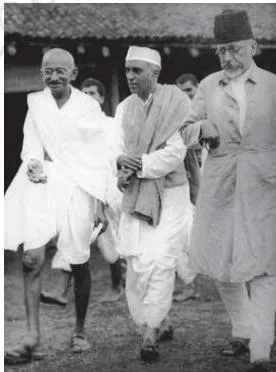
Fig. 10 shows Gandhi with Nehru and Maulana Azad at Sevagram Ashram in 1935 — three leaders from different communities who kept negotiating unity even after the movement had faded (p. 44).
The Sense of Collective Belonging: Bharat Mata, the Flag and Folklore
National unity came partly through united struggles, but also through cultural processes — history and fiction, folklore and songs, popular prints and symbols (p. 46). People had to believe they belonged to one nation, and these processes built that belief.
The image of Bharat Mata was first created by Bankim Chandra Chattopadhyay, who wrote ‘Vande Mataram’ as a hymn to the motherland in the 1870s and later included it in his novel Anandamath. It was widely sung during the Swadeshi movement in Bengal (pp. 46-47).
Abanindranath Tagore’s 1905 painting showed Bharat Mata as an ascetic figure — calm, composed, divine, spiritual. Devotion to the mother figure came to be seen as evidence of one’s nationalism (p. 47).
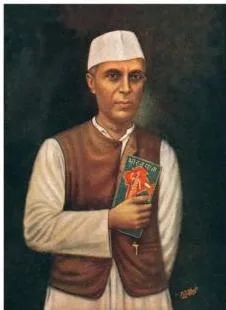
Fig. 12 is the painting described above. As the caption notes, the mother figure dispenses learning, food and clothing, and the mala in one hand stresses her ascetic quality (p. 47).
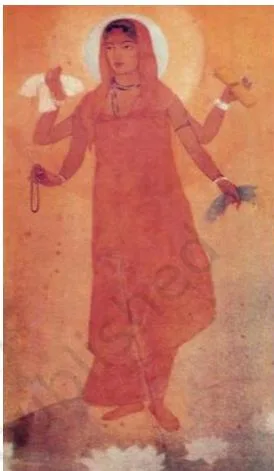
Fig. 13 is a popular print of Nehru holding Bharat Mata and the map of India to his heart. Popular prints often showed leaders offering their heads to the mother; the idea of sacrifice for her was powerful in the popular imagination (p. 47).
Nationalists also revived Indian folklore, collecting folk songs and tales that, they believed, preserved a traditional culture corrupted by outside forces. Rabindranath Tagore collected ballads and myths in Bengal; Natesa Sastri published the four-volume Folklore of Southern India (p. 47).
Flags gave the nation a visible identity. The Swadeshi tricolour — red, green and yellow — carried eight lotuses for eight provinces and a crescent for Hindus and Muslims. Gandhi’s Swaraj flag of 1921 — red, green and white — placed a spinning wheel at the centre for self-help. Carrying the flag became a symbol of defiance (p. 47).
Nationalism also grew through a reinterpretation of history. Against the British claim that Indians were backward and incapable of governing themselves, nationalist historians celebrated the country’s ancient achievements and described colonial rule as a period of decline (pp. 47-48).
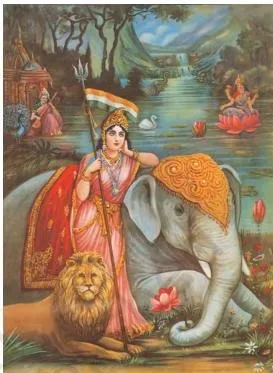
Fig. 14a offers the contrast: a Bharat Mata with a trishul, beside a lion and an elephant — symbols of power and authority, not ascetic calm (p. 48).
Yet these efforts created problems of their own. When the past being glorified was Hindu and the images drew on Hindu iconography, people of other communities felt left out (p. 48).
The book’s Activity asks whether such images would appeal to all castes and communities. A good answer weighs both sides: a mother figure could unite people across regions, but an image drawn from one religious tradition could feel alienating to those outside it — the very problem the chapter names on p. 48.
Reading the Chapter’s Images: Six Photographs That Carry the Argument
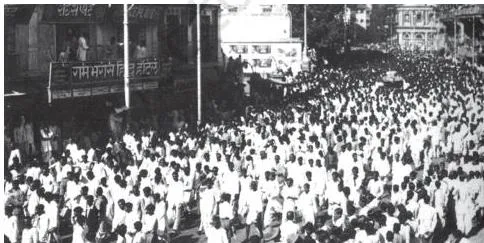
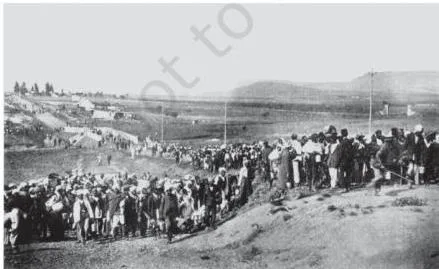
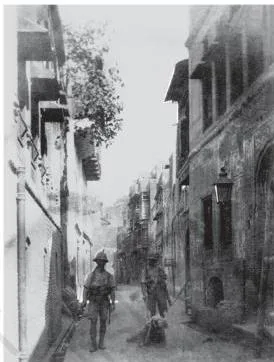
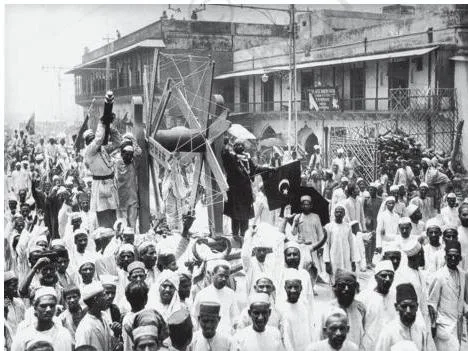
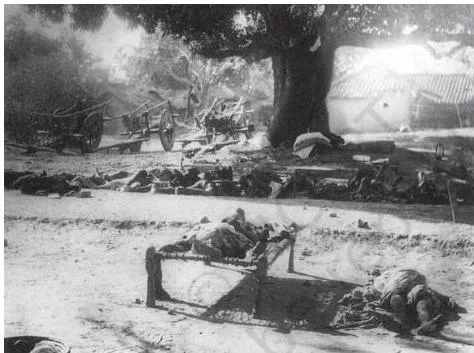
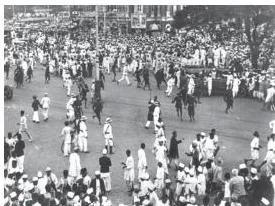
Mass politics was new, and photographs of processions, marches and repression made the movement visible to everyone. Read six of the chapter’s images in order, as historical evidence, in the book and here.
The image on p. 29 opens the chapter with the Rowlatt hartal: mass processions on the streets on 6 April 1919. The point is visual — politics had moved from petitions and meeting halls to the streets of the cities.
On p. 30, Indian workers march through Volksrust in 1913, Gandhi at their head. This march from Newcastle to Transvaal is where satyagraha was developed before it came to India (p. 30).
On p. 32, British soldiers administer General Dyer’s crawling orders in Amritsar, 1919. After Jallianwalla Bagh, satyagrahis were forced to crawl on the streets — the humiliation that Gandhi’s method answered.
On p. 33, the boycott of foreign cloth in July 1922. Foreign cloth was burnt in huge bonfires as a symbol of Western economic and cultural domination, making an economic argument visible.
On p. 37, Chauri Chaura, 1922. A peaceful demonstration in a bazaar turned into a violent clash with the police, and hearing of it, Gandhi called a halt to the Non-Cooperation Movement. This photograph explains the chapter’s biggest turning point.
On p. 40, police crack down on satyagrahis in 1930. Peaceful satyagrahis were attacked, women and children beaten, and about 100,000 people arrested — the armed response of the colonial state to Civil Disobedience (p. 40).
Key Terms Explained: Forced Recruitment, Boycott, Picket and Begar
The chapter glosses four terms in ‘New words’ boxes, and two more run through the whole argument. Each of these is a mark-scoring definition.
| Term | Meaning as the chapter uses it | Page |
|---|---|---|
| Forced recruitment | The colonial state forcing people to join the army | p. 30 |
| Boycott | Refusing to deal or associate with people, join in activities, or buy and use things — usually as a protest | p. 33 |
| Picket | Blocking the entrance to a shop, factory or office as a demonstration or protest | p. 34 |
| Begar | Labour that villagers were forced to contribute without any payment | p. 35 |
| Satyagraha | Truth-force; non-violent struggle that appeals to the conscience of the oppressor | p. 30 |
| Swaraj | Self-rule — but with no single meaning in this chapter; each group defined it through its own grievances | pp. 34-36 |
Common Mistakes Students Make in This Chapter
Most lost marks in this chapter come from mixing up movements, dates and pacts. The table names the errors before you make them.
| Common mistake | What is actually correct | How to check your answer |
|---|---|---|
| Confusing the two movements | Non-Cooperation (1921-22) asked people to refuse cooperation; Civil Disobedience (1930) asked them also to break colonial laws (p. 39) | Ask of any action in the question: did it refuse cooperation, or break a colonial law? Breaking the salt law means Civil Disobedience. |
| Believing the Jallianwalla Bagh crowd was only protesters | Many had come for the annual Baisakhi fair and did not know martial law had been imposed (p. 31) | The chapter says some came to protest, others to attend the fair. |
| Mixing up the pacts | Gandhi-Irwin Pact (5 March 1931): prisoners released, Congress to the Round Table. Poona Pact (September 1932): reserved seats for the Depressed Classes, elected by the general electorate (pp. 40, 43) | Match the pact to the problem it solved: negotiations, or dalit representation. |
| Treating swaraj as simple independence | It meant no begar and lower revenue to Awadh peasants, free movement to plantation workers, forest rights to tribals (pp. 34-36) | Check what the group’s own grievance was. |
| Getting the order of events wrong | Chauri Chaura (Feb 1922) → Simon Commission (1928) → Lahore Congress (Dec 1929) → Salt March (1930) | Use the timeline table below. |
| Thinking Khilafat was only a religious issue | Gandhi deliberately used it to bring Hindus and Muslims into one movement (p. 31) | The chapter calls it an opportunity to unify. |
What the Chapter’s Own Exercises Ask You to Explain
The chapter closes with Write in brief, Discuss and a Project. Treat them as the revision checklist: each question points to a specific section and page. For revision help across the whole subject, start at the Class 10 Social Science notes hub.
Write in brief (p. 50) maps like this:
- (a) Why colonial nationalism is linked to an anti-colonial movement — the opening pages (p. 29).
- (b) How the First World War helped the national movement — the war’s economic effects (p. 30).
- (c) Why Indians were outraged by the Rowlatt Act — detention without trial (p. 31).
- (d) Why Gandhi withdrew the Non-Cooperation Movement — Chauri Chaura (p. 37).
- What satyagraha means — Section 1.1 (pp. 30-31).
- Newspaper report on Jallianwalla Bagh — p. 31; on the Simon Commission — p. 38.
- Compare Bharat Mata with Germania from Chapter 1 — Section 4 (pp. 46-47).
Discuss (p. 50) points to:
- Social groups of 1921 — choose any three from Section 2 (pp. 34-36).
- The Salt March as an effective symbol — Section 3.1 (p. 39).
- A woman’s experience of Civil Disobedience — Section 3.2 (pp. 41-42).
- Differences over separate electorates — Section 3.3 (pp. 43-45).
Five in-text Activities form the chapter’s own question bank: Gandhi’s meaning of active resistance (p. 31); design a 1921 poster urging students to join Non-Cooperation (p. 34); how you, as a UP peasant of 1920, would respond to the call for swaraj (p. 35); martyrs compared with Indo-China (p. 36); and whether the Bharat Mata images appeal to all castes and communities (p. 48).
Model answer: why the Salt March was an effective symbol
Answer in four steps, all from p. 39:
- Salt was consumed by the rich and the poor alike, so the tax touched everyone.
- The tax and the government monopoly revealed, Gandhi declared, the most oppressive face of British rule.
- The law could be broken by ordinary people anywhere — manufacturing salt, picketing shops, refusing revenue — so protest moved from the abstract idea of Purna Swaraj to a concrete, everyday issue.
- The march itself made the campaign visible: 240 miles, 78 volunteers, thousands joining on the way to Dandi.
Model answer: why Gandhi withdrew the Non-Cooperation Movement
Answer in three steps, all from p. 37:
- The violence at Chauri Chaura in February 1922, where a peaceful demonstration turned into a violent clash with the police.
- Gandhi’s conviction that satyagrahis were not yet properly trained for mass struggle.
- His principle that a non-violent movement could not continue once it had turned violent.
The Chapter’s Timeline: Key Dates from 1915 to 1942 in One Table
This table condenses the whole chapter into dates. Each row names the event, why it matters, and the page that tells it; it is built from the chapter’s own ‘Some important dates’ box (p. 42) and the running text.
| Year | Event | Why it matters | NCERT page |
|---|---|---|---|
| January 1915 | Gandhi returns from South Africa | Brings the satyagraha method to India | p. 30 |
| 1917 | Champaran satyagraha | First campaign, for plantation peasants | p. 30 |
| 1918 | Ahmedabad and Kheda satyagrahas | Mill workers; peasants hit by crop failure | p. 30 |
| 1918-19 | Baba Ramchandra organises UP peasants | Awadh rebellion takes shape | p. 42 |
| March 1919 | Khilafat Committee formed in Bombay | Bridge for Hindu-Muslim unity | p. 31 |
| 6 April 1919 | Hartal against the Rowlatt Act | Nationwide satyagraha begins | p. 31 |
| 13 April 1919 | Jallianwalla Bagh massacre | Dyer fires on a mixed crowd | p. 31 |
| June-Oct 1920 | Nehru tours Awadh; Oudh Kisan Sabha set up | Over 300 branches in a month | p. 34 |
| September 1920 | Calcutta Congress accepts non-cooperation | The party commits to the strategy | p. 32 |
| December 1920 | Nagpur Congress adopts the programme | Compromise ends the internal tussle | p. 33 |
| January 1921 | Non-Cooperation-Khilafat Movement launched | Mass movement begins | p. 34 |
| February 1922 | Chauri Chaura; movement withdrawn | Violence halts the movement | p. 37 |
| May 1924 | Alluri Sitaram Raju arrested | Two-year tribal struggle ends | p. 42 |
| 1928 | Simon Commission; ‘Go back Simon’ | All-British commission rejected | p. 38 |
| December 1929 | Lahore Congress demands Purna Swaraj | Full independence becomes the goal | p. 38 |
| 26 January 1930 | Independence Day pledge | Call to struggle for complete independence | p. 39 |
| 31 January 1930 | Gandhi’s letter to Irwin, eleven demands | Ultimatum before the Salt March | p. 39 |
| 1930 | Ambedkar founds Depressed Classes Association | Dalit political organisation | p. 42 |
| 6 April 1930 | Dandi; salt law broken | Civil Disobedience Movement begins | p. 39 |
| 5 March 1931 | Gandhi-Irwin Pact | Prisoners released; Congress attends talks | p. 40 |
| December 1931 | Second Round Table Conference | Negotiations break down | p. 42 |
| September 1932 | Poona Pact | Reserved seats, general electorate | p. 43 |
| 1932 | Civil Disobedience re-launched | Movement resumes, then fades by 1934 | p. 42 |
| 8 August 1942 | Quit India resolution; ‘Do or Die’ speech | Mass movement for British withdrawal | p. 49 |
The pattern the chapter draws from all this: grievances were wide-ranging, freedom meant different things to different people, and unity within the movement often broke down. What emerged was a nation with many voices wanting freedom (p. 49).
Related Resources: Class 10 Social Science
This listing is maintained for the 2026-27 academic session using the NCERT textbook information available to us. NCERT remains the authority for confirming the latest edition.
For revision, the Class 10 Social Science notes hub gathers the whole paper in one place, and the wider Class 10 hub covers every subject.
Teachers may want the notes for the teacher. The geography half of the same paper — Water Resources, for instance — sits under the same hub in the CBSE notes library.
You can verify the current edition of India and the Contemporary World-II on the official NCERT textbook page for this book.
Sources and Data Verification
Four points about where this page’s facts come from:
- The page describes NCERT’s India and the Contemporary World-II, Class 10 Social Science, current NCERT edition, chapter 2 — printed pages 29 to 50 of the book.
- It covers only this chapter. The other chapters of the book are linked from the Class 10 Social Science page.
- This listing is maintained for the current academic session using the NCERT information available to us.
- NCERT settles textbooks, editions and official PDFs; CBSE settles the curriculum, syllabus and examinations. Textbook contents and the examinable syllabus are not always identical — check the current official syllabus.
| What the chapter holds | Count | Where it is used |
|---|---|---|
| Printed pages | 22 | |
| Sections in the chapter | 9 | |
| Figures with NCERT captions | 12 | |
| Activities | 5 | |
| Official NCERT PDF | Download the chapter PDF | the chapter exactly as NCERT publishes it |
FAQs: Nationalism in India Class 10
What is the difference between the Non-Cooperation Movement and the Civil Disobedience Movement?
They differed on aims and methods. The Non-Cooperation Movement (1921-22) asked Indians to refuse cooperation with the British — boycotting schools, courts, councils and foreign goods — while Civil Disobedience (1930-34) asked people also to break colonial laws, beginning with the salt law (p. 39).
The outcomes differed too: Non-Cooperation was withdrawn after Chauri Chaura (p. 37), while Civil Disobedience peaked with the Gandhi-Irwin Pact and faded by 1934 (p. 40).
Why did Mahatma Gandhi withdraw the Non-Cooperation Movement?
Because the movement had turned violent. At Chauri Chaura in February 1922, a peaceful demonstration in a bazaar became a violent clash with the police, and hearing of it, Gandhi called a halt (p. 37).
He believed satyagrahis needed proper training before mass struggle, and that a non-violent movement could not continue once it had turned violent (p. 37).
Why did Gandhi choose salt as the symbol of the Civil Disobedience Movement?
Because salt was consumed by the rich and the poor alike and was one of the most essential items of food. The tax on salt and the government monopoly over its production revealed, Gandhi declared, the most oppressive face of British rule (p. 39).
And because the law could be broken by ordinary people anywhere, salt connected the abstract demand for Purna Swaraj to a concrete, everyday issue (p. 39).
Which social groups joined the Non-Cooperation Movement and what did swaraj mean to each?
Townspeople wanted swaraj through boycott and self-rule; Awadh peasants wanted lower revenues, an end to begar and secure tenancy; Gudem Hills tribals wanted their forests and traditional rights back; plantation workers in Assam wanted the right to move freely and return to their villages. The chapter’s point is that each group defined swaraj through its own grievances (pp. 34-36).
Why did dalits and Muslim organisations stay away from the Civil Disobedience Movement?
Because the abstract idea of swaraj did not answer their concrete fears. Dalit leaders like Ambedkar wanted political power — reserved seats and a separate electorate — not just social reform (p. 43). Large sections of Muslims felt alienated after the Khilafat movement declined, and feared their identity would be submerged under a Hindu majority (p. 44).
Who was Alluri Sitaram Raju and why is he called a folk hero?
Alluri Sitaram Raju led the Gudem Hills tribal rebellion in Andhra Pradesh in the early 1920s against forest closures and begar. He claimed special powers and used Gandhi’s name, but he believed only force could win; his guerrilla attacks ended when he was captured and executed in 1924.
He is remembered as a folk hero for standing up to the colonial state (pp. 35-36, 42).
Reference: NCERT Class 10 Social Science textbook, chapter 2, official edition on ncert.nic.in.
Explore Class 10 Social Science Books
- Previous: Notes for the Teacher
- Next: Water Resources
Related chapters: