
Looking for The Pot Maker class 9 chapter as an official PDF? This page has it. The NCERT Class 9 English book “Kaveri”, chapter 2, “The Pot Maker”, runs 36 printed pages (Kaveri pages 33–68) and holds the Temsula Ao story, Galsworthy’s “Quality”, the poem unit “Gifts of Grace”, grammar and activities — the official PDF is linked right below.
The Pot Maker Class 9 NCERT PDF: Official Download
Download the Class 9 English Kaveri Chapter 2 The Pot Maker PDF from the official NCERT website — one file containing all 36 printed pages of the chapter, free from ncert.nic.in.
This page is maintained for the current academic session. If the direct file link is ever moved, the NCERT textbook portal lists every chapter of the Kaveri book.
The Pot Maker Class 9: Chapter at a Glance
A table on this page lists exactly how much the chapter holds — its sections, figures and exercises — so you know the size of the file before you open it.
In its shape, the chapter is one story with three companions. The main text is “The Pot Maker” by Temsula Ao (pages 34–41), an abridged story about a girl learning her mother’s craft.
After the language work comes a linked reading, “Quality” by John Galsworthy (pages 52–56), on handmade craft against mass production. The poem unit “Gifts of Grace: Honouring Our Vocations” (pages 58–62) celebrates every kind of skilled work.
Two short extension texts close the chapter: “The Lamplighter” by R.L. Stevenson and a Japanese haiku task (pages 67–68). Around these texts the chapter teaches vocabulary, noun clauses, relative clauses, determiners, and listening, speaking and writing tasks. The table carries the exact counts; the rest of this page describes what the chapter teaches.
What This Chapter Covers: A Story, a Reading and a Poem on Vocation
One theme runs through everything in this chapter: skilled work — who does it, who owns it, and what it is worth. Each text below looks at that theme from a different angle.
The Pot Maker: The Main Story (Kaveri Pages 34–41)
The story has two halves, and the turn happens in the girls’ dormitory.
Part one (pages 34–36): the secret dream. Sentila has dreamed of becoming a pot maker like her mother and grandmother since she was old enough to follow her parents to the fields. Her mother Arenla wants her to weave instead.
Sentila overhears Arenla’s reasons. The potters’ clay lies 16 kilometres away at the riverbank; the climb and the pounding of the clay are exhausting; months of labour end in a pittance. Weaving, by contrast, is clean, indoor, possible in all seasons and better paid (p. 34).
Sentila keeps visiting expert potters to watch them work, and village gossip reaches the council. The elders summon her father Mesoba and rule that skills such as pot making belong to no individual — experts must pass them on to anyone who wishes to learn (p. 36).
Part two (pages 37–40): the dormitory, the watching, the final session. Arenla teaches Sentila for almost a year with no success, because the girl is too tense for the clay to yield (pp. 37–38).
According to custom, the grown Sentila then stays in the girls’ dormitory, supervised by a kind widow the girls call Onula. Onula decides to help her, and a single evening lesson works. Her one criticism — “The mouth of the pot is all wrong” — sends Sentila back to watching her mother shape the rim (p. 39).
On a bright sunny day, Arenla finishes her own batch, complains of a headache and backache, and leaves Sentila alone. Sentila discovers she can make pot after pot, finishing one short of her mother’s tally — then finds her mother dead (pp. 39–40).
Onula later sees two identical rows of pots in the shed and understands what has happened: “A new pot maker was born” (p. 40).
What the ending means: the skill has passed to the next generation. The two rows are identical because the handover is complete — Sentila’s craft has become her mother’s craft.
Quality by John Galsworthy (Pages 52–56)
“Quality” is the Learning Beyond the Text reading introduced on page 51: students read it, review it, and present on the decline of traditional crafts against industrialisation.
The narrator’s boots are made by Mr Gessler, a craftsman who works slowly, never advertises, uses the best leather, and makes boots that last so long the narrator cannot visit him often (pp. 52–54). His German-accented speech — “Id is an ardt” — marks him as a foreign craftsman and carries his pride in the work (p. 52).
Big firms take his customers with advertising, not work. He starves rather than cut quality, and the shop’s new owner sums him up: “not a man in London made a better boot” (p. 56).
The story’s point for this chapter: handcraft dies when customers will not wait and quality cannot compete with advertising. Gessler’s nobility and his ruin are the same decision — refusing to compromise.
Gifts of Grace: Honouring Our Vocations (Pages 58–62)
“Gifts of Grace: Honouring Our Vocations” is a free-verse poem (pages 58–59) that celebrates craftspersons, artisans with lutes, carpenters, electricians, boatmen, shoemakers, cooks, designers and masons — each line giving one vocation its moment.
The unit opens with riddles about vocations (p. 57) and closes with exercises on tone, mood, imagery and other devices (pp. 60–62). The line students most often need is the poem’s anchor: “The voice of their vocation is the voice of their identity” (p. 59).
When the Check Your Understanding asks whether the poem follows a rhyme scheme, the answer is no — it is free verse, and the varying line lengths carry the celebration (p. 60).
The Lamplighter and the Haiku (Pages 67–68)
“The Lamplighter” (p. 67) is R.L. Stevenson’s poem of a child at tea-time watching Leerie the lamplighter pass with lantern and ladder. The child chooses, when stronger, to light the lamps with Leerie rather than be a driver or go to sea.
It is a child’s version of the chapter’s vocation theme: even a small job chosen with love outranks a rich one chosen without.
The haiku page (p. 68) teaches the Japanese form — 17 syllables in three lines of 5, 7 and 5 — using the snail poem “Make up your mind, Snail!”. The task asks you to write your own haiku.
Key Ideas in This Chapter: Skill, Tradition and Vocation
The chapter keeps asking one question: what makes skilled work valuable? Five ideas come back again and again, each tied to a page.
- Skill as community property — the council rules that pot making belongs to no individual; experts must teach anyone who wishes to learn (p. 36).
- Learning by watching — Sentila learns from expert potters, then from her mother’s hands at the mouth of the pot, not from lectures (pp. 38–40).
- Passion against practical return — Sentila’s dream survives Arenla’s honest list of reasons why weaving pays better (p. 34).
- Craft against mass production — Gessler’s slow handmade boots lose to firms that advertise (pp. 55–56).
- Identity through work — “The voice of their vocation is the voice of their identity” (p. 59).
| Character | What they want | Where it shows |
|---|---|---|
| Sentila | To become a pot maker like her mother and grandmother | pp. 34, 39–40 |
| Arenla | A weaver’s easier, better-paid life for Sentila — yet she secretly passes the skill on | pp. 34, 37–40 |
| Mesoba | To keep peace with the village council and his family | p. 36 |
| Onula | To see Sentila succeed at pot making | pp. 38–39 |
| Village elders | That the skill must not die out | p. 36 |
Taken together, the five ideas explain the ending. Sentila inherits a skill the community treated as common property, learns it by watching, and finds her identity in doing it.
The Dormitory Scene: Where Sentila Finally Learns
The chapter’s key illustration appears at the opening of Part II, on page 38. The scene it shows is the hinge of the whole story.
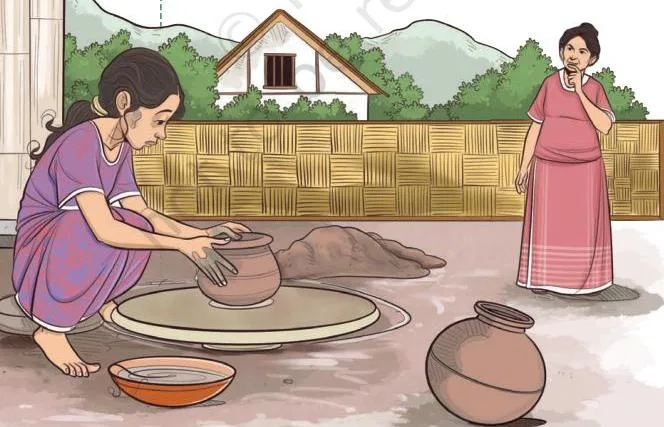
By this point, a year of Arenla’s coaching had failed because Sentila was too tense — the clay “seemed unable or unwilling to yield the right shape” (p. 39).
Onula’s calm promise — “Don’t worry, little one, I shall teach you how to make a perfect pot” — unlocks the same skill that anxious practice could not (p. 39).
Her one criticism, that the mouth of the pot is all wrong, sends Sentila back to watching her mother. That watching sets up the final scene in the work shed.
In short, the dormitory is where the story turns from failure to mastery. The figure shows the setting and the two people who make that turn happen: Onula and Sentila.
Word Meanings in The Pot Maker: The Glossary, Grouped
The chapter teaches new words in three places: the story margins, the vocabulary exercise, and the poem. This section groups them so you can look up a meaning without flipping pages.
Story words (pages 34–41)
| Word | Plain meaning | Page |
|---|---|---|
| outgrow | lose interest in something as you grow older | 34 |
| indifference | lack of interest | 34 |
| pittance | a very small amount of money | 34 |
| pounding | repeated beating | 34 |
| tedious | tiring and dull | 34 |
| deftly | skilfully | 35 |
| spatula | flat tool a potter uses to shape a pot | 35 |
| tend | take care of | 35 |
| followed suit | did the same as someone else had just done | 36 |
| dao | an instrument used for digging | 37 |
| malleable | able to be shaped without breaking or cracking | 37 |
| dormitories | large rooms with many beds, as in a hostel | 38 |
| resolved | determined | 38 |
| wearily | tiredly | 39 |
| slackened | relaxed | 39 |
| momentum | driving force | 40 |
| dexterity | skill with the hands | 40 |
| tally | a count of pots | 40 |
| threshold | the entrance to a room | 40 |
| intuitively | by feeling rather than reasoning | 40 |
| momentous | of great significance | 40 |
| phenomenon | an unusual incident | 40 |
| profound | powerful, deep | 41 |
| revelation | a moment of realisation | 41 |
Livelihood and economy words (page 45)
| Word | Plain meaning | Page |
|---|---|---|
| pittance | a very small payment | 45 |
| rupees | Indian money | 45 |
| reward | payment for work | 45 |
| return | what work or an enterprise gives back | 45 |
| bankrupt | unable to pay debts | 45 |
| credit | borrowed money that must be repaid | 45 |
| currency | the money used in a country | 45 |
| debt | money owed | 45 |
| fiscal | relating to government money and taxation | 45 |
| inflation | a general rise in prices | 45 |
| investment | money put into something to earn a return | 45 |
| interest | the charge for borrowing, or earnings on savings | 45 |
Poem vocabulary (page 63)
| Word | Plain meaning | Page |
|---|---|---|
| myriad | countless | 63 |
| hues | shades, colours | 63 |
| precision | exactness | 63 |
| varied | of different kinds | 63 |
| delicious | very pleasing | 63 |
| horticulturist | one who studies or grows garden plants | 63 |
| ASHA worker | a trained female community health worker | 63 |
| sericulturist | a producer of raw silk | 63 |
| confectioner | a maker or seller of sweets and chocolates | 63 |
| goldsmith | a metalworker who works in precious metals | 63 |
| welder | a person who fuses materials together | 63 |
Grammar in the Chapter: Noun Clauses, Relative Clauses and Determiners
The language pages (45–47) teach three sentence-building tools. Each gets a short block, with a fresh example and the book’s own example named for reference.
Noun clauses
A noun clause is a subordinate clause that does the work of a noun — usually the object of a verb. In “The potter knew that the kiln was ready”, the clause is the object of “knew”.
The book’s own examples are the two “that” clauses from the story: “she realised that the pot was ready” and “She intuitively sensed that something momentous had happened” (p. 46).
Relative clauses
A relative clause (also called an adjectival clause) describes a noun and starts with who, which, that, where or whose. Fresh example: “Onula, who was a widow, taught Sentila.”
The book’s example: “Arenla took Sentila to the riverbank where the grey and red clay was found” (p. 46).
Determiners
Determiners come before nouns and tell you quantity, definiteness or ownership. The book’s list (p. 47) runs from articles (a, an, the) through demonstratives (this, that, these, those), possessives (my, your, her), definite and indefinite numerals, to distributives (each, every, either, neither).
The story’s own examples include “some clay”, “as many pots”, “any individual” and “this place of wonder” (p. 47).
The tell-apart test: ask what the clause does. If it fills a noun slot (subject or object), it is a noun clause. If it describes a noun, it is a relative clause.
Poetic Devices in Gifts of Grace: How the Poem Works
The poem’s Check Your Understanding asks you to find six devices. The table tells you what each device is and which line to point to.
| Device | What it is | Where it appears in the poem |
|---|---|---|
| Imagery | Word-pictures that appeal to the senses | Artisans “with lutes”; boatmen “gathering their nets from the shore” (pp. 60–61) |
| Metaphor | Calling one thing by the name of another to compare them | “The delicious singing of the cook” — sound praised as if it were taste (p. 61) |
| Personification | Giving human qualities to non-human things | Vocations given a voice — the line about “the voice of their vocation” (pp. 59, 61) |
| Repetition | Repeating a word or line for emphasis | “I hear Bharat celebrating, the varied vocations I hear” opens and closes the poem (p. 61) |
| Alliteration | Repeated consonant sounds at word beginnings | “carpenters celebrating; they create” (c/k sound); “sailing, and singing” (s sound) (pp. 58–59) |
| Symbolism | One thing standing for something larger | Each vocation symbolises identity and heritage, more than a job (p. 61) |
One format point settles several questions: the poem is free verse. It has no fixed rhyme scheme, and the varying line lengths echo the different rhythms of different jobs (p. 60).
Listening, Speaking and Writing Tasks in the Chapter
The chapter pairs reading with doing. Listening, speaking and writing tasks sit at pages 48–50 and again at pages 64–68, and each expects a specific product.
Listening: stone statues (page 48)
Two tasks. First, fill the blanks in a paragraph about how a statue is carved, writing the exact words you hear. Second, select the six correct steps of statue-making from nine listed (p. 48).
Your job in the second task is to sort the true steps from the false ones. The final listed step — “work to bring out the imagined shape” — is the one the book illustrates.

Speaking: role-play from the story (page 49)
Work in pairs: choose Sentila and one other character — Arenla, Mesoba, Onula or a village elder — and prepare a conversation. It should cover Sentila’s desire to learn pot making, the challenges she faces, and the advice the other character offers (p. 49).
The book adds the licence shown in this figure: you may use direct quotes from the story and creatively expand on the characters’ thoughts and feelings (p. 50).

Speaking: the vocation speech (page 65)
For the poem unit, form groups of five and allot five vocations from the poem. Each student speaks for 1–2 minutes about their vocation — who they are, what they do, where they work, their experiences, the problems they face, and a message for all (p. 65).

Writing: reflective write-up and Career Mela poster (pages 49–50, 66)
The reflective writing task builds a write-up about your own skills and passion in five steps: introduction; describing skills; passion into profession; examples and reflection; conclusion (pp. 49–50).
The poster task asks you to complete a Career Mela poster announcing the event. A poster must sit in a box, be visually attractive, use letters of different fonts and sizes, keep proportionate spacing, and stay near 50 words (p. 66).
The poem unit also carries its own listening task (p. 64), about two friends discussing their parents’ occupations, and the chapter closes with a presentation on a vocation of your choice (p. 68).
What to prepare: for the listening tasks, train your ear for exact words and for ordering steps. For the role-play, know each character’s stance from the table above. For the speech, pick one vocation and cover the five points. For the writing, decide on your own skill and passion before you start.
Common Mistakes Students Make in This Chapter
Five errors recur with this chapter. Reading this table before you answer saves the marks.
| Mistake | Correct rule | How to check your answer |
|---|---|---|
| Reading the ending as “Sentila caused her mother’s death” | The story never says that. Arenla dies suddenly during Sentila’s solo session, and Sentila’s cry “I did not wish it to happen this way” is guilt, not causation. The point is the seamless handover of the skill; the two identical rows of pots are the “profound revelation” (p. 40). | Re-read pages 39–40: nothing links Arenla’s death to Sentila’s actions; the story’s last words are about the pots, not the death. |
| Mixing up noun clauses and relative clauses | Noun clauses fill noun slots (subject or object); relative clauses describe a noun (pp. 45–46). | Ask: does the clause fill a noun slot or describe a noun? |
| Taking “handsome return” and “delicious singing” literally | “Handsome” here means substantial; “delicious” is a metaphor for a pleasing sound (pp. 42, 60–61). | Replace the word with its plain meaning — if the sentence still makes sense, you have read it right. |
| Reading Gessler’s dialogue as careless English | His accent (“Id is an ardt”) marks a German craftsman’s speech in London; his refusal to advertise is both his nobility and his ruin (pp. 52–53, 55–56). | Note the context: a German boot maker in London; his accent points to his origin, not to low skill. |
| Confusing repetition with alliteration in the device questions | Repetition repeats whole words or lines; alliteration repeats initial consonant sounds (p. 61). | Are the repeated elements whole words (repetition) or single sounds (alliteration)? |
How the Chapter’s Exercises Work: Exam-Style Practice
The chapter’s own exercises train formats that English papers use, so they are worth practising exactly as printed. The syllabus note is at the end of this section.
The Critical Reflection format (pages 42–44)
Two extracts from the story, each with an assertion-reason choice, vocabulary in context (“handsome”, “fashioned”), a cause-effect question, and short answers (pp. 42–44).
Notice the rhetorical move in “And the reward?” (p. 42). The question mark turns Arenla’s complaint into a question, so the listener feels the unfairness — months of labour, a few rupees — instead of being told about it.
The short answers expect a pattern: a brief reference to the extract, then an explanation in your own words. Answers that only quote earn less than answers that quote and explain.
The sequence exercise (page 41)
Put the nine events in order. The correct sequence is 4, 6, 3, 1, 8, 5, 2, 9, 7, for these reasons:
- 4 — Sentila’s passion stays secret. The story opens with her dream and her silence about it.
- 6 — She overhears her mother. This is what makes her keep the dream hidden.
- 3 — She watches expert potters. Her secret visits feed the village gossip.
- 1 — The council calls Mesoba. The gossip forces the family issue into the open.
- 8 — A year of failed training. After the ruling, Arenla teaches, but Sentila cannot learn while tense.
- 5 — Onula guides her. The dormitory lesson succeeds where a year failed.
- 2 — Arenla leaves her alone. The final session begins with the mother’s batch and her excuse of headache and backache.
- 9 — Sentila finds her speed. She makes pot after pot, one short of her mother’s tally.
- 7 — Onula sees the two rows. After Arenla’s death, the identical pots reveal the handover.
The poem’s true-or-false format (pages 60–61)
Seven statements to judge; for the false ones you must also rectify — rewrite them so they become true. Statement 6 is the trap: the poem celebrates vocations, not patriotism.
The poster task (page 66)
The poster features are fixed: a boxed layout, visual appeal, varied fonts and sizes, proportionate spacing, and a 50-word limit.
Practice question (not from the textbook)
Read the passage and answer the two questions.
Onula, the kind widow who ran the girls’ dormitory, had quietly decided to help Sentila after hearing of the discord in the family. One evening she watched the girl struggle, her tense hands refusing to make the clay yield. Instead of scolding her, Onula promised to teach her, and her gentle words did what a year of anxious coaching had not.
(i) The word “discord” in the passage most nearly means:
- A. harmony
- B. disagreement
- C. celebration
- D. weariness
Correct answer: (B) disagreement. “Discord” names the family conflict over weaving versus pot making. Option A (harmony) is its opposite; options C (celebration) and D (weariness) name moods, not conflict.
(ii) Why did Onula’s gentle words succeed where a year of coaching had not?
Answer: Sentila’s failure came from tension — the clay would not yield because her hands were too tense (p. 39). Onula removed that pressure with reassurance and a calm promise to teach her. The calm confidence passed to Sentila, and with ease came mastery.
Syllabus note: textbook contents and the examinable syllabus are not always identical — check the current official syllabus for Class 9 English. Also note that this chapter is from the current NCERT Class 9 English book “Kaveri”; older Class 9 English readers are different books with different chapters, so guides written for those older books do not match this chapter.
Key Takeaways: What to Remember from the Chapter
A whole-chapter recap in our words — story, themes, companion texts and language items — for a final pass before you close the PDF.
- The story in five steps: the secret dream (p. 34); the mother’s objection and the council’s ruling that no one owns a skill (p. 36); a year of failed training in which tension beats talent (pp. 37–38); Onula’s dormitory lesson and the lesson of watching (pp. 38–39); the final solo session, the mother’s death, and the two identical rows — “A new pot maker was born” (p. 40).
- The theme in one line: skill belongs to the community, and identity is tied to vocation (pp. 36, 59).
- The companion texts: “Quality” — craft dies without customers who will wait (pp. 55–56); “Gifts of Grace” — every vocation deserves celebration (pp. 58–59).
- The language items: noun clauses and relative clauses (p. 46), determiners (p. 47), and the economic-vocabulary group (p. 45).
Related NCERT Pages for Class 9 English
These are the neighbouring pages for the Class 9 English book and the Class 9 hub.
- Class 9 English book page — every chapter of the Kaveri book with its official PDF
- Class 9 NCERT books — all subjects of Class 9
- Kaveri Chapter 1
- Kaveri Chapter 3
Revision notes for the chapters that sit alongside this one in the Class 9 English collection — How I Taught My Grandmother to Read and Winds of Change — live on the notes hub. The Class 9 English notes hub, the Class 9 hub and the CBSE notes home page collect study material for the whole class.
Sources and Data Verification
This listing is maintained for the 2026-27 academic session using the NCERT textbook information available to us. NCERT remains the authority for confirming the latest edition.
This page describes the NCERT Class 9 English textbook “Kaveri”, Chapter 2, “The Pot Maker”, in the official edition published on ncert.nic.in. Page numbers follow the printed Kaveri edition: the story runs pp. 34–41, language work pp. 44–47, activities pp. 48–51, “Quality” pp. 52–56, and the poem unit pp. 57–68.
This page covers Kaveri Chapter 2 only — not other Class 9 English books, and not the full CBSE syllabus. The listing is maintained for the current academic session using the NCERT information available to us.
NCERT settles textbook editions and PDFs; CBSE settles the curriculum and examinations.
| What the chapter holds | Count | Where it is used |
|---|---|---|
| Printed pages | 36 | |
| Figures with NCERT captions | 4 | |
| Tables | 7 | |
| In-text questions | 10 | |
| Official NCERT PDF | Download the chapter PDF | the chapter exactly as NCERT publishes it |
Reference: NCERT Class 9 English textbook (Kaveri), chapter 2, official edition on ncert.nic.in.
The Pot Maker Class 9: Frequently Asked Questions
Who wrote The Pot Maker and what is the story about?
The Pot Maker is by Temsula Ao, abridged in Kaveri on pages 34–40. It is the story of Sentila, a girl with a secret dream to learn her mother’s pot-making craft, and of how the skill passes to her despite a year of failed training.
Why does Arenla want Sentila to become a weaver instead of a pot maker?
Because weaving is clean, indoor, possible in all seasons, and much better paid (p. 34). Pot making means a 16-kilometre walk for clay, exhausting pounding, months of labour, and only a pittance at the end.
What does the ending “A new pot maker was born” mean?
It means the skill has passed to the next generation (p. 40). The two identical rows of pots prove the handover is complete: Sentila’s craft has become her mother’s craft.
What other texts appear in this chapter besides The Pot Maker?
“Quality” by John Galsworthy (pp. 52–56), the poem “Gifts of Grace: Honouring Our Vocations” (pp. 58–62), and, at the end, “The Lamplighter” by R.L. Stevenson and a Japanese haiku task (pp. 67–68).
What grammar does this chapter teach?
Noun clauses, relative clauses and determiners, on pages 45–47, with completion exercises for each.
Does this chapter have listening and speaking tasks?
Yes. Two listening tasks on stone statues (p. 48), a role-play between Sentila and another character (p. 49), a listening task on two friends discussing their parents’ occupations (p. 64), and a 1–2 minute vocation speech for the poem unit (p. 65).
Explore Class 9 English Books
- Previous: How I Taught My Grandmother to Read
- Next: Winds of Change
Related chapters:
- Vitamin-M
- The World of Limitless Possibilities
- Twin Melodies