
This page carries the official NCERT Class 9 English Kaveri Chapter 1 — ‘How I Taught My Grandmother to Read’, a story by Sudha Murty, followed by the poem ‘Bharat Our Land’ by Subramania Bharati. The chapter runs about 32 printed pages in the textbook.
The download for How I Taught My Grandmother to Read Class 9 below is the full official PDF, and the section-by-section guide that follows works through the story, the exercises and the poem with the book’s own page numbers.
Download the official Class 9 English Kaveri Chapter 1 PDF
The official file is the full printed chapter as published by NCERT — the story, the exercises and the poem in one document.
Open the NCERT Class 9 English Kaveri Chapter 1 How I Taught My Grandmother to Read PDF to read the chapter exactly as it appears in the textbook.
The chapter at a glance
Think of this section as a map of the chapter. The totals table on this page gives the overall size; the roster below shows where each part begins, with the NCERT page numbers from the book itself.
| Part | What it holds | Pages |
|---|---|---|
| Pre-reading: Reflect and Respond | Word web, discussion questions about grandparents, and a matching exercise on words such as protagonist, episode and community | p.1 |
| Story Part I | The setting, the writer Triveni and the serial Kashi Yatre, the week at a wedding; the cause-and-effect exercise follows on p.6 | pp.2-6 |
| Story Part II | The grandmother’s confession, her decision to learn Kannada, and the Dassara climax; the true/false exercise follows on p.9 | pp.7-9 |
| Critical Reflection | Two extract-based comprehension sets and seven short-answer questions on the story | pp.10-12 |
| Vocabulary and Structures in Context | Binomials, prefixes, idioms, and simple past versus past perfect tense | pp.13-16 |
| Listen and Respond | A listening task on digital literacy; the teacher’s transcript is on p.259 | p.17 |
| Speaking Activity | A turncoat debate: argue for and against a topic, one minute on each side | pp.17-18 |
| Writing Task | A letter to the editor on adult literacy, with a full formal format box | pp.19-20 |
| Learning Beyond the Text | A table of family words in five Indian languages and a gift-a-book idea | p.20 |
| ‘Do you know?’ notes | National Literacy Mission, financial literacy, the Early Literacy Project and cultural literacy | pp.21-22 |
| Poem: Bharat Our Land | Subramania Bharati’s ode with comprehension, device, vocabulary, listening and writing exercises | pp.23-32 |
What this chapter covers: a story, a poem and the skills between them
The chapter is built as a complete English unit, not just a story. It starts with talking, moves into reading, then builds vocabulary, grammar, listening and speaking, and ends with a poem.
- Reflect and Respond (p.1): a warm-up about grandparents and elderly relatives, with a word web and a vocabulary matching passage.
- Story Part I (pp.2-6): reading with a cause-and-effect check.
- Story Part II (pp.7-9): reading with a true/false check.
- Critical Reflection (pp.10-12): extract-based questions in the board literature style.
- Language work (pp.13-16): binomials, prefixes, idioms and the past perfect tense.
- Listen and Respond (p.17): complete sentences about digital literacy from a passage the teacher reads (transcript on p.259).
- Speaking (pp.17-18): a turncoat debate — one minute for, one minute against.
- Writing (pp.19-20): a formal letter to the editor on student participation in adult literacy camps.
- ‘Do you know?’ (pp.21-22): the National Literacy Mission, financial literacy, the Early Literacy Project and cultural literacy.
- Poem ‘Bharat Our Land’ (pp.23-32): Subramania Bharati’s ode, with its own full exercise set.
- Collaborative tasks: the Indian languages table (p.20) and the group geography project (p.32).
The story: plot, characters and the Kashi Yatre parallel
The story is a first-person account by a girl of about twelve who teaches her sixty-two-year-old grandmother to read Kannada. It is told in two parts, each followed by a comprehension check.
The world of the story
Set in a village in north Karnataka, the story opens with a slow transport system: the morning paper arrives only in the afternoon and the weekly magazine comes a day late. The household waits eagerly for the bus that brings the papers, magazines and post.
Triveni was a popular Kannada writer whose style was easy to read and very convincing. Her serial Kashi Yatre, printed in the weekly Karmaveera, is the family’s weekly event. The chapter pauses on p.3 to note that she died very young, which is why the unfinished serial matters so much.
Kashi Yatre is the story of an old lady with an ardent desire to go to Kashi. She believes that worshipping Lord Vishweshwara there is the ultimate punya.
In the story, an orphan girl falls in love but there is no money for the wedding. The old lady finally gives away all her savings, saying the girl’s happiness matters more than the pilgrimage (p.2).
Krishtakka never went to school, so she could not read. The narrator reads each new episode to her every Wednesday, and the grandmother can repeat the whole episode by heart afterwards. The grandmother too has never been to Kashi, so she identifies with the novel’s protagonist more than anyone else (pp.2-4).
What a week at a wedding does
The narrator leaves for a wedding in the neighbouring village and stays a week. When she returns, she finds her grandmother in tears — something she had never seen before, even in the hardest situations (p.5).
The grandmother explains that she opened the magazine, saw the picture beside the story and could not understand a word of what was written. She rubbed her hands over the pages, wished she were educated, and felt dependent and helpless. She even thought of asking someone in the village but was too embarrassed (p.7).
So she decides to learn the Kannada alphabet from the very next day, with Saraswati Puja day during Dassara as her deadline. When the narrator laughs at the idea of a sixty-two-year-old learning to read, the grandmother simply smiles and answers, ‘For learning there is no age bar’ (pp.7, 11).
The climax at Dassara
The narrator secretly buys Kashi Yatre, which has been published as a novel by then. On Dassara the grandmother calls her to the puja place, seats her on a stool, and gives her a gift of frock material (p.8).
Then she bends down and touches the narrator’s feet — the reverse of the tradition in which younger people touch the feet of elders and teachers. She says she is touching the feet of a teacher, not her granddaughter, because that teacher made her independent (p.8).
Finally she opens the novel and reads the title Kashi Yatre by Triveni and the publisher’s name aloud. The narrator knows her student has passed with flying colours (p.8).
This is the complete cause-and-effect chain from the exercise on p.6, with every cause matched to its effect.
| Cause | Effect |
|---|---|
| The transport system was poor | The morning papers arrived late in the day and the weekly magazines came one day late |
| The grandmother never went to school | She could not read and depended on the narrator for each episode |
| The grandmother identified with Kashi Yatre‘s protagonist | She was deeply interested and discussed every episode with her friends |
| The narrator went to a wedding for a week | The grandmother felt helpless and decided to learn to read |
| Education for girls was not considered essential then | The grandmother never went to school |
| The grandmother regretted not going to school | She made sure her children and grandchildren studied well |
The true/false exercise on p.9 tests the same events. Here are all six answers with the reason each is correct.
| Statement (p.9) | Answer | Why |
|---|---|---|
| 1. She wanted to learn the Kannada alphabet to gain independence | True | She said her goal was to be independent and read a novel on her own by Saraswati Puja day (p.7) |
| 2. She asked someone in the village to read to her while the narrator was away | False | She thought of it but was too embarrassed to ask anyone (p.7) |
| 3. The narrator was her first teacher | True | The narrator was her only teacher, and she was the narrator’s first student (p.8) |
| 4. She believed there was no age limit for learning | True | The grandmother herself said that learning has no age limit (p.11) |
| 5. She touched the narrator’s feet as a mark of respect for her teacher | True | She said she was touching the feet of a teacher, not her granddaughter (p.8) |
| 6. The narrator was disappointed with her progress | False | The narrator saw her read the title aloud and knew she had passed with flying colours (pp.8-9) |
Characters at a glance and why the grandmother identifies with Kashi Yatre
The cast is small, and every character exists to serve one idea: that literacy is independence.
| Character | Who they are | Pages |
|---|---|---|
| The narrator | A girl of about twelve who reads the serial aloud, teaches her grandmother, and later becomes a Computer Science teacher | pp.2, 8 |
| Krishtakka / Avva | The sixty-two-year-old grandmother who never went to school and decides to learn at that age | pp.2, 7 |
| Triveni | The popular Kannada writer of Kashi Yatre, who died very young | pp.2-3 |
| The old lady of Kashi Yatre | The serial’s protagonist, who gives away her savings instead of going to Kashi | p.2 |
The parallel between the grandmother and Kashi Yatre‘s protagonist is the emotional engine of the story. Both are old women with an unfulfilled longing: the protagonist never reaches Kashi, and Krishtakka never went to school.
Both finally choose something greater — the protagonist chooses the orphan girl’s happiness, and the grandmother chooses the independence that literacy brings. That is why the letter-writing task on adult literacy follows the story.
The poem: what Bharat Our Land celebrates
The second half of the chapter is Subramania Bharati’s ode to India. Most of its exercises ask you to name a literary device and point to the line that proves it, so the tables below do that work for you.
What the poem is about
The poem declares that the mighty Himavant, the generous Ganga, the sacred Upanishads, gallant warriors, sages, divinest music, Brahma-knowledge and the Buddha’s dhamma all belong to India. The refrain ‘she’s peerless, let’s praise her!’ returns like a chorus of pride (p.24).
Its tone is proud, reverent and celebratory — not nostalgic or sad. The warm-up on p.23 asks you to recall the National Anthem before you read, which sets that patriotic context.
The devices the chapter asks you to identify
The table below matches each literary device to the line from the poem that proves it.
| Device | Line from the poem | What it does |
|---|---|---|
| Ode | The whole poem — ‘she’s peerless, let’s praise her!’ | A lyrical poem of deep praise written in an elevated, formal style (pp.24, 27) |
| Allusion | ‘The sacred Upanishads are ours’ | An indirect reference to ancient scriptures; the poem also alludes to Brahma-knowledge and the Buddha’s dhamma (p.27) |
| Hyperbole | ‘there’s no equal anywhere on earth’ | Extreme exaggeration to make a point; not meant literally (p.26) |
| Personification | ‘The generous Ganga is ours’ | A river is given the human quality of generosity |
| Symbolism | ‘This sunny golden land’ | The land stands for richness and glory (p.25) |
| Imagery | ‘the mighty Himavant’, ‘this sunny golden land’ | Descriptive language that creates a vivid mental picture |
| Refrain | ‘she’s peerless, let’s praise her!’ | A repeated chorus that builds a chant-like rhythm and a mood of pride |
The hyphens in the first stanza create deliberate pauses, give the lines a measured chant-like rhythm, and place a key element of India’s greatness before the hyphen with a strong assertion of uniqueness after it (p.26).
The question marks at the end of lines four and six — ‘which other river can match her grace?’ — emphasise a point rather than express doubt (p.28). The same caution applies to the refrain: it is a claim of pride, not hesitation.
The symbolism exercise on p.25 asks you to match each symbol to what it suggests. Here is the complete matching from the book.
| Symbol | What it suggests (p.25) |
|---|---|
| Himavant | strength and permanence |
| Ganga | purity and generosity |
| Upanishads | spiritual and philosophical legacy |
| Gallant warriors and sages | courage and wisdom |
| Brahma-knowledge and Buddha’s Dhamma | knowledge and enlightenment |
| Sunny golden land | richness and glory |
Language work: tenses, binomials, prefixes and idioms
The exercises between pp.13-16 build four language tools. Each has a rule you can apply to any sentence, not just the ones in the book.
Simple past and past perfect
When two actions both happened in the past, the earlier action takes the past perfect tense (had + past participle) and the later action takes the simple past. The book states this rule on p.14 and gives examples on p.15.
Example 1. ‘By the time the morning paper reached our village, Avva had already finished her chores.’
Here reached is the simple past because the paper’s arrival is the later action. Had finished is the past perfect because the chores were done before the paper arrived.
Example 2. ‘When Avva touched my feet, I had already understood what she meant.’
In this pair, touched is the simple past (the later action) and had understood is the past perfect (the earlier action). The mistake to avoid is putting both verbs in past perfect — only the earlier action earns ‘had’.
Binomials
A binomial is a fixed pair of words joined by and or or, used together in a set order. The story gives you ‘hide and seek’; the exercise adds, for example, ‘sink or swim’, ‘mix and match’ and ‘part and parcel’ (p.13).
One original sentence: ‘Whether the village library survives depends on the community — it is sink or swim for everyone involved.’
Prefixes and idioms
Prefixes such as un-, ir-, in-, im- and dis- reverse a word’s meaning: unhappy, unusual, unfortunately, irrespective, independent (pp.13-14).
An idiom is a phrase whose meaning is not literal. ‘Passed with flying colours’ means an outstanding performance, and ‘hit the books’ means studying seriously (p.14).
Original sentence: ‘Every evening she hit the books, and by Dassara she could read a whole novel on her own.’
The illustrations and the moments they mark
The chapter prints pictures at key story moments, and each one marks a moment the exercises return to. Treat them as reading clues rather than decoration.

The first picture sits beside the passage on p.3. The chapter pauses there because Triveni’s early death is why the serial matters: her style was easy to read and very convincing, so the grandmother could follow every episode by ear even though she could not read.
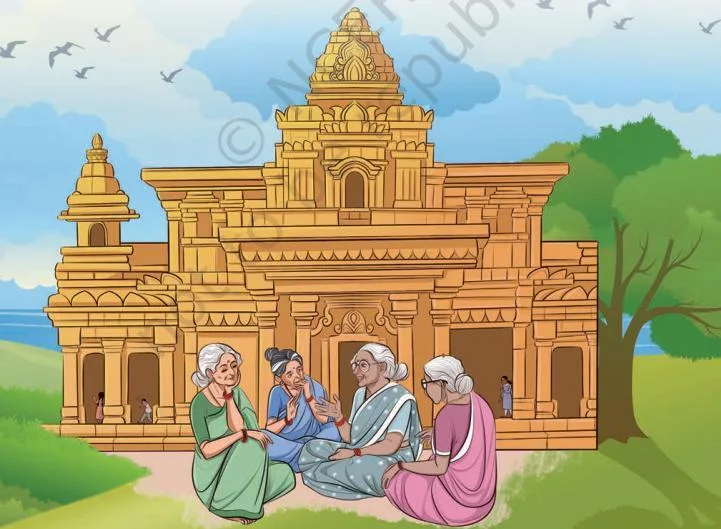
This image marks the serial as a community event, not a private reading. The grandmother joins her friends at the temple courtyard to discuss the latest episode while the children play hide and seek (p.4) — the exact phrase the binomial exercise on p.13 later reuses.
The Dassara festival picture is the climax of the story (p.8). The grandmother calls her teacher to the puja place, gives her frock material, and bends to touch her feet — the moment every earlier page has been building towards.
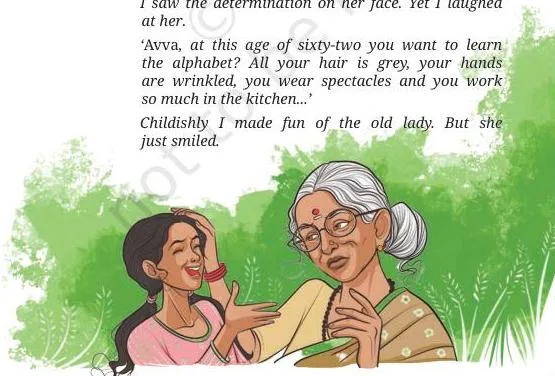
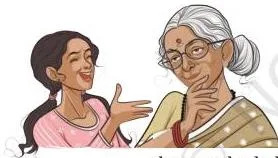
The final picture shows the narrator childishly making fun of the old lady who wants to learn the alphabet at sixty-two (p.11). The grandmother just smiles, and her smile carries the answer the whole chapter teaches: ‘For learning there is no age bar’.
Words and terms the chapter defines
This section collects the words the chapter itself teaches, so you can find any definition without searching the book.
| Term | What it means | Where the chapter introduces it |
|---|---|---|
| ardent | keen | p.3 |
| savouring | enjoying to the fullest | p.5 |
| immensely | extremely | p.7 |
| taken aback | surprised by something unexpected | p.9 |
| Avva | mother in the Kannada spoken in north Karnataka | p.4 |
| punya | religious merit | p.2 |
| protagonist | main character | p.1 |
| binomial | a fixed two-word expression joined by and or or | p.13 |
| idiom | a phrase whose meaning is not literal; ‘passed with flying colours’ means outstanding performance | p.14 |
| past perfect tense | the earlier of two completed past actions | pp.14-15 |
| hyperbole | extreme exaggeration | p.26 |
| ode | a lyrical poem of deep praise | p.27 |
| allusion | an indirect reference to a well-known person, place or text | p.27 |
| personification, symbolism, imagery, refrain | figures and devices the poem exercises ask you to identify | pp.25-26 |
Mistakes students make in this chapter’s exercises
The exercises in this chapter have predictable traps. The table names each one, gives the correction, and tells you how to check your answer.
| Mistake | Correct rule | How to check your answer |
|---|---|---|
| Reversing the cause-and-effect chain on p.6 | Education for girls was not considered essential then → she never went to school → she could not read; her regret → her children studied well | At every row ask: ‘Did this cause happen before that effect?’ |
| Marking statement 2 as true on p.9 | She thought of going to the village but was too embarrassed to ask anyone | Re-read the confession on p.7 before ticking |
| Marking statement 6 as true on p.9 | The narrator was delighted; her student passed with flying colours | Check the final lines of Part II on p.8 |
| Choosing ‘tired’ instead of ’emotional’ in the extract on p.10 | She nodded but did not reply because she was too emotional to respond | Read the extract’s tone: she is in tears, not exhausted |
| Reading the narrator’s laugh as cruelty | ‘Childishly I made fun’ is an assumption about age, not malice; the grandmother just smiled | Notice the grandmother’s reply about the age bar (p.11) |
| Putting both verbs in past perfect in the tense exercise (pp.15-16) | Earlier action = past perfect; later action = simple past | Find which action happened first; only that verb takes ‘had’ |
| Dropping the subject line or using an informal salutation in the letter (p.19) | Subject in 4-5 words, salutation Sir/Madam, three paragraphs, close ‘Yours truly’ | Run the format box on p.19 like a checklist |
| Reading the poem’s question marks and refrain as doubt (pp.26-28) | The question marks emphasise a point; the refrain is a chorus of pride | The correct option on p.28 says ’emphasise a point’, not ‘show doubt’ |
Preparing for exams with this chapter
The chapter’s own exercises are the best practice material it offers. They train exactly the formats you meet in literature papers, and most need no teacher to check.
- The two extract-based sets on pp.10-12 mirror board-style literature questions. Practise by covering the extract, answering the multiple-choice items first, then the short answers.
- The letter to the editor format box on p.19 is worth memorising as a checklist: name/designation/address, date, subject in 4-5 words, salutation Sir/Madam, three paragraphs (problem, analysis, suggestions), close with ‘Yours truly’, formal language throughout.
- The poem section defines ode, allusion and hyperbole on pp.26-27. Know each definition and be ready to point to its line in the poem.
- The listening tasks on pp.17 and 30 use the teacher’s transcript (pp.259-260). In self-study, ask your teacher for the passage instead of guessing the answers.
- The turncoat debate on pp.17-18 is good practice for any argument-style speaking task — use the sentence prompts and try both sides.
- For revision across subjects, the Class 9 notes hub on this site gathers chapter-wise notes for every core subject.
One honest caveat: textbook contents and the examinable syllabus are not always identical, so check the current official CBSE syllabus for what is examinable this year. No page can promise which questions will appear.
Revise in ten minutes: story, poem and language
This is the whole chapter compressed for a last reading the night before.
The story in six lines
- A twelve-year-old girl in north Karnataka reads the serial Kashi Yatre aloud to her grandmother every week (p.2).
- The grandmother, who never went to school, lives for each episode and identifies with its protagonist (p.4).
- A week away at a wedding leaves the grandmother unable to read the new episode; she breaks down, feeling dependent and helpless (pp.5, 7).
- She decides to learn the Kannada alphabet by Saraswati Puja day and says learning has no age bar (pp.7, 11).
- The girl teaches her, and the grandmother works harder than any other student (p.8).
- On Dassara the grandmother reads the published novel herself and touches her teacher’s feet (p.8).
The poem in three lines
- An ode to India’s mountains, rivers, scriptures, sages, warriors and the Buddha (p.24).
- Held together by the refrain ‘she’s peerless, let’s praise her!’ (p.24).
- The exercises test the devices: ode, allusion, hyperbole, personification, symbolism and imagery (pp.25-27).
The language tools
- Binomials are fixed pairs like ‘hide and seek’ or ‘sink or swim’ (p.13).
- Past perfect marks the earlier of two past actions; simple past marks the later (p.14).
- ‘Passed with flying colours’ is an idiom meaning outstanding performance (p.14).
- The letter to the editor needs the three-paragraph format and ‘Yours truly’ (p.19).
Related resources and official links
This listing is maintained for the 2026-27 academic session using the NCERT textbook information available to us. NCERT remains the authority for confirming the latest edition.
The NCERT Class 9 English book page lists this chapter alongside the others in the volume, and the Class 9 hub on this site organises the NCERT books for the whole year.
For revision, the Class 9 English notes on this site compress each chapter into key points, and the notes for other texts in this book, such as The Pot Maker, work the same way. The full CBSE notes section is the starting point for every Class 9 subject.
The official file for this chapter is the iebe101 PDF linked at the top of this page. The chapter itself recommends the adult education page run by the Department of School Education and Literacy on p.21, which explains the adult education programmes in India.
Sources and data verification
This page describes the NCERT Class 9 English textbook Kaveri, chapter 1, as published in the current NCERT edition.
It covers this single chapter — the Sudha Murty story and the Subramania Bharati poem — and not other Class 9 English material.
The page is maintained for the current academic session using the NCERT information available to us.
NCERT settles textbooks, editions and official PDFs; CBSE settles curriculum, syllabus and examinations.
| What the chapter holds | Count | Where it is used |
|---|---|---|
| Printed pages | 32 | |
| Figures with NCERT captions | 4 | |
| Tables | 18 | |
| In-text questions | 6 | |
| Official NCERT PDF | Download the chapter PDF | the chapter exactly as NCERT publishes it |
Frequently asked questions
Where can I download the official Class 9 English Kaveri Chapter 1 PDF?
The download block at the top of this page links the official NCERT Class 9 English Kaveri Chapter 1 PDF on ncert.nic.in — the full printed chapter, story and poem together.
Who wrote How I Taught My Grandmother to Read?
Sudha Murty wrote the story. It is told in the first person by the granddaughter, who says she later became a Computer Science teacher (p.8).
Why did the grandmother touch the narrator’s feet at the end of the story?
Because she was touching the feet of a teacher, not her granddaughter. She said a teacher should be respected irrespective of gender and age, and that this teacher had made her independent (p.8).
What is the novel Kashi Yatre about, and why does it matter in the story?
Kashi Yatre is the serial in the weekly Karmaveera that the grandmother follows. It is about an old lady who longs to go to Kashi but finally gives her savings to an orphan girl so the girl can marry. The grandmother identifies with the protagonist because she too never went to Kashi (pp.2, 4).
Why was the grandmother unable to read the magazine on her own?
Because she never went to school — education for girls was not considered essential in her time — so she could not read. She depended on the narrator to read each episode aloud, and when the narrator was away for a week she felt dependent and helpless (pp.5, 7).
Is the poem Bharat Our Land part of this same chapter?
Yes. ‘Bharat Our Land’ by Subramania Bharati is the second half of the same chapter, printed on pp.23-32 with its own exercises.
Reference: NCERT Class 9 English (Kaveri) textbook, chapter 1, official edition on ncert.nic.in.
Explore Class 9 English Books
- Next: The Pot Maker
Related chapters:
- Winds of Change
- Vitamin-M
- The World of Limitless Possibilities