
The Planning for Kaushal Mela Class 7 chapter is Chapter 7 of NCERT’s Kaushal Bodh, the Class 7 Vocational Education textbook. It is about running a school skill fair — where students show family and community the project work they have done — through seven planning steps, from brainstorming to post-event cleanup.
The official chapter PDF is right below, and the rest of the page explains the chapter in plain words you can revise from.
NCERT Class 7 Planning for Kaushal Mela Chapter PDF
If you want the exact file the chapter is printed from, open the NCERT Class 7 Planning for Kaushal Mela chapter PDF (official) — it has the full chapter text, Table 7.1 and both step illustrations in NCERT’s own layout. This is the official NCERT file for the chapter, published on the NCERT website.
Chapter 7 at a glance
The table below shows what the chapter contains at a glance — its sections, figures, tables and questions — so you can see what is inside without opening the PDF, and confirm you have the right chapter.
What Chapter 7 is about: planning a Kaushal Mela
A Kaushal Mela is the school event where students show their family and the wider community the project work they have done — what they made, and how they made it.
Planning comes first because it decides how to reach that goal: what must be done, when it must be done, and who will do it, so that everything runs smoothly and resources are not wasted.
Two examples in the chapter opening make the idea concrete. A puppet show has to be scheduled at a time and venue where the maximum number of people can actually watch it — that is planning for timing.
A tie-and-dye demonstration needs every material available in one place, in the right quantity, before it starts — that is planning for resources. Together they show that planning prevents wastage of time and of materials.
The unifying idea behind both: every task in the Mela needs an owner, a deadline and a process. The chapter is explicit that responsibilities must be assigned for each activity, that the process for each activity must be discussed in detail, and that the class needs a plan to work together as a team.
Table 7.1 is the tool that holds all three: its in-charge column is the owner, its date column is the deadline, and its details column is the process.
The seven planning steps of the chapter
The whole chapter runs on a seven-step sequence: Brainstorming → Timeline → Checklist → Execution of tasks → Preparation of displays → Event day → Post-event activities.
| Step | What you do | What it produces |
|---|---|---|
| 1. Brainstorming | List together everything that needs to happen for the Mela | A full list of tasks agreed by the team |
| 2. Timeline | Fix the date by which each task must be completed | Deadlines for every task |
| 3. Checklist | Turn tasks into tick-box items — the chapter’s own tick items are posters, labels and invites | A tick-list that proves tasks are done |
| 4. Execution of tasks | Actually do the planned work — make posters, send invites, gather materials | Completed preparations |
| 5. Preparation of displays | Set up stalls and work so visitors can understand it — labelling, signboards, arrangement | A ready, labelled display |
| 6. Event day | Run the Mela itself on the planned schedule | The event, run as planned |
| 7. Post-event activities | Clean up, return equipment, remove waste, collect feedback | A closed event with lessons noted |
Timeline comes before Checklist for a reason. The timeline decides the deadlines first; the checklist is the tick-list that proves the deadlines were met. If you build the checklist first, you are listing work with no date attached — and a task with no date is a task that quietly never gets done.
To keep the order in your head, remember: Before The Celebration, Everyone Prepares Everything Properly. The first letters, B-T-C-E-P-E-P, match the seven steps in order, and the last word reminds you that post-event activities are part of the plan from the start, not an afterthought.
- Before → Brainstorming
- The → Timeline
- Celebration → Checklist
- Everyone → Execution of tasks
- Prepares → Preparation of displays
- Everything → Event day
- Properly → Post-event activities
Why does the checklist matter so much? Suppose the tie-and-dye stall’s material list is never ticked off: on the day, the dye is still in the store room, or there is only half the cloth needed — time is lost fetching material and the demonstration shrinks.
The checklist exists to catch exactly that before the event. It is the chapter’s idea that planning prevents wastage of time and resources, applied one day earlier.
Planning for Kaushal Mela Class 7: how to fill Table 7.1
Table 7.1 is the chapter’s working tool, and every column needs an answer — the plan is complete only when no cell is left blank.
Here is a completely filled sample of Table 7.1 for an original project: a stall demonstrating paper-bag making, with the Mela on 21 December, 10:00 am to 1:00 pm, in the school ground. The guests are parents and Class 6 students.
Basic details block: this is where the plan fixes date, venue and guests before anything else.
- Date and Time: 21 December, 10:00 am – 1:00 pm
- Venue: School ground, entrance corner
- Who will attend: Parents and Class 6 students
- What will you present: A paper-bag making stall, with samples of bags made in class
- Additional support required: Two tables, six chairs, open space near the entrance, water for hand-washing
The planning rows, filled: each row below has details, a deadline and an in-charge — the three columns Table 7.1 asks for.
| S. No. | Component of planning | Details | To be completed by | In-charge / Coordinator |
|---|---|---|---|---|
| 1 | Presentation of the work you did | Wall chart showing how a paper bag is folded; 30 sample bags made in class on display | 15 December | Meera |
| 2 | Setting up stall and decoration | Two tables at the entrance corner; recycled-paper bunting; sample bags hung as decoration | 20 December | Rohan |
| 4 | Setting up displays | Each bag labelled with its size and the project it belongs to | 20 December | Sania |
| 5 | Signboards | Entry, First Aid and Toilet signboards written and placed | 19 December | Sania |
| 6 | Inviting guests | Printed invites for 25 parents; Class 6 teacher informed; invites handed out | 12 December | Aarav |
| 8 | Cleanliness and waste management | Three labelled dustbins; paper scraps collected in a basket for reuse | 20 December | Ananya |
| 9 | First aid station | Kit with antiseptic and bandages, placed at the school office corner | 20 December | Kabir |
| 14 | Registration of guests | Register at the entrance; name and class or relation recorded on arrival | 21 December, 10:00–10:30 am | Aarav, Meera |
| 16 | Cleaning up after the Kaushal Mela | Return tables and chairs to the store; clear waste; note leftover material | 21 December, by 2:00 pm | Rohan, Sania |
Notice what makes the plan work: every single row has a deadline and an in-charge. If a row has an empty date or in-charge cell, nobody owns that task and it will not happen. The chapter also invites you to add more details based on your discussions — Table 7.1 is a starting framework, not a fixed form.
The two figures in the chapter: execution and displays
The chapter marks two of the seven steps with an illustration each — step 4, execution of tasks, and step 5, preparation of displays. Here they are as the chapter shows them.
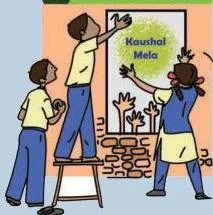
In the execution phase, the checklist becomes real work: posters are made and put up, invites are written and sent, materials are gathered into one place, and any support the stall needs is confirmed. This is the phase where a plan survives or fails — a task that was brainstormed, dated and listed now either gets done or gets skipped.
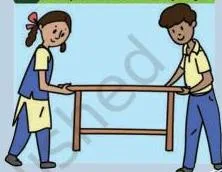
The display figure marks step 5, preparation of displays. Here the stall takes its final shape: the work is labelled so visitors understand what they are seeing, signboards are placed where people will look for them, and the components of the stall are arranged in a sensible order.
Preparing displays is what turns completed work into something a guest can walk up to and understand without asking.
Key terms of the chapter, in plain words
These are the words the chapter uses for planning, explained the way the chapter uses them. The book has no printed glossary, so treat this as a quick reference, not a quotation.
| Term | What it means in this chapter |
|---|---|
| Kaushal Mela | The school event where students share the project work they have done with their family and the wider community. |
| Brainstorming | Listing together, as a team, everything that needs to be done for the Mela. |
| Timeline | The dates by which each task must be completed. |
| Checklist | A tick-list that confirms tasks are done — the chapter’s own tick items are posters, labels and invites. |
| Execution of tasks | Actually doing the planned work, instead of only writing it down. |
| In-charge / Coordinator | The person a task is assigned to; every activity in the plan needs one. |
| Post-event activities | What happens after the Mela ends: cleaning up, returning equipment, removing waste and collecting feedback from guests. |
Mistakes students make while planning the Kaushal Mela
Most planning failures are not about the event day itself — they are the columns students leave blank. Each mistake below is matched to the row of Table 7.1 that prevents it.
| Mistake | Correct rule | How to check your answer |
|---|---|---|
| Leaving date, time and venue undecided | Settle the basic details first — nothing else can be dated before them | The Basic details block has all five answers filled |
| Assigning a task with no deadline and no in-charge | Every task needs both a due date and an owner | The date and in-charge columns are filled in every row |
| Planning the stalls but not the guests | Guests are planned like every other task — invited, listed, registered | Basic detail 3 (who will attend), row 6 (inviting guests) and row 14 (registration) are complete |
| Skipping safety, first aid and cleanliness | These are regular planning rows, not optional extras | Rows 7 (safety), 8 (cleanliness) and 9 (first aid) are filled |
| Ending the plan at the event | Post-event activities are the chapter’s final step | Rows 15 (feedback) and 16 (cleaning up, returning equipment) are filled |
The pattern behind all five: Table 7.1 is not a form to get done — it is the event in advance. If a row is empty, the event will feel it.
What completing this chapter looks like
This chapter is taught through the plan itself, so the deliverable is a working plan, not a set of answers. The chapter is complete when Table 7.1 is filled in, extended with your class’s own rows, and the Kaushal Mela the table describes has actually run — guests registered, displays up, cleanup done.
Two honest notes. The chapter expects the plan to grow — it tells you to add more details based on your discussions. And textbook contents and the examinable syllabus are not always identical, so check the current official syllabus for how this chapter is assessed in your school.
Chapter 7 in one page: the planning sequence
Planning turns a goal into a sequence of owned tasks: decide what has to happen, fix when each task finishes, tick it off, do it, display it, run it, close it down.
- Before the event: Brainstorming → Timeline → Checklist → Execution of tasks → Preparation of displays.
- Event day: run the Mela on the schedule the plan built — registration, anchoring, displays, and everything planned for the event’s duration.
- After the event: post-event activities — feedback from guests, cleaning up, returning equipment, removing waste.
If you can say the seven steps in order and name what each one produces, you have the whole chapter.
Related resources and sources
This listing is maintained for the 2026-27 academic session using the NCERT textbook information available to us. NCERT remains the authority for confirming the latest edition.
Planning for Kaushal Mela is Chapter 7 of Kaushal Bodh, the Class 7 Vocational Education textbook. For the full chapter list of the book, see the Class 7 Vocational Education (Kaushal Bodh) book page, or use the Class 7 hub to reach the other subjects listed for this class.
For notes on the rest of the book, see the Class 7 Vocational Education revision notes, the previous chapter (Project 6) notes for the chapter before this one, and the Class 7 notes hub with the main notes index to navigate the rest of the site.
If you are checking a child’s copy: this is Class 7, Kaushal Bodh (Vocational Education), Chapter 7, and the PDF at the top of this page is the official NCERT file. Official editions of the book are published on the NCERT portal (ncert.nic.in).
Common questions about Planning for Kaushal Mela
What is a Kaushal Mela in Class 7?
A Kaushal Mela is the school event where students show their family and the wider community the project work they did and how they did it. The chapter’s point is that this sharing works only if every detail — when, where, who, what — is planned first.
How should I fill Table 7.1 for the Kaushal Mela?
Fill the basic-details block first — date and time, venue, guests, what you will present, support needed — then one row per task with its details, its deadline and an in-charge name. A row with an empty deadline or in-charge is a task nobody owns.
What are the seven steps of the Kaushal Mela plan?
Brainstorming, Timeline, Checklist, Execution of tasks, Preparation of displays, Event day and Post-event activities. The phrase Before The Celebration, Everyone Prepares Everything Properly keeps them in order.
What does the Kaushal Mela checklist include?
In the chapter, the checklist’s own tick-box items are posters, labels and invites. Its job is to confirm that every task from the timeline is actually done before the event.
Which activities come after the Kaushal Mela event day?
The chapter’s last step, post-event activities, covers cleaning up after the Mela — returning equipment and removing waste — and collecting feedback from guests, so the class learns what to do better next time.
| What the chapter holds | Count | Where it is used |
|---|---|---|
| Printed pages | 3 | |
| Figures with NCERT captions | 2 | |
| Tables | 3 | |
| Official NCERT PDF | Download the chapter PDF | the chapter exactly as NCERT publishes it |
Reference: NCERT Class 7 Vocational Education textbook (Kaushal Bodh), chapter 7, official edition on ncert.nic.in.
Explore Class 7 Vocational Education Books
Related chapters: