
Wit and Humour Class 7 is Chapter 2 of NCERT’s English textbook Poorvi. It holds a story, two poems and a play, each followed by its own language exercises. The official chapter PDF is right below.
Download Wit and Humour Class 7 PDF
Wit and Humour Class 7 (Poorvi Chapter 2) official NCERT PDF is the file you need. It carries the full printed chapter, pages 43-90 of the current NCERT Class 7 English book, including every exercise block and the teacher’s listening transcripts at the end. You can open it directly from the official NCERT textbook portal on ncert.nic.in.
Download the Wit and Humour Class 7 (Poorvi Chapter 2) official NCERT PDF from ncert.nic.in.
Chapter 2 at a Glance
This chapter runs to 48 printed pages in the book. The table below shows what is inside: the named texts, the exercise blocks that follow each one, and the figures that illustrate them.
| Sections | Figures | Exercise blocks |
|---|---|---|
| Four texts: a story, two poems and a play | 21 captioned figures across the four texts | Each text carries its own Let us discuss, think, learn, listen, speak and write blocks, plus three Let us explore culture pages |
What This Chapter Covers: a Story, Two Poems and a Play
This is a humour unit, and each text makes you laugh in a different way. Knowing which device each one uses is the fastest way to answer its questions.
- ‘Animals, Birds, and Dr. Dolittle’ by Hugh Lofting, pages 44-58. Doctor Dolittle learns animal languages from the parrot Polynesia, becomes an animal doctor, prescribes green spectacles to a plough horse, and installs separate doors for each animal.
- ‘A Funny Man’ by Natalie Joan, pages 60-68. A man wears a shoe on his head and hats on his feet. The humour is inversion — everything is swapped around.
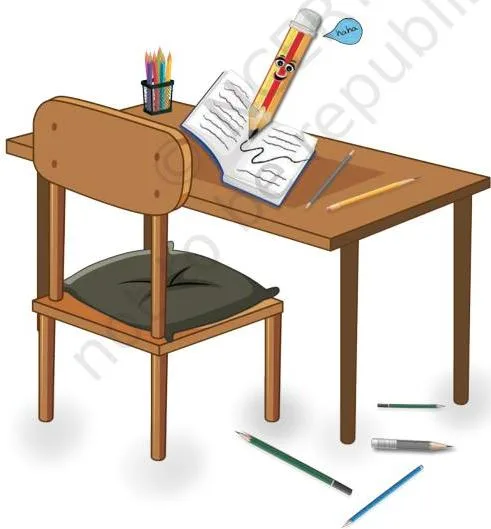
- ‘My Lost Pencil’, page 69. A light read-and-enjoy comic poem about losing pencils. It has no exercise block of its own — the book marks it ‘read and enjoy’ — but its illustration is worth seeing.
- ‘Say the Right Thing’ by G.C. Thornley, pages 71-87. A play in which Mary is sure she knows polite conversation and then offends every guest. The final line reverses the farewell line her mother taught her (page 76).
The chapter also opens the play with the pre-reading discussion ‘Athithi Devo Bhava’ (page 70) and closes each text with a Let us explore culture page (pages 58, 67-68, 86-87).
Key Concepts: How the Humour Works, and What the Exercises Teach
The chapter runs on a rhythm: read a text, discuss it, then learn one language idea from its words. The grammar blocks below follow that same rhythm, so they are easy to predict.
Three Humour Devices: Gentle Fantasy, Nonsense, Dramatic Irony
Before the grammar, notice why each text is funny. That difference is the chapter’s real subject.
| Text | What is funny | Device |
|---|---|---|
| ‘Animals, Birds, and Dr. Dolittle’ | Animals talk back, and a horse orders green spectacles | Gentle fantasy (pages 44-48) |
| ‘A Funny Man’ | Clothes swapped, a currant bun offered as a rose, hopping home on his head | Nonsense inversion (pages 60-62) |
| ‘My Lost Pencil’ | Ordinary frustration pushed to the absurd — ‘lost fifty this year’ | Comic exaggeration (page 69) |
| ‘Say the Right Thing’ | Mary knows the right lines, but every line lands on a guest | Dramatic irony (pages 74-76) |
Dramatic irony means the reader sees what the character cannot. Mary means well; we see the disaster coming before she does.
Compound Words and Palindromes
These two word-play ideas come from the Dr. Dolittle story. Compound words are about how words join; palindromes are about how they read backwards.
A compound word combines two words into one new meaning (page 52). The story gives all three types: hyphenated (Cat’s-food-Man), open (bird language, plough horse) and closed (flowerpots, teatime). A palindrome reads the same backwards — spaces included (page 53), like ‘Madam, I’m Adam’ and ‘A man, a plan, a canal – Panama’.
The test is simple: reverse the whole phrase. Rotator and radar pass; ‘Step on no pets’ passes as a sentence too.
The Present Perfect Family of Tenses
This chapter introduces two tenses that students constantly mix up. The difference is whether the action is finished or still running.
- Present perfect (has/have + V3, page 54): a recently completed action, or a past action relevant now — ‘It has stopped raining’.
- Present perfect continuous (has/have + been + V-ing, page 82): the duration of an action still running, with visible results — ‘She has been staying with them for a while’.
Compare the pair: ‘He has written the book’ (finished, relevant now) against ‘He has been writing the book’ (still going on).
Phrasal Verbs and Words for Movement
Two vocabulary blocks come from the poem section. Both ask you to see how one word changes meaning when its partner changes.
A phrasal verb is a verb plus a preposition or adverb acting as one unit, often with a meaning different from the words alone (page 63). The chapter’s five ‘take’ verbs: take up (begin to do), take after (resemble a family member), take in (understand), take over (assume control), take off (become successful quickly).
The poem also collects words for ways of walking — walking, staggered, hopped — to be arranged by increasing pace (page 64).
Suffixes, Say and Tell, and the Four Kinds of Sentences
The play section carries the heaviest grammar load. It groups three ideas: how words grow, which word to choose, and how sentences are classified.
Suffixes are word endings added to a root (page 80): -ous, -ly, -ing, -ful. Watch the spelling changes: come drops its e before -ing (coming), and beauty turns y to i before -ful (beautiful).
Confusable pairs like say vs tell follow one clear rule (page 81): say focuses on the message and does not always need a listener; tell always needs a listener because it names the receiver.
Sentence kinds (page 83) are four: declarative states facts, interrogative asks, exclamatory feels, imperative orders. The play’s own lines supply the examples — ‘Put that coat away in your bedroom.’ is imperative.
The Writing and Speaking Tasks
Sort these deliberately and each one is quick to master. There are three writing tasks and three speaking tasks.
| Task | What to do | Page |
|---|---|---|
| Writing: notice | A formal notice in about 50 words, in a box, third person, with reason, date, time, venue and contact | 57 |
| Writing: limerick | A five-line comic poem with the AABBA rhyme scheme | 66-67 |
| Writing: story rewrite | Rewrite the play as a short story, keeping its humour and emotions | 86 |
| Speaking: doctor-patient | A conversation using the cue cards for cough, dry lips, sore throat, fatigue | 55-56 |
| Speaking: joke | Tell a given joke, then invent one for the class | 66 |
| Speaking: stress and intonation | Stress content words, not function words, and use falling intonation for statements | 84-85 |
The ‘Remember to’ box for notices (page 57) lists the fixed parts: formal language, third person, the reason, and a box around the notice.
Reading the Illustrations: What Each Picture Adds
The pictures here are not decoration. Each one sets up a joke or pays it off, and two of them are the details examiners ask about most.
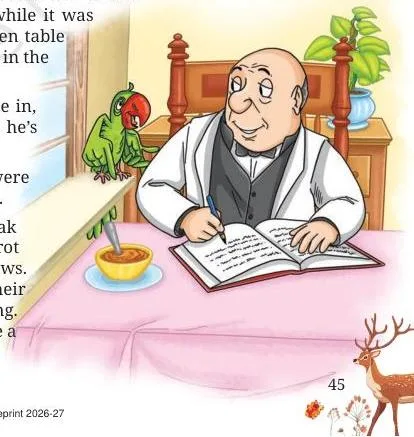
Polynesia the parrot opens the story’s fantasy — she is the first talking animal (page 45). Her ‘bird language’ line is what hooks the Doctor into learning animal talk.
As soon as the Cat’s-food-Man spreads the news, old ladies bring their cake-stuffed pugs and poodles (page 46). The practice takes off — absurd, but warm.
The special doors marked HORSES, COWS and SHEEP (page 48) are the story’s visual signature — and its most frequently tested detail. Even the mice get a tiny tunnel to the cellar.
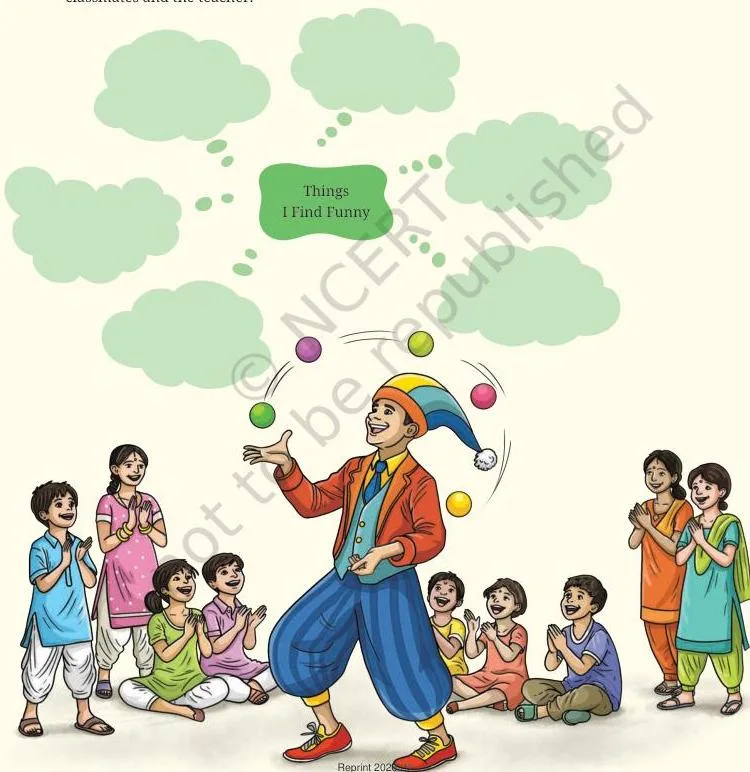
This bubbles page (page 59) is the pre-reading moment for the poem — you note what makes you laugh before the funny man walks in.
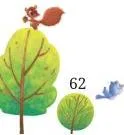
The man hops home on his head (page 62) — the poem’s closing inversion. Pair it with stanza 1: shoe on head, hats on feet, and now the whole body upside down.
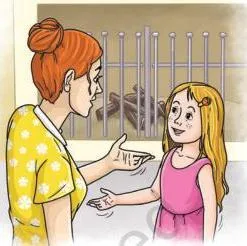
These two pictures of Mary (pages 72-73) frame the irony. She is confident in the first and promises in the second — and everything still collapses when the guests arrive (pages 74-76).

This panel holds the whole speaking lesson in one image (page 86): same words, different stress, different meaning.

The Vasudhaiva Kutumbakam panel (page 87) closes the chapter’s cultural note: the world is one family — Dr. Dolittle’s animal patients are the story-level version of the same idea.
Words and Terms the Chapter Defines
Two quick reference tables. The first collects the margin words; the second collects the grammar terms the chapter teaches.
| Word | Meaning | Page |
|---|---|---|
| scholar | a learned person | 44 |
| cracker | a thin, dry biscuit | 45 |
| Birds’ A.B.C. | the language that birds speak | 45 |
| cellar | a room below ground level, often for storage | 48 |
| countryside | rural area | 48 |
| hilariously / blunders / embarrasses | very funnily / careless mistakes / makes guests uncomfortable | 71 |
The play’s four characters are Mary Shaw (a young girl), Mrs. Shaw (her mother), Mrs. Harding and Mrs. Lee (the guests) — page 71.
| Grammar term | Definition in brief | Page |
|---|---|---|
| compound word | two words joined into one new meaning | 52 |
| palindrome | a word or phrase that reads the same backwards | 53 |
| present perfect | has/have + V3 for a recent or still-relevant action | 54 |
| phrasal verb | verb + preposition/adverb acting as one unit | 63 |
| suffix | a word ending added to a root word | 80 |
| present perfect continuous | has/have + been + V-ing for an action still running | 82 |
| sentence stress and intonation | emphasis on certain words; the rise and fall of pitch | 84 |
| four sentence kinds | declarative, interrogative, exclamatory, imperative | 83 |
Common Mistakes in This Chapter, and the Fix
The book itself marks out these distinctions, which means examiners expect you to make them cleanly. Each mistake below is one a real student makes in this chapter.
| Mistake | Correct rule | How to check your answer |
|---|---|---|
| ‘She said me to go.’ | say focuses on the message and needs no listener; tell names the receiver — ‘She told me to go.’ | If a listener is named in the sentence, use tell (page 81). |
| ‘She has been finishing the work’ for a completed action | Present perfect = finished and relevant now; present perfect continuous = still running with visible results | Ask: is the action over? Over → has/have + V3 (54, 82). |
| Calling ‘Nitin speaks in Malayalam’ a palindrome | The whole phrase must read the same backwards — ‘Nitin’ alone passes, the full sentence does not | Reverse the entire phrase, spaces and all (page 53). |
| Writing a limerick where only lines 1 and 5 rhyme | Every limerick is AABBA — lines 1, 2, 5 rhyme; lines 3, 4 rhyme | Label the last words of each line with letters before you write (page 67). |
| A chatty, first-person notice | Notices are formal, written in the third person, inside a box | Read the ‘Remember to’ box: heading, reason, date, time, venue, contact (page 57). |
| Saying every sentence with flat stress | Content words are stressed, not function words; a statement with rising intonation sounds like a question | Test the five readings of ‘I didn’t hurt anyone today’ — each stress changes the meaning (page 85). |
| Calling Mary cruel or malicious | Mary is naive, not cruel — the comedy is dramatic irony: the reader knows what she does not | Note her ‘Oh, I’m sorry’ apologies after each blunder (pages 74-76). |
Exam Notes: How the Chapter Asks Its Questions
Every text follows the same exercise pattern, which makes this chapter predictable to revise. Learn the pattern once and you can apply it four times.
- Let us discuss — MCQs, sentence completion, true/false, and event ordering (for the story).
- Let us think and reflect — extract-based questions with answer options, then short-answer questions.
- Let us learn — the grammar blocks: compound words, tenses, phrasal verbs, suffixes, say/tell, sentence kinds.
- Let us listen — three listening tasks; the teacher reads the transcript aloud (pages 88-89).
- Let us write — the notice, the limerick, and the story rewrite.
For extract questions, quote or paraphrase the exact line in your answer and then explain it — that pairing is what a full answer needs. For the listening tasks, the transcript for the teacher is printed at the end of the chapter (pages 88-89), so you can practise with it at home.
One honest caution: textbook contents and the examinable syllabus are not always identical — check the current official syllabus. No question here is guaranteed to appear, and only the official curriculum can state marks or weightage.
Revision Summary: The Chapter on One Page
Run your finger down this table the night before, then do the four-step revision order below it.
| Text | Type | Pages | What to remember |
|---|---|---|---|
| ‘Animals, Birds, and Dr. Dolittle’ | Story | 44-58 | Animal languages, green spectacles, special doors, separate mouse tunnel |
| ‘A Funny Man’ | Poem | 60-68 | Inversion, rhyme on lines 2 and 4 of each stanza, ‘funny’ repeated on purpose |
| ‘My Lost Pencil’ | Poem | 69 | Comic exaggeration — no exercise block, read and enjoy |
| ‘Say the Right Thing’ | Play | 71-87 | Dramatic irony and the reversed farewell: ‘Must you stay? Can’t you go?’ |
| Language blocks | Grammar | 52-54, 63-64, 80-83 | Compound words, palindrome, present perfect, phrasal verbs, suffixes, say/tell, sentence kinds |
Revision order that follows the chapter’s own structure: read the text, answer its comprehension questions, do its grammar block, then attempt its writing task. Four steps per text, and the chapter is covered.
Related Resources
This listing is maintained for the 2026-27 academic session using the NCERT textbook information available to us. NCERT remains the authority for confirming the latest edition.
Continue revising with the Class 7 English notes, or jump to the Class 7 hub for every subject. The chapter before this one is Learning Together (Chapter 1), and the one after it is Dreams and Discoveries (Chapter 3).
Sources and Data Verification
- The chapter described here is Chapter 2, Wit and Humour, from the current NCERT Class 7 English textbook Poorvi, printed pages 44-90.
- This page covers the NCERT textbook only — not the CBSE syllabus, which is a separate document maintained by CBSE.
- The listing is maintained for the current academic session using the NCERT edition currently published on ncert.nic.in.
- NCERT settles textbooks, editions and official PDFs; CBSE settles curriculum and examinations.
| What the chapter holds | Count | Where it is used |
|---|---|---|
| Printed pages | 48 | |
| Figures with NCERT captions | 21 | |
| Tables | 9 | |
| Official NCERT PDF | Download the chapter PDF | the chapter exactly as NCERT publishes it |



Wit and Humour Class 7: Frequently Asked Questions
Which texts are in Wit and Humour Class 7 (Poorvi Chapter 2)?
Four texts: the story ‘Animals, Birds, and Dr. Dolittle’ by Hugh Lofting (pages 44-58), the poems ‘A Funny Man’ by Natalie Joan (pages 60-68) and ‘My Lost Pencil’ (page 69), and the play ‘Say the Right Thing’ by G.C. Thornley (pages 71-87). Each text carries its own exercise blocks.
Why does Mary keep offending the guests in the play ‘Say the Right Thing’?
Mary knows the polite lines — ‘Good afternoon’, ‘How are you?’ — but she cannot read a situation. She praises Mrs. Harding’s children, who do not exist; mocks bankers, and Mrs. Lee’s brother is one; insults the dog, which belongs to the guests. The comedy is dramatic irony: the reader sees each disaster before Mary does (pages 74-76).
What is the difference between present perfect and present perfect continuous tense in this chapter?
Present perfect (has/have + V3, page 54) describes a recently completed action or a past action relevant now — ‘It has stopped raining’. Present perfect continuous (has/have + been + V-ing, page 82) describes an action that started in the past and is still running, with visible results — ‘She has been staying with them for a while’.
What are the three types of compound words in the Dr. Dolittle story?
Hyphenated (Cat’s-food-Man, check-in), open with a space (bird language, plough horse) and closed with no space (flowerpots, teatime). Page 52 names all three types.
What is the rhyme scheme of the poem ‘A Funny Man’?
Each stanza rhymes on lines 2 and 4 — the pattern is ABCB. The poem also uses inversion, changing normal word order to keep the rhythm, and repeats the word ‘funny’ on purpose (page 61).
Where are the listening exercise transcripts for this chapter printed?
At the very end of the chapter, in the section marked ‘Let us listen (refer to page …)’ — the teacher’s transcripts for all three listening tasks appear on pages 88-89. You can use them to practise at home.
Reference: NCERT Class 7 English textbook, chapter 2, official edition on ncert.nic.in.
Explore Class 7 English Books
Related chapters: