
This is **Unit 1 of the NCERT Class 7 English textbook *Poorvi*** — the chapter **Learning Together**, a 42-page unit that opens the book with a story, a poem and an essay. The official Learning Together Class 7 English Chapter 1 (Poorvi) PDF is published by NCERT, and the download link is right below.
Open the official Learning Together Class 7 English Chapter 1 (Poorvi) PDF on the NCERT website — it holds the complete 42-page unit exactly as published, with all of its figures, activities and teacher-only listening transcripts, and it is the version your school follows.
What is in the Learning Together Class 7 chapter?
The unit is a small anthology: three complete texts, each wrapped in the same run of activities. The table below shows which text sits where and what each block drills.
| Text | Author and form | Pages | What the block practises |
|---|---|---|---|
| The Day the River Spoke | Kamala Nair — a story (extract adapted from the book of the same name) | 1–15 | Reading and comprehension; sound words; prepositions; listening to five speakers; asking for and giving advice; a descriptive paragraph |
| Try Again | Eliza Cook — a poem | 16–27 | Reading poetry; metaphor and simile; alliteration and rhyme; opposites; listening to a story; narrating a personal experience; writing a letter |
| Three Days to See | Helen Keller — an essay | 28–42 | Reading; sensory words; modal verbs; listening about inclusion; speaking about the senses; writing a descriptive paragraph; Braille |
One note before you open it: textbook contents and the examinable syllabus are not always identical — check the current official syllabus to see what your school will assess.
The three texts and what they share
Each text stands alone, but the three were chosen to work together. Here is what each one does.
The Day the River Spoke is an extract from Kamala Nair’s story of the same name. Jahnavi, nearly ten, lives in a coastal village and longs to go to school, but her mother keeps saying she is ‘too small’ and must mind her baby brother.
A sleepy, murmuring River — a character, not scenery — tells her that little girls can do as much as little boys, and that it is up to her. Jahnavi walks into school on her own, and the teacher promises to talk to her father.
The story ends with her dream granted and a bigger plan: she will become a teacher and bring every girl in the village to school.
Try Again, by Eliza Cook, is a narrative poem about King Bruce of Scotland. Defeated and sunk in despair, Bruce watches a spider fall again and again as it climbs to its web — nine brave attempts, nine falls — until the tenth succeeds. ‘He conquered, and why shouldn’t I?’ Bruce asks, and his next attempt succeeds too.
Three Days to See is an essay by Helen Keller, who could not see. She imagines the three days she would spend if sight were given to her — the first with the people she loves, the second in the museums, the third in the workaday city.
She ends with a hint to everyone who can see: use your eyes, ears and hands as if you would lose those senses tomorrow.
All three pull in the same direction: persistence when a task is hard, equal opportunity for girls and for people with disabilities, and full use of the abilities you have. That is what ‘learning together’ means here — you learn from a river, a spider and a writer who could not see.
How the chapter teaches: the activity pattern
Every text runs through the same teaching loop, so once you know the loop you can predict what comes next. The unit has no separate back-of-chapter question set; every task lives inside the loop.
- Pre-reading — ‘Let us do these activities before we read’ sets the topic (dreams, inspiration, the five senses).
- Reading — the text itself, with difficult words glossed in the margin (pp. 1–4, 29–31).
- Discussion — ‘Let us discuss’ turns the text back into talk, in pairs or with the class.
- Comprehension — ‘Let us think and reflect’ drills extract questions and open answers.
- Grammar and vocabulary — ‘Let us learn’ teaches sound words, prepositions, metaphor, modals.
- Listening — ‘Let us listen’ plays an audio task tied to the text’s theme.
- Speaking — ‘Let us speak’ gives sentence prompts for pair work.
- Writing or exploring — ‘Let us write’ or ‘Let us explore’ ends the loop with a product: a paragraph, a letter, a web of wool.
Three listening tasks sit inside the unit — on pages 12, 24 and 36. Their scripts are printed only in the teacher pages at the end of the unit (pp. 39–42), so you work from the recording, not from printed answers.
Every stage expects you to produce something: a completed table, a spoken sentence, a written paragraph. For the same skill map across the rest of the book, start at the Class 7 English notes page.
Key concepts from the story: personification, nouns, prepositions
This block teaches three language ideas that look easy until you must explain them: why the River is capitalised, what the sound words do, and how to tell a preposition from an adverb.
Personification gives human behaviour to something that is not human. The River talks, chuckles, laughs and gives advice, so the author treats it as a person — which is why ‘River’ carries a capital letter even though it is a common noun. NCERT asks this exact question on p. 8.
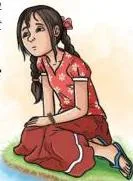
The illustration on NCERT p. 7 shows the River leaning toward Jahnavi as a speaking presence — visual proof that the River is a character, not a backdrop.
The story is dense with sound words: splashed, slithered, murmured, shrieked, wailed, rattling, rustle (NCERT, pp. 1–4). The ‘Let us learn’ task matches each word to a definition — shrieked for a high-pitched sound, splashed for liquid striking a surface, wailed for a long cry of pain.
A preposition links a noun or pronoun to the rest of the sentence and shows direction, location or time (NCERT, p. 10). In the River’s line — ‘down towards the sea… over the mountains and down to the sea’ — towards and over point out direction.
The same small words — on, off, up, down — can switch jobs. Followed by an object, they are prepositions: ‘She ran up the stairs’. With no object, they are adverbs: ‘She rang me up’ (NCERT, p. 11).
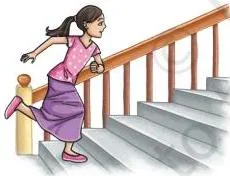
The book’s own example on p. 11 is the adverb case: ‘up’ has no object, it simply adds meaning to the verb ‘rang’.
The test: ask ‘up what?’ or ‘down what?’. If a noun answers, the word is a preposition; if nothing answers, it is an adverb. In ‘A kingfisher swept down’ there is no ‘down what?’, so down is an adverb.
Key concepts from the poem: metaphor, simile, rhyme scheme
This block is where the chapter defines figures of speech properly. The labels matter because the extract questions ask you to name them.
A metaphor is an implied comparison without like or as — one thing simply is another (NCERT, p. 20). In the poem, the spider’s climb is not like Bruce’s struggle; it stands for it. ‘His anger was a storm’ is a metaphor.
A simile is the explicit version and uses like or as: ‘She was as steady as a rock’, or from the book’s exercise, ‘He ran as fast as a cheetah’ (NCERT, p. 20).
The exercise on p. 20 turns similes into metaphors and back. The method: find the comparison marker. Remove like or as and reshape — ‘Her smile was like sunshine’ becomes ‘Her smile was sunshine’. Add like or as when the marker is missing — ‘His anger was a storm’ becomes ‘His anger was like a storm’.
Alliteration repeats the same starting consonant sound in nearby words — the poem’s ‘silken, filmy clue’ is one example, and NCERT asks you to collect more (p. 19).
The rhyme scheme of Try Again is ABAB (NCERT, p. 19). ‘Bravo!’ is an interjection — a word that bursts out as a reaction — and ’twas and ’tis are contractions the poet uses for rhythm, not spelling errors.
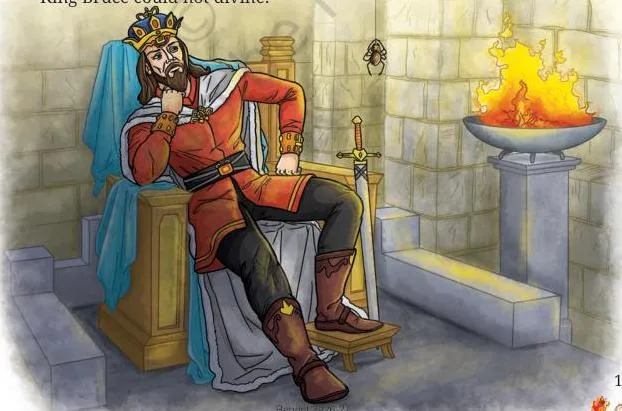
This image on p. 17 marks the poem’s turning point: Bruce stops mid-thought to watch the spider, and ‘could not divine’ means he cannot work out how the thread will carry it home.
Key concepts from the essay: sensory words and modal verbs
This block teaches two toolkits: the vocabulary of the five senses and the grammar of tone — modal verbs. Both come with tables in the book.
Sensory words describe what we see, hear, smell, taste and feel (NCERT, p. 34). The book pairs each sense with a word from the essay:
| Sense | Sensory word from the essay |
|---|---|
| What you see | panorama |
| What you hear | music |
| What you smell | perfume |
| What you taste | relish |
| What you feel | rough |
The whole essay is built on such words — the smooth skin of a silver birch, the shaggy bark of a pine, the happy quiver of a bird in full song.
Modal verbs — can, could, may, might, shall, should, will, would, must, ought to — sit before a main verb and add a function: possibility, necessity, permission, ability, request, suggestion or moral obligation (NCERT, pp. 34–35).
The book’s exercise gives a situation and asks for the modal. The trick: read the situation, name the function, then pick the word. Dark clouds → possibility → ‘It might rain’. A deadline tomorrow → obligation → ‘I must finish’. Choosing a picnic spot → suggestion → ‘We could go to any park nearby’.
Should expresses advice or suggestion; must expresses obligation (NCERT, p. 35). ‘You should consider the pros and cons’ advises; ‘I must finish this report by tomorrow’ commits. Helen Keller’s repeated ‘I should…’ is a plan she is imagining, not a duty she is under.
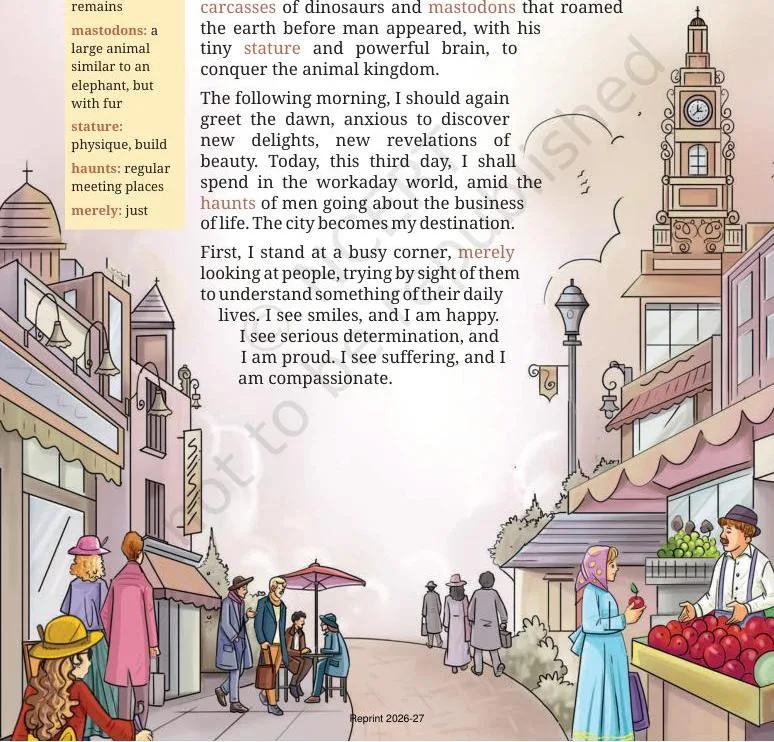
This scene on p. 30 is Keller’s imagined third day: standing at a city corner, reading faces — smiles, serious determination, suffering. The figure turns the essay’s ‘third day’ from an idea into a scene you can see.
What the figures in the chapter show
The figures that belong to the three texts — the River with Jahnavi, King Bruce and the spider, Keller at the busy corner — sit with the concepts they teach, as do the grammar figure and the extract example.
Four more illustrations carry the unit’s activities and its closing idea. Each is tied to a task you will do.

After the poem, the speaking task asks you to narrate a time you refused to give up. The seven prompt stages end with a reflection — ‘The lesson I learnt from this is…’ — and the illustration on p. 25 marks that final stage of looking back.

The ‘Let us explore’ spider-web craft on p. 27 turns the poem into something physical: tie three sticks in the centre, loop wool around each stick, weave the web, and knot the thread where the web is complete. The figure shows the finished web, which you then decorate with the poem’s own words.
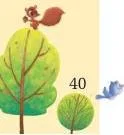
The listening story for the poem is about an ant that cannot move a piece of roti. The figure on p. 40 fixes the turning point: the ant, ready to give up, watches a bird build its nest while the wind keeps blowing the twigs away, and decides that if the bird can keep trying, so can she.
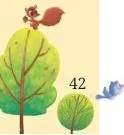
The unit closes on p. 42 with this line from the final listening conversation about a classmate who reads in Braille and uses a screen reader. It separates tools — Braille, assistive apps — from attitude, and calls the attitude the more important half.
Common mistakes students make in this chapter
Five errors are so common in this unit that NCERT’s own exercises are built around them. Name the mistake, take the rule, check your work.
| Mistake | Correct rule | How to check your answer |
|---|---|---|
| Calling ‘down’ an adverb in ‘swept down the path’ | With an object it is a preposition: ‘down the path’. A preposition is always followed by an object; an adverb tells more about the verb (NCERT, p. 11). | Ask ‘down what?’ — if a noun in the sentence answers, it is a preposition. In ‘A kingfisher swept down’ nothing answers, so down is an adverb. |
| Labelling ‘He ran as fast as a cheetah’ a metaphor | The word ‘as’ makes it a simile. A simile uses like or as; a metaphor does not (NCERT, p. 20). | Look for like or as. Present → simile; absent → metaphor. |
| Reading ‘should’ as ‘must’ | ‘Should’ advises or suggests; ‘must’ states obligation (NCERT, p. 35). | Try ‘ought to’ — if it still sounds like advice, keep should; if it is a demand, use must. |
| Answering the ‘Let us listen’ tasks from printed words | The tasks test the recording; the transcripts exist only for the teacher (pp. 39–41). | Listen for each speaker’s stance before you tick or match anything. |
| Missing the chapter’s gentle-suggestion pattern | The River’s ‘shouldn’t cry’ and Keller’s repeated ‘should’ are warm suggestions, not commands. | Ask who is speaking and what their relationship with the listener is. |
Exam-style thinking: how the chapter trains you
The chapter rehearses the same small set of question shapes again and again. Master the shapes and you have prepared for the comprehension and grammar part of the unit.
- Extract-based multiple choice and word meaning: the River’s tone (assuring/sympathising) on p. 7; pondered on p. 21; thrilling and the leaf-passage tone on p. 32.
- True/false and phrase selection: judge a statement, or pick the exact phrase — ‘well, almost every day’ shows how often Jahnavi visited the river (p. 7).
- Analogy and word-pair questions built on the poem’s vocabulary, such as the ‘toil : hard’ item (p. 21).
- Open inference questions: ‘What can you infer about Jahnavi and the school?’ and ‘Why does the writer refer to the earth as “sleeping earth”?’ (pp. 7, 32).
- Extract questions quote the passage, so the evidence is inside the same lines — answer by pointing back at those words.
- Tone questions are decided by the speaker’s situation, not one word — the River addresses a crying, frightened girl, and that context decides what each option means.
- ‘Main message’ answers should name the value the text argues for — education for girls, perseverance, using every sense.
Textbook contents and the examinable syllabus are not always identical — check the current official syllabus to see which parts of this unit will be assessed.

This is one ‘Think and reflect’ extract as it appears on p. 32: the book quotes the passage, then sets separate tasks on it. Practise reading a quoted passage twice — once for meaning, once for the exact words you will be asked to lift out.
Quick revision summary of the unit
Ten minutes before a test: read the tables above and these eight points.
- Story: Jahnavi wins the right to go to school, encouraged by a personified River and backed by her mother.
- Story message: girls deserve education, and one person’s steady encouragement can change a life.
- Poem: King Bruce, in despair, watches a spider fall nine times and succeed on the tenth.
- Poem message: failures are stepping stones to success; keep trying.
- Essay: Helen Keller imagines three days of sight — people, museums, the city — and urges full use of every sense.
- Essay message: value inclusion; the right mindset matters more than the right tools.
- Skills: the unit practises listening for a speaker’s stance, asking for and giving advice, narrating an experience, writing a letter and a descriptive paragraph, and observing nature.
- Grammar: prepositions and adverbs (ask ‘down what?’), modals (situation → function → modal), metaphor and simile (look for like/as).
For a different kind of Class 7 English chapter, see the Wit and Humour notes.
Related resources
This listing is maintained for the 2026-27 academic session using the NCERT textbook information available to us. NCERT remains the authority for confirming the latest edition.
Useful places to go next: the Class 7 English notes page indexes every unit of the book; the Class 7 notes hub covers all subjects at this level; and the CBSE notes collection links notes across classes.
Sources and data verification
This page describes the NCERT Class 7 English textbook Poorvi, Unit 1 — ‘Learning Together’ — the official edition published on NCERT’s website.
It covers this unit only, not the full Poorvi book or other Class 7 English materials.
This page is maintained for the current academic session using the NCERT information available to us.
NCERT settles textbooks, editions and PDFs; CBSE settles curriculum, syllabus and examinations.
| What the chapter holds | Count | Where it is used |
|---|---|---|
| Printed pages | 42 | |
| Figures with NCERT captions | 9 | |
| Tables | 9 | |
| Official NCERT PDF | Download the chapter PDF | the chapter exactly as NCERT publishes it |
Frequently asked questions
What is the Learning Together chapter in Class 7 English Poorvi about?
It is Unit 1 of the NCERT Class 7 English textbook Poorvi — a unit with three texts: the story ‘The Day the River Spoke’, the poem ‘Try Again’, and the essay ‘Three Days to See’.
They share the themes of perseverance, equal opportunity and making full use of your abilities, and each text is followed by discussion, comprehension, grammar, listening, speaking and writing activities.
Which authors and texts are in the Learning Together chapter?
Kamala Nair’s story ‘The Day the River Spoke’ opens the unit (pp. 1–15); Eliza Cook’s poem ‘Try Again’ follows (pp. 16–27); Helen Keller’s essay ‘Three Days to See’ closes it (pp. 28–42).
What grammar and vocabulary does the Learning Together chapter teach?
The story block teaches sound words, borrowed words such as catamaran, and prepositions — including the preposition/adverb test for up, down, on and off (NCERT, p. 11). The poem block teaches opposites, distance words, metaphor, simile, alliteration and rhyme. The essay block teaches sensory words (p. 34) and modal verbs with their functions (pp. 34–35).
Why does the chapter capitalise the word River?
Because the River is a character, not a backdrop. It speaks, chuckles and gives advice, so the author writes it with the capital letter of a name — NCERT sets this as a question on p. 8. A personified thing can carry a capital even when it is an ordinary common noun.
How are the three texts in Learning Together connected?
All three are about not stopping: the spider and King Bruce try again, Jahnavi walks into school against her family’s hesitation, and Helen Keller turns loss of sight into a determination to use every sense fully. The unit also joins them through skills — each text drills reading, listening, speaking and writing in the same order.
Reference: NCERT Class 7 English textbook, chapter 1, official edition on ncert.nic.in.
Explore Class 7 English Books
Related chapters: