
Dreams and Discoveries Class 7 English Chapter 3 is a 48-page chapter in NCERT’s Poorvi textbook, running from page 91 to page 138. It brings together three texts: Anita Rau Badami’s story ‘My Brother’s Great Invention’, Rabindranath Tagore’s poem ‘Paper Boats’, and C.G. Salamander’s postcards titled ‘North, South, East, West’.
The official NCERT PDF is linked right below, and this page then explains what each text teaches and what activities follow it. If you are revising the night before a test, jump to the quick revision at the end.
Download the NCERT Class 7 English Dreams and Discoveries chapter PDF
This is the official NCERT edition on ncert.nic.in — the same 48-page chapter that appears in the printed book, with all three texts, the activity pages and the listening transcripts at the end. Open it to read, download or print the full chapter: NCERT Class 7 English Dreams and Discoveries chapter PDF.
Chapter at a glance: what sits inside Dreams and Discoveries
The chapter is built around three texts, and every text is followed by the same chain of activities. The table below shows how much of the chapter each part takes up — use it for the numbers, and the rest of this page for what they mean.
What this chapter covers: three texts, one repeating pattern
Dreams and Discoveries is a compilation, not one continuous piece, so the chapter is easier to navigate than it looks. Each of its three texts is followed by the same chain: Let us read, Let us discuss, Let us think and reflect, Let us learn, Let us listen, Let us speak, Let us write, Let us explore.
| Text | Form | Writer | Printed pages | Main skill it builds |
|---|---|---|---|---|
| My Brother’s Great Invention | Humorous short story | Anita Rau Badami | 92-108 | Reading a narrative: cause and effect, character traits, ordering events |
| Paper Boats | Poem | Rabindranath Tagore | 109-117 | Reading a poem: theme, imagery, tone, mood, symbolism |
| North, South, East, West | Travel postcards | C.G. Salamander | 118-135 | Reading for information: geography, inference, noticing change |
The three listening transcripts sit together at the end of the chapter (pp. 136-138): Anita and Toby the Martian, a father-daughter conversation about origami, and the story of how Agartala got its name from the agar tree.
The three texts explained
The chapter groups these three texts because all three are about imagination: a boy inventing, a child dreaming, and a traveller discovering her own country. Each one asks you to notice a different way people think and express themselves.
My Brother’s Great Invention: a boy who thinks he is a scientist
Anita, fourteen, narrates the story of her younger brother Anand, who is convinced he is a scientist and keeps building inventions that backfire. His schemes drag the whole family into chaos, and that is what makes the story funny.
- The burglar alarm: thefts in the colony scare Anand into inventing an alarm that drops a water bag when the door is opened gently — exactly how Papa opens doors, so Papa gets soaked (NCERT, p. 93).
- After the family watches Back to the Future, Anand builds a time machine in his room. Papa locks away his tools and refuses a test run (NCERT, pp. 93-94).
- Papa and Ma leave for a wedding in Kharagpur. In the night, Boppa the compound sweeper breaks in; Anand sends him to his own room instead of Papa’s, buying time (NCERT, p. 95).
- Strange noises follow — a crash, a scream, muffled thumps, an eerie whine and a low humming. By the time neighbours arrive, Boppa has gone; only his green scarf lies near the machine (NCERT, pp. 96-97).
- Anand insists the machine worked and sent Boppa into the past, but the machine is never tested: Papa dismantles it, with what the narrator calls a niggling suspicion that it worked (NCERT, p. 98).
The first discussion task (p. 94) is a cause-and-effect table: the alarm causes Papa to get soaked, the film causes the time-machine project, and Papa’s refusal forces Anand to wait.
The character-trait table (pp. 99-100) is the chapter’s comprehension target. Anand comes out as bothersome, creative and confident; Anita as responsible, curious and cautious — and each trait must be supported by a quoted line from the story.
The story never reveals what happened to Boppa, and that is deliberate. The sequencing task (p. 98) and the ‘give an ending’ question (p. 100) both expect you to decide what you believe.
The story also fits the humour strand of Class 7 English — the Class 7 Wit and Humour notes collect similar comic texts.
Paper Boats: what the child sends downstream
The poem (p. 110) gives a child’s worldview in eight lines: the child floats paper boats on a running stream, writes his name and village on each, loads them with shiuli flowers, imagines the clouds racing his boats, and dreams of them sailing under the midnight stars with the fairies of sleep carrying baskets of dreams.
Page 111’s discussion tasks pin down the poem’s craft. The theme is innocence, imagination and playfulness; the setting is natural and outdoor; the tone is gentle and wishful; the mood is thoughtful.
The same page asks you to match the poem’s symbols. The table below gives the chapter’s own pairs.
| Symbol | What it stands for |
|---|---|
| Paper boats | The child’s innocence, dreams, hopes and messages sent out into the world |
| Shiuli flowers | Purity, beauty and the start of a new day |
| Midnight stars | The vast universe and the child’s dreams continuing through the night |
For the alliteration task, look for repeated starting sounds in neighbouring words — ‘paper boats’ and ‘big black letters’ are two clear pairs from the poem.
The repetition task points to the opening line: ‘Day by day I float my paper boats one by one.’ The words day and one repeat to mark the passage of time.
North, South, East, West: Shaana’s postcards from across India
Shaana lives on Rameswaram island and travels the length and breadth of India with her parents, sending dated postcards to her classmates. Each postcard is written in an excited, first-person child’s voice — a format the chapter later asks you to reflect on (p. 127).
The discussion table on page 125 asks for each stop’s interesting descriptions and activities; the journey table below gives the evidence you need.
| Place | What Shaana notices |
|---|---|
| Thajiwas glacier, Kashmir | White-and-blue glacier; four layers of clothes; snowball fights; less snow than last year |
| Himachal Pradesh | Quiet mountains; birds chirping at sunrise; ‘Appa snoring’ |
| Arunachal Pradesh | Thick forest; a treehouse; hopes to see red pandas |
| Sundarbans, West Bengal | Wetlands; mangroves growing in seawater; crocodiles; flooding |
| Gujarat desert | Hot and dry; sand everywhere; colourful clothes |
| Narmada river | Rafting; water wild and fast; Appa swears he will never raft again |
| Goa | Plateaus, hills, beaches; tunnels she no longer fears |
| Chennai and Puducherry | Learning to surf; fell only twice; rougher, browner waves |
| Pamban bridge | Ocean visible on both sides |
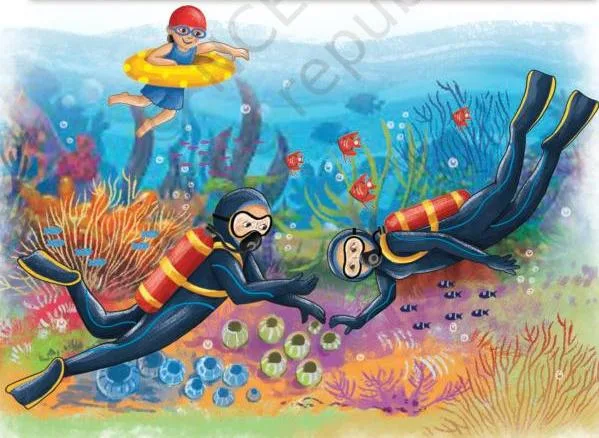
| Olaikaadu beach | Floating to watch fish; parents dive; collecting pebbles |
The postcards teach geography terms in context: glacier, wetland, mangrove, plateau, desert, rafting, surfing, diving and pebbles all appear on the journey (pp. 121-124).
Shaana also records two quiet observations: there was much more snow in Kashmir last year, and the Sundarbans floods more today. Think-and-reflect question 3 (p. 127) asks what these indicate — both are places changing, and her parents’ memories are the clue.
The journey belongs with the travel theme of Class 7 English — the Class 7 Travel and Adventure notes gather similar journeys.
Language work across the chapter: what to practise
Eight grammar and literary points appear in the chapter’s ‘Let us learn’ blocks. Practise them in the order below and the activities stop feeling mysterious.
| Point | Where it appears | Plain explanation | Fresh example |
|---|---|---|---|
| Onomatopoeia | p. 101 | Words that imitate the sound they name | crash, humming, hissed |
| Binomials | pp. 101-102 | Two words joined by and/or, used in a fixed order | safe and sound, pros and cons |
| Idioms | pp. 102-103 | A phrase whose meaning differs from its individual words | ‘got on Papa’s nerves’ = annoyed him |
| Phrasal verbs | p. 102 | Verb + particle with a special meaning | tripped off, rigged up, ran out of |
| Past perfect vs simple past | pp. 103-104 | The earlier of two past actions takes had + past participle | the worked example below |
| -ough pronunciation | p. 105 | One spelling, five sounds | through, cough, though, bough, thought |
| Phrases with ‘of’ | p. 113 | Poetic naming: noun + of + noun | blooms of the dawn; fairies of sleep |
| Subject-verb agreement | pp. 130-131 | The verb must match the real subject | the six rules below |
The past-perfect rule (pp. 103-104) is about order, not time. When two things happened in the past, the earlier one takes had plus a past participle: ‘By the time the guests arrived, Amma had already set the table.’ The words before, after, by the time and when mark which action came first — that action carries had.
A second everyday example: ‘After Meera had finished her homework, she went out to play.’ The finishing came first, so it takes the past perfect.
One spelling, five sounds — that is the whole -ough trap (p. 105). The book gives the cue that ‘though’ rhymes with ‘low’ while ‘enough’ rhymes with ‘puff’. One memory line holds all five: ‘Though the cough came through the bough, I gave it no thought.’
For phrases built with ‘of’ (p. 113), the poem’s examples are ‘blooms of the dawn’ and ‘fairies of sleep’. Fresh ones of your own could be ‘tales of the monsoon’ and ‘laughter of the stream’.
The subject-verb agreement block (pp. 130-131) boils down to six rules. Each row gives the rule and a fresh example.
| Rule | Fresh example | Why it works |
|---|---|---|
| Subjects joined by ‘and’ take a plural verb | Ravi and his friends play cricket every evening. | Two subjects together mean more than one. |
| ‘It’ as subject takes is or was by tense | It was cold this morning. | ‘It’ is always singular. |
| Sentences starting with ‘there’ put the subject after the verb | There are two parks near our school. | ‘There’ is not the subject. |
| each, either, every, much and neither take singular verbs | Every student carries a water bottle. | These pronouns point to one person at a time. |
| ‘pair of’ + a plural noun: ‘pair’ is the subject | This pair of trousers needs washing. | The unit, not its parts, is the subject. |
| Subjects joined by or/nor: verb matches the nearer subject | Either the manager or the employees are responsible. | The nearer noun decides the verb. |
Writing and speaking tasks the chapter prepares
Five production tasks sit inside the chapter, and each one comes with scaffolding — a format, a box of phrases or a given opening. Practise these five and you have covered every writing type the chapter asks for.
- A paragraph about a chosen vocation (p. 106), using hints about training, tools, co-workers, teamwork, customers and pride in the work.
- A presentation of a craft item made from eco-friendly materials (p. 115), with starter phrases such as ‘Today, I’m going to show you…’.
- A diary entry about a rainy day (p. 116), with the opening sentence given.
- A conversation about preferences (p. 132), using structures like ‘I prefer… to… because…’.
- A leave application to the Principal (p. 133), with the full format given.
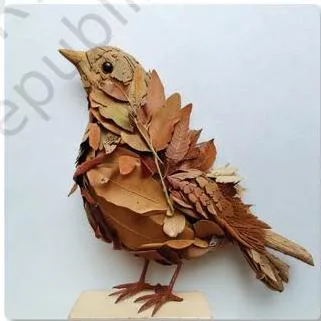
End the craft presentation with exactly these words — ‘Thank you for your attention’ — after you have described the item, how you made it and why it is special (p. 115).
The diary entry follows four guidelines (p. 116): day, date and time; a general opening sentence; details; and a final remark. The model below continues the book’s given opening.
Friday, 15 July 20XX
6:30 p.m.
Dear Diary, It was quite humid today. On my journey back from school, I wished that it would rain. And it did!By the time I reached the gate, the first drops had turned into a full shower. I stood on the balcony and watched the garden drink the rain while Amma made hot pakoras. The whole house smelled of wet earth.
I hope it rains again tomorrow — days like this make even homework feel lighter.
The leave application (p. 133) needs, in order: your address and the date, the Principal’s address, a subject line naming the days, the request with exact dates and reason, a promise to complete school work, and a closing with your name, class, section and roll number. The model below follows that format.
12, Lake View Road
Bhopal, Madhya Pradesh
12 August 20XX The Principal
Sunrise Public School
Bhopal Subject: Request for leave for three days Dear Sir, I am writing to request three days’ leave with effect from 14 August to 16 August in order to attend my cousin’s wedding in my hometown.I would like to assure you that I will complete all my pending work and copy the notes I miss from my classmates.
I would be grateful if you could grant me the leave.
Yours sincerely,
Arjun Mehta
Class VII-B, Roll No. 24
Let us explore: inventors, heritage sites and festivals
The explore blocks widen the chapter from reading into general knowledge. One of them defines the title words: creativity is ‘thinking new things’, innovation is ‘doing new things’, and an invention is ‘bringing ideas or objects together in a novel way’ (p. 107).
Four Indian pioneers are named on pages 107-108, one in each field.
| Inventor | Field | Contribution |
|---|---|---|
| Sushruta (sixth century B.C.) | Medicine | Pioneer whose surgical innovations paved the way for modern surgery |
| Dr Janaki Ammal (Padma Shri) | Cytogenetics | A leading woman scientist of India; significant contribution to the field |
| Dr A.P.J. Abdul Kalam (Bharat Ratna) | Space research | Under his ISRO directorship, Rohini was launched by India’s first Satellite Launch Vehicle, SLV-III, in 1980 |
| Dr Narinder Singh Kapany (Padma Vibhushan) | Fibre optics | ‘Father of Fibre Optics’; one of seven ‘Unsung Heroes of the Twentieth Century’ |
Two Indian World Heritage sites appear on page 135: the Kailasa temple at Ellora, carved from the vertical basalt cliffs of the Sahyadri Hills, and Rani-ki-Vav, the Queen’s Stepwell at Patan in Gujarat — a water system that grew from a pit in sandy soil into multi-storey architecture.
The Hornbill festival is held annually at Kisama village near Kohima, Nagaland; the task is a group research project on when it is held, who takes part and what events happen (p. 135).
Four water-body riddles close the poem’s explore section (pp. 116-117). Their answers in order are the sea, a lake, a stream and a river — the clues are dolphins and whales, ducks and frogs, paper boats on rain, and a bed with a bank.
The final crossword (p. 134) tests States and Union Territories from clues such as Pangong Lake and the Rann of Kutch — good mental-map revision.
Figures in Dreams and Discoveries, read properly
The chapter’s pictures are not decoration — each one supports a task you will actually do. The key illustrations to read alongside the texts are below.
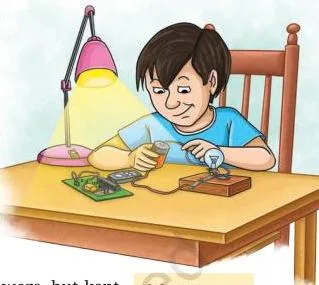
This image sits beside the moment Anand announces his time machine (p. 93). Hold it in your mind during the event-ordering task (p. 98) — it is the invention the whole second half of the story turns on.

Say it fast three times: the twister exists to make you feel the -ough trap — tough, dough, bough and cough share one spelling but four different sounds (p. 106).
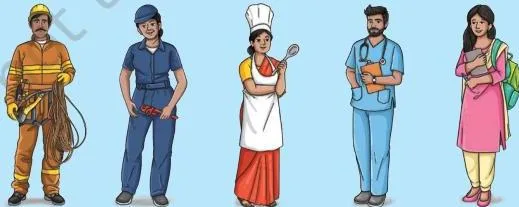
The vocation collage (p. 106) supplies the vocabulary for the paragraph task — name the person, the training and the tools the job needs.
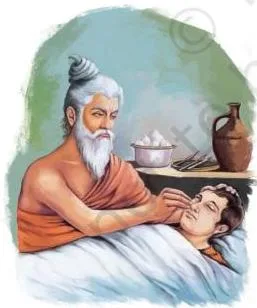
This image (p. 107) opens the inventors exploration with the idea that curiosity and creativity drive every invention — read it before you meet Sushruta, Dr Ammal, Dr Kalam and Dr Kapany.
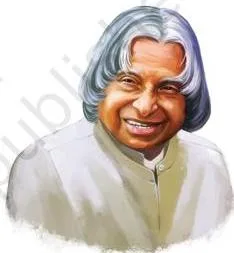
The caption in the book is cut short — ‘Under the directorship of Dr.’ — and the text beside it supplies the rest: Dr A.P.J. Abdul Kalam, under whose ISRO directorship the satellite Rohini was launched in near-earth orbit by India’s first Satellite Launch Vehicle, SLV-III, in 1980 (p. 108).

The diary page (p. 116) shows exactly how to begin: day, date, time, then ‘Dear Diary’ and the given first line. Your continuation follows the same page.
Shaana signs most postcards with this warm sign-off (p. 124). The image is a reminder that every postcard is a short, first-person message — one reason the author chose this format.
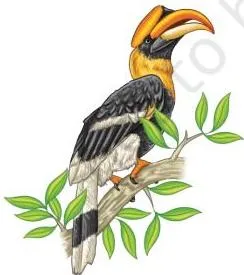
The Hornbill festival picture (p. 135) is the springboard for the group research task: find out when the festival is held, who participates and what events take place.
The agar tree image (p. 138) pairs with the final listening transcript: agar means a type of tree, tala means underneath, so Agartala means ‘under the agar tree’.
Key words from the chapter’s glossaries
The book explains difficult words in margin glosses. The table below collects the most useful ones in plain English, grouped by the text they come from.
| Group | Word | Plain meaning |
|---|---|---|
| Story (pp. 92-97) | racket | a loud, disturbing noise |
| scowling | wearing an angry or frowning expression | |
| rigged up | assembled something temporarily | |
| sceptical | doubtful | |
| crestfallen | sad and disappointed | |
| brandishing | waving something, like a stick, threateningly | |
| muffled | a sound that is not clear or loud | |
| eerie | strange and frightening | |
| Poet’s words (p. 109) | running | flowing |
| skipping | moving along with light, quick jumps | |
| bulging | swelling outwards | |
| lading | loading | |
| burying | pressing into, as into a pillow | |
| Travel words (pp. 119-124) | glacier | a slow-moving mass of ice |
| chirping | the short, sharp sound birds make | |
| snoring | noisy breathing while asleep | |
| wetland | land that stays covered with water | |
| mangrove | a tree that can grow in seawater | |
| rafting | riding a river in an inflatable rubber boat | |
| plateau | a flat stretch of high land | |
| pebbles | small, smooth stones |
Mistakes students make in this chapter’s activities
Six traps recur in this chapter’s exercises. Each row names the mistake, the rule that fixes it, and a quick way to check yourself.
| Mistake | Correct rule | How to check your answer |
|---|---|---|
| Writing both past actions in simple past: ‘The train left before we reached the station.’ | The earlier action takes had + past participle: ‘The train had left before we reached the station.’ | Ask which action finished first; the earlier one gets had. |
| Calling alliteration onomatopoeia. | Onomatopoeia imitates a sound (crash, humming); alliteration repeats a starting sound across nearby words (paper boats). | Does the word copy a real noise, or does a sound repeat? |
| Sounding every -ough the same. | One spelling, five sounds: through (oo), cough (off), though (o), bough (ow), thought (aw). | Rhyme each word with a known one — though with low, enough with puff. |
| Matching the verb to the wrong subject in ‘either/or’ and ‘pair of’ sentences. | With or/nor the verb matches the nearer subject; in ‘a pair of scissors’ the word pair is the subject, so the verb is singular. | Cover the words between subject and verb, then check the match. |
| Swapping tone and mood. | Tone is the poet’s voice (gentle and wishful); mood is what the reader feels (thoughtful). | Tone belongs to the writer; mood belongs to you. |
| Marking an assertion-reason item correct just because both statements are true. | The reason must actually explain the assertion; in the Sundarbans item (p. 126), both are true yet the reason does not explain the assertion. | Read ‘X because Y’ and ask whether Y is the cause of X. |
How this chapter’s activity formats are used in assessments
The chapter’s question styles are the same formats CBSE English papers use, so they are worth naming from the start: extract-based questions with options (pp. 99, 112), inference and comparison questions (p. 100), a multiple-correct-option question (p. 112), assertion-reason (p. 126), and completing tables with text evidence (pp. 99-100, 125).
The book labels the three listening transcripts ‘for the teacher’ (pp. 136-138), which marks them as classroom material rather than written exercises.
One honest warning: textbook contents and the examinable syllabus are not always identical — check the current official CBSE syllabus for what is actually asked this year.
Quick revision: Dreams and Discoveries Class 7 in five minutes
Read the beats below, then the grammar checklist, and you have the whole chapter in your head.
The story in six beats:
- The burglar alarm soaks Papa.
- Back to the Future inspires a time machine.
- Papa refuses a test run.
- Parents leave for Kharagpur.
- Boppa breaks in and vanishes.
- Only the green scarf remains — and the machine is dismantled.
The poem in four images:
- Paper boats carry the child’s name and village.
- Shiuli flowers are the cargo.
- Clouds race the boats.
- The fairies of sleep carry baskets of dreams.
The journey in one line: Thajiwas glacier to Himachal to Arunachal to the Sundarbans to the Gujarat desert to the Narmada river to Goa to Chennai and Puducherry to the Pamban bridge to Olaikaadu beach, and home.
The grammar checklist:
- Onomatopoeia, binomials, idioms and phrasal verbs
- Past perfect versus simple past
- The five sounds of -ough
- Subject-verb agreement
For the poem, remember the pairs: innocence, imagination and playfulness as theme; gentle and wishful as tone; thoughtful as mood.
Related resources
This listing is maintained for the 2026-27 academic session using the NCERT textbook information available to us. NCERT remains the authority for confirming the latest edition.
Keep the book open while you use these pages. The NCERT Class 7 English book (Poorvi) holds the full textbook in one volume, and the Class 7 NCERT books page collects the Class 7 textbooks.
For topic-wise revision, the Class 7 English notes, the Class 7 study notes hub and the general CBSE notes centre cover the same texts from a revision angle.
Sources and data verification
Four plain facts about where this page’s information comes from.
- This page describes the NCERT Class 7 English textbook Poorvi, Chapter 3 ‘Dreams and Discoveries’, official edition published on ncert.nic.in, spanning textbook pages 91-138.
- It covers this one chapter of this one book — not any other Class 7 English book or edition.
- The listing is maintained for the current academic session using the NCERT information available to this site.
- NCERT settles textbooks, editions and PDFs; CBSE settles curriculum, syllabus and examinations.
The official NCERT website (ncert.nic.in) is the authority for both the PDF above and the edition details on this page.
| What the chapter holds | Count | Where it is used |
|---|---|---|
| Printed pages | 48 | |
| Figures with NCERT captions | 13 | |
| Tables | 17 | |
| Official NCERT PDF | Download the chapter PDF | the chapter exactly as NCERT publishes it |

Frequently asked questions
What are the three texts in NCERT Class 7 English Dreams and Discoveries?
‘My Brother’s Great Invention’ by Anita Rau Badami (a humorous story, pp. 92-108), ‘Paper Boats’ by Rabindranath Tagore (a poem, pp. 109-117), and ‘North, South, East, West’ by C.G. Salamander (travel postcards, pp. 118-135).
Did Anand’s time machine really work in ‘My Brother’s Great Invention’?
The story deliberately leaves it open. Anand insists the machine worked and sent Boppa into the past; Mr Sharma smiles indulgently and does not believe him; and Papa dismantles the machine, possibly because he had a niggling suspicion that it did work. The reader never learns what happened to Boppa.
What is the theme and tone of the poem ‘Paper Boats’?
The theme is innocence, imagination and playfulness — the correct option on page 111 is 1, 2 and 4. The tone is gentle and wishful, and the mood is thoughtful.
Which grammar topics does the chapter cover?
Onomatopoeia, binomials, idioms, phrasal verbs, past perfect versus simple past, the five sounds of -ough, phrases built with ‘of’, and subject-verb agreement — each with its own ‘Let us learn’ block.
Why is Agartala called Agartala in the listening activity?
Because agar means the agar tree and tala means underneath, so Agartala means ‘under the agar tree’ (listening transcript, p. 138).
How does Shaana’s journey show the diversity of India?
Through landscape, language and people: Shaana travels from a glacier to forests, wetlands and mangroves, a desert, a river, plateaus, beaches and the Pamban bridge over the sea, and notes new languages and different people at every stop (p. 127).
Reference: NCERT Class 7 English textbook (Poorvi), chapter 3, official edition on ncert.nic.in.
Explore Class 7 English Books
Related chapters: