
This page is about Bravehearts class 7 — Chapter 5 of the NCERT English textbook Poorvi, in its revised 2026-27 edition. The chapter runs from printed page 178 to page 225 and holds three texts: two linked letters, a poem by A.P.J. Abdul Kalam, and a graphic story. The official chapter PDF is in the download section that follows.
Open the PDF to read the texts in their original layout, with the margin glosses and listening transcripts. The guide below explains what each text means, what its images show, and how the exercises test you.
Download the Bravehearts Class 7 Chapter 5 PDF
The book is published by NCERT, so the file lives on NCERT’s official textbook portal. The Bravehearts class 7 chapter PDF contains all three texts — the letters about the National War Memorial, Kalam’s poem, and the Rani Abbakka comic — together with every exercise and the listening transcripts at the end of the chapter.
On the NCERT page, select Class VII and the English book Poorvi to reach Chapter 5.
Chapter 5 at a Glance: Letters, Poem and Comic
Three texts carry the chapter’s theme, and each text is followed by the same set of skill sections. The counts table on this page lists how many sections, figures and exercise questions the chapter holds — use it to judge how long each text will take. The table below shows the chapter’s shape.
| Text | What it is | Where it starts |
|---|---|---|
| A Homage to Our Brave Soldiers | Two linked letters: Soumya’s account of her visit to the National War Memorial, and Ananda’s reply with the poem Pushp ki Abhilasha and the story of Captain Anuj Nayyar | p. 178 |
| My Dear Soldiers | A poem by A.P.J. Abdul Kalam addressing the soldiers of India | p. 199 |
| Rani Abbakka | A graphic story about the queen of Ullal and her fight against the Portuguese | p. 207 |
| Skill sections | Let us discuss, Let us think and reflect, Let us learn, Let us listen, Let us speak, Let us write, Let us explore — repeated after each text | from p. 187 |
The listening transcripts for all three texts are collected at the end, on pages 223–225.
What This Chapter Covers: Three Texts, One Theme
All three texts are tributes to people who put the nation before themselves. Read them in the order the book prints them, because each one builds on the last.
- Part 1 — A Homage to Our Brave Soldiers (p. 178). A pre-reading activity asks what ‘homage’ means. Soumya’s letter to Ananda describes her school trip to the National War Memorial: 29,000 tablets carrying more than 26,000 names, the four chakras, the Amar Jawan Jyoti, and the citations of Lance Naik Albert Ekka and Major Padmapani Acharya. Ananda’s reply adds the poem Pushp ki Abhilasha and the story of Captain Anuj Nayyar.
- Part 2 — My Dear Soldiers (p. 199). A short poem by A.P.J. Abdul Kalam. A printed note says ‘great sons’ means all soldiers — men and women.
- Part 3 — Rani Abbakka (p. 207). A graphic story, told in comic frames, about the queen of Ullal who refused to pay tribute to the Portuguese.
The grammar work spans prefixes, main and subordinate clauses, collocations, ie/ei spelling, silent letters, and direct and indirect speech. The speaking and writing tasks then ask you to use these skills: reciting the poem, writing an acrostic, drafting a note of gratitude, and reporting a conversation.
Key Concepts: What Each Text Is Really About
Why does the chapter place a modern memorial, a poem, and a 16th-century queen side by side? Because all three are the same story at different dates: ordinary people who chose the nation over their own lives.
Why the National War Memorial matters
Soumya’s teacher explains the point plainly: the memorial exists so that we never forget the cost of freedom (p. 181). Each block of the memorial is called a tablet, and every tablet carries the name of a soldier who made the supreme sacrifice for the country.
The memorial holds 29,000 tablets with more than 26,000 names, from 1947 to today — the Indo-China conflict of 1962, the Indo-Pak wars of 1965 and 1971, and the Kargil war of 1999. It stands on 40 acres near the iconic India Gate, was built between April 2018 and February 2019, and was inaugurated by the Prime Minister (p. 180).
The gallantry awards named in the chapter
The Param Vir Chakra (PVC) is India’s highest wartime gallantry medal; the chapter says 21 bravehearts have received it (p. 181). The Maha Vir Chakra (MVC) is the second-highest gallantry award (p. 190). The letter also names the Kirti Chakra (KC), Vir Chakra (VrC) and Shaurya Chakra (SC).
Posthumously means after death. Major Somnath Sharma received the first PVC posthumously, at the Battle of Badgam in 1947; Ekka, Sekhon, Khetarpal and Hoshiar Singh were among the 1971 PVC awardees; Acharya and Nayyar received the MVC posthumously for Kargil. The chapter reproduces the official citations — the Gazette records of each soldier’s action.
You can read the same citations on the official Gallantry Awards portal — the source the letter itself names after Major Acharya’s citation.
The four chakras of the National War Memorial
The memorial is built as four concentric circles around a 15-metre obelisk that holds the eternal flame, the Amar Jawan Jyoti (p. 184). Each circle has a name, a meaning and a job.
| Chakra | Also called | What it holds |
|---|---|---|
| Amar Chakra (innermost) | Circle of Immortality | The obelisk with the eternal flame — the Amar Jawan Jyoti |
| Veerta Chakra (second) | Circle of Bravery | A covered gallery with six bronze murals of battle actions |
| Tyag Chakra (third) | Circle of Sacrifice | Circular walls of honour in the Chakravyuh formation, with granite tablets bearing names in golden letters |
| Raksha Chakra (outermost) | Circle of Protection | A row of trees, each standing for the soldiers who guard the nation |
Reading ‘My Dear Soldiers’
Kalam addresses the defenders of borders as the great sons of his land, and a printed note adds that this means all soldiers, men and women (p. 200). The poem’s heart is the line ‘Prime of your youth given to the nation!!’ — the soldiers give their best years, and the nation answers with respect.
Two images carry the meaning. The soldiers tread lonely stretches like yogis — patient, disciplined, asking nothing — and the wind chimes vibrating in the breeze stand for the nation’s respect for what the soldiers have done.
The tone is admiring, respectful, grateful and prayerful: the poem ends with a blessing, not a lament (p. 201).
Rani Abbakka’s stand
The graphic story begins where most stories end: Hiriya Abbakka, queen of Ullal — a small principality on the west coast of Karnataka — lies on her deathbed, and her daughter and successor Abbakka Devi takes up the fight (p. 207).
- Ullal had been captured by the Portuguese and had become a vassal — a state forced to pay tribute to the colonial power (p. 207).
- After her coronation, Abbakka spoke of her plans to her husband Veera Narasimha, the king of Bangadi; he felt the decision was hasty, and when she declared she would not be frightened by the Portuguese, he ordered the soldiers to stop her (p. 208).
- She refused the Portuguese demand for tribute and, in alliance with the Zamorin of Kozhikode, built merchant ships and traded profitably with Arabia.
- When the Portuguese seized the returning ships, she unleashed her forces and attacked the Portuguese fort; the commander Ribero escaped with his life (p. 211).
The key word is sovereign: a sovereign country answers to no outside power. Abbakka’s words to the Portuguese envoy — ‘We are a sovereign country. We don’t pay tribute to Portugal.’ — are the lines every exercise circles back to (p. 214).
Figure Walkthrough: What the Images Add
The chapter’s pictures are not decoration — each one carries information the exercises ask for. Here is what to look for in each.
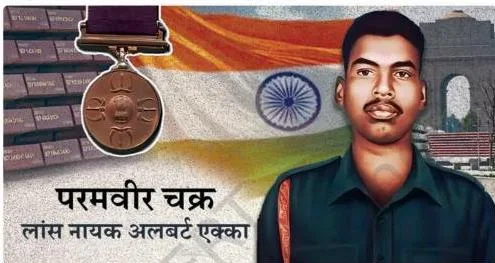
The photograph sits beside the official citation — and the citation is worth reading closely, because the exercises ask about it. At Gangasagar on the eastern front, Ekka silenced a Light Machine Gun by charging a bunker and bayoneting two enemy soldiers (p. 182).
Though seriously wounded, he kept clearing bunkers, then crawled to a building, lobbed a grenade through a loophole, scaled the wall and bayoneted the gunner of a Medium Machine Gun so the attack could succeed. He died after the objective was captured and received the Param Vir Chakra posthumously.
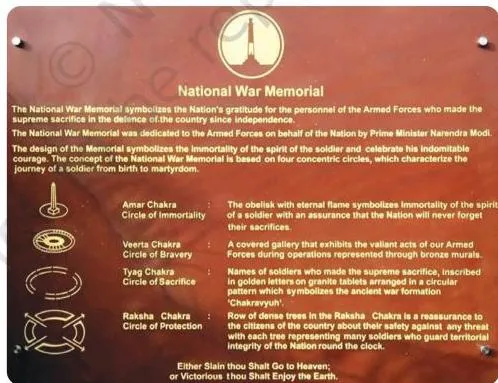
This is the wall of honour the letter describes, the third circle of the memorial. Its walls stand in the ancient Chakravyuh formation, and every granite tablet is dedicated to one fallen hero of post-independence India, with the name etched in golden letters (p. 184).
When an exercise asks what the Tyag Chakra signifies, this picture is the answer: sacrifice, remembered one name at a time.
The portrait belongs to Major Padmapani Acharya of 2 Rajputana Rifles, awarded the Maha Vir Chakra posthumously for Kargil (Operation Vijay, 1999). Before the battle he wrote to his father that he was not afraid to lose his life protecting the motherland (p. 186).
The letter quoted the Gita’s message that the warrior loses nothing either way — slain, he gains the celestial abode; victorious, he enjoys the earth — so he must rise and fight.
His citation describes leading a reserve platoon up a steep, mined rock face, then firing on the enemy while ordering his men to leave him; he died after the objective was captured.
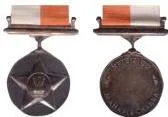
Captain Anuj Nayyar of the 17 Jat regiment received the Maha Vir Chakra posthumously for the Kargil war of 1999. His mother Meena Nayyar wrote the memoir Tiger of Drass – Capt. Anuj Nayyar – 23 – Kargil Hero, and the chapter quotes her feeling that if she did not write about him, no one would know of his sacrifice (p. 190).
The Rani Abbakka story is told in comic frames. The five frames below carry the whole plot, so read them in sequence like any comic.
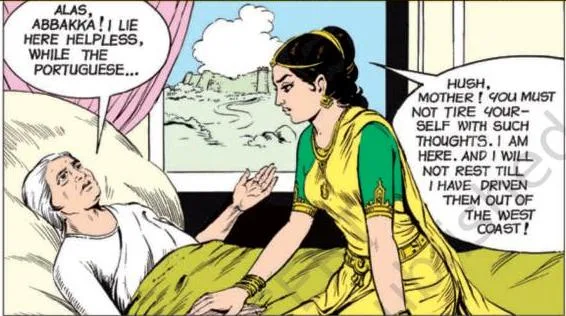
Frame 1 sets up the conflict. Hiriya Abbakka, the queen of Ullal, is on her deathbed; years earlier the Portuguese captured Ullal and made it a vassal that had to pay tribute. Her daughter and successor, Abbakka Devi, is by her side (p. 207).
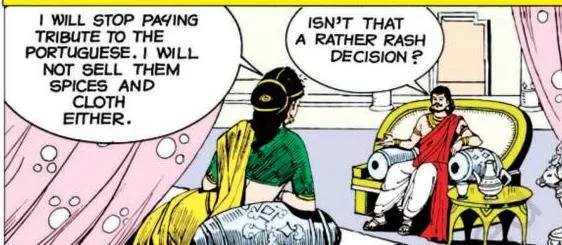
Frame 2 jumps to the coronation. Abbakka tells her husband Veera Narasimha, the king of Bangadi, about her future plans — and the cause-effect exercise on page 213 asks what he thought of her decision. He felt it was hasty.
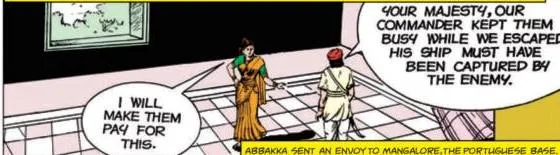
Frame 3 shows the turning point. Abbakka had ordered merchant ships to be built and, in alliance with the Zamorin of Kozhikode, had opened a profitable trade with Arabia. The Portuguese navy apprehended the ships on their return, and only the commander’s ship failed to come back — which deeply angered the queen (p. 211).
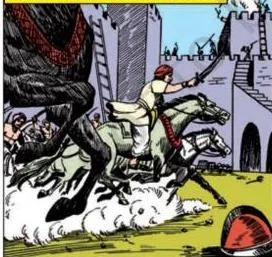
Frame 4 is the answer. The Portuguese attacked, and Abbakka in turn unleashed her forces; they attacked the Portuguese fort (p. 211).
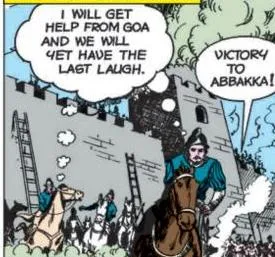
Frame 5 closes the battle. Ribero, the Portuguese commander, escaped with his life — the queen’s gamble had paid off (p. 211).
The last image supports the listening task on page 224. Rani Gaidinliu was born on 26 January 1915 in present-day Tamenglong district of Manipur, joined the Heraka movement at 13, was arrested at 16 in 1932, and remained in prison until 1947.
The bio-table the teacher reads out adds the honours: the title ‘Rani’, the Padma Bhushan in 1982, the Birsa Munda Award posthumously, a postal stamp in 1996 and a commemorative coin in 2015.
Definitions: Key Words from the Chapter in Plain English
The chapter glosses these words in its margins and in the Rani Abbakka vocabulary match. Learning them first makes the extract questions and the writing tasks faster.
| Word | Meaning |
|---|---|
| homage | something said or done to show respect publicly for someone |
| territorial integrity | keeping the nation’s borders safe |
| tribute | showing respect and gratitude; also, the payment a vassal is forced to make |
| etched | engraved into a surface |
| gallantry | exceptional courage, especially in battle |
| posthumously | after death |
| citation | the official record of meritorious performance of duty |
| awestruck | amazed |
| commemorates | remembers officially and shows respect |
| obelisk | a tapering stone pillar |
| wreaths | circular arrangements of flowers placed in remembrance |
| interminable | everlasting |
| valiant | very brave |
| memoir | an account of one’s own life and experiences |
| vassal | a state controlled by a more powerful country and obliged to pay money |
| coronation | the ceremony at which a person is made king or queen |
| successor | a person who takes over from another |
| rash | acting without thinking about the consequences |
| sovereign | having complete authority; a sovereign country answers to no outside power |
| league | an association or partnership |
| wrath | extreme anger |
| seize | take hold of suddenly or forcibly |
| resolve | determination |
| raged | happened in a violent way |
| decisive | showing the ability to make decisions effectively |
| apprehended | captured |
| dauntless | fearless |
| avenge | take revenge for |
Common Mistakes in Bravehearts and How to Avoid Them
Most of this chapter’s traps sit in the grammar and vocabulary exercises rather than in the stories. The table names each trap and the rule that fixes it.
| Mistake | Correct rule | How to check your answer |
|---|---|---|
| Assuming every prefix means ‘not’ | dis-, in-, im- and un- can give a negative sense (disregard, inconsequential, immortal, undaunted), but re-, mal-, anti-, extra-, ex- and de- mean again, badly, against, beyond, former and remove. ‘Extraordinary’ means beyond ordinary, not ‘not ordinary’. | Match the prefix to its meaning in the Let us learn table (p. 194) before guessing a new word. |
| Applying ‘i before e except after c’ to every word | The rule works after c — receive, deceive, ceiling, perceive. Weight, society, protein and friend are exceptions. | Learn the exceptions by heart; the spelling exercise on p. 215 lists them. |
| Pronouncing silent letters | The w in wrath is silent, and the final r of successor is not pronounced. The chapter also flags campaign, knowledge, pneumonia, honour, calm. | Use the pronunciation notes in Let us speak (p. 221) before reading aloud. |
| Forgetting that reported speech changes three things | Direct to indirect speech shifts the tense back (will to would, present to past), changes pronouns (I to she, we to they), and adjusts time and place words (now to then, tomorrow to the following day). | After rewriting, check tense, pronouns and time words separately; commands use asked, advised or instructed with a to-infinitive. |
| Marking ‘It truly is a majestic site’ as a fact | ‘Truly’ is an intensifier, not proof. The sentence is an opinion, and the extract question on p. 192 expects that answer. | Ask: could someone reasonably disagree? If yes, it is an opinion. |
| Calling the tone of ‘My Dear Soldiers’ sad | The tone is admiring, respectful, grateful and prayerful (p. 201). | Re-read the closing blessing — a prayer is not a lament. |
Reported speech: a worked example
Here is the conversion done once, slowly, with new sentences. The rules are the chapter’s (pp. 217–218).
Direct: Mother said to me, ‘I will make your favourite breakfast tomorrow.’
| Change | Direct | Indirect |
|---|---|---|
| Reporting verb | said to me | told me |
| Modal verb | will | would |
| Speaker pronoun | I | she |
| Listener pronoun | your | my |
| Time expression | tomorrow | the following day |
Indirect: Mother told me that she would make my favourite breakfast the following day. The meaning is unchanged, but every layer has stepped back: verb form, pronouns, and time word.
Commands work the same way, with the reporting verb changed to asked, advised or instructed plus a to-infinitive. For example, a captain who says ‘Defend this post till sunset’ is reported as instructing the soldiers to defend that post till sunset.
How the Exercises in This Chapter Test You
Each text has its own exercise pattern. Knowing the pattern makes revision faster.
| Text | Exercise formats | What a complete answer includes |
|---|---|---|
| A Homage to Our Brave Soldiers (pp. 187–198) | Completing a war-hero table; matching feelings to paragraphs; extract questions with an analogy (flame : valour :: wreath : respect); fact and opinion choices; longer answers in your own words | Quote or locate the right paragraph, then explain in your own words; state the analogy pair clearly; choose the tone that matches the writer’s admiration. |
| My Dear Soldiers (pp. 201–205) | Summary completion with exact words from the poem; poetic devices (imagery, simile, metaphor, repetition, alliteration); theme and tone multiple-choice questions; terrains vocabulary; collocations | Copy the exact word from the poem for each summary blank; name the device and quote the phrase that shows it. |
| Rani Abbakka (pp. 213–222) | A 14-item vocabulary match; cause and effect table; extract questions on the ‘sovereign country’ dialogue; ie/ei spelling; silent letters; dictionary work; direct to indirect speech | State both the cause and the effect; in reported speech change tense, pronoun and time or place words together. |
- Listening (pp. 223–225): Gunjan’s speech on why she wants to join the Armed Forces, answered in two or three exact words; the poem ‘A Soldier’s Pride’ completed while listening; the Rani Gaidinliu bio-table filled from the teacher’s reading.
- Writing: a letter on the Armed Forces’ peace-time role, an acrostic poem that spells SOLDIER, a note of gratitude in 50 words, and a conversation between Pratap and Tarana.
- Speaking: reciting the Kalam poem with pauses and emphasis, using volume and pace to carry the emotion (p. 204).
- Explore: the mottos of the three Armed Forces, women in the forces, and a collage or presentation on a brave woman.
One honest note: textbook contents and the examinable syllabus are not always identical — check the current official CBSE syllabus before you plan revision.
The Whole Chapter in One Read
Soumya’s letter carries the chapter’s spine: a visit to the National War Memorial where every tablet, chakra and citation teaches that freedom has a price paid in lives (pp. 180–186).
Ekka silenced two machine guns at Gangasagar and died after the objective fell; Acharya led his men up a mined rock face at Kargil and quoted the Gita to his father before he went. Both medals came posthumously.
Ananda’s reply adds the flower that asks to be thrown on the path where brave warriors march, and the story of Captain Anuj Nayyar, kept alive by his mother’s memoir. Kalam’s poem turns the soldier into a sleepless guardian of every terrain — heights, valleys, deserts, marshes, seas and air — whose youth is given to the nation.
The Rani Abbakka comic reaches back to 16th-century Karnataka and shows the same defiance in a queen: she calls her country sovereign, refuses tribute, and attacks the Portuguese fort. The grammar thread ties it all together — prefixes build words, clauses connect ideas, collocations pair them, and reported speech lets us pass another person’s words on.
Related Resources and Official Sources
Continue with the other chapters on the Class 7 English NCERT book page, or open the travel and adventure guide from the same English section. The Class 7 hub gathers the subject notes for this class, and the CBSE notes home page is where every class’s notes are listed.
For the chapter’s own sources: the National War Memorial website and the Gallantry Awards portal are the two official sites the letters name. Use them to read the full citations of Ekka and Acharya and to explore the memorial’s design.
Sources and Data Verification
This page describes the NCERT Class 7 English textbook Poorvi, Chapter 5, ‘Bravehearts’, printed pages 178–225. It covers only that chapter of that book, not other Class 7 English readers or other chapters. NCERT settles the textbook, its editions and the official PDF; CBSE settles the curriculum, the syllabus and the examinations. Page references follow the printed NCERT edition.
| What the chapter holds | Count | Where it is used |
|---|---|---|
| Printed pages | 48 | |
| Figures with NCERT captions | 17 | |
| Tables | 15 | |
| Official NCERT PDF | Download the chapter PDF | the chapter exactly as NCERT publishes it |



Frequently Asked Questions About Bravehearts Class 7
Quick answers to the questions students search for after reading the chapter.
Which gallantry award is India’s highest and how is it different from the Maha Vir Chakra?
The Param Vir Chakra (PVC) is India’s highest wartime gallantry medal, and the chapter says 21 bravehearts have received it (p. 181). The Maha Vir Chakra (MVC) is the second-highest gallantry award (p. 190).
Both can be awarded posthumously: in this chapter Ekka holds the PVC, while Acharya and Nayyar hold the MVC. The letter also names the Kirti Chakra, the Vir Chakra and the Shaurya Chakra.
What are the four chakras of the National War Memorial?
From the centre outwards: Amar Chakra (Circle of Immortality) holds the obelisk with the Amar Jawan Jyoti; Veerta Chakra (Circle of Bravery) holds six bronze murals of battle; Tyag Chakra (Circle of Sacrifice) holds the walls of honour with names in golden letters; and Raksha Chakra (Circle of Protection) is the outermost row of trees (p. 184).
What does the flower in Pushp ki Abhilasha want?
In Makhanlal Chaturvedi’s poem Pushp ki Abhilasha, the flower refuses to be woven into ornaments, strung in a lover’s garland, laid on an emperor’s body, or worn on the heads of gods. Its one wish is to be plucked and thrown on the path where brave warriors march to offer their heads for the motherland (p. 189).
How is Rani Abbakka’s story presented in Chapter 5?
As a graphic story — a comic told in framed pictures with captions, not a prose narration. The frames show the queen of Ullal on the west coast of Karnataka refusing tribute to the Portuguese, allying with the Zamorin of Kozhikode, having her ships seized, and attacking the Portuguese fort while the commander Ribero escapes (pp. 207–211).
The exercises after the story include a vocabulary match, a cause-and-effect table, and direct to indirect speech.
What grammar points do the Bravehearts exercises cover?
Six areas: prefixes and their meanings; main and subordinate clauses with subordinating conjunctions such as when, because, though, unless and so that; collocations like ‘scorching sun’; ie/ei spelling; silent letters; and direct and indirect speech with tense, pronoun and time changes (pp. 194–195, 202, 215–219).
Is the Amar Jawan Jyoti part of the National War Memorial?
Yes. The Amar Jawan Jyoti now burns in the obelisk at the centre of the National War Memorial, surrounded by the four chakras (p. 184).
It was first lit under the arch of India Gate in January 1972 to commemorate India’s victory in the 1971 war. When the memorial was inaugurated, the Prime Minister lit a new flame, and the flame from India Gate was later merged with it (p. 183).
Reference: NCERT Class 7 English Poorvi textbook, chapter 5, official edition on ncert.nic.in.
Explore Class 7 English Books
Related chapters: