
This page is about The Making of a Scientist, Chapter 6 of the NCERT Class 10 English supplementary reader Footprints without Feet, for the current academic session.
It tells the true story of Richard Ebright, who grew from a butterfly-collecting boy in Pennsylvania into the scientist who, at twenty-two, published a new theory on how cells work. The official chapter PDF is right here, and below it you will find a walkthrough of the story, its two figures, its glossary words, and the chapter’s own questions.
Download The Making of a Scientist Class 10 PDF
The complete chapter, exactly as printed in the current NCERT edition of Footprints without Feet, is published free by NCERT on its official textbook portal. That portal holds every Class 10 English book, so it is also where you will find the rest of this reader.
Open the portal, choose Footprints without Feet from the Class 10 English list, and take The Making of a Scientist Class 10 PDF (Footprints without Feet, Chapter 6) to read the chapter online or save the file.
Chapter at a Glance: What Is Inside Chapter 6
This is a biographical narrative by Robert W. Peterson, not a textbook lesson: it follows one person’s life and draws a lesson from it. After the story, the chapter closes with discussion questions and a short list of further reading.
A data table on this page carries the chapter’s numbers — sections, figures and question sets. The list below names each part of the chapter.
- The main narrative: Ebright’s life from childhood collecting to Harvard and the new theory on cells.
- A boxed list, “Species and Sub-species of Butterflies Collected in Six Weeks in Reading, Pennsylvania”.
- A graph of the butterfly collecting season around Reading.
- Two READ AND FIND OUT question sets — one before the story, one in the middle.
- Think about It, Talk about It and a Suggested reading list at the end.
What This Chapter Covers: Richard Ebright’s Story
What this chapter covers, in one line: a boy’s hobby becomes a scientific career, and the chapter shows every step of how it happened.
The opening frame tells you the end — Ebright has received the Searle Scholar Award and the Schering Plough Award for Biochemistry and Molecular Biology, and has excited the scientific world with a new theory on how cells work.
That theory was published with his college room-mate in an important scientific journal — the first time that journal had ever printed the work of college students. The chapter compares the feat to making the big leagues at fifteen and hitting a home run at first bat. Then it rewinds to the beginning: all of it started with butterflies.
Ebright grew up north of Reading, Pennsylvania, as an only child. There was no team to join — he could not play football or baseball with a team of one — so he collected: butterflies from kindergarten, then rocks, fossils and coins, and he became an eager astronomer who sometimes star-gazed all night.
By second grade he had collected all twenty-five local butterfly species.
His mother was his constant support. She took him on trips, bought him telescopes, microscopes, cameras and mounting materials, and spent almost every evening at the dining table making sure he had something to learn. Her own words describe the rule: “If he didn’t have things to do, I found work for him — not physical work, but learning things.”
Collecting could have stopped there — Ebright said that might well have been the end of his butterfly collecting. Then his mother gave him a children’s book, The Travels of Monarch X, which told how monarch butterflies migrate to Central America. That book, the chapter repeats, opened the world of science to him.
The table below links each stage of the story to the project Ebright attempted and the result he got. It is the fastest way to keep the order straight.
| Stage in the story | Project Ebright attempted | Result |
|---|---|---|
| Kindergarten onwards | Collected butterflies, rocks, fossils and coins; star-gazed; his mother supplied equipment and trips | All 25 local butterfly species collected by second grade |
| After The Travels of Monarch X | Raised monarchs from egg to caterpillar to pupa to adult; tagged their wings and released them | Learned the full life cycle; only two tagged butterflies were ever recaptured |
| Seventh grade | Entered the county science fair with slides of frog tissues under a microscope; then wrote to Dr Urquhart for ideas | Lost — and learned that winners did real experiments, not neat displays; Urquhart’s ideas carried him through high school |
| Eighth grade | Tried to find the cause of a viral disease that kills monarch caterpillars | No clear result, but showed he had tried the experiment — and won |
| Next year | Tested whether birds would eat monarchs, to check the viceroy-monarch theory | A starling ate monarchs; first in zoology, third overall at the county fair |
| Second year of high school | Asked what the twelve gold spots on a monarch pupa are for | Built a device showing the spots produce a hormone; first place at the county fair, third for zoology internationally |
| High school junior | Continued the gold-spot experiments on the monarch pupa | First place at the International Science Fair |
| Senior year | Grew monarch wing cells in culture and fed them the gold-spot hormone | Cells formed normal wing scales only with the hormone; first place for zoology at the International Fair |
| Harvard years | Identified the hormone’s chemical structure; studied X-ray photos of it | The idea for his new theory on how a cell reads its DNA |
Ebright did not shout “Eureka!” when he saw the X-ray photos. He simply believed the photos, together with his insect-hormone findings, answered a long-standing puzzle: how a cell reads the blueprint of its DNA. He and his room-mate James R.
Wong worked all night drawing pictures and building plastic models of molecules to show how it could happen, then wrote the paper.
The chapter then rounds off the picture: highest honours at Harvard, second in a class of 1,510, research at Harvard Medical School, and the hope that the theory could lead to new ideas for preventing some types of cancer.
It also shows the rest of the man — a champion debater and public speaker, a canoeist, an all-around outdoors-person and an expert photographer of nature.
Key Ideas: What Made Ebright a Scientist
The chapter is a biography, but it is built on reasons. This section turns those reasons into a short list of lessons you can use in an answer.
A children’s book opened the door to science
The turning point in the story is not a discovery but a book. The Travels of Monarch X was a children’s book, not a textbook, and it did one simple thing: it showed how monarch butterflies migrate to Central America. For a boy who had already collected every local species, that glimpse of a wider world changed everything.
The chapter says the book “opened the world of science to him.”
His mother was an enabler, not a taskmaster
Ebright’s mother bought the equipment and arranged the experiences — trips, telescopes, microscopes, cameras, mounting materials — and her evenings were given to him, finding learning tasks rather than chores. The distinction matters: she did not force him to study; she made learning available, and he wanted it.
The loss at the science fair taught the real lesson
Ebright’s first fair entry, in seventh grade, was a display: slides of frog tissues shown under a microscope. He won nothing, and the sting taught him what the winners had done differently — they had tried real experiments. For the next fair he resolved to do a real experiment, and he chose the subject he knew best, his insect work.
One question led to another, from gold spots to DNA
The chain is the chapter’s quiet argument: a question about ornamental-looking spots on a monarch pupa led to a hormone, then to wing cells in culture, then to X-ray photos that gave Ebright his theory of how a cell reads its DNA. Each step came from the one before.
The recipe at the end: mind, curiosity, purpose
The chapter’s final lesson is stated as a recipe: start with a first-rate mind, add curiosity, and mix in the will to win for the right reasons.
Mr Weiherer, Ebright’s social studies teacher, supplies the meaning of “the right reasons”: Ebright was competitive, he said, but not in a bad sense.
He did not want to win for the prize; he wanted to do the best job he could — and he put in three or four hours of debate research at night on top of his butterfly work.
The Two Figures in This Chapter, Explained
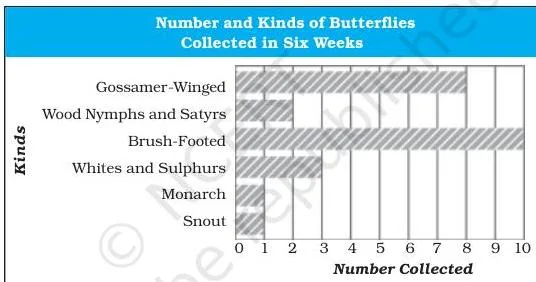
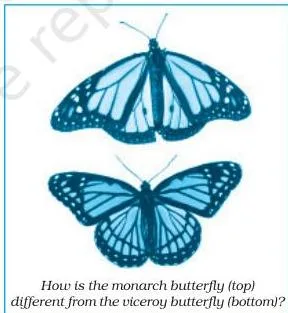
The chapter carries two illustrations, and each one carries information the story needs. Read them with the text, not past them.
This graph gives a practical reason for what Ebright did next. Because the season lasts only six weeks in late summer, chasing butterflies one by one would not catch many.
So he changed method: he caught a female monarch, took her eggs, and raised them in his basement through the whole life cycle — from egg to caterpillar to pupa to adult butterfly — then tagged the wings and let them go. For years his basement held thousands of monarchs at different stages.
This picture accompanies the passage about Ebright’s test of the viceroy-monarch theory. The theory said viceroys look like monarchs because monarchs do not taste good to birds — so copying the monarch’s look keeps a viceroy safe from becoming a bird’s dinner.
Ebright’s experiment found that a starling would not eat ordinary bird food but would eat all the monarchs it could get. So in this test, at least, the monarchs did not taste bad to birds. Later research by other people, the chapter notes, showed that viceroys probably do copy the monarch after all.
Words and Terms Explained
The chapter ends with a small glossary of six everyday words, and the story itself uses several biology terms you may recognise from science class. The two tables below separate the two groups.
Everyday words from the chapter’s own glossary:
| Everyday word | Meaning in this chapter |
|---|---|
| leagues | groups of sports clubs or teams that play matches among themselves — used in the baseball comparison at the start |
| county | a region; the science fairs Ebright entered were county-level fairs |
| starling | a common European bird that nests near buildings and is a good mimic; the bird in Ebright’s experiment ate monarchs |
| entomology | the study of insects; Ebright spent summers at an entomology laboratory |
| eureka | a cry of triumph at a discovery — the word Ebright did not shout when he saw the X-ray photos |
| canoeist | a person who paddles a canoe; one of Ebright’s other skills |
Science terms that appear inside the story:
| Science term | What it means in the story |
|---|---|
| monarch butterfly | the butterfly listed in the chapter’s box as “monarch or milkweed”, which Ebright raised through its life cycle and tagged |
| viceroy butterfly | the butterfly in the mimicry theory — it looks like the monarch, and the theory says this protects it from birds |
| pupa | the stage between caterpillar and adult butterfly; the twelve gold spots are on the monarch pupa |
| hormone | a chemical made in one part of the body that controls growth or development elsewhere; the gold spots produce one needed for the butterfly’s full development |
| DNA | the substance in the nucleus of a cell that controls heredity — the blueprint for life, in the chapter’s phrase |
| cells | the building blocks of living things; Ebright grew cells from a monarch’s wing in a culture |
Common Mistakes to Avoid in This Chapter
This is a biography, so the story is easy to remember broadly and misremember in detail. The table below names the five details most worth checking before you write an answer.
| Mistake | Correct rule | How to check your answer |
|---|---|---|
| “Ebright won his first science fair.” | He lost in seventh grade; the loss taught him that real experiments beat neat displays. | Ask what his first entry was: slides of frog tissues — a display, not an experiment. |
| “The Travels of Monarch X was a school textbook.” | It was a children’s book about how monarch butterflies migrate to Central America. | The chapter calls it a children’s book, and its subject is migration, not school science. |
| “The starling experiment proved the viceroy theory.” | It showed a starling would eat monarchs. The chapter says later research by other people showed viceroys probably do copy the monarch. | Look for “later research by other people” — that is their work, not Ebright’s proof. |
| “The twelve gold spots on a monarch pupa were only ornamental.” | Everyone assumed that, but the spots produce a hormone needed for the butterfly’s full development. | Ebright built a device that showed the spots producing the hormone. |
| “Competitive meant winning at any cost.” | Mr Weiherer said Ebright was competitive, but not in a bad sense — he wanted to do the best job he could, for the right reasons. | The teacher’s full comment is about doing your best, not about prizes. |
Exam Notes: How to Revise This Chapter
The chapter sets its own revision map: its question sets tell you exactly what the writer thinks matters. Use them as your checklist rather than guessing.
- READ AND FIND OUT (first set) checks story facts: how the book became a turning point in Ebright’s life, and how his mother helped him.
- READ AND FIND OUT (second set) checks the argument: the lesson of losing, the experiments and projects he then undertook, and the qualities that go into the making of a scientist.
- Think about It asks you to reflect — how anyone becomes a scientist, and how Ebright’s work connects to the cells and DNA you have studied in science class.
- Talk about It is for discussion: children’s questions as the beginning of scientific inquiry, with examples from Discovered Questions by Professor Yash Pal and Dr Rahul Pal, such as what DNA fingerprinting is and how honeybees find their own honeycombs.
For the chapter’s central question — what qualities go into the making of a scientist — a complete answer has three parts:
- Opening: state the chapter’s closing recipe — a first-rate mind, curiosity, and the will to win for the right reasons.
- Body: give evidence in order — the childhood collecting driven by curiosity; his mother’s support; the lost fair and the lesson it taught; the chain of experiments from the viral disease project to the gold-spot hormone; Mr Weiherer’s comment that Ebright wanted to do his best job, not win prizes.
- Conclusion: say what the qualities achieved — a boy’s hobby became a theory about cells and DNA, and the chapter ends by noting that Ebright never lost his scientific curiosity.
If you are asked what Ebright learned from the fair, a full answer must name all four pieces: the event (the seventh-grade county science fair), the entry (slides of frog tissues under a microscope), the outcome (he won nothing), and the lesson (the winners had tried real experiments; a neat display is not enough).
Missing the word experiment weakens the answer.
One reminder: textbook contents and the examinable syllabus are not always identical. Check the current official syllabus to see how this chapter is assessed this year.
Quick Recap: The Making of a Scientist in Ten Steps
A last-minute scan of the whole chapter, in story order, in ten steps.
- Kindergarten: Ebright begins collecting butterflies, along with rocks, fossils and coins, and takes up astronomy.
- His mother supports every interest — trips, equipment, and evening learning time — and by second grade he has all 25 local butterfly species.
- His mother gives him The Travels of Monarch X, the children’s book about monarch migration that opens science to him.
- He raises monarchs at home from egg to caterpillar to pupa to adult, tags their wings, and releases them.
- Seventh grade: he loses the county science fair with frog-tissue slides — the lesson that real experiments beat neat displays.
- He writes to Dr Urquhart, who sends a stack of experiment ideas that carry him through high school.
- Eighth grade: the monarch viral-disease project wins because he tried; the next project shows a starling eating monarchs and wins first in zoology, third overall.
- Second year of high school: gold spots on the monarch pupa are shown to produce a hormone; the work continues through junior year.
- Senior year: wing cells grow into normal scales only when fed the gold-spot hormone.
- Harvard: the hormone’s structure leads to the theory of how cells read DNA, and the chapter closes with the recipe — a first-rate mind, curiosity, and the will to win for the right reasons.
Related Chapters and Resources
This listing is maintained for the 2026-27 academic session using the NCERT textbook information available to us. NCERT remains the authority for confirming the latest edition.
The Making of a Scientist is Chapter 6 of Footprints without Feet. It is preceded by Chapter 5, also called Footprints without Feet, and followed by Chapter 7, The Necklace. Use the links below to move around the book and the wider notes collection.
- The Class 10 English notes hold the study material for both readers, Footprints without Feet and First Flight.
- For every Class 10 subject and chapter, start at the Class 10 hub.
- A full index of the notes collection is on the main CBSE Notes page.
- Related story notes from First Flight include Mijbil the Otter and Madam Rides the Bus.
- All NCERT Class 10 English textbook PDFs are published free on the official NCERT textbook portal.
Sources and Data Verification
The information on this page describes NCERT Class 10 English, the supplementary reader Footprints without Feet, Chapter 6, The Making of a Scientist, in the official edition published on ncert.nic.in. The two figures above are reproduced from that edition.
This page covers this NCERT textbook chapter and what is inside it. It does not describe the CBSE curriculum or examination papers, and the revision guidance is limited to what the chapter itself contains.
This listing is maintained for the current academic session using the NCERT information available to us.
NCERT settles textbook editions and the official PDFs of its books. CBSE settles the curriculum, syllabus and examinations. For what is examinable this year, check the current official syllabus.
| What the chapter holds | Count | Where it is used |
|---|---|---|
| Printed pages | 7 | |
| Figures with NCERT captions | 2 | |
| Official NCERT PDF | Download the chapter PDF | the chapter exactly as NCERT publishes it |
Frequently Asked Questions
Why is The Travels of Monarch X called a turning point in The Making of a Scientist?
Because it was the book that opened the world of science to him. Before it, Ebright had collected every local butterfly species and said that might have been the end of his collecting.
The children’s book told how monarch butterflies migrate to Central America, which led him to raise monarchs through their life cycle and begin the work that never really stopped.
What did Richard Ebright learn from losing at his first science fair?
He learned that real science means doing real experiments, not making a neat display. His seventh-grade entry was slides of frog tissues shown under a microscope, and he won nothing. He realised the winners had tried actual experiments, and he resolved that the next year’s fair would get a real experiment from him.
What was the purpose of the twelve gold spots on a monarch pupa?
They produce a hormone the monarch needs for its full development. Everyone assumed the spots were merely ornamental, but Ebright and another student built a device that showed the spots producing the hormone. His later cell-culture work confirmed it: monarch wing cells formed normal scales only when fed the gold-spot hormone.
What qualities go into the making of a scientist according to the chapter?
The chapter’s own answer is its closing recipe: start with a first-rate mind, add curiosity, and mix in the will to win for the right reasons. The story adds the supporting evidence — a mother who made learning possible, a teacher who modelled doing your best, and a habit of hard work that ran alongside debate, photography and canoeing.
How did Richard Ebright’s mother and teacher Mr Weiherer help him?
His mother made science possible at home: she took him on trips, bought him telescopes, microscopes, cameras and mounting materials, and gave her evenings to finding him things to learn.
Mr Weiherer, his social studies teacher, opened his mind to new ideas through the Debating and Model United Nations clubs and described the best kind of competition — wanting to do the best job you can, for the right reasons.
Reference: NCERT Class 10 English textbook, chapter 6, official edition on ncert.nic.in.
Explore Class 10 English Books
Related chapters: