
Here is NCERT Class 10 English First Flight, Chapter 7 — “Madam Rides the Bus,” the story of an eight-year-old girl’s first bus journey beyond her village, followed by the ballad The Tale of Custard the Dragon. The lesson spans printed pages 94 to 110 of the official book, and the chapter PDF is right below.
Use the download link to get the official file, then read the sections here to know what happens in the story, who the characters are, what the poem means, and how the exercises work — before you open the book.
Download the Official NCERT Chapter PDF
The file you need is the official NCERT edition — the same text your school follows, with no edits and no extra material added. It is published free on the NCERT website.
Open Madam Rides the Bus Class 10 NCERT PDF to read or download Chapter 7 of First Flight: on the NCERT textbook portal, choose the Class 10 English book First Flight and go to Chapter 7, printed pages 94 to 110.
Chapter at a Glance: What This File Contains
The lesson holds two texts together — a prose story and a poem — so the table below shows the shape of the whole file: its sections, its illustrations and its exercise questions. You can see what is inside before you read a single line.
The table is followed by the poem The Tale of Custard the Dragon, which closes the lesson on pages 108 to 110.
How the Lesson Is Organised: Story, Checks, Exercises and Poem
The lesson is built in two halves — a story you read in four parts, then a poem. Knowing where each piece sits saves you time when a teacher sets homework on a specific page.
- BEFORE YOU READ (page 94) — a note that frames the story around life and death, plus an Activity that previews the words of the bus ride and asks what you can see from a fast-moving bus.
- Part I (pages 95–96) — Valli’s wish and how she gathers facts about the bus; followed by an Oral Comprehension Check.
- Part II (pages 97–99) — the boarding, the conductor’s teasing and the first sights of the ride; followed by an Oral Comprehension Check.
- Part III (pages 100–102) — the saving of the fare, the running cow and the town; followed by an Oral Comprehension Check.
- Part IV (pages 103–104) — the return journey and the dead cow.
- Thinking about the Text (page 105) — the story’s main exercise questions.
- Speaking and Writing (pages 105–107) — a dialogue-mimicking task and three writing topics.
- The Tale of Custard the Dragon (pages 108–110) — the ballad, its glossary, Thinking about the Poem and a ballad-writing task.
The Story in One Page: What Happens in Madam Rides the Bus
Here is the whole story in three movements, so you can follow the plot before you read the full text. The page numbers let you jump to the exact lines for evidence.
The wish. Valli is eight and has no playmates, so her favourite pastime is standing in the front doorway and watching the street (NCERT, p. 95). The bus between her village and the nearest town passes hourly, and a wish to ride it grows into an overwhelming desire.
She listens to passengers and asks a few careful questions, and learns the facts of the journey: the town is six miles away, the fare is thirty paise one way, and the trip takes forty-five minutes.
Thirty paise is nothing to the well-dressed passengers she overhears, but a fortune to a girl who scarcely sees that much money in a month.
The best part of the plan is the arithmetic: if she stays in her seat and pays another thirty paise, she can return on the same bus — take the one o’clock bus, reach the town at one forty-five, and be home by about two forty-five (NCERT, p. 96).
The ride. Across months she saves sixty paise in stray coins, refusing peppermints, toys and balloons, and resolutely skipping the merry-go-round at the fair (NCERT, p. 100). She slips out during her mother’s afternoon nap and boards the bus alone, refusing the conductor’s helping hand and paying her own fare (NCERT, p. 97).
On the way she sees the canal, palm trees, grassland and green fields, laughs till tears come at a young cow running in front of the bus, watches a train rush past at a crossing, and is struck dumb by the town’s bright shops and crowds (NCERT, pp. 98–101).
She stays on the bus for the return, and politely refuses the conductor’s offer of a cold drink.
The return. On the way back she sees the same young cow lying dead by the roadside, where a fast-moving vehicle had struck it. The creature she had laughed at hours earlier now looks horrible, legs spreadeagled, and the memory of it haunts her; she no longer wants to look out of the window (NCERT, p. 103).
Home at three forty, she finds her mother and aunt talking. Her mother remarks that we can’t know about everything, and even what we do know we often can’t understand completely; Valli breathes “Oh, yes!” in agreement and smiles to herself (NCERT, p. 104).
Characters in Madam Rides the Bus: Valli, the Conductor and the Others
Character answers need textual evidence — the exact words a person says or the action the narrator records. Use this table to find the lines quickly.
| Character | What they are like | Where it shows in the text |
|---|---|---|
| Valli (Valliammai) | Eight years old, curious, determined, fiercely independent, and insistent that she is not a child | Watches the street from the doorway day after day (p. 95); “There’s nobody here who’s a child” (p. 98); saves sixty paise coin by coin (p. 100) |
| The conductor | Jolly, fond of joking, but genuinely caring — he teases her yet watches out for her | Calls her “my fine madam” (p. 97); warns her she may fall (p. 98); offers a cold drink as his treat (p. 102); “come and join us… don’t forget to bring your fare” (p. 104) |
| The elderly man | Concerned and well-meaning; sharply rebuffed | “You shouldn’t stand like that. Sit down” (p. 98); Valli answers haughtily that there is no child here (p. 98) |
| The elderly woman | Chatty and nosy; Valli finds her repulsive | Valli notices her ugly earrings and betel juice, and answers curtly (pp. 98–99) |
| The mother and the aunt | Kind but unobservant — the adult world that misses Valli’s inner life | The aunt calls her “a chit of a girl” who pokes her nose in (p. 104); the mother unknowingly states the story’s theme (p. 104) |
A character sketch from the textbook’s own clues
Question 3 of Thinking about the Text (page 105) asks you to fill blanks by picking exact words from the story — the words themselves are the evidence. Here are the answers and the trait each one supports.
| Blank in the question | Word or phrase from the story | Trait it shows |
|---|---|---|
| “a tiny hand was raised ___” | commandingly | determination — she stops the bus on her own |
| “Yes, I ___ go to town” | simply have to | determination — the ride is a settled decision |
| “There’s nobody here ___” | who’s a child | self-respect — she has paid like everyone else |
| “I can ___… I’m not a child… she said ___” | get on by myself / irritably | independence, and irritation at being treated as small |
| “I ___” (to the woman’s questions) | can take care of myself | independence — she needs no one’s supervision |
| “Well, sir, I hope ___” | to see you again | politeness — her courtesy to the conductor |
Added to these, her curiosity is the trait that starts everything — “very curious about things,” watching the street daily and asking discreet questions (NCERT, p. 95). The standard answer shape is therefore: determined, independent, self-respecting and curious.
Themes: Knowing about Death Is Not Understanding It
The lesson sets up its own reading in the BEFORE YOU READ note: an eight-year-old’s first bus journey is also her induction into the mystery of life and death, and the story shows the gap between knowing that death exists and understanding it (NCERT, p. 94).
The knowing–understanding gap. On the way to town, the young cow makes Valli laugh till she cries (p. 101). On the way back, the same cow lies dead by the roadside, and the memory of it haunts her; she stops looking out and sits glued to her seat (p. 103).
She knows what happened but cannot absorb it — that is the gap the story is about. The encounter and its aftermath are what the mother’s closing words speak to.
The mother’s closing words. Back home, the mother says, without knowing what Valli has seen, that we can’t possibly know about everything, and that even what we know we often cannot understand completely. Valli’s “Oh, yes!”
is her quiet recognition — the theme spoken by an adult who does not know she is answering the child’s real experience (NCERT, p. 104).
Independence and curiosity. The second thread is a child’s bid for independence: the wish (p. 95), the careful saving (p. 100), the decision to go alone and refuse help (pp. 97–98), and her answer to the elderly woman — “I can take care of myself” (p. 98). The ride is her first step out of the doorway and into the world.
The Tale of Custard the Dragon: Ballad, Parody and Poetic Devices
The poem, by Ogden Nash, is printed with a note that it is written in the style of a ballad — a poem that tells a story — and is “a humorous ballad close to a parody” (NCERT, p. 108). Ballads usually celebrate courage; this one mocks it, which is why the story and the poem sit together.
The story of the poem
Belinda lives in a little white house with a black kitten called Ink, a grey mouse called Blink, a yellow dog called Mustard, and a dragon called Custard. Everyone boasts of bravery except Custard, who cries for a nice safe cage.
When a pirate climbs in at the window, Belinda cries for help, Mustard flees with a yelp, Ink trickles away and Blink mouseholes — but Custard jumps up, clashes his tail and gobbles the pirate. Then the others claim they would have been twice or three times as brave, and Custard agrees that everybody is braver than him (pp. 108–109).
How Custard follows and parodies the ballad
The lesson’s Writing task lists what a ballad needs (p. 110). This poem meets every item — and then twists it.
| Ballad feature (from the lesson) | How Custard follows it | How it becomes a parody |
|---|---|---|
| Tell a simple narrative | A complete story: trouble arrives, the “coward” saves everyone | The hero is the character everyone laughed at |
| A few major characters | Belinda, Ink, Blink, Mustard, Custard, the pirate | The “heroes” are a kitten, a mouse and a small dog |
| A strong rhythm and rhyme | Rhyming couplets throughout, regular beat for reading aloud | Nonsense rhymes like “realio, trulio” break the grand tone |
| A refrain | The closing stanza repeats the earlier boasts about Belinda, Ink and Mustard, and Custard’s crying for a cage | The refrain repeats the lie — the brave ones never prove it |
That is the parody of courage: the ballad’s expected brave characters run away, and the dragon meant to be the monster turns out to be the only fighter (p. 108).
Poetic devices with line evidence
Question 4 of Thinking about the Poem (p. 110) gives one simile and asks you to find more devices. The table below is the full set to revise from.
| Device | A line from the poem | What it does |
|---|---|---|
| Simile | “Clashed his tail like irons in a dungeon” | Compares Custard’s tail to clashing iron; the sound fills the line |
| Hyperbole | “Belinda giggled till she shook the house” | Exaggerates for comedy — a giggle cannot shake a house |
| Alliteration | “with a clatter and a clank” | Repeats the c sound to echo the clash of the dragon’s tail |
| Onomatopoeia | “Meowch!” (and “Weeck!” for the mouse) | Words that sound like the noise they name; the comic sounds suit a comic poem |
| Irony | “I quite agree / That everybody is braver than me” | Custard says it after being the only one who fought — the opposite is true |
The note on page 109 adds that Ogden Nash wrote over four hundred pieces of comic verse. This poem is typical of his style — informal rhyme treating a serious form playfully.
Figures from the Lesson, Explained
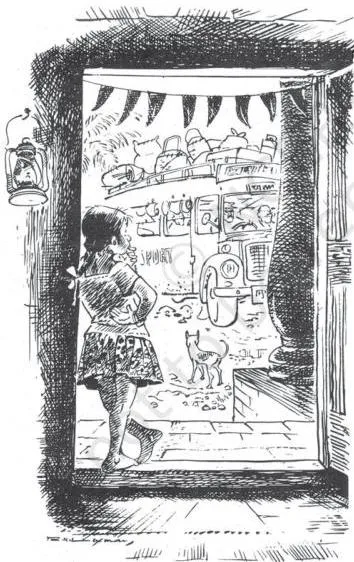

The story is illustrated by R. K. Laxman, and its three illustrations carry real information about Valli. Each one below is captioned and then read for you.
The doorway as Valli’s window onto the world (page 95)
This drawing sits beside the opening of the story (p. 95). With no playmates on her street, the passing scene becomes Valli’s game, and the bus — arriving each hour with a fresh set of passengers — is the most fascinating sight of all.
The picture is the starting point of the plot: the wish to ride is born exactly here.
“Listen, child,” said the voice (page 98)
This is the exchange that defines Valli’s character (p. 98). The man is honestly concerned — she could fall when the bus turns — but she reads his “child” as an insult to her independence.
Her answer — “There’s nobody here who’s a child. I’ve paid my thirty paise like everyone else.” — is the clash at the heart of the story: the world sees a little girl; Valli sees a passenger.
“Read the conversations carefully” (page 105)
This illustration opens the Speaking section of the lesson (p. 105). Its caption is its instruction: the story advances through talk.
In the section that follows, the conductor’s jokes, the elderly man’s concern, the elderly woman’s questioning and the mother and aunt’s chatter each carry the story forward, and the task asks you to mimic a real conversation the same way.
Words That Carry the Story: Glossary in Context
The lesson prints the meanings of difficult words in the margin, next to the line where they appear. That is a signal — comprehension questions test exactly these words — so learn each one inside its sentence.
| Word | Meaning (as used) | The line it appears in | What it shows |
|---|---|---|---|
| wistfully | longingly | “Valli would stare wistfully at the people who got on or off” (p. 95) | her longing for the ride |
| haughtily | proudly | “‘There’s nobody here who’s a child,’ she said haughtily” (p. 98) | her pride and self-respect |
| curtly | showing displeasure | “‘Yes, I’m travelling alone,’ she answered curtly” (p. 98) | she keeps strangers at a distance |
| repulsive | causing strong dislike | “Valli found the woman absolutely repulsive” (p. 98) | her direct, childish judgement |
| drivel | silly nonsense | “the old woman went on with her drivel” (p. 99) | how little patience Valli has for empty talk |
| thriftily | spending money carefully | “She had thriftily saved whatever stray coins came her way” (p. 100) | her self-control and determination |
| resolutely stifled | suppressed with determination | “she had resolutely stifled a strong desire to ride the merry-go-round” (p. 100) | the same determination, tested by temptation |
| thoroughfare | a busy public road | “entered a wider thoroughfare” (p. 101) | the noise and scale of the town |
| spreadeagled | spread out | “legs spreadeagled, a fixed stare in its lifeless eyes” (p. 103) | the shock of the death scene |
| haunted | returned repeatedly to her mind | “The memory of the dead cow haunted her” (p. 103) | the story’s central effect — the death stays with her |
| pokes her nose | takes an interest in what does not concern her | “how she pokes her nose into our conversation” (p. 104) | the aunt still sees Valli as a child |
| grog / gyrate | a sailor’s drink / to move around in circles | “gulped some grog from his pocket flagon”; “Ink and Blink in glee did gyrate” (glossary, p. 110) | the poem’s comic, sailor-story flavour |
Common Mistakes Students Make in This Lesson
The errors below are the ones that actually appear in answers — each is a misreading of a specific line, and each is easy to fix once you know the line.
| Mistake | Correct rule | How to check your answer |
|---|---|---|
| Saying Valli was bored on the return trip | The story says she “wasn’t bored in the slightest” until she saw the dead cow; it is the cow that damps her joy | Quote the effect, not a mood word: “the memory of the dead cow haunted her” (p. 103) |
| Calling the conductor’s “madam” pure mockery | It is affectionate teasing that also grants her dignity — he helps her on, warns her about falling, offers a drink, and says goodbye warmly | List one caring action after each joke (pp. 97–102) before you call it mockery |
| Mixing up the fare and the timing | Thirty paise one way; another thirty paise to return; sixty paise in total; the town is six miles away and the trip takes forty-five minutes | Re-check against Part I (pp. 96 and 100): one-o’clock bus out, home by about two forty-five |
| Reducing the theme to “a bus ride” | The BEFORE YOU READ note frames the story as an induction into life and death; the dead cow and the mother’s words carry that theme | End theme answers with the cow (p. 103) and the mother’s closing words (p. 104), not with the ticket |
| Treating Valli as completely fearless | She is cautious too: she will not get off in town alone and refuses the conductor’s drink (p. 102) | Quote “All by myself? Oh, I’d be much too afraid” alongside her boldness |
| Reading Custard’s bravery flatly | It is irony — the braggarts flee, then claim they would have been braver; the one everyone mocked is the only fighter | Track who acts versus who talks: Mustard fled, Ink trickled, Blink mouseholed (p. 108) |
Exam Notes: Answering Character and Theme Questions
No one can promise which question will appear, and textbook contents and the examinable syllabus are not always identical — check the current official Class 10 English syllabus on cbse.gov.in for what is examinable. What this lesson’s own exercises show is how character and theme answers are phrased and what a full answer must contain.
The short-answer pool. The Oral Comprehension Checks built into the lesson (pages 97, 100 and 103) are short factual questions: Valli’s favourite pastime, what she found out about the bus, why the conductor calls her madam, how she saved the fare, why she did not get off in town.
A two-sentence answer — the fact, then the line that proves it — is enough for these.
The long questions. Thinking about the Text (p. 105) moves from facts to character: question 3 is a fill-in-the-blanks evidence exercise, question 6 asks why she refuses to look out on the way back, question 7 asks the meaning of her final “I was just agreeing…”, and question 8 asks for evidence of the eight-year-old point of view.
In the poem, question 4 (p. 110) asks you to list poetic devices, starting from one given simile.
A five-mark answer structure. For both character and theme questions, use these four moves: point, quote, explain, link back.
- Point — state the answer in one clear sentence. Example: Valli stops looking out because the dead cow has changed her mood.
- Quote — give the shortest precise line, with its speaker or situation. Example: “The memory of the dead cow haunted her.”
- Explain — unpack the words: hours earlier she had laughed at the same cow running; now the creature’s death is a shock she cannot absorb, so she sits glued to her seat.
- Link back — close by connecting to the question: the refusal is not sulking, it is her first real encounter with death — the lesson’s theme from the BEFORE YOU READ note.
End every character answer with the trait the evidence supports, and every theme answer with the knowing-versus-understanding idea — that is what the lesson itself points to (p. 94).
Revision at a Glance: From the Doorway to the Dead Cow
A sixty-second recap of the whole lesson for the night before the test.
- Start — eight-year-old Valli, no playmates, watches the street from the front doorway; the hourly bus becomes an overwhelming desire to ride (p. 95).
- The plan — six miles, thirty paise one way, forty-five minutes; one-o’clock bus out, home by about two forty-five (p. 96).
- The saving — sixty paise in small coins, refusing peppermints, toys and the merry-go-round (p. 100).
- The ride — alone, without help; the canal and green fields; the running cow; the train; the town’s shops and crowds; she stays on the bus for the return (pp. 97–102).
- The return — the same cow dead; the memory haunts her; no more window; home at three forty (p. 103).
- The close — the mother’s unknowing words about knowing without understanding; Valli’s “Oh, yes!” and quiet smile (p. 104).
- The poem — brave looks deceive: Custard the “coward” is the only one who fights the pirate, and the braggarts still claim they would have been braver — a ballad and its parody (pp. 108–110).
Related Resources: This Chapter in the Class 10 English Book
This listing is maintained for the 2026-27 academic session using the NCERT textbook information available to us. NCERT remains the authority for confirming the latest edition.
Use these links to place this lesson in the rest of the Class 10 English book. Work through the whole book from the Class 10 English hub, which holds the First Flight chapters on this site; for all other Class 10 subjects go to the Class 10 hub, or start from the main CBSE notes index.
Two pages connect directly to this lesson: the Words and Expressions 2 workbook unit for Madam Rides the Bus for the language exercises that accompany the story, and the First Flight chapter The Sermon at Benares if you want another chapter in which a character confronts loss and the meaning of death.
Sources and Data Verification
- The chapter described here is the NCERT Class 10 English textbook First Flight, Chapter 7, “Madam Rides the Bus,” printed on NCERT pages 94 to 110 of the official edition.
- This page covers Chapter 7 only — the story, its exercises, and the companion poem The Tale of Custard the Dragon with its exercises. Other chapters of First Flight are covered on their own pages on this site.
- The page is maintained for the current academic session using the NCERT information available to us. NCERT settles the textbook, its editions and the official PDF; CBSE settles the syllabus and examinations.
| What the chapter holds | Count | Where it is used |
|---|---|---|
| Printed pages | 17 | |
| Figures with NCERT captions | 3 | |
| Exercise questions | 8 | answered in our NCERT Solutions |
| In-text questions | 12 | |
| Activities | 1 | |
| Official NCERT PDF | Download the chapter PDF | the chapter exactly as NCERT publishes it |
Reference: NCERT Class 10 English textbook, chapter 7, official edition on ncert.nic.in.
Frequently Asked Questions
Who is Valli in Madam Rides the Bus?
Valli — short for Valliammai — is the eight-year-old girl at the centre of the story. She is very curious, has no playmates of her own age, and makes her first bus journey alone from her village to the town (NCERT, p. 95).
Why does the conductor call Valli madam?
The conductor is a jolly man fond of joking, and “madam” is his affectionate teasing — it also grants her the grown-up dignity she insists on. He calls her “my fine madam,” yet he also helps her on the bus, warns her about falling and offers her a cold drink (NCERT, pp. 97–102).
What did Valli see on her first bus ride?
On the way she saw a canal with palm trees, grassland, distant mountains and green fields; a young cow running in front of the bus; a train rushing past the crossing; and the town’s busy shopping street with its bright shops and crowds (NCERT, pp. 98–101).
Why did Valli refuse to look out of the window on the way back?
Because she had seen the same young cow lying dead by the roadside. The memory of the dead cow haunted her and dampened her enthusiasm, so she no longer wanted to look out (NCERT, p. 103).
What is the central theme of Madam Rides the Bus?
A child’s first step into the wider world, and her induction into the mystery of life and death — knowing that death exists is not the same as understanding it. The dead cow and the mother’s closing words carry this theme (NCERT, pp. 94 and 104).
What are the poetic devices used in The Tale of Custard the Dragon?
The main devices are simile, hyperbole, alliteration, onomatopoeia and irony — with line evidence in the table above: “Clashed his tail like irons in a dungeon” (simile), “giggled till she shook the house” (hyperbole), “clatter and a clank” (alliteration and onomatopoeia), and Custard, the only one who fights, being called the least brave (irony).
The poem’s question 4 points you to these (NCERT, p. 110).
Explore Class 10 English Books
Related chapters: