
For Class 10 students, the NCERT First Flight book contains Chapter 4, “From the Diary of Anne Frank” — the diary of a thirteen-year-old who wrote while hiding in Amsterdam during the German occupation of the Netherlands in World War II.
The official chapter PDF is right here. Below it is a section-by-section walkthrough of what the file holds: Anne’s diary entries, the three Mr Keesing essays, the language work, the skills tasks and the closing poem, Amanda!.
Download the From the Diary of Anne Frank Class 10 PDF
Download the From the Diary of Anne Frank Class 10 PDF from NCERT’s official textbook portal — this is the same chapter file that appears in the printed First Flight book, free to read online or to save for later study.
One practical note: this is Chapter 4 of First Flight, and the same file also carries the poem “Amanda!” at its end, so a single download covers both the prose lesson and the poem.
Chapter at a Glance: What This PDF Contains
Here is how the PDF is organised, in the order the book prints it. The counts table on this page shows the size of the file at a glance; the notes below describe what is actually inside it.
The chapter opens with a Before You Read page that introduces Anne Frank and sets up a matching activity on diary, journal, log and memoir. The main text is Anne’s own diary entry of 20 June 1942, with margin glosses that define words such as confide, old fogey, incorrigible and ingenuity exactly where they appear.
Three Oral Comprehension Check boxes break up the reading so you can test yourself before moving on. After the diary come Thinking about the Text questions, then Thinking about Language: compound words, phrasal verbs, idioms and contracted forms.
The file then turns to skills — a Speaking play extract, a week-long Writing diary task and a Listening exercise based on Samuel Pepys’s diary of the Great Fire of London. A teacher-support page follows, and the chapter closes with the poem Amanda! and its Thinking about the Poem questions.
Why Anne Writes: Paper Has More Patience Than People
Everything in the chapter flows from one idea: Anne needs someone to talk to, and she decides a notebook is the best listener she can find.
Writing feels strange to her, she says, because she has never written anything before, and because she doubts that she or anyone else will care about the musings of a thirteen-year-old schoolgirl (NCERT, p. 2). Still, she feels like writing and badly needs to get things off her chest.
The key line is “Paper has more patience than people”. She remembers the saying on a dull, listless day, and it strikes her that paper will wait and accept whatever she puts on it. That is the moment she decides to keep a diary.
But the deeper reason is loneliness of a particular kind. Anne has loving parents, a sixteen-year-old sister, a good home and about thirty people she can call friends — yet she cannot get closer to any of them, because they talk only about ordinary everyday things (NCERT, p. 2).
To confide in someone means to tell personal things privately to a person you trust. Anne feels she has no one to confide in, so she makes the diary itself her friend and gives that friend a name: Kitty.
Anne’s Family and School Life in Brief
Before the diary can mean anything, Anne gives Kitty a quick sketch of who she is and where her family came from. These are the details she chooses to put first.
- Her father married at thirty-six; her mother was twenty-five. Her sister Margot was born in Frankfurt in 1926; Anne was born on 12 June 1929 (NCERT, p. 4).
- The family left Germany as the Nazis gained power. Her father emigrated to Holland in 1933, her mother followed in September, Margot in December, and Anne the next February — plunked down on the table as a birthday present for Margot.
- She started at the Montessori nursery school. In the sixth form her teacher was Mrs Kuperus, the headmistress, and they both wept at the end of the year (NCERT, p. 4).
- Her grandmother fell ill in the summer of 1941 and died in January 1942. The birthday celebration in 1942 lit a candle for her, to make up for the earlier one.
Plunked down is marked in the margins as an informal way of saying “put down in a casual way”. Anne uses it about herself the way she might joke about a parcel.
The text itself asks why she provides this sketch, and her answer is practical: no one would understand a word of her stories to Kitty if she plunged straight in. The family background is the entrance into the diary (NCERT, p. 4).
The Three Mr Keesing Essays: Chatterbox to Quack Quack Quack
The liveliest episode in the chapter is a running argument between Anne and her maths teacher, Mr Keesing, fought with essays instead of raised voices.
Mr Keesing — “the old fogey who teaches maths”, as Anne calls him — was annoyed with her for ages because she talked too much in class (NCERT, p. 7). After several warnings, he gave her extra homework: an essay on the subject “A Chatterbox”.
| Essay | What Anne wrote | How Mr Keesing responded |
|---|---|---|
| “A Chatterbox” | She argued that talking is a student’s trait, that she would keep it under control, but that she could never cure the habit because her mother talked as much as she did — it was an inherited trait. | He had a good laugh at her arguments, but when she talked her way through the next lesson he assigned a second essay. |
| “An Incorrigible Chatterbox” | She handed it in. What she wrote is not given in the text. | He had nothing to complain about for two whole lessons, then assigned a third essay. |
| “Quack, Quack, Quack, Said Mistress Chatterbox” | With her friend Sanne, who was good at poetry, she wrote it entirely in verse — a poem about a mother duck and a father swan whose three baby ducklings were bitten to death because they quacked too much. | He took the joke the right way, read the poem to the class with his own comments, and to several other classes as well. Since then Anne has been allowed to talk, and Mr Keesing makes jokes himself. |
The margin notes set the tone: old fogey means an old-fashioned person; incorrigible describes something that cannot be corrected, usually a bad quality; ingenuity means originality and inventiveness (NCERT, p. 7).
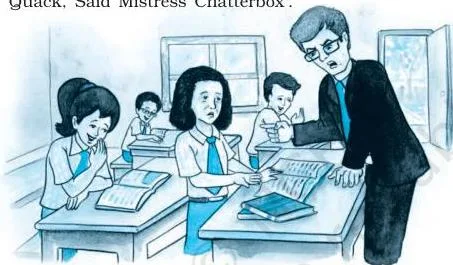
The illustration printed beside this episode (NCERT, p. 53) matters because it shows the teacher laughing, not fuming. That is precisely the “unpredictable” side of teachers Anne talks about: a man who punishes, yet enjoys her cleverness.
Diary, Journal, Log or Memoir: What Each Term Means
The opening activity tests whether you can tell apart four words we use for personal written records. It is worth mastering before the diary begins, because Anne’s own writing is a case study in one of them.
- Diary: a book with a separate page for each day, in which you write down your thoughts and feelings, or what happened on that day.
- Journal: a full record of a journey, a period of time or an event, written every day.
- Log: a written record of events with times and dates, usually official.
- Memoir(s): a record of a person’s own life and experiences, usually of a famous person.
The activity then offers four sample entries and asks you to sort them (NCERT, p. 2). Here is the reasoning that fits each one:
- The entry about waking up late and getting scolded before the FIFA World Cup matches is private daily feeling — a diary.
- The entry with 10:30 a.m., 01:00 p.m. and 05:45 p.m. timings is an official-style record with times and dates — a log.
- The account of the ride to Ooty followed by the noise of Bangalore is a journey record — a journal.
- The story of how Raj Kapoor found the narrator outside R.K. Studios is a famous person’s life story — a memoir.
Read backwards, the activity defines Anne’s own choice: her diary is personal, daily and addressed to an imaginary friend — closer to the first category than to any other.
Phrasal Verbs and Idioms: The Words That Mean More Than They Say
The language section begins with a warning: a phrasal verb’s meaning is often different from the meanings of its separate parts (NCERT, p. 8).
A phrasal verb is a verb followed by a preposition or an adverb. “She got on at Agra” is literal — she entered the bus — but “get on in life” means succeed. Same words, different meaning.
| Phrasal verb in the chapter | Idiomatic meaning | Why a literal reading misleads you |
|---|---|---|
| plunge (right) in | go straight to the topic | “Plunge” means dive, so it sounds physical, not explanatory. |
| ramble on | talk or write aimlessly for a long time | “Ramble” also means walking in the countryside. |
| get along with | have a good relationship with | “Along” suggests movement, not friendship. |
| calm down | make someone quiet | You forget the object — she cannot calm them down. |
| make up for | compensate for something | “Make up” alone suggests inventing, or cosmetics. |
| hand in | submit homework to the teacher | You forget what was handed in — the essay. |
| move up | go to the next grade | It sounds like shifting position, not being promoted. |
| kept back | not promoted | It sounds like being physically delayed, not held back a year. |
| stay in | remain indoors | The closest to literal of the set — she wonders whether to stay in or go out. |
Idioms are groups of words with a fixed order whose total meaning differs from their parts (NCERT, p. 9). The margins give you several from the text:
- Quaking in its boots — shaking with fear and nervousness; the whole class feels this before the promotion meeting.
- Not to lose heart — to stay hopeful; the class keeps telling one another this while waiting for the teachers’ decision.
- For ages — for a very long time; Mr Keesing was annoyed with Anne for ages.
- The joke was on him — the joke turned against its maker, Mr Keesing.
- Caught my eye — attracted my attention; the essay note caught Anne’s eye that evening.
The chapter adds a dictionary tip worth keeping: for an idiom like caught my eye, look under the first meaningful word — here under caught, which you will find listed under its base verb catch (NCERT, p. 9).
Contracted Forms: I’ve, I’d, Who’ll and Their Full Forms
Diaries are written speech, and speech is full of shortened forms. The grammar section asks you to notice them and undo them.
Contracted forms shorten two words into one, with an apostrophe marking the missing letters: can’t = cannot, she’s = she is, I’ve = I have (NCERT, p. 11). Diaries, plays and novels use them because they sound like actual speaking.
Here is the exercise worked in the chapter’s own spirit:
- “the teachers decide who’ll move up” → who will move up
- “I’ve never written anything before” → I have never written
- “You’re going to pass” → you are going to pass
- “it’s ‘You’re going to pass'” → it is
The trap the exercise wants you to find: I’d can stand for I would or I had (NCERT, p. 11). Compare two lines from the entry: “I’d worry about that later” — I would worry; “after I’d finished the rest of my homework” — I had finished.
The verb that follows gives it away: a base verb like worry points to would; a past participle like finished points to had.
The exercise asks you to list every contracted form from the text and rewrite each as two full words — a quick way to check that you have read the entry closely.
Speaking, Writing and Listening: What the Chapter Asks You to Try
After the language exercises, the chapter hands you the pen: three skills tasks built around the same insight — that diaries are speech written down.
Speaking (NCERT, p. 11). You are given an extract from a one-act play in which angry neighbours arrive to destroy Joe the Inventor’s spinning machine, which they fear will cost them their jobs. Your task is to change the written verbs into contracted forms so the dialogue sounds real, then speak the lines aloud.

The illustration beside the extract shows Mary’s blunt answer to the mob (NCERT, p. 58). “He is sick, and weary. You would not harm him!” becomes far more natural spoken as “He’s sick, and weary. You wouldn’t harm him!” — which is exactly the contract-the-dialogue task.
Writing (NCERT, p. 12). You are asked to keep a diary for a week. The hints: write as if for someone else even though it is private, present your thoughts convincingly, use feeling words and words that paint pictures, and be brief.
The chapter also warns about diary language — subjectless sentences like “Got up late in the morning”, sentence fragments, contracted forms and everyday expressions. Use them in a diary, not in formal writing.
Listening (NCERT, p. 12). Your teacher reads an extract from Samuel Pepys’s diary about the Great Fire of London in 1666, and you complete a gap-fill summary.
The passage itself (NCERT, p. 13) sets the details: Jane called the household up about three in the morning, Pepys went back to sleep because he judged the fire far enough off, he rose again about seven — by which time above three hundred houses had burned — and he walked to the Tower to watch it spread.
What the Two Images in This Chapter Show
The illustrations in this chapter — Mr Keesing laughing, and Mary’s reply “In his bed.” — are easy to skip, but each one repeats a line from the text and makes you notice it.
Mr Keesing having a good laugh (NCERT, p. 53). The caption is the quotation itself: “Mr Keesing had a good laugh at my arguments, but when I proceeded to talk my way through the next lesson, he assigned me a second essay.” Read it as evidence about character: a teacher who punishes and then laughs is not simply strict.
He responds to Anne’s wit, which is why she calls teachers “the most unpredictable creatures on earth”.
Mary’s line “In his bed.” (NCERT, p. 58). Here the caption is the dialogue itself. The image shows how a short written line carries force when spoken: Mary is shielding her sick husband from the crowd, and her flat, unadorned answer is the whole scene. It also models the speaking task, where you convert such written lines into contracted speech.
Common Mistakes Students Make in This Chapter
Readers trip in the same few places every year. Here is what goes wrong, the rule that fixes it, and a way to check yourself.
| Mistake | Correct rule | How to check your answer |
|---|---|---|
| Reading a phrasal verb word by word, e.g. “make up for” as inventing something. | A phrasal verb has its own idiomatic meaning — learn it whole. | Put the dictionary meaning into the sentence: “make up for the other birthday” = compensate for it. Does the sentence still make sense? |
| Expanding “I’d” only as “I would”. | “I’d” = “I would” or “I had”. | Look at the verb after it: a base verb (worry) → would; a past participle (finished) → had. |
| Mixing up diary and log. | Diary = private daily feelings; log = official record with times and dates. | Ask who the record is for: your own eyes, or an official purpose? |
| Thinking Anne literally had no friends. | She has loving parents, a sister and about thirty friends — but no one she can confide in or feel close to. | Re-read her words: “on the surface I seem to have everything, except my one true friend”. The lack is closeness, not company. |
| Reading “Paper has more patience than people” as a statement about waiting patiently. | It is a metaphor: the paper waits and listens without judging or getting bored. | Ask what the paper does that people don’t — it receives her words, so she can say anything to it. |
Every one of these errors comes from taking the chapter’s words more literally than Anne meant them.
Using the NCERT Questions to Revise This Chapter
The chapter gives you its own revision order. Follow it and you cover recall first, then judgement, then language.
- Oral Comprehension Checks (NCERT, pp. 4 and 7). Short recall questions — why the sketch, why Mr Keesing was annoyed, what he made her write. These check that you have actually read the entry; a strong answer names the detail the question asks for.
- Thinking about the Text (NCERT, p. 7). Questions of inference and opinion — was Anne right about the world’s interest, what do these statements tell you about her as a person, is Mr Keesing unpredictable. A strong answer states a judgement, then proves it with a line from the entry.
- Thinking about Language (NCERT, pp. 8-11). The mechanical work — compound words, phrasal verbs, idioms, contracted forms and the dictionary strategy. Practise these until the matching is automatic.
When you finish the prose questions, the same PDF closes with the poem Amanda! and its Thinking about the Poem questions, so you can move straight on without changing books.
One-Page Revision Summary of From the Diary of Anne Frank
In a few lines, the whole chapter for the night before an assessment:
- Who she was. Anne Frank, born 12 June 1929 in Frankfurt, wrote this diary while hiding in Amsterdam during the German occupation; she died of typhus in Bergen-Belsen within days of her sister Margot. Her father Otto, the only survivor, had it published in English as The Diary of a Young Girl (NCERT, p. 1).
- Why she wrote. She felt she had no one to confide in; “Paper has more patience than people”; she made the diary her friend and named it Kitty (NCERT, p. 2).
- The diary itself. Given for her thirteenth birthday, it covers 12 June 1942 to 1 August 1944 and was originally written in Dutch.
- Her family. Father, mother, sister Margot; the move to Holland in 1933-34; her grandmother died in January 1942 (NCERT, p. 4).
- The class anxiety. The 20 June 1942 entry opens with the whole class dreading the promotion meeting — who will move up, who will be kept back (NCERT, p. 7).
- The three essays. “A Chatterbox”, “An Incorrigible Chatterbox”, and “Quack, Quack, Quack, Said Mistress Chatterbox” — the last written in verse with Sanne, a poem about ducklings quacked to death.
- The outcome. Mr Keesing read the poem to the class and to several other classes, and has let Anne talk since; he even makes jokes himself now.
Related Resources: Other First Flight Chapters
This listing is maintained for the 2026-27 academic session using the NCERT textbook information available to us. NCERT remains the authority for confirming the latest edition.
If this chapter is part of a longer Class 10 English run, these pages keep you moving:
- Class 10 English notes — the home page for all First Flight chapters.
- The previous First Flight chapter: Two Stories about Flying
- The next chapter in the book: Glimpses of India
- Class 10 study materials and the wider CBSE notes collection.
Sources and Data Verification
This page describes the NCERT Class 10 English First Flight textbook, Chapter 4: “From the Diary of Anne Frank”, official edition available on ncert.nic.in. It covers this chapter only, not other Class 10 English books such as Footprints without Feet.
The listing is maintained for the current academic session using the NCERT information available to us. Textbook contents and the examinable syllabus are not always identical for every subject, so check the current official CBSE syllabus.
NCERT settles the textbooks, editions and PDFs; CBSE settles the curriculum, syllabus and examinations.
| What the chapter holds | Count | Where it is used |
|---|---|---|
| Printed pages | 15 | |
| Figures with NCERT captions | 2 | |
| Tables | 3 | |
| Exercise questions | 7 | answered in our NCERT Solutions |
| In-text questions | 9 | |
| Activities | 1 | |
| Official NCERT PDF | Download the chapter PDF | the chapter exactly as NCERT publishes it |
Chapter-wise notes for this subject are not published yet. The unit-wise syllabus on this page is complete and verified against the official CBSE curriculum document.
Reference: NCERT Class 10 English First Flight textbook, chapter 4, official edition on ncert.nic.in.
Frequently Asked Questions about From the Diary of Anne Frank
Why does Anne Frank call her diary Kitty?
Answer: Because she wants the diary to be her friend. Anne says she wants to enhance the image of this long-awaited friend in her imagination, and a friend needs a name — so she calls it Kitty (NCERT, p. 2).
What language was Anne Frank’s diary originally written in?
Answer: Dutch. It was translated from its original Dutch into English and many other languages, and published as The Diary of a Young Girl (NCERT, p. 1).
What were the three essays Mr Keesing asked Anne to write?
Answer: “A Chatterbox”, “An Incorrigible Chatterbox”, and “Quack, Quack, Quack, Said Mistress Chatterbox”. The first two were prose; the third she wrote in verse with her friend Sanne (NCERT, p. 7).
Was Anne Frank really alone even though she had family and friends?
Answer: No. She had loving parents, a sister and about thirty people she could call friends. Her loneliness was that she could not get close enough to anyone to confide in them (NCERT, p. 2).
What does “Paper has more patience than people” mean?
Answer: It means the paper will always wait and listen without interrupting or judging. Anne is not talking about patience as waiting politely; she means the diary is a silent listener she can say anything to (NCERT, p. 2).
Does the Class 10 First Flight chapter “From the Diary of Anne Frank” also include the poem Amanda!?
Answer: Yes. The same chapter closes with the poem “Amanda!” by Robin Klein — about a girl who escapes into fantasies of being a mermaid, an orphan and Rapunzel — followed by its Thinking about the Poem questions and a short glossary (NCERT, p. 14).
Explore Class 10 English Books
Related chapters: