
This page gives you the NCERT Class 10 English chapter 2 PDF — “The Thief’s Story” from the supplementary reader Footprints without Feet, and then explains the whole chapter: the story in order, the people in it, the themes, the glossary, and the chapter’s questions answered with the lines that prove them.
The story is by Ruskin Bond. The official NCERT chapter PDF is right here — the download link is in the very next section — and the chapter file and what it contains are laid out below, followed by a full walkthrough.
Download the official NCERT Class 10 chapter PDF: “The Thief’s Story”
Download the NCERT Class 10 English Footprints without Feet Chapter 2 PDF — The Thief’s Story (jefp202.pdf) from the official NCERT website to read the full story, its glossary and every exercise in the exact page layout of the printed book, free and with no login needed.
This is the official chapter from the current NCERT edition of Footprints without Feet, hosted on ncert.nic.in.
What is inside the chapter file
This section maps the file so you know where the story stops and the exercises begin. The summary table on this page shows the chapter at a glance; below is the reading route through it.
- The chapter opens with a short note that frames the reading: a young boy makes friends with Anil, Anil trusts him completely and employs him — “Does the boy betray his trust?”
- The first Read and Find Out block sits before the story begins, with its checkpoint questions.
- The first half of the story follows and answers them; the second Read and Find Out block is placed right after the theft.
- The second half of the story answers those questions a page or two later.
- The Glossary closes the story, and the exercise blocks that follow are Think About It, Talk About It and the Suggested reading list.
Read and Find Out blocks are NCERT’s comprehension checkpoints, placed inside the story so you read actively. Each question is answered in the pages that follow the block, which lets you check your reading as you go rather than only at the end of the chapter.
The printed folios 9, 10, 11 and 12 appear through the story, and the chapter’s closing page carries the folio 15. The opening pages and the question pages at the end carry no visible page number, so the references below say “the opening pages” where no folio exists.
What happens in the chapter: the story of The Thief’s Story
This section retells the plot in order, beat by beat, so you can check your reading against the book. The page references point to the printed folios you can see in the chapter.
The meeting. The narrator is 15 and a thief when he picks Anil, a tall, easy-going man of about 25, at a wrestling match. Flattery, two lies — that he can wrestle, and later that he can cook — and the false name “Hari Singh” get him noticed.
He takes a new name every month to stay ahead of the police and his former employers. Anil cannot pay wages, but if the boy can cook, Anil can feed him — and so the thief moves into the room over the Jumna Sweet Shop.
The first meal. It is so terrible that Anil gives it to a stray dog and tells the boy to leave. Hari hangs around, smiling, and Anil ends up laughing and teaching him to cook instead — and to write his name.
The working arrangement. Life settles into a routine: tea in the morning, the day’s supplies, a profit of about a rupee a day on the shopping, and the promise of lessons in whole sentences and numbers. Anil knows about the small cheating and does not mind; Hari calls him “the most trusting person I had ever met.”
(NCERT, p. 9) The money. One evening Anil comes home with a bundle of notes, having sold a book to a publisher, and Hari watches him tuck it under the mattress. After almost a month of honest work, the theft feels different.
His reasoning: it is easy to rob a greedy man, who can afford the loss, but hard to rob a careless man — one who may not even notice, which takes all the pleasure out of the job. (NCERT, p. 9) The theft. In the moonlight Hari creeps to the bed.
Anil’s sleeping face is clear and unlined — his own face carries more marks. The notes come out without a sound, and he is out of the room before Anil, sighing in sleep, turns towards him. Counting on the road: 600 rupees in fifties. (NCERT, p. 10) The missed train. At the station the 10.30 Express to Lucknow is already moving.
Hari could still jump a carriage, but he hesitates “for some reason I can’t explain,” and the chance is gone. Alone on the deserted platform, he realises the only person he knows well is the man he has just robbed. (NCERT, p. 10) The faces passage.
Walking through the bazaar, Hari reviews what his career has taught him about victims: the greedy show fear, the rich show anger, the poor show acceptance. Anil, he knows, would show only a touch of sadness — not for the money, but for the loss of trust. (NCERT, p. 11) The rain.
Soaked in a cold early-November drizzle, he waits under the clock tower at midnight and finds the notes damp. The thought that turns him back: no more cooking Anil’s meals, no more bazaar runs, no more lessons — and whole sentences, he realises, could one day bring him more than a few hundred rupees. (NCERT, p. 11) The return.
He hurries back more nervous than he was when he took the money, because returning it undetected is harder than stealing it. Anil is still asleep; Hari feels his breath on his hand and slips the notes back under the mattress. (NCERT, p. 11) The morning after. Anil has made the tea.
He holds out a fifty-rupee note — “Now you’ll be paid regularly” — and then adds “Today we’ll start writing sentences.” The note is still wet from the night’s rain. He knew; neither his lips nor his eyes showed anything. (NCERT, p. 12)
The people and the setting of the chapter
The chapter’s own questions demand character sketches: Think About It asks about each man directly, and Talk About It asks where the story is set. This section gives you both.
Hari Singh: the thief behind a false name
Hari Singh is 15 years old and an “experienced and fairly successful hand” at stealing. He changes his name every month, and his face carries scars earned in his short career.
His ambition reaches beyond theft: he wants to be “a big man, a clever and respected man.” Hold this one point for answers: “Hari Singh” is a lie, and the story never reveals his true name.
Anil: the trusting writer who cannot pay wages
Anil is about 25, tall, lean, easy-going and kind — “the most trusting person” Hari has ever met, and he proves it by handing over the key to his room.
He is a struggling writer who has just sold a book to a publisher, and he cannot pay wages, so he pays in food, a place to sleep and teaching. That is why the 600 rupees matters to both: real money to Hari, and to Anil far less important than the boy.
The setting: clues in the names of places
The story gathers its place from the names it drops: the room over the Jumna Sweet Shop, the maidan, the bazaar with its clock tower, the railway station, and the 10.30 Lucknow Express that was to take Hari away.
“Jumna” is an older English name for the Yamuna, and a train to Lucknow runs east across the North Indian plain.
The story therefore reads as set in a North Indian town in early-November cold, where people would most naturally have spoken Hindi — and the English on the page is Ruskin Bond writing for his readers, not a record of what the characters said.
Talk About It, question 4, asks for exactly these clues, and the full answer sits below in the questions section.
The big idea of the chapter: trust, learning, and the chance to change
Exam answers and class discussions need the meaning of the chapter, not just the plot. Three linked ideas run through it: trust against betrayal, theft as a trade against respect as a goal, and education as the way up.
The chapter uses first-person narration — the thief tells his own story — so the reader sits inside the calculation at first, then inside the doubt. We hear why robbing Anil is difficult, and we watch the decision to return form in real time. That is why the ending feels earned rather than sudden.
How people react when they are robbed
This passage on NCERT page 11 is the chapter’s most-quoted paragraph, and it compresses into a table. The professional thief reads faces the way a trader reads a market; he can exploit three kinds of reaction, and Anil’s is the one he cannot use.
| Person | Reaction when robbed | What it reveals |
|---|---|---|
| The greedy man | fear | he dreads losing what his wealth protects |
| The rich man | anger | he can absorb the loss and resents being targeted |
| The poor man | acceptance | loss fits the life he already expects |
| Anil | only a touch of sadness | sadness not for the money but for the loss of trust |
The point of the table is the exception. Greedy, rich or poor victims react according to what they own; Anil reacts according to what he believes. Because the thief cannot read Anil as a customer, the theft stops feeling like a job — and the money begins to burn in his hands.
Education, not guilt alone, drives the return. Hari’s own words give the reason: he should go back to Anil “if only to learn to read and write.”
Whole sentences, he has worked out, could one day bring him more than a few hundred rupees; being “a really big man, a clever and respected man” is “something else” from being a successful thief. (NCERT, p. 11) The smile that changes.
Early in the story Hari’s smiles are “appealing” — tools of his trade, used to get in and to stay in. The last one “came by itself, without any effort.” That unpractised smile is the author’s way of marking that real change has begun, and it is the note the chapter ends on. (NCERT, p. 12)
Reading the illustration: “It was quite pleasant working for Anil.”
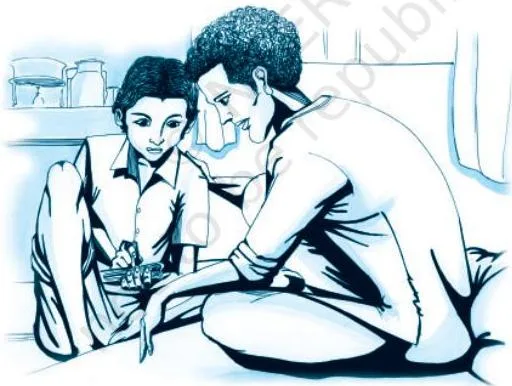
The chapter’s illustration carries the story’s own sentence as its caption. It sits beside the passage on NCERT page 9 where Hari describes the settled routine.
The caption is the sentence that closes Hari’s account of the pleasant working arrangement — tea in the morning, the day’s supplies, a rupee a day profit — and of Anil’s willingness to overlook the small cheating.
The illustration does a precise narrative job. It shows the comfortable, trusting household just before the evening Anil arrives with the publisher’s money, so the picture makes the coming betrayal more painful and the return more believable: the scene you are looking at is the thing Hari is about to throw away.
The glossary of the chapter: five words and the work they do
The glossary lists five words after the story, but they are best learned in place. Here each word appears with the moment it comes from. (The glossary entries themselves sit on NCERT p. 12.)
| Word | What it means | Where it appears in the story |
|---|---|---|
| flattery | praise the speaker does not really feel | the opening line to Anil at the wrestling match — the narrator’s first tool |
| modestly | without boasting; in a humble way | “Well,” I said modestly, “I do wrestle a bit” |
| grunting | making low, rough, throaty sounds | the well-oiled wrestlers lifting and throwing each other about |
| appealing | attractive, likeable | Hari’s smile — his repeated instrument for getting in and staying in |
| unlined | (here) showing no sign of worry or anxiety | Anil’s sleeping face as Hari creeps up to the bed |
Two entries matter most for comprehension. Appealing describes Hari’s smile again and again — and that smile is his main tool, so when the final smile “came by itself,” the change is measured in that one word.
Unlined carries NCERT’s “(here)”, which marks a context-specific sense: not just a face without lines, but a face showing no sign of worry or anxiety. Context senses are exactly what vocabulary questions target.
One practical note: the glossary sits after the story, but read the entry for “unlined” before the final part of the story. It describes Anil’s face in the paragraph where Hari creeps up to the bed, and it is the detail that makes the betrayal feel wrong.
The chapter’s questions: what to answer and where the answers sit
This section works through every question block in the chapter, in order, with each answer and the lines that prove it. Use it to check your reading — not to skip the story.
Read and Find Out: the first checkpoint
Who does “I” refer to in this story?
Answer. The narrator: a 15-year-old thief who calls himself Hari Singh. The name is a lie — he takes a new name every month — and the story never reveals his real name. The proof is in the opening lines: “I was still a thief when I met Anil.”
(the opening pages of the chapter) What is he “a fairly successful hand” at?
Answer. Stealing. The sentence continues “an experienced and fairly successful hand” and follows directly after the word “thief,” so the skill in question is theft, established in the chapter’s first paragraph.
What does he get from Anil in return for his work?
Answer. Food, a place to sleep on the balcony, and teaching — Anil shows him how to write his name and promises whole sentences and numbers, since he cannot pay wages. The arrangement is set in the exchange “Can you feed me?” and “If you can cook, then may be I can feed you.” (NCERT, p. 9)
Read and Find Out: the second checkpoint
How does the thief think Anil will react to the theft?
Answer. With only a touch of sadness — and not for the money, but for the loss of trust. The answer sits in the faces passage on NCERT page 11, where Anil is the exception in Hari’s whole study of victims.
What does he say about the different reactions of people when they are robbed?
Answer. The greedy man showed fear, the rich man showed anger, the poor man showed acceptance. The lines are on NCERT page 11, and the comparison table in the themes section above sets them out side by side.
Does Anil realise that he has been robbed?
Answer. Yes. Anil was indoors all night, so he could not have wet the notes himself; the fifty-rupee note he holds out the next morning is still wet from the night’s rain — it is one of the stolen notes. His quiet line “Today we’ll start writing sentences” is his way of saying he knows: “He knew.
But neither his lips nor his eyes showed anything.” (NCERT, p. 12)
Think About It: the long-answer questions
What are Hari Singh’s reactions to the prospect of receiving an education? Do they change over time? What makes him return to Anil?
Answer. His reaction sharpens as he understands what learning is worth. Early on, writing like an educated man means “no limit to what I could achieve” — a dream, still vague.
Later, walking home in the rain, the calculation is exact: whole sentences could one day bring more than a few hundred rupees, while stealing carries the risk of being caught — and being “a really big man, a clever and respected man” is “something else” entirely.
(NCERT, pp. 9, 11) What makes him return is the realisation that the theft has cancelled that future: he can no longer cook Anil’s meals, run to the bazaar, or learn whole sentences.
His own stated motive is “if only to learn to read and write”; the imagined sadness on Anil’s face makes staying away harder, but literacy is the reason the narrator gives.
(NCERT, p. 11) Why does Anil not hand the thief over to the police? Do you think most people would have done so? In what ways is Anil different from such employers?
Answer. Anil reads people instead of judging them. He has watched the boy cheat on the shopping and let it pass; he has trusted him with a key; and when the theft happens he chooses to behave as though it had not — paying Hari regularly and announcing the sentences lesson give the thief a reason to stop.
The story offers no survey of employers, but Anil is clearly written as the exception: Hari calls him “the most trusting person I had ever met,” and the whole plot depends on trust being rarer than suspicion. Most people, the chapter implies, would have called the police; Anil values the person above the money and uses trust as the cure.
Talk About It: the discussion prompts
Do you think people like Anil and Hari Singh are found only in fiction, or are there such people in real life?
Direction. This is an opinion question, and the story supplies the material. The utterly trusting employer and the self-reforming thief are rare enough to feel fictional, yet the feelings that drive them — loneliness, the wish to be respected — are ordinary. The ending suggests the author believes the change is possible in real people; build your answer on that.
Do you think it a significant detail in the story that Anil is a struggling writer? Does this explain his behaviour in any way?
Direction. Yes, on both counts. It explains why Anil cannot pay wages and teaches instead, why 600 rupees is a real sum to him, and why he values literacy enough to insist on the sentences lesson the morning after the theft. A writer also studies people for a living, which fits the way he reads Hari from the very first meeting.
Have you met anyone like Hari Singh? Can you think and imagine the circumstances that can turn a fifteen-year-old boy into a thief?
Direction. Answer from your own experience, then ground the second half in the text. The chapter shows a boy with no friends (“friends were more trouble than help”), no home, and no trade except stealing, moving every month to stay ahead of the police.
Poverty, loneliness and the absence of any other way to survive are the pressures the story points to.
Where is the story set? Which language or languages are spoken in these places? Do you think the characters spoke to each other in English?
Direction. Collect the names: the Jumna Sweet Shop, the maidan, the bazaar with its clock tower, the railway station, the 10.30 Lucknow Express. Together they place the story in a North Indian town on the Yamuna side, in early-November cold.
The characters most likely spoke Hindi to each other; the English on the page is the author’s language for his readers, not a transcript of what was said. (See the setting subsection above.)
Mistakes students make with this chapter
These are the misreadings that cost marks on this chapter, named before you make them.
| Mistake | Correct rule | How to check your answer |
|---|---|---|
| “Hari Singh was the narrator’s real name.” | The name is a lie; he takes a new name every month and his true name is never given. | Re-read the exchange at the match: “What’s your name?” — “Hari Singh,” I lied. |
| “The wet note is just a background detail.” | The damp fifty-rupee note proves Anil knew about the theft; he had not been out in the rain. | Trace the note: it was wet when Hari returned it, and still wet when Anil hands it back. |
| “Hari returns out of guilt.” | His stated motive is ambition — to learn to read and write, and one day be clever and respected. | Quote him: “I should go back to Anil… if only to learn to read and write.” |
| “The ending is really about the money.” | The payment is Anil’s silent forgiveness; the lesson — “Today we’ll start writing sentences” — is the real gift. | Compare Anil’s two actions: paying regularly and teaching sentences. |
| “Anil is a rich man.” | He is a struggling writer who cannot pay wages; 600 rupees is a fortune to Hari. | Anil’s first words: “But I can’t pay you.” And Hari’s “oil-rich Arab” fantasy shows what the money means. |
Each of these details — the false name, the wet note, the changed smile — is the kind of small thing a question is built on. Reading for them is half the preparation.
How to use this chapter for exam preparation
This is the second chapter of the supplementary reader Footprints without Feet, and its own exercise blocks — Read and Find Out, Think About It, Talk About It — are the chapter’s official question set. Their subjects (character, motive, turning point, theme, setting) are standard prose question types, so preparing for them transfers to unseen questions on this text.
A character-sketch answer moves through five moves: what the character does, what he says, how others see him, the turning point, and the author’s judgement at the end.
- Hari: he flatters, lies and smiles for a living, under a false name he changes every month; Anil sees a boy worth teaching. The turning point is the missed train and the rain, when he chooses literacy over the money. The ending — the smile that came by itself — is the author’s verdict.
- Anil: a struggling writer who cannot pay wages, so he teaches; he gives the key of his room to a thief. Hari’s judgement supplies the other-view evidence — “the most trusting person.” The turning point is the morning after, when he pays the boy and announces the sentences lesson. The verdict: trust, not punishment, reforms.
A “Why did Hari return?”
answer carries three reasons, in the narrator’s own order: the ambition for literacy — whole sentences could one day bring more than a few hundred rupees; the imagined sadness on Anil’s face — the one victim he cannot bear to rob; and the cold, lonely night under the clock tower that gives him time to think.
Support each with one line from NCERT pages 10 to 11.
Textbook contents and the examinable syllabus are not always identical — check the current official syllabus for what is examinable this year. For further help, see the Class 10 English notes, the Class 10 hub and the wider CBSE notes library on this site.
Quick recap of the chapter
The whole chapter in short steps, for a last read the night before the exam.
- A 15-year-old thief, calling himself Hari Singh, meets the easy-going writer Anil at a wrestling match.
- Two lies — that he can wrestle, that he can cook — win him a place in the room over the Jumna Sweet Shop.
- The first meal is so bad that Anil feeds it to a stray dog, then laughs and teaches him to cook instead.
- Routine sets in: tea in the morning, the day’s supplies, a rupee a day profit; Anil teaches him to write his name.
- Anil sells a book to a publisher and tucks the money under the mattress that night.
- Hari takes the 600 rupees but misses the 10.30 Express to Lucknow — he hesitates for a reason he cannot explain.
- In the cold November rain under the clock tower, he feels the damp notes and realises what the theft has cost him.
- He goes back “if only to learn to read and write” and slips the notes under the mattress.
- Next morning Anil pays him with a fifty-rupee note, still wet from the rain — then says “Today we’ll start writing sentences.”
- The final smile “came by itself, without any effort”; Anil knew, and said nothing.
Anil stands for trust; Hari wants respect, and he learns that respect runs through literacy, not theft. The ending leaves the change begun: a smile that came by itself, without any effort.
Related chapters and further reading
“The Thief’s Story” is the second chapter of Footprints without Feet: it follows A Triumph of Surgery and comes before The Midnight Visitor. Browse the whole book on the Class 10 English book pages.
The chapter closes with a Suggested reading list of three short stories: “He Said It with Arsenic” by Ruskin Bond, “Vanka” by Anton Chekhov, and “A Scandal in Bohemia” by Arthur Conan Doyle (NCERT, p. 15). Each is a short story about deception, close observation, or a child in a hard world — the same territory as Hari Singh’s tale.
The list is for your own reading; the stories are not part of the chapter’s exercises. If you are also working through the main textbook or its workbook, see the First Flight notes on “Two Stories about Flying” and the Words and Expressions unit on “A Letter to God”.
Sources and data verification
This listing is maintained for the 2026-27 academic session using the NCERT textbook information available to us. NCERT remains the authority for confirming the latest edition.
The story text, glossary, questions and illustration on this page come from the NCERT Class 10 English supplementary reader Footprints without Feet, chapter 2, “The Thief’s Story” by Ruskin Bond, in the edition published on ncert.nic.in.
This page covers the supplementary reader Footprints without Feet only — not First Flight or the Words and Expressions workbook.
The page is maintained for the current academic session using the NCERT edition available on the official NCERT website; the NCERT e-textbook page lists the current editions of all Class 10 books.
NCERT settles the textbook, its edition and the official PDF; CBSE settles the curriculum, syllabus and examinations. Textbook contents and the examinable syllabus are not always identical — check the current official syllabus.
| What the chapter holds | Count | Where it is used |
|---|---|---|
| Printed pages | 6 | |
| Figures with NCERT captions | 1 | |
| Official NCERT PDF | Download the chapter PDF | the chapter exactly as NCERT publishes it |
Reference: NCERT Class 10 English Footprints without Feet textbook, chapter 2, official edition on ncert.nic.in.
Frequently asked questions about The Thief’s Story
Who does “I” refer to in The Thief’s Story?
The narrator, a 15-year-old thief who calls himself Hari Singh. The name is a lie — he takes a new name every month — and the story never reveals his real name. The opening line, “I was still a thief when I met Anil,” establishes it on the chapter’s first page. (See the first Read and Find Out answer above.)
Why did Hari Singh come back to Anil instead of catching the Lucknow Express?
Because he wanted what the theft had cancelled: the chance to learn. Whole sentences, he realises, could one day bring more than a few hundred rupees, and being “a clever and respected man” matters more than the money. His own words: he should go back to Anil “if only to learn to read and write.” (NCERT, p. 11)
Did Anil know that Hari Singh had taken the money?
Yes. The proof is the fifty-rupee note Anil hands him the next morning: it is still wet from the night’s rain, and Anil had not been out in it. Anil’s quiet line, “Today we’ll start writing sentences,” is his way of acknowledging the theft and forgiving it without a word. (NCERT, p. 12)
Why is the fifty rupee note wet at the end of the chapter?
Because it is one of the stolen notes. Hari was caught in heavy rain while deciding whether to leave, and the notes were damp when he slipped them back under the mattress. When Anil pays him with that same note, its dampness signals that Anil knows everything. (NCERT, pp. 11-12)
What makes Anil different from other employers in the story?
He reads people instead of punishing them. He knew about the rupee-a-day profit on the shopping and did not mind; he gave the thief a key to the room; and after the robbery he chose to pay the boy regularly and teach him sentences rather than call the police. Hari’s verdict: “the most trusting person I had ever met.”
(NCERT, p. 9)
What are the main themes of The Thief’s Story?
Trust and betrayal: the theft breaks trust, and the return restores it. Theft as a trade versus respect as a goal: Hari wants to be clever and respected, not merely successful. Education as the way up: learning is the one thing the thief cannot steal for himself, so it is the thing he comes back for. (NCERT, pp. 9, 11, 12)
Explore Class 10 English Books
Related chapters: