
Mijbil the Otter Class 10 is a unit in Words and Expressions 2, the NCERT workbook that accompanies First Flight. This page explains the whole unit — its three readings, vocabulary, grammar work and skill activities (printed pages 74–91 of the current NCERT reprint) — and the official NCERT PDF is right here.
Download the Mijbil the Otter Class 10 PDF
Download the Mijbil the Otter Class 10 chapter PDF (official NCERT) straight from NCERT’s own textbook viewer at ncert.nic.in. It is the complete unit from the official edition of Words and Expressions 2 — no third-party file, no watermark, no missing pages.
Chapter at a glance: what is inside the Mijbil the Otter unit
The unit table on this page lists the blocks this workbook chapter holds, and the list below shows where to find any activity in your book.
- Let’s Begin — discussion on Maxwell’s care for Mijbil, plus an extrapolation table on Mijbil’s emotions.
- Text I — “Baby Bhakat” and the Look Up and Understand word set.
- Text II — two passages: human–wildlife conflict, then animal rights, each with its own word set.
- Vocabulary and Idiom — odd-one-out, verb/noun pairs, “cat got your tongue”.
- Grammar — noun modifiers, -ed/-ing adjective forms, would / used to.
- Editing and Fun Facts — punctuation, sentence reordering, affluence/effluence.
- Listening and Tongue Twister — the story of Gangaram the crocodile.
- Speaking — puppet dialogue, group discussion, opinion paragraph.
- Project — two research tasks.
What this unit covers, and how the pieces fit together
Words and Expressions 2 is the workbook that goes with the First Flight textbook on the Class 10 English book page. The unit does not reprint Gavin Maxwell’s story “Mijbil the Otter” — it assumes you have read it in First Flight and builds activities on it.
The opening discussion asks you to list the care Maxwell took: getting fish, walking and exercising Mijbil, and providing space to play.
Then the unit answers a question you may have asked yourself: why does a unit named after an otter start with a story about a baby civet cat? Because the unit keeps one theme — wild animals raised by, and living beside, humans — and carries it through three different kinds of reading:
- a true story told by the animal itself (the civet cat Bhakat);
- an informational passage on people and wildlife sharing space; and
- an argumentative passage on animal rights.
So the logic runs: first you see one tame animal, then you see the conflict that happens when wild animals are not tame, then you consider what we owe animals in general (NCERT, p. 74).
The three readings in the unit
This section is for the reading practice that carries most of the unit’s value: each text has its own comprehension task, and each task asks for a different kind of answer.
Text I: Baby Bhakat, a civet cat raised by humans
“Baby Bhakat” is a true story from Assam by conservation photographer Rommel Shunmugam. Bhakat is a three-month-old civet cat — also called a toddy cat, because these cats live on palm trees and drink the sweet sap collected by toddy tappers.
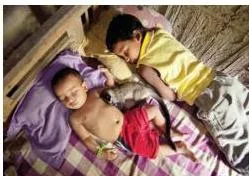
Bhakat fell from his mother’s nest in a coconut tree, villagers took him to Dharini, and Dharini and Anjali raised him in their thatched hut along with his two brothers (NCERT, p. 74).
The story is told in Bhakat’s own voice, and through it you learn the vocabulary of animal behaviour: he is nocturnal (his large eyes help him see at night), arboreal (he naps in the rafters, high up like a tree), and omnivorous (he loves meat and fruits but dislikes vegetables).
The most memorable scene is the monsoon flood — the river overflows, the hut is “helter-skelter”, and Dharini and Anjali carry the babies outside. Bhakat hates water, so he stays high on the fence with his long tail kept dry.
The flood also gives Bhakat a job: snails had climbed walls and branches to escape drowning, and because snails eat plants, Bhakat’s snail-eating keeps the garden balanced (NCERT, pp. 75–76).
The unit’s questions on this story are of the tick-the-right-answer type — six questions on Dharini, the civet cat’s other name, Bhakat’s favourite food, what he hates, his home, and the “not true” statement.
Question 6 is the trap: the text says the hut’s doors are always open, so the option about keeping the doors closed to keep Bhakat safe is the false one (NCERT, p. 76). The flood rescue picture on this page is the illustration the question about Bhakat and water goes with — see the figure walkthrough below.
Text II: why people and wildlife come into conflict
This passage opens with its own caption: “It’s not easy having elephants in your backyard.” The main idea is simple — as communities expand and wild places shrink, people and wildlife compete for food and living space. The passage moves through three moves: the problem, the impacts, and the solutions (NCERT, p. 77).
The examples are global: baboons in Namibia attacking young goats, elephants in Nepal eating crops, European bears and wolves killing livestock. The losses run on both sides — people lose crops, livestock, income and sometimes their lives; animals that are already threatened or endangered are killed in retaliation.
Then comes the creative fix: planting chilli barriers, since elephants and some other wildlife dislike chilli — and the chilli can be sold, so the solution benefits people too. That is the passage’s definition of mutually beneficial coexistence (NCERT, p. 78).
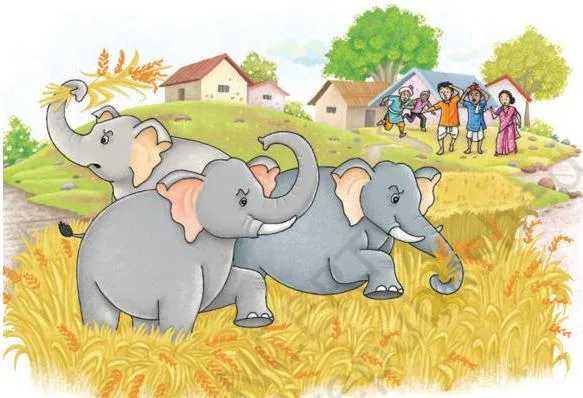
The tasks are short-answer questions plus one tick-the-statement item. Check every option against the passage’s exact words: for example, the option that says solutions “generate income naturally” is marked not true, because the passage only says chilli “can be sold to increase income” — it never claims the income comes naturally. The elephants-in-the-backyard illustration below belongs to this passage.
Text II: what animal rights means
The second supplementary passage is an argument, not a story. Its claim: all animals have inherent worth — a value separate from their usefulness to humans — and they feel pain, fear, frustration, loneliness and familial love in the same way we do. Because they can suffer, we are morally obligated to take their needs into account (NCERT, p. 79).
The passage’s most useful idea — and its most confusing one — is the distinction between equal consideration and equal treatment. Animal rights does not mean animals should vote or drive cars; those rights would not benefit them. But their interest in not suffering deserves the same weight as ours, though what that requires will differ from species to species.
The passage closes with everyday action: the food we eat, the clothes we wear and the products we buy are a form of non-violent protest, because our choices cut the profits of corporations that harm animals and grow the market for cruelty-free products (NCERT, p. 80).
Reading the two illustrated pages
Only two pages of the unit carry full illustrations. Both earn a close look because each one states the theme of its passage before you read a word.
Figure 1 belongs to Text I. Dharini and Anjali carry the baby civets to safety as the flooded river surrounds the hut — the moment Bhakat describes as “helter-skelter”. Notice the details the story leans on: the water and mud everywhere, the sun still out, and Bhakat’s determination to stay dry.
This is the image that explains why Bhakat, an animal that sleeps in trees, hates to be in water.
Figure 2 opens the human–wildlife conflict passage. An elephant family stands beside a homestead — imagine them as the elephants of Nepal eating a family’s crops. The image frames “conflict” from the family’s side: wildlife is not a threat in the abstract but a set of animals right outside the door, competing for the same space.
Vocabulary: the words this unit expects you to know
The three “Look Up and Understand” boxes collect the words each reading needs. Learn them through the reading, not as a bare list.
| Word | Part of speech | What it means in this unit |
|---|---|---|
| arboreal | adjective | living in trees — Bhakat naps in the rafters |
| inculcate | verb | to fix an idea in someone’s mind by repetition |
| nocturnal | adjective | awake and active at night |
| omnivorous | adjective | eating both plants and meat |
| rehabilitates | verb | nurses an injured or orphaned animal back to health |
| coexistence | noun | living side by side without harming each other |
| conflict | noun | a clash, here over food and space |
| endangered | adjective | at risk of dying out |
| livestock | noun | farm animals such as goats and cattle |
| retaliation | noun | harming someone in return for harm done |
| consideration | noun | taking something into account in a decision |
| exploitation | noun | using someone or something unfairly for your own gain |
| familial | adjective | relating to family |
| inherent | adjective | built into something’s very nature |
| arbitrary | adjective | based on no clear reason; random |
| compassion | noun | sympathy that moves you to help |
| documentary | noun | a factual film about real life |
| empathy | noun | the ability to feel what another being feels |
The Vocabulary section then practises odd-one-out — find the word that does not share the group’s meaning. For example, among appalling, atrocious, wonderful, awful, dreadful, the odd one is wonderful, because the other four all mean “very bad” (NCERT, p. 81).
The same section asks you to use one word as both a verb and a noun — for instance, book as a verb (“I booked a ticket”) and as a noun (“I read a book”).
The idiom of the unit: “cat got your tongue?” — said to someone who is at a loss for words. It has nothing to do with an actual cat (NCERT, p. 81). Fun Facts also pairs affluence (having a lot of money) with effluence (a substance that flows out, like sewage) — one letter’s difference, two unrelated meanings (NCERT, p. 85).
Grammar and language work: noun modifiers, word forms, and would or used to
Three language tasks, each of which first states a rule and then drills it. Learn the rule, then the blanks become mechanical.
Noun modifiers
You met noun modifiers in “Mijbil the Otter” in First Flight, page 112. A noun modifier is an adjective or adjective phrase placed before a noun to give more information. The exercise joins two or three short sentences into one: move the describing phrases in front of the noun.
Worked example (original): “We visited a museum. It was newly built. It was fascinating.” → “We visited a fascinating, newly built museum.”
Watch the word order. When two adjectives of different kinds come together, opinion normally comes before fact: the workbook’s “I bought a Maruti car. The colour is blue. It is sporty” reads far better as “a sporty blue Maruti car” than “a blue sporty Maruti car” (NCERT, p. 83).
-ed and -ing adjectives
This is the rule: -ing describes the thing or situation that causes the feeling; -ed describes the person or animal that feels it. The exercise works through five pairs — shock, interest, excite, amuse, disgust (NCERT, p. 84).
Original pair: The news about the cancelled match is disappointing (the news causes the feeling) → the players are disappointed (they feel it). Test each blank by asking: is this noun the cause, or the feeler?
would or used to
Both would and used to describe repeated actions in the past, and in most action sentences either works. But only used to can describe a past state — something that was true over a period, not an action you performed each time (NCERT, p. 84).
Original examples: “Every winter, we would / used to build a snowman in the garden” — both correct. “I used to believe that fireflies were small fireballs” — would fails here, because believing is a state, not an action. The workbook’s own sentence about believing is the one that settles this rule.
Editing, listening, speaking and the project
These blocks test skills rather than knowledge, so they only surprise you if you have not looked at them. One practical tip for each.
- Editing: a punctuation paragraph about the Bishnois of Rajasthan, a community for whom protecting wildlife is part of its religion. Add capitals, full stops, commas and inverted commas — read the paragraph aloud and you will hear where each belongs (NCERT, p. 85). The reordering task gives jumbled sentences; one of them places otters “in the marshes near Basra” (Iraq) — a quiet echo of the unit’s otter theme.
- Listening: the story of Gangaram, a crocodile about three metres long, estimated to be 130 years old, buried by grieving villagers in Bawamohatra, Chhattisgarh, where the village came to be known as the crocodile’s village. Listen for the numbers — age, length, the number of mourners — and for the reasons he was called friendly (NCERT, pp. 86–87).
- Tongue twister: “Nine nice night nurses nursing nicely” — slow, then fast, then faster.
- Speaking: write and perform a short puppet dialogue between Mijbil and Maxwell (the scene: Mijbil playing with water and spilling it everywhere), then hold a group discussion on wild animals as pets. The discussion pairs with “The Bond of Love” from the Class 9 book Beehive, about a sloth bear that grew too big to keep at home (NCERT, p. 88).
- Writing: an opinion paragraph on keeping wild animals, guided by the points loss of natural habitat, cruelty and loss of freedom; and a paragraph on animal rights using the quotations by Gandhi and Ingrid Newkirk (NCERT, p. 89).
- Project: research which animals can legally be exported or imported (customs seizures show snakes, leopards and lizards smuggled in tiny suitcases), and design an imaginary pet with a specification table of what it has, what it can do and what it is (NCERT, pp. 90–91).
Common mistakes in this unit
The traps in this unit are all places where a quick answer feels right. Meet them before the exercise does.
| Mistake | Correct rule | How to check your answer |
|---|---|---|
| Choosing “keep the doors closed” as true in Bhakat Q.6 | The text says the hut’s doors are always open, so this option is the not-true one | Re-read the home paragraph and match each option to its exact sentence |
| Calling the civet cat a “night cat” | It is a toddy cat — it lives on palm trees and drinks toddy sap | Look for “also called” in the introduction |
| Picking the odd word by spelling instead of meaning | The odd one out is the word with a different meaning (e.g. wonderful among “very bad” words) | Say the group’s shared meaning first, then test each word against it |
| Writing “I was disappointing” instead of “I was disappointed” | -ing = cause, -ed = feeler | Ask: is the noun causing the feeling, or experiencing it? |
| Using “I would believe” for a past belief | Only used to fits past states like believing; would needs an action | If the verb is a state (believe, know, live), choose used to |
| Taking “cat got your tongue” literally | It means “have you nothing to say?” — being at a loss for words | Read the workbook’s one-line meaning on page 81 |
| Writing “a blue sporty Maruti car” | Opinion adjectives come before colour: “a sporty blue Maruti car” | Read both orders aloud — the natural-sounding one is correct |
| Marking “generate income naturally” as true | The passage says chilli can be sold to increase income — it never says “naturally” | Compare the option’s exact words with the passage’s exact words |
Exam notes: how this workbook unit prepares you for the exam
This unit is skills practice whose formats mirror common board-paper patterns — nothing here is guaranteed to appear, but every block trains a skill the Class 10 English paper uses.
- Reading comprehension — the civet story’s tick questions, the conflict passage’s short answers and the animal-rights questions all rehearse finding information and judging statements against the text.
- Grammar — noun modifiers, -ed/-ing forms and would / used to are the kinds of single-blank items used to test accuracy.
- Editing and reordering — adding punctuation and rearranging jumbled sentences is direct practice for the writing paper’s editing-style tasks.
- Paragraph writing — the opinion paragraph and the animal-rights paragraph train the structure: a clear point of view, reasons, and a conclusion.
Textbook contents and the examinable syllabus are not always identical — check the current official CBSE syllabus before deciding what to revise. More Class 10 support, including the other English chapters, is on the Class 10 notes hub.
Revision summary: the whole unit in one place
The workbook unit has no printed summary, so this recap is yours. Reread it the night before and you will know what the unit holds.
- Three texts, one theme: wild animals raised by, and living beside, humans — the civet cat Bhakat, human–wildlife conflict, animal rights.
- Bhakat’s facts: civet cat = toddy cat; nocturnal, arboreal, omnivorous; hates water and vegetables; the flood and the snail balance.
- Conflict passage: shrinking wild spaces → competition for food and space → chilli barriers → coexistence.
- Rights passage: inherent worth → equal consideration, not equal treatment → consumer choices as non-violent protest.
- Vocabulary: 18 words in three sets, plus the odd-one-out logic and verb/noun pairs.
- Idiom: “cat got your tongue” = at a loss for words.
- Grammar: noun modifiers go before the noun with opinion before fact; -ing causes, -ed feels; would for actions, used to for actions and states.
- Skills: Bishnois editing, Gangaram listening, Mijbil–Maxwell dialogue, opinion paragraph, two project tasks.
Related resources
- Start at the Class 10 English notes hub for every chapter in one place.
- See the Mijbil the Otter story notes for the First Flight chapter this unit builds on.
- Continue in the workbook with the next unit, Glimpses of India.
- All NCERT e-textbooks start at NCERT’s official textbook portal.
| What the chapter holds | Count | Where it is used |
|---|---|---|
| Printed pages | 20 | |
| Figures with NCERT captions | 2 | |
| Tables | 2 | |
| Official NCERT PDF | Download the chapter PDF | the chapter exactly as NCERT publishes it |
Reference: NCERT Class 10 English (Words and Expressions 2) textbook, chapter on Mijbil the Otter, official edition on ncert.nic.in.
Sources and data verification
The contents and illustrations on this page describe the NCERT textbook Words and Expressions 2, Class 10 English, current NCERT reprint (2026-27), as published on ncert.nic.in. This page covers the Mijbil the Otter unit only; it does not cover the rest of the workbook or the First Flight textbook.
The page is maintained for the current academic session using NCERT’s official textbook files. NCERT settles textbooks, editions and PDFs; CBSE settles the curriculum, syllabus and examinations. This page has not been reviewed by outside subject experts, so if you spot an error, check it against the official PDF before relying on it.
FAQ: Mijbil the Otter Class 10 questions, answered
Is the Mijbil the Otter in Words and Expressions 2 the same story as the First Flight chapter?
No. First Flight holds Gavin Maxwell’s original story about the otter; the Words and Expressions 2 unit assumes you have read it and builds exercises on it — it does not reprint the story.
What is the story Baby Bhakat about, and how does it connect to Mijbil?
It is a true first-person story of Bhakat, a baby civet cat rescued from a coconut tree and raised by Dharini and Anjali in Assam. It connects to Mijbil because both are wild animals raised by humans who care for them like family.
What does the idiom cat got your tongue mean in this unit?
It is said to someone who is at a loss for words — it has nothing to do with an actual cat.
When should I use would and when used to in the grammar exercise?
Both suit repeated past actions, so most action blanks accept either; only used to fits past states, so the sentence about believing something is answered with used to.
What are noun modifiers, and how do I do the joining sentences exercise?
Noun modifiers are adjectives or adjective phrases placed before a noun to give more information. Join the sentences by moving the describing phrases in front of the noun — for example, “a fascinating, newly built museum” — and keep opinion adjectives before colour adjectives.
Why does the unit include passages on human wildlife conflict and animal rights?
The unit carries one theme — humans and animals living together — from the single tame otter to whole ecosystems. The conflict passage shows what happens when sharing space fails, and the rights passage asks what we owe animals in general.
Explore Class 10 English Books
Related chapters:
- A Letter to God
- A Triumph of Surgery
- A Letter to God