
NCERT Class 1 English Mridang Chapter 2 is titled Let Us Read, and it is where the book starts turning a child from a listener into a reader — greetings, letter sounds, action rhymes and the story The Sparrow Family, across 32 pages of the official PDF.
If you searched for the Let Us Read Class 1 chapter PDF, it is right here, followed by a parent-ready tour of the chapter’s activity strands, maintained for the current academic session from the NCERT edition on ncert.nic.in. This page is written for parents and teachers guiding a child through the book, one activity at a time.
Download the NCERT Let Us Read Class 1 Chapter 2 PDF
The official file is the NCERT Class 1 English Mridang Chapter 2 (Let Us Read) PDF, published by NCERT on its official portal ncert.nic.in — the same edition schools follow. Open it to find the Greetings page, the three letter-sound tables, Hop a Little, The Sparrow Family and every picture activity exactly as the book prints them.
Chapter at a glance
The table below lists how much Let Us Read holds, drawn from the chapter itself.
| What the chapter holds | Count | Where it is used |
|---|---|---|
| Printed pages | 32 | |
| Figures with NCERT captions | 13 | |
| Tables | 5 | |
| Activities | 3 | |
| Official NCERT PDF | Download the chapter PDF | the chapter exactly as NCERT publishes it |
The chapter moves through six activity strands:
- Greeting phrases — Namaste, Good morning, Good afternoon, Good evening and Good night.
- Letter tracing from G to Z — Gg–Pp first, then Qq–Zz, with the ABC song as the anchor.
- Initial letter sounds, f to t — three groups of five letters: f–j, k–o, p–t.
- Action words and rhymes — Hop a Little, hopscotch, matching and fill-in tasks.
- The Sparrow Family story — with sight words, new words and family talk.
- Picture talk, drawing and life skills — a family drawing and the bathroom talk that ends on closing the tap.
What this chapter covers: from morning greetings to The Sparrow Family
Let Us Read is an early-literacy chapter, not a story-only chapter. It builds reading readiness through greetings, letters, sounds, actions and family talk, arranged in short “Let us” blocks — Let us write, Let us speak, Let us sing, Let us read and Let us do.
Greetings for every time of day
The chapter opens with one phrase per moment: Namaste when meeting someone, Good morning, Good afternoon, Good evening, and Good night at bedtime. A teacher note asks children first how they greet in their mother tongue — Namaskar, Vanakkam — then introduces the English phrases. A matching exercise adds action words such as combing, eating and hearing.
| Time of day | Greeting |
|---|---|
| Meeting someone | Namaste |
| Morning | Good morning |
| Afternoon | Good afternoon |
| Evening | Good evening |
| Going to bed | Good night |
Letters and sounds, in groups of five
The writing pages follow the ABC song: children trace Gg to Pp, then Qq to Zz, with letter flash cards showing the direction of each stroke. The sound tables keep the same rhythm — three groups of five letters, each letter given three picture words that begin with its sound.
| Group | Letters | Picture words |
|---|---|---|
| 1 | f g h i j | fox, goat, house, iron, jacket |
| 2 | k l m n o | kettle, leaf, mouth, nine, owl |
| 3 | p q r s t | pencil, question mark, rainbow, spoon, ten |
Action words and rhymes
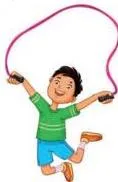
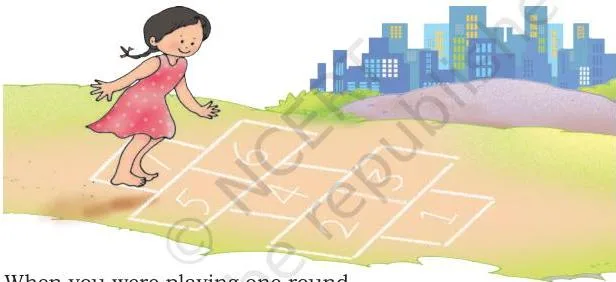
Hop a Little gets the child moving through ten action words — hop, jump, stamp, skip, tap, dance, twist, shake, yawn, sleep — listed as New words. Hopscotch (one foot in each box, from 1 to 7) makes the words physical, and matching tasks fix them: They are dancing, She is jumping, He is yawning.
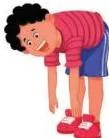
A fill-in page gives dance, hop, skip, sleep, bend, jump and eat.
The family: My Family and The Sparrow Family
The My Family rhyme repeats one pattern — Will you play with me? Yes, I shall — through mother, father, brother, sister, grandmother and grandfather, and a teacher note adds that families come in various kinds.
Then comes the story: Mama and Papa sparrow build a nest, three eggs break open, and the babies grow until they hop out and fly into the big blue sky.
Speaking and drawing tasks follow — name your family members, draw your family with its pets and plants, and sort f and m words such as fox, feather, food (father) and man, mask, moon (mother).
Playful extras
The chapter closes light on purpose: turn your book’s pages without using your hands, hold the page with H B over A C in a mirror, sing the alphabet loudly for capitals and softly for small letters, and make six paper-strip puppets of your family.
Key concepts: letters, sounds and words the chapter teaches
Six reading-readiness ideas run through Let Us Read. Each appears in the book in a specific way, and each exists because early reading depends on it.
- Letter recognition and tracing — Gg to Zz, with the ABC song as the anchor and flash cards showing the direction of each stroke.
- Initial letter sounds — the sound tables pair each letter with picture words: fox, foot and fish for f, so the child hears the first sound of a word, not the alphabet name. The groups of five run f to j, then k to o, then p to t.
- Sight words — common little words a child should recognise instantly, whole, without sounding them out; the chapter lists and, they, them.
- Action words — hop, jump, skip and the rest, learned through rhyme and movement so each word carries its meaning.
- Family words — mother, father, grandmother, grandfather, aunt, uncle, cousin, reinforced by the story and by the f and m sound activity.
- Capital and small letters — the loud-and-soft alphabet pairs each capital with its small letter, so the two forms are learned together.
Picture activities and how to use them with your child


Most of the teaching in Let Us Read happens through pictures. The book’s own word for them is picture activities, and each one is an observing-and-speaking exercise, not a test. Here is what each picture prompt is for.
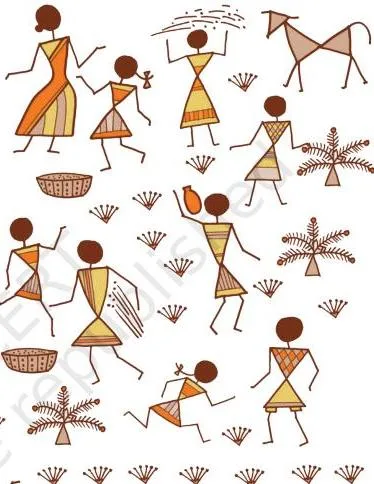
- The games picture — four questions: how many children, what games they play, your favourite game, and what the children not playing are doing. The child practises counting, noticing detail and answering in full sentences.
- Match the actions with the pictures — sentences such as They are dancing, She is jumping and He is yawning are matched to pictures, practising the link between a spoken action word and what it shows.
- Fill in the action words — dance, hop, skip, sleep, bend, jump and eat go into the blanks, practising reading and writing the words together.
- Family Picture Talk — identify the family members, say what they are doing, how you help your family, and what you liked most; the child practises speaking about their own home.
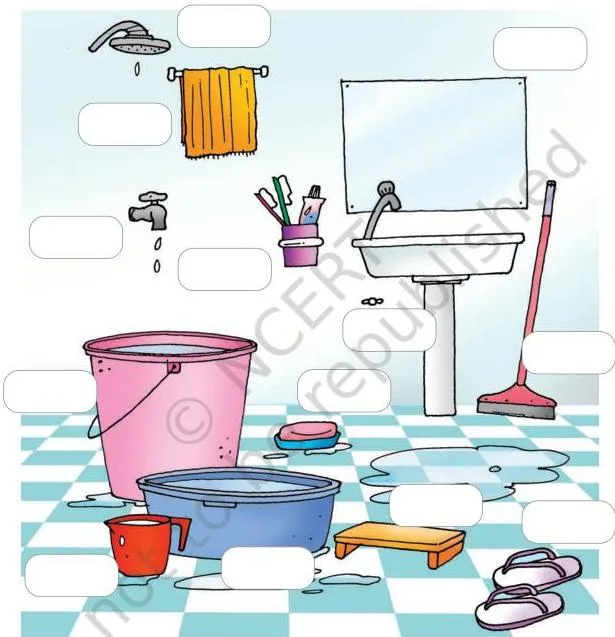
- The bathroom picture talk — label the things, say what you see, then answer two questions: do you remember to close the tap, and why should we? Reading practice ends in a life habit — closing the tap.
Words the chapter asks your child to recognise
Four kinds of words appear in this chapter. Here is each kind in plain language.
- Sight words — common little words a child should recognise instantly, whole, without sounding them out. The chapter’s list, from The Sparrow Family story, is and, they, them.
- New words — the story’s vocabulary: nest, sparrow, egg, grandmother, grandfather, aunt, uncle, cousin, mother and father.
- Action words — the ten words from Hop a Little: hop, jump, stamp, skip, tap, dance, twist, shake, yawn, sleep.
- Family words — father, mother, sister and brother, used in the f and m sorting task so family names double as sound practice.
Common mistakes in early reading and how this chapter prevents them
Five small confusions trip up most children in this chapter. The book has a built-in fix for each one.
- Letter name versus letter sound — a child may say the letter’s name f when the exercise wants the sound at the start of fox. The picture tables train exactly that: say the word, listen to its first sound.
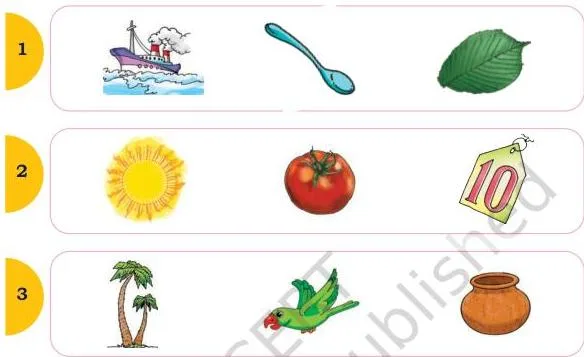
- The odd one out rows — say the three words aloud and compare first sounds. Among lion and lamp, hand is the odd word because lion and lamp begin with l while hand begins with h. The same logic makes cap the odd one among mouse and mango (m versus c) and six the odd one among nest and nine (s versus n).
- Letters that flip — the mirror activity asks the child to hold the page with H B over A C in front of a mirror. H and A keep their shape because they are symmetrical; B and C do not. The game trains the eye to notice that letter orientation matters.
- Capital and small letters — the loud-and-soft alphabet pairs each capital with its small letter, so the two forms are learned together rather than as separate sets.
- Mother-tongue greetings versus English — the teacher note invites the child’s own greeting (Namaskar, Vanakkam) first, then adds the English phrases. The home language is a support, never an error.
How the chapter checks progress
Class 1 has no CBSE board examination, so finishing Let Us Read is not measured in marks. The chapter’s own tasks are the checks: an adult watches what the child can do and repeats what is weak.
By the end of the chapter, a child should be able to:
- sing the ABC song and trace the letters Gg to Zz;
- say the initial sound of picture words such as fox and mouth;
- encircle, circle, tick and match the right pictures;
- fill in action words from the given box;
- read the sight words and new words aloud;
- draw and talk about their family; and
- answer the picture-talk questions in short sentences.
What the child takes away from Let Us Read
In one paragraph: the child finishes the chapter able to greet in English at any time of day, recognise and trace the letters G to Z, hear the initial sounds of words, use ten action words, follow a short continuous story, and name the family members the story visits.
The book ends with play — the loud-and-soft alphabet game and paper-strip family puppets — so the last thing a child meets is the idea that reading is fun.
Related NCERT Class 1 English resources
This listing is maintained for the 2026-27 academic session using the NCERT textbook information available to us. NCERT remains the authority for confirming the latest edition.
Continue with the rest of the book and the notes this site keeps for Class 1:
- The Mridang Class 1 English notes cover the book chapter by chapter.
- The Class 1 notes hub gathers English with the other Class 1 subjects this site indexes.
- The wider CBSE notes library holds study material for other classes.
- The My Family and Me unit notes cover the unit this chapter belongs to.
- The Life Around Us unit notes cover the unit that follows.
For the official source, the NCERT textbook portal lists the current Mridang editions. One honest note: textbook contents and the examinable syllabus are not always identical — check the current official syllabus for what is examined.
Sources and data verification
- The chapter described on this page is Let Us Read, Chapter 2 of the NCERT Class 1 English textbook Mridang, official edition published on ncert.nic.in.
- This page covers that single chapter only — not the full CBSE Class 1 English scheme, and not the whole Mridang book.
- NCERT settles textbooks, editions and PDFs; CBSE settles curriculum, syllabus and examinations.
- No expert review or syllabus-alignment claim is made; the description follows the NCERT text as published.
Reference: NCERT Class 1 English Mridang textbook, chapter 2 (Let Us Read), official edition on ncert.nic.in.
Frequently asked questions about Mridang Let Us Read Class 1
Where can I download the official NCERT Class 1 English Mridang Chapter 2 PDF?
The official file is the NCERT Class 1 English Mridang Chapter 2 (Let Us Read) PDF on ncert.nic.in — the same file schools use, with all 32 pages from Greetings to the puppet-making activity.
What does the Let Us Read chapter contain?
It is an early-literacy chapter: greeting phrases, letter tracing from G to Z, letter sounds in groups of five from f to t, the Hop a Little rhyme, hopscotch, the My Family rhyme, the story The Sparrow Family with its sight words and new words, picture talks, drawing tasks, and a playful close with mirror play and puppet making.
Which letters and letter sounds does this chapter teach?
The tracing pages cover Gg to Pp first and Qq to Zz later, with the ABC song as the anchor. The sound tables teach f to j, then k to o, then p to t — three groups of five — with picture words such as fox, foot and fish for f.
What are the sight words in The Sparrow Family story?
The sight words are and, they and them. The chapter also lists new words from the story: nest, sparrow, egg, grandmother, grandfather, aunt, uncle, cousin, mother and father.
How should parents use the Note to the teacher boxes at home?
The notes are the book telling the adult what to do: ask about mother-tongue greetings first, make flash cards for tracing direction, draw attention to the initial sound of each word, sing the rhyme with actions, let the child answer in home language and then help find English words, and encourage free speaking about family.
Follow the same sequence at home.
Does Class 1 English have written exercises, or only reading and speaking?
A little of both. The written tasks are light — trace letters, match pictures, encircle and tick, fill in action words, write the family words father, mother, sister and brother. The heavier work is speaking: matching actions, answering picture-talk questions and telling the class about a family drawing.
Explore Class 1 English Books
Related chapters: