
This page is for Food Class 1 — Chapter 6 of the NCERT English book Mridang for Class 1. It is a picture-led unit on fruits, vegetables and the market: the child counts fruit, sings a poem about sharing, follows a story about a market visit, and builds a first food vocabulary.
The chapter runs about 14 pages in the printed book, and the official NCERT Class 1 Mridang Chapter 6 Food PDF is right below.
Food Class 1 Mridang Chapter 6 PDF: Download from NCERT
The file below is the official NCERT Class 1 Mridang Chapter 6 Food PDF — the NCERT edition published on ncert.nic.in. Open it on any phone or tablet to read the chapter; the link to the full Mridang textbook sits in the Related pages section at the end of this article.
Food Class 1 Chapter 6 at a glance
The table below is a plain summary of what the chapter file holds — pages, sections, pictures and activities. Use it to see the size and shape of the unit before opening the file.
| What the chapter holds | Count | Where it is used |
|---|---|---|
| Printed pages | 14 | |
| Figures with NCERT captions | 7 | |
| Activities | 1 | |
| Official NCERT PDF | Download the chapter PDF | the chapter exactly as NCERT publishes it |
The named parts of the chapter, in the order children meet them:
- the poem Fruits for All — counting fruits and sharing them
- the story A Visit to the Market — Mini and her father
- the ten sight words
- the picture vocabulary grid of fruits and vegetables
- Let us draw — drawing and colouring favourite fruits and vegetables
- Let us write — copying colour-plus-food phrases
- the fill-in-the-blanks Yes/No activity that closes the chapter
What the Food Class 1 chapter contains
The Food chapter is the food unit of the Class 1 year — every page adds one more way for a child to name what they eat. The book even prints a Note to the teacher beside most activities, so a parent reading aloud can follow the same guidance. Here is the order of the parts inside the PDF:
- Let us speak opens with a picture talk: count the fruits, count the vegetables, name the red fruits and the green vegetables, and say which you like most. (NCERT chapter p. 2)
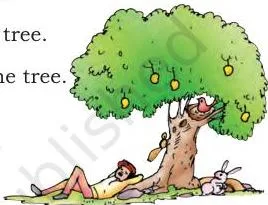
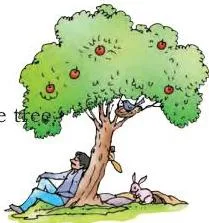
- The poem Fruits for All gives five mangoes — one each to the traveller, the bird, the squirrel, the rabbit and you. Its apple verse changes one line: the rabbit gets one less. A short Let us speak follows, with the child circling the words for and on. (NCERT chapter p. 3)
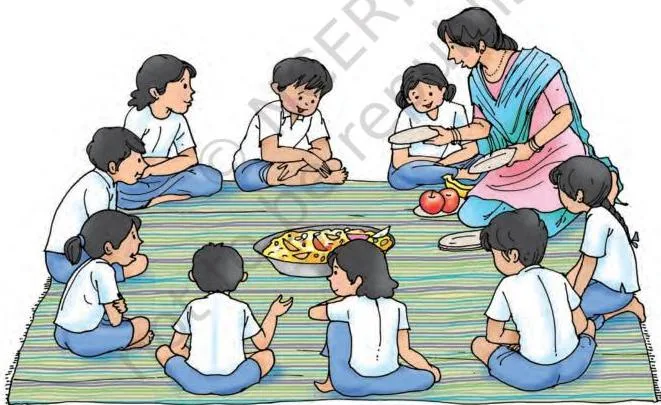
- Let us do is the hands-on moment: bring one fruit, wash it, and make a fruit chaat together in a circle. (NCERT chapter p. 4)
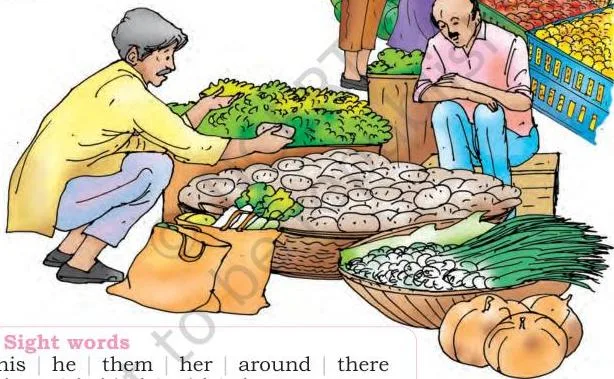
- The story A Visit to the Market follows Mini and her farmer father on Saturday. It places pineapples behind the apples, oranges on the right of them, and a watermelon on the left of them. (NCERT chapter p. 5)
- The sight words page lists ten short words the child should recognise instantly. (NCERT chapter p. 7)
- A short Let us speak turns the story to the child’s own life: Is there a market near your house? Do you go, and with whom? (NCERT chapter p. 8)
- The picture vocabulary grid — onions, brinjals, pineapples, jackfruit, cauliflowers, mangoes, radish, guava, carrots, cabbages, peas — is read aloud. (NCERT chapter p. 8)
- B. Think of words for the pictures is a market-trip story with pictures in place of words. (NCERT chapter p. 10)
- Let us draw asks the child to draw and colour the fruits and vegetables they like, and to say why. (NCERT chapter p. 11)
- Let us write fixes colour-plus-food phrases — yellow mango, red apple, purple brinjal and the rest — copied in order. (NCERT chapter p. 11)
- The closing fill-in-the-blanks activity practises Are these / Is this questions and ends with the line “Vegetables are good for health.” (NCERT chapter p. 13)
The ideas this chapter teaches
A Class 1 English unit does not teach grammar rules — it teaches the child to hear, say and recognise useful words. The Food chapter works on seven ideas, each tied to an activity in the book:
- Sharing and counting to five — each verse of the poem hands one fruit to a character. The apple verse changes the count word: the rabbit gets one less, so the child hears the idea of one-less-than inside a rhyme. (NCERT chapter p. 3)
- Picture words — fruit and vegetable names are taught as pictures the child reads aloud. (NCERT chapter p. 8)
- Sight words vs picture words — ten words (his, he, them…) are for instant recognition by sight, while food words are read from pictures. (NCERT chapter p. 7)
- The Are these / Is this pattern — plural questions get “Yes, they are” or “No, they are not”; the singular cabbage line gets “Yes, it is.” (NCERT chapter p. 13)
- Colour-plus-food phrases — the colour word comes first: yellow mango, not mango yellow. (NCERT chapter p. 11)
- Position words — the market story is where the child says where things sit: behind, on the right of, on the left of. (NCERT chapter p. 5)
- Two health messages — “Vegetables are good for health” closes the unit, and the teacher note after the picture-word story brings up not wasting food. (NCERT chapter pp. 10, 13)
What the pictures in the chapter ask the child to do
The Food chapter teaches through pictures — the picture is the lesson, not decoration. Keep the book or PDF open beside you: this page does not reproduce the chapter’s pictures, so the list below works from the task NCERT sets for each one.
- The opening scene (Let us speak) — count the fruits, count the vegetables, name the red fruits, name the green vegetables, say which you like most, and say why we eat them. (NCERT chapter p. 2)
- The market illustration (A Visit to the Market) — read position words through placement: roses, marigolds and jasmine as flowers; pineapples behind the apples; oranges on the right of the apples; watermelon on the left. (NCERT chapter p. 5)
- The vocabulary grid — eleven pictures (onions, brinjals, pineapples, jackfruit, cauliflowers, mangoes, radish, guava, carrots, cabbages, peas) read aloud. (NCERT chapter p. 8)
- Think of words for the pictures — a story about a visit to the market, with pictures in place of words; the child reads the picture and says the word. (NCERT chapter p. 10)
- Let us draw — draw and colour the fruits and vegetables the child likes, and discuss why. (NCERT chapter p. 11)
In this chapter the pictures carry the teaching: the child reads words out of pictures, which is why the book prints the food words as pictures rather than as plain word lists.
Words this chapter teaches
The chapter meets words in two ways — words the child recognises by sight, and words the child reads from pictures. The tables below collect both, plus the colour phrases the writing page fixes.
The ten sight words and where they appear
Each sight word below is shown with the place where the story uses it, so the child can hunt for it on the page:
| Sight word | Plain use in the story |
|---|---|
| his | “his farm” — the father’s farm |
| he | “He grows vegetables” — the father |
| them | “He sells them” — the vegetables |
| her | “takes her around” — Mini |
| around | “around the market” |
| there | “There are many people” |
| those | “Those are jasmine” |
| behind | “behind the apples” |
| with | “with him to the market” |
| these | “These are roses” |
Fruit and vegetable words
| Fruit words | Vegetable words |
|---|---|
| mango | onion |
| apple | brinjal |
| banana | cauliflower |
| orange | radish |
| guava | carrot |
| pineapple | cabbage |
| jackfruit | pea |
| watermelon | potato |
| tomato | |
| pumpkin |
Some words repeat on purpose: mango, guava and pineapple appear in more than one activity, so the child meets each name several times. Tomato and pumpkin appear in the closing fill-in activity.
Colour-plus-food phrases to copy
| Phrase to copy | What it joins |
|---|---|
| yellow mango | colour + fruit |
| red apple | colour + fruit |
| yellow banana | colour + fruit |
| green guava | colour + fruit |
| purple brinjal | colour + vegetable |
| brown potato | colour + vegetable |
| orange carrot | colour + vegetable |
| white radish | colour + vegetable |
Orange does two jobs in this chapter: a fruit in the story (oranges) and a colour word on the writing page (orange carrot).
The Are these / Is this pattern
| Question | Correct answer | Pattern |
|---|---|---|
| Are these onions? | Yes, they are. These are onions. | plural — they |
| Are these tomatoes? | No, they are not. These are brinjals. | plural — they |
| Is this a cabbage? | Yes, it is. This is a cabbage. | singular — it |
The rule in one line: plural questions use these and they, while the one singular question uses this and it. Read each pair aloud — question, then answer — and the pattern fixes itself.
Practice the picture-word pattern with this set. In the book the missing words are printed as pictures; here they are printed in a box:
Word box: market · fruits · vegetables · pineapples · watermelon · apple · flowers
- Mini goes to the ______ with her father every Saturday.
- People in the market buy ______ and ______.
- The large fruits kept behind the apples are ______.
- The big green fruit kept on the left of the apples is a ______.
- The rabbit gets one less ______ than the bird.
- There are many colourful ______ in the market.
Answers: 1. market · 2. fruits, vegetables · 3. pineapples · 4. watermelon · 5. apple · 6. flowers.
Where Class 1 children usually slip in this chapter
Four small slips are typical in this chapter. Each has a one-line correction — and none is a sign the child is struggling, only that the pattern is new.
| Mistake | Correct rule | How to check your answer |
|---|---|---|
| Answering the cabbage line with “they are” | “Is this a cabbage?” is singular, so the answer is “Yes, it is.” | Read the question aloud; if it starts with this, answer with it |
| Filling a picture blank from memory, not from the picture | The picture is the word — look, name, then write | Point to the picture, say the word, then fill the blank |
| Not noticing the apple verse changed | The rabbit gets one less apple than in the mango verse | Read the two verses side by side and circle the line that changed |
| Writing “mango yellow” | Colour word first: yellow mango | Copy the phrase, cover it, write it again, then compare |
One thing is never marked wrong: answering in the home language. The note to the teacher on the opening page asks teachers to encourage every answer, even in the child’s home language, and then help find the English name (NCERT chapter p. 2).
How schools use this chapter in Class 1
Class 1 is not a board-exam year, so this chapter is not measured by a written test. Schools check it through observation, oral questions and the child’s book work. What gets noticed:
- whether the child answers the Let us speak questions in a full sentence (NCERT chapter p. 2)
- whether the child recognises the ten sight words at sight (NCERT chapter p. 7)
- whether the child completes the Are these / Is this pattern correctly (NCERT chapter p. 13)
- whether the child copies the colour phrases in the right order (NCERT chapter p. 11)
- whether the child joins the Let us do fruit chaat and talks about it — the practical, share-and-talk moment the unit builds around (NCERT chapter p. 4)
The teacher notes suggest two more classroom moments: role play, with children taking the parts of Mini and her father (NCERT chapter p. 7), and naming local flowers and fruits in both the local language and English.
Textbook contents and the examinable syllabus are not always identical — check the current official syllabus on cbse.gov.in for what is expected this session.
What the child should be able to do after this chapter
Six things, each from the chapter’s own activities. Run through them tonight and you will know exactly where the child stands:
- Name the fruits and vegetables in the pictures — the picture vocabulary grid checks this.
- Answer “What do you see?” questions in a full sentence — the opening Let us speak.
- Join the poem and spot that the rabbit gets one less — Fruits for All.
- Read the ten sight words without pausing — the sight words page.
- Answer Are these / Is this questions correctly — the closing fill-in.
- Copy colour-plus-food phrases in the right order — Let us write.
This list is the chapter’s own summary of what it teaches, expressed in this page’s words.
Related pages and the official NCERT source
The official source for this chapter is the NCERT Mridang textbook page on ncert.nic.in, where the Food chapter PDF is published together with the rest of the Class 1 book.
For the rest of the unit, open the Class 1 English book page to browse the Mridang chapters, or start from the Class 1 hub for every subject in the year. Study help for this book lives in the Class 1 English notes hub, inside the wider CBSE notes index; the Class 1 notes page gathers the year’s pages together.
Related Class 1 English chapter notes on this site include A Farm and The Food We Eat.
Sources and data verification
This listing is maintained for the 2026-27 academic session using the NCERT textbook information available to us. NCERT remains the authority for confirming the latest edition.
- The description on this page follows the official NCERT Mridang Class 1 English textbook, Chapter 6 Food, current NCERT edition as published on ncert.nic.in.
- This page covers Chapter 6 of the Class 1 English book only — not the whole Mridang book, and not other Class 1 subjects.
- The listing is maintained for the current academic session using the NCERT information available to us.
- NCERT settles textbooks, editions and PDFs; CBSE settles curriculum, syllabus and examinations. Textbook contents and the examinable syllabus are not always identical.
Questions parents and teachers ask about Food Class 1
What is the Class 1 English Mridang Chapter 6 Food about?
It is the food unit of the Class 1 English book. The child learns to name fruits and vegetables, meets ten sight words, hears a counting poem (Fruits for All) and a market story (A Visit to the Market), and practises Are these / Is this questions — all through pictures.
Which sight words does the Food chapter teach?
Ten: his, he, them, her, around, there, those, behind, with, these. They appear on the sight words page right after the story.
Does the Food chapter have a poem and a story?
Yes. The poem is Fruits for All — five mangoes, then five apples with one less for the rabbit — and the story is A Visit to the Market, where Mini goes to the Saturday market with her farmer father.
Where can I download the official Food Class 1 Mridang chapter PDF?
From the official NCERT textbook page at ncert.nic.in, linked in the Related section above. The download block at the top of this page also carries the chapter PDF directly.
How can I help my child with the Food chapter at home?
Name the fruits and vegetables in the pictures, read the ten sight words aloud, act out the market visit using the position words (behind, on the right of, on the left of), and let the child copy the colour phrases in order. Answering in the home language is fine — help the child find the English name.
Is there an exam for Class 1 English?
No board exam. Schools observe oral answers, sight-word reading and in-class book work instead of written tests.
Reference: NCERT Class 1 English (Mridang) textbook, chapter 6, official edition on ncert.nic.in.
Explore Class 1 English Books
Related chapters: